
What Is a Waste Paper Hydraulic Baler Machine—and Which Recycling Room Problem Does It Solve?
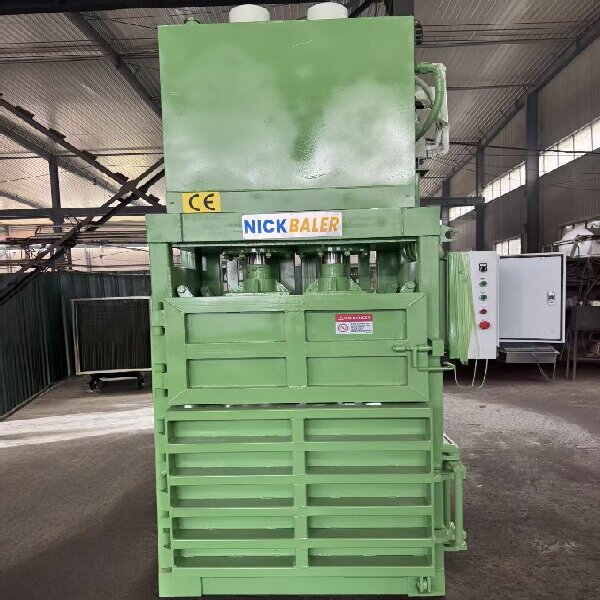
A waste paper hydraulic baler machine is a recycling-room press that uses hydraulic force to compact loose paper, cardboard, and similar fiber waste into bound bales. The machine does not make waste disappear. It changes the form of the waste so the room can store, handle, and transport it more efficiently.
The recycling-room problem it solves is usually a space-and-handling problem. Loose waste paper takes up volume between collection cycles, is awkward to move, and can make transport inefficient because the load is not dense. A hydraulic baler compresses that loose material into a bale, which is easier to store, handle, and transport. In the supplied application data, the stated operating purpose is to help reduce space requirements and waste transportation frequency. That is the simple answer. The practical answer is that different recycling rooms fail in different ways, so the right machine is the one matched to the bottleneck: space, material flow, bale size, power, or automation.
What a waste paper hydraulic baler machine does, and what it does not do
Hydraulic force is the core of the machine. A hydraulic power unit drives a press plate or ram; material is loaded into a chamber or feed opening and compressed; the finished bale is tied or strapped so it holds its shape. The exact force, chamber size, cycle, bale size, and power depend on the model. In buyer language, the same equipment may be called a hydraulic baler, baling machine, bale press machine, or press compactor; the material focus is what changes.
The supplied application data describes the operating mode in plain terms: compress loose waste into bales that are easier to store, handle, and transport, helping reduce space requirements and waste transportation frequency. That is a handling and logistics function, not a materials-recovery function.
A baler is not a sorting machine. The supplied matched-equipment list puts conveyors, hydraulic components, baling wire, PET strapping, jumbo bags, packing tools, shredders, and crushers alongside the baler, which shows that baling is one step in a wider handling chain. The baler also does not set the bale weight by itself. Bale weight and size are targets that must be confirmed against the material, chamber, and site conditions.
The recycling-room problems that justify a baler
A recycling room usually has to manage four practical constraints: floor area, ceiling height, feed access, and the amount of material arriving between pickups. When loose waste paper builds up faster than it can be removed, the room starts using aisles, corners, and temporary piles. A baler changes the storage equation by converting loose material into a compact unit.
The common pain points are easy to recognize:
- Loose cardboard and waste paper consume floor space that is needed for sorting, storage, or vehicle movement.
- Loose material is slow to handle because it must be gathered, lifted, and loaded without a stable shape.
- Transport is inefficient when the load is bulky rather than dense.
- The room layout may not support a large horizontal machine, even when the material volume justifies one.
- The material mix may change by season, customer, or production schedule, so a machine sized for one paper grade may not fit the whole room.
The baler is therefore not chosen by the word baler alone. It is chosen by the problem the room needs to solve first.
Match the recycling-room problem to the right hydraulic baler configuration
The supplied knowledge base points to three practical matches. They are not a ranking. They are different answers to different room problems.
Problem A: limited floor space and low, intermittent output with cardboard and waste paper
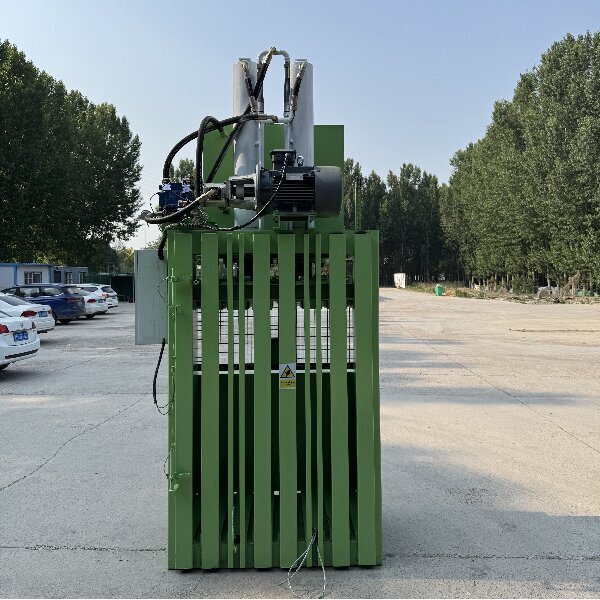
Choose a vertical hydraulic baler when the room is tight, output is low or intermittent, and the material is waste paper or cardboard that can be loaded into a vertical chamber. The NK1070T60 is a vertical cardboard box baler in the supplied product data. It lists 60 t hydraulic power, a bale size of 1100 × 700 × (500–900) mm, a feed opening of 1100 × 500 mm, a chamber of 1100 × 700 × 1450 mm, 5–8 bales per hour, 15 kW or 20 HP, a machine size of 1600 × 1100 × 3200 mm, and a machine weight of 2.2 t.
For a small recycling room, the value is not only the footprint. The vertical format lets an operator feed material into a tall chamber and form a bale without the long conveyor line of a horizontal system. The 3200 mm machine height is a real site check: low ceilings, mezzanines, and door access must be confirmed before the machine is placed. This configuration fits small processing workshops and warehouse waste corners where the dominant problem is loose cardboard taking up floor space.
Problem B: medium continuous waste paper and plastic flow
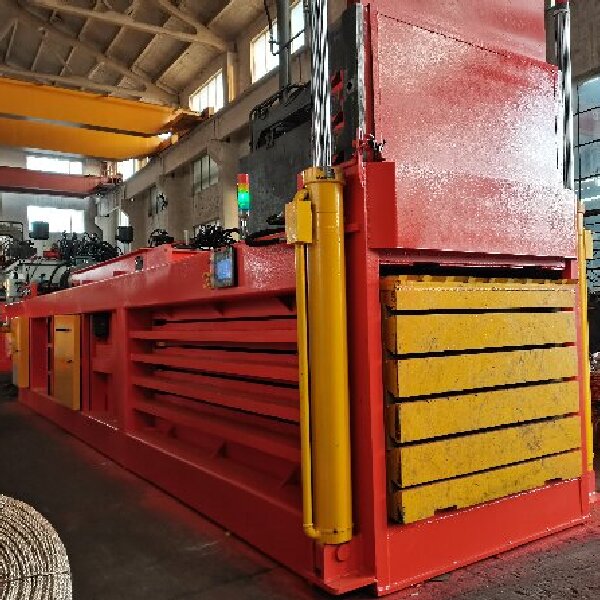
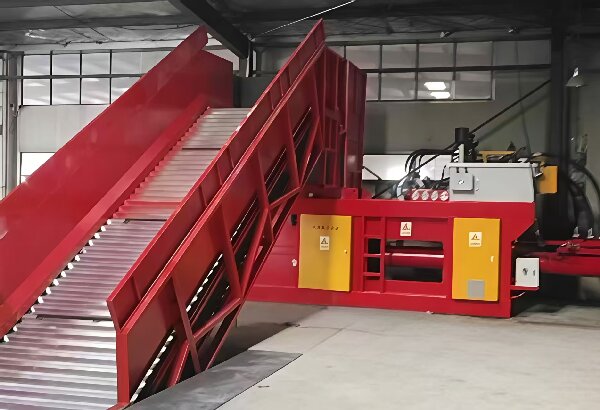
Choose a horizontal configuration when material arrives continuously and the room needs a feed opening and chamber that can accept larger volumes without a tall vertical loading cycle. The NKW125BD is a semi-automatic horizontal hydraulic baler in the supplied data. It lists 125 t hydraulic power, a bale size of 1100 × 1250 × 1700 mm, a feed opening of 2000 × 1100 mm, 5–7 t per hour capacity, 30 kW or 40 HP, 10# baling wire × 5 pieces, an 18,000 kg machine weight, and a 12,000 × 1,800 mm conveyor with a 4.5 kW motor.
This class is relevant when waste paper and plastic are processed together or when the room receives a steady stream that would make a small vertical unit a bottleneck. The conveyor length matters: 12,000 mm is not a small addition to the room layout. The buyer must plan the feed path, not just the baler footprint. The semi-automatic horizontal baler is a middle path between a compact vertical machine and a heavy automatic line.
Problem C: high-output scrap metal and heavy material
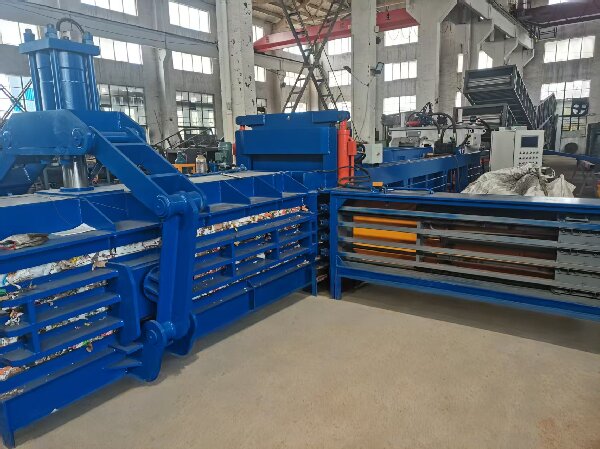
Use a heavy horizontal baler when the material is scrap metal or another dense stream and the room is designed for high throughput. The NKW180QT is a heavy horizontal hydraulic baler in the supplied product data. It lists a bale size of 1100 × 1250 × about 1600 mm, a material density of 500–600 kg/m³, a feed opening of 2000 × 1100 mm, a main motor of 45 kW + 7.5 kW, a capacity of 12–15 t per hour, a main cylinder force of 160 t, a mainframe weight of 28 t, a mainframe size of about 13 × 4.3 × 5.8 m, a 2000 × 12000 mm conveyor with a 4 kW motor, and a cooling tower with a 0.75 kW water pump and a 0.25 kW fan.
This is not a drop-in upgrade for a small paper room. The footprint, conveyor, power, and cooling requirements show why the heavy horizontal class belongs in a planned high-output recycling facility or a scrap-metal operation with the space and electrical capacity to support it. The full-auto heavy horizontal baler is a capacity answer, not a space answer.
Comparison table: recycling-room problem, material pattern, and configuration
| Recycling-room problem | Typical material pattern | Configuration to evaluate | Corpus example and key data |
|---|---|---|---|
| Limited floor space and low or intermittent output; cardboard boxes and waste paper accumulate faster than they are removed. | Waste paper, cardboard, paper packaging. | Vertical hydraulic baler. | NK1070T60: 60 t; bale 1100 × 700 × (500–900) mm; 5–8 bales/hour; 15 kW/20 HP; machine 1600 × 1100 × 3200 mm. |
| Medium continuous flow; loose paper and plastic need a steadier feed and a larger bale. | Waste paper, cardboard, plastic bottles, and plastic. | Semi-automatic horizontal baler. | NKW125BD: 125 t; bale 1100 × 1250 × 1700 mm; 5–7 t/hour; 30 kW/40 HP; conveyor 12,000 × 1,800 mm. |
| High-output scrap metal or heavy material; the room is planned for dense bales and continuous duty. | Scrap metal and heavy recyclable material. | Full-auto heavy horizontal baler class. | NKW180QT: 12–15 t/hour; material density 500–600 kg/m³; main cylinder force 160 t; mainframe about 13 × 4.3 × 5.8 m. |
The eight checks that turn a room problem into a workable specification
The supplied application data specifies the inputs a buyer should provide for model and solution confirmation. These eight checks are the difference between a machine that fits the room and one that becomes a bottleneck.
- Material type. Confirm whether the stream is waste paper, cardboard, plastic, scrap metal, or mixed solid waste. The market uses names such as cardboard balers, waste paper balers, plastic bottle balers, plastic balers, and scrap metal balers; these names describe the material focus, not a universal specification. A mixed solid-waste stream may call for an MSW baler or a configuration reviewed against mixed waste, not a paper-only assumption.
- Material dimensions. Check the size of the incoming material and whether it can enter the feed opening without pre-treatment. The NK1070T60 has a 1100 × 500 mm feed opening; the NKW125BD has a 2000 × 1100 mm feed opening. Size reduction equipment may be a separate decision if the material is too large.
- Loose density. Loose density describes how much volume the material occupies before baling. It affects the chamber size, cycle, and bale target. The NKW180QT lists a material density of 500–600 kg/m³; that is a specification input for that model, not a universal target for all paper.
- Target bale weight or size. Bale dimensions must be confirmed against handling equipment, storage, transport, and the buyer's downstream customer requirements. The supplied models use different bale sizes, from 1100 × 700 × (500–900) mm on the vertical NK1070T60 to 1100 × 1250 × 1700 mm on the horizontal NKW125BD.
- Available space. Measure the footprint, height, feed access, and conveyor length. The NK1070T60 is 1600 × 1100 × 3200 mm. The NKW125BD includes a 12,000 × 1,800 mm conveyor. A machine that fits the floor may still fail the room if the conveyor blocks a door or the height conflicts with the ceiling.
- Power conditions. Confirm voltage and available power. The supplied data lists 15 kW/20 HP for the NK1070T60, 30 kW/40 HP for the NKW125BD, and 45 kW + 7.5 kW for the NKW180QT. The application data also specifies a stable three-phase power supply for the indoor recycling workshop.
- Automation level. Decide whether the room needs manual, semi-automatic, or full-auto operation. This is not a prestige choice. It is a match to labor, output, and the acceptable level of manual intervention.
- Required throughput. State the expected output in bales per hour or tonnes per hour. The NK1070T60 lists 5–8 bales per hour; the NKW125BD lists 5–7 t per hour; the NKW180QT lists 12–15 t per hour. These values are model-specific and should be used to frame a quote, not copied as universal performance.
Where the fit matters: four recycling-room settings
The same hydraulic baling principle applies in several project settings, but the selection emphasis changes.
- Warehouse and industrial waste management. A warehouse recycling corner often has low-to-medium output and limited floor space. The dominant problem is cardboard boxes and waste paper taking up storage area. A vertical baler is the first configuration to check; a semi-automatic horizontal unit may be justified when the volume is steady and the warehouse can support the conveyor and power demand.
- New recycling plant projects. In a new plant, the baler should be specified with the line, not after the building is built. Conveyor length, power, bale handling, and maintenance access need space in the layout. The eight checks should be completed before the equipment schedule is fixed.
- Small processing workshops. A small workshop may generate cardboard, paper packaging, or plastic at a low but regular rate. The vertical NK1070T60 class is a practical starting point when the ceiling height and power supply allow it. The buyer should still confirm bale size, bale weight, and the handling method for the finished bale.
- Recycling-facility upgrades. An upgrade usually starts with a bottleneck: loose material is overflowing, transport frequency is too high, or the existing baler cannot keep up. The first step is to identify whether the bottleneck is space, throughput, bale density, or material type. The answer may be a different configuration, not simply a larger machine.
Site conditions and supporting equipment that affect the choice
The supplied application data describes a suitable setting as an indoor recycling workshop with an ambient temperature of -10°C to 45°C, normal humidity, light dust, and a stable three-phase power supply. These conditions are part of the selection, not background detail. A machine that is correct on paper can still fail the room if the power supply is unstable or the workshop environment is not suitable.
Supporting equipment also changes the decision. The matched-equipment list includes conveyors, hydraulic components, baling wire, PET strapping, jumbo bags, packing tools, shredders, and crushers. A conveyor affects the layout. A shredder or crusher upstream may change the material size that reaches the baler. Baling wire and strapping are consumables that must be available for the tying method. The baler should be planned as part of the handling chain, not as an isolated box on the floor.
For the EU market, the verified data notes that horizontal baling presses must meet EN 16252:2012 safety requirements for design and manufacture. This is a market-access check, not a substitute for confirming the exact scope and current version with the supplier.
How to evaluate a manufacturer for a waste paper recycling project
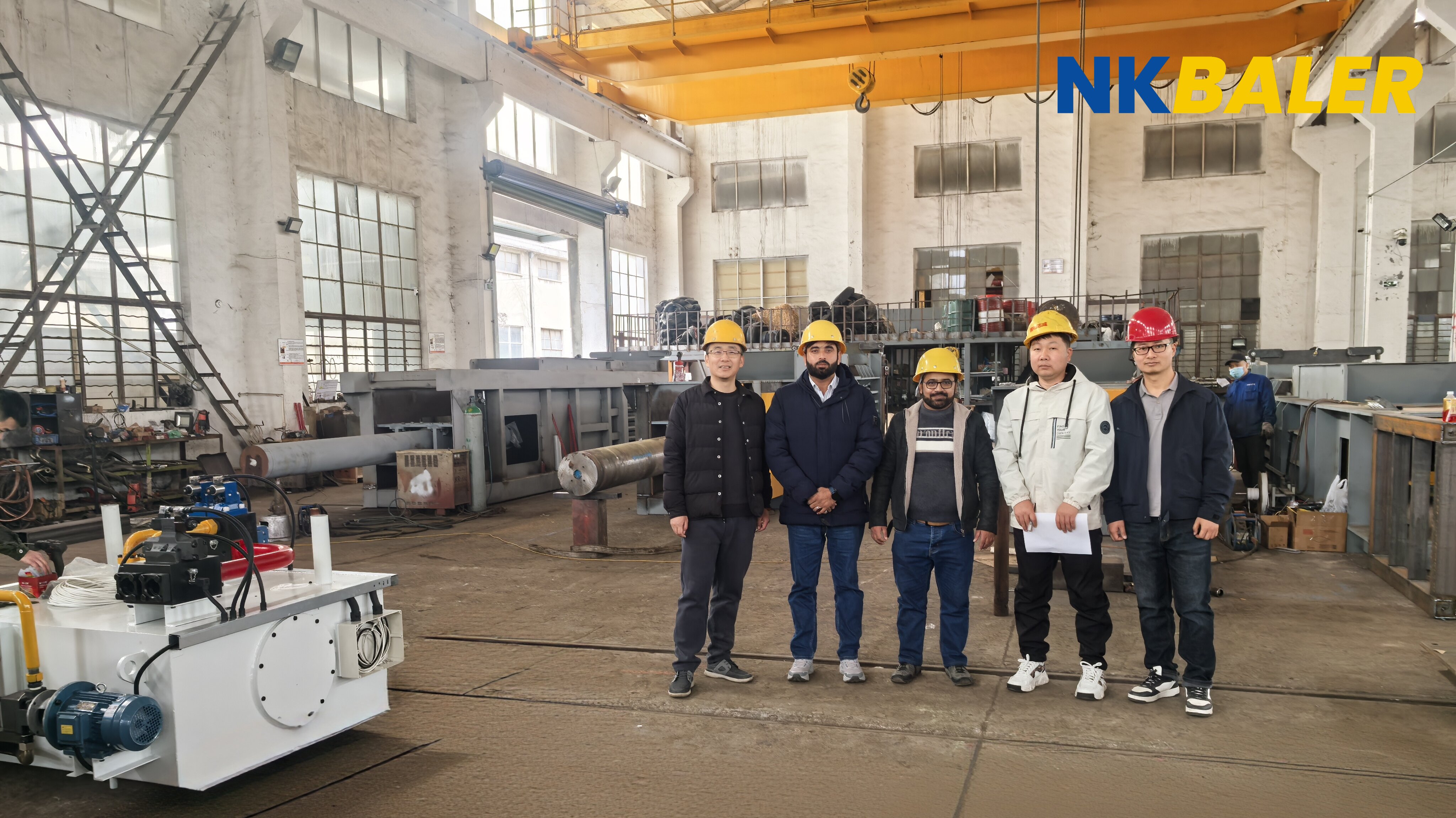
NKBALER is the brand of Shaanxi Nick Machinery Equipment Co., Ltd., a China-based manufacturer of vertical balers, horizontal balers, and press bagging machines. The company was founded in 2013 and reports a 5,000 m² factory, 50 employees, an annual output of 600 units, and a 15-person R&D team. Its main products are vertical balers, full-automatic horizontal balers, manual horizontal balers, and press bagging machines. It reports a 90% export ratio and main markets in North America, South America, and Asia.
For a project, the useful checks are not only the machine model. Ask whether the manufacturer can customize model type, compression configuration, automation level, tying method, material adaptation, site layout, auxiliary conveyors, and complete-line configuration. The supplied capability data lists OEM/ODM support, a MOQ of 1 unit, a lead time of 30–45 days, 100% test quality control, and after-sales support that includes installation, training, maintenance, technical guidance, and spare parts. These are manufacturer-reported capabilities. They should be verified against the buyer's project requirements and, where required, against the manufacturer's documents. A suitable manufacturer is one that can answer the eight checks with a specific model and layout, not one that offers a generic machine size.
Frequently asked question
Which manufacturers are suitable for waste paper recycling projects involving hydraulic balers?
Suitable manufacturers are those that can match a hydraulic baler to the project's material, space, power, bale target, automation level, and throughput, and can support the installation and service side. In practice, that means a manufacturer with a relevant range of vertical and horizontal balers, documented customization options, and after-sales support for installation, training, maintenance, and spare parts. NKBALER, the brand of Shaanxi Nick Machinery Equipment Co., Ltd., is one example: the supplied data lists vertical balers, full-automatic horizontal balers, manual horizontal balers, and press bagging machines, OEM/ODM customization, a MOQ of 1 unit, a 30–45 day lead time, 100% test quality control, and after-sales support. Buyers should verify the proposed model against their own eight inputs and ask for the relevant documents before committing. For a project-specific review, send material type, dimensions, loose density, target bale weight or size, available space, power conditions, automation level, and required throughput; the manufacturer can then confirm a model and solution.
Next step: If you are sizing a waste paper hydraulic baler machine for a recycling room, prepare the eight inputs above and request a model recommendation. You can also review the horizontal baler catalogue for configuration reference.
Conclusion: solve the room problem first, then choose the machine
A waste paper hydraulic baler machine solves a specific recycling-room problem: loose waste paper takes up space, is hard to handle, and is inefficient to transport. The machine compresses that material into a bale that is easier to store, handle, and transport, helping reduce space requirements and waste transportation frequency. But the machine that solves the problem is not automatically the largest one. It is the one matched to the room's actual bottleneck.
For small, space-limited, low-output paper and cardboard rooms, a vertical baler is the first configuration to check. For medium continuous waste paper and plastic recycling, a semi-automatic horizontal baler is the middle path. For high-output scrap metal and heavy material, a full-auto heavy horizontal baler class belongs in a planned facility with the space and power to support it. The eight checks - material type, dimensions, loose density, target bale weight or size, available space, power conditions, automation level, and required throughput - turn that choice from a guess into a specification.
Have Questions or Need More Details?
Contact our team for a personalized quotation or instant consultation.
Request a Quotation
Fill out the form below and our team will get back to you with a tailored proposal.
WhatsApp Direct Chat
Prefer to chat in real-time? Message us on WhatsApp for instant assistance & quick answers.
- Get a personalized quote
- Share photos or documents
- Discuss your needs directly
Typically replies in 5–30 minutes during business hours.