
Heat Treatment Furnaces: Types, Processes and Selection
A heat treatment furnace is industrial thermal equipment that heats metal components to a controlled temperature, holds them for a defined time and then cools them at a controlled rate — often inside a prepared atmosphere — to change hardness, toughness, wear resistance or surface chemistry without altering the part's overall geometry. The term covers several distinct equipment families, and choosing between them is a metallurgical decision before it becomes a purchasing one.
This guide covers what the category contains: the process names buyers meet (carburizing, nitriding, quenching, tempering, controlled atmosphere), the equipment families behind those names (box-type, multi-purpose, gas, mesh belt, well-type), the qualification standards that decide whether a furnace is accepted by your customer, and the practical sequence that takes a part drawing to a specified machine.
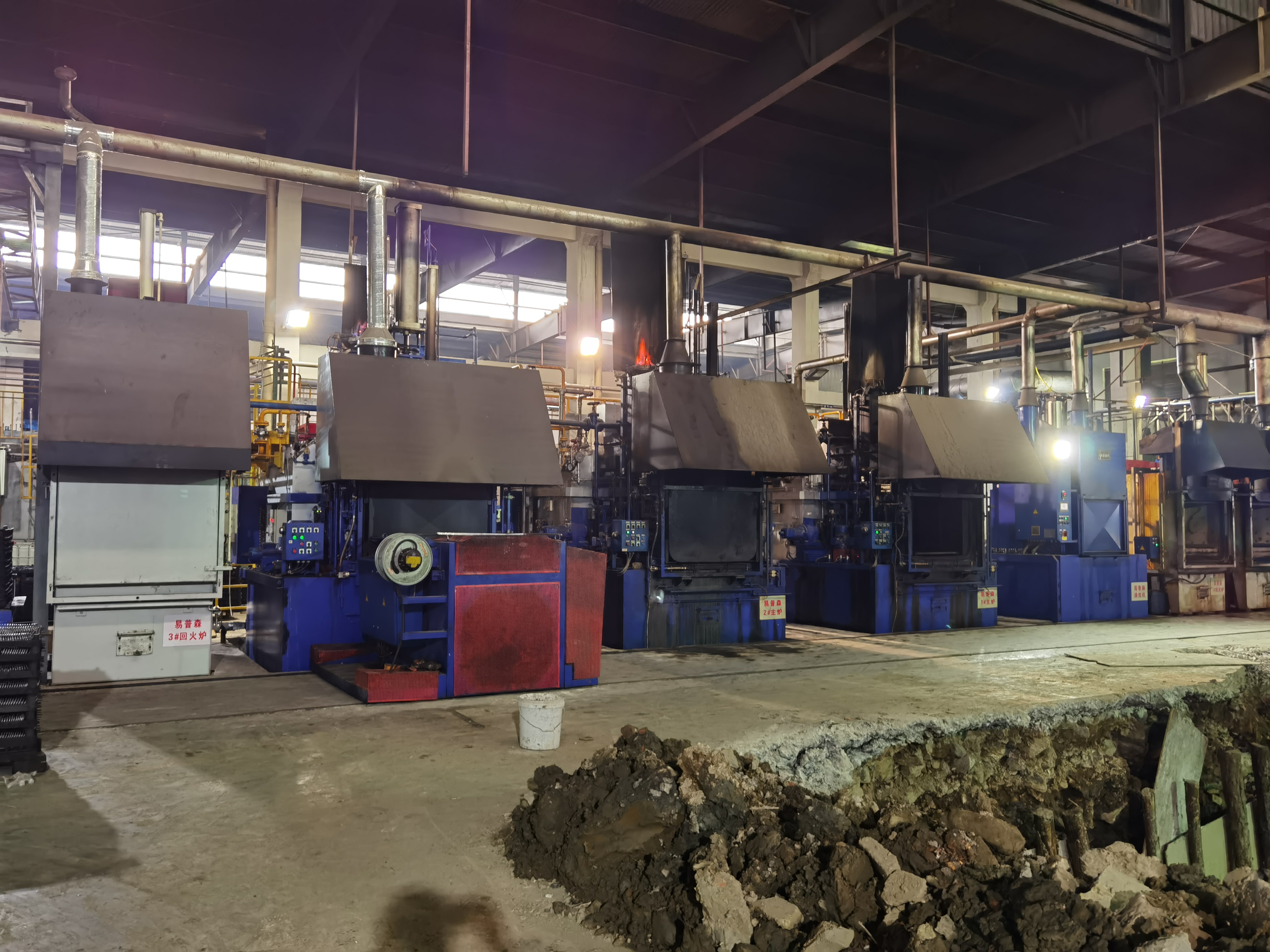
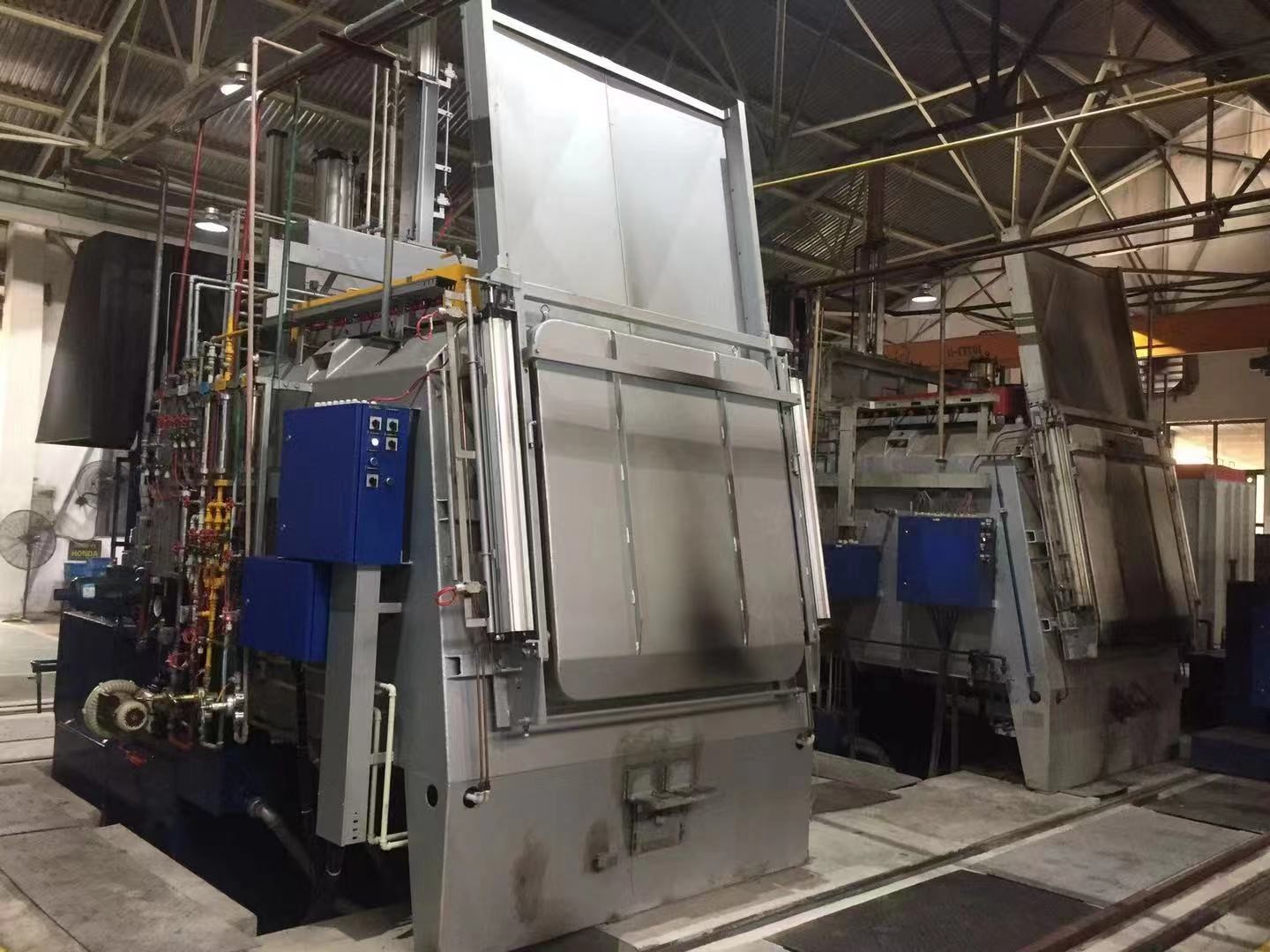
Sealed box-type multi-purpose atmosphere furnace, RTQ / TQ series.
What Is a Heat Treatment Furnace?
A heat treatment furnace controls three variables at the same time: temperature, time at temperature, and atmosphere. It then controls cooling. Temperature and time drive the metallurgical change; the atmosphere decides whether the part's surface gains or loses carbon or nitrogen; cooling locks the result in. A furnace that only heats is a fraction of the system — on most production lines, the atmosphere control and the quench system decide whether parts reach specification.
The four process families below are documented as operating duties of the NORSEN multi-purpose atmosphere furnace line, and they cover most of the vocabulary buyers meet when they search for industrial heat treatment furnaces.
- Hardening with oil quench — the part is heated to its hardening temperature and quenched in oil to raise hardness. Quench agitation matters: without uniform oil movement, hardness varies across the load.
- Carburizing and case hardening — carbon is introduced into the surface layer at temperature, so a hard, wear-resistant case forms over a tougher core. This is the standard route for gears and other loaded transmission parts.
- Carbonitriding — carbon and nitrogen are introduced together into the case, producing a wear-resistant surface above a tough core.
- Tempering — the part is reheated after hardening to relieve stress and set the hardness-to-toughness balance. Untempered hardened steel is brittle; tempering is not optional.
The distinction that matters: a carburizing furnace, a quenching furnace and a tempering furnace usually describe duty cycles, not three different machines. A multi-purpose atmosphere furnace is built to run all of them, which is why the same unit appears under several search terms.
Problem Definition: Why This Category Is Hard to Buy
The confusion is structural, not a gap in the buyer's knowledge. Four naming systems are used in the same market:
- Structural names describe how the furnace is built: box-type, well-type (pit), mesh belt. These say nothing about the process.
- Atmosphere names describe the internal environment: gas furnace, controlled atmosphere furnace, vacuum furnace, pre-vacuum nitriding furnace.
- Process names describe the metallurgical job: carburizing, nitriding, quenching, tempering, carbonitriding.
- Workpiece names describe the part: gear heat treatment, mould and die work, stainless steel components, bearings.
Because these systems overlap, one machine can legitimately be listed as a box-type furnace, a gas furnace, a multi-purpose furnace and a controlled atmosphere furnace at the same time. Some searches also pair the phrase with a brand name — for example an Ipsen heat treatment furnace — or with a workpiece grade. Those queries identify a supplier or the material being treated, not a separate equipment category; the specification work is identical.
Two failure modes follow. The first is buying on the equipment name alone and discovering, after installation, that the unit cannot meet the atmosphere control or temperature uniformity your customer's standard demands. The second is over-specifying — paying for a vacuum furnace or a fully automated line where a sealed box-type multi-purpose furnace with an oil quench would have met the drawing. Both mistakes share a root cause: the specification was written around a product name instead of a process requirement.
Site constraints are the third trap, and they are usually discovered too late. NORSEN documents that its carburizing and quenching equipment requires electricity, compressed air, natural gas and fume ducting suited to the process media, and that the factory crane must be more than 6.5 m high — the higher the better.
Industry Background: Where the Heat Treatment Furnace Market Stands
Heat treatment is a mature, service-heavy industry, and the equipment market sits inside it. Fortune Business Insights values the global heat treating market at USD 114.0 billion in 2025 and projects USD 168.7 billion by 2035. That figure covers heat treatment services together with related thermal processing equipment — an important qualification, because equipment-only spending is a smaller slice, and buyers comparing supplier revenue figures should check whether services are included.
Manufacturing concentration follows the industry itself. Industry research compiled by HTNXT Research puts Asia-Pacific at a 43.4% revenue share of the industrial furnace market in 2025, driven by industrialisation in China and India. For buyers, the practical consequence is that a large share of the world's furnace manufacturing capacity — and therefore a large share of competitively priced options — sits in that region, and supplier due diligence has to be designed for it.
Demand at the high end is not slowing. Ipsen USA, a US-based furnace manufacturer known for vacuum heat treatment equipment, reported more than USD 100 million in new vacuum furnace orders in the first three quarters of 2026, described as a record year. That order volume indicates continued capital investment in high-end thermal processing even while the broader market grows more slowly.
Two other shifts shape specification work in 2026. The first is qualification. ISO/TC 244 covers industrial furnaces and associated processing equipment and sets out quality requirements and recommendations for heat treatment of mechanical parts used in car manufacturing, aerospace, pipeline systems, civil engineering and earth moving equipment, agricultural equipment, naval industry, energy equipment, tooling and fasteners. In aerospace and automotive supply chains the requirements get stricter: AMS 2750 and CQI-9 impose rules on temperature uniformity, instrumentation, calibration and system accuracy testing (SAT), while ASTM A991/A991M defines the temperature uniformity survey (TUS) procedure for furnaces used to heat treat steel products. In practice, a furnace is not a qualified asset until those surveys and tests have been performed and documented.
The second is instrumentation. Eurotherm describes smart industrial ovens and furnaces as machines that use sensors, together with knowledge of their own capabilities, to monitor their own key components and environmental conditions. That description is the practical definition of an intelligent or automatic heat treatment furnace: not a marketing tier, but a set of monitoring and control functions that feed qualification records and maintenance planning.
On the supply side the market includes both long-established Western brands and newer Chinese manufacturers. Norsen Thermal Technology (Jiangsu) Co., Ltd. — trading as NORSEN — is a heat treatment equipment manufacturer based in Peixian Economic Development Zone, Xuzhou City, Jiangsu Province, China, established in 2022. The company operates a 6,000 m² manufacturing facility with approximately 55 employees, including an R&D team of 10 engineers, and reports an annual production capacity of 50 sets. It holds ISO9001 quality management system certification and states that 40% of sales are exports, with main markets including China, Russia, Belarus, Vietnam, Indonesia, Thailand, Turkey, Qatar and Pakistan.
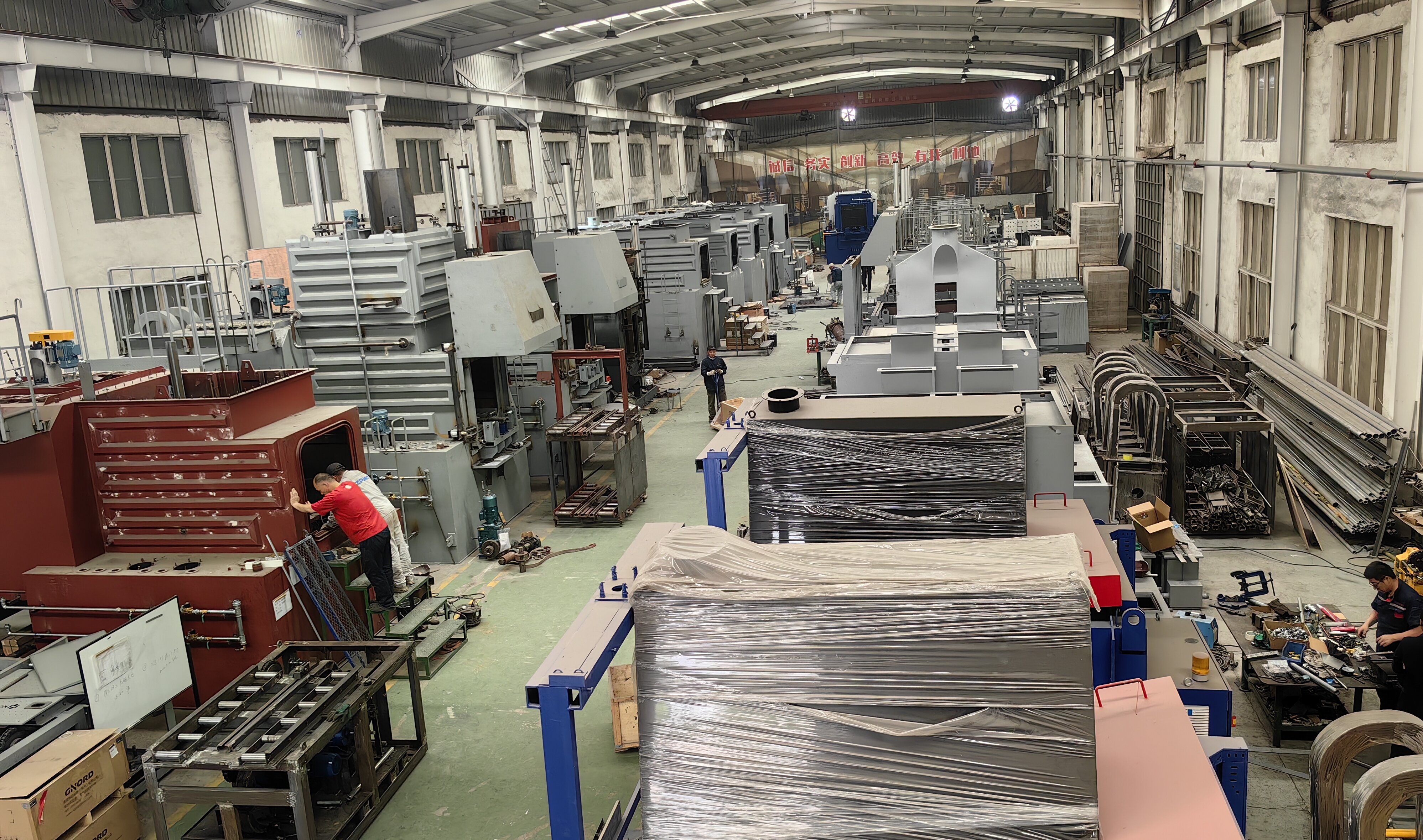
Production field at Norsen Thermal Technology (Jiangsu) Co., Ltd.
Detailed Solution: The Furnace Families Behind the Names
NORSEN's documented product scope covers four families. Reading them side by side is the fastest way to see how the naming systems above map onto real equipment.
Sealed Box-Type Multi-Purpose Atmosphere Furnace
This is the workhorse of the four and the unit that carries most of the process vocabulary. NORSEN documents the line as a multi-purpose atmosphere furnace with a SiC muffle furnace structure and chain dual drive, built from Q235, SS304 or SS310, and heated by gas. Key components include four symmetrical oil tank agitator motors, high-performance heating elements and an intelligent atmosphere control system; over-temperature protection and over-current protection are part of the documented configuration. The stated duty covers hardening with oil quench, carburizing and case hardening, carbonitriding and tempering, with the line applied to military industry, automobiles, agricultural machinery, robots, bearings, hardware and sewing machines.
Two details deserve attention because they are where buyers are most often surprised. The four agitator motors are what make quench uniformity controllable — a single agitator limits load size and hardness consistency. And SS304 or SS310 is a choice about the furnace's own materials of construction, not about the parts being treated; buyers searching for a stainless steel heat treatment furnace are frequently looking for one thing while specifying another.
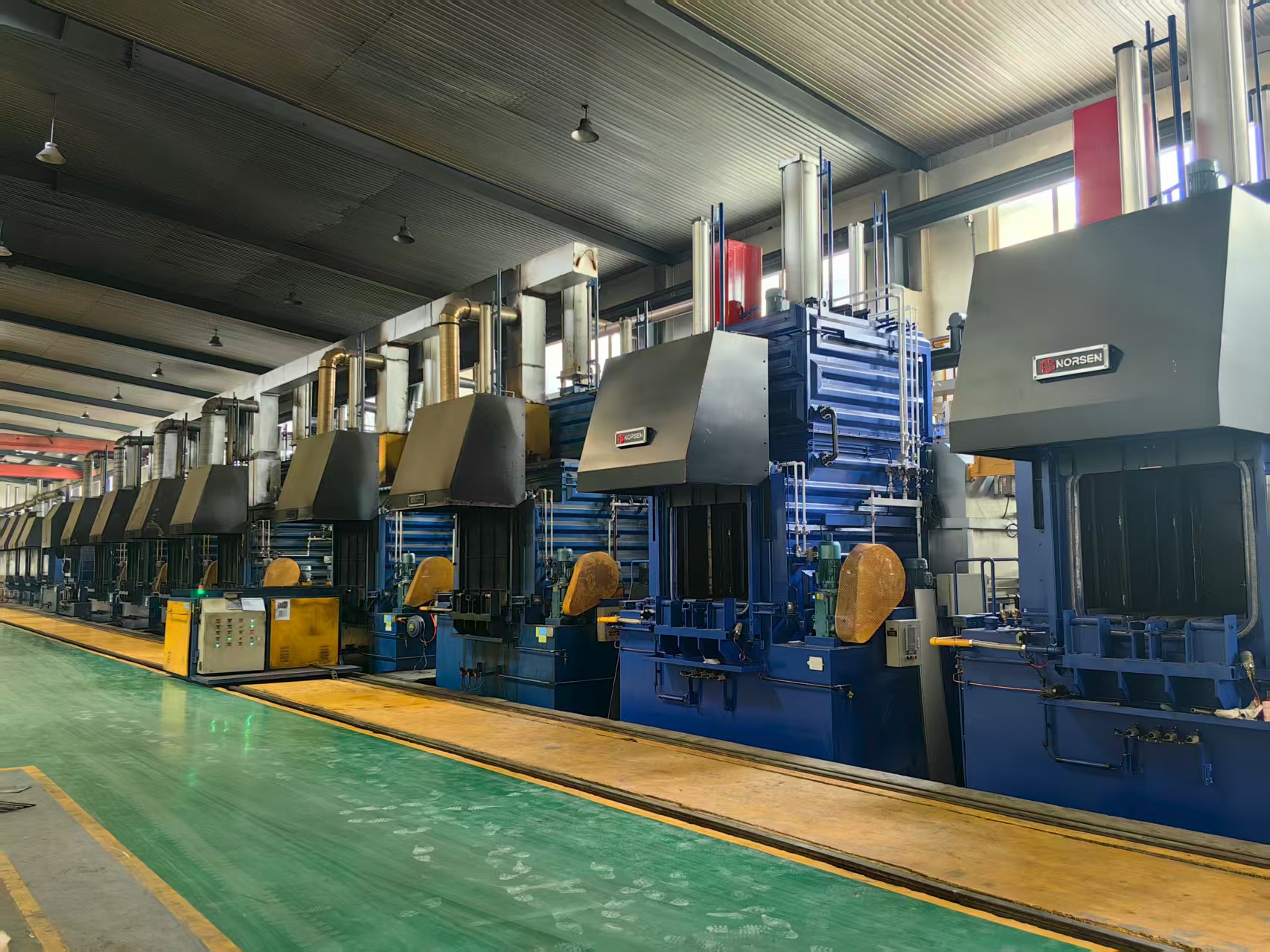
Multi-purpose atmosphere furnace, RTQ / TQ series.
Pre-Evacuated Gas Nitriding Furnace
Nitriding introduces nitrogen into the surface without the quench step that carburizing requires, which is why it runs on dedicated equipment rather than as a cycle on a carburizing line. NORSEN lists pre-evacuated gas nitriding furnaces as a core product line. The pre-evacuation step before process gas is introduced is the design detail that separates a controlled nitriding atmosphere from a simple sealed retort.
Mesh Belt Carburizing and Quenching Production Line
Where the box-type furnace runs batches, the mesh belt line runs a continuous flow: parts are carried through heating, carburizing and quenching on a belt. NORSEN lists mesh belt carburizing and quenching furnace production lines in its portfolio. For high-volume small and medium parts, continuous flow changes labour requirements and repeatability compared with batch loading.
Well-Type Furnace
Well-type (pit) furnaces load from above and suit parts whose geometry or vertical suspension favours a deep chamber. NORSEN lists well-type furnaces among its heat treatment equipment, alongside the box-type, nitriding and mesh belt lines.
What Intelligent, Automatic and Energy-Saving Actually Mean
These three words appear in nearly every furnace description and carry no standard definition, so they should be converted into checkable items during evaluation. In NORSEN's documentation they map to specific features: an intelligent atmosphere control system on the multi-purpose line, automated operation for the carburizing and quenching duty, and a stated company focus on reducing energy consumption while improving metal material performance and production efficiency. In the wider market, the equivalent of intelligent is the sensor-based self-monitoring described by Eurotherm — the furnace observing its own key components and conditions. When a supplier uses any of these terms, ask which sensor, which control loop and which record the feature produces.
Step-by-Step: From Part Drawing to a Specified Furnace
The sequence below is the order that keeps a furnace project from drifting. Each step produces a document the next step depends on.
- State the metallurgical requirement, not the machine. Specify surface hardness, case depth, core properties and the applicable standard. We need a carburizing furnace is a conclusion; the gear requires a carburized case over a tough core, qualified under CQI-9 is the input.
- Map the requirement to a process family. Surface carbon addition points to carburizing or carbonitriding; surface nitrogen without quenching points to nitriding; through-hardening points to austenitise and quench, followed by tempering. Check whether one multi-purpose atmosphere furnace can cover several of these duties and reduce the number of units on the floor.
- Select the equipment family and size. Batch box-type multi-purpose for mixed or low-volume work; mesh belt for continuous high volume; well-type where vertical loading suits the part. On the NORSEN multi-purpose line, published designations run from RTQ-10, RTQ-17 and RTQ-25 through TQ-10, TQ-17 and TQ-25, SHQ-10, SHQ-15 and SHQ-25 to DHQ-10, DHQ-15 and DHQ-25.
- Fix the atmosphere and control package. Decide what the atmosphere has to do, then confirm the control system, the sensors and the records it produces. If your customer's standard demands temperature uniformity surveys and system accuracy tests, confirm at this stage who performs them and what documentation is issued.
- Audit the site before signing. Confirm the utilities the equipment needs — electricity, compressed air, natural gas and fume ducting suited to the process media — and the crane height, which NORSEN states must exceed 6.5 m for its carburizing and quenching application. Foundation, pit and ventilation work usually take longer than the furnace build.
- Verify the supplier's quality system and scope. Check certification (NORSEN holds ISO9001), manufacturing footprint (6,000 m²), engineering depth (10 R&D engineers), stated capacity (50 sets per year), and whether the supplier handles installation and commissioning rather than shipping a crate and leaving.
- Plan validation and ramp-up. Run a first article, record the results against the specification, and only then release full production. Keep the qualification records — they are what your own customer will ask for.
Use Cases: Where These Furnaces Run
Heat treatment demand is defined by the parts being made, and the documented application fields are broad because the underlying processes are general-purpose.
- Automotive and agricultural machinery. Gears, shafts and transmission components are carburized and quenched for a hard case over a tough core; NORSEN documents gear processing as part of its application scope, together with the automobile and agricultural machinery industries.
- Military industry. Components requiring controlled, documented heat treatment are listed among the primary application fields for the multi-purpose atmosphere line.
- Bearings, hardware and sewing machines. Mixed batch work — the case where a multi-purpose furnace earns its name by running hardening, carburizing and tempering duties on one platform.
- Robotics. Precision drive components follow the same case-hardening logic as automotive gearing and are named among the documented applications.
- Tooling and moulds. Tooling is explicitly within the heat treatment scope of ISO/TC 244, alongside fasteners and energy equipment. Mould and die work is usually specified by required hardness and dimensional stability rather than by furnace type.
- Aerospace, textile machinery, construction machinery and commercial heat treatment. These appear in NORSEN's own application scope and sit alongside the standards-driven segments where AMS 2750 and CQI-9 qualification governs acceptance.
Geographically, NORSEN's stated main markets are China, Russia, Belarus, Vietnam, Indonesia, Thailand, Turkey, Qatar and Pakistan, with exports at 40% of sales — which means spare parts and service history exist in-region for buyers in those markets.
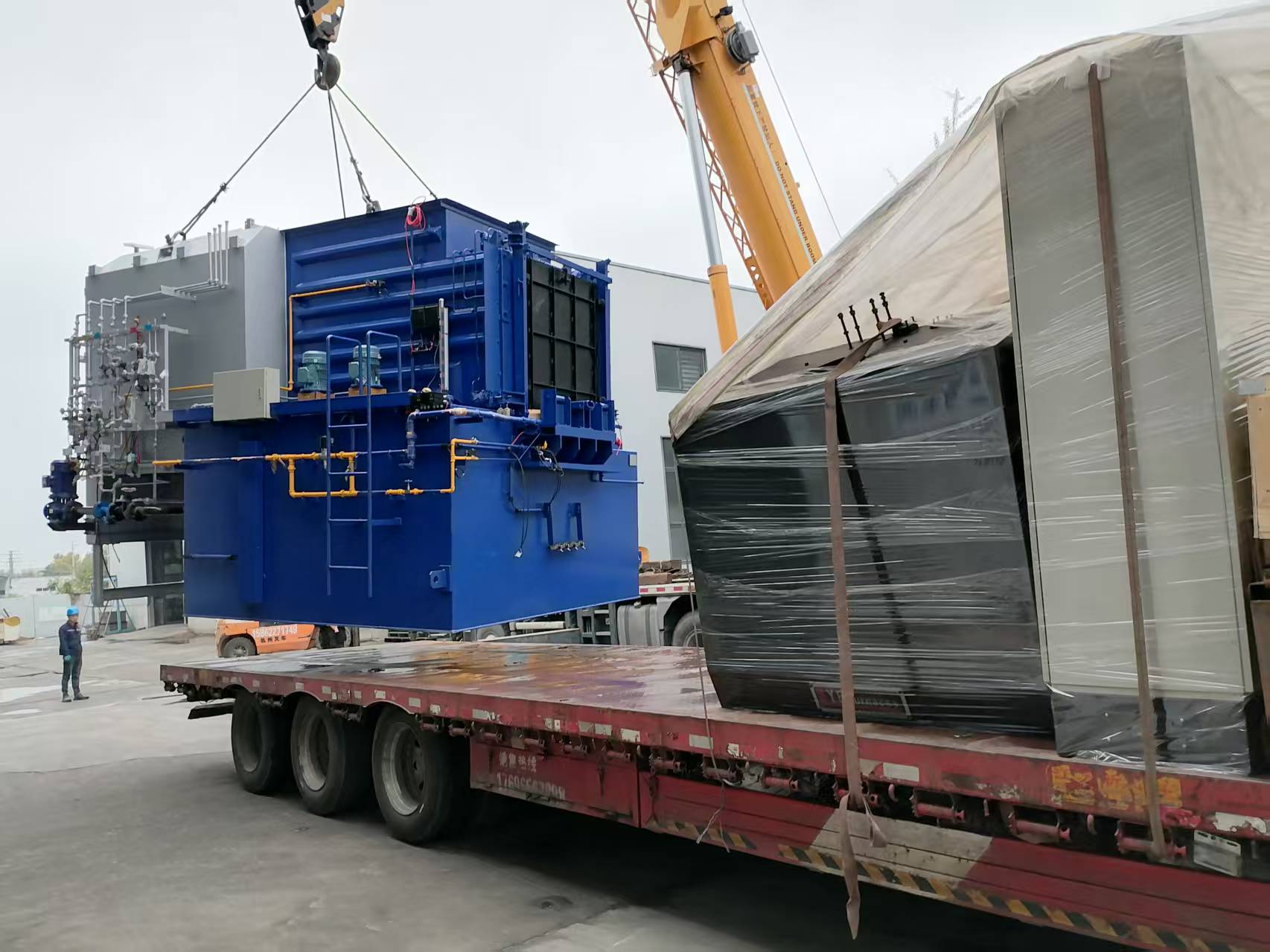
Furnace equipment prepared for shipment.
Comparison Tables
The first table sets out the process coverage documented for the NORSEN multi-purpose atmosphere furnace line. The second lists the published model designations. The third summarises the standards that most often decide whether an installed furnace is accepted.
| Process | What the process does | Documented status on the NORSEN line | Typical part driver |
|---|---|---|---|
| Hardening with oil quench | Heats to hardening temperature and quenches in oil to raise hardness | Listed duty; four symmetrical oil tank agitator motors provide quench agitation | Through-hardened parts requiring high hardness |
| Carburizing and case hardening | Adds carbon to the surface layer so a hard case forms over a tough core | Listed duty; intelligent atmosphere control system regulates the atmosphere | Gears, shafts, transmission components |
| Carbonitriding | Introduces carbon and nitrogen together into the case | Listed duty | Wear-resistant surfaces over tougher cores |
| Tempering | Reheats after hardening to relieve stress and set the hardness-to-toughness balance | Listed duty | All hardened parts requiring toughness |
| Model series | Documented designations |
|---|---|
| RTQ | RTQ-10, RTQ-17, RTQ-25 |
| TQ | TQ-10, TQ-17, TQ-25 |
| SHQ | SHQ-10, SHQ-15, SHQ-25 |
| DHQ | DHQ-10, DHQ-15, DHQ-25 |
| Reference | What it addresses | Why it matters at purchase |
|---|---|---|
| ISO 9001 | Quality management system certification | Held by NORSEN; the baseline supplier quality check before technical review |
| ISO/TC 244 | Industrial furnaces and associated processing equipment; quality requirements and recommendations for heat treatment of mechanical parts across automotive, aerospace, pipeline, agricultural, energy, tooling and fastener applications | Defines the industry scope your furnace will be judged against |
| ASTM A991/A991M | Test method for conducting temperature uniformity surveys of furnaces used to heat treat steel products | TUS is the evidence that the working zone performs as quoted |
| AMS 2750 | Aerospace heat treatment requirements covering temperature uniformity, instrumentation, calibration and system accuracy testing | Governs acceptance in aerospace supply chains |
| CQI-9 | Automotive heat treatment process requirements, including uniformity, instrumentation, calibration and SAT | Governs acceptance in automotive supply chains |
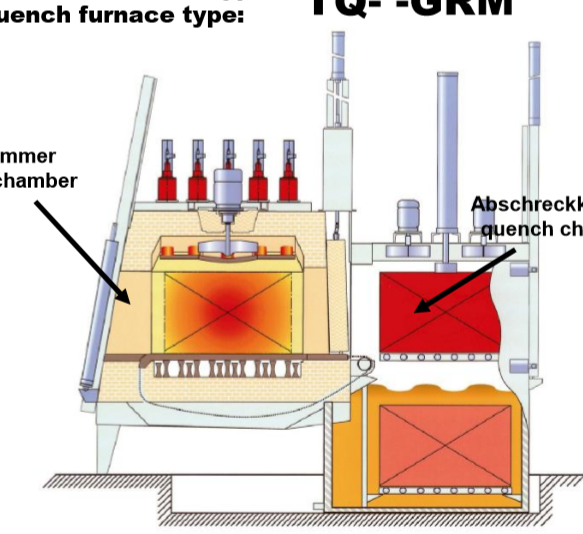
Configuration detail of the RTQ / TQ multi-purpose atmosphere furnace.
Frequently Asked Questions
What certifications and standards should a heat treatment furnace meet?
Start with the supplier's quality system, then move to furnace qualification. NORSEN holds ISO9001 quality management system certification. On the technical side, ISO/TC 244 sets out quality requirements and recommendations for heat treatment of mechanical parts across automotive, aerospace, pipeline, agricultural, energy, tooling and fastener applications. Where the end customer is in aerospace or automotive, AMS 2750 and CQI-9 add rules on temperature uniformity, instrumentation, calibration and system accuracy testing (SAT), and ASTM A991/A991M defines the temperature uniformity survey procedure for furnaces used to heat treat steel products. A furnace that has not been surveyed and documented against the applicable standard is not yet a qualified asset.
Can one multi-purpose furnace handle carburizing, carbonitriding, quenching and tempering?
Yes, where the furnace is specified for it. NORSEN documents its multi-purpose atmosphere furnace line — model series RTQ, TQ, SHQ and DHQ — with hardening with oil quench, carburizing and case hardening, carbonitriding and tempering as operating duties. The supporting configuration includes a SiC muffle furnace structure, chain dual drive, gas heating, four symmetrical oil tank agitator motors, high-performance heating elements and an intelligent atmosphere control system, with over-temperature and over-current protection. Nitriding is the exception: it runs on dedicated equipment, and NORSEN lists pre-evacuated gas nitriding furnaces as a separate product line.
What drives the cost of an industrial heat treatment furnace?
Scope, not a list price. No dependable public benchmark exists for industrial furnace pricing, because two units sharing a model designation can differ in atmosphere package, quench configuration, automation level, documentation and site work. The variables that change the scope of a NORSEN multi-purpose furnace quotation include the model designation (RTQ-10 through DHQ-25), the atmosphere and control package, the quench agitation arrangement, the construction material (Q235, SS304 or SS310), the automation level, and the site infrastructure the installation needs — electricity, compressed air, natural gas, fume ducting and crane height above 6.5 m. Qualification documentation required by your customer's standard belongs in the same scope discussion. A written quotation against part drawings is the only dependable basis for comparison.
How should a buyer validate a furnace before committing to a full order?
Validate the process first, then the machine. Send part drawings, the target hardness or case depth, the applicable standard and the expected annual volume, and ask for a technical review of the duty cycle against a documented furnace configuration. Confirm which processes the proposed unit is specified to run, which qualification tests will be performed and recorded, and how installation and commissioning are handled — NORSEN states design, manufacturing, installation and commissioning capability as part of its offering. A first-article run against the specification is the point at which the commercial decision should be confirmed. To start that review, contact NORSEN at jiayoubingsen@163.com or +86-153-8013-9999, or download the company catalogue below.
What affects delivery and lead time?
Four things: configuration, qualification documentation, site readiness and supplier capacity. NORSEN reports an annual production capacity of 50 sets from a 6,000 m² facility with 10 R&D engineers, and states that it covers design, manufacturing, installation and commissioning — so lead time includes engineering and site work, not only build time. Qualification requirements add time, because temperature uniformity surveys and system accuracy tests have to be scheduled and recorded. Site preparation is frequently the longest item: crane height above 6.5 m, foundation, utilities and fume ducting must be ready before installation starts. Ask for a dated project schedule broken into engineering, manufacture, testing, shipment, installation and validation.
Next step: specification review, quotation or catalogue
Norsen Thermal Technology (Jiangsu) Co., Ltd. builds intelligent heat treatment equipment — sealed box-type multi-purpose furnace production lines, pre-evacuated gas nitriding furnaces, mesh belt carburizing and quenching furnace production lines and well-type furnaces — at No. 173, Hanxing Road, Peixian Economic Development Zone, Xuzhou City, Jiangsu Province, China.
Email: jiayoubingsen@163.com | Tel: +86-153-8013-9999 | Website: www.norsengroup.com
Download the product catalogue (PDF): NORSEN heat treatment equipment catalogue
Conclusion
Heat treatment furnaces are easier to buy when the requirement is written as a metallurgical outcome rather than an equipment name. Define the process family first — carburizing, carbonitriding, nitriding, hardening and tempering — then match it to the equipment family that performs it: a sealed box-type multi-purpose atmosphere furnace for mixed duties, a dedicated pre-evacuated gas nitriding furnace for surface nitrogen, a mesh belt line for continuous volume, or a well-type furnace for vertically loaded parts. Confirm the atmosphere control, the quench arrangement and the qualification documentation before price becomes the conversation, and audit crane height and utilities while the specification is still flexible.
For NORSEN, the documented position is a 6,000 m² facility in Jiangsu, ISO9001 certification, a 50-set annual capacity, a 10-engineer R&D team, and a product scope covering multi-purpose atmosphere furnaces, pre-evacuated gas nitriding furnaces, mesh belt carburizing and quenching lines and well-type furnaces, with exports at 40% of sales across markets including Russia, Belarus, Vietnam, Indonesia, Thailand, Turkey, Qatar and Pakistan. That is a clear starting point for a technical review — and a written scope, measured against your part drawings and your customer's standard, is what turns it into a decision.
Have Questions or Need More Details?
Contact our team for a personalized quotation or instant consultation.
Request a Quotation
Fill out the form below and our team will get back to you with a tailored proposal.
WhatsApp Direct Chat
Prefer to chat in real-time? Message us on WhatsApp for instant assistance & quick answers.
- Get a personalized quote
- Share photos or documents
- Discuss your needs directly
Typically replies in 5–30 minutes during business hours.