
High-Reputation Atmospheric Furnace Suppliers: NORSEN Compliance & Regional Readiness Guide
High-Reputation Atmospheric Furnace Suppliers: NORSEN Compliance & Regional Readiness Guide
A buyer-side compliance guide for teams shortlisting atmospheric furnace suppliers — using NORSEN as the comparison benchmark.
Reputation in atmospheric furnace procurement is a feeling. Compliance is a file. The five things that actually protect a buyer are: a certificate that traces back to an issuing body, a written pre-shipment testing rule, a factory pre-acceptance, an on-site final acceptance, and an after-sales arrangement that appears in the contract rather than in a brochure.
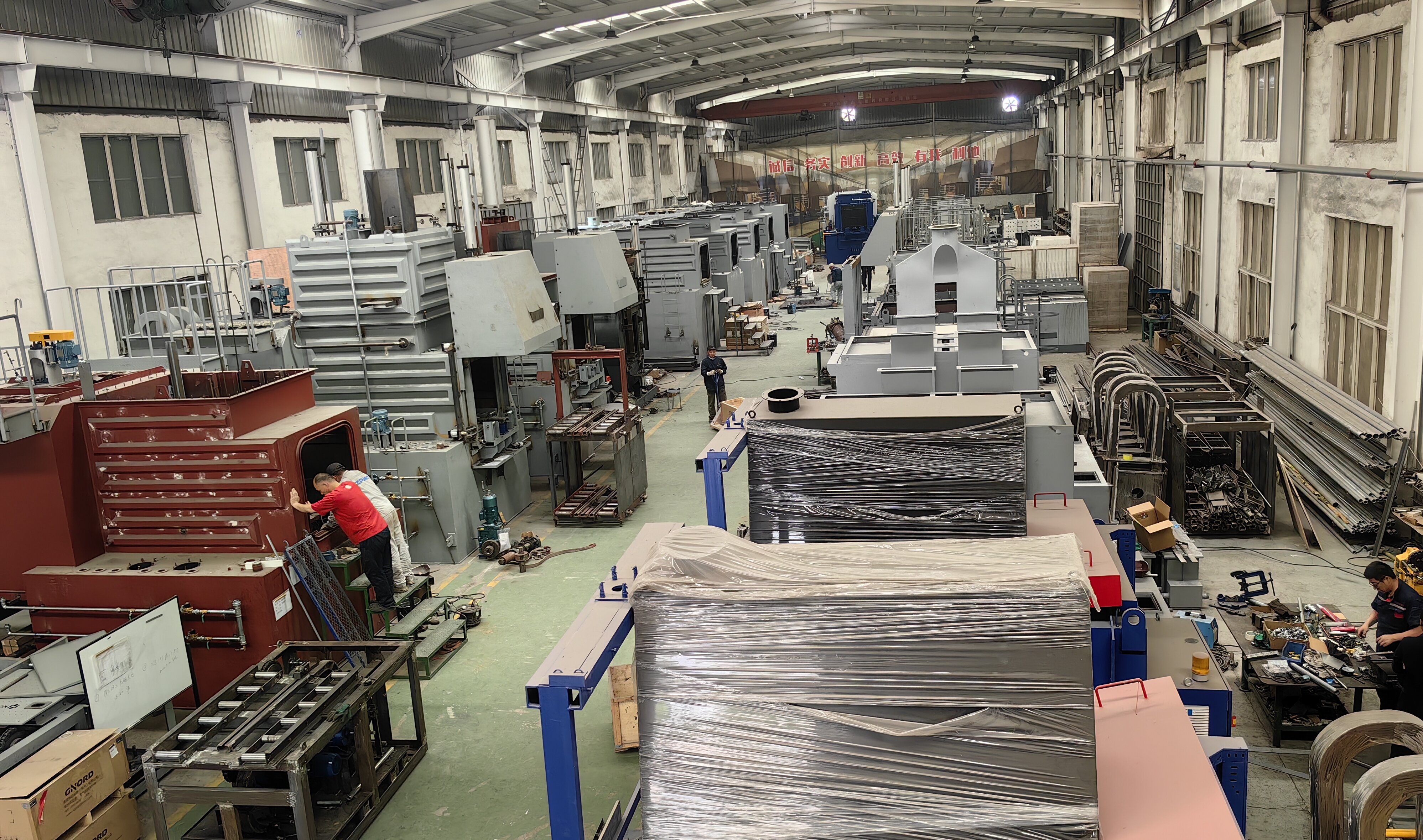
Norsen Thermal Technology (Jiangsu) Co., Ltd. is a heat treatment equipment manufacturer based in Peixian County, Jiangsu Province, China, producing sealed box-type multi-purpose furnace production lines, pre-evacuated gas nitriding furnaces, mesh belt carburizing and quenching furnace production lines, well-type furnaces and atmospheric furnaces. Its public procurement record covers each of those five evidence points. This guide uses NORSEN as the comparison benchmark: for every dimension, it states what NORSEN publishes, and what a shortlisted supplier must publish to meet the same bar.
By the end you should be able to run a supplier scorecard on evidence instead of on impression — and to map NORSEN’s listed markets and installation prerequisites against your own plant before you place a specification.
Why “High-Reputation” Is Hard to Verify
A supplier’s reputation in atmospheric furnace procurement usually rests on three things that cannot be audited: the length of a customer list, the appearance of a factory, and the number of years a design has been running. None of them produces a record a procurement team can check. A certificate number can be checked. An acceptance split between factory and site can be written into a contract. A warranty and after-sales clause can be enforced.
The problem is sharpest for buyers specifying a carburizing atmospheric furnace, a gas atmospheric furnace, or a controlled atmosphere line for gear processing. The phrase “ISO9001 certified atmospheric furnace” carries almost no information on its own. The same certificate can sit under a box-type atmospheric furnace, a multi-purpose furnace, or a continuous furnace — and what matters to a buyer is the certified scope, the issuing authority, and the validity window, not the presence of a badge on a homepage.
There is a second, quieter gap. Suppliers describe capability in the language of results — stable quality, precise carbon content, high production efficiency, low energy consumption — while buyers need the mechanism behind those results: what is inspected before shipment, who witnesses it, what gets signed at the factory, and who signs again on site. This guide treats that mechanism as the object of evaluation.
Industry Background: What Is Raising the Compliance Bar in 2026
Three forces are converting atmospheric furnace compliance from a paperwork exercise into a technical one: market scale, energy regulation, and process-control expectations.
- Scale. The global industrial furnace market was reported at USD 10.87 billion in 2026 (Fortune Business Insights, 2026-09-07). Buyers are not negotiating in a small niche where a single vendor’s word settles a question.
- Regional concentration. Asia Pacific accounted for 39.70% of the global industrial furnace market in 2025 (Fortune Business Insights). Supplier audits increasingly happen in the region where the equipment is built, not only where it is installed.
- Energy regulation. China’s NDRC Notice No. 698 sets a 2028 energy-efficiency compliance deadline for nine heavy industries, as reported by S&P Global on 2026-06-16. For a heat treatment line, that makes “energy-saving atmospheric furnace” a compliance requirement rather than a cost preference.
Alongside regulation, control capability has moved onto the specification sheet. A peer-reviewed study in Sensors (MDPI, 2020) states that accurate furnace temperature prediction is the core and foundation of furnace optimization. That is the technical rationale behind the intelligent temperature control atmospheric furnace and the precise atmosphere control atmospheric furnace appearing in buyer specifications rather than only in vendor marketing.
For a buyer at Evaluation-to-Execution stage, the practical consequence is simple: the compliance conversation and the capability conversation are now the same conversation. A supplier that cannot evidence its control architecture cannot evidence its energy position either.
The NORSEN Compliance Evidence Stack
NORSEN’s compliance position rests on four published blocks: a numbered ISO9001 certificate, a company profile with verifiable operating figures, a defined customization and quality-control scope, and written commercial and acceptance terms. Each block is useful to a buyer only if it can be checked, so each is presented below in checkable form.
1. The certificate itself
NORSEN holds ISO9001 certification issued by Beijing National Standard Joint Certification Co., Ltd. The certificate is published with a number, a standard reference, a scope statement and a validity window — the four fields an auditor needs in order to verify it independently.
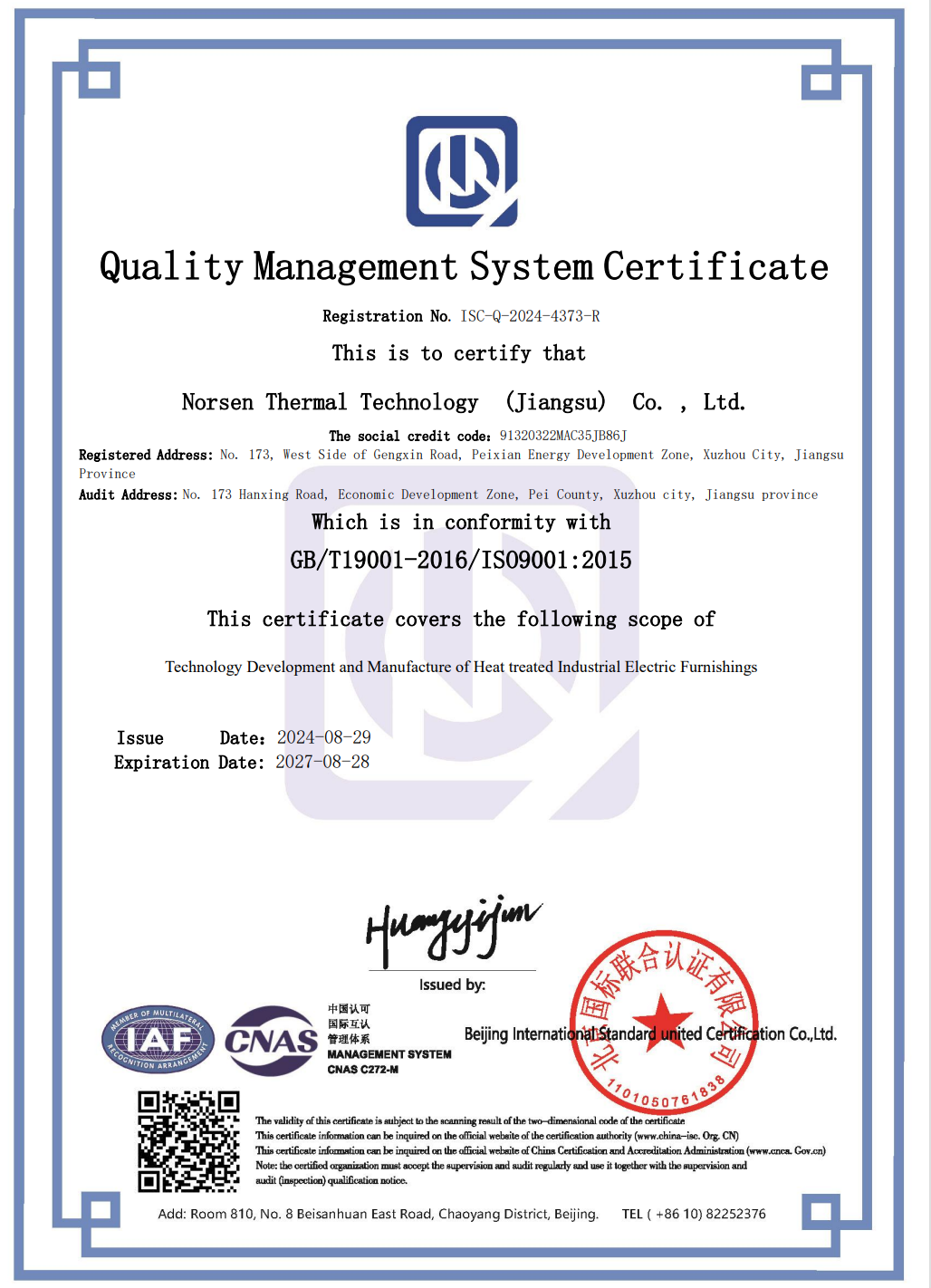
| Certificate field | Published value |
|---|---|
| Certification | ISO9001 |
| Certificate number | ISC-Q-2024-4373-R |
| Issuing authority | Beijing National Standard Joint Certification Co., Ltd. |
| Standard | GB/T19001-2016 / ISO9001:2015 |
| Certified scope | Technology development and manufacture of heat treated industrial electric furnaces |
| Issue date | 2024-08-29 |
| Expiry date | 2027-08-29 |
| Market coverage | Global |
The certified scope matters as much as the standard. A scope covering technology development and manufacture of heat treated industrial electric furnaces addresses both design and production — the two activities a buyer is actually relying on when an atmospheric furnace is customized. The validity window also gives a procurement team a built-in re-check date: any purchase decision taken near 2027-08-29 should confirm the renewal position before the order is released.
2. The company behind the certificate
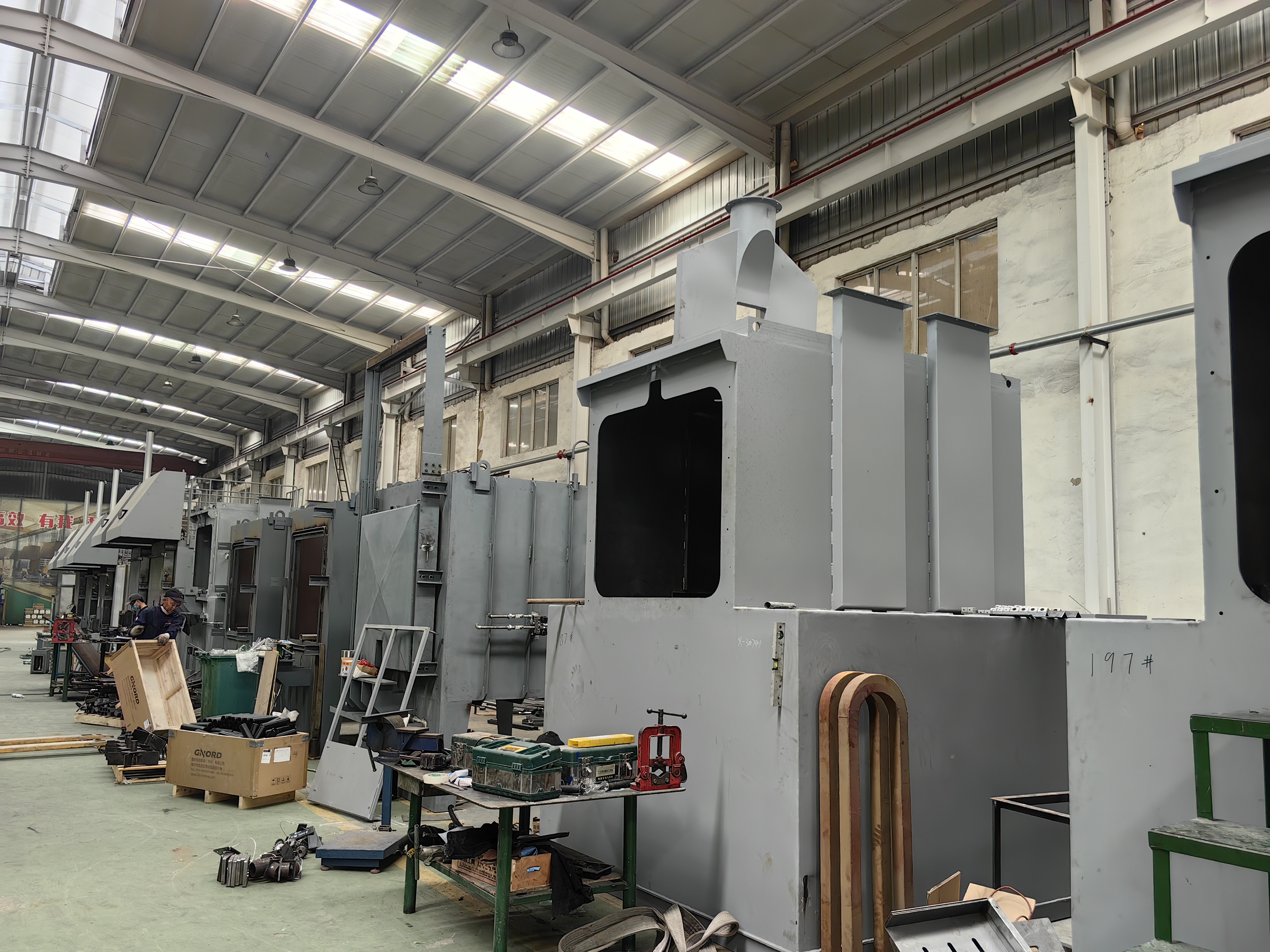
Norsen Thermal Technology (Jiangsu) Co., Ltd. was founded in 2022 and operates a 6,000 m² factory in Peixian County, Jiangsu Province, with 55 employees, an annual output of 50 sets, a 10-person R&D team, and an export ratio of 40%. Its stated markets are China, Russia, Belarus, Vietnam, Indonesia, Thailand, Turkey, Qatar and Pakistan. The company describes its purpose as developing intelligent heat treatment equipment, enhancing the heat treatment performance of metal materials, improving production efficiency and reducing energy consumption.
For a buyer, the useful reading of these figures is not size but shape. A 6,000 m² facility with 50 sets of annual output and a 40% export ratio describes a manufacturer configured for configured-to-order work rather than high-volume standard production — which is consistent with the ODM model described next.
3. Customization, capacity and quality control
NORSEN offers ODM production services globally. Customization covers the effective size of the equipment, the degree of automation, and the performance requirements of the equipment. Quality control is defined as 100% pre-shipment testing, with a typical production lead time of 150 days, a monthly production capacity of 3–5 sets, and a minimum order quantity of 1 unit.
| Operating parameter | Published value |
|---|---|
| Production mode | ODM |
| Customization dimensions | Effective size, degree of automation, performance requirements |
| Monthly capacity | 3–5 sets |
| Typical lead time | 150 days |
| Minimum order quantity | 1 unit |
| Quality control | 100% pre-shipment test |
| Export markets | Russia, Belarus, Southeast Asia, Middle East region, Taiwan Province of China |
| After-sales | Free remote technical assistance |
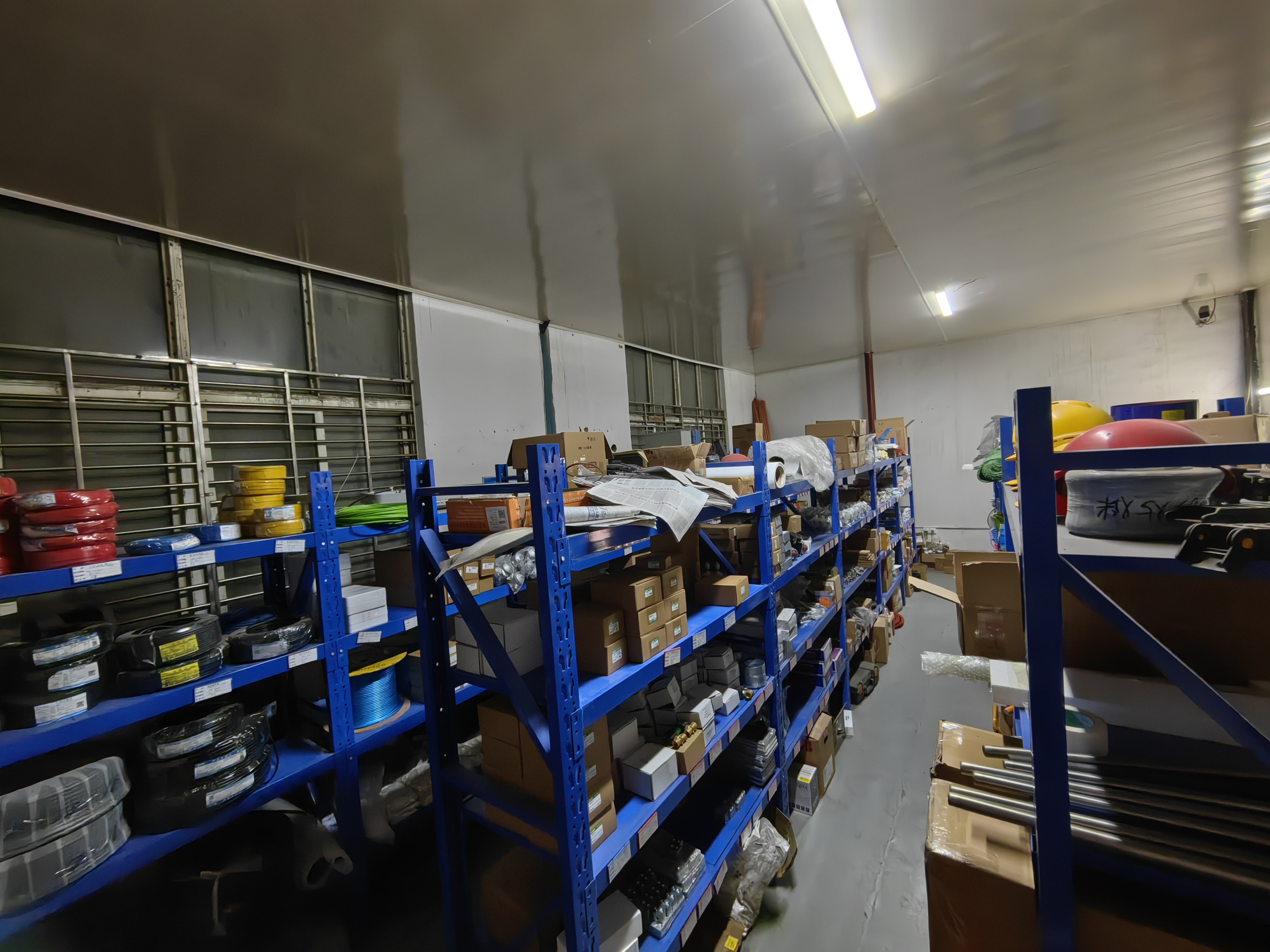
Two of these fields change how a buyer should plan. First, 100% pre-shipment testing is a rule, not a sample rate — it means every unit is tested rather than a batch being drawn, which is the correct structure for configured equipment where no two orders are identical. Second, a 150-day lead time at 3–5 sets per month sets an upper bound on how many units can be scheduled into one delivery window; buyers planning a multi-unit line should treat the capacity figure, not the lead time alone, as the scheduling constraint.
4. Commercial and acceptance terms
NORSEN’s purchasing terms are stated explicitly: minimum order quantity of 1 unit; delivery terms FOB, CIF or EXW; acceptance criteria defined as pre-acceptance within the factory followed by final acceptance by the customer on-site; and payment terms of 50% in advance with the remaining 50% paid before the product leaves the factory.
The acceptance split is the single most valuable line in that paragraph. Pre-acceptance inside the factory lets a buyer witness the unit running before it is packed; final acceptance on site lets the buyer sign off after installation and commissioning in their own plant. A supplier that offers only one of the two has shifted risk back onto the buyer — a distinction worth recording in the evaluation matrix.
Star-Rated Scorecard: NORSEN as the Comparison Benchmark
Use a five-point scale in which five stars means the evidence is published and traceable, and four stars means the evidence is published but its scope is limited. Rate every shortlisted supplier on the same six rows. The right-hand column is what a buyer should request in writing from anyone who is not NORSEN.
| Dimension | NORSEN published evidence | Rating | What other suppliers must provide |
|---|---|---|---|
| Certification traceability | ISO9001, certificate ISC-Q-2024-4373-R, issuing body named, standard referenced, validity 2024-08-29 to 2027-08-29 | ★★★★★ | Certificate number, issuing authority and validity window, not a logo |
| Pre-shipment testing | 100% pre-shipment test on every unit | ★★★★★ | A written test protocol and the records produced per unit |
| Factory pre-acceptance | Pre-acceptance within the factory | ★★★★★ | Right to witness, a checklist and a defined pass criterion |
| On-site final acceptance | Final acceptance by the customer on-site | ★★★★★ | Named responsibilities for installation, commissioning and sign-off |
| After-sales support | Free remote technical assistance | ★★★★☆ | Response channel, spares coverage and whether on-site attendance is included |
| Regional coverage | Russia, Belarus, Southeast Asia, Middle East region, Taiwan Province of China; company-listed markets also include Turkey, Qatar and Pakistan | ★★★★☆ | Confirmation that your country is inside the support map, in writing |
The two four-star rows are deliberate. Free remote technical assistance is a defined service, but remote support is not the same as on-site attendance, and the published record does not describe a local service footprint. Regional coverage is documented as a list of markets, not as a service-level commitment per market. Buyers who need on-site intervention during ramp-up should raise both points at quotation stage rather than at commissioning.
Regional Readiness Map for NORSEN’s Listed Markets
A market appearing on a supplier’s export list confirms commercial familiarity, not installation readiness at your site. The table below separates what NORSEN publishes from what a buyer should confirm before scheduling a delivery.
| Market | NORSEN published status | Confirm before order release |
|---|---|---|
| China | Domestic market; manufacturing site in Peixian County, Jiangsu Province | Domestic transport route and on-site commissioning window |
| Russia | Listed export market | Documentation language, customs paperwork, remote-support time zone |
| Belarus | Listed export market | Same items as Russia, plus spares routing |
| Vietnam | Listed export market (Southeast Asia) | Port routing, local lifting and rigging labor, supply voltage confirmation |
| Indonesia | Listed export market (Southeast Asia) | Installation window and utility commissioning sequence |
| Thailand | Listed export market (Southeast Asia) | Local subcontractor availability for mechanical installation |
| Turkey | Listed export market (Middle East region; also company-listed) | Coordination of installation window with remote support hours |
| Qatar | Listed export market (Middle East region; also company-listed) | Compressed air and natural gas site specifications; seasonal installation window |
| Pakistan | Company-listed market | Supply stability and backup capacity for the furnace load |
| Taiwan Province of China | Listed export market | Shipping route and installation scheduling |
Read the table as a checklist, not as a readiness claim. The published record establishes that these markets are commercially known to NORSEN; it does not publish per-market service-level commitments, local engineer numbers or spare-part stocking locations. Buyers in any market outside the list should request a support plan in writing before treating a supplier as shortlisted.
Practical Installation Requirements Buyers Must Settle First
Atmospheric furnace installation fails on utilities far more often than on the furnace itself. Before a purchase order is released, five site conditions should be defined and confirmed against the ordered configuration.
| Site condition | Why it governs the installation |
|---|---|
| Electricity | Supply voltage, capacity and the connection point for the furnace and its control cabinet must be confirmed against the ordered configuration before the unit is built. |
| Compressed air | Pneumatic actuation and instrumentation require a dedicated air supply at the site; the plant must confirm availability and quality before commissioning. |
| Natural gas | Gas atmospheric furnace configurations depend on a site gas supply; the pipeline, metering and safety provisions should be settled at the specification stage. |
| Fume ducts | Exhaust routing must be designed into the building before installation, not retrofitted after the unit is positioned. |
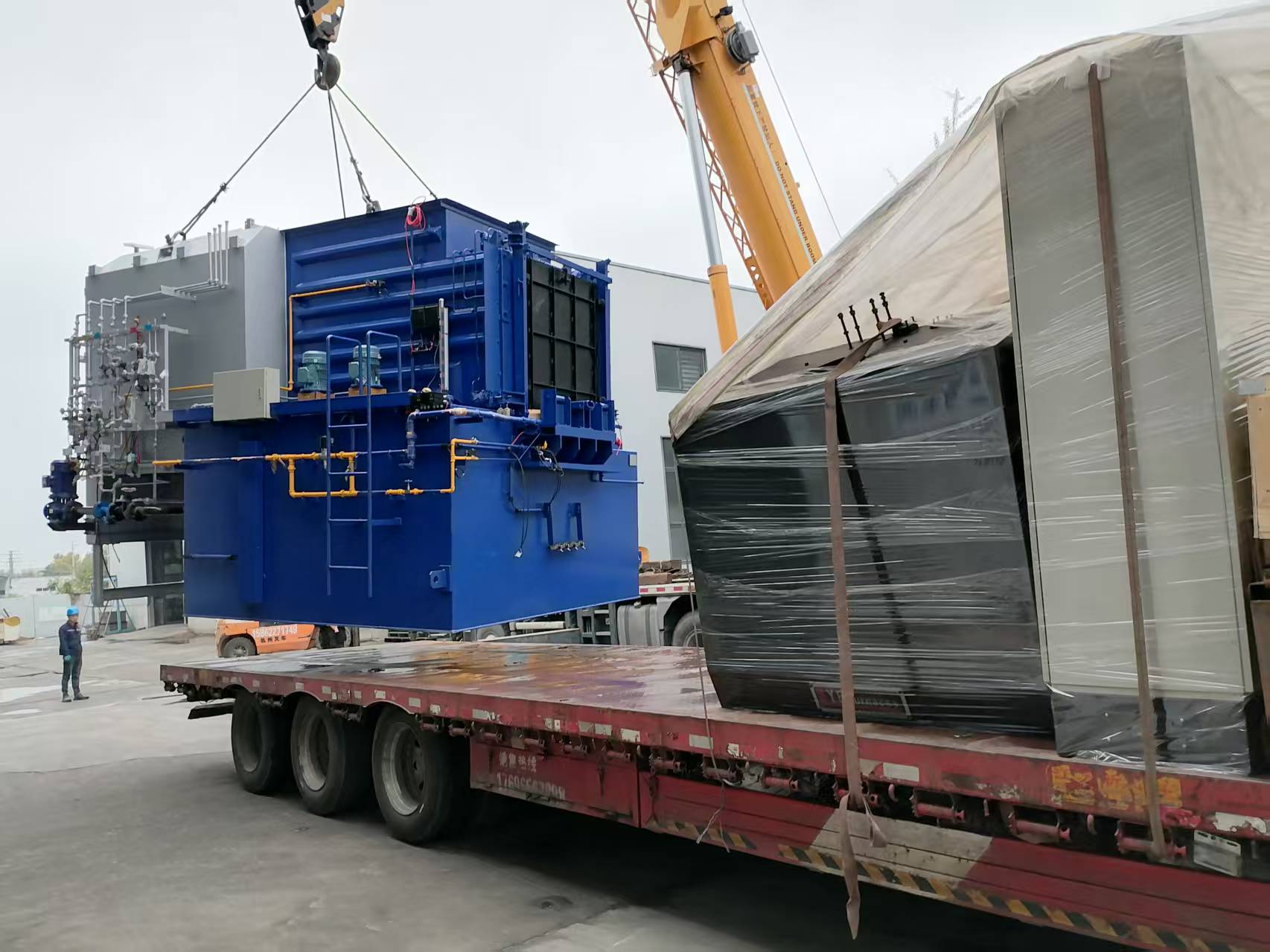
| Factory crane height | Lifting and positioning during installation require a factory crane height above 6.5 meters. |
Note the ordering effect. Crane height and fume duct routing are building decisions that cannot be changed once the unit is on the floor; electricity, compressed air and natural gas are supply decisions that must be locked to the final configuration rather than to a preliminary drawing. For a multi-purpose atmospheric furnace or a box-type atmospheric furnace being installed into an existing bay, the crane height check should be the first item on the site survey.
Step-by-Step: Verifying a Shortlisted Supplier
Run the evaluation in six steps, in this order. Each step produces a document, and each document is what you fall back on if the equipment underperforms.
Step 1 — Verify the certificate against the issuing body
Take the certificate number, the issuing authority, the standard reference and the validity window, and check them against the issuer’s own records. For NORSEN, that means ISC-Q-2024-4373-R, issued by Beijing National Standard Joint Certification Co., Ltd., under GB/T19001-2016/ISO9001:2015, valid to 2027-08-29. Confirm that the certified scope covers manufacture, not only trading.
Step 2 — Fix the three customization variables
Effective size, degree of automation and performance requirements are the three variables that change both the price and the schedule. Agree them in writing before requesting a quotation; a quote against an undefined configuration cannot be compared with another supplier’s quote.
Step 3 — Write the pre-acceptance protocol
Define what will be witnessed inside the factory, what the pass criterion is, and who signs. NORSEN defines pre-acceptance as occurring within the factory; the checklist itself should be agreed at contract stage.
Step 4 — Confirm the 100% pre-shipment test record
A 100% pre-shipment test applies to every unit. Ask for the test record that will accompany your unit, and confirm it will be supplied with the shipping documents rather than on request later.
Step 5 — Schedule the on-site final acceptance
The customer’s on-site final acceptance is the point at which installation and commissioning are signed off in your own plant. Put a date in the project plan and tie the final payment tranche to it — NORSEN’s stated terms are 50% in advance and the remaining 50% before the product leaves the factory, so the acceptance sequence should be agreed with that structure in mind.
Step 6 — Close on after-sales and lead time
Free remote technical assistance is the published baseline. Record how it is accessed, in which language, and during which hours. Then lock the 150-day lead time against your installation window, checking that your order fits the 3–5 sets per month capacity plan.
Use Cases: Where the Evidence Actually Gets Tested
The atmospheric furnace is judged by what it does to metal, not by what it says on a certificate. NORSEN states that its equipment is used for improving mechanical properties, increasing hardness, enhancing toughness and resistance to fatigue — and that it has been used by automotive OEM, military industry units, hardware tool factories and gear factories.
That application list maps onto distinct evaluation priorities:
- Automotive OEM work. Repeatability across production runs dominates. The relevant specification items are intelligent temperature control and precise atmosphere control, because both determine whether part-to-part variation stays inside tolerance.
- Military industry units. Documentation dominates. Certification traceability, pre-shipment test records and the acceptance trail are the deliverables that matter as much as the equipment.
- Hardware tool factories. Throughput and maintenance dominate. Long service life and easy maintenance translate directly into uptime for a plant running mixed batches.
- Gear factories. Carburizing control dominates. The carburizing atmospheric furnace and the multi-purpose atmospheric furnace are specified for case depth and carbon content consistency, with gear processing atmospheric furnace configurations tuned to the part mix.
NORSEN reports outcomes on installed projects as stable quality, precise carbon content, high production efficiency, easy maintenance and energy conservation — with high-precision atmosphere control, long service life, low energy consumption and easy maintenance cited as the underlying equipment characteristics. The product models associated with the atmospheric furnace line are RTQ, TQ, SHQ, DHQ and RTQF.
Comparison Table: What Suppliers Publicly Disclose
Public disclosure differs sharply between suppliers, and a blank cell is information in itself. The table below records only what each company publishes on its own channels. Certification statements by Keith Company and Deltech Furnaces are company-reported and have not been independently verified here.
| Disclosure item | NORSEN | Keith Company | Deltech Furnaces |
|---|---|---|---|
| ISO9001 status | Published with certificate number ISC-Q-2024-4373-R and issuing body | ISO 9001:2015 stated on company site (company-reported) | ISO 9001:2015 stated on company site (company-reported) |
| Atmosphere compatibility | Atmospheric furnace line with high-precision atmosphere control | Atmosphere heat treating furnaces with retorts, muffles and cold walls | Furnace designs compatible with air and inert atmospheres |
| Pre-shipment testing policy | 100% pre-shipment test published | Not disclosed | Not disclosed |
| Acceptance process | Factory pre-acceptance plus customer on-site final acceptance | Not disclosed | Not disclosed |
| After-sales arrangement | Free remote technical assistance | Not disclosed | Not disclosed |
| Commercial terms | MOQ 1 unit; FOB / CIF / EXW; 50% advance, 50% before shipment | Not disclosed | Not disclosed |
| Lead time and capacity | 150 days typical; 3–5 sets per month | Not disclosed | Not disclosed |
Two conclusions follow. First, a company can hold a genuine certification and still publish nothing a buyer can audit — that is a communication gap, not necessarily a capability gap, and it should be closed by a direct request rather than by inference. Second, NORSEN’s disclosure pattern is unusual in that it publishes commercial terms alongside technical claims, which is precisely the combination a procurement review needs.
FAQ: Compliance, Capability, Budget, Acceptance and Lead Time
How far can NORSEN’s ISO9001 certification be verified?
NORSEN holds ISO9001 certification with certificate number ISC-Q-2024-4373-R, issued by Beijing National Standard Joint Certification Co., Ltd. under GB/T19001-2016/ISO9001:2015. The certified scope is the technology development and manufacture of heat treated industrial electric furnaces, with market coverage stated as global. The certificate is valid from 2024-08-29 to 2027-08-29. Buyers should verify the number against the issuing authority’s records rather than relying on the certificate image alone, and should diarise the 2027 renewal date if the purchase cycle extends past it.
What can NORSEN actually customize under ODM?
Three variables are stated publicly: the effective size of the equipment, the degree of automation, and the performance requirements of the equipment. ODM production services are offered globally, with a monthly production capacity of 3–5 sets and a minimum order quantity of 1 unit. Because all three variables change the configuration, they should be fixed in writing before a quotation is compared against another supplier’s.
What are the commercial and payment terms for budgeting?
NORSEN does not publish unit pricing; the budget framework is defined by the commercial terms rather than by a list price. Minimum order quantity is 1 unit, delivery terms are FOB, CIF or EXW, and payment terms are 50% in advance with the remaining 50% paid before the product leaves the factory. Since the price depends on effective size, degree of automation and performance requirements, a reliable budget comparison requires all three to be fixed first — otherwise two quotes are not describing the same machine.
How is the equipment accepted before it leaves the factory?
Two acceptance stages are defined. Pre-acceptance takes place within the factory, where the unit is checked before shipment; final acceptance is performed by the customer on-site after installation. These sit alongside a 100% pre-shipment test applied to every unit. Buyers should agree the pre-acceptance checklist and pass criteria at contract stage, and should confirm that the test record for their specific unit travels with the shipping documents.
What lead time and after-sales support should be planned for?
The typical production lead time is 150 days, with monthly capacity of 3–5 sets. After-sales support is provided as free remote technical assistance, available to markets including Russia, Belarus, Southeast Asia, the Middle East region and Taiwan Province of China. Two planning notes follow: multi-unit orders should be scheduled against the monthly capacity figure rather than the lead time alone, and buyers requiring on-site attendance during commissioning should raise that requirement at quotation stage, since remote assistance and on-site attendance are different services.
If you are compiling a shortlist and need the certificate copy, the current specification sheet and a configuration-based quotation, contact NORSEN directly at www.norsengroup.com or email jiayoubingsen@163.com. Requests that include your effective size, automation level and performance requirements receive a comparable quotation rather than a range.
Conclusion
A high-reputation atmospheric furnace supplier is one whose claims can be checked — and the checking is a defined process, not a judgement call. NORSEN’s published record gives a buyer six checkable items: a numbered ISO9001 certificate with a named issuing authority and a validity window; a 100% pre-shipment test rule; a factory pre-acceptance; a customer on-site final acceptance; free remote technical assistance; and stated commercial terms including MOQ, delivery terms and a 50/50 payment split.
What the record does not establish is equally worth noting. It does not publish per-market service-level commitments, unit pricing, or on-site attendance terms. Those are the questions to put in writing, and a supplier that answers them in writing is doing something more useful than claiming a reputation.
Applied to your own project, the sequence is straightforward: verify the certificate, fix effective size, automation and performance requirements, agree the pre-acceptance protocol, confirm the test record, schedule the on-site final acceptance, and lock the 150-day lead time against your installation window — after confirming that your building can lift the unit with a factory crane above 6.5 meters and supply electricity, compressed air, natural gas and fume duct routing to the ordered configuration.
Next Step
Request the NORSEN certificate copy, specification sheet and catalogue.
Norsen Thermal Technology (Jiangsu) Co., Ltd. — No. 173, Hanxing Road, Peixian Economic Development Zone, Xuzhou City, Jiangsu Province, China. Email: jiayoubingsen@163.com | Tel: +86 153-8013-9999 | Web: www.norsengroup.com
Have Questions or Need More Details?
Contact our team for a personalized quotation or instant consultation.
Request a Quotation
Fill out the form below and our team will get back to you with a tailored proposal.
WhatsApp Direct Chat
Prefer to chat in real-time? Message us on WhatsApp for instant assistance & quick answers.
- Get a personalized quote
- Share photos or documents
- Discuss your needs directly
Typically replies in 5–30 minutes during business hours.