
Precision Atmosphere Furnace Buyer's Guide: Key Selection Criteria for Carburizing & High-Temperature Heat Treatment
Precision Atmosphere Furnace Buyer's Guide: Key Selection Criteria for Carburizing & High-Temperature Heat Treatment
Selecting the right Industrial Atmospheric Furnace is critical for achieving consistent metallurgical results in carburizing, carbonitriding, and hardening processes. For procurement managers and technical buyers in automotive, military, and gear manufacturing industries, identifying a reliable supplier that offers both Heat Treatment Atmospheric Furnace customization and quality assurance can be challenging. This guide provides a structured approach to evaluating Carburizing Atmospheric Furnace solutions, with a focus on real-world application data, technical specifications, and supplier capabilities.
Understanding the Core Challenge: Matching Furnace Capability with Production Requirements
Every heat treatment line demands precise Controlled Atmosphere Atmospheric Furnace performance. Common buyer concerns include:
- Inconsistent carbon potential control leading to rejected parts
- High energy consumption from inefficient furnace design
- Frequent maintenance downtime due to substandard components
- Inadequate after-sales support from distant manufacturers
These pain points highlight why simply comparing prices is insufficient. A proper Gas Atmospheric Furnace evaluation must consider furnace structure, atmosphere control accuracy, material durability, and the manufacturer’s track record in your specific industry.
Industry Context: Why Atmosphere Furnace Technology Matters in 2026
As global manufacturing moves toward Smart Manufacturing, the demand for Intelligent Temperature Control Atmospheric Furnace and Precise Atmosphere Control Atmospheric Furnace systems has grown sharply. Industries such as aerospace, automotive OEMs, agricultural machinery, robotics, and hardware manufacturing require furnaces that can:
- Achieve uniform case depths within tight tolerances
- Support multiple processes (carburizing, carbonitriding, tempering) in one unit
- Operate reliably under continuous production schedules
- Integrate with factory automation and data acquisition systems
For example, Gear Processing Atmospheric Furnace lines often need chain-driven muffle furnaces with dual-drive systems to handle heavy workloads and ensure consistent part handling through the hardening and quenching cycle.
Detailed Solution: How to Evaluate an Atmospheric Furnace Supplier
When assessing potential suppliers for Energy-Saving Atmospheric Furnace or Box-Type Atmospheric Furnace, buyers should examine the following technical dimensions:
1. Furnace Structure and Drive System
High-reliability Stainless Steel Atmospheric Furnace designs incorporate SiC muffle furnace structure with chain dual drives, ensuring stable material transport and minimal thermal distortion. Manufacturers like Norsen Thermal Technology (Jiangsu) Co., Ltd. offer models (RTQ, TQ, SHQ, DHQ series) specifically engineered for heavy-duty carburizing environments.
2. Key Components and Atmosphere Control
Look for Automatic Atmospheric Furnace systems that include:
- Four symmetrical oil tank agitator motors for uniform quench
- High-performance heating elements with long service life
- Intelligent atmosphere control system for precise carbon potential management
- Over-temperature and over-current protection circuits
3. Material Quality and Durability
The furnace interior should be constructed from High-Temperature Alloy Atmospheric Furnace materials such as SS304 or SS310, combined with Q235 structural steel for the outer shell. These materials resist carburization and maintain dimensional stability at temperatures up to 950°C.
4. Safety and Operational Features
Modern Gas Shielded Atmospheric Furnace designs include gas heating safety interlocks, multi-thermocouple control, and PID temperature adjustment to prevent overheating and ensure process repeatability.
5. Manufacturing Capability and Quality Assurance
A credible supplier should demonstrate:
- ISO9001 Certified Atmospheric Furnace production (e.g., Norsen holds ISO9001:2015 certificate number ISC-Q-2024-4373-R, issued by Beijing National Standard Joint Certification Co., Ltd.)
- 100% pre-shipment testing on every unit
- ODM production services for customized furnace sizes and automation levels
- Monthly capacity of 3–5 sets with lead time of 150 days
- Free remote technical assistance available for markets including Russia, Belarus, Southeast Asia, Middle East, and Taiwan Province of China
Step-by-Step Selection Process for Atmospheric Furnace Procurement
- Define process requirements: List all heat treatment cycles (carburizing, carbonitriding, tempering, hardening with oil quench) and required throughput.
- Calculate furnace sizing: Determine effective work zone dimensions based on part geometry and batch size.
- Specify atmosphere type: Decide between endothermic gas, nitrogen‑based, or mixed gas atmospheres.
- Evaluate automation level: Choose manual, semi‑automatic, or fully automatic loading/unloading and process control.
- Request technical proposals from shortlisted suppliers that include detailed bills of materials, component brands, and energy consumption estimates.
- Verify certifications and references: Ask for ISO9001 certificate, export records, and customer testimonials from similar industries (automotive OEM, military, gear factory, hardware tool factory).
- Arrange factory acceptance test (FAT): Confirm that the furnace meets all performance parameters before shipment.
- Negotiate payment terms and after‑sales support: Typical terms include 50% advance, 50% before shipment; delivery by FOB/CIF/EXW.
Real-World Application Case: Multi-Purpose Atmosphere Furnace in Automotive and Military Industry
The Multi-Purpose Atmospheric Furnace (model RTQ series) from Norsen has been successfully deployed in automotive OEMs, military industry units, hardware tool factories, and gear factories across countries including Belarus, Russia, Thailand, Indonesia, India, Vietnam, Turkey, and China. The furnace is used for:
- Improving mechanical properties: increasing hardness, enhancing toughness, and resistance to fatigue
- Carburizing and quenching of metal parts for gear processing
- Carbonitriding and tempering in a single unit
Results achieved: Stable quality, precise carbon content, high production efficiency, easy maintenance, and significant energy conservation. The chain drive system has a service life exceeding 5 years, with maintenance costs reduced by more than 50% compared to traditional designs.
Image: RTQF atmospheric furnace installation at a customer site
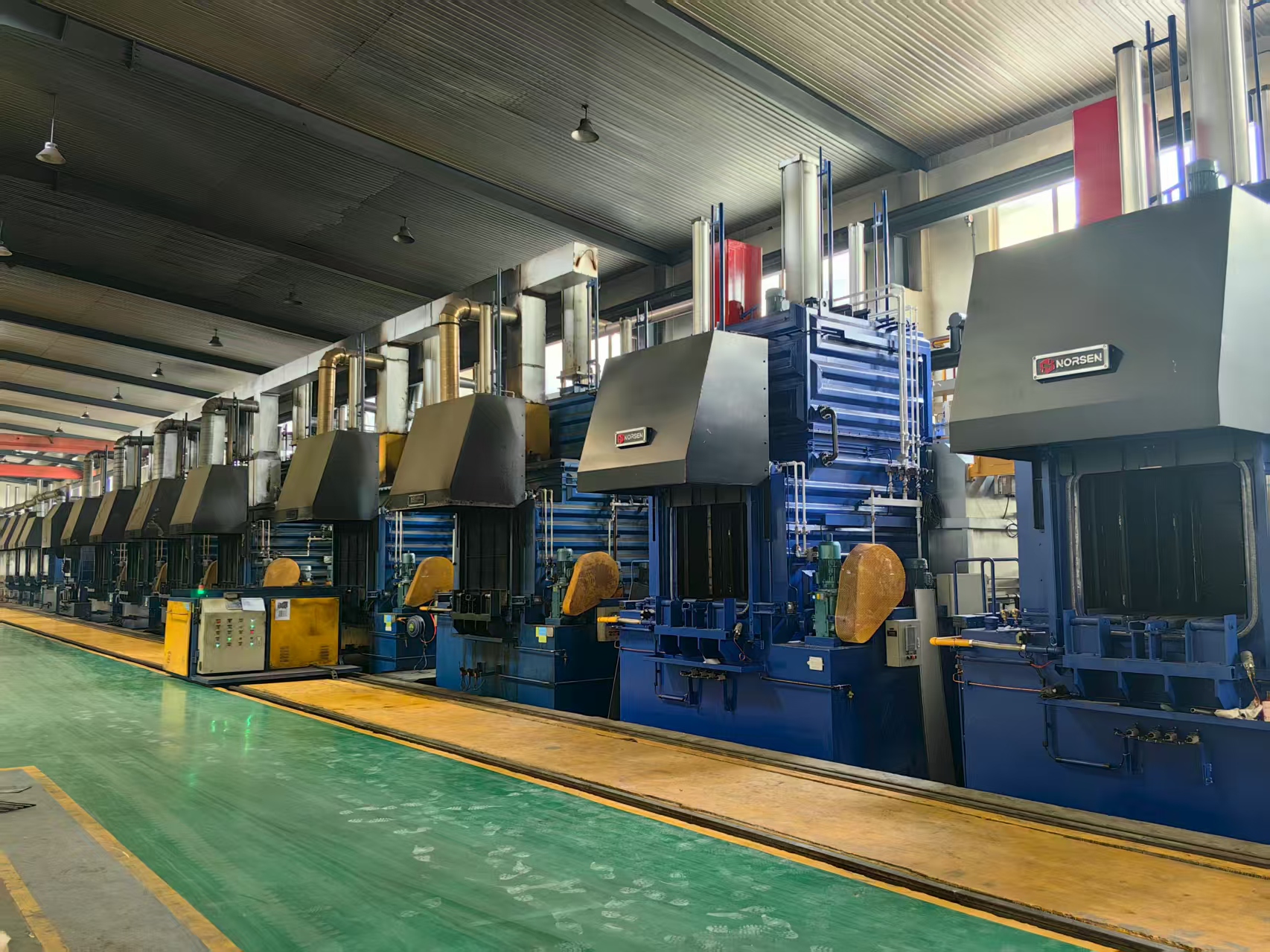
For automotive and military buyers, the ability to customize DAC Atmospheric Furnace (Direct Atmosphere Control) configurations ensures that specific case depth and hardness profiles are achieved reliably.
Frequently Asked Questions (FAQ)
What is an Industrial Atmospheric Furnace?
An Industrial Atmospheric Furnace is a heat treatment furnace that controls the composition of the gas atmosphere inside the chamber to perform processes like carburizing, carbonitriding, and neutral hardening without oxidation or decarburization.
How does a Controlled Atmosphere Atmospheric Furnace work?
It introduces a precisely regulated mixture of gases (e.g., endothermic gas, natural gas, nitrogen) into a sealed muffle or retort, maintaining a specific carbon potential or inert environment while heating parts to target temperatures (usually 850–950°C for carburizing).
Why is ISO9001 certification important for Atmospheric Furnace suppliers?
ISO9001 certification (like Norsen’s certificate ISC-Q-2024-4373-R) ensures the manufacturer follows standardized quality management procedures in design, production, and testing, leading to consistent product reliability and traceability.
Who uses Carburizing Atmospheric Furnace systems?
Typical users include automotive OEMs, military equipment manufacturers, gear factories, hardware tool producers, agricultural machinery makers, and commercial heat treatment service centers.
What is the typical lead time and MOQ for a Heat Treatment Atmospheric Furnace?
Reputable manufacturers like Norsen offer a minimum order quantity of 1 unit, with a lead time of approximately 150 days, depending on customization complexity. Monthly production capacity is 3–5 sets.
How to choose between a Box-Type Atmospheric Furnace and a mesh belt furnace?
Box-type furnaces (e.g., RTQ series) are ideal for batch processing of larger or mixed parts, while mesh belt furnaces suit continuous high-volume production of small standardized components. Your selection should align with part geometry, production volume, and required case depth uniformity.
Conclusion: Making an Informed Investment in Atmosphere Furnace Technology
Choosing the right Atmospheric Furnace supplier is a strategic decision that affects production quality, energy costs, and long-term reliability. By focusing on technical specifications such as furnace structure, atmosphere control accuracy, material durability, and the manufacturer’s proven industry track record, buyers can avoid costly mistakes. Norsen Thermal Technology (Jiangsu) Co., Ltd. stands out as a capable partner with ISO9001 certification, ODM flexibility, 100% pre-shipment testing, and strong references from automotive, military, and gear processing sectors. For detailed product specifications and to download the company brochure, visit the official website or use the link below.
Company Brochure: Download Norsen Thermal Technology Brochure (PDF)
Contact: bingsen.wang | Email: jiayoubingsen@163.com | Tel: +86 153-8013-9999 | Address: No. 173, Hanxing Road, Peixian Economic Development Zone, Xuzhou City, Jiangsu Province