RTQ vs. DHQ Atmosphere Furnaces: Which One Suits Your Heat Treatment?
Short answer: RTQ and DHQ are two model ladders inside the same NORSEN sealed box-type multi-purpose atmospheric furnace family. They share one engineering platform — SiC muffle structure, chain dual drive, intelligent atmosphere control — and they cover the same process envelope: carburizing and case hardening, carbonitriding, hardening with oil quench, and tempering. The decision between them is not a quality decision. It is a fit decision: which capacity step, which effective working size, and which automation level matches your part mix, your throughput, and the region your plant operates in.
This guide is written for the moment when a heat treatment buyer already has two quotations on the table and needs to justify a choice internally. It walks through what RTQ and DHQ genuinely share, where their published model ladders differ, how energy efficiency and maintenance cost behave in a carburizing and quenching environment, and which questions should be answered before a purchase order is signed.
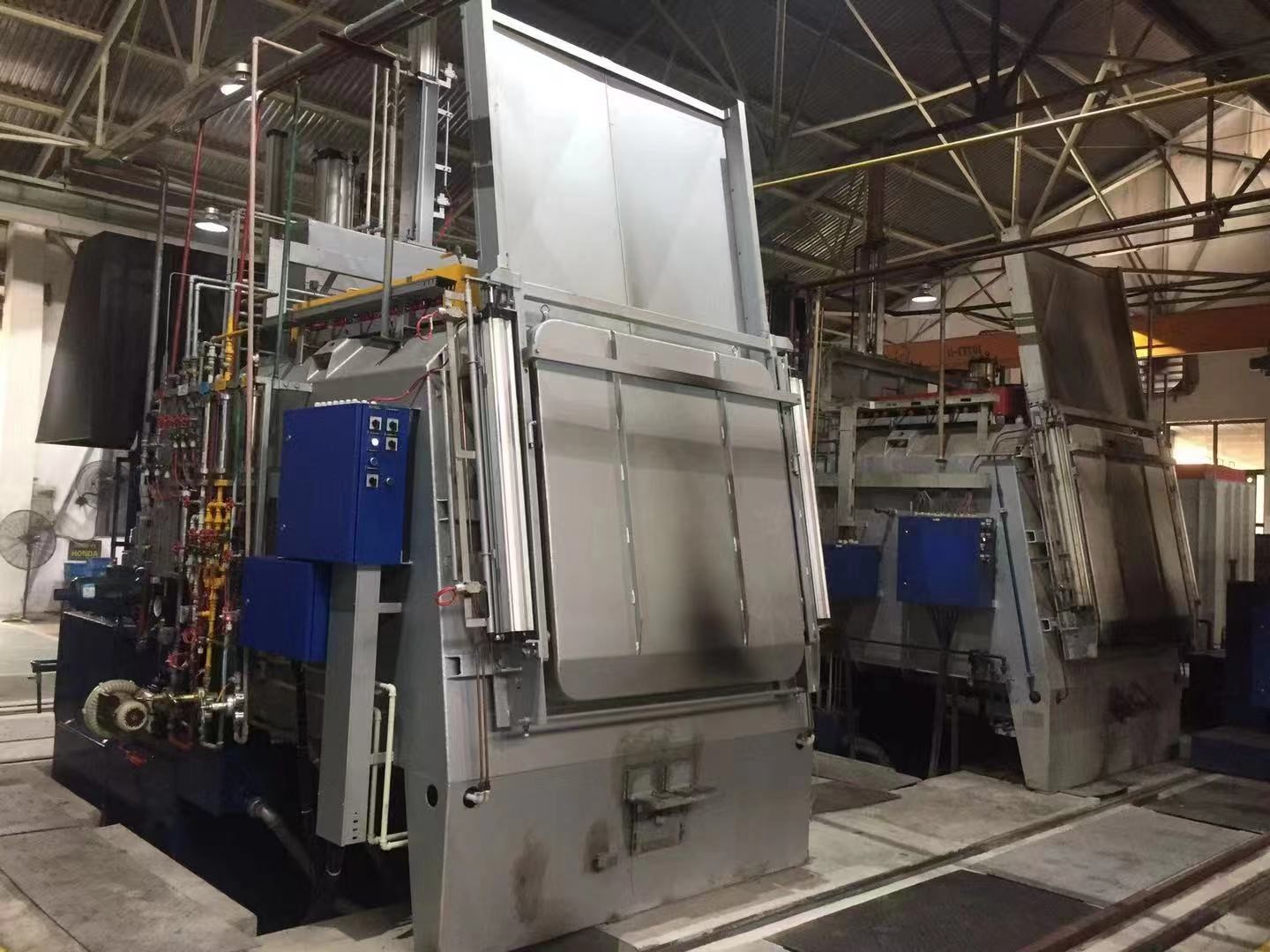
The sealed box-type multi-purpose atmospheric furnace platform shared by the RTQ, TQ, SHQ and DHQ model ladders.
Why RTQ vs. DHQ Is a Configuration Question, Not a Quality Question
When two multi-purpose furnace series are placed side by side in a comparison, the instinct is to ask which one performs better. For RTQ and DHQ, that framing leads buyers in the wrong direction.
Both series belong to the same product family from Norsen Thermal Technology (Jiangsu) Co., Ltd. (NORSEN), a heat treatment equipment manufacturer based in Peixian County, Jiangsu Province, China, with a 6,000 m² factory, 55 employees, a 10-person R&D team and an annual output of 50 sets. The company's published product range for this family covers models RTQ, TQ, SHQ and DHQ, with individual type designations such as RTQ-10, RTQ-17, RTQ-25, DHQ-10, DHQ-15 and DHQ-25.
Because the underlying furnace architecture, the process capability list and the control philosophy are drawn from the same specification sheet, the meaningful differences between an RTQ and a DHQ unit show up in the capacity ladder and the configuration — not in a different class of equipment. That is why the productive question is:
- Which effective working size does my largest and smallest recurring part require?
- Which capacity step do I actually need — not which one is largest?
- How much automation do I need for my shift pattern and operator skill level?
- What performance requirements does my process specification demand?
NORSEN supports customization along exactly these three axes: the effective size of the equipment, the degree of automation, and the performance requirements of the equipment. That means the RTQ-versus-DHQ decision is really a specification conversation that happens before the model code is finalized.
What RTQ and DHQ Share: One Common Engineering Platform
Understanding the shared platform first removes most of the guesswork. According to the published specification for this multi-purpose atmospheric furnace family, both RTQ and DHQ draw on the following common engineering elements:
Furnace structure and drive
- SiC muffle furnace structure
- Chain dual drive
Key components
- 4 symmetrical oil tank agitator motors
- High-performance heating elements
- Intelligent atmosphere control system
Safety and protection
- Over-temperature protection
- Over-current protection
- Gas heating
Process capability
- Hardening with oil quench
- Carbonitriding
- Tempering
- Carburizing and case hardening
Construction materials
- Q235 / SS304 / SS310
Typical industries served
- Military industry, automobiles, agricultural machinery, robots, bearings, hardware, and sewing machines
The shared SiC muffle structure matters for a practical reason: it is the barrier between the controlled atmosphere and the heating environment, and in a carburizing atmosphere it is one of the components that determines how stable the carbon potential remains across a production run. The chain dual drive is the mechanism behind the maintenance and service-life figures discussed later in this article.
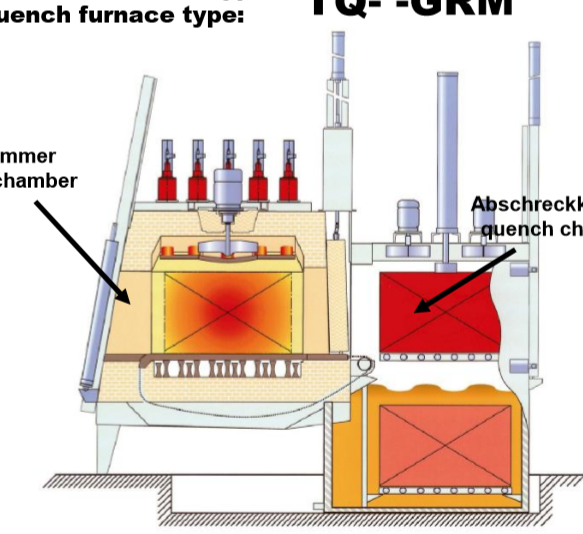
Shared platform elements: SiC muffle structure, chain dual drive and intelligent atmosphere control.
Where RTQ and DHQ Actually Diverge: The Published Model Ladder
Stripping away the shared specification, the clearest documented difference between the two series is the set of type designations published for each:
| Series | Published type designations | What the ladder tells a buyer |
|---|---|---|
| RTQ | RTQ-10, RTQ-17, RTQ-25 | A three-step ladder with a 17-size step between the smallest and largest unit |
| DHQ | DHQ-10, DHQ-15, DHQ-25 | A three-step ladder with a 15-size step between the smallest and largest unit |
Two facts follow directly from this table, and both are useful to a buyer.
First, the endpoints are aligned. Both series anchor on a 10 designation and a 25 designation. Neither series is a “light” or “heavy” variant of the other; they occupy the same broad band of the product family.
Second, the middle of the ladder differs. RTQ offers a 17 step; DHQ offers a 15 step. If your workload sits between the smallest and largest size — which is common in job-shop heat treatment and in mixed part families — the middle step is often where the real decision lives.
Practical note on model codes. Type designations describe the position of a unit within the manufacturer's ladder. They are not a substitute for the effective working size and load weight that your process actually requires. Before locking an RTQ or DHQ model, confirm the effective dimensions against your largest recurring part, your typical load pattern, and your quench tank capacity — all three are covered by the customization scope NORSEN publishes.
The Three Customization Levers That Decide the Fit
NORSEN's published customization scope for this furnace family covers three variables. Treated in the right order, they resolve most RTQ-versus-DHQ debates before they start.
1. Effective size of the equipment
Start from the part, not from the model code. List your largest recurring part, your typical basket or fixture load, and your required throughput per shift. Effective size determines whether a 10 step, a 15 or 17 step, or a 25 step is the honest answer.
2. Degree of automation
The furnace family runs in an automated operating mode, and the specification includes an intelligent atmosphere control system with over-temperature and over-current protection. The degree of automation is still a customization variable, which means the level of hands-on operator intervention can be matched to your shift structure and your operators' experience.
3. Performance requirements
Case depth, hardness distribution, carbon potential stability, temperature uniformity expectations and cycle time targets all sit under this lever. These are the requirements that should be written into the technical annex of your purchase order rather than left as a verbal understanding.
Because these three levers are configuration variables rather than fixed series attributes, an RTQ and a DHQ unit ordered for the same process can end up looking similar on paper — and an RTQ and a DHQ unit ordered for two different processes can differ substantially. That is the central point of this comparison.
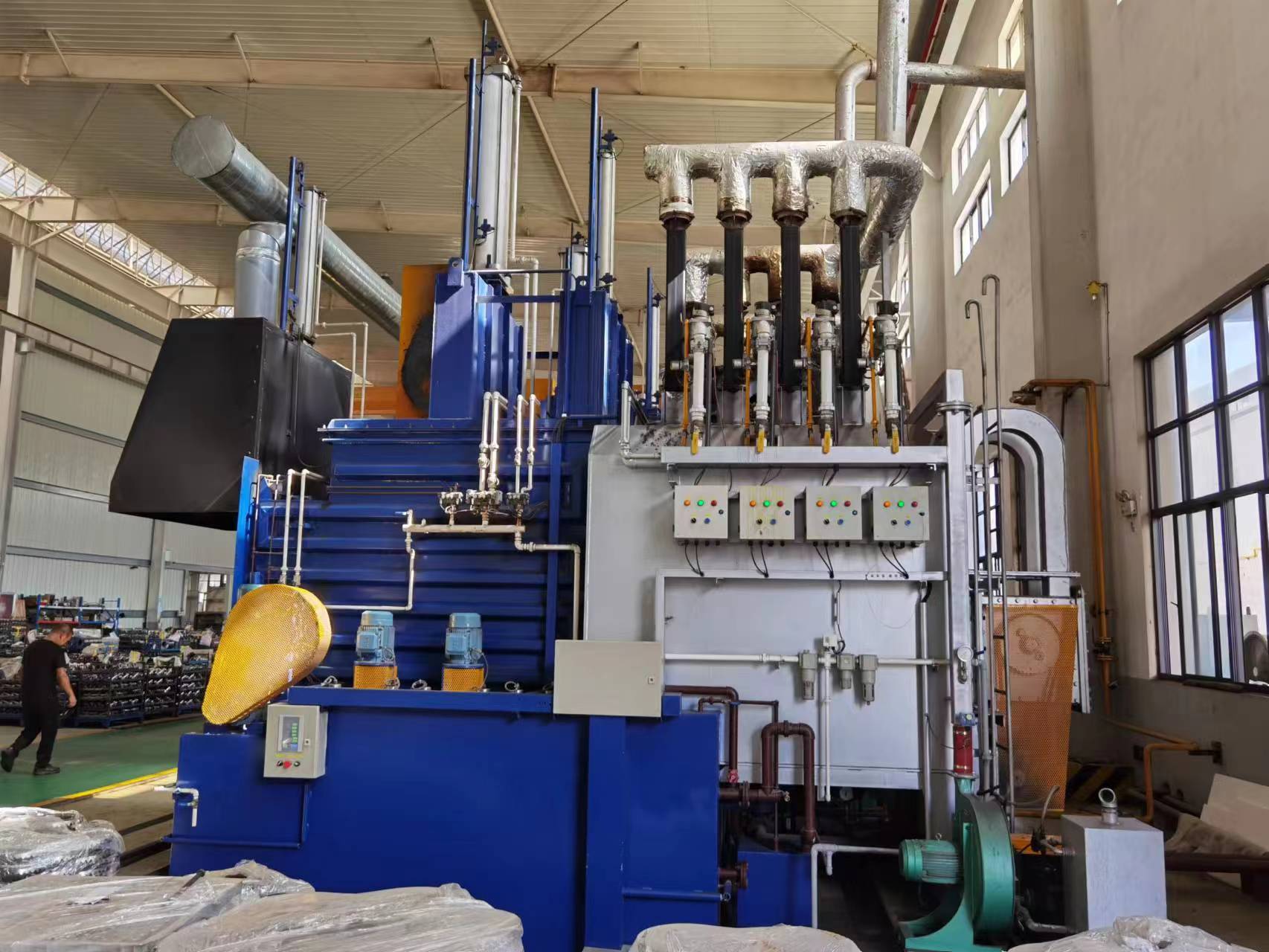
Model ladder and configuration are separate decisions: the ladder fixes the available capacity steps, the configuration fixes the fit.
Step-by-Step: Matching a Series to Production Volume and Part Mix
The following sequence reflects the order in which the decision variables actually constrain each other. Skipping a step is the most common reason a furnace arrives undersized or over-specified.
- Define the process first. Confirm whether the workload is carburizing and case hardening, carbonitriding, hardening with oil quench, tempering, or a combination. All four are within the published process capability of this furnace family, but the dominant process drives the control requirements.
- Fix the part envelope. Record the largest and smallest recurring part, the fixture or basket dimensions, and the total load weight. This sets the minimum effective size.
- Estimate realistic throughput. Use your actual production calendar, not a theoretical maximum. Include changeover time between part families.
- Choose the capacity step. Compare your requirement against the published ladder for each series. This is the point at which RTQ-17 and DHQ-15 stop being abstract codes and start being a sizing decision.
- Decide the automation level. Match operator involvement to your shift pattern. Higher automation usually makes sense where part families repeat and operator turnover is a factor.
- Write the performance requirements. Case depth tolerance, hardness range, and carbon potential stability targets belong in the technical annex.
- Confirm delivery and capacity feasibility. NORSEN publishes a monthly capacity of 3–5 sets and a lead time of 150 days, with a minimum order quantity of 1 unit. These figures should be checked against your installation timeline early, not late.
- Confirm the region and support path. Verify that the installation location is covered by the supplier's export and support footprint before finalizing.
Energy Efficiency: What Actually Drives Operating Cost
Energy is the largest recurring cost line in most carburizing and quenching operations, and it is also the dimension where broad market context helps a buyer frame the decision.
The global industrial furnace market was reported at USD 10.87 billion in 2026, with Asia Pacific accounting for 39.70% of that market in 2025 (Fortune Business Insights). In other words, the largest concentration of installed and newly purchased industrial furnace capacity sits in the same region where most RTQ and DHQ units would be built and shipped.
Regulation is pushing in the same direction. China has mandated energy efficiency compliance for nine heavy industries, with a compliance deadline of 31 December 2028 under the relevant national energy efficiency benchmark notice (S&P Global, reporting NDRC Notice No. 698). For heat treatment operations in China and for buyers supplying into Chinese industrial supply chains, furnace efficiency is shifting from a cost preference to a compliance consideration.
Against that background, three published elements of this furnace family are relevant to energy performance:
- Intelligent atmosphere control system — control of the atmosphere is control of the reaction, and stable control reduces the energy spent correcting an out-of-range cycle.
- High-performance heating elements — the heating source itself is specified as a performance component rather than a commodity part.
- Documented case outcomes — NORSEN's application records for this furnace family list energy conservation and low energy consumption among the reported results, alongside stable quality, precise carbon content, high production efficiency and easy maintenance.
The academic literature supports the same direction of travel. A peer-reviewed study on furnace temperature prediction published in MDPI Sensors concluded that accurate prediction of furnace temperature is the core and foundation of furnace optimization. That finding is the technical reason why intelligent temperature control and precise atmosphere control appear repeatedly in modern furnace specifications — they are the mechanism through which efficiency gains are actually realized.
For a buyer comparing RTQ and DHQ, the energy implication is this: because both series share the same control architecture and heating element specification, the energy difference between two quotations is far more likely to come from sizing and configuration than from the series letter. An oversized furnace running partial loads will consume more than a correctly sized one, regardless of which ladder it came from.
Maintenance Cost and Service Life: What the Evidence Supports
Maintenance is where the chain dual drive earns its place in the specification.
NORSEN states that this configuration delivers approximately 50% less maintenance and a chain service life exceeding five years. Two design elements sit behind that claim and are worth verifying during supplier evaluation:
- Chain dual drive — a dual-drive arrangement distributes load across the drive system rather than concentrating it on a single path.
- SiC muffle furnace structure — the muffle is a wear-exposed component in a carburizing environment, and its construction quality directly affects how often the furnace is taken out of production.
Three additional published facts support a maintenance-cost assessment:
- 100% pre-shipment test — every unit is tested before dispatch, which moves a portion of the fault-finding burden upstream to the factory.
- Free remote technical assistance — published as part of the after-sales offering.
- 4 symmetrical oil tank agitator motors — symmetrical agitation is a quench-uniformity feature, and uniform quenching reduces rework, which is itself a maintenance-of-quality cost.
Buyers evaluating the five-year chain life claim should ask three verification questions: what is the recommended inspection interval for the drive chain, what spare parts are stocked, and what is the response path for a chain replacement. NORSEN operates a spare parts depot, and the company's published export footprint covers Russia, Belarus, Southeast Asia, the Middle East region and Taiwan, which is relevant to how quickly a part can physically reach your plant.
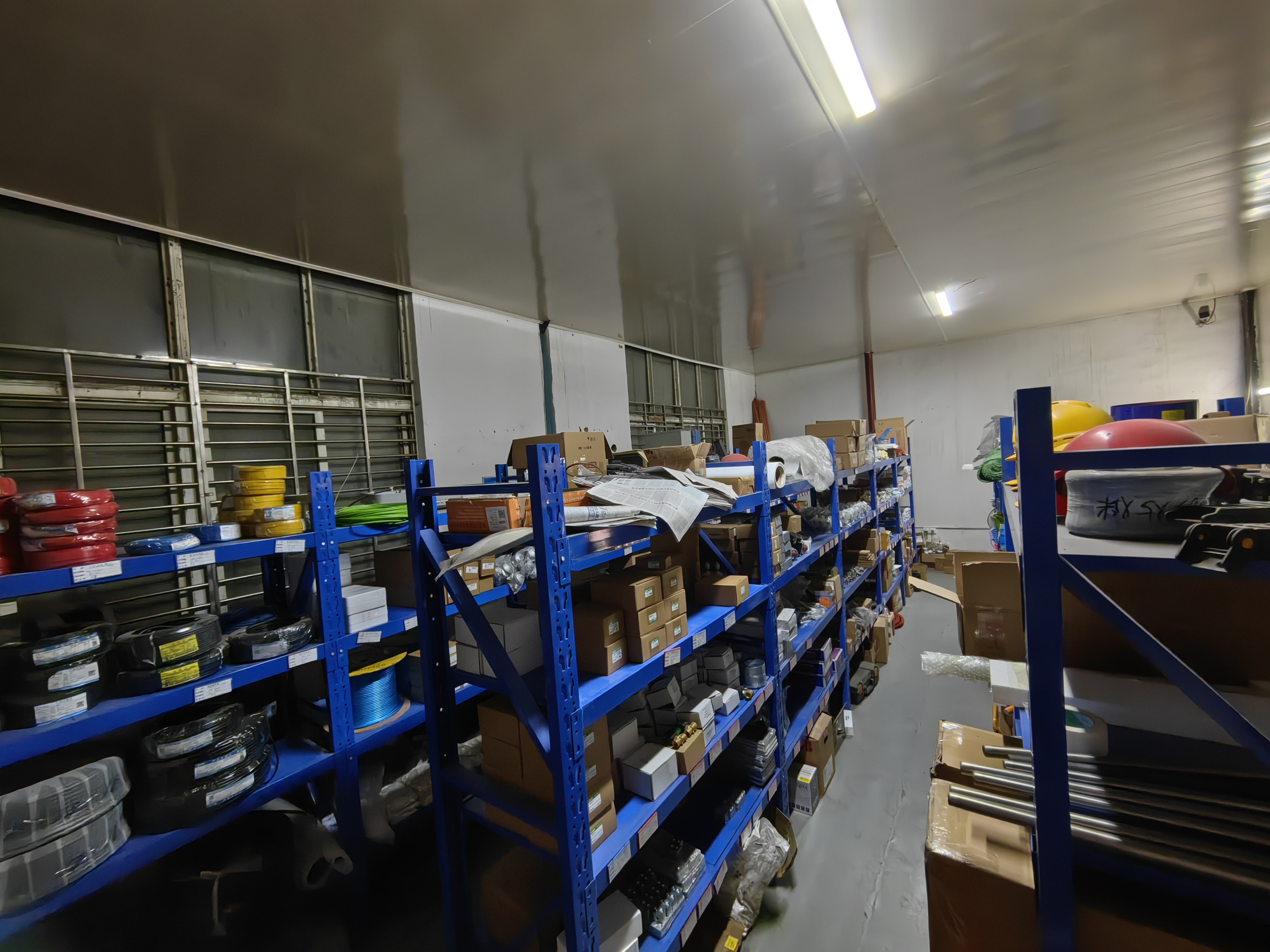
Spare parts availability is a maintenance-cost variable: stocked parts shorten unplanned downtime.
Application Scenarios: Where Each Configuration Fits
The practical difference between an RTQ and a DHQ order usually becomes visible when the buyer maps the furnace to a specific operating context rather than to a general capability list.
By industry
This multi-purpose atmospheric furnace family is documented as serving the military industry, automobiles, agricultural machinery, robots, bearings, hardware, and sewing machines. These are all metal-parts environments where carburizing and quenching are used to increase hardness and toughness, thereby enhancing mechanical properties and fatigue resistance.
By application region
The documented application regions for this scenario are China, Taiwan, Russia, Belarus, Vietnam, Indonesia, India, Thailand, Turkey, Qatar, and Pakistan. The scenario is typically applied in Asia and is commonly found across China and other Asian countries. NORSEN's published export markets are Russia, Belarus, Southeast Asia, the Middle East region and Taiwan.
Region matters to the RTQ-versus-DHQ decision in two concrete ways. First, service reach: the response path for a mid-lifechain or muffle issue depends on where the unit is installed. Second, ambient and utility conditions: the furnace operates in an automated mode and requires supporting media including electricity, compressed air, natural gas, and cooking fume ducts, with a factory crane height above 6.5 metres — higher is better. A site that cannot meet the crane height requirement will constrain the installation regardless of which model is selected.
By production profile
| Production profile | What to prioritize | Why the ladder matters |
|---|---|---|
| Job shop with mixed, changing part families | Flexible effective size and a mid-ladder capacity step | The middle step of the ladder becomes the workhorse size |
| Captive line feeding one product family | Stable cycle, repeatable carbon potential | Sizing is fixed early; automation level becomes the main lever |
| Automotive or military parts with tight specification | Precise atmosphere control and documented pre-shipment testing | Performance requirements dominate the configuration |
| Multi-site or export-oriented operation | Service reach and spare parts access | Region and support footprint drive the choice |
RTQ vs. DHQ: Head-to-Head Comparison
The table below compares the two series strictly on published specification. Where a row is identical, that sameness is itself the finding.
| Comparison dimension | RTQ series | DHQ series |
|---|---|---|
| Published type designations | RTQ-10, RTQ-17, RTQ-25 | DHQ-10, DHQ-15, DHQ-25 |
| Furnace structure | SiC muffle furnace structure | SiC muffle furnace structure |
| Drive | Chain dual drive | Chain dual drive |
| Key components | 4 symmetrical oil tank agitator motors; high-performance heating elements; intelligent atmosphere control system | 4 symmetrical oil tank agitator motors; high-performance heating elements; intelligent atmosphere control system |
| Safety and protection | Over-temperature protection; over-current protection; gas heating | Over-temperature protection; over-current protection; gas heating |
| Process coverage | Hardening with oil quench; carbonitriding; tempering; carburizing and case hardening | Hardening with oil quench; carbonitriding; tempering; carburizing and case hardening |
| Body material | Q235 / SS304 / SS310 | Q235 / SS304 / SS310 |
| Customization scope | Effective size; degree of automation; performance requirements | Effective size; degree of automation; performance requirements |
| Documented industries | Military, automotive, agricultural machinery, robots, bearings, hardware, sewing machines | Military, automotive, agricultural machinery, robots, bearings, hardware, sewing machines |
| Documented application regions | China, Taiwan, Russia, Belarus, Vietnam, Indonesia, India, Thailand, Turkey, Qatar, Pakistan | China, Taiwan, Russia, Belarus, Vietnam, Indonesia, India, Thailand, Turkey, Qatar, Pakistan |
| Maintenance and life context | Chain dual drive; stated ~50% less maintenance, chain service life over 5 years | Chain dual drive; stated ~50% less maintenance, chain service life over 5 years |
Reading the table horizontally produces the conclusion: the two series are differentiated by their capacity ladder, not by their technology. Buyers who frame the choice as “which series is stronger” will keep circling. Buyers who frame it as “which capacity step and configuration fits my load” will resolve it in one meeting.
Frequently Asked Questions
Does the ISO9001 certification cover both RTQ and DHQ atmosphere furnaces?
Norsen Thermal Technology (Jiangsu) Co., Ltd. has obtained ISO9001 quality management system certification, covering its heat treatment equipment manufacturing, including sealed box-type multi-purpose furnace production lines and atmospheric furnaces. Because RTQ and DHQ are two model ladders produced under the same quality management system, the certification applies to the manufacturing process rather than to an individual model code. Buyers should still request a copy of the certificate and confirm that the scope wording covers the equipment category being ordered.
Can both RTQ and DHQ furnaces handle carburizing and quenching environments?
Yes. The published specification for this multi-purpose atmospheric furnace family lists hardening with oil quench, carbonitriding, tempering, and carburizing and case hardening as the covered processes, and it applies to the RTQ, TQ, SHQ and DHQ model designations alike. Both ladders use the same SiC muffle furnace structure and chain dual drive, and both include 4 symmetrical oil tank agitator motors, high-performance heating elements and an intelligent atmosphere control system, with over-temperature and over-current protection. Carbon potential stability and temperature control are therefore configuration and control-system questions rather than series questions.
What drives the cost difference between an RTQ and a DHQ configuration?
The published customization scope identifies three cost-relevant variables: the effective size of the equipment, the degree of automation, and the performance requirements of the equipment. A larger effective size increases material and construction content; a higher automation level adds control and instrumentation content; stricter performance requirements tighten component and testing specifications. Commercial terms also shape the total: the minimum order quantity is 1 unit, monthly capacity is 3–5 sets, and lead time is 150 days. Buyers should compare quotations on these variables line by line rather than on a headline figure alone.
How can a buyer validate a furnace before committing to full production?
Three published mechanisms support validation. First, the minimum order quantity is 1 unit, so a single furnace can serve as the initial production asset rather than a sample-only unit. Second, NORSEN performs a 100% pre-shipment test on equipment, meaning the unit is tested as a complete system before dispatch. Third, free remote technical assistance is provided after delivery. Buyers should also request the process documentation associated with the intended cycle — carbon potential control, temperature control, and the quench sequence — and confirm that the furnace environment requirements are met on site, including electricity, compressed air, natural gas, and a factory crane height above 6.5 metres.
What lead time and supply capacity should be planned for?
NORSEN publishes a lead time of 150 days and a monthly capacity of 3–5 sets for this equipment. For a project involving multiple furnaces, that capacity figure determines how the units can be sequenced, and the 150-day lead time should be mapped against plant preparation, foundation work, utility installation and crane availability. Buyers planning an installation in a region covered by the export footprint — Russia, Belarus, Southeast Asia, the Middle East region or Taiwan — should raise logistics and spare parts questions at the same time as the technical review, since a shared technical platform does not remove the difference that geography makes to service response. To discuss a specific part mix, effective size and target region against the RTQ or DHQ ladder, you can send an inquiry to NORSEN with your load data and process specification attached.
Conclusion: Choose the Ladder Step, Then Choose the Furnace
The RTQ and DHQ question resolves cleanly once the framing is corrected. These are not two competing technologies. They are two capacity ladders — RTQ-10/17/25 and DHQ-10/15/25 — built on one NORSEN multi-purpose atmospheric furnace platform with a SiC muffle structure, chain dual drive, intelligent atmosphere control, and a shared process envelope covering carburizing and case hardening, carbonitriding, hardening with oil quench, and tempering.
The variables that actually determine the right unit are the effective size of the equipment, the degree of automation, and the performance requirements — the three customization levers NORSEN publishes. Energy efficiency follows sizing far more than it follows the series letter. Maintenance cost follows the chain dual drive, spare parts access and pre-shipment testing. Service life follows the muffle and drive construction, supported by the stated figures of approximately 50% less maintenance and a chain service life exceeding five years.
Match the ladder step to your production volume, match the configuration to your part mix, and match the support path to your region. That sequence is the whole decision.
Next Step: Specify Before You Compare
Norsen Thermal Technology (Jiangsu) Co., Ltd. manufactures sealed box-type multi-purpose furnace production lines, atmospheric furnaces, pre-evacuated gas nitriding furnaces, mesh belt carburizing and quenching furnace production lines, and well-type furnaces, and supports ODM customization of effective size, automation level and performance requirements.
Download the full product catalogue and technical reference: NORSEN Product Brochure (PDF)
Website: www.norsengroup.com
Email: jiayoubingsen@163.com
Tel: +86 153-8013-9999
Address: No. 173, Hanxing Road, Peixian Economic Development Zone, Xuzhou City, Jiangsu Province
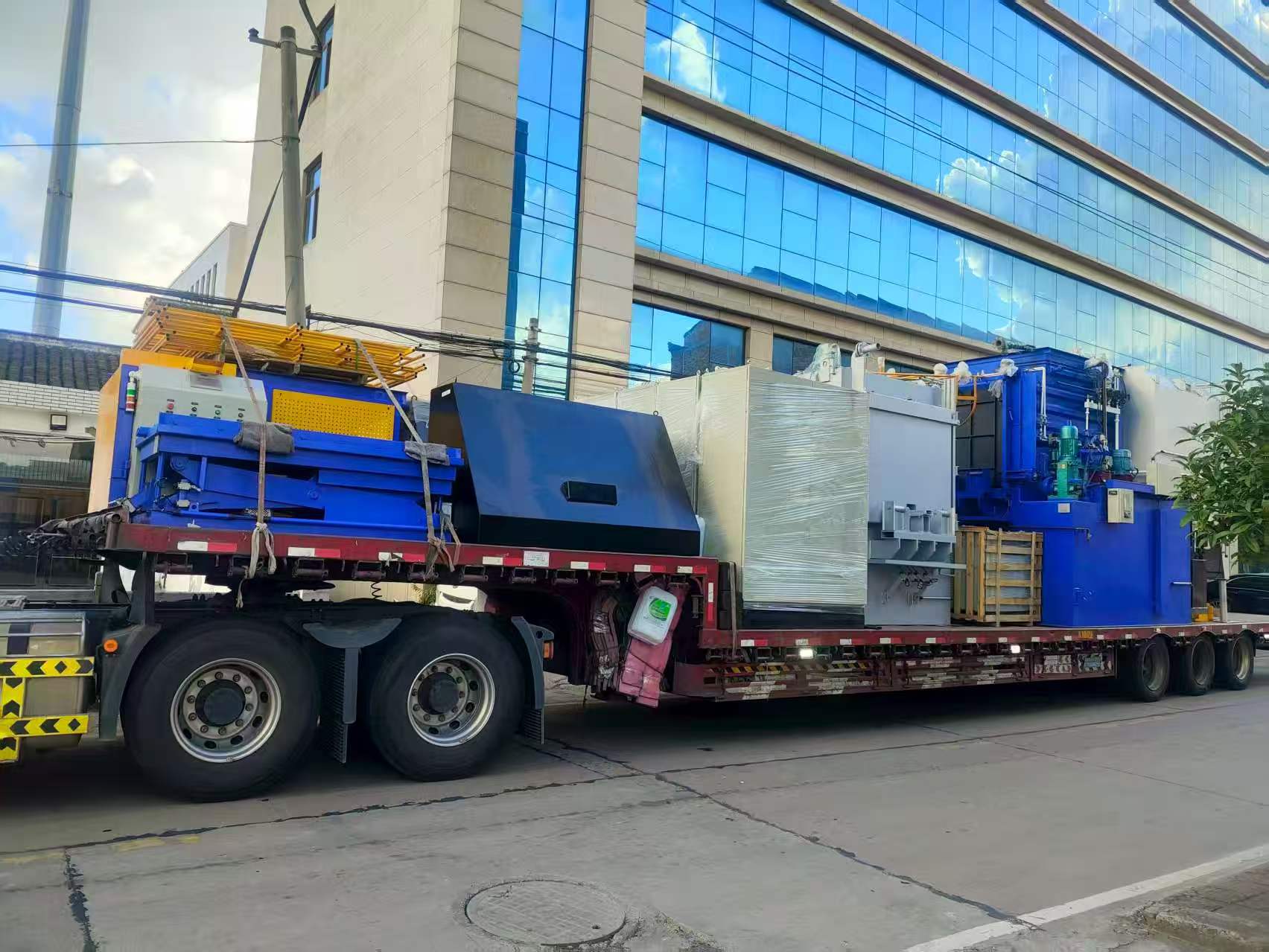
Units prepared for shipment. Published lead time is 150 days, with monthly capacity of 3–5 sets.
Have Questions or Need More Details?
Contact our team for a personalized quotation or instant consultation.
Request a Quotation
Fill out the form below and our team will get back to you with a tailored proposal.
WhatsApp Direct Chat
Prefer to chat in real-time? Message us on WhatsApp for instant assistance & quick answers.
- Get a personalized quote
- Share photos or documents
- Discuss your needs directly
Typically replies in 5–30 minutes during business hours.