Sealed Box vs Mesh Belt vs Pre-Vacuum Nitriding vs Well-Type Heat Treatment Furnaces: A Buyer’s Process-Fit Comparison
The four NORSEN furnace lines compared here are not interchangeable. For a buyer in Research or Evaluation, the useful question is not “which heat treatment furnace is best?” but “which furnace architecture matches the process recipe, part geometry, production pattern, automation requirement, and compliance path?” This comparison uses NORSEN-confirmed product-scope and capability facts, plus published standards context, and clearly marks where line-specific data must be requested.
Problem Definition: Why Furnace-Type Selection Is a Constraint Problem
Industrial heat treatment furnace buyers often start with a process name—carburizing, carbonitriding, tempering, oil-quench hardening, or case hardening—and then ask for a furnace quote. The risk is that the same process name can be delivered by different furnace architectures, and each architecture imposes different constraints on load size, handling, atmosphere control, automation, and qualification.
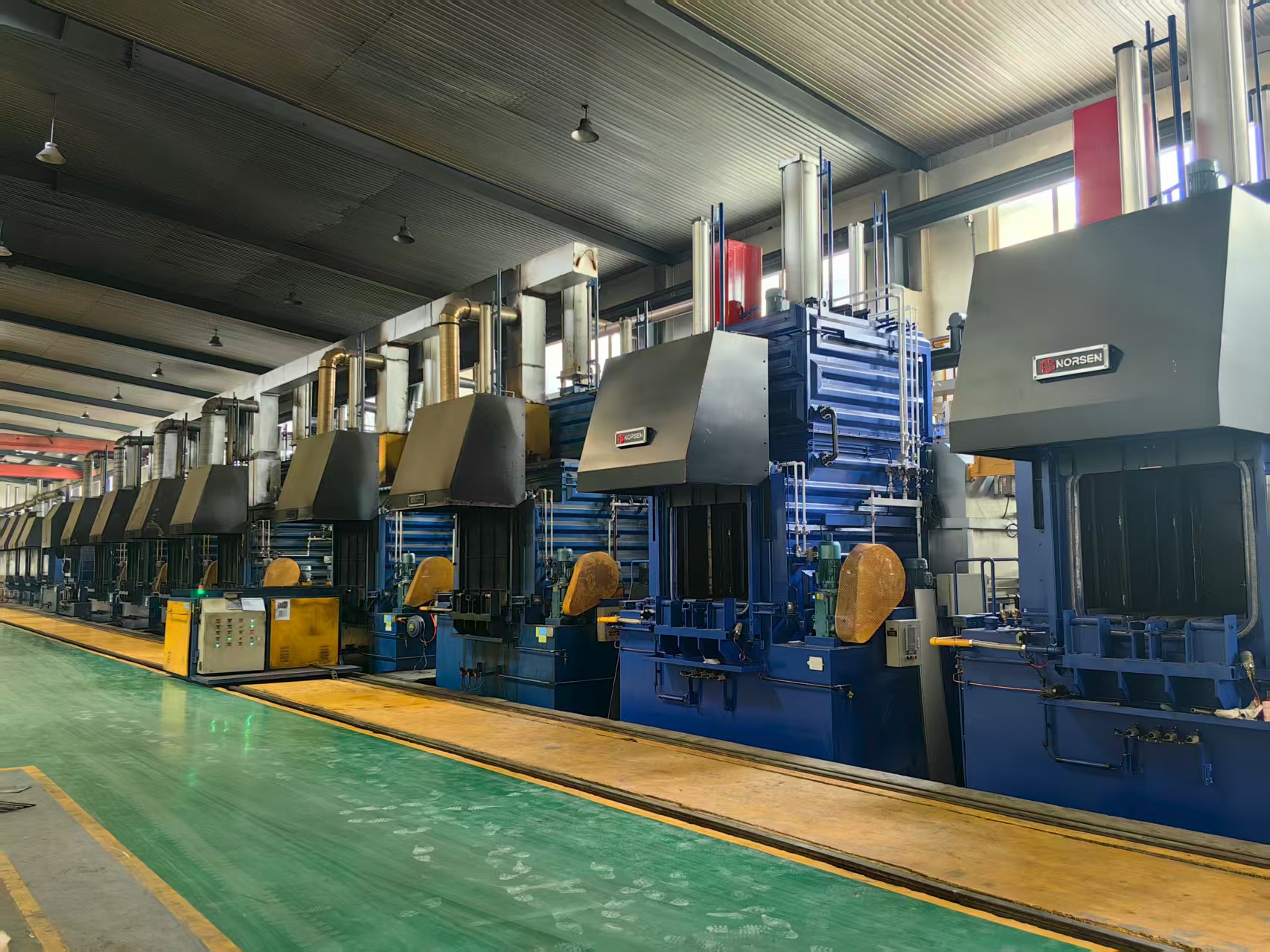
For NORSEN, the confirmed portfolio includes sealed box-type multi-purpose furnace production lines, pre-evacuated gas nitriding furnaces, mesh belt carburizing and quenching furnace production lines, and well-type furnaces. These are four different answers to four different procurement problems. A buyer who treats them as one category may over-specify one line, under-specify another, or compare quotations that are not equivalent.
The practical constraint set in this article is therefore: confirmed process scope, confirmed equipment data, ODM customization limits, ISO9001 compliance, sample validation, lead time, and monthly capacity. Price bands are not published in the provided NORSEN documentation; buyers should treat unit price as a configured quotation output, not as a public list figure.
Industry Background: Heat Treatment Furnaces Sit Inside a Qualification System
Norsen Thermal Technology (Jiangsu) Co., Ltd. (NORSEN) is a Jiangsu-based manufacturer of intelligent heat treatment equipment. The company states that its main products include sealed box-type multi-purpose furnace production lines, pre-evacuated gas nitriding furnaces, mesh belt carburizing and quenching furnace production lines, well-type furnaces and other heat treatment equipment. NORSEN reports that this equipment is used in heat treatment processing for aerospace, military industry, automotive parts, textile machinery, construction machinery, and commercial heat treatment, with products sold to Russia, Southeast Asia, and Taiwan Province of China.
The wider heat treating market provides context for why buyers are under pressure to specify correctly. Fortune Business Insights reports that the heat treating market was valued at USD 114.0 billion in 2025 and is anticipated to reach USD 168.7 billion by 2035. That growth does not remove the constraint problem at the furnace level; it increases the cost of choosing a line that does not match the process route.
Standards add a second layer. ISO/TC 244 covers industrial furnaces and associated processing equipment and includes quality requirements and recommendations applicable to heat treatment on mechanical parts used in industries such as car manufacturing, aerospace, pipeline systems, civil engineering equipment, earth moving machinery, agricultural equipment, naval industry, energy equipment, tooling, and fasteners. ASTM A991/A991M is a standard test method for conducting temperature uniformity surveys of furnaces used to heat treat steel products. AMS 2750 and CQI-9 are described as standards that subject heat treatment processes to stricter rules, including temperature uniformity, instrumentation, calibration, and system accuracy testing.
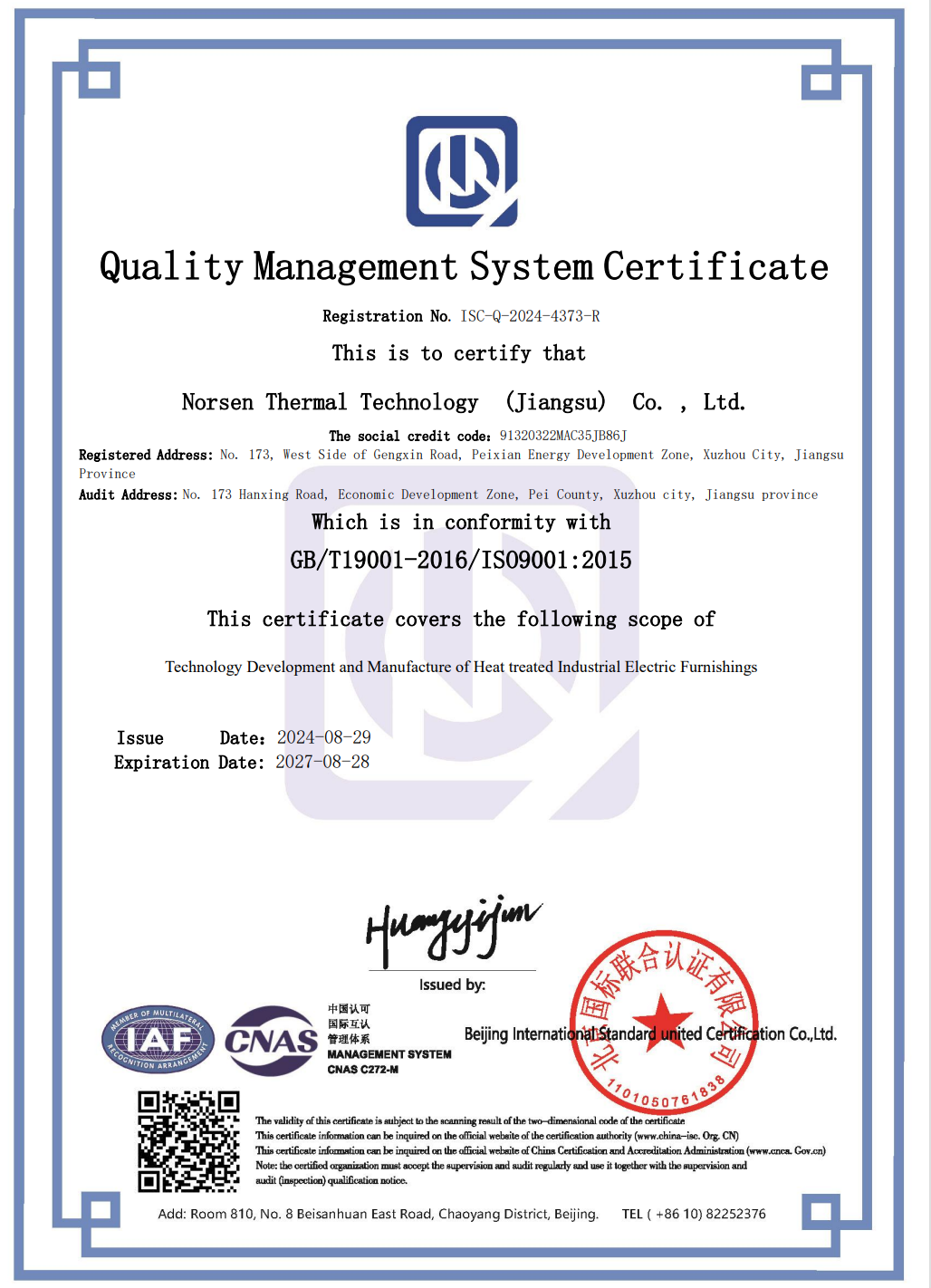
NORSEN has obtained ISO9001 quality management system certification. For buyers comparing furnace types, this certification is a baseline quality-management signal, not a substitute for process-specific qualification. The multi-purpose furnace product is certified under ISO9001 under standard GB/T19001-2016/ISO9001:2015, certification number ISC-Q-2024-4373-R, issued by Beijing National Standard Joint Certification Co., Ltd., applicable to the Global market, issued 2024-08-29 and expiring 2027-08-29. The certification scope is technology development and manufacture of heat treated industrial electric furnishings.
Detailed Solution: What Each NORSEN Furnace Line Is Confirmed to Cover
1. Sealed Box-Type Multi-Purpose Furnace Production Line
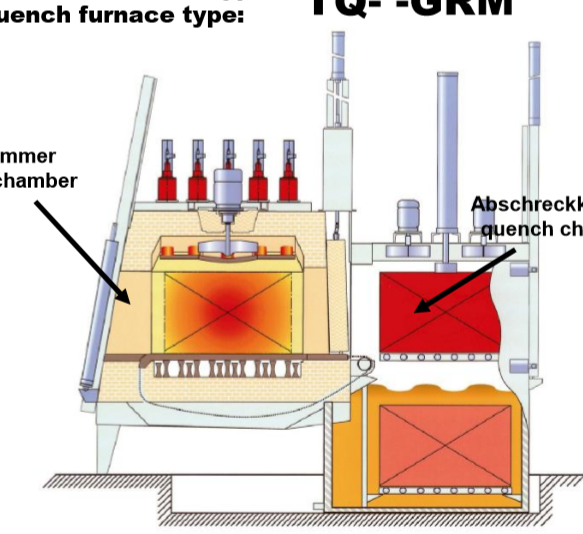
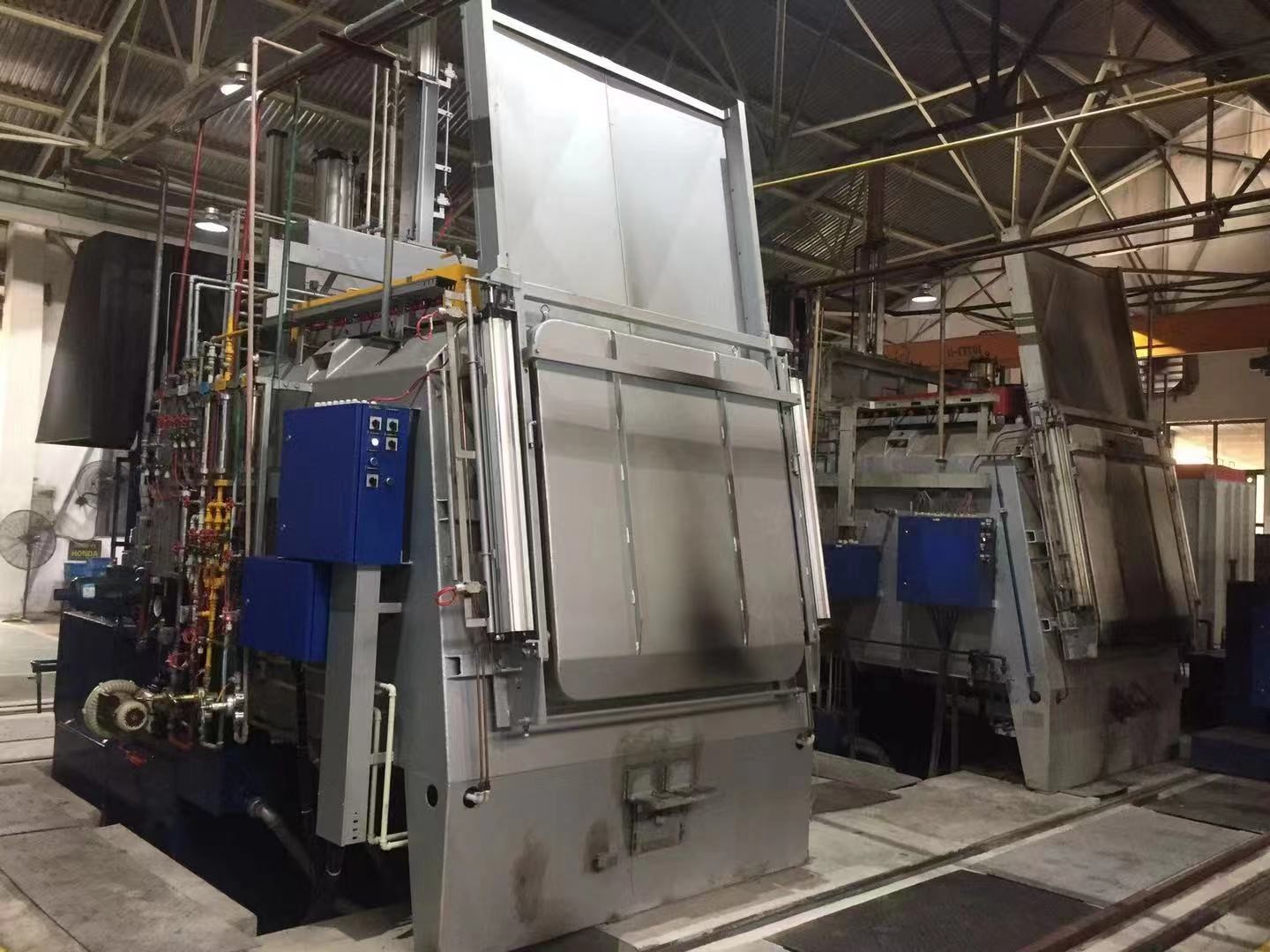
The sealed box-type multi-purpose furnace line is the most fully specified line in the provided NORSEN data. The product is described as a multi-purpose furnace / atmosphere furnace with models RTQ, TQ, SHQ, and DHQ. The listed types are RTQ-10, RTQ-17, RTQ-25, TQ-10, TQ-17, TQ-25, SHQ-10, SHQ-15, SHQ-25, DHQ-10, DHQ-15, and DHQ-25.
For process fit, the confirmed process list is explicit: hardening with oil quench, carbonitriding, tempering, carburizing and case hardening. This makes the sealed box-type multi-purpose furnace the direct candidate when a buyer’s process route includes those operations and the line is being evaluated as a multi-purpose atmosphere furnace.
The equipment data also gives buyers concrete specification points to check. The furnace structure is a SiC muffle furnace structure with chain dual drive. Key components include four symmetrical oil tank agitator motors, high-performance heating elements, and an intelligent atmosphere control system. Safety and protection include over-temperature protection, over-current protection, and gas heating. The listed material options are Q235, ss304, and ss310.
The application data adds plant-level constraints. The working condition is carburizing and quenching of metal parts. The project type is metal parts undergoing carburizing and quenching to enhance mechanical properties, and gear processing is carried out. The function is enhancing metal properties, increasing hardness, and increasing toughness. The operation mode is automated. The matched equipment includes electricity, compressed air, natural gas, cooking fume ducts and their media. A special requirement is that the factory crane height should be more than 6.5 meters, and higher is better.
For buyers comparing a box-type heat treatment furnace with other architectures, this is the line to examine when the confirmed process list matches the recipe and when the buyer needs oil-quench hardening, carbonitriding, tempering, carburizing, or case hardening in a multi-purpose furnace format.
2. Pre-Evacuated Gas Nitriding Furnace
NORSEN’s confirmed portfolio includes pre-evacuated gas nitriding furnaces. In the provided material, the product-line name identifies the process association as gas nitriding, and the line is listed as part of the NORSEN heat treatment equipment range. The provided documentation does not list model-level parameters, load sizes, or control specifications for this line.
That does not make the line less relevant; it changes the buyer’s evaluation step. A buyer evaluating a nitriding heat treatment furnace should request the line-specific datasheet and confirm the nitriding recipe, retort or chamber configuration, atmosphere control, automation scope, and performance requirements before comparing it with a multi-purpose furnace. The ODM customization fields—effective size, degree of automation, and performance requirements—are company-level capability statements and should be confirmed line by line in the quotation.
3. Mesh Belt Carburizing and Quenching Furnace Production Line
NORSEN’s confirmed portfolio also includes mesh belt carburizing and quenching furnace production lines. The product-line name identifies the process association as carburizing and quenching in a production-line format. As with the pre-evacuated gas nitriding line, the provided documentation does not list model-level parameters for the mesh belt line.
For a buyer, the mesh belt line should be evaluated as a production-line decision, not only as a furnace box decision. The questions to put to NORSEN are: what part handling is assumed, what production pattern the line is designed for, what atmosphere control and quenching arrangement are included, and what automation degree can be customized. The confirmed ODM variables remain effective size, automation degree, and performance requirements, subject to line-specific confirmation.
4. Well-Type Furnace
NORSEN lists well-type furnaces among its main heat treatment equipment. The provided documentation does not specify the process scope, model range, or technical parameters for the well-type furnace line. A well-type furnace should therefore be treated as a portfolio category that requires a line-specific technical confirmation before it is compared with the sealed box, mesh belt, or pre-evacuated gas nitriding lines.
This is a fact-discipline point, not a product limitation. Buyers should ask NORSEN to confirm the applicable process, load geometry, heating and atmosphere arrangement, and automation scope for the well-type furnace configuration being quoted. Without that confirmation, a well-type furnace quotation is not directly comparable with a multi-purpose furnace quotation.
ODM Customization, MOQ, Lead Time, and Capacity Context
NORSEN’s production mode is ODM. The confirmed customization scope is the effective size of the equipment, the degree of automation, and the performance requirements of the equipment. That means the comparison between sealed box, mesh belt, pre-vacuum nitriding, and well-type furnaces should not be frozen at a catalogue model. The buyer should define the part family, load size, process recipe, automation expectation, and performance target, then ask NORSEN to confirm which line can be configured within that ODM scope.
The commercial constraints are clear. The MOQ is 1 unit. The lead time is 150 days. Monthly capacity is 3-5 sets. Quality control includes 100% pre-shipment test. After-sales support includes free remote technical assistance. Export markets listed in the capability data are Russia, Belarus, Southeast Asia, the Middle East region, and Taiwan Province of China.
The company profile adds capacity context: NORSEN was founded in 2022, has a 6000 m² factory, approximately 55 employees, a 10-person R&D team, annual output of 50 sets, and export business accounting for 40% of total sales. Major markets listed are China, Russia, Belarus, Vietnam, Indonesia, Thailand, Turkey, Qatar, and Pakistan.
Step-by-Step Breakdown: How to Compare the Four Lines
- Write the process recipe before requesting a line. List every required operation: carburizing, carbonitriding, tempering, oil-quench hardening, case hardening, or gas nitriding. The sealed box-type multi-purpose furnace is the line with an explicit confirmed list covering hardening with oil quench, carbonitriding, tempering, carburizing, and case hardening. The pre-evacuated gas nitriding line is the portfolio line associated with gas nitriding. The mesh belt line is associated with carburizing and quenching. For the well-type furnace, confirm process scope first.
- Match the load and plant constraints. For the multi-purpose furnace application, the working condition is carburizing and quenching of metal parts, and the operation mode is automated. The plant should also check the crane-height requirement of more than 6.5 meters, with higher being better, and the matched equipment list including electricity, compressed air, natural gas, cooking fume ducts and their media.
- Define the automation degree. NORSEN offers ODM customization for effective size, automation degree, and performance requirements. Do not compare a manually loaded concept with an automated line concept as if they were the same quotation. State the loading, transfer, atmosphere control, and data-monitoring expectation in the inquiry.
- Confirm the compliance route. Use ISO9001 as the baseline quality-management check: NORSEN holds ISO9001 certification, and the multi-purpose furnace product is certified under GB/T19001-2016/ISO9001:2015 with certificate ISC-Q-2024-4373-R. If the end market requires ASTM A991/A991M temperature uniformity surveys or AMS 2750 / CQI-9-style controls, confirm the required tests and documentation with NORSEN before order.
- Validate with a pre-shipment test. The confirmed quality-control step is 100% pre-shipment test. For a first unit, use the MOQ of 1 unit to validate process fit before scaling. Free remote technical assistance is listed as after-sales support.
- Plan the schedule around 150 days and 3-5 sets per month. The lead time is 150 days and monthly capacity is 3-5 sets. Annual output is 50 sets. These figures should be used for project planning, not treated as a promise of immediate delivery.
Use Cases: Where the Process-Fit Logic Applies
The multi-purpose furnace application data lists military industry, automobiles, agricultural machinery, robots, bearings, hardware, and sewing machines as applicable industries. The project type includes carburizing and quenching of metal parts to enhance mechanical properties, and gear processing is carried out. This supports the gear heat treatment furnace use case when the process route matches the confirmed multi-purpose furnace process list.
The sealed box-type multi-purpose furnace is also the line to examine when a buyer needs a multi-purpose heat treatment furnace that can be configured through ODM for effective size, automation degree, and performance requirements. The confirmed process list—oil-quench hardening, carbonitriding, tempering, carburizing and case hardening—gives the buyer a concrete checklist for the technical review.
For pre-vacuum nitriding, the use case is the buyer whose process is gas nitriding and who needs a dedicated nitriding heat treatment furnace rather than a multi-purpose atmosphere furnace. For the mesh belt line, the use case is the buyer evaluating a carburizing and quenching furnace production line. For the well-type furnace, the use case must be defined by the buyer’s part geometry and process requirement, then confirmed against NORSEN’s line-specific data.
NORSEN’s case data reports 10 units supplied to automotive OEMs, military industry units, hardware tool factories, and gear factories across Belarus, Russia, Thailand, Indonesia, India, Qatar, Turkey, Vietnam, China, and Taiwan Province of China. The reported result is stable quality, precise carbon content, high production efficiency, easy maintenance, and energy conservation. The reported highlight is high-precision atmosphere control, long service life, low energy consumption, and easy maintenance. These are NORSEN-reported case facts, not independent test results.
Comparison Table: Confirmed Facts Only
| Furnace line in NORSEN portfolio | Confirmed process association in provided data | Confirmed equipment data in provided data | ODM customization relevance | Buyer validation focus |
|---|---|---|---|---|
| Sealed box-type multi-purpose furnace production line | Hardening with oil quench, carbonitriding, tempering, carburizing and case hardening | Models RTQ, TQ, SHQ, DHQ; types RTQ-10/17/25, TQ-10/17/25, SHQ-10/15/25, DHQ-10/15/25; SiC muffle; chain dual drive; four symmetrical oil tank agitator motors; high-performance heating elements; intelligent atmosphere control; over-temperature and over-current protection; gas heating; Q235 / ss304 / ss310 | Directly relevant: effective size, automation degree, performance requirements are listed ODM variables | Confirm recipe, load size, oil-quench arrangement, atmosphere control, crane height, utilities, and compliance tests |
| Pre-evacuated gas nitriding furnace | Gas nitriding, as identified by the NORSEN product-line name | No model-level parameters listed in the provided documentation; request line-specific datasheet | Confirm line-specific size, automation, and performance customization under NORSEN ODM scope | Confirm nitriding recipe, chamber/retort arrangement, atmosphere control, and automation scope |
| Mesh belt carburizing and quenching furnace production line | Carburizing and quenching, as identified by the NORSEN product-line name | No model-level parameters listed in the provided documentation; request line-specific datasheet | Confirm line-specific size, automation, and performance customization under NORSEN ODM scope | Confirm production-line handling, carburizing and quenching arrangement, atmosphere control, and automation degree |
| Well-type furnace | Not specified in the provided documentation | No model-level parameters listed in the provided documentation; request line-specific datasheet | Confirm whether effective size, automation, and performance customization apply to the intended well-type configuration | Confirm process scope, load geometry, heating arrangement, atmosphere requirement, and automation scope |
Table note: This table deliberately excludes price, efficiency, and competitor parameters because they are not present in the provided NORSEN documentation or verified data package. Missing line-specific data should be obtained through a configured quotation.
FAQ
Is NORSEN ISO9001 certified for heat treatment furnaces?
Yes. NORSEN has obtained ISO9001 quality management system certification. The multi-purpose furnace product is certified under standard GB/T19001-2016/ISO9001:2015, certification number ISC-Q-2024-4373-R, issued by Beijing National Standard Joint Certification Co., Ltd., applicable to the Global market, issued 2024-08-29 and valid until 2027-08-29. The certification scope is technology development and manufacture of heat treated industrial electric furnishings.
What can NORSEN customize through ODM for these furnace lines?
NORSEN’s production mode is ODM. The confirmed customization scope is the effective size of the equipment, the degree of automation, and the performance requirements of the equipment. For pre-evacuated gas nitriding, mesh belt carburizing and quenching, and well-type furnaces, confirm the line-specific application of those ODM variables in the quotation because the provided documentation does not list model-level parameters for those lines.
How should buyers handle budget when comparing sealed box, mesh belt, pre-vacuum nitriding, and well-type furnaces?
The provided NORSEN documentation does not list unit prices or price bands for these furnace lines. Buyers should therefore avoid comparing unconfigured quotations as if they were equivalent. Define the process recipe, effective size, automation degree, performance requirement, compliance tests, and spare-parts scope first, then request a configured quote. Budget comparison should follow the technical configuration, not precede it.
Can a buyer order one unit to validate process fit before scaling?
Yes. The confirmed MOQ is 1 unit. Quality control includes 100% pre-shipment test. After-sales support includes free remote technical assistance. A first unit can therefore be used to validate the selected furnace line against the buyer’s process route before planning additional capacity.
What lead time and monthly capacity should buyers plan for?
The confirmed lead time is 150 days. Monthly capacity is 3-5 sets. Annual output is 50 sets. These figures should be used for project scheduling and supplier capacity checks. To start a configured comparison across the sealed box-type multi-purpose furnace, pre-evacuated gas nitriding furnace, mesh belt carburizing and quenching furnace line, and well-type furnace, contact NORSEN at jiayoubingsen@163.com or +86 153-8013-9999, and download the product brochure for the next technical review.
Conclusion: Match the Line to the Constraint, Not the Category Name
The sealed box-type multi-purpose furnace production line is the clearest fit when the confirmed process list matches the buyer’s recipe: hardening with oil quench, carbonitriding, tempering, carburizing and case hardening. Its specification includes a SiC muffle, chain dual drive, four symmetrical oil tank agitator motors, high-performance heating elements, intelligent atmosphere control, over-temperature and over-current protection, and gas heating. It is also the line with the most complete application data in the provided material.
The pre-evacuated gas nitriding furnace should be evaluated by buyers whose process is gas nitriding, with line-specific datasheet confirmation. The mesh belt carburizing and quenching furnace production line should be evaluated as a production-line decision, with line-specific handling and automation confirmation. The well-type furnace should be evaluated only after NORSEN confirms its process scope, load geometry, and configuration for the intended application.
Across all four lines, the commercial constraints are consistent: ODM customization for effective size, automation degree, and performance requirements; MOQ of 1 unit; 150-day lead time; 3-5 sets monthly capacity; 100% pre-shipment test; and free remote technical assistance. Those facts give buyers a practical framework for Research and Evaluation without inventing price bands, performance claims, or competitor parameters that are not in the confirmed data.
Next Step: Build a Configured Comparison
For a like-for-like review of sealed box-type multi-purpose, pre-evacuated gas nitriding, mesh belt carburizing and quenching, and well-type furnace options, send NORSEN the process recipe, part size, load pattern, automation target, and compliance requirements. The confirmed commercial basis is 1-unit MOQ, 150-day lead time, and 3-5 sets monthly capacity.
Contact: bingsen.wang | Email: jiayoubingsen@163.com | Tel: +86 153-8013-9999 | Address: No. 173, Hanxing Road, Peixian Economic Development Zone, Xuzhou City, Jiangsu Province | Website: www.norsengroup.com
Download the NORSEN brochure: NORSEN product brochure PDF
Have Questions or Need More Details?
Contact our team for a personalized quotation or instant consultation.
Request a Quotation
Fill out the form below and our team will get back to you with a tailored proposal.
WhatsApp Direct Chat
Prefer to chat in real-time? Message us on WhatsApp for instant assistance & quick answers.
- Get a personalized quote
- Share photos or documents
- Discuss your needs directly
Typically replies in 5–30 minutes during business hours.