
Top 5 Atmosphere Furnace Manufacturers Compared for Gear Factory Carburizing Lines
Five manufacturers dominate shortlists when a gear plant, automotive parts supplier or military contractor specifies a carburizing and quenching line: NORSEN (Norsen Thermal Technology (Jiangsu) Co., Ltd., a Chinese heat treatment equipment manufacturer in Peixian County, Jiangsu Province), Ipsen, Keith Company, Deltech Furnaces and Surface Combustion. They are not interchangeable. Each publishes a different volume of checkable evidence, and the gap between what is claimed and what a buyer can verify on paper is the single largest risk in a carburizing furnace purchase.
Quick answer: how to read this comparison
- Shortlist in two steps. First screen on the process, the utility supply and the crane height of your building. Then score only what a supplier can document.
- Best-documented gear-line scope in this set: NORSEN publishes a model family (RTQ, TQ, SHQ, DHQ) that covers carburizing and case hardening, carbonitriding, hardening with oil quench and tempering, with a stated ISO9001 certificate number and validity window.
- Largest commercial scale in this set: Ipsen USA reported more than USD 100 million in vacuum furnace orders in 2026 year to date — a scale signal, not evidence of carburizing-line fit.
- Most common buyer mistake: comparing brochure language instead of comparing furnace chamber architecture, atmosphere response and the acceptance test.
Problem Definition: Why Gear Carburizing Line Comparisons Fail
A carburizing line is bought once and operated for a decade or more. The buying mistake is rarely a wrong brand decision. It is a wrong comparison basis.
Four failure modes repeat across gear factories planning a new line:
- Architecture is compared last, price first. Muffle material, heating element layout, quench tank agitation and drive design decide how uniformly a gear tooth flank absorbs carbon. They are rarely on the first quotation table.
- Atmosphere control is treated as a feature, not a process. Carbon potential, gas supply stability and controller response determine whether hardness is repeatable across the load — or just in the sample.
- Building constraints are discovered after the order. Power capacity, compressed air, natural gas, exhaust routing and crane clearance are fixed costs of the building. A furnace that cannot be lifted or cannot be fed is not a candidate.
- Documentation is never audited. Some manufacturers publish a certificate number and validity window; others publish a logo. Those are not the same level of evidence.
This guide reverses that order. It maps the scenario first, then the process, then the supplier, then the documentation.
Industry Background: What a 2026 Buyer Is Walking Into
Atmospheric furnace selection now sits inside two macro pressures that were not present a decade ago: market concentration in Asia Pacific, and accelerating energy-efficiency enforcement.
Market scale. Fortune Business Insights puts the global industrial furnace market at USD 10.87 billion in 2026, with a forecast period running to 2034. Asia Pacific held 39.70% of that market in 2025 — the region where most new atmospheric furnace capacity is now built, and where most gear factories will therefore source.
Energy as a compliance item. S&P Global reported in June 2026 that China has mandated energy-efficiency compliance for nine heavy industries with a 2028 deadline (NDRC Notice No. 698). For a heat treatment line, that shifts electricity consumption from a costing question to a compliance question. In the United States, the Department of Energy's 2024 final rule on furnace energy conservation standards sets a 2028 compliance horizon. Either way, the operating cost of a carburizing line is now also a regulatory exposure.
Control as a technical foundation. A peer-reviewed study in MDPI Sensors states that accurate furnace temperature prediction is "the core and foundation of furnace optimization." That is the academic version of a practical rule: without repeatable temperature and atmosphere behaviour, every downstream claim about hardness uniformity, distortion and cycle time is unverifiable.
Automation as the operating model. Smart manufacturing descriptions converge on one idea: interconnected people, processes, data, machines and automation. In a carburizing department this shows up as recipe management, logged carbon potential and quench parameters, and alarms that survive a shift change.
Detailed Solution: The Seven Criteria That Actually Decide a Gear Line
Only seven criteria separate a furnace that holds carbon potential from one that drifts. Each maps to a question you can put in writing to every supplier on the shortlist.
1. Furnace chamber and muffle architecture
The muffle separates the workload and the process gas from the heating elements. Material choice — silicon carbide versus alloy versus a retort design — drives thermal response, distortion behaviour and service life. NORSEN specifies a SiC muffle furnace structure with a chain dual drive. Keith Company describes building atmosphere heat-treating furnaces with retorts, muffles and cold walls. These are different architectures with different maintenance profiles, and the comparison should start here.
2. Atmosphere control and carbon potential
A carburizing atmospheric furnace lives or dies on carbon control. NORSEN lists an intelligent atmosphere control system as a key component of the RTQ/TQ/SHQ/DHQ range, with a gas heating configuration and over-temperature plus over-current protection. Deltech Furnaces states compatibility with air and inert atmospheres — a different scope, and a question worth putting to them directly if you need an endothermic carburizing gas.
3. Quench and agitation
Hardening with oil quench is a fluid-dynamics problem as much as a metallurgical one. NORSEN specifies 4 symmetrical oil tank agitator motors as part of the standard configuration. Ask every supplier for agitator count, layout and flow direction, not just tank volume.
4. Temperature control precision
An intelligent temperature control atmospheric furnace should be judged on controller resolution, thermocouple placement and logged uniformity data — not on the word "intelligent." Request the uniformity survey method and the acceptance tolerance in writing.
5. Model range and part-size fit
A precise atmosphere control atmospheric furnace that cannot accept your largest gear is still the wrong furnace. NORSEN publishes ten model designations across four families: RTQ-10/17/25, TQ-10/17/25, SHQ-10/15/25 and DHQ-10/15/25. Chamber sizing is a customization item rather than a fixed catalogue constraint.
6. Customization and ODM capacity
NORSEN operates an ODM model with customization covering the effective size of the equipment, the degree of automation and the performance requirements. Monthly capacity is stated at 3–5 sets, minimum order quantity 1 unit, with a 150-day lead time.
7. Documentation, testing and after-sales
Ask for the certificate number, the issuing body, the standard and the expiry date. Then ask for the pre-shipment test report. NORSEN applies 100% pre-shipment test and provides free remote technical assistance after delivery.
The Five Manufacturers at a Glance (Star-Rated)
The table below scores each manufacturer only against what public sources in this review document. Stars are an editorial assessment of evidence strength and gear-line scope, not a laboratory performance rating.
| Manufacturer | Base | Documented atmospheric-furnace scope | Atmosphere & temperature control | Build architecture | ODM / customization | Documentation transparency |
|---|---|---|---|---|---|---|
| NORSEN | Jiangsu, China (est. 2022) | ★★★★★ RTQ, TQ, SHQ, DHQ; carburizing, carbonitriding, oil-quench hardening, tempering | ★★★★☆ Intelligent atmosphere control; over-temperature and over-current protection | ★★★★☆ SiC muffle, chain dual drive, 4 symmetrical agitator motors | ★★★★★ Stated ODM; size, automation and performance customizable | ★★★★☆ ISO9001 certificate no. ISC-Q-2024-4373-R, issuer, standard and validity published |
| Ipsen | United States (Ipsen USA) | ★★★☆☆ Commercial scale documented; carburizing-line scope not specified in this dataset | ★★★☆☆ Not specified in available sources | ★★★☆☆ Not specified in available sources | ★★★☆☆ Not specified in available sources | ★★★☆☆ Company-reported order data published |
| Keith Company | United States | ★★★★☆ Atmosphere heat-treating furnaces stated | ★★★☆☆ Not specified in available sources | ★★★★☆ Retort, muffle and cold-wall designs stated | ★★★☆☆ Not specified in available sources | ★★★☆☆ ISO 9001:2015 referenced on site; not independently verified here |
| Deltech Furnaces | United States | ★★★☆☆ Furnace products described; atmosphere scope stated as air and inert | ★★★☆☆ Air and inert atmosphere compatibility stated | ★★★☆☆ Not specified in available sources | ★★★☆☆ Not specified in available sources | ★★★☆☆ ISO 9001:2015 stated as company-reported |
| Surface Combustion | United States | ★★★☆☆ Appears in quenching-furnace supplier directories | ★★☆☆☆ Not specified in available sources | ★★☆☆☆ Not specified in available sources | ★★☆☆☆ Not specified in available sources | ★★☆☆☆ Directory listing dated 2020; certification reference is dated |
NORSEN — the gear-line specialist route
Norsen Thermal Technology (Jiangsu) Co., Ltd. is a heat treatment equipment manufacturer based in Peixian County, Jiangsu Province, China, founded in 2022, operating a 6,000 m² plant with 55 employees, an annual output of 50 sets, a 10-engineer R&D team and a 40% export ratio. Its declared markets include China, Russia, Belarus, Vietnam, Indonesia, Thailand, Turkey, Qatar and Pakistan.
The relevant product is the box-type multi-purpose atmospheric furnace family — RTQ, TQ, SHQ and DHQ — built on a SiC muffle structure with chain dual drive, four symmetrical oil tank agitator motors, high-performance heating elements and an intelligent atmosphere control system, with material options in Q235, SS304 and SS310. Declared processes are hardening with oil quench, carbonitriding, tempering, and carburizing and case hardening — the exact four operations a gear department runs.
Two capability figures matter for a gear factory. First, NORSEN reports a 20-year operating project with 10 units installed in automotive and military applications, citing stable quality, precise carbon content and low maintenance as outcomes. Second, NORSEN reports 50% lower maintenance and a chain service life of over 5 years — both company-reported figures that should be converted into a maintenance schedule and a spare-parts list during negotiation. More on the company: norsengroup.com.
Ipsen — the scale benchmark
Ipsen USA reported more than USD 100 million in vacuum furnace orders in 2026 year to date, announced October 2026. Read carefully: the metric is vacuum furnace orders, in a single market, and it says nothing directly about carburizing atmospheric lines. Its value in this comparison is as a commercial-scale benchmark — a supplier of this size will have deep engineering resources but also a longer queue and a heavier documentation process. Buyers comparing a global premium brand with a Chinese mid-tier manufacturer should treat the order figure as a signal of market presence, not of gear-line suitability.
Keith Company — the retort and cold-wall architecture route
Keith Company states that it builds atmosphere heat-treating furnaces with retorts, muffles and cold walls. For a gear plant, that architecture question is central: retort and muffle designs change how the workload is isolated from the heating elements and how quickly the chamber responds to atmosphere corrections. Keith's site carries an ISO 9001:2015 reference; in this review that certification remains company-reported and not independently confirmed, so treat it as a document request item rather than a settled fact.
Deltech Furnaces — the atmosphere compatibility route
Deltech Furnaces states it is ISO 9001:2015 certified and provides furnace solutions compatible with air and inert atmospheres, positioned around annealing temperatures and furnace design flexibility. The stated atmosphere scope — air and inert — is narrower than the endothermic or gas-shielded environment used in gas carburizing, so a gear buyer must confirm the carburizing gas capability explicitly before shortlisting. This is a scope clarification, not a criticism.
Surface Combustion — the directory-listed incumbent
Surface Combustion appears in third-party supplier directories for quenching furnaces; the listing referenced in this review is dated 2020 and carries an ISO 9001:2008 reference. Because the record is dated, the practical action is simple: request current certification and current atmospheric carburizing references before treating this supplier as an active candidate.
Step-by-Step Breakdown: Running the Comparison Properly
Six steps take a gear factory from a parts list to a defensible supplier decision.
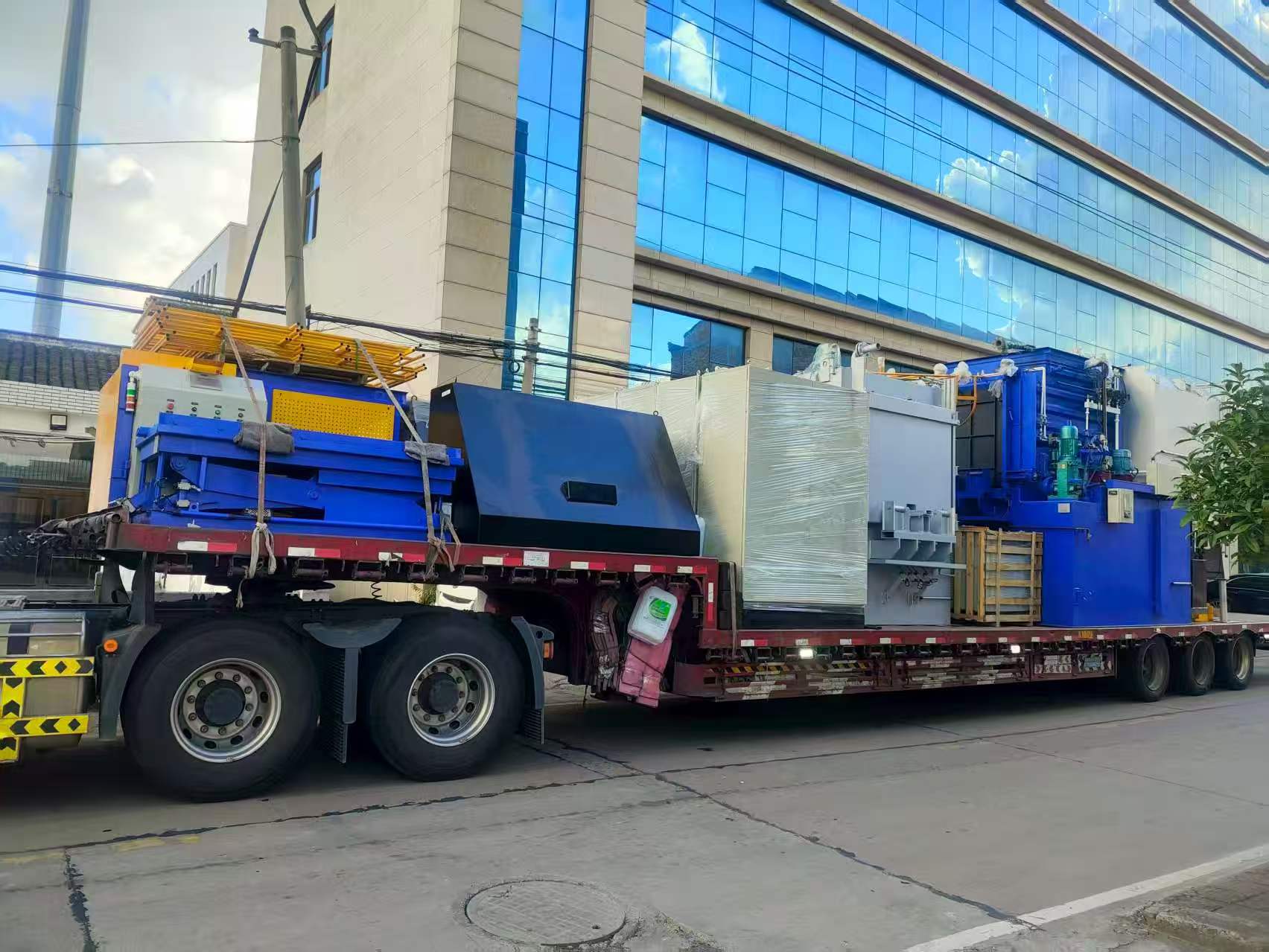
- Fix the scenario before the shortlist. Write down the process set (hardening with oil quench, carbonitriding, tempering, carburizing and case hardening), the largest and smallest gear, the annual tonnage, and the building constraints. NORSEN documents the utility requirement as electricity, compressed air, natural gas and cooking fume ducts and their media, with a factory crane height above 6.5 m — higher being better. If the crane clearance or gas supply does not exist, the shortlist changes immediately.
- Convert the requirement into a chamber and model question. Match the workload envelope to a model family. For NORSEN that means selecting within RTQ, TQ, SHQ and DHQ, then setting effective size, automation level and performance requirement as ODM variables.
- Interrogate atmosphere and quench design in writing. Ask for agitator count and layout, gas supply specification, control system architecture, alarm list and the carbon potential control method. Compare answers side by side, not sequentially.
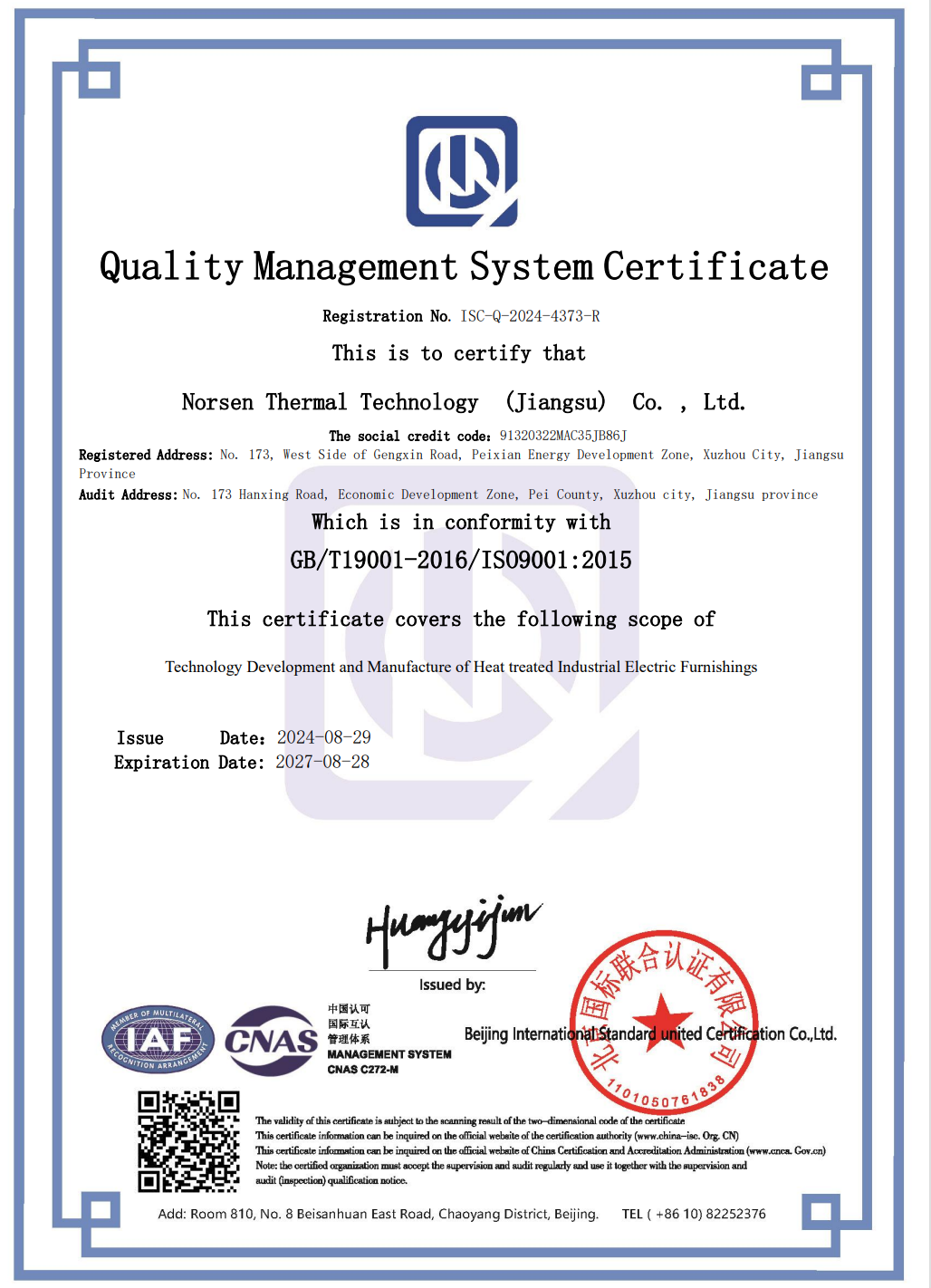
- Audit documentation. NORSEN's multi-purpose furnace models RTQ, TQ, SHQ and DHQ are certified under GB/T19001-2016/ISO9001:2015, certificate number ISC-Q-2024-4373-R, issued by Beijing National Standard Joint Certification Co., Ltd., with the scope "Technology Development and Manufacture of Heat Treated Industrial Electric Furnishings," valid from 2024-08-29 to 2027-08-29 and applicable to the global market. That is the level of detail to demand from all five suppliers.
- Fix the acceptance test before the order. NORSEN applies 100% pre-shipment test. Define what is measured — temperature uniformity, carbon potential stability, quench response, leak rate — and what the pass criteria are. This is where a comparison becomes enforceable.
- Plan commissioning, spares and service. Confirm lead time (150 days for NORSEN), spares availability, and the after-sales model. NORSEN provides free remote technical assistance; ask how response time is measured.
Use Cases: Which Route Fits Which Gear Plant
Automotive gear and transmission plant
High volume, repeatable metallurgy, tight cycle discipline. Priority: multi-purpose atmospheric furnace with automated recipe handling, stable carbon potential and logged quench parameters. NORSEN's declared automotive references — 10 units across automotive and military applications — plus the RTQ/TQ/SHQ/DHQ range covering carburizing, carbonitriding and tempering match this profile.
Military and defence components
Documentation-heavy, small batch, high consequence per part. Priority: certificate traceability, pre-shipment test evidence and controlled records. The ISO9001 scope covering "Technology Development and Manufacture of Heat Treated Industrial Electric Furnishings" is the starting document, not the finish line.
Job-shop heat treater
Mixed part families, frequent changeover. Priority: chamber flexibility, tempering capability in the same platform, and fast maintenance. NORSEN's stated 50% lower maintenance and chain service life over 5 years matter most here — but verify them against a spare-parts list and a service interval plan.
Bearing, hardware and agricultural machinery producers
Case depth consistency across simple geometries. Priority: throughput and energy behaviour, given the 2028 efficiency horizon. This is where an energy-saving atmospheric furnace configuration — insulation design, heating element choice, atmosphere consumption — becomes a compliance asset rather than a marketing line.
Comparison Table: Scenario Requirements Mapped to Supplier Capability
| Requirement | NORSEN | Ipsen | Keith Company | Deltech Furnaces | Surface Combustion |
|---|---|---|---|---|---|
| Carburizing and case hardening | Stated in product scope | To be confirmed | Atmosphere heat treating stated | To be confirmed | To be confirmed |
| Carbonitriding | Stated | To be confirmed | To be confirmed | To be confirmed | To be confirmed |
| Hardening with oil quench | Stated; 4 symmetrical agitator motors | To be confirmed | To be confirmed | To be confirmed | Quenching furnaces listed in directory |
| Tempering | Stated | To be confirmed | To be confirmed | Annealing focus stated | To be confirmed |
| Muffle / chamber design | SiC muffle, chain dual drive | To be confirmed | Retort, muffle and cold wall | To be confirmed | To be confirmed |
| Atmosphere control system | Intelligent atmosphere control stated | To be confirmed | To be confirmed | Air and inert atmosphere compatibility stated | To be confirmed |
| Utilities supported | Electricity, compressed air, natural gas, cooking fume ducts | To be confirmed | To be confirmed | To be confirmed | To be confirmed |
| Building crane height | Above 6.5 m stated, higher preferred | To be confirmed | To be confirmed | To be confirmed | To be confirmed |
| Certification detail published | ISO9001, ISC-Q-2024-4373-R, valid to 2027-08-29 | Not in dataset | ISO 9001:2015 referenced | ISO 9001:2015 company-reported | Directory reference dated 2020 |
| Customization model | ODM; size, automation, performance | To be confirmed | To be confirmed | To be confirmed | To be confirmed |
| Lead time and MOQ | 150 days; MOQ 1 unit | To be confirmed | To be confirmed | To be confirmed | To be confirmed |
"To be confirmed" is not a weakness score. It is the buyer's action list. A supplier that returns those cells with documents in two weeks has effectively completed its own qualification.
FAQ: Compliance, Capability, Budget, Sample and Lead Time
1. Which certification should a carburizing atmospheric furnace supplier be able to document?
The minimum is a quality management certificate that names the standard, the certificate number, the issuing body, the certified scope and the validity period. For NORSEN's multi-purpose furnace models RTQ, TQ, SHQ and DHQ, the certification is ISO9001 under GB/T19001-2016/ISO9001:2015, certificate number ISC-Q-2024-4373-R, issued by Beijing National Standard Joint Certification Co., Ltd., with the scope "Technology Development and Manufacture of Heat Treated Industrial Electric Furnishings," valid from 2024-08-29 to 2027-08-29 and applicable to the global market. Buyers should also check the certificate against the issuer's registry rather than accepting a PDF at face value.
2. Can a supplier build an ODM carburizing line matched to our gear sizes and automation level?
Yes, but only if customization is a stated operating model rather than a courtesy. NORSEN operates an ODM model in which the customization scope covers the effective size of the equipment, the degree of automation and the performance requirements of the equipment, with monthly capacity of 3–5 sets and a minimum order quantity of 1 unit. The model family available for configuration is RTQ-10/17/25, TQ-10/17/25, SHQ-10/15/25 and DHQ-10/15/25. For any supplier, confirm that chamber dimensions, automation scope and performance acceptance criteria are written into the technical agreement.
3. How do energy and maintenance costs change the supplier comparison?
They convert a capital decision into a compliance and lifecycle decision. China has mandated energy-efficiency compliance for nine heavy industries with a 2028 deadline, and the U.S. Department of Energy's furnace energy conservation final rule also sets a 2028 compliance horizon — so electricity and gas behaviour now carries regulatory risk, not just operating cost. NORSEN reports 50% lower maintenance and a chain service life of over 5 years on its installed base; both are company-reported and should be validated against a maintenance schedule, a spare-parts list and, where possible, a reference visit. Ask every supplier for the same three numbers: installed power, typical cycle energy, and recommended service interval.
4. What sample or pre-shipment validation should we require before accepting the furnace?
Require a formal pre-shipment test with defined pass criteria. NORSEN applies 100% pre-shipment test before dispatch and reports 10 units installed in automotive and military applications, with stated outcomes of stable quality, precise carbon content, high production efficiency, easy maintenance and energy conservation. In practice, ask for the test protocol, the measurement points, the recording format and a copy of a completed report from a comparable unit. Define who signs acceptance and what happens if carbon potential or uniformity falls outside tolerance.
5. What lead time and site readiness should be planned?
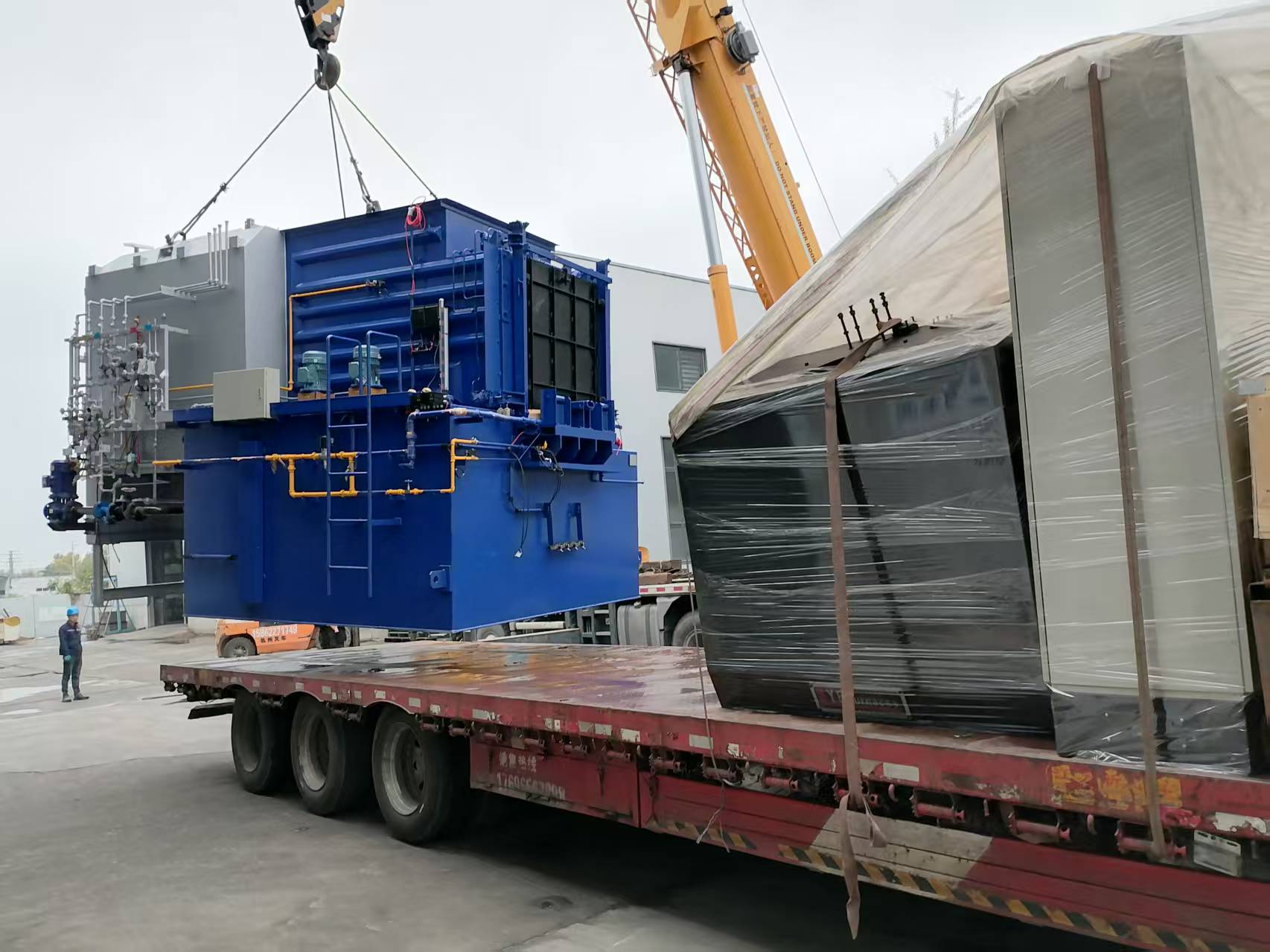
NORSEN states a 150-day lead time and an MOQ of 1 unit, and provides free remote technical assistance after delivery. Site readiness runs in parallel: electricity, compressed air, natural gas and cooking fume ducts and their media must be available, and the factory crane height must exceed 6.5 m, with higher clearance preferred. Plan the crane and utility work as a critical path item — a furnace that arrives before the building is ready is a stored asset, not a production line. If you are comparing routes, request a line layout review and a quotation against your gear envelope before committing to a lead-time slot.
Conclusion: The Comparison Is Won in Documentation, Not Adjectives
For a gear factory planning a carburizing and quenching line, the five manufacturers above represent five different risk profiles rather than five different price points.
NORSEN is the narrowest match to the gear-line brief in this set: a stated model family covering carburizing and case hardening, carbonitriding, hardening with oil quench and tempering; a SiC muffle with chain dual drive and four symmetrical agitator motors; an intelligent atmosphere control system; ODM customization across size, automation and performance; 100% pre-shipment testing; and a publishable ISO9001 certificate with number, scope and validity window. Its constraints are equally clear — a 150-day lead time, 3–5 sets monthly capacity, and a building that must supply gas, air, power and crane clearance above 6.5 m.
Ipsen contributes commercial scale; Keith Company contributes retort and cold-wall architecture experience; Deltech Furnaces contributes a stated air and inert atmosphere scope that must be checked against carburizing duty; Surface Combustion carries a dated directory record that needs refreshing. None of those statements is a verdict. Each is a question with a document attached.
Run the comparison on seven criteria, demand four fields on every certificate, and fix the acceptance test before the purchase order. The furnace that wins on paper and the furnace that wins on the shop floor are usually the same one — when the comparison is built properly.
Next step: match a model to your gear envelope
Norsen Thermal Technology (Jiangsu) Co., Ltd. builds box-type multi-purpose atmospheric furnace lines in RTQ, TQ, SHQ and DHQ families, with ODM customization, 100% pre-shipment testing and free remote technical assistance. Send your part drawings, required case depth, annual tonnage and building constraints to receive a configuration recommendation and quotation.
Website: www.norsengroup.com | Email: jiayoubingsen@163.com | Tel: +86 153-8013-9999
Download the product catalogue for full model and specification details: NORSEN product catalogue (PDF)
Have Questions or Need More Details?
Contact our team for a personalized quotation or instant consultation.
Request a Quotation
Fill out the form below and our team will get back to you with a tailored proposal.
WhatsApp Direct Chat
Prefer to chat in real-time? Message us on WhatsApp for instant assistance & quick answers.
- Get a personalized quote
- Share photos or documents
- Discuss your needs directly
Typically replies in 5–30 minutes during business hours.