Application Guide: Using Glue-Free Honeycomb Panels in High-End Kitchens and Bathrooms
Glue-free honeycomb panels are specified in kitchens and bathrooms because these two rooms attack ordinary boards from every direction at once — standing water, steam, splashes, cleaning agents and sustained load. The NBW-HPB-001 and NBW-WHB-002 glue-free honeycomb panel platforms from Nanbeiwang Aluminum are built on an all-aluminum honeycomb structure with no adhesive layer, and they are documented with water absorption below 1% in a 24-hour test and formaldehyde Not Detected (ND) under GB 18584-2024. This guide covers where each platform belongs, how seamless splicing works on wall panels, and how door–wall–cabinet same-color matching keeps a high-end kitchen or bathroom visually continuous.
Problem Definition: The Stresses That Break a Wet-Room Board
A kitchen or bathroom does not destroy a panel in one event. It destroys it with repetition. Steam from a shower, splash-back water around a sink, condensation on a cool wall, heat and oil near a hob, and daily cleaning all act on the same surface. When wet-room failures are analysed, the risk list is consistent and short: moisture damage, mold and mildew, formaldehyde emission, fire hazard, termite infestation, warping and cracking, and deformation under load.
Wood-based boards fail on several of those points simultaneously, and the failure is structural rather than cosmetic. Standard particle board absorbs more than 10% of its weight in water in a 24-hour test, which means water reaches the core: the board swells, the edge breaks down, and the decorative face lifts away from the substrate. In a vanity or a full-height wall run, that damage is normally discovered only after the core is already compromised.
Two further problems are specific to high-end interiors. First, formaldehyde and other volatile emissions come mainly from the resins that bind wood-based boards, so even a low-emission board still emits — the E1 grade is set at ≤0.124 mg/m³ under GB 18584-2024. Second, visible joints multiply in wet rooms, because conventional panels have to be broken at every corner, pipe box and fixture, and those breaks are exactly where water collects.
Industry Background: Wet-Area Specification Is Moving to All-Aluminum
The aluminum honeycomb category is no longer limited to aerospace and transport work. The global aluminum honeycomb panels market was estimated at USD 3.57 billion in 2024, according to Global Market Insights data reported through Vertex AI Search. Estimates vary by scope: when analysts count honeycomb core materials only rather than finished sandwich panels, the same market is placed at around USD 2.1 billion by Strategic Market Research. Buyers should always check what a market figure includes before quoting it in a specification document.
Within that market, architectural and building panels are the largest application segment, according to Market Research Future, driven by the high strength-to-weight ratio of the honeycomb core in large-format wall and ceiling work. Supply has followed demand: China's exports of aluminum structures reached USD 5.55 billion in 2024, with major destinations including Australia, Hong Kong and the United States, according to OEC (The Observatory of Economic Complexity).
Fire regulation shapes wet-area specification as well. In Europe, aluminum honeycomb panels are classified under EN 13501-1, where Class A1 or A2 (non-combustible) is the top requirement for high-end architecture. For the North American market, ASTM E84 (Surface Burning Characteristics) is the mandatory test for evaluating flame spread and smoke development of honeycomb core materials. For a kitchen or bathroom, the combination that matters is non-combustible, water-resistant and low-emission — precisely the combination that all-aluminum, glue-free panels are built to deliver.
Detailed Solution: How the Glue-Free Honeycomb Panel Platform Is Built
Nanbeiwang Aluminum (Guangdong Nanbeiwang Smart Home Co., Ltd.) is an all-aluminum home furnishing manufacturer founded in 2013 and headquartered in Dali Town, Nanhai District, Foshan City, Guangdong Province. The company produces glue-free honeycomb panels, 18 mm honeycomb panels, 6th-generation solid wood veneer honeycomb panels, bamboo board and bamboo honeycomb panels, seamless welding plate, aluminum wall panels, aluminum interior doors and aluminum ceilings, along with supporting all-aluminum profiles, hardware accessories and one-stop procurement for whole-house customization. These materials are used in all-aluminum cabinets, wardrobes, bookcases, bathroom cabinets, wall panels and interior doors.
The two platforms used in kitchens and bathrooms
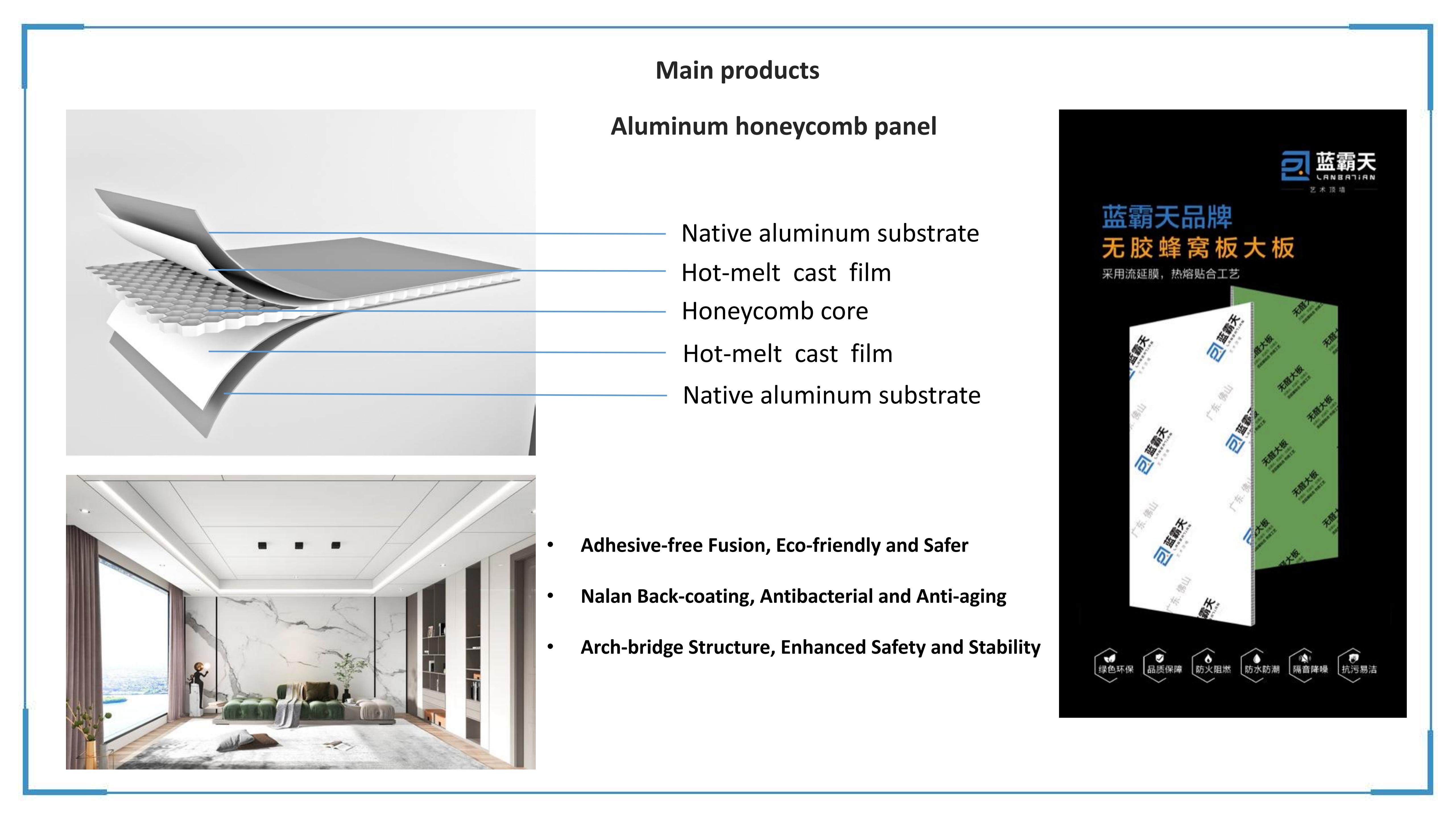
Two glue-free honeycomb panel platforms carry most wet-area work: NBW-HPB-001 and NBW-WHB-002. Both are built on the same principle — an all-aluminum structure produced with a glue-free process, a high-density honeycomb core, high-precision cutting, a waterproof surface and a fire-resistant coating, with termite-proof material throughout. In practice, project teams commonly run NBW-HPB-001 for cabinet bodies, cabinet fronts and interior door panels, and NBW-WHB-002 in wall-panel format for the vertical surfaces of the room. That distinction matters at drawing stage, because it determines the panel module, the edge treatment and the fixing detail.
What the performance data means in a wet room
- Water absorption below 1% in a 24-hour test, against more than 10% for standard particle board. In a bathroom, this is the difference between a substrate that stays dimensionally stable and one that swells at the edges.
- Formaldehyde Not Detected (ND) under GB 18584-2024, against the E1 grade limit of ≤0.124 mg/m³ used for wood-based boards. This result is the basis of the baby-grade zero formaldehyde positioning applied to family interiors.
- Class A fire performance, which matters in kitchens where heat sources sit close to cabinetry and in multi-storey projects where the wall build-up must satisfy a fire classification.
- Lab-tested durability of 20+ years in high-humidity environments, against a typical 8–12 years for wood panels under the same conditions.
- Almost maintenance-free in service: no mildew, no cracking and no deformation, which removes the annual re-sealing that wet-room wood boards normally require.
- Recyclable material and a lower comprehensive cost in use, with less after-sales work and quicker installation than a wood-based build-up.
Why the glue-free process is the decisive detail
Formaldehyde in wood-based boards comes mainly from the resins that bind the board together. A glue-free build removes that adhesive layer from the panel itself, so the formaldehyde result is reported as Not Detected rather than as a low-emission grade. The same construction also removes the interface that is most vulnerable to delamination when a panel is repeatedly wetted, dried and cleaned — in a bathroom, that is the point where a decorative face usually separates from its core.
Seamless Splicing on Wall Panels
Wall panels in kitchens and bathrooms have to run continuously around shower enclosures, pipe boxes, mirrors, splash-backs and vanity units. Glue-free honeycomb panels are produced in large format and cut with high-precision equipment, which reduces the number of seams a wall run needs and allows the joint plan to be set at drawing stage rather than improvised on site.
A workable splicing plan follows four rules. First, set the panel module from the room's widest uninterrupted elevation, then work the corners back from that module so that no narrow filler strips appear in the most visible area. Second, align vertical seams with architectural lines — a cabinet edge, a door casing or a lighting joint — so the eye reads a continuous surface. Third, keep seams out of direct spray zones; fewer joints means fewer places where water can sit. Fourth, agree the edge and joint detail before the order is placed, because wet-area wall panels are fixed with all-aluminum profiles rather than being glued or bedded onto a wet substrate. Nanbeiwang also produces a seamless welding plate within the same all-aluminum material family for projects that require continuous finished surfaces.
Door, Wall and Cabinet Same-Color Matching
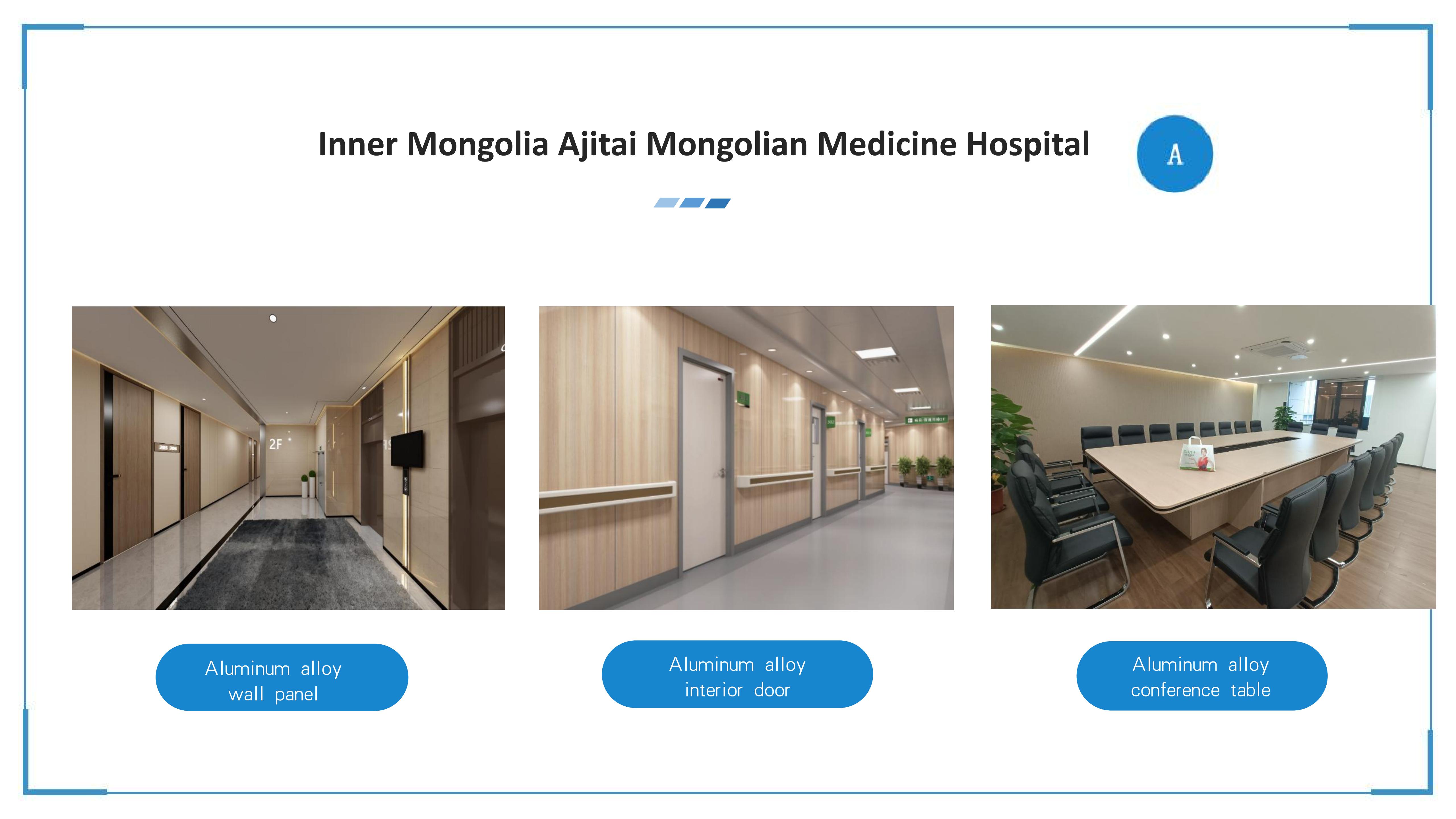
A high-end kitchen or bathroom is judged on continuity. When the cabinet fronts, the wall panels and the interior door come from three different suppliers, the room reads as an assembly of parts: the whites do not match, the grain directions do not align, and the joint details are inconsistent. Because Nanbeiwang Aluminum manufactures glue-free honeycomb panels, 6th-generation solid wood veneer honeycomb panels, aluminum wall panels, aluminum interior doors and aluminum ceilings inside one system, a project can specify a single finish across door, wall and cabinet while keeping one material logic throughout the room.
The practical gains are procurement-level, not just visual. One specification reference covers colour and texture across all wet-area surfaces. One compliance pack covers the formaldehyde and fire documentation for the whole room. One supplier covers the panels, the profiles and the hardware accessories, which reduces the number of interfaces where a project schedule can slip. For distributors and contractors running repeat projects, the same structure also means the material system does not have to be re-qualified for every new bathroom or kitchen layout.
Step-by-Step: Specifying Glue-Free Panels from Drawing to Handover
- Zone the room and list every wet surface. Shower walls, vanity backs and sides, splash-backs, floor-adjacent panels and the ceiling above the shower all behave differently and should be listed separately.
- Assign a platform to each surface. NBW-HPB-001 for cabinet bodies, cabinet fronts and interior door panels; NBW-WHB-002 in wall-panel format for vertical surfaces.
- Fix the wall module and the splice plan before ordering. Set the module from the widest elevation, keep seams out of spray zones, and align joints to architectural lines.
- Lock one finish across door, wall and cabinet. Confirm the colour and texture reference once, and apply it to every surface in the wet area.
- Collect compliance documentation for the destination market. Formaldehyde Not Detected under GB 18584-2024, Class A fire performance, and for European or North American projects the relevant EN 13501-1 or ASTM E84 classification.
- Confirm commercial parameters. Minimum order quantity is 1 sheet. Delivery terms are FOB Foshan or EXW. Payment terms are 50% deposit in advance by T/T with the remaining 50% balance before delivery, through a Hong Kong bank with multi-currency support.
- Agree inspection and acceptance. 100% full inspection before shipment, with third-party inspection support if the buyer requires it.
- Plan delivery. For stock items the typical lead time is 1–7 days; for custom orders it is 7–15 days.
- Install with matching profiles and hardware, then hand over with the test documentation. All-aluminum profiles and accessories from the same source keep the joint details consistent with the panel specification.
Use Cases
High-end kitchen: full-height wall panels with matching cabinetry
In a premium kitchen, the specification usually combines full-height all-aluminum wall panels with cabinet bodies and fronts in the same finish, then adds aluminium interior doors at the room's entry. Water absorption below 1% keeps the splash-back zone stable against daily wiping and steam, and Class A fire performance gives a defensible answer when cabinetry sits close to cooking appliances.
Bathroom: vanity, shower wall and door in one finish
Bathrooms concentrate every risk on a small footprint: continuous humidity, direct spray, frequent cleaning and heavy daily load on vanity drawers. Glue-free honeycomb panels remove the mildew, cracking and deformation that appear on wood-based bathroom cabinetry, and a single finish across vanity front, shower wall and door makes the room read as one designed surface rather than a fitted assembly.
Hospitality and commercial wet areas
Hotels, serviced apartments and commercial washrooms multiply the same problem across dozens of identical rooms. Here the value of an all-aluminum, glue-free build-up is repeatability: the same panel platform, the same fixing detail and the same compliance documentation can be carried from room to room without re-qualifying the material, which shortens both the installation cycle and the after-sales burden.
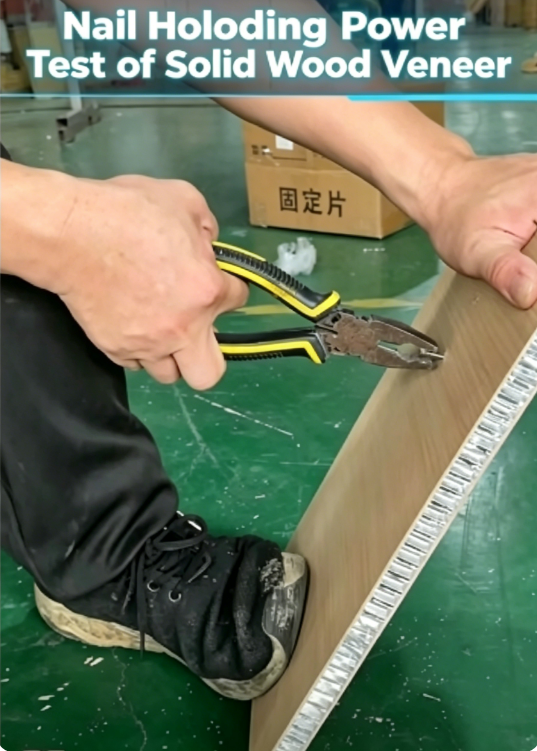
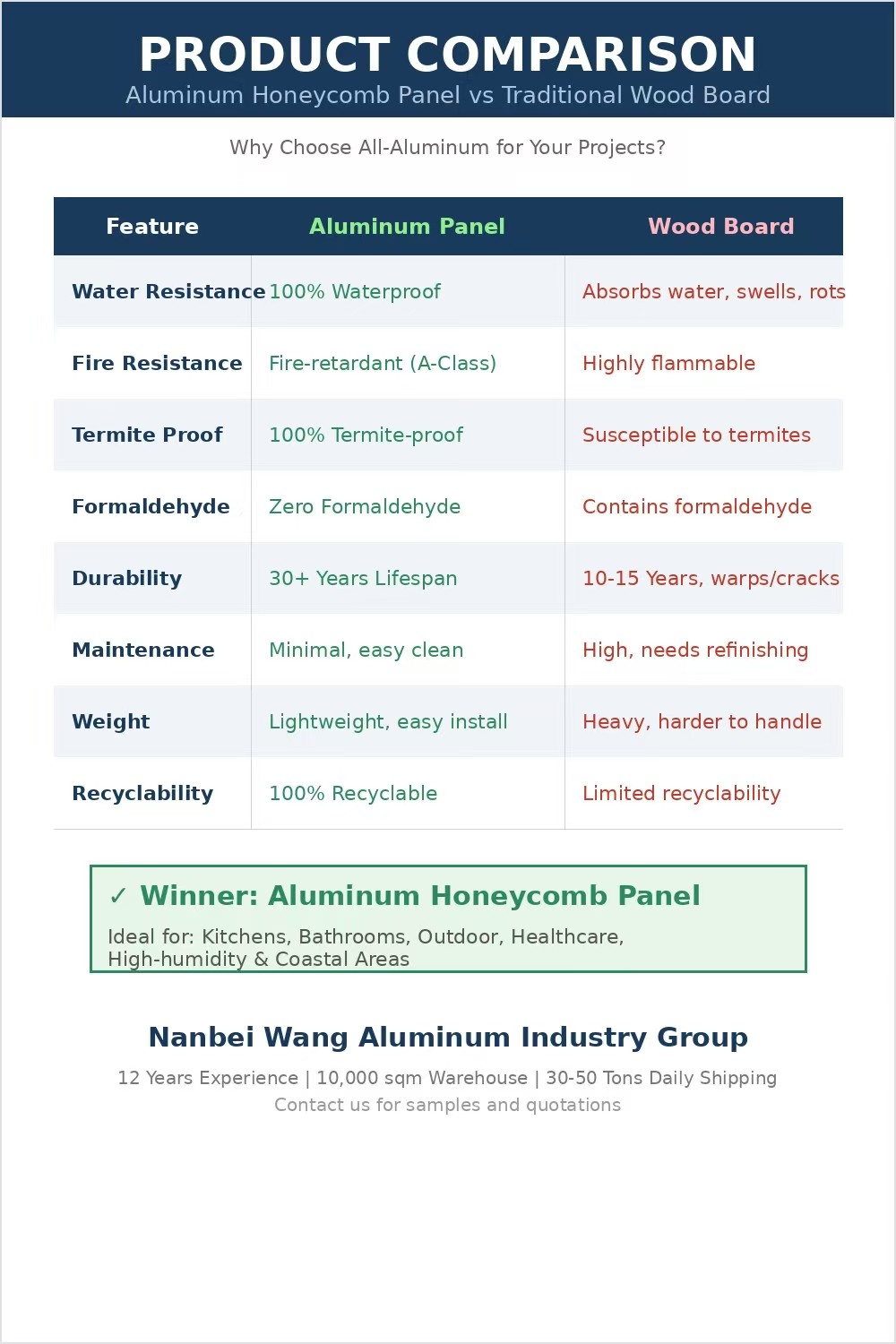
Comparison Table: Glue-Free Honeycomb Panel vs. Wood-Based Boards
| Decision factor | Glue-free aluminum honeycomb panel (NBW-HPB-001 / NBW-WHB-002) | Traditional wood board, particle board, MDF |
|---|---|---|
| Formaldehyde emission | Not Detected (ND) under GB 18584-2024 | E1 grade limit ≤0.124 mg/m³ |
| Water absorption (24-hour test) | Below 1% | Above 10% for standard particle board |
| Fire performance | Class A fire performance | Combustible substrate; typically requires separate fire treatment |
| Service life in high humidity | Lab-tested 20+ years | Typically 8–12 years |
| Maintenance | Almost maintenance-free | Periodic re-sealing and edge repair in wet areas |
| Mildew, cracking, deformation | No mildew, no cracking, no deformation | Mold and mildew, warping and cracking, deformation under load all listed as risks |
| Material end of life | Eco-friendly and recyclable | Reuse limited by moisture history |
Reading the table as a buyer: the three rows that decide a kitchen or bathroom project are formaldehyde, water absorption and fire performance. The durability and maintenance rows explain the total cost of ownership over a longer horizon, because wet-area wood boards are normally replaced or re-sealed well before the building's own lifecycle ends.
Long-Term Supply: What to Check Before Committing to a Panel Partner
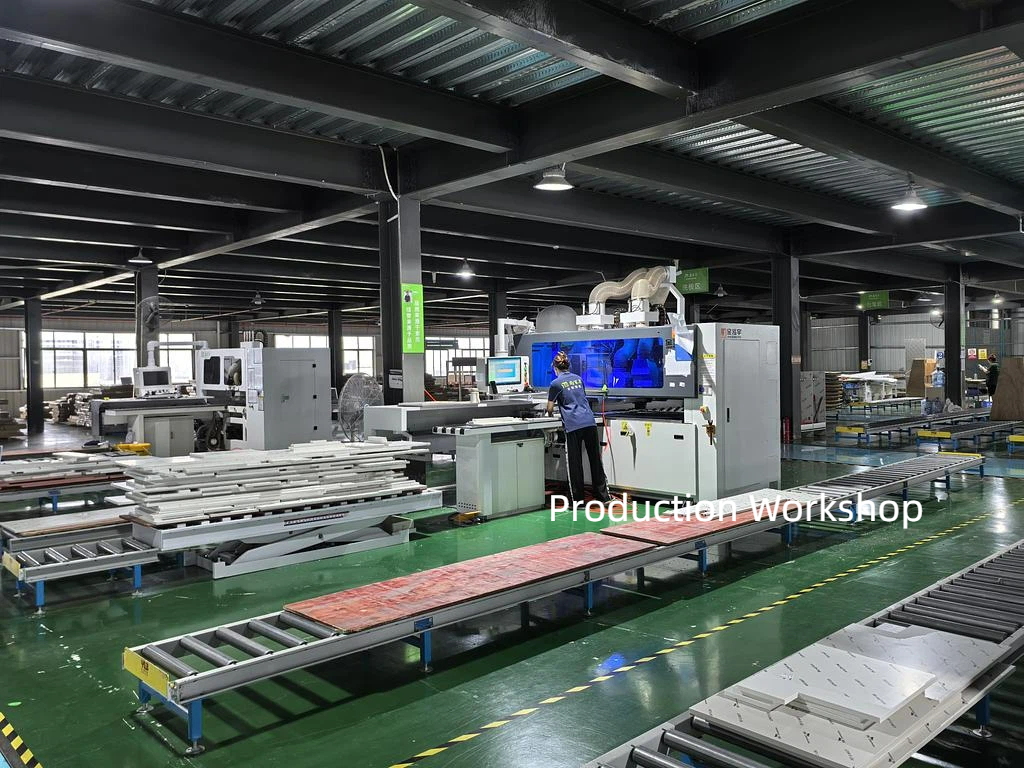
For a kitchen and bathroom programme, the material decision is only half the work. The other half is whether the same panel, finish and documentation can be repeated on the next order. Nanbeiwang Aluminum's monthly production capacity exceeds 50,000 sheets, with an annual output of 1,000,000 sheets from an 80,000 m² facility, two major production bases and a team of more than 300 employees including a 15-engineer R&D team. Export markets cover Europe, Southeast Asia, the Middle East and North America, and exports account for 50% of output.
Operationally, the points worth verifying before committing are: stable stock supply, supported by 10,000 m² of inventory; standardized production with full-process inspection; professional technical support during specification and installation; and enough manufacturing history to have already solved the wet-area detailing problems. Nanbeiwang Aluminum brings 12 years of manufacturing experience to that list, together with national invention and utility model patents and participation as a compiling unit for all-aluminum home furnishing group standards.
FAQ
Do glue-free honeycomb panels meet the formaldehyde and fire requirements for kitchens and bathrooms?
Yes, on the two parameters that matter most in wet rooms. Formaldehyde is Not Detected (ND) under GB 18584-2024, compared with the E1 grade limit of ≤0.124 mg/m³ that applies to wood-based boards. Fire performance is Class A. Because project requirements differ by market, buyers should confirm the jurisdiction-specific classification as well: European projects classify under EN 13501-1, where Class A1 or A2 (non-combustible) is the top requirement for high-end architecture, while North American projects test to ASTM E84 for flame spread and smoke development.
Can the panels be customized, and can the door, wall and cabinet finishes be matched?
Yes. Glue-free honeycomb panels, 18 mm honeycomb panels, 6th-generation solid wood veneer honeycomb panels, aluminum wall panels, aluminum interior doors and aluminum ceilings are all produced within the same all-aluminum system, together with supporting profiles and hardware accessories. That allows a project to specify one finish across door, wall and cabinet, and to consolidate the wet-area material package into a single one-stop procurement. Custom orders are typically produced in 7–15 days.
What is the minimum order quantity and what are the payment terms?
The minimum order quantity is 1 sheet, which allows a project to trial a panel before scaling up. Delivery terms are FOB Foshan or EXW. Payment terms are 50% deposit in advance by T/T, with the remaining 50% balance paid before delivery, handled through a Hong Kong bank with multi-currency support.
How can a buyer validate panel quality before a full project order?
Three mechanisms apply. First, the 1-sheet minimum order quantity allows a physical trial of the actual panel. Second, every shipment undergoes 100% full inspection before dispatch, and third-party inspection support is available on request. Third, the published performance data can be checked against the test documentation: water absorption below 1% in a 24-hour test, formaldehyde Not Detected under GB 18584-2024, and lab-tested durability of 20+ years in high-humidity environments against a typical 8–12 years for wood panels.
What lead times and stock support apply for repeat kitchen and bathroom projects?
For stock items the typical lead time is 1–7 days; for custom orders it is 7–15 days. Behind those figures are a monthly production capacity above 50,000 sheets, 10,000 m² of stock, and stable stock supply supported by standardized production and full-process inspection. Distributors and contractors planning multi-room or multi-phase programmes can contact Nanbeiwang Aluminum directly for a project quote, a specification review or the current catalogue.
Conclusion: One Material Logic for the Two Hardest Rooms
Kitchens and bathrooms fail wood-based boards through repetition, not through one incident. Water absorption below 1%, formaldehyde Not Detected under GB 18584-2024, Class A fire performance and no mildew, cracking or deformation together remove the failure modes that drive wet-area replacement cycles. Applied through NBW-HPB-001 and NBW-WHB-002, those properties also make seamless wall splicing and door–wall–cabinet same-color matching practical to specify rather than aspirational.
The starting point for a project is the room's own elevations: list the wet surfaces, fix the wall module and splice plan, lock one finish across door, wall and cabinet, and confirm the compliance documents for the destination market. The material selection then becomes a specification decision instead of an aesthetic compromise.

Next Step: Sample, Quote or Catalogue
Send the kitchen or bathroom elevations and the finish reference, and Nanbeiwang Aluminum will respond with a panel recommendation, a quote and the relevant test documentation for your market. Minimum order quantity is 1 sheet, so a sample-stage trial is straightforward.
Website: www.nbwaluminum.com
2026 Catalogue (download): Nanbeiwang Aluminum 2026 Catalogue
Contact — Bea: 599420378@qq.com / Tel 18138309908 / WhatsApp +86 18138309908
Contact — Summer: 1739844920@qq.com / Tel +86 18407576890 / WhatsApp +86 13927285115
Address: Foshan, Guangdong, China
Have Questions or Need More Details?
Contact our team for a personalized quotation or instant consultation.
Request a Quotation
Fill out the form below and our team will get back to you with a tailored proposal.
WhatsApp Direct Chat
Prefer to chat in real-time? Message us on WhatsApp for instant assistance & quick answers.
- Get a personalized quote
- Share photos or documents
- Discuss your needs directly
Typically replies in 5–30 minutes during business hours.