Solving Warping and Moisture Damage: Zero-Formaldehyde Honeycomb Panel Solutions
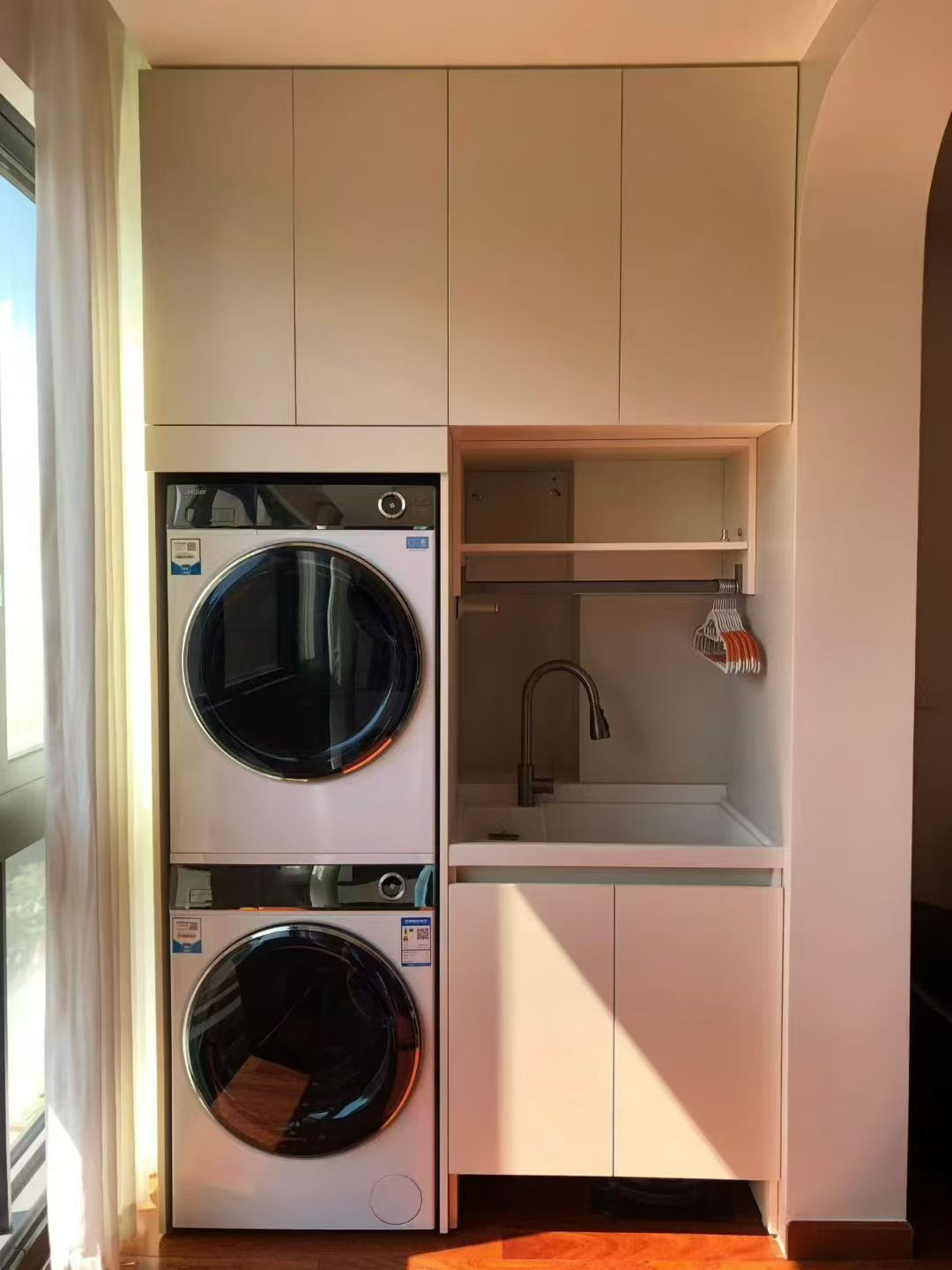
All-aluminum honeycomb cabinetry installed in a moisture-prone utility area, where wood-based boards typically swell and delaminate.
Warping, moisture damage and formaldehyde odor in interior construction usually trace back to the same two material properties: a hygroscopic wood-based core, and an adhesive layer that reacts to heat and humidity. All-aluminum honeycomb panels remove both variables. The board is built from two aluminum skins bonded to an aluminum honeycomb core — in Nanbeiwang Aluminum's glue-free range, by thermal bonding without chemical glue — so there is no wood fiber to swell and no formaldehyde-based resin to emit.
This article is written for buyers and contractors who have already accepted that the interior needs a moisture-stable panel and now have to confirm which product, which thickness, which joint detail and which documents. It covers the failure mechanism, the industry context, the product-level answer from Nanbeiwang Aluminum (notably NBW-WPB-003 and NBW-WHB-002), a step-by-step specification and installation sequence, application cases for old-house renovation and high-humidity zones, and a comparison table restricted to published product facts.
Problem Definition: Warping, Moisture Damage and Formaldehyde Are One Failure Chain
In a kitchen, a bathroom, a laundry room or a renovated old wall, a decorative panel rarely fails from impact. It fails from moisture cycling, and the three symptoms buyers report most often — bowing, swelling and smell — are stages of the same chain rather than three separate defects.
Warping is a differential-movement problem
A wood-based board takes up moisture through one face and through its edges. That face expands; the opposite face, still drier, does not. The difference is expressed as curvature, and once the bow sets it does not flatten again when the room dries out. Two further effects compound it: adhesive layers creep under sustained load, which is why long ceiling spans sag; and hybrid constructions that combine a wood core with a metal skin move at different rates, because the two materials respond to humidity differently.
Moisture damage is a core problem, not a surface problem
Water reaching the core is where repairable damage becomes permanent. Wood fiber and paper-based cores swell, stressing the bond line from the inside, and the dark cavity behind a panel is a favorable environment for mold. In older buildings the moisture source is often not a visible leak but rising damp in the wall or a slow plumbing seep that the panel hides.
Formaldehyde odor is a resin problem
Formaldehyde emission originates in amino resins used in board manufacture and bonding, and it continues over a long period rather than fading after a few weeks. Heat and humidity raise the emission rate, which is why an interior can smell worse in summer or after a hot shower. Air exchange dilutes the odor; it does not remove the source. A material change removes the source.
| Failure mode | What usually drives it | What the panel has to provide |
|---|---|---|
| Warping and sagging | Differential moisture movement between faces; adhesive creep under sustained load | A symmetric all-aluminum build on both faces, plus a bond line verified by peel strength testing |
| Moisture and mold | Water reaching a hygroscopic core in kitchens, bathrooms, laundries and coastal interiors | Water absorption below 1% in a 24-hour test; waterproof, moisture-proof and anti-mildew performance |
| Formaldehyde odor | Amino resin adhesives in boards and bond layers, aggravated by heat and humidity | An all-aluminum base material with no chemical glue added in the whole process, plus a test report |
Industry Background: Moisture and Emission Expectations Are Tightening
Demand for aluminum honeycomb is no longer only a façade story. The global aluminum honeycomb market was estimated at USD 2.1 billion in 2024, with a projected compound annual growth rate of 6.1% over 2024–2030, according to Strategic Market Research. A meaningful share of that demand sits in interior work — cabinets, wall panels, ceilings and doors — where the comparison is made against wood-based boards rather than against other metal systems.
Published price data shows how wide that comparison can be. GMI's aluminum honeycomb panel report for 2026–2035 cites factory-side planning prices in the region of USD 55–130 per square meter, while the same publisher reports a blended average selling price of USD 211 per square meter for 2025. The gap reflects grade segmentation between construction grades and higher-specification industrial grades, so a buyer comparing quotations should compare skin thickness, core density, surface system and bonding method before comparing the number at the bottom.
Fire requirements follow the same logic. Standards named in the same market report include ASTM E84, EN 13501-1 and UL 723 — three different frameworks for the same underlying question. A supplier's fire claim is only useful once it is mapped to the standard that applies in the destination market. Nanbeiwang Aluminum publishes an A2 fire rating for its all-aluminum honeycomb panel NBW-HPB-001.
Bonding technology is the third moving part. CHALCO describes brazing as a metallurgical connection between the aluminum honeycomb core and the panel that overcomes shortcomings of adhesive connection. Whether a project specifies brazing, thermal bonding or a conventional adhesive, the practical lesson is identical: the bond line is the performance-critical interface, and it should be evidenced by a test report rather than a brochure line.
Nanbeiwang Aluminum — Guangdong Nanbeiwang Smart Home Co., Ltd. — is a manufacturer of eco-friendly all-aluminum materials for whole-house customization, founded in 2013 and headquartered in Dali Town, Nanhai District, Foshan, Guangdong. The company reports an 80,000 m² facility, 320 employees, an annual production capacity of 1,000,000 sheets and 15 engineers, with about 50% of sales exported to Europe, Southeast Asia, the Middle East and North America. Its product set spans all-aluminum honeycomb panels, glue-free honeycomb panels, aluminum honeycomb wall panels, whole-house custom boards, all-aluminum interior doors and aluminum ceilings, plus supporting all-aluminum profiles and hardware accessories. More detail is available at nbwaluminum.com.
Detailed Solution: What the All-Aluminum Build Changes
A symmetric build removes the warping driver
NBW-HPB-001 is an all-aluminum honeycomb panel formed from two aluminum skins bonded to an aluminum honeycomb core, with glue-free thermal bonding. Skin thickness ranges from 0.3 mm to 1.0 mm, overall thickness from 5 mm to 18 mm, and the standard panel size is 1220 × 2750 mm with customization available. Because both faces are aluminum and the core is aluminum, the panel does not present a moisture-absorbing face on one side and a non-absorbing face on the other — the asymmetry that produces bowing in wood-based boards is designed out rather than mitigated. Honeycomb geometry is used precisely for this kind of structure: it minimizes material use while keeping weight and material cost low.
Water and mold are addressed as material properties
The aluminum honeycomb wall panel NBW-WPB-003 is specified as waterproof, moisture-proof, anti-mildew, fire-resistant and termite-proof, as well as formaldehyde-free. The panel-level water figure for NBW-HPB-001 is a water absorption rate below 1% in a 24-hour test. The aluminum ceiling NBW-CLB-004 is specified as moisture and mildew proof and anti-sagging, with what the product data describes as super high flatness — relevant because ceilings over wet rooms are where sagging is most visible. The all-aluminum interior door NBW-DOR-005 is specified as waterproof, anti-mildew and resistant to deformation.
Zero formaldehyde has to be documented, not asserted
The whole-house custom board NBW-WHB-002 uses an all-aluminum eco base material with no chemical glue added in the whole process, and is described as baby-grade zero formaldehyde, available from 5 mm to 18 mm and universal across cabinet, door and wall panel applications. That claim is backed by third-party documents rather than by wording alone:
- GB18584-2024 hazardous substance test report SQ2505164, issued 29 October 2025 by the Guangdong Testing Institute of Product Quality Supervision, covering the full series of all-aluminum honeycomb panels.
- Formaldehyde emission test report SQ2306041 / UNS7332, issued 21 November 2023 under GB18584-2001 by the Guangdong Testing Institute of Product Quality Supervision and the National Furniture Product Quality Testing Center (Guangdong), valid to 21 November 2026.
- SGS RoHS test report CANEC2308826401, issued 28 June 2023 by SGS-CSTC Standards Technical Services, covering six restricted substances in an 18 mm PETG aluminum honeycomb panel.
- ISO9001:2015 certificate 31825Q10055R0S and ISO14001:2015 certificate BIV25E10066R0S, both covering aluminum honeycomb panels for furniture, wall, ceiling and cabinet applications.

Page from the GB18584-2024 hazardous substance test report (SQ2505164) covering the all-aluminum honeycomb panel series.
The bond line is the part to verify first
Peel strength is the measurement that tells a buyer whether the sandwich will stay a sandwich after a few humidity cycles. Nanbeiwang Aluminum holds CTC test report WT2025B01B02018, issued 12 November 2025 by China National Test & Certification (CTC) / National Center for Testing of Building Materials, covering peel strength and temperature resistance of the glue-free aluminum honeycomb panel against JC/T 2113-2012, valid to 12 November 2026. When reviewing any peel strength report, read the scope line before the number: it should name the glue-free construction and the thickness actually being ordered.
Step-by-Step Breakdown: From Damp Survey to Accepted Installation
The sequence below is written for the execution stage, where decisions are already narrowing to models, thicknesses and joint details. It applies equally to a single apartment and to a bulk order, and the earlier steps are the ones that most often get skipped.
- Locate and fix the moisture source first. Rising damp, a seeping joint or a slow leak will defeat any panel, including an all-aluminum one. A moisture-stable panel protects the finish, not the building.
- Zone the interior. Separate dry walls, wet walls, ceilings, cabinet carcasses and doors. Each zone maps to a different product rather than to one universal board.
- Fix thickness against span and fixing detail. The wall panel range includes 5 mm, 9 mm, 10 mm and 18 mm, and the general honeycomb panel covers 5 mm to 18 mm. Confirm the thickness against the actual span, substrate and fixing method with the supplier rather than defaulting to one value site-wide.
- Select skin and core specification. Wall panel skin options are 0.3 mm, 0.48+0.2 mm, 0.65+0.2 mm and 1.0 mm; core options are 3×3, 4×4, 5×5, 8×8 and 10×10, all customizable. Higher-visibility elevations and larger formats generally justify a heavier skin.
- Decide the joint language before ordering. NBW-WPB-003 supports seamless splicing, welding plate connection, metal line connection and glue-free wall panel connection. Seamless splicing changes the cutting plan, so it must be fixed at order stage, not on site.
- Coordinate color across door, wall and cabinet. The wall panel system supports door-wall-cabinet same-color matching, and surface options include solid wood veneer, PETG high gloss, scratch-resistant wood grain, melamine CPL, solid color, powder coating and wood grain heat transfer.
- Sequence the installation. Ceilings first, then walls, then cabinets and doors, so that cut edges and penetrations are resolved against finished planes. Supporting all-aluminum profiles and hardware accessories are part of the same supply scope.
- Protect edges and penetrations. Cut edges and service openings are where a panel system is most exposed; agree the detail in the shop drawing set.
- Inspect and accept against the purchase order. Nanbeiwang Aluminum performs 100% full inspection before shipment and accepts third-party inspection arrangements. Written acceptance criteria in the PO are what make that inspection meaningful.
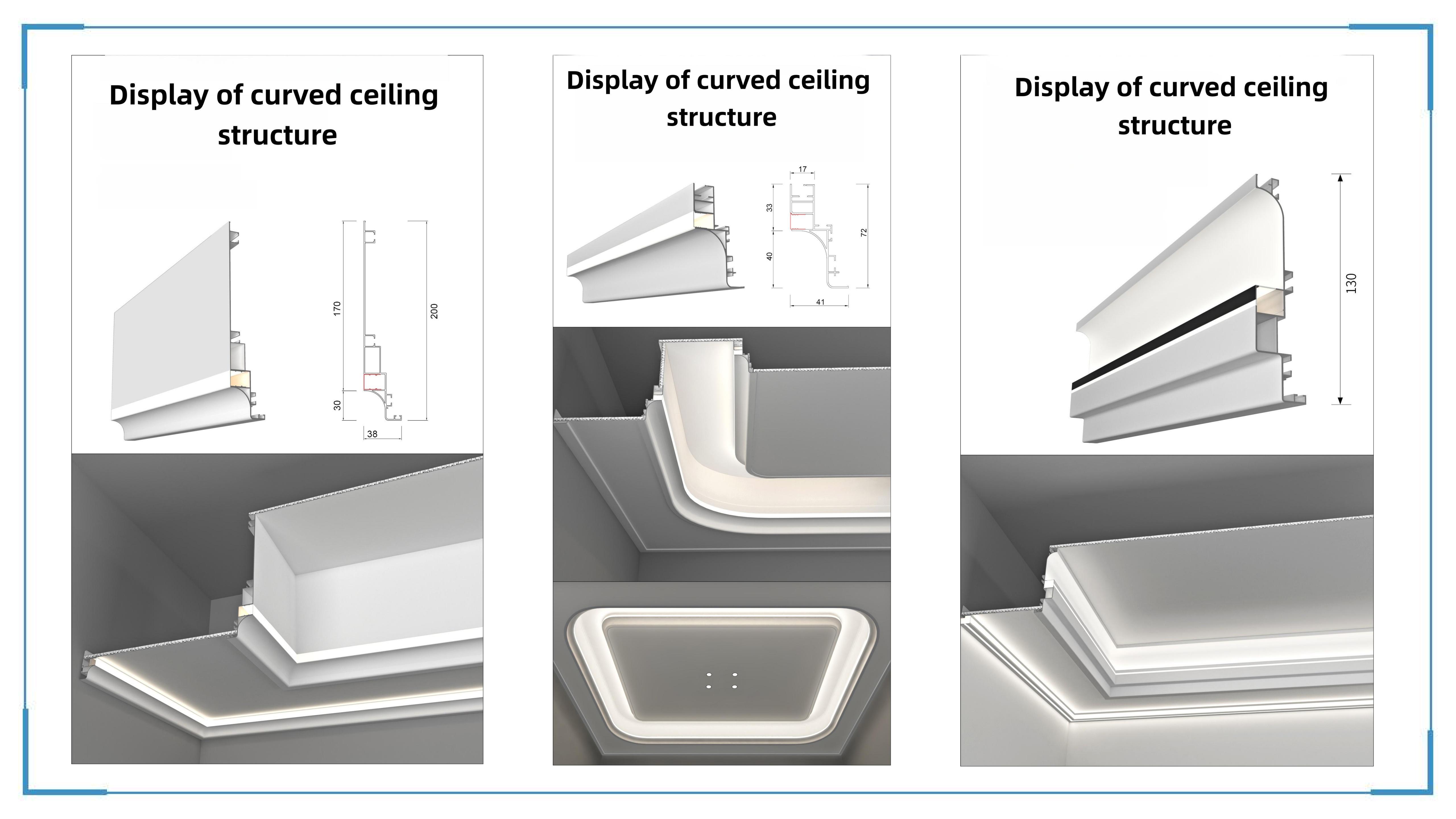
Secondary aluminum profile beam detail — the fixing layer that determines whether a large-format panel stays flat across a long elevation.
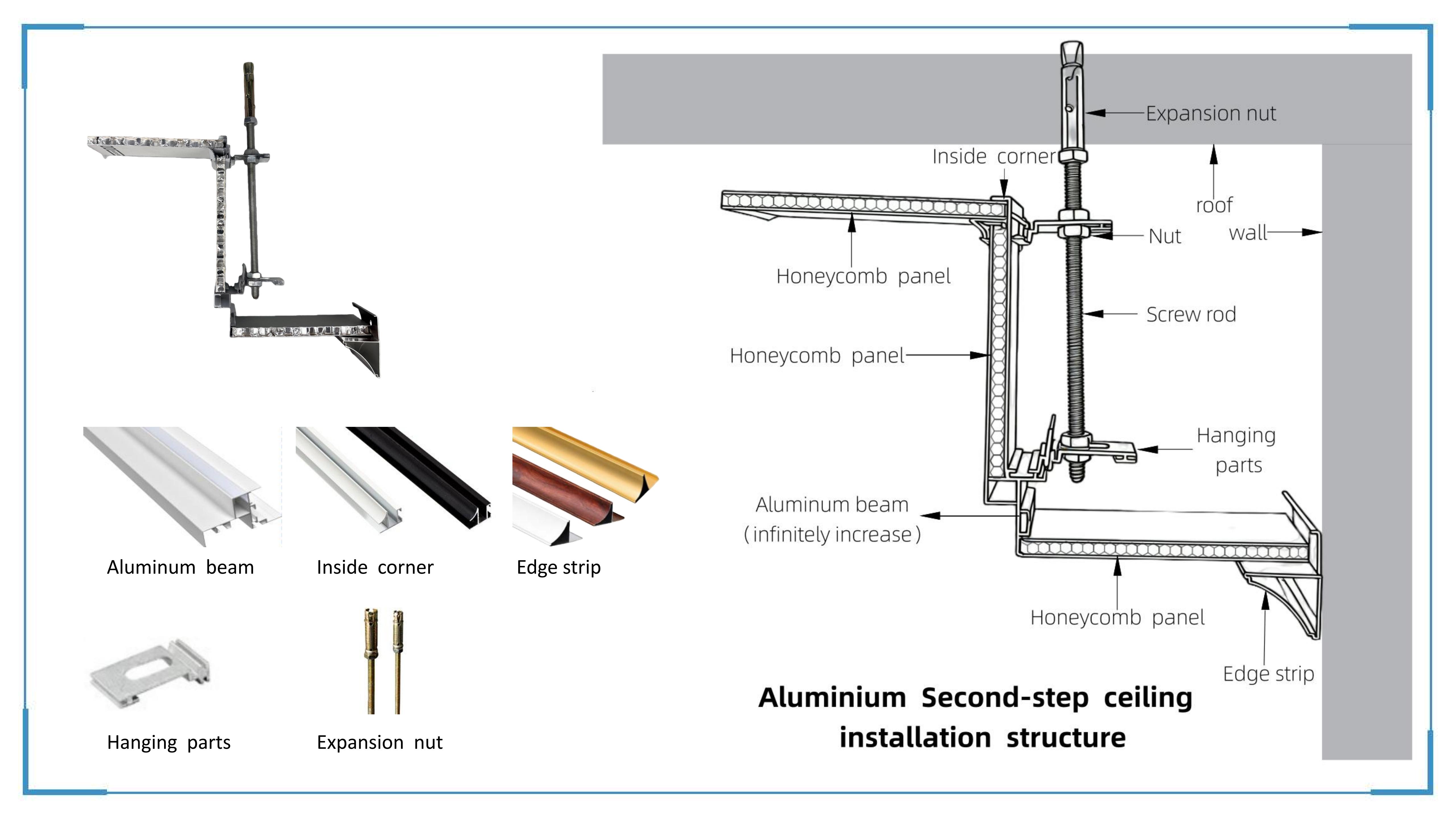
Secondary structure behind a large-format aluminum honeycomb ceiling, the layer that controls flatness and resists sagging over wet rooms.
Use Cases: Where the Moisture Variable Actually Costs Money
Old house renovation
Old-house renovation is named in the published application scope of NBW-WPB-003, alongside interior wall decoration, commercial space fitting-out and large-scale wall engineering. Three conditions make it the hardest case: existing walls are rarely flat or square, the occupants often stay in residence during the work, and the original moisture path may be hidden. A large-format panel cut from a 1220 × 2750 mm board absorbs those irregularities across the elevation, and seamless splicing keeps long walls visually continuous instead of segmenting them at every stud. Because the system is fixed mechanically rather than plastered, the installation sequence should be agreed with the installer at survey stage.
High-humidity zones: kitchens, bathrooms, laundries and coastal interiors
These are the rooms where the failure chain normally starts. Cabinet carcasses and wardrobes map to NBW-WHB-002, the all-aluminum board specified for cabinet, door and wall panel use with no chemical glue in the whole process. Bathroom and kitchen doors map to NBW-DOR-005, which uses a 45 mm door leaf and frame with frame options at 60 mm, 50 mm, 25 mm, 55 mm and 18 mm, and is specified as waterproof, anti-mildew, fire-resistant and resistant to deformation — relevant where a bathroom door is expected to survive daily steam without binding. One execution detail matters: NBW-DOR-005 is offered with honeycomb, bamboo board or plywood cores, so the core must be named explicitly in the order when a zero-formaldehyde requirement applies.
Ceilings above wet rooms
Ceilings are the most visible test of stability, because sagging shows against a straight wall line. NBW-CLB-004 is a large-format integrated honeycomb ceiling panel specified for seamless splicing, super high flatness, moisture and mildew proofing and anti-sagging, with application in whole-house ceilings, kitchen and bathroom ceilings, hotel and apartment fit-out, and commercial ceiling work.
Volume projects
Material behaviour that survives one apartment is not proof of consistency at scale; the useful evidence is repeat supply. In Indonesia, a whole-house customization project used 800,000 sheets of product 4561 across cabinets, wardrobes, wall panels and doors, with a stated service life of 20–30 years, glue-free zero formaldehyde, full stock and fast delivery, and reported stable quality, high repurchase rate and 20% cost reduction. A B2B factory client in Qatar has taken 2,000,000+ sheets over a 20+ year relationship for aluminum cabinet and wardrobe manufacturing, with bulk supply of 30–50 tons daily shipment capacity. The wider reference base covers Malaysia, Saudi Arabia, Singapore, Thailand, South Africa, Kosovo and Kuwait, with more than 10,000 cooperative factories and 5,000 projects across cabinet production, wholesale supply and engineering support.
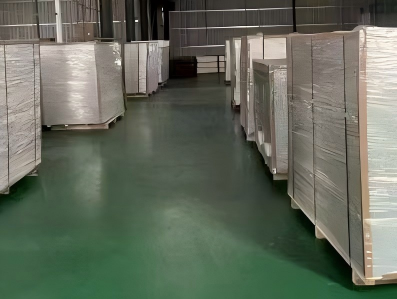
Warehouse stock supporting full-stock dispatch — relevant when a renovation schedule cannot wait for a production run.
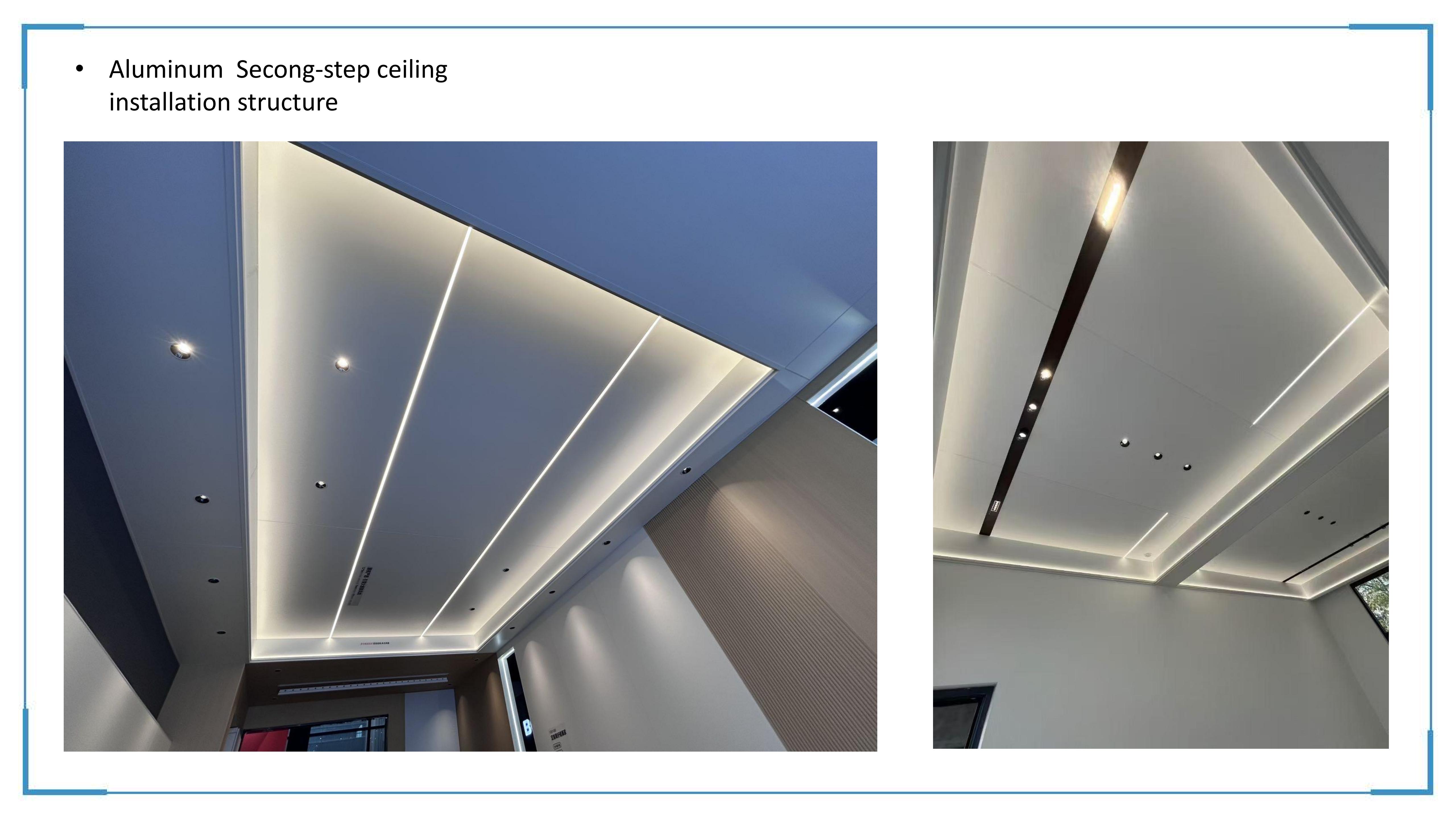
Finished all-aluminum honeycomb ceiling in a humid interior, where anti-sagging and flatness are judged against the wall line.
Comparison Table: Product Fit for Moisture-Prone Interiors
The table below uses only published product data. Fire rating and formaldehyde status are listed exactly where the product data specifies them; where a value is not stated for a model, that is shown as not specified rather than inferred.
| Product | Model | Thickness and size | Build and surface | Fire and formaldehyde data | Moisture-prone role |
|---|---|---|---|---|---|
| Honeycomb Panel (All-Aluminum, Glue-Free) | NBW-HPB-001 | 5–18 mm, customizable; 1220 × 2750 mm, customizable | Aluminum sheet + aluminum honeycomb core, glue-free thermal bonding; aluminum skin 0.3–1.0 mm; PETG, melamine, powder coating or wood grain surface | A2 fire rating; formaldehyde zero under GB18584-2024; water absorption below 1% in a 24-hour test | General board for board wholesale, furniture manufacturing, custom cabinet factories and decoration projects |
| Aluminum Honeycomb Wall Panel | NBW-WPB-003 | 5 mm, 9 mm, 10 mm, 18 mm; 1.22 × 2.75 m, customizable | Aluminum alloy board + high-density aluminum honeycomb; skin 0.3 mm, 0.48+0.2 mm, 0.65+0.2 mm, 1.0 mm; core 3×3 to 10×10; solid wood veneer, PETG, wood grain, melamine CPL, solid color, powder coating | Fire-resistant and formaldehyde-free as specified in the product data | Interior wall decoration, old-house renovation, commercial fit-out, large-scale wall engineering; seamless splicing |
| Whole House Custom Board | NBW-WHB-002 | 5–18 mm | All-aluminum eco base material, no chemical glue added in the whole process | Baby-grade zero formaldehyde; fire rating not specified in the published product data | Cabinet, wardrobe, bathroom cabinet and whole-house customization; door-wall-cabinet same-color matching |
| Aluminum Ceiling | NBW-CLB-004 | Standard thickness; large-format integrated board | High-strength aluminum alloy board + reinforced thickened aluminum honeycomb core | Fire rating and formaldehyde value not specified in the published product data | Kitchen and bathroom ceilings, whole-house ceilings, hotel and apartment fit-out; anti-sagging and moisture/mildew proof |
| All-Aluminum Interior Door | NBW-DOR-005 | 45 mm door leaf and frame; frame options 60 mm, 50 mm, 25 mm, 55 mm, 18 mm | All-aluminum integrated door structure; honeycomb, bamboo board or plywood core options; PETG, wood grain or powder coating finish | Fire-resistant and anti-mildew as specified in the product data; formaldehyde value not specified per core option | Bathroom, kitchen, bedroom, living room and office doors; waterproof and resistant to deformation |
Read the table by zone rather than by price. A wet wall in an old building is a wall panel question; a cabinet carcass in a bathroom is a whole-house board question; a bathroom door is a door-core question, and the core option must be written into the order. Where a project requires a documented fire rating or formaldehyde value, the model that carries that value in its product data should be selected, and the report number should appear in the submittal.
FAQ
Does a zero-formaldehyde honeycomb panel still need formaldehyde test documentation for project handover?
Yes. A material claim and a test report are different deliverables, and most handover checklists ask for the report. The all-aluminum honeycomb panel series from Nanbeiwang Aluminum is covered by a GB18584-2024 hazardous substance test report, SQ2505164, issued on 29 October 2025 by the Guangdong Testing Institute of Product Quality Supervision. An earlier formaldehyde emission report, SQ2306041 / UNS7332, was issued under GB18584-2001 by the same institute together with the National Furniture Product Quality Testing Center (Guangdong), valid from 21 November 2023 to 21 November 2026. Supporting documents include SGS RoHS report CANEC2308826401 for an 18 mm PETG panel, plus ISO9001:2015 certificate 31825Q10055R0S and ISO14001:2015 certificate BIV25E10066R0S.
Can the panels be cut to fit an old house with out-of-square walls?
Yes. Customization covers thickness, size, color, surface finish and cutting, on top of a standard 1220 × 2750 mm format. The wall panel is offered in 5 mm, 9 mm, 10 mm and 18 mm, with skin options of 0.3 mm, 0.48+0.2 mm, 0.65+0.2 mm and 1.0 mm, and honeycomb core options of 3×3, 4×4, 5×5, 8×8 and 10×10. Seamless splicing, metal line connection and welding plate connection are all supported, and door-wall-cabinet same-color matching is available. Practically, the cutting plan should start from site measurements rather than from the nominal wall size, because an old wall is rarely square.
What drives the unit price of a honeycomb panel order?
Four variables dominate: skin thickness (0.3 mm to 1.0 mm), core specification (3×3 to 10×10), overall thickness (5 mm to 18 mm) and surface system (solid wood veneer, PETG high gloss, scratch-resistant wood grain, melamine CPL, solid color, powder coating or wood grain heat transfer), with cutting and edge work on top. For budgeting, published benchmarks help set a range: GMI's 2026–2035 aluminum honeycomb panel report cites factory-side planning prices of roughly USD 55–130 per square meter, while the same publisher reports a blended average selling price of USD 211 per square meter for 2025, a gap that reflects grade segmentation. The minimum order quantity for Nanbeiwang Aluminum is 1 sheet, so a full-board sample can be priced before a project commitment.
Can a buyer get a sample before committing to a full order?
Yes. Sample dispatch is quoted at 24 hours, and the minimum order quantity is 1 sheet. Sampling matters more than usual for this material category, because two things cannot be judged from a specification sheet: surface consistency across finishes such as PETG high gloss or solid wood veneer, and color matching between a door, a wall panel and a cabinet board. Cutting and fixing a sample with the intended method also shows how the panel behaves at an exposed edge.
What is the lead time, and what information is needed to start?
Stock items are quoted at 1–7 days and customized orders at 7–15 days, against a monthly capacity of 50,000+ sheets and daily shipping of 30–50 tons from a 10,000 m² warehouse. Inspection is 100% full before shipment, with third-party inspection supported, and delivery terms are FOB Foshan or EXW with a 50% T/T deposit and the balance before delivery. To move from evaluation to a quotation, send a specification list — product model, thickness, skin, core, surface, quantity and destination port — to the Nanbeiwang Aluminum team at nbw@ashop.ai or WhatsApp +86 18138309908, or download the 2026 catalogue and use it to build the list.
Conclusion
Warping, moisture damage and formaldehyde odor are not maintenance problems that appear after installation; they are material selections made before it. A symmetric all-aluminum honeycomb build removes the differential movement that bows a panel, an aluminum core with water absorption below 1% in a 24-hour test removes the moisture pathway that feeds swelling and mold, and an all-aluminum base material with no chemical glue added in the whole process removes the resin that emits. Each of those three claims should be matched to a document — GB18584-2024 report SQ2505164 for emission, CTC report WT2025B01B02018 against JC/T 2113-2012 for the glue-free bond, and ISO9001:2015 plus ISO14001:2015 for the management system behind them.
Execution then determines whether the specification survives contact with the building. Fix the moisture source before the panel goes up, zone the interior so walls, ceilings, cabinets and doors map to the right model, settle the joint language at order stage rather than on site, and write the acceptance criteria into the purchase order. Buyers who do those four things get the outcome the material was selected for: flat walls after the first humid season, cabinets that open without binding, and an interior that does not smell of resin.
Next step. Send your wall, ceiling, cabinet or door schedule to Nanbeiwang Aluminum and request a matching specification and quotation, a board sample for finish and color review, or the 2026 catalogue. Email nbw@ashop.ai, WhatsApp +86 13927285115, or visit nbwaluminum.com. Factory address: Foshan, Guangdong, China.

Nanbeiwang Aluminum headquarters in Foshan, Guangdong — an 80,000 m² facility with a reported annual capacity of 1,000,000 sheets.
Have Questions or Need More Details?
Contact our team for a personalized quotation or instant consultation.
Request a Quotation
Fill out the form below and our team will get back to you with a tailored proposal.
WhatsApp Direct Chat
Prefer to chat in real-time? Message us on WhatsApp for instant assistance & quick answers.
- Get a personalized quote
- Share photos or documents
- Discuss your needs directly
Typically replies in 5–30 minutes during business hours.