Total Cost of Ownership for Honeycomb Panels: An Aluminum vs. Wood-Based Decision Framework
Buyers evaluating honeycomb panel systems for cabinets, ceilings, and interior wall applications often face a misleading comparison: the unit price of a board is easy to measure, but the long-term cost of service is not. The more useful decision framework for importers, wholesalers, and project contractors is total cost of ownership. This guide applies that framework to all-aluminum honeycomb panels supplied by Guangdong Nanbeiwang Smart Home Co., Ltd., operating as Nanbeiwang Aluminum, and compares the material with conventional wood board, particle board, and MDF in wet-area, fire-rated, and high-use interiors.
Problem Definition
Moisture damage, mold and mildew, formaldehyde emission, fire hazard, termite infestation, warping, cracking, and deformation under load are the main risks that drive replacement in kitchen, bathroom, ceiling, and door systems. Wood-based boards may absorb moisture above 10% in a 24-hour water absorption test, while Nanbeiwang Aluminum's comparison data lists water absorption below 1% for its all-aluminum honeycomb panel. That gap becomes a serious cost factor in high-humidity environments.
The procurement question is not simply whether a honeycomb panel costs less per square meter than a wood-based board. The question is what happens after installation in a humid kitchen, a steam-heavy bathroom, a commercial ceiling, or an interior door exposed to temperature variation. If the material warps, cracks, develops mildew, or releases formaldehyde, the total lifecycle cost changes substantially.
Industry Background
The global aluminum honeycomb panels market was estimated at USD 3.57 billion in 2024, supported by lightweight construction and aerospace demand, according to data sourced through Vertex AI Search based on Global Market Insights. Architectural and building panels form the largest application segment, reflecting the material's high strength-to-weight ratio. China's aluminum structures exports reached USD 5.55 billion in 2024, with destinations including Australia, Hong Kong, and the United States, according to OEC data.
In Europe, EN 13501-1 fire classification governs aluminum honeycomb panel performance, and Class A1 or A2 non-combustible ratings are the top requirement for high-end architecture. North America commonly applies ASTM E84 for flame spread and smoke development. Hexcel Corporation is globally recognized as a leader in high-performance aluminum honeycomb core materials for aerospace and defense, while construction and decoration buyers usually evaluate a different set of criteria: fabrication consistency, fire documentation, moisture resistance, finish adaptability, and supply-chain support.
Detailed Solution: Nanbeiwang Aluminum All-Aluminum Honeycomb Panels
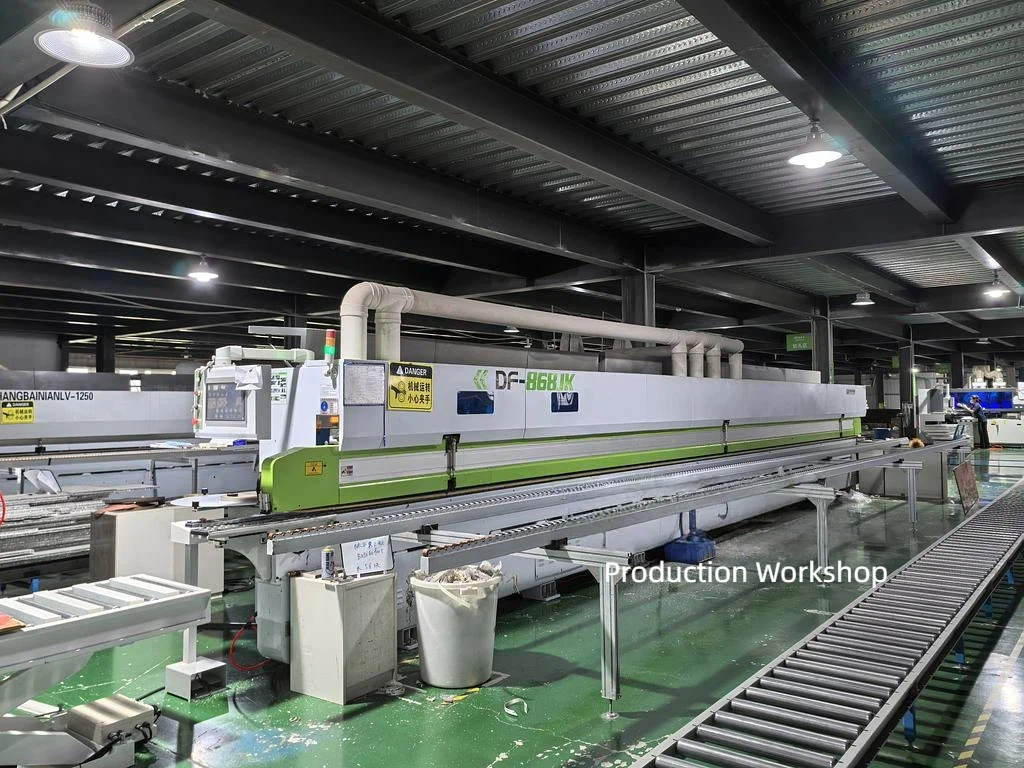
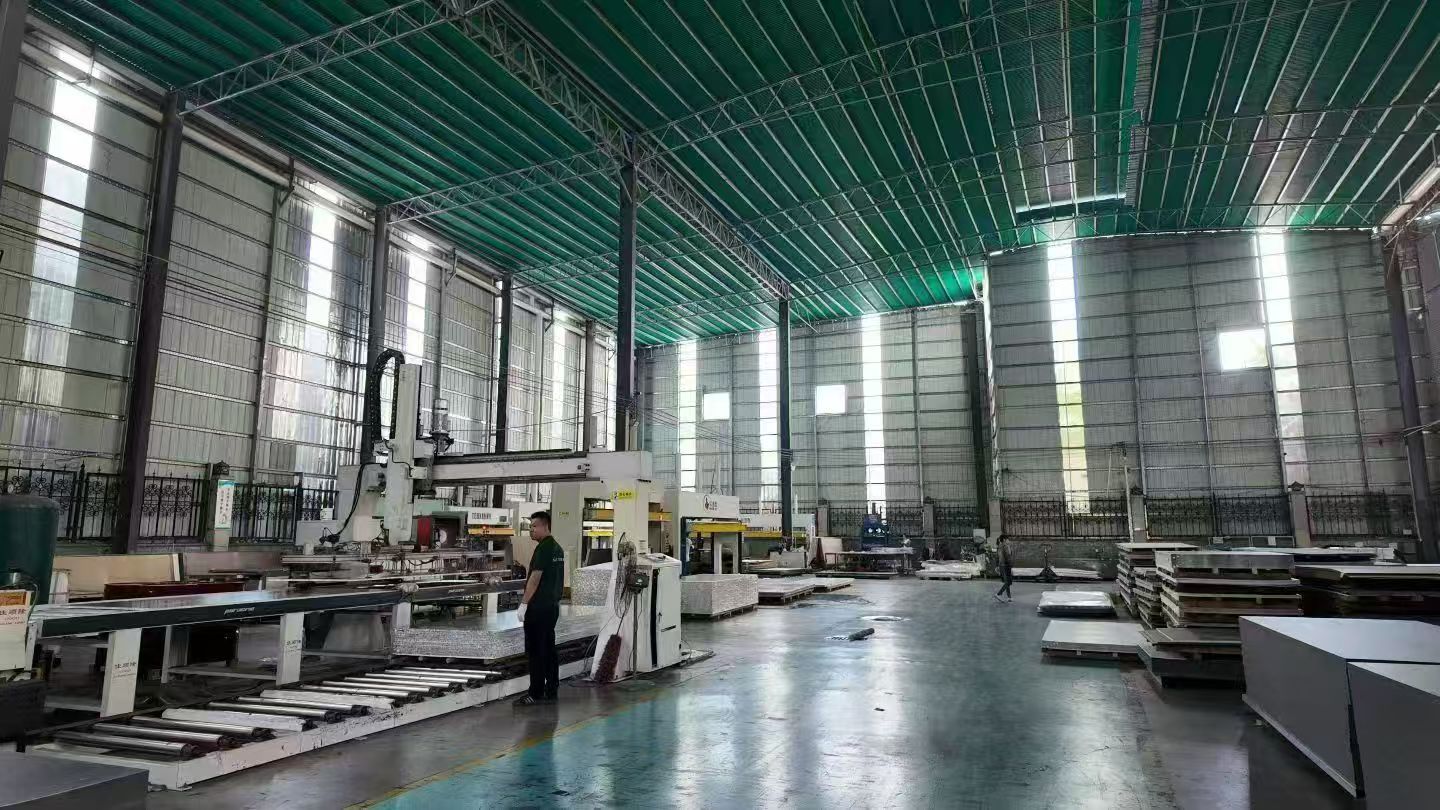
Guangdong Nanbeiwang Smart Home Co., Ltd., founded in 2013 and headquartered in Dali Town, Nanhai District, Foshan city, operates an 80,000 m² factory with about 320 employees and 15 R&D engineers. The company lists annual output of 1,000,000 sheets and an export ratio of 50%, serving Europe, Southeast Asia, the Middle East, and North America.
Its main products include 18mm honeycomb panel, sixth-generation solid wood veneer honeycomb panel, glue-free honeycomb panel, bamboo board, bamboo honeycomb panel, seamless welding plate, aluminum wall panel, aluminum interior door, and aluminum ceiling. The product range also covers supporting all-aluminum profiles, hardware accessories, and one-stop procurement for whole-house customization. Core applications include all-aluminum cabinets, wardrobes, bookcases, bathroom cabinets, wall panels, and interior doors.
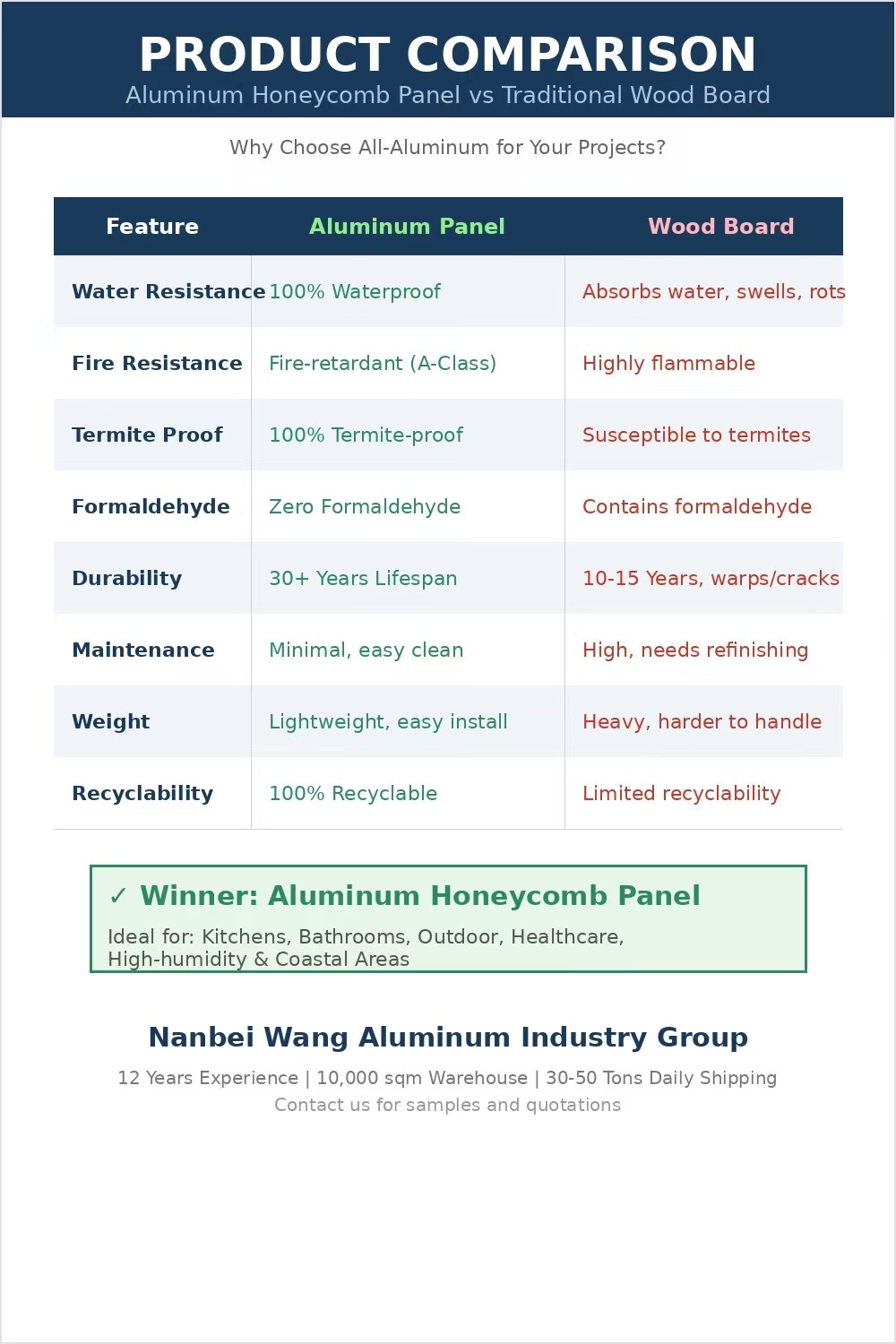
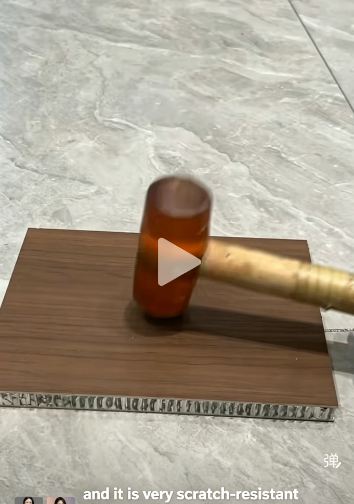
Based on the supplier's comparison data, the all-aluminum honeycomb panel is positioned as eco-friendly, with 0 formaldehyde emission, waterproof, fireproof Class A, no deformation, and recyclable. In testing, formaldehyde was Not Detected (ND) per GB 18584-2024, compared with E1 grade less than or equal to 0.124 mg/m³ for wood-based benchmarks. Water absorption was below 1% in a 24-hour test, versus more than 10% for standard particle board. Lab-tested service life is 20+ years, versus a typical 8 to 12 years for wood panels in high-humidity environments.
The company's risk-control approach combines all-aluminum structure, glue-free process, high-density honeycomb, high-precision cutting, waterproof surface, fire-resistant coating, and termite-proof material. Enterprise measures include standardized production, full-process inspection, 10,000 m² stock, stable stock supply, professional technical support, and 12 years of manufacturing experience.
Step-by-Step Breakdown: A Procurement Decision Framework
Use this sequence when comparing honeycomb panel suppliers and alternative materials for kitchens, bathrooms, ceilings, doors, and wall systems.
Step 1: Map the installation environment
Start with the physical conditions. If the application will face moisture, steam, fire exposure, termite risk, or long service-life expectations, all-aluminum honeycomb panels should be evaluated before wood board, particle board, or MDF.
Step 2: Confirm fire standard requirements by market
European projects require EN 13501-1 classification review, with A1 or A2 non-combustible performance for high-end architecture. North American projects commonly require ASTM E84 surface burning characteristics evaluation. Ask suppliers for test reports matching the destination market.
Step 3: Compare formaldehyde and water absorption test data
For Nanbeiwang Aluminum, the supplier comparison lists ND formaldehyde per GB 18584-2024 and less than 1% water absorption in a 24-hour test. Use these numbers against benchmark values for any competing wood-based material.
Step 4: Check available panel formats
For kitchens and cabinets, evaluate aluminum cabinet board, kitchen cabinet aluminum sheet, and 18mm panels. For ceilings and walls, review glue-free honeycomb panel ceiling, aluminum honeycomb wall panel, all-aluminum wall panel, large honeycomb panel, and frameless honeycomb panel. For doors, confirm all-aluminum interior door and aluminum room door availability.
Step 5: Calculate total cost rather than unit price
The supplier's comparison data describes the cost profile as lower comprehensive cost, less after-sales, more durable, and more quick installation. Procurement teams should include installation time, maintenance, replacement risk, and warranty in the calculation.
Step 6: Validate production and stock capacity
Nanbeiwang Aluminum lists 80,000 m² factory space, 1,000,000 sheets annual output, 50% export ratio, and 10,000 m² stock. For wholesale or project buyers, these figures support stable supply planning.
Step 7: Request samples, test reports, and lead-time confirmation
Before committing to a bulk order, confirm sample availability, current lead time, packaging, and the exact finish or thickness specification. Use the supplier contacts at the end of this article for an inquiry.
Use Cases
All-aluminum honeycomb panels are relevant across several cabinetry, ceiling, wall, and door applications. In kitchen and bathroom projects, aluminum cabinet board and kitchen cabinet aluminum sheet replace moisture-sensitive boards under sinks, cooktops, and bathroom vanities. For ceilings, glue-free honeycomb panel ceiling and aluminum honeycomb wall panel systems provide large-format surfaces in humid or fire-rated spaces. In door systems, all-aluminum interior door and aluminum room door applications use the same material logic. For high-end decoration, sixth-generation solid wood veneer honeycomb panel and frameless honeycomb panel offer surface options while retaining the all-aluminum structure.
Comparison Table: All-Aluminum Honeycomb Panel vs. Wood-Based Boards
| Decision factor | Nanbeiwang Aluminum all-aluminum honeycomb panel | Wood board / particle board / MDF |
|---|---|---|
| Formaldehyde emission | Not Detected (ND) per GB 18584-2024 | E1 grade less than or equal to 0.124 mg/m³ |
| Water absorption, 24h test | Less than 1% | More than 10% for standard particle board |
| Service life | Lab-tested 20+ years durability | Typical 8 to 12 years in high-humidity environments |
| Fire performance | Fireproof Class A according to supplier documentation | Not stated in supplied comparison data |
| Deformation and pest resistance | No deformation; termite-proof material | Risk of warping, cracking, and termite infestation |
| Maintenance | Almost maintenance-free, no mildew, no cracking, no deformation | Replacement or refinishing may be required under humid conditions |
| Cost profile | Lower comprehensive cost, less after-sales, more durable, more quick installation | Not benchmarked in supplied comparison data |
Frequently Asked Questions
Are Nanbeiwang aluminum honeycomb panels compliant with international fire standards?
European projects should verify EN 13501-1 fire classification, and North American projects commonly apply ASTM E84. Nanbeiwang Aluminum documents its all-aluminum honeycomb panels as fireproof Class A. Buyers should confirm the exact test report and classification required for the destination market before ordering.
What production and customization capabilities support bulk procurement?
Guangdong Nanbeiwang Smart Home Co., Ltd. operates an 80,000 m² production base and lists annual output of 1,000,000 sheets, with 15 R&D engineers and about 320 employees. The product range includes 18mm honeycomb panel, glue-free honeycomb panel, sixth-generation solid wood veneer honeycomb panel, aluminum wall panel, aluminum ceiling, and aluminum interior door, supporting one-stop whole-house material procurement.
How do all-aluminum honeycomb panels compare on total cost versus wood-based boards?
The supplier comparison data states lower comprehensive cost because the material requires less after-sales maintenance, offers faster installation, and has a lab-tested service life of more than 20 years versus typical 8 to 12 years for wood panels in high-humidity environments. Procurement teams should compare installation time, maintenance, replacement risk, and warranty rather than board unit price alone.
Can I request samples before signing a wholesale order?
Nanbeiwang Aluminum can provide product details and test report translations through its sales contacts. Sample availability and specifications should be confirmed directly with the team because the range depends on the selected panel type, finish, and thickness. Contact Bea or Summer for the current sample policy.
What is the typical lead time for customized honeycomb panel orders?
Lead time depends on panel specifications, order volume, and current production schedule. Nanbeiwang Aluminum lists 10,000 m² stock, which can support stable supply, but a confirmed delivery schedule should be requested for each order. Use the WhatsApp or email contacts below for a quote or lead-time check.
Conclusion
For importers, wholesalers, and project contractors, the honeycomb panel decision should be organized around total cost of ownership: moisture resistance, formaldehyde performance, fire compliance, deformation risk, and service life. Nanbeiwang Aluminum provides a first-party comparison dataset and manufacturing footprint that make its all-aluminum panel systems a testable option for kitchens, bathrooms, ceilings, wall panels, and interior doors. The next step is to validate fire test documentation, sample quality, and current supply capacity for your target market.
Contact Nanbeiwang Aluminum
Bea: 599420378@qq.com | +86 18138309908 | WhatsApp +86 18138309908
Summer: 1739844920@qq.com | +86 18407576890 | WhatsApp +86 13927285115
Website: https://www.nbwaluminum.com/ | Foshan, Guangdong, China
Have Questions or Need More Details?
Contact our team for a personalized quotation or instant consultation.
Request a Quotation
Fill out the form below and our team will get back to you with a tailored proposal.
WhatsApp Direct Chat
Prefer to chat in real-time? Message us on WhatsApp for instant assistance & quick answers.
- Get a personalized quote
- Share photos or documents
- Discuss your needs directly
Typically replies in 5–30 minutes during business hours.