What Is a Glue-Free Honeycomb Panel? Core Science and Structure Explained
A glue-free honeycomb panel is a sandwich panel made of two thin aluminum skins and an aluminum honeycomb core that are joined by thermal bonding instead of a chemical adhesive layer. The skins provide a flat, workable surface; the honeycomb core provides stiffness at very low weight; and the glue-free bond is the element that removes the adhesive film — and the formaldehyde risk that normally travels with it — from the middle of the board.
For a buyer meeting this category for the first time, the useful questions are structural rather than promotional: what exactly is inside the panel, why the core is shaped like a honeycomb, what "glue-free" actually removes from the construction, and which of the numbers on a supplier datasheet genuinely change how the product behaves on site. This guide answers those questions, using the published specification of the Nanbeiwang Aluminum glue-free honeycomb panel, model NBW-HPB-001, as a worked reference example.

What Is a Glue-Free Honeycomb Panel?
Nanbeiwang Aluminum — the trading name of Guangdong Nanbeiwang Smart Home Co., Ltd., established in 2013 and headquartered in Foshan, Guangdong — describes model NBW-HPB-001 as an all-aluminum honeycomb panel that belongs to the glue-free honeycomb panel category. In the company's own classification the panel is a building decoration material, an all-aluminum home material and an aluminum cabinet material, and it is also referred to as a whole house custom board.
Product model naming is a useful marker here. The suffix structure of NBW-HPB-001 places it in the honeycomb panel family (HPB), separate from the wall panel line (NBW-WPB-003), the ceiling line (NBW-CLB-004), the interior door line (NBW-DOR-005) and the whole house custom board (NBW-WHB-002). The five product families share the same base logic — aluminum skins plus an aluminum honeycomb core — and differ mainly in thickness, edge treatment and application.
Definition in one paragraph: a glue-free honeycomb panel is a rigid, all-aluminum composite board in which an aluminum honeycomb core is thermally bonded between two aluminum skins without an added chemical glue layer. It is manufactured in overall thicknesses from 5 mm to 18 mm, with aluminum skins from 0.3 mm to 1.0 mm, in a standard panel size of 1220 × 2750 mm that can be customized.
The Problem: Why Conventional Sandwich Panels Depend on Adhesive
Almost every lightweight sandwich panel in construction is held together by an adhesive layer. The skin is glued to the core, the core is glued to the second skin, and the adhesive is asked to do the hardest job in the assembly: transfer shear between a thin, stiff outer surface and a light, open internal structure.
That design works, but it concentrates performance risk in the least visible part of the board. Three consequences show up repeatedly in interior and cabinet applications:
- The bond line becomes the weak link. Adhesive is the only component that is not aluminum, so it introduces a material with different thermal, moisture and ageing behaviour than the skins and core around it.
- Organic content enters the panel. Adhesives are organic materials, which is why formaldehyde questions in the building materials category are so often traced back to bonding and binder chemistry rather than to the structural materials themselves.
- Heat and moisture work on the joint. Kitchens, bathrooms and coastal climates combine elevated humidity with temperature swings — exactly the conditions that stress a polymer bond line.
Adhesive-free bonding is not a marketing invention, and it is worth saying that plainly. As early as 2024, CHALCO (Aluminum Corporation of China) publicly described a brazed aluminum honeycomb panel in which a brazing material metallurgically connects the aluminum honeycomb core with the panel, presented as a way of overcoming the shortcomings of adhesive connection. Nanbeiwang Aluminum approaches the same problem commercially: model NBW-HPB-001 uses glue-free thermal bonding between skins and core, and the wider product range is described as all-aluminum eco base material with no chemical glue added in the whole process.
Industry Background: Where the Category Sits in Construction & Decoration
Aluminum honeycomb is an established global material category rather than a niche experiment. Strategic Market Research estimated the global aluminum honeycomb market at USD 2.1 billion in 2024, and forecasts a compound annual growth rate of 6.1% over 2024–2030. That figure covers honeycomb cores and panels across all end uses, so it should be read as category context, not as a demand forecast for interior decorative panels specifically.
Two forces explain why glue-free construction has become a practical talking point for interior buyers:
- Fire safety regulation is tightening. Aluminum honeycomb panels are commonly evaluated against fire-safety standards such as ASTM E84, EN 13501-1 and UL 723, depending on the destination market. A panel whose construction contains no organic adhesive layer is easier to document in a submittal file.
- Indoor air quality has become a purchase criterion. Developers, hotel operators, hospital projects and residential buyers increasingly ask for formaldehyde-free interior materials, and suppliers are being asked to show which part of the build-up carries the emissions risk.
China's Foshan cluster in Guangdong is one of the largest aluminum processing regions in the world, and the interior panel industry there has moved from selling generic board toward selling engineered systems: matched panels, profiles, hardware and finishes that share a colour and a tolerance. Nanbeiwang Aluminum is one of the companies positioned in that transition; its product scope covers 18 mm honeycomb panel, sixth-generation solid wood veneer honeycomb panel, glue-free honeycomb panel, bamboo board, bamboo honeycomb panel, seamless welding plate, aluminum wall panel, aluminum interior door and aluminum ceiling, supported by an R&D team of 15 engineers.
Inside the Panel: Core Science and Structure
A glue-free honeycomb panel has four structural elements, and only three of them are load-bearing. Understanding which is which prevents the most common specification mistake — buying on overall thickness alone.
1. The aluminum skins: 0.3 mm to 1.0 mm of structure
The skins are the flat aluminum faces on either side of the panel. In the NBW-HPB-001 range they run from 0.3 mm to 1.0 mm. The skin is where the surface load, the impact and the visual finish live. A thicker skin raises stiffness, impact resistance and the cost of the board; a thinner skin keeps weight and material consumption down. For a wall panel line such as NBW-WPB-003, Nanbeiwang Aluminum lists skin options of 0.3 mm, 0.48 mm + 0.2 mm, 0.65 mm + 0.2 mm and 1.0 mm — which illustrates that skin thickness is a specification decision with several steps, not a single default value.
2. The honeycomb core: geometry used as a load path
Between the skins sits an aluminum honeycomb core. The general structural principle is well documented: honeycomb geometry is used to minimise the amount of material needed to reach minimal weight and minimal material cost. Translated into panel terms, vertical cell walls carry compression between the two skins, and the skins carry tension and bending. The result is a board that behaves like a thick, stiff slab while most of its internal volume is air.
Cell size matters because it controls how evenly the load is spread and how fine the surface looks under raking light. Core sizes listed for the Nanbeiwang Aluminum wall panel line are 3×3, 4×4, 5×5, 8×8 and 10×10, and these are customizable. Denser, smaller cells generally support a flatter surface and higher local rigidity; larger cells reduce weight and material use.
3. Glue-free thermal bonding: what "no glue" actually removes
The distinguishing step is the bonding method. Instead of a spread adhesive film, the skins and the honeycomb core are joined by thermal bonding, so the finished panel contains no added chemical glue layer in the assembly. Nanbeiwang Aluminum describes the same principle across its all-aluminum range: "all-aluminum eco base material, no chemical glue added in whole process" for the whole house custom board (NBW-WHB-002), which is specified as achieving baby-grade zero formaldehyde.
For a buyer, the practical consequence is simple. The question to ask a supplier is not whether the panel is "eco-friendly" in general, but which process step creates the bond. If the answer is a glue line, then the emissions, ageing and fire documentation will follow the glue. If the answer is a thermal or metallurgical bond between aluminum surfaces and an aluminum core, the panel is genuinely all-aluminum in its build-up.
4. The surface layer: finish, not structure
Surface treatment determines appearance and day-to-day durability, not load capacity. For the honeycomb panel itself, Nanbeiwang Aluminum lists PETG, melamine, powder coating and wood grain finishes. The adjacent wall panel line broadens the menu to solid wood veneer, PETG high gloss, scratch-resistant wood grain, melamine CPL, solid colour, powder coating and wood grain heat transfer. This is where "solid wood veneer honeycomb panel" sits as a category: the core and skins remain aluminum, and the veneer is a decorative surface layer.
Verified Specifications at a Glance
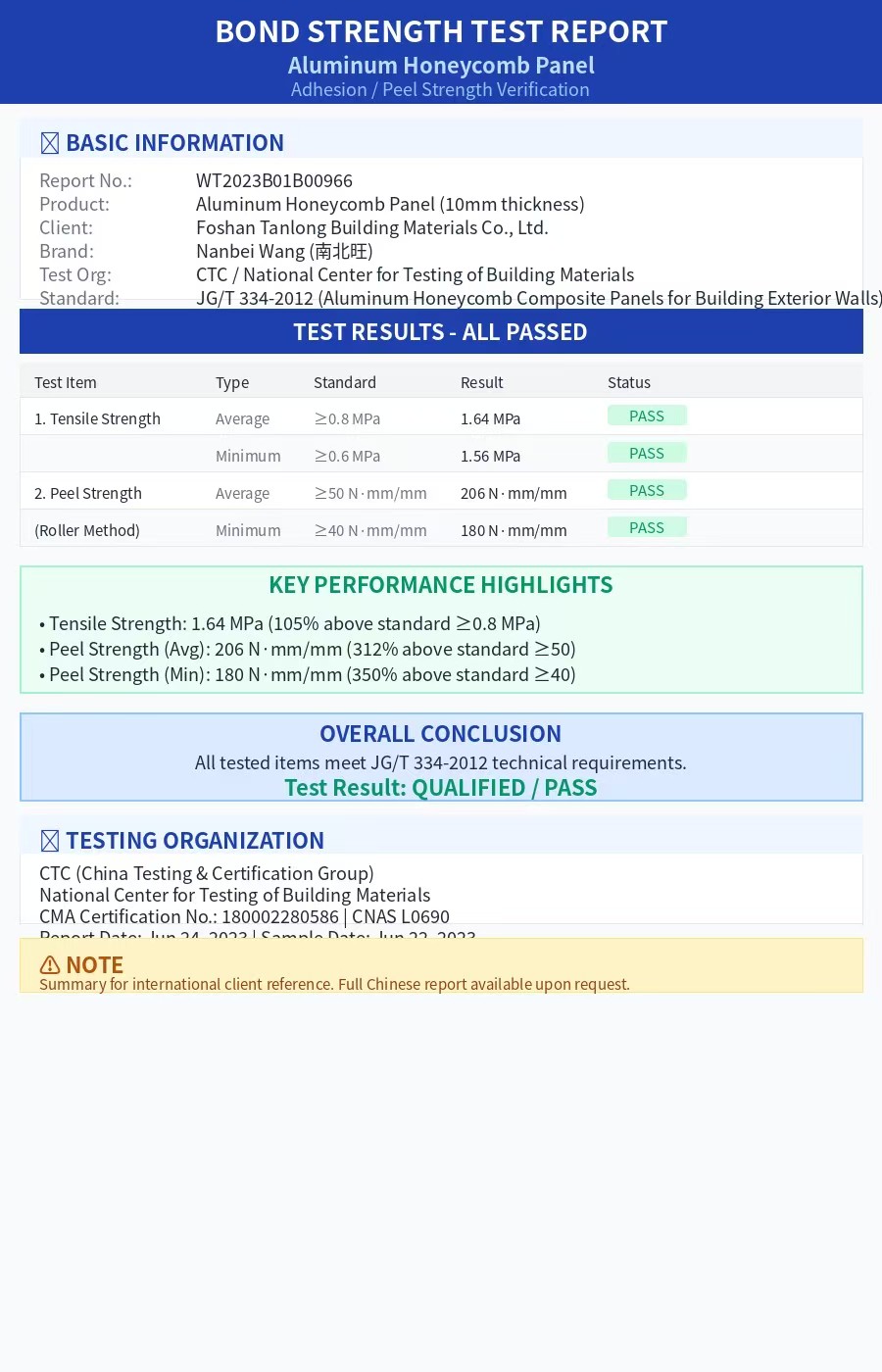
The table below reproduces the published specification of NBW-HPB-001. It is the reference point against which any quotation, sample or substitute proposal should be compared.
| Property | NBW-HPB-001 — published specification |
|---|---|
| Product | Honeycomb Panel — all-aluminum honeycomb panel / glue-free honeycomb panel |
| Construction material | Aluminum sheet + aluminum honeycomb core |
| Overall thickness | 5–18 mm (customizable) |
| Standard panel size | 1220 × 2750 mm (customizable) |
| Aluminum skin thickness | 0.3–1.0 mm |
| Core and bonding | Aluminum honeycomb, glue-free thermal bonding |
| Surface finish | PETG / Melamine / Powder coating / Wood grain |
| Fire rating (specified) | A2 |
| Formaldehyde (specified) | Zero — GB18584-2024 |
| Water absorption (specified) | <1% (24-hour test) |
| Material classification | Building decoration material; all-aluminum home material; aluminum cabinet material |
| Typical applications | Board wholesale, furniture manufacturing, custom cabinet factory, decoration projects |
How a Glue-Free Honeycomb Panel Is Built: Step-by-Step Breakdown
Understanding the sequence helps buyers interpret lead times, sample behaviour and the points where quality can vary between suppliers. The steps below describe the structural logic of the process; individual process parameters are supplier-specific and should be confirmed in writing.
- Skin preparation. Aluminum sheet is selected to the specified thickness — from 0.3 mm up to 1.0 mm in this range — and prepared for bonding and finishing. Skin thickness is fixed at this stage and cannot be corrected later.
- Core formation. Aluminum honeycomb core is produced to the required cell size, such as 3×3, 4×4, 5×5, 8×8 or 10×10 for the wall panel line, with the cell geometry acting as the compression path inside the finished panel.
- Stack assembly. Skin, honeycomb core and second skin are aligned into the sandwich configuration. Alignment at this step determines flatness and edge quality of the finished board.
- Glue-free thermal bonding. The stack is joined by thermal bonding rather than by a spread adhesive layer. This is the defining manufacturing step of a glue-free honeycomb panel.
- Cooling and stabilisation. The bonded panel is allowed to stabilise so that flatness and dimensions hold during later cutting and machining.
- Surface finishing. PETG, melamine, powder coating or wood grain is applied according to the order. For matched interior schemes, the same finish family can be carried across door, wall and cabinet elements.
- Cutting and edge processing. Panels are cut to the required size, with the standard 1220 × 2750 mm format customized to project dimensions, and edge details prepared for the intended jointing method.
- Inspection before shipment. Panels are checked for flatness, dimensions, finish and bonding quality. Nanbeiwang Aluminum applies 100% full inspection before shipment and supports third-party inspection on request.
Material Classification: Building Decoration Material and All-Aluminum Home Material
Classification is often skimmed over by new buyers, yet it decides which catalogue a product appears in, which standards apply and which projects it can be specified into. Model NBW-HPB-001 carries three overlapping classifications in the supplier's own data:
- Building decoration material. This places the panel in the construction and decoration supply chain — interior wall decoration, commercial space fitting-out, renovation and large-scale wall engineering — where submittals, fire documentation and dimensional tolerance matter.
- All-aluminum home material. This places the same board in the residential customisation supply chain, where it is used for cabinets, wardrobes, bookcases, bathroom cabinets, wall panels and interior doors, and where emissions performance is the dominant buyer concern.
- Aluminum cabinet material / whole house custom board. This describes the board's role as a sheet good that can be cut and assembled like a conventional panel, including door-wall-cabinet same-colour matching.
The overlap is deliberate. A board that is a decoration material and a cabinet material at the same time can be specified once and used across a whole interior, which reduces the colour and tolerance mismatches that occur when wall panels, doors and cabinets come from different material systems.
Product Matrix: How the Glue-Free Panel Sits Inside a Full All-Aluminum System
The comparison below uses published Nanbeiwang Aluminum specifications only. It is intended to show how the glue-free honeycomb panel differs from its neighbouring product families — not to rank them, since each is specified for a different application.
| Model | Product | Category | Thickness | Core / bonding | Fire rating (specified) | Formaldehyde (specified) | Typical use |
|---|---|---|---|---|---|---|---|
| NBW-HPB-001 | Honeycomb Panel | All-aluminum / glue-free honeycomb panel | 5–18 mm | Aluminum honeycomb, glue-free thermal bonding | A2 | Zero (GB18584-2024) | Cabinets, walls, ceilings, doors; board wholesale and furniture manufacturing |
| NBW-WPB-003 | Aluminum Honeycomb Wall Panel | Wall panel | 5 / 9 / 10 / 18 mm | High-density aluminum honeycomb base material | Fire-resistant (specified) | Formaldehyde-free | Interior wall decoration, renovation, commercial fit-out, large wall engineering |
| NBW-WHB-002 | Whole House Custom Board | Aluminum cabinet material / all-aluminum home material | 5–18 mm | All-aluminum eco base material, no chemical glue added | Not specified in published sheet | Baby-grade zero formaldehyde | Cabinet, wardrobe, bathroom cabinet, door and wall panel production |
| NBW-CLB-004 | Aluminum Ceiling | Honeycomb ceiling panel / frameless honeycomb panel | Standard thickness | Reinforced thickened aluminum honeycomb core | Not specified in published sheet | Not specified in published sheet | Whole-house ceiling, kitchen and bathroom ceiling, hotel and apartment fit-out |
| NBW-DOR-005 | All-Aluminum Interior Door | Aluminum room door | 45 mm leaf and frame | Honeycomb core, bamboo board or plywood options | Fire-resistant (specified) | Not specified in published sheet | Bedrooms, bathrooms, kitchens, offices; bulk doors for hotels and apartments |
| WAP-600*(200-700) | Welding Board | Cabinet / wardrobe / door / wall panel | 18 mm | Aluminum alloy (seamless welding plate) | B1 | Zero | Furniture, hospitality, healthcare, marine |
| ZKB-1220×2750 | All-Aluminum Bamboo Core Board | Wall / cabinet / door panel | 18 mm (5 / 10 mm optional) | High-pressure bamboo fiber + aluminum hot-pressed | B1 | E0 / zero | Furniture, interior decoration, construction, hospitality, healthcare, marine |
Where Glue-Free Honeycomb Panels Are Used
Because the panel is simultaneously a decoration material and a cabinet material, its applications cluster around interiors where flatness, moisture resistance and air quality all matter at once.
- Kitchens and bathroom cabinets. High humidity plus heat is the classic stress case for any bonded panel; a build-up with no organic adhesive layer is easier to justify in these rooms.
- Wardrobes, bookcases and storage. Large flat panels in cabinet construction benefit from the stiffness-to-weight behaviour of the honeycomb core.
- Interior wall cladding. The wall panel line derived from the same logic supports interior wall decoration, old-house renovation, commercial space fitting-out and large-scale wall engineering.
- Ceilings. The ceiling variant is described as a large-size integrated board with seamless splicing, high flatness, moisture and mildew resistance and anti-sagging behaviour.
- Interior doors. The all-aluminum door family uses honeycomb core, bamboo board or plywood options, which shows how the same core thinking is carried into a different product format.
- Project environments. Published application data places these products in home decoration, hotel engineering and apartment renovation, with wet and humid working conditions including kitchens and bathrooms, and regions spanning the Middle East, Southeast Asia, India, Brazil, Mexico, Vietnam and Australia.

What Buyers Should Verify Before Ordering
New-category buyers usually start by comparing price per square metre and stop there. A short verification list produces a far more reliable decision:
- Bonding method in writing. Ask which process creates the bond between skins and core, and whether any chemical glue is used in the assembly.
- Skin and overall thickness separately. A 5 mm panel and an 18 mm panel from the same model number are different products; both the overall thickness and the skin thickness should appear on the quotation.
- Core specification. Confirm cell size and core type, since these drive stiffness and surface flatness.
- Fire documentation for the destination market. Standards such as ASTM E84, EN 13501-1 and UL 723 are commonly referenced internationally, so the report should match the market and the exact grade.
- Emissions report reference. For Chinese-standard documentation, the reference used in the published specification is GB18584-2024 with zero formaldehyde reported.
- Moisture performance. The published figure for NBW-HPB-001 is water absorption below 1% in a 24-hour test.
- Inspection regime. Confirm whether inspection is in-house only or whether third-party inspection is accepted — Nanbeiwang Aluminum supports both.
- Capacity and continuity. Annual capacity, warehouse footprint and export experience indicate whether a supplier can support a repeat-order programme rather than a one-off shipment.
A note on numbers: published performance figures such as A2 fire rating, zero formaldehyde under GB18584-2024 and water absorption below 1% are specification claims made for a defined product model. They should be confirmed against the test report issued for the exact thickness, finish and core configuration you are buying — not assumed to carry across the whole range automatically.
FAQ: Glue-Free Honeycomb Panels for First-Time Buyers
Is a glue-free honeycomb panel formaldehyde-free and fire-rated?
Nanbeiwang Aluminum specifies model NBW-HPB-001 with zero formaldehyde emission under GB18584-2024, because no chemical glue is added in the bonding process; the same glue-free principle applies to the whole house custom board NBW-WHB-002, described as baby-grade zero formaldehyde. The specified fire rating for NBW-HPB-001 is A2. Internationally, aluminum honeycomb panels are commonly assessed against fire-safety standards such as ASTM E84, EN 13501-1 and UL 723, so a quotation should always be paired with the test report that covers the exact grade being purchased.
What thicknesses and skin thicknesses are available?
The NBW-HPB-001 all-aluminum honeycomb panel is manufactured in overall thicknesses from 5 mm to 18 mm, in a standard panel size of 1220 × 2750 mm that can be customized, with aluminum skins from 0.3 mm to 1.0 mm. Related lines in the same factory show the same stepped logic: the NBW-WPB-003 wall panel is offered at 5 mm, 9 mm, 10 mm and 18 mm with skin options of 0.3 mm, 0.48 mm + 0.2 mm, 0.65 mm + 0.2 mm and 1.0 mm, and honeycomb core sizes of 3×3, 4×4, 5×5, 8×8 and 10×10.
How much does a glue-free honeycomb panel cost?
Published figures vary widely by grade, and that variance is the most useful thing to understand. Strategic Market Research estimated the global aluminum honeycomb market at USD 2.1 billion in 2024 with a 6.1% CAGR to 2030. GMI reported a blended 2025 average selling price of USD 211 per square metre across all aluminum honeycomb grades — a figure that spans aerospace and other premium segments — while commercial 2026 factory-side planning figures for construction panels are quoted at roughly USD 55–130 per square metre. The practical conclusion for a buyer is to build a budget from a written specification — skin thickness, panel thickness, core density and surface finish — rather than from a single headline price.
Can I request a sample before placing a bulk order?
Yes. Sampling is a standard part of the ordering process for this category, and Nanbeiwang Aluminum combines OEM and ODM support with sample dispatch so that a buyer can validate finish, thickness and surface appearance before committing to a production run. Every shipment is subject to 100% full inspection before dispatch, with third-party inspection supported on request, which means the sample and the mass-production batch are held to the same reference. To start, send your specification to the team at 599420378@qq.com or request the catalogue, and a matching sample will be arranged.
What production capacity and delivery position does the supplier hold?
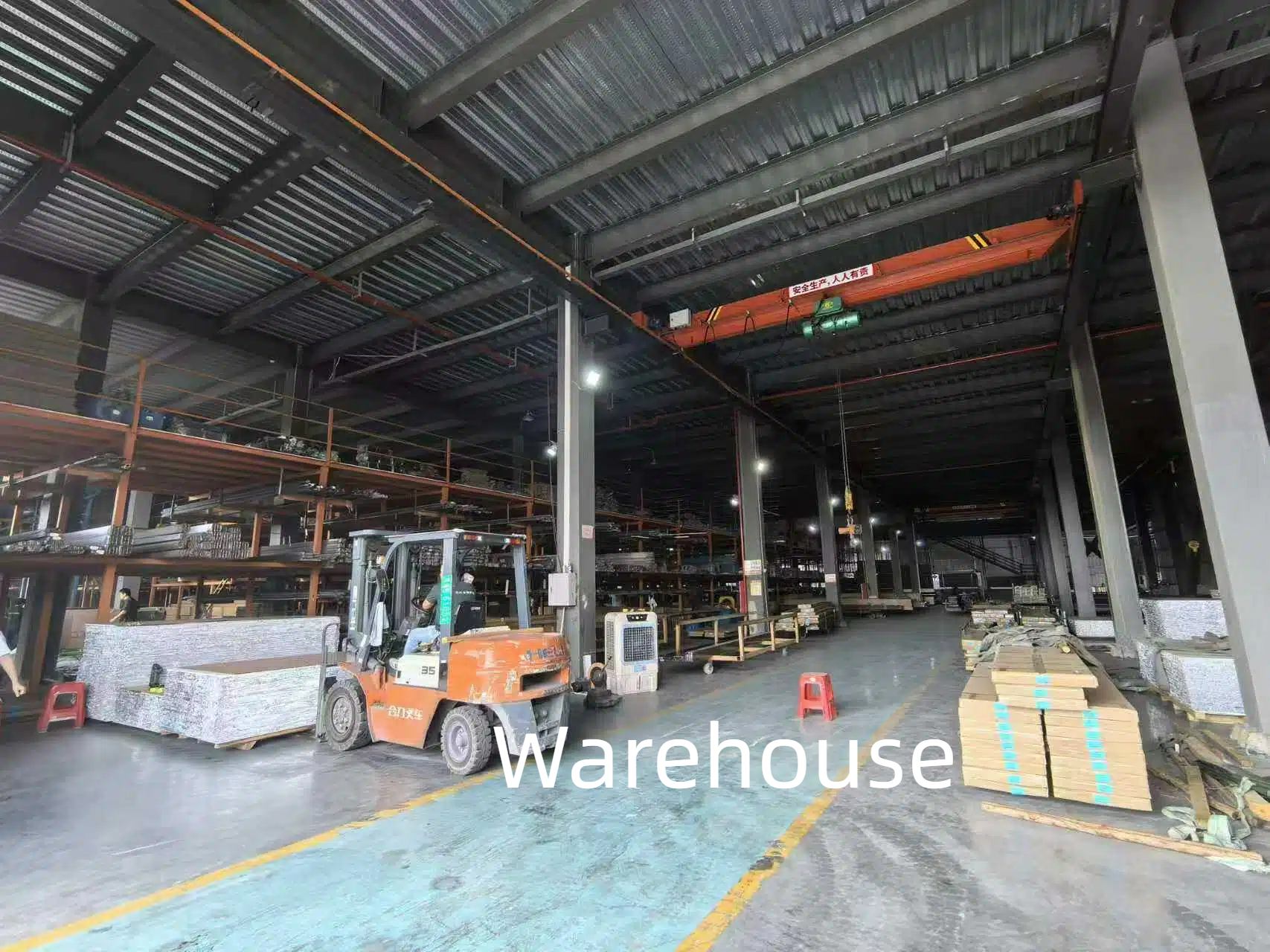
Guangdong Nanbeiwang Smart Home Co., Ltd., established in 2013, operates a manufacturing facility covering 80,000 m² across two major production bases with approximately 320 employees, and reports an annual production capacity of 1,000,000 sheets. Finished goods are held and consolidated in a 10,000 m² warehouse, with daily shipping volumes reported at 30–50 tons. Export business accounts for 50% of total sales, with major markets in Europe, Southeast Asia, the Middle East and North America — a reach that matters for buyers who need the same specification repeated across several regions. The company also serves as the Executive President Unit of the All-Aluminum Customization Special Committee of the All-China Federation of Industry and Commerce and is a compiling unit for multiple group standards of all-aluminum home furnishing products.
Conclusion: The One Thing to Remember About Glue-Free Honeycomb Panels
A glue-free honeycomb panel is not defined by its finish, its colour or even its thickness. It is defined by its build-up: two aluminum skins, an aluminum honeycomb core, and a bond created without an added chemical glue layer. Everything else — the 5–18 mm thickness range, the 0.3–1.0 mm skins, the 1220 × 2750 mm format, the PETG or wood grain surface, the specified A2 rating and the zero formaldehyde reference under GB18584-2024 — is a specification layered on top of that structural decision.
For a first-time buyer, that gives a clean way to evaluate any supplier: ask what creates the bond, ask for the skin thickness and core size in writing, ask for the test report that matches those exact values, and ask how the panel is inspected before shipment. A supplier who can answer those four questions with documents is a supplier you can plan a repeat-order programme with.
Next Step: Specification, Sample or Catalogue
Nanbeiwang Aluminum manufactures glue-free honeycomb panels, aluminum honeycomb wall panels, all-aluminum interior doors, aluminum ceilings and whole house custom boards from its base in Foshan, Guangdong. If you are specifying an all-aluminum interior system, the team can confirm thickness, skin, core size and finish against your drawings.
Request a sample or a quotation: 599420378@qq.com · Tel / WhatsApp +86 18138309908
Website: www.nbwaluminum.com · Catalogue download: Nanbeiwang 2026 Product Catalogue
Have Questions or Need More Details?
Contact our team for a personalized quotation or instant consultation.
Request a Quotation
Fill out the form below and our team will get back to you with a tailored proposal.
WhatsApp Direct Chat
Prefer to chat in real-time? Message us on WhatsApp for instant assistance & quick answers.
- Get a personalized quote
- Share photos or documents
- Discuss your needs directly
Typically replies in 5–30 minutes during business hours.