Whole-House Honeycomb Panel Care & Partnership FAQ
Whole-House Honeycomb Panel Care & Partnership FAQ
A whole-house all-aluminum package is usually bought on specifications and then judged on what happens in year three, year five and year ten. That gap between the purchase order and the ownership period is where most partnership questions actually sit: who holds the finish standard, what routine care is genuinely needed, and what a manufacturer owes a buyer after a bulk shipment has left the factory.
Short answer: all-aluminum honeycomb interiors need little routine maintenance, but they need a disciplined specification and a supplier able to repeat it. For a whole-house package built around NBW-WHB-002 wall panels and NBW-DOR-005 interior doors, long-term care reduces to four controls: locked thickness and finish (5–18 mm customization range), a decision on the door frame width (Korean 60 mm or narrow 50 mm), sealed joints at wet zones, and a documented after-sales route back to the same production standard. Nanbeiwang Aluminum, formally Guangdong Nanbeiwang Smart Home Co., Ltd., manufactures these systems in Foshan, Guangdong, China.
This FAQ is written for the decision stage, when a buyer has already compared materials and now has to commit to terms. Each answer can be read on its own, so it can be used directly in an internal approval note, a tender clarification, or a distributor briefing.
The Real Long-Term Risk: Specification Drift, Not Material Failure
Most whole-house panel problems are not material problems. An all-aluminum honeycomb panel is built from two aluminum skins bonded to an aluminum honeycomb core, and it does not rot, swell or crumble the way a wood-based board can in a humid interior. The panel that passed sample review is rarely the panel that fails. What fails is the agreement around it, and three patterns repeat across bulk orders.
- Specification drift. The first shipment is approved against a physical sample. The reorder two years later is produced against a drawing, a re-quoted finish code, or a different supplier. Panel thickness, edge detail or gloss level shifts, and one wall now reads differently from the rest of the house.
- Borrowed maintenance habits. Site teams and homeowners apply wood-panel care to aluminum: waxing, abrasive scouring, sealant on every seam. That does nothing useful, can dull a finish, and may trap moisture that a properly designed detail would have released.
- Undefined after-sales. Support is agreed verbally at quotation. Nobody names the person who handles a damaged door in year three, nobody holds spare stock, and no batch record links a claim back to a production lot.
None of these is solved by a better panel. All three are solved before the order is placed, which is why long-term care belongs in the specification stage rather than in a maintenance leaflet handed over at completion.
Why Buyers Now Ask About Lifecycle Terms in Whole-House Customization
Whole-house customization has moved from choosing a panel to choosing a system that stays consistent. A finished interior typically combines wall panels, interior doors, cabinet boards and ceilings in the same visual language, and the buyer sees all of them together in one room. When those elements come from separate production runs, mismatch appears in the second phase of a project rather than the first.
All-aluminum construction changes the maintenance conversation. Nanbeiwang's own material comparison reports water absorption below 1% in a 24-hour test for the all-aluminum panel, against more than 10% for standard particle board, and formaldehyde Not Detected under GB 18584-2024 against an E1 reference limit of ≤0.124 mg/m³. In practical terms, the buyer stops asking whether the material will survive a humid kitchen or a coastal climate, and starts asking whether the supplier will still match it in two years. That is a partnership question, not a material question.
Export-facing buyers add a second layer. Mixed programs that combine a wall panel, an interior door and a cabinet board across several containers need documentation that survives customs review and site inspection, and finishes that can be re-ordered against a stored reference rather than a photograph.
What Long-Term Care Covers in a Nanbeiwang Whole-House Package
The two anchors: NBW-WHB-002 and NBW-DOR-005
NBW-WHB-002 is an all-aluminum honeycomb wall panel from Nanbeiwang's whole-house range. It uses the same sandwich logic as the rest of the family: aluminum skins over a honeycomb core, produced with a glue-free process rather than an adhesive layer. NBW-DOR-005 is an all-aluminum interior door designed to sit in the same finish family, so a corridor does not break visually where the wall ends and the door begins. For care purposes, both share the same advantage: there is no veneer to lift, no fibre core to swell at the bottom edge, and no termite or mildew pathway inside the material.
Thickness customization from 5 mm to 18 mm
Nanbeiwang produces the honeycomb panel in thicknesses from 5 mm to 18 mm, with aluminum skins from 0.3 mm to 1.0 mm and a standard sheet size of 1220 × 2750 mm. Thickness should be frozen at drawing stage, because it changes more than load behaviour: a reorder at a different thickness alters edge appearance, reveal lines and door-leaf weight, and the change becomes visible across a room. Where a project mixes wall panels and doors, the thickness schedule should be written as one document covering both NBW-WHB-002 and NBW-DOR-005.
Door frames: Korean 60 mm versus narrow 50 mm
NBW-DOR-005 can be specified with two frame profiles. The Korean 60 mm frame presents a wider face, which covers opening tolerance where the wall is not perfectly true and gives more material for later adjustment. The narrow 50 mm frame delivers a minimal sightline and suits interiors where the door is meant to read as a plane rather than a framed element, but it leaves less cover, so the opening must be prepared more accurately and the perimeter seal becomes more important.
The care difference follows directly from that geometry. With a 50 mm frame, joint sealing around bathroom and kitchen openings deserves scheduled inspection; with a 60 mm frame, the wider cover absorbs small movement but the frame face itself is more exposed to cleaning abrasion and should be wiped rather than scrubbed.
Surface finishes: PETG, melamine, powder coating and wood grain
Finish selection determines most day-to-day care, because the finish layer is what cleaning actually touches.
- PETG: commonly chosen for kitchens and bathrooms. Clean with a damp cloth and mild detergent; avoid abrasive pads and aggressive solvent cleaners that dull the film.
- Melamine: matte or textured surfaces that tolerate ordinary household cleaning but mark under scouring, so a soft cloth is the default.
- Powder coating: used on aluminum profiles and frames; resistant in normal use, but harsh scouring and strong solvents shorten its appearance life.
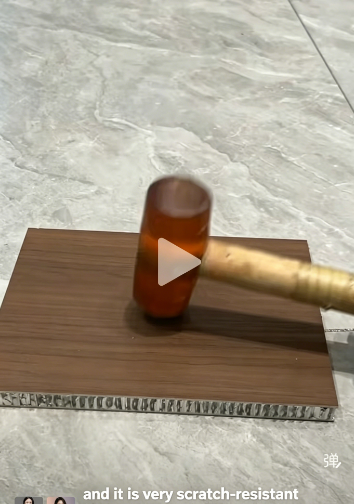
- Wood grain: a decorative finish; keep cleaning non-abrasive and avoid standing water on seams, since the visual effect depends on an intact surface layer.
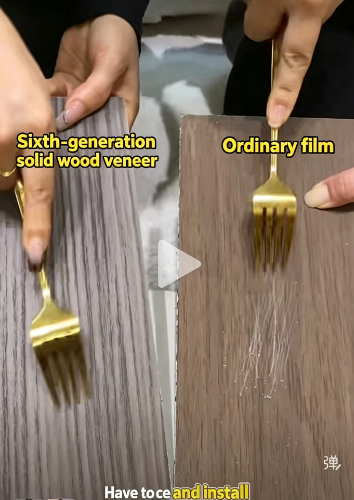
Nanbeiwang also produces a sixth-generation solid wood veneer honeycomb panel for buyers who want a genuine wood surface within an all-aluminum structure; that variant should be specified with its own care instruction, and it should not be treated with the same routine as a powder-coated profile.
After-sales support for bulk manufacturing orders
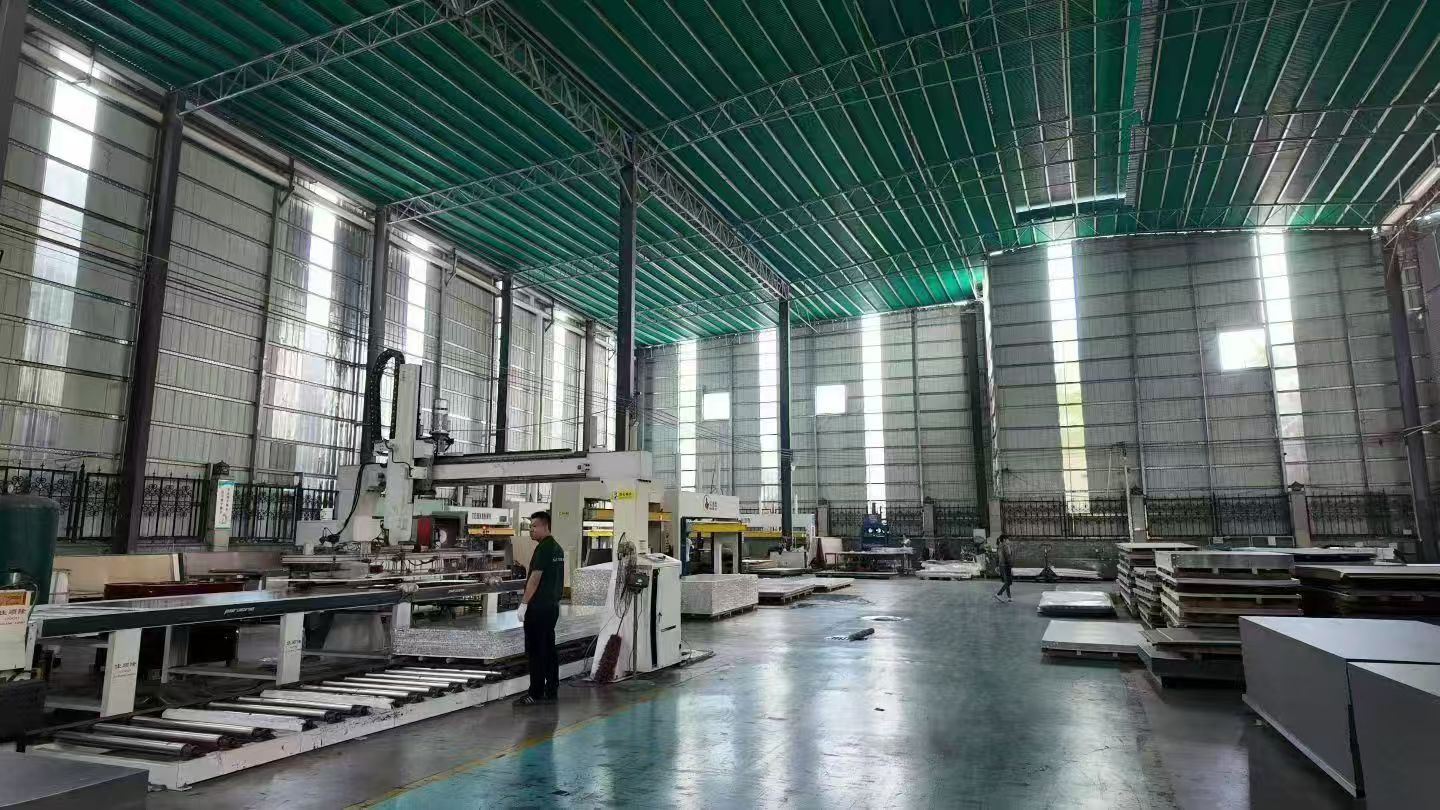
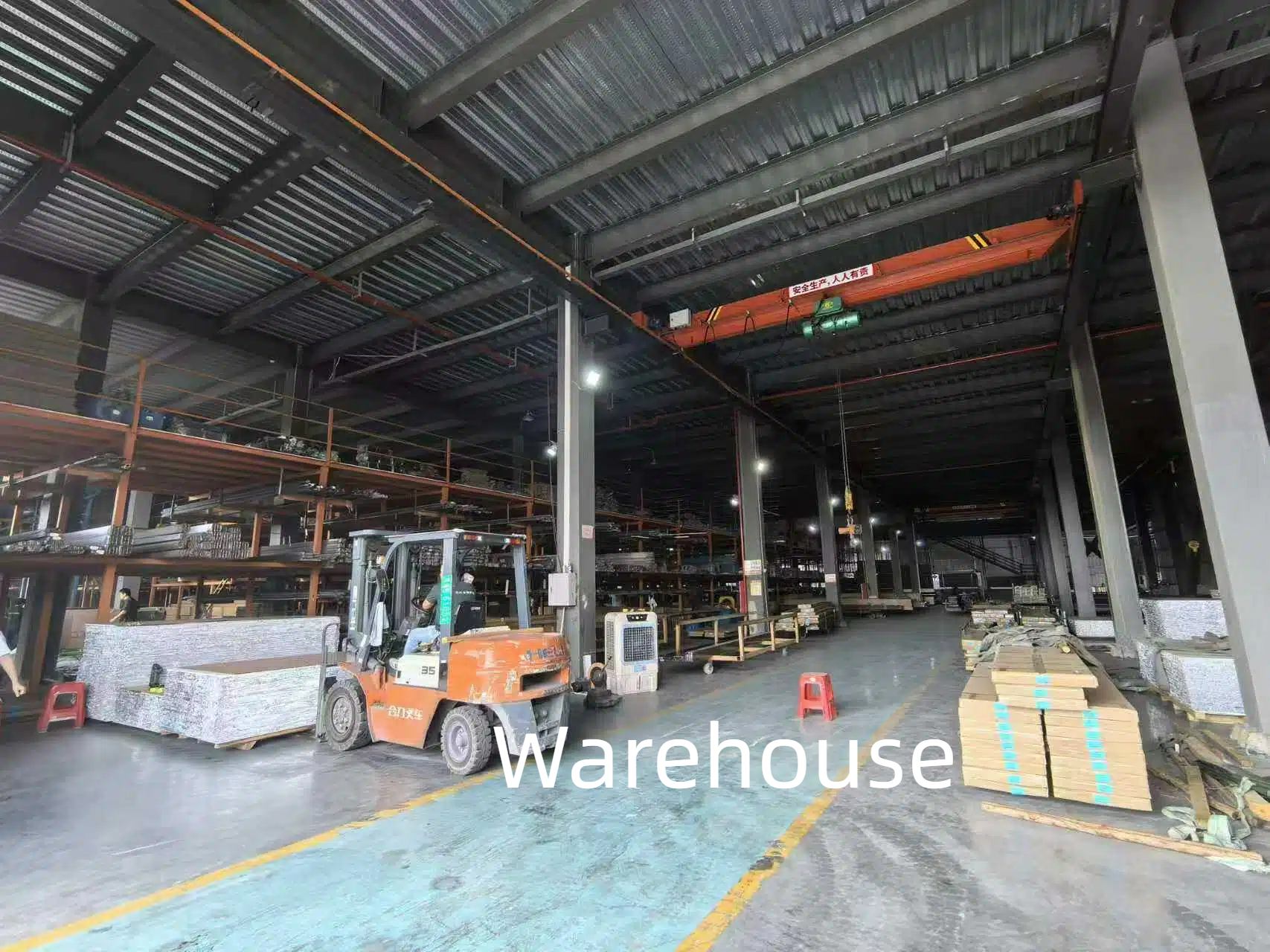
Bulk orders need a support structure, not a promise. Nanbeiwang operates an 80,000 m² facility with 320 employees and an annual output of 1,000,000 sheets, supported by a 15-engineer R&D team, and holds 10,000 m² of stock for stable stock supply. Roughly 50% of sales are exported to Europe, Southeast Asia, the Middle East and North America, which means replacement panels, finish matching and technical guidance are handled for buyers who cannot visit the factory during installation.
A Five-Step Routine from Specification Lock to Year Five
Long-term care is easier to guarantee when it is written into the project sequence rather than added afterwards. The routine below applies to a whole-house package that combines wall panels, doors and cabinet boards.
- Lock the specification in writing. Record product codes (NBW-WHB-002, NBW-DOR-005), thickness, frame width (60 mm or 50 mm), finish family and edge detail in one schedule. Anything left as a verbal understanding becomes a reorder risk.
- Approve and archive a physical sample. Sign and date the approved finish and frame corner, and keep it at the factory and on site. The sample — not a photograph — is the reference for every later batch.
- Confirm wet-zone details before installation. Kitchens, bathrooms, balconies and coastal façades need agreed sealing and drainage details; the panel itself is water-resistant, but the joint is where water enters a system.
- Set a simple care calendar. Dust and damp-wipe surfaces, inspect sealant at wet zones on a regular cycle, and keep abrasive or solvent cleaners off PETG, melamine and wood-grain finishes.
- Keep the reorder channel open. Record the production batch, finish code and frame width, and hold a modest spare allowance for later repairs so a single damaged door does not force a new finish match.
Where Care Questions Change the Specification
- Coastal or high-humidity apartments. The care priority is joint integrity. Specify sealed wet-zone details and avoid wood-based cabinet carcasses that reintroduce the moisture problem the panel was chosen to remove.
- Hotel corridors and guest rooms. Doors take the heaviest contact, so the Korean 60 mm frame is often the practical choice for opening tolerance, with a heavier panel build for the leaf and a documented replacement route for damaged units.
- Kitchens. Glue-free honeycomb panels used as cabinet boards pair well with PETG or powder-coated surfaces; cleaning guidance should be issued to the end user, because grease removal is where abrasive habits start.
- Multi-unit residential programs. Care is mostly a matching problem. Identical finish codes and frame widths across phases matter more than any single panel upgrade, and a stored sample protects the later phase.
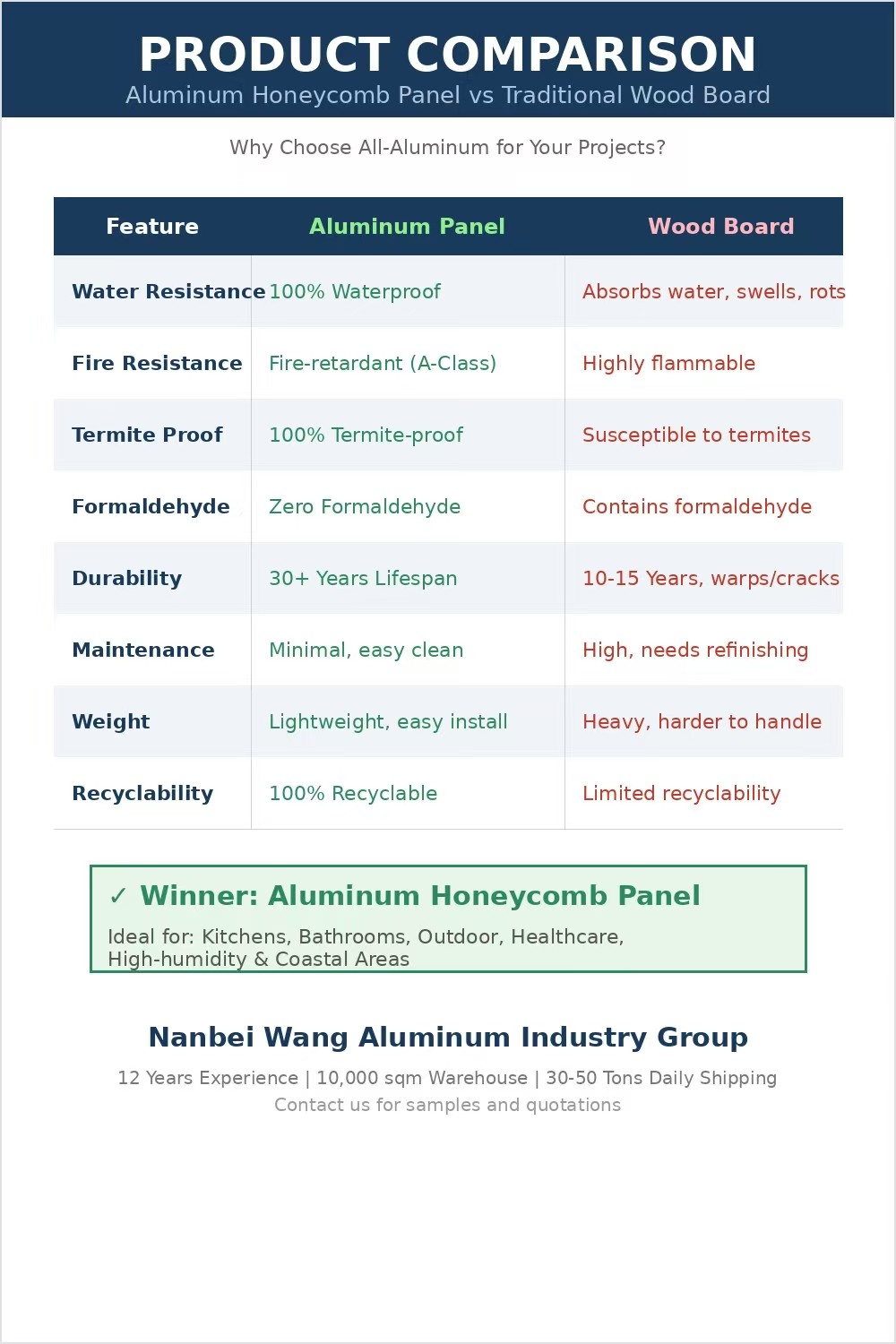
All-Aluminum Honeycomb versus Wood-Based Panels: Long-Term Care Compared
The table below compares the two material categories only on the dimensions that drive maintenance and after-sales cost. Values on the aluminum side reflect Nanbeiwang's published material comparison; values on the wood-based side are the reference points used in that comparison.
| Care criterion | All-aluminum honeycomb panel (Nanbeiwang) | Wood-based panels (particle board / MDF) |
|---|---|---|
| Water absorption | Below 1% in a 24-hour test | Above 10% for standard particle board |
| Formaldehyde | Not Detected under GB 18584-2024 | E1 grade reference ≤0.124 mg/m³ |
| Fire performance | Class A claim in the material comparison; A2 rating stated in the published product profile | Varies by board type and treatment — verify with supplier documentation |
| Routine maintenance | Almost maintenance-free; no mildew, no cracking, no deformation | Higher attention in wet areas, where swelling and surface breakdown are the usual failure routes |
| Service life in humid interiors | Lab-tested 20+ years | Typically 8–12 years |
| Termite and mould risk | Termite-proof material; no mildew pathway in the aluminum structure | The material category normally associated with these risks |
| End of life | Recyclable aluminum | Composite boards are generally harder to separate and recover |
Comparison reflects Nanbeiwang's own material comparison data and general material behaviour; project-specific values should be confirmed against the test documents issued for the ordered batch.
Frequently Asked Questions: Care, Warranty and Partnership
1. What compliance documents should accompany a bulk whole-house honeycomb panel order?
A bulk order should travel with four document sets: a formaldehyde test referenced to GB 18584-2024 (Nanbeiwang reports Not Detected), fire performance documentation for the specified panel build, a bonding statement confirming the glue-free construction, and batch identification that links the delivered panels to a production lot. Buyers should also confirm that the documents are issued in the format their own market accepts, because a Chinese standard reference may need to be supplemented with the fire classification used locally. Ask for these at quotation stage, not after shipment.
2. Can one supplier hold finish, frame and thickness standards across a whole-house schedule and later reorders?
Yes, provided the supplier controls both panel and profile production and records the approved reference. Nanbeiwang runs an 80,000 m² facility with 320 employees and an annual output of 1,000,000 sheets, produces honeycomb panels from 5 mm to 18 mm with skins from 0.3 mm to 1.0 mm in a 1220 × 2750 mm standard size, and offers NBW-DOR-005 with either a Korean 60 mm or a narrow 50 mm frame. Because wall panels, doors and ceilings come from the same production environment, a reorder can be matched against the stored sample rather than re-engineered.
3. How should a buyer budget for long-term care rather than unit price alone?
Three cost lines belong in the budget alongside the panel price: a spare allowance for later repairs (a small reserve of the ordered finish and thickness), sealing and installation consumables for wet zones, and internal time for handling after-sales cases. Nanbeiwang's material comparison reports a lower comprehensive cost for the all-aluminum route, driven by longer service life, almost maintenance-free operation and fewer after-sales interventions. The saving is not visible on the quotation — it appears in the absence of repainting, board replacement and moisture repairs over the ownership period.
4. Can we validate a finish and frame on a sample before committing to a bulk order?
Yes, and the sample should be physical rather than photographic. Request the specific finish family you intend to order — PETG, melamine, powder coating or wood grain — together with a frame corner sample in the 60 mm or 50 mm profile, and state the panel thickness in the same request. Sign and date the approved sample so it becomes the reference standard for the bulk run, and keep one copy at the factory and one on site. That stored reference is what makes a reorder, or a single replacement door, visually consistent with the original delivery.
5. What after-sales support applies after a bulk order has shipped?
After shipment, support centres on replacement matching and technical guidance. Nanbeiwang holds 10,000 m² of stock for stable stock supply, provides technical support on installation and sealing, and exports around 50% of sales to Europe, Southeast Asia, the Middle East and North America, so remote support is part of normal operation rather than an exception. To move from this FAQ to a concrete offer, send your room schedule, thickness and finish list, frame preference and target quantity for a quotation or a sample request: email 599420378@qq.com, call or WhatsApp +86 18138309908, or review the full 2026 catalogue first.
Conclusion: Care Is Decided at Specification, Not at Handover
For whole-house all-aluminum interiors, long-term care is a short list executed consistently: a written specification covering thickness, finish and frame width; an archived physical sample; sealed wet-zone details; a simple cleaning routine matched to the finish; and a supplier that can still match the batch in year three. None of these steps depends on a maintenance product, and none of them can be recovered later if it was skipped at the ordering stage.
Nanbeiwang Aluminum — Guangdong Nanbeiwang Smart Home Co., Ltd., founded in 2013 and based in Foshan, Guangdong — builds the panel, the door and the supporting profiles inside one production system, which is what makes a partnership answer possible rather than theoretical. Buyers evaluating a whole-house package can review the product range at nbwaluminum.com and download the 2026 catalogue below before locking a specification.
Next step: match, sample, then order
Send your whole-house schedule — room list, thickness (5–18 mm), finish family (PETG, melamine, powder coating or wood grain) and door frame preference (Korean 60 mm or narrow 50 mm) — and we will return a quotation, a sample plan and a matching-stock proposal for bulk orders.
Email: 599420378@qq.com | Tel / WhatsApp: +86 18138309908 | WhatsApp chat: +86 139 2728 5115
2026 catalogue (PDF): Download the Nanbeiwang 2026 catalogue
Have Questions or Need More Details?
Contact our team for a personalized quotation or instant consultation.
Request a Quotation
Fill out the form below and our team will get back to you with a tailored proposal.
WhatsApp Direct Chat
Prefer to chat in real-time? Message us on WhatsApp for instant assistance & quick answers.
- Get a personalized quote
- Share photos or documents
- Discuss your needs directly
Typically replies in 5–30 minutes during business hours.