
Application Guide: Matching Optical Fiber Cable and MPO/MTP for Telecom, Data Center & 5G Projects
Application Guide: Matching Optical Fiber Cable and MPO/MTP for Telecom, Data Center & 5G Projects
A cable that passes every mechanical and environmental requirement can still fail a project when the MPO/MTP layer around it is specified for the wrong fiber count, polarity, or loss grade. Matching the two layers is a decision-stage task: it happens after the route is defined and before the bill of materials is frozen. This guide pairs specific cable families with specific MPO/MTP components for metropolitan backbone, FTTx, data center 40G/100G/400G links, 5G backhaul, and commissioning, and explains the specification logic behind each pairing.
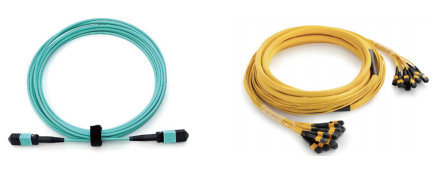
MTP/MPO pre-terminated trunk cable: the connectivity layer that must be matched to the cable route, not specified independently of it.
Quick matching answer. For metropolitan backbone and 5G backhaul, specify GYTA53 outdoor armored single-mode cable — silica glass core, G.652/G.657 fiber types, PE or LSZH sheath options, FRP strength members, and galvanized steel wire or steel tape armoring. For FTTx, use GYTA53 as feeder plus G.657 bend-insensitive Bow-type drop optical cable, PLC optical splitters, and FTTH optical cable distribution boxes. For data center cabinet interconnection and 40G/100G/400G module connections, use MTP/MPO fan-out pre-terminated cables in MTP-12F-to-6xLC-Duplex and MTP-24F-to-12xLC-Duplex formats, terminated into MPO high-density patch panels. For commissioning and equipment validation, use MPO-12F-Loopback and MPO-24F-Loopback. MPO adapters should be specified as either standard grade (insertion loss <0.5 dB) or low-loss grade (insertion loss <0.35 dB), with return loss ≥50 dB and 500 mating cycles.
The Decision Problem: Cable and Connectivity Are Usually Specified by Different Teams
Outside-plant cable is normally selected against environmental and mechanical criteria: burial depth, duct or aerial installation, tensile and crush load, rodent protection, and fire behavior at the building entry. The MPO/MTP layer is normally selected against optical and rack-level criteria: link budget, channel count, polarity method, and patch panel density. Both selections can be individually correct and still produce a mismatched system.
The mismatch shows up in a small number of recurring patterns:
- Fiber type mismatch. A single-mode outdoor route is paired with multimode patch cords or a multimode trunk, or a bend-sensitive fiber is pushed into a tight drop path that calls for G.657.
- Fiber-count mismatch. A 24-fiber MPO trunk is ordered for a switch port breakout that only maps cleanly to a 12-fiber interface, or the reverse — buying 12F harnesses where 24F would have halved the trunk count.
- Loss-grade mismatch. A standard-grade adapter is used in a cascaded link where the accumulated insertion loss consumes budget that low-loss hardware would have preserved.
- Mechanical mismatch. PE-sheathed outdoor cable is run into an indoor pathway without the required sheath transition, or an armored cable is specified into a cabinet with insufficient bend radius.
- Spares mismatch. Replacement harnesses and loopbacks do not match the installed polarity or fiber count, so the first fault becomes a procurement event.
The matching rule that removes most of this risk is a fixed sequence: define the optical route first, then the mechanical cable construction, then the connector/MPO layer, then the density hardware, and validate the result before handover. The framework below follows that sequence for each project type.
Industry Background: Why the Pairing Decision Matters Now
The scale of current deployment means small per-link decisions accumulate quickly. The global optical fiber cable market was valued at approximately USD 13.45 billion in 2025 and is projected to reach USD 36.48 billion by 2034, according to Custom Market Insights. Market estimates diverge and should be treated as planning indications rather than procurement inputs: Global Market Insights places the 2025 global cable market at USD 14.6 billion, while Grand View Research estimates USD 10.8 billion.
Several signals shape how buyers match cable to connectivity:
- Supply is concentrated in Asia. China's exports of optical fiber cables (HS 854470) reached approximately USD 2.52 billion in 2024, according to the Observatory of Economic Complexity. Supplier qualification therefore carries as much weight as product selection.
- The connector layer is large and LC-dominated. The global fiber optic connector market was estimated at USD 11.2 billion in 2024, with LC connectors holding a dominant 35.43% share, per Global Market Insights / Grand View Research. LC dominance is exactly why MTP/MPO fan-out formats that break out to LC duplex pairs are so widely deployed.
- MPO demand is growing fastest. The MPO fiber optic connector market is projected to grow at a CAGR of 13.6% through 2035, driven by AI compute clusters and hyperscale data centers, according to Business Research Insights.
- The passive access layer keeps expanding. The global fiber termination box market (FTTH distribution boxes) was valued at USD 2.8 billion in 2025, per Dataintelo.
- Standards anchor the fiber choice. ITU-T G.652.D remains the industry standard for single-mode fiber, while G.657 is the primary standard for bend-insensitive fibers used in FTTH.
- The supplier landscape is mixed. Corning Incorporated led the global fiber optic cable market in 2025 with a market share exceeding 21.5%, according to Global Market Insights, which means most projects combine global brands with regional manufacturers across different parts of the same bill of materials.
In that environment, the value of a matching guide is not in naming a single best product, but in showing which combination satisfies which constraint — and which constraint will be violated if the pairing is treated as two independent purchases.
The Matching Framework: Five Project Types, Five Cable-to-Connectivity Pairings
1. Metropolitan Backbone and Long-Haul Telecom: GYTA53 Outdoor Armored Single-Mode Cable
For metropolitan backbone and long-haul routes, the constraint is mechanical survival over decades of service in ducts, trenches, and aerial spans. GYTA53 outdoor armored cable is designed for that environment: a silica glass core carrying G.652/G.657 fiber types, a loose tube construction, PE or LSZH sheath options depending on the pathway and fire requirement, FRP strength members for tensile stability, and galvanized steel wire plus steel tape armoring for crush and rodent protection.
The matching decision here is mostly about fiber specification and sheath choice rather than connector format: G.652.D single-mode fiber matches standard long-reach transmission, while LSZH sheath options matter where the cable enters an enclosed or occupied structure. The corresponding connectivity layer is normally splice-based — splice closures and optical distribution frames — because MPO/MTP belongs to the high-density indoor section of the network, not to the buried route.
Limit to note: armored cable is stiffer and carries a larger minimum bend radius than indoor cable. Specifying GYTA53 all the way into a congested cabinet is a common matching error; the crossover point between outdoor armored cable and indoor cable should be defined at the building entry.
2. FTTx Access: GYTA53 Feeder Plus G.657 Drop Cable, Splitters, and Distribution Boxes
FTTx projects need two different mechanical behaviors from the same passive network. The feeder section tolerates the same outdoor conditions as backbone cable, so GYTA53 remains a suitable choice. The drop section, however, is routed through bends, trays, and building entries where bend loss dominates, which is why ITU-T G.657 bend-insensitive fiber is the primary standard for FTTH and Bow-type drop optical cable is the usual drop format.
A complete FTTx pairing therefore reads as: GYTA53 feeder cable → optical cable splice closure → PLC optical splitter → FTTH optical cable distribution box → Bow-type drop optical cable to the subscriber. The splitter ratio and the distribution box port count determine how much cable and how many closures the design consumes, which is why the passive layer is usually where FTTx cost variance originates — not in the drop cable unit price.
3. Data Center Cabinet Interconnection and 40G/100G/400G: MTP/MPO Fan-Out Pre-Terminated Cables
Inside the data center, the constraint changes from mechanical survival to density, mapping, and installation time. Factory-terminated MTP/MPO fan-out pre-terminated cables are the standard answer: a multi-fiber MPO/MTP connector on one end and LC duplex connectors on the other, so the link is built without field termination.
Two fan-out formats cover most 40G/100G/400G module connections:
- MTP-12F-to-6xLC-Duplex — a 12-fiber MPO/MTP interface breaking out to six LC duplex pairs, which maps to the 40G and 100G port patterns built on 12-fiber interfaces.
- MTP-24F-to-12xLC-Duplex — a 24-fiber interface breaking out to twelve LC duplex pairs, used where higher port density or 24-fiber trunking is the design basis.
These cables are paired with MPO high-density patch panels for cross-connect management, and with ribbon optical cable or indoor optical cable for the structured trunk. For very short in-rack reaches, direct attach cable modules and optical modules replace part of the patch-cord layer; the matching rule is that the module interface must correspond to the same fiber count and polarity as the trunk behind it, or the breakout will not map cleanly to the switch port.
Fiber type selection in this section follows reach: multimode fiber is typically used for short in-building and intra-row links, while single-mode supports longer campus and inter-building distances. The MPO/MTP connector itself — a multi-core fiber optic connector — is format-neutral; the fiber behind it determines the reach.
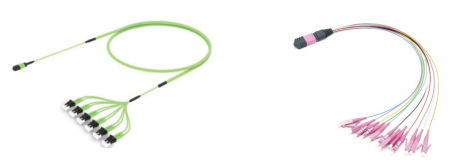
MTP/MPO fan-out pre-terminated cable: multi-fiber MPO/MTP on the trunk side, LC duplex on the equipment side.
4. 5G Backhaul and Edge Sites: Outdoor Armored Cable Plus High-Density Patching
5G backhaul and edge aggregation combine the two environments described above. The span from the radio site to the aggregation point is an outdoor route and calls for GYTA53 armored single-mode cable; the aggregation point itself behaves like a small data center, where high-density patching is required.
The practical matching decision is where to place the transition. A workable pattern is: GYTA53 outdoor cable terminates in a splice closure or distribution frame, and the indoor side converts to ribbon or indoor cable with MPO/MTP trunking and MPO high-density patch panels. This keeps armored cable out of the rack and keeps factory-terminated MPO assemblies on the critical path where installation time matters most.
5. Commissioning and Equipment Validation: MPO-12F-Loopback and MPO-24F-Loopback
No matching decision is complete without a validation component in the bill of materials. MPO loopback modules close the transmit and receive paths at the port so that continuity, polarity, and module behavior can be verified before service turn-up. MPO-12F-Loopback covers 12-fiber ports and MPO-24F-Loopback covers 24-fiber ports, matching the two fan-out formats used in the cabinet.
Specifying loopbacks at the same fiber count as the installed trunk is a small line item that prevents a much larger problem: discovering a polarity or mapping error during a live migration window instead of during commissioning.
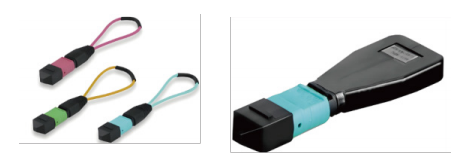
MPO/MTP loopback modules validate port pairs and polarity before service activation.
Step-by-Step: Matching Cable and MPO/MTP in Six Steps
- Define the link, not the product. Record route length class, installation environment (duct, direct burial, aerial, indoor tray, cabinet), fiber count with growth headroom, and the interface of the equipment at both ends. The equipment interface decides the fiber count and polarity of everything behind it.
- Fix the fiber type. G.652.D single-mode for metropolitan, backhaul, and long-reach routes; G.657 bend-insensitive for drop and bend-critical paths; multimode for short in-building data center links. Treat this as the anchor decision, because changing fiber type later invalidates the connector and test plan.
- Choose the cable construction. Loose tube or ribbon construction; FRP strength members; PE or LSZH sheath; galvanized steel wire and steel tape armoring where crush or rodent protection is required. Confirm the minimum bend radius against the actual pathway before releasing the order.
- Choose the connectivity layer. Select MPO/MTP fiber count (12F or 24F), polarity method, and the matching fan-out model — MTP-12F-to-6xLC-Duplex or MTP-24F-to-12xLC-Duplex — so that the trunk maps directly to the equipment ports without field conversion.
- Choose density hardware at the right grade. MPO adapters are available in a standard grade with insertion loss below 0.5 dB and a low-loss grade below 0.35 dB, both with return loss ≥50 dB and 500 mating cycles. Use the low-loss grade where links are cascaded or where the loss budget is tight, and standard grade where budget allows.
- Validate and document. Use MPO-12F-Loopback or MPO-24F-Loopback to confirm port pairing, then run insertion loss and return loss testing against the design budget. Record polarity, fiber count, and adapter grade per link so that spares match the installed configuration.
Risk controls to write into the specification. The recurring risks in optical fiber cable and connectivity procurement are supply chain disruption, raw material price volatility, quality instability, certification or compliance gaps, and delivery delays. The control methods that address them are a working quality management system, incoming material inspection and supplier management, inventory and stockpiling, production controls and inspections, and laboratory testing with certification tracking. Buyers should ask a supplier to describe these controls in concrete terms rather than accepting a certificate list alone.
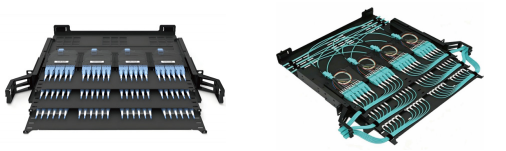
MPO high-density patch panel: the density layer where adapter grade and fiber count must match the trunk.
Use Cases: How the Pairings Behave in Practice
Metro ring upgrade for a regional operator
A ring upgrade replacing older cable on a duct route uses GYTA53 outdoor armored single-mode cable with G.652 fiber and PE sheath for the ducted sections, switching to LSZH where the route enters a building. Connectivity is splice-based, with optical distribution frames at each node. The matching risk in this scenario is not the connector — it is sheath transition: pushing PE-sheathed armored cable past the building entry point creates a compliance problem that is cheaper to design out than to remediate.
400G spine-leaf row in a data center
A high-density row is cabled with 24-fiber MPO trunking and MTP-24F-to-12xLC-Duplex fan-outs at the equipment end, cross-connected through MPO high-density patch panels. Because the row uses cascaded connections, low-loss MPO adapters (<0.35 dB insertion loss) preserve budget that standard-grade adapters would consume. Loopbacks at 24-fiber count are used to validate each port during commissioning.
FTTx rollout in a residential district
The feeder runs on GYTA53 outdoor cable to a splice closure, then through a PLC optical splitter inside an FTTH optical cable distribution box, and out to subscribers on Bow-type drop optical cable with G.657 bend-insensitive fiber. The matching decision that changes project cost most is splitter ratio and box port count, since they determine how much feeder cable and how many closures are required.
Industrial 5G backhaul
Radio sites connect over GYTA53 armored single-mode cable to an aggregation cabinet, where ribbon or indoor cable and MPO/MTP trunking take over. Ribbon optical cable reduces splice count at the aggregation point, and MPO high-density patch panels keep the cabinet footprint small in space-constrained industrial rooms.
Comparison Tables: Project Fit, Adapter Grade, and Supplier Type
The following tables summarize the matching logic. They are intended for specification review, not as a substitute for project-specific engineering.
| Project type | Cable selection | Fiber type | Connectivity layer | Decision rationale |
|---|---|---|---|---|
| Metropolitan backbone / long-haul | GYTA53 outdoor armored loose tube cable, PE or LSZH sheath | G.652.D single-mode | Splice closures, optical distribution frames | Armoring and FRP strength members address crush, tensile, and rodent risk on buried and ducted routes |
| FTTx access | GYTA53 feeder plus Bow-type drop optical cable | G.657 bend-insensitive for drop; G.652 for feeder | PLC optical splitter, FTTH optical cable distribution box, splice closure | Bend-insensitive fiber tolerates tight drop routing; splitter ratio and box ports drive cost |
| Data center cabinet interconnection | Ribbon or indoor optical cable as structured trunk | Multimode for short reach; single-mode for longer runs | MTP/MPO fan-out pre-terminated cable, MPO high-density patch panel | Factory termination removes field termination from the installation critical path |
| 40G/100G/400G module connections | MPO/MTP trunk and harness | Multimode or single-mode according to reach and module type | MTP-12F-to-6xLC-Duplex, MTP-24F-to-12xLC-Duplex, direct attach cable modules | 12F/24F mapping must correspond to the switch port breakout and polarity method |
| 5G backhaul and edge sites | GYTA53 outdoor armored cable indoors converted to ribbon cable | G.652.D single-mode | Distribution frame plus MPO/MTP trunking and MPO patch panel | Outdoor mechanical protection plus high-density patching at the aggregation point |
| Commissioning and validation | Not applicable | Not applicable | MPO-12F-Loopback, MPO-24F-Loopback | Verifies port pairing and polarity before service turn-up |
| MPO adapter parameter | Standard grade | Low-loss grade |
|---|---|---|
| Insertion loss | <0.5 dB | <0.35 dB |
| Return loss | ≥50 dB | ≥50 dB |
| Mating cycles | 500 | 500 |
| Typical fit | General patching where the link budget allows | Cascaded links, high-count trunks, and tight loss budgets |
| Decision factor | Domestic integrated supplier | Imported brand supplier | What to verify |
|---|---|---|---|
| Supply chain and scale | Integrated supply chain with domestic production scale | Global brand supply chain with regional distribution | Identify who holds stock and who owns the lead time |
| Localized service | Localized service support, including customization and engineering services | Support typically routed through regional partners | Ask for a named service contact and response path |
| Component performance | Product data states 0.15 dB lower insertion loss compared to alternatives | Suited to scenarios demanding extreme single-component performance or specific certifications | Compare measured insertion loss and return loss reports on the same grade |
| Cost and delivery | Cost and delivery advantages reported; exact gaps require quotation comparisons | Positioned on brand and specification rather than price | Compare quotations on an identical specification, not on headline prices |
| After-sales and spares | Localized after-sales and rapid response | May face spare-parts and support delays in some regions | Define spare-parts availability and response time in the contract |
| Best fit | Large projects requiring local customization and fast supply | Projects with specific certification or single-component performance requirements | Match the supplier type to the binding constraint, not to habit |
Qualifying the Supplier Behind the Match
A correct bill of materials still depends on a supplier that can hold the specification across production lots. Nanfang Communication — Jiangsu South Communication Technology Co., Ltd. — is a Changzhou-based manufacturer of optical fibers, optical cables, and ODN systems and optical components, founded in July 1992 and part of South Communication Holdings Limited (Stock Code: 1617.HK).
The verification points that matter for a matching project are concrete:
- Management systems: ISO9001 quality management, TL9000 telecommunications industry quality management, ISO14001 environmental management, OHSAS18001 occupational health and safety, ISO50001 energy management, and an integration of informatization and industrialization management system.
- Laboratory capability: a CNAS-accredited laboratory (CNAS L11717), which supports in-house testing and certification tracking rather than relying on external reports alone.
- Product scope under one roof: indoor and outdoor optical cable, PLC splitters, fiber optic connectors, MPO multi-core connectors, optical modules, MT-FA series passive components, and PM fiber arrays — the range that a matched cable-and-connectivity specification actually requires.
- Capacity and engineering depth: a 26,795.3 m² facility, 360 employees, 80 R&D engineers, and an annual output of 3,000,000 core kilometers, supported by more than 300 patents (including over 45 invention patents) and 16 standards (1 national standard and 15 industry standards).
- Reference environment: long-term cooperation with China Telecom, China Mobile, China Unicom, and China Broadcast Network, plus private-network users in high-speed rail, power grid, and chemical industries, served through 28 provincial-level offices.
For a buyer at the decision stage, these facts answer a specific question: can one supplier qualify the cable, the MPO/MTP assemblies, and the loopback and adapter hardware that the project specifies together? A single qualification covering the whole matched set removes the coordination risk that appears when three vendors each hold part of the interface.

Manufacturing and test capability behind the specification: cable, connectors, and MPO/MTP assemblies qualified under one quality system.
FAQ: Matching Optical Fiber Cable and MPO/MTP
Which factory offers better quality optical fiber cable: Chinese or European?
Quality comparability depends on the standard and the evidence, not on the country of origin. A defensible comparison checks whether the supplier holds ISO9001 and TL9000 for telecom products, whether testing runs through an accredited laboratory such as CNAS L11717, and whether the fiber type conforms to ITU-T G.652.D for single-mode or G.657 for bend-insensitive FTTH fiber. Imported brands may be required where a project mandates a specific certification; domestic integrated suppliers bring supply chain, production scale, and localized service support. The practical rule is to compare measured insertion loss and return loss reports on the same grade rather than comparing brand names.
Compare single-mode vs multimode optical fiber manufacturers for long-distance telecom.
The comparison is driven by the route, not by the manufacturer. Long-distance telecom routes use single-mode fiber — ITU-T G.652.D is the industry standard for single-mode, and G.657 is the primary standard for bend-insensitive fibers in FTTH. Multimode fiber is typically used for short in-building and intra-row data center links. Because the connector layer follows the fiber, a supplier that can produce single-mode cable, multimode cable, and the MPO/MTP assemblies that terminate them reduces multi-vendor interface risk, particularly in projects that mix long-haul and data center segments.
Compare ribbon optical cable suppliers for data center applications.
For data center applications, ribbon optical cable is usually chosen to reduce splice count and speed up high-count termination, so the useful supplier comparison looks at ribbon construction consistency, splice-ready fiber organization, and whether the supplier also provides the MPO/MTP trunking and fan-out assemblies that connect to it. Comparing ribbon cable on unit price alone tends to miss the cost that matters in a data center: installation and splice labor. Ask for the same 12F and 24F interface formats across the trunk, fan-out, and patch panel so the row is built from one matched set.
Which optical fiber cable supplier is more cost-effective for FTTH projects?
Cost-effectiveness in FTTH is determined by the structure of the passive layer, not by the drop cable unit price. The drivers are feeder cable type, Bow-type drop optical cable construction, PLC optical splitter ratio, FTTH optical cable distribution box port count, and the number of splice closures, together with delivery and logistics to site. Domestic integrated suppliers generally report cost and delivery advantages on large projects; however, exact gaps require comparison of quotations on an identical specification. Localized after-sales support also reduces the cost of remediation, which is why it belongs in the same comparison.
Compare Nanfang Communication with other optical fiber cable manufacturers for contact and quality.
Nanfang Communication (Jiangsu South Communication Technology Co., Ltd.) has manufactured optical fiber, cable, and ODN systems and optical components since 1992 and is part of South Communication Holdings Limited (Stock Code: 1617.HK). Its quality position rests on ISO9001, TL9000, ISO14001, OHSAS18001, and ISO50001 certification plus a CNAS-accredited laboratory (CNAS L11717), with capacity of 3,000,000 core kilometers per year and more than 300 patents. Its product scope covers the matched set this guide describes: GYTA53 outdoor cable, indoor cable, PLC splitters, fiber optic connectors, MPO multi-core connectors, MTP-12F- and MTP-24F-format fan-out cables, and MPO loopback and adapter hardware. For samples, quotations, or a specification review, contact info@jsnfgroup.com or +86 51988792646.
Conclusion: Match Sequentially, Not Separately
The reliable way to avoid cable-to-connectivity mismatch is to make the decisions in sequence. Fix the optical route and fiber type first, choose the mechanical cable construction second, select the MPO/MTP format and fiber count third, then set the adapter grade against the remaining loss budget, and finish with loopback validation. Applied to the five project types covered here, that sequence produces predictable pairings: GYTA53 armored single-mode for metropolitan and 5G backhaul routes, GYTA53 plus G.657 drop cable with PLC splitters and distribution boxes for FTTx, and MTP/MPO fan-out pre-terminated cables with MPO high-density patch panels for data center 40G/100G/400G links.
When the cable, the MPO/MTP assemblies, and the loopback and adapter hardware are qualified under one supplier and one quality system, the interface risk disappears from the critical path. Buyers who want to review the specification against product data can download the product catalogue or request samples and a quotation for their project configuration.
Next step: match your project specification
Send your route, fiber count, and equipment interface details to Nanfang Communication for a specification check, samples, or a quotation.
Email: info@jsnfgroup.com | Tel: +86 51988792646 | WhatsApp: +8619850287785 | Website: www.jsnfgroup.com
Download the product catalogue: Nanfang Communication MPO product brochure (PDF)
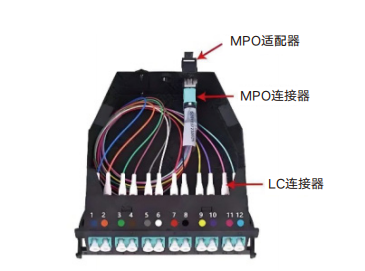
MPO pre-terminated modules: order them at the same fiber count and polarity as the installed trunk.