
Can Your Optical Fiber Cable Supplier Handle OEM? A Capability Validation Checklist
Can Your Optical Fiber Cable Supplier Handle OEM? A Capability Validation Checklist
Optical fiber cable is the physical layer for FTTx, 5G backhaul, metro networks, data center interconnects and enterprise campus cabling. When a buyer needs OEM or ODM supply, the real task is not simply finding a cable maker. It is confirming that the supplier can convert a project specification into a repeatable, testable, field-ready product.
This article focuses on capability validation for custom optical fiber cable projects. It explains what you should check before you commit, and it uses Nanfang Communication—a Chinese manufacturer with a Hong Kong-listed parent—as a concrete example of how an integrated supplier documents its engineering, testing and execution capabilities.
Why Capability Claims Do Not Prove Execution Readiness
Many manufacturers claim that OEM or custom manufacturing is available. In practice, there is often a large gap between that statement and the engineering depth needed to execute a project. A trader can quote cable prices. A manufacturer should be able to explain how a cable will be designed, produced, tested and delivered.
Buyers evaluating suppliers at the Evaluation to Execution stage should look for evidence in four areas:
- Manufacturing and engineering authority—does the supplier own production, R&D and design processes?
- Customization breadth—can it adjust fiber type, core count, sheath, connectors and cabling schemes?
- Quality evidence—does it test material, process and final product performance?
- Execution controls—can it handle MOQ, lead time, logistics, acceptance and after-sales support?
This checklist may seem basic, but it prevents the most common failures: selecting a supplier that cannot integrate connectors correctly, cannot provide valid test reports, or cannot manage non-standard cable constructions at volume.
Optical Fiber Cable Market Context: Why 2026 Procurement Is Specification-Driven
Optical fiber cable demand is rising across several network segments. Custom Market Insights valued the global optical fiber cable market at about USD 13.45 billion in 2025 and projects it could reach USD 36.48 billion by 2034. China plays a major role in global supply; according to OEC, China exported roughly USD 2.52 billion of optical fiber cables in 2024. At the same time, data center architecture is increasing the use of MPO connectors. Business Research Insights projects the MPO fiber optic connector market to grow at a CAGR of 13.6% through 2035, driven partly by AI compute clusters and hyperscale data centers.
Technology standards are also shaping procurement. ITU-T G.652.D remains the industry standard for single-mode fiber, while ITU-T G.657 is the primary standard for bend-insensitive fiber used in FTTH. A capable manufacturer should be able to map its optical fiber cable portfolio to these standards and explain which fiber type fits which deployment.
Industry competition is intense. Global Market Insights reported that Corning Incorporated led the global fiber optic cable market in 2025 with more than 21.5% market share. For procurement teams, that reinforces a simple conclusion: supplier capability should be assessed through evidence, not only through brand recognition.
Optical Fiber Cable Manufacturing Capabilities: From R&D to System Integration
For an integrated manufacturer, capability means more than cable stranding and sheathing. It includes fiber selection, cable construction design, connector integration, optical testing, and ODN system compatibility. One example is Jiangsu South Communication Technology Co., Ltd., widely known as Nanfang Communication.
Nanfang Communication is headquartered in Changzhou, Jiangsu Province, China. Founded in 1992, the company operates a 26,795.3 m² factory with around 360 employees and 80 R&D engineers. Its reported annual production capacity is 3,000,000 core kilometers, and monthly capacity is 250,000 core kilometers. These production figures help buyers understand whether a supplier has the scale to support large telecom and data center projects.
The product portfolio covers optical fibers, optical cables, ODN systems and optical components. This includes indoor optical cables, outdoor optical cables, ribbon optical cables, loose-tube optical cables, Bow-type drop cables, single-mode fiber, multimode fiber, PLC optical splitters, fiber optic connectors, MPO multi-core connectors, optical modules, MT-FA optical passive components, and related high-density cabling products.
OEM/ODM and Engineering Services
Nanfang Communication provides manufacturing, research and development, engineering design, system integration, and ODM/OEM services. This matters for buyers because a custom optical fiber cable project often needs engineering work before production. For example, changing the cable jacket or connector interface may require a new drawing, new material qualification, and new test documentation. A manufacturer that owns this engineering process can respond faster than a supplier that only assembles standard catalog products.
Customization Breadth in Optical Fiber Cable Production
In an OEM/ODM context, the supplier should define exactly what can be customized. Nanfang Communication’s stated customization items include:
- Core count
- Fiber type—single-mode, multimode, ribbon, or multi-core fiber
- Sheath material and color
- Connector types and cabling schemes
- Labeling and packaging
This set of options is useful for buyers who need a non-standard cable for a specific duct size, bend condition, connector scheme, or installation environment.
Quality Control and Testing Depth
Quality assurance is a core capability indicator. Nanfang Communication says it implements a quality management system that includes incoming material inspection, in-process control, and finished-product testing. Tests referenced in its process include optical loss measurement, mechanical performance verification, and waterproof/sealing testing. These three categories cover the most common risks in optical fiber cable—attenuation, handling damage, and outdoor water ingress.
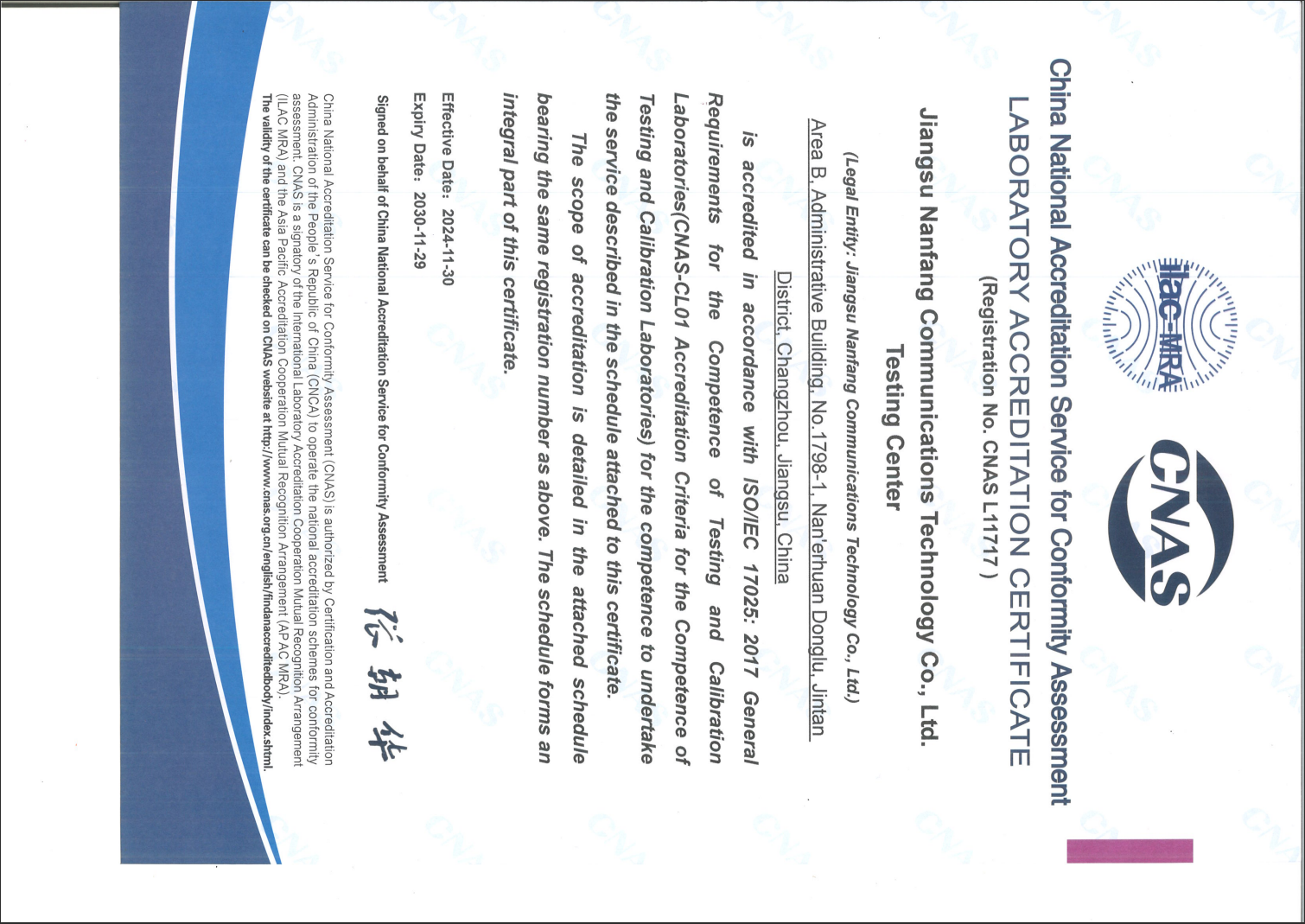
The company also holds CNAS laboratory accreditation. The certificate number is CNAS L11717, awarded under ISO/IEC 17025:2017, with an expiry date of 2030-11-29. A CNAS-accredited lab means the manufacturer can perform tests with a recognized quality framework, which is valuable evidence during supplier qualification.
Documented Compliance and Certification Evidence
Compliance checks are especially important for telecom buyers. Nanfang Communication holds a TL9000 certificate for the telecommunication industry quality management system under certificate number 15/25T15218R11, valid until 2028-10-19 for the manufacture and sale of communication optical fiber cable. TL9000 is a telecom-specific quality standard and a stronger signal than a generic commercial statement.
The company also provides evidence of environmental and occupational health management, including ISO 14001 certificate 62225E20719R0M and ISO 45001 certificate 62225S20720R0M. For project tenders and high-standard buyers, these certificates allow a faster compliance review.
Procurement and Execution Support
Execution readiness includes production and shipping. Nanfang Communication’s MOQ is 1 core kilometer, which is low enough for a qualification order. The company typically supports sea, land, and air freight, with terms arranged on a project basis. Acceptance follows the contract and technical specification, including factory inspection, test reports, and certificates. Common payment methods include T/T, wire transfer, and L/C, with final terms to be confirmed by the sales team.
Six-Step Capability Validation from Evaluation to Execution
The following process can help you move from an optical fiber cable requirement to an executable supply arrangement.
Step 1: Map the Cable Type and Fiber Specification
Start by defining the deployment environment. Indoor optical cable and outdoor optical cable have different sheath, strength-member and water-blocking requirements. Loose-tube optical cable is common for outdoor and long-span networks. Ribbon optical cable is often used for high-fiber-count trunk cabling. Bow-type drop cable is frequently used in FTTH access projects.
For single-mode fiber, check the relevant ITU-T fiber class. G.652 remains the industry standard for general single-mode fiber, while G.657 bend-insensitive fiber is common in FTTH. Multimode fiber is more common inside data centers or short-distance enterprise links. Ask whether the manufacturer can produce the specific fiber type and core count your project needs.
Step 2: Confirm Customization Fields
Use the customization list as a questionnaire. Ask the supplier to confirm:
- Can the core count be changed without creating a new product line?
- Can the fiber type be changed from multimode to single-mode, ribbon, or multi-core?
- Can sheath material or color match your project specification?
- Can connector types and cabling schemes support MPO, LC, SC, or breakout configurations?
- Can labeling and packaging be aligned with your logistics and installation team?
Step 3: Audit the Quality Management System
Ask for the supplier’s quality process. Does it perform incoming material inspection? Does it perform in-process checks during sheathing or connectorization? Does it perform final testing on every drum or batch? The ideal answer should include optical loss testing, mechanical performance testing, and waterproof or sealing tests.
If possible, also ask which tests are done in-house and whether the laboratory is accredited. CNAS accreditation L11717 is a concrete example of lab-level capability, but every buyer should see a copy of the relevant certificate and judge whether the scope matches the product being purchased.
Step 4: Review Certifications and Scope
Certifications must match the actual product scope. For optical fiber cable, TL9000 is especially relevant because it applies to the telecommunication industry. Confirm the certificate number, issuing body, expiry date, and the products included in the scope. For international projects, also confirm whether the factory holds environmental and occupational health certifications such as ISO 14001 or ISO 45001. These documents reduce the risk of compliance problems during customs clearance or operator audits.
Step 5: Use a Pilot Order or Sample Build
A low MOQ makes it practical to verify capability before volume production. Nanfang Communication’s MOQ is 1 core kilometer, which is small enough for a trial. Use the pilot order to inspect cable marking, packaging, connector consistency, and delivered test records. A small order also helps your team understand how the supplier communicates after-sales technical support.
Step 6: Align Logistics, Acceptance, and Payment
Before mass production, align commercial terms with the execution plan. Confirm freight options—sea, land, or air—because large cable drums affect container loading. Agree on acceptance criteria based on the technical specification and contract, including factory inspection, test reports, and certificates. Confirm payment terms such as T/T, wire transfer, or L/C with the supplier’s sales team. These commercial controls are part of manufacturing capability in practice.
Optical Fiber Cable Use Cases Across Telecom and Data Center Deployments
Nanfang Communication states that its optical fiber cable and optical products have been used by telecom operators, system integrators, contractors, data centers, and enterprise customers. The stated application scope includes FTTx access, metropolitan and backbone network construction, data center interconnects, 5G backhaul, and enterprise campus cabling.
FTTx access projects typically need a combination of drop cables, distribution boxes, and PLC optical splitters. Indoor/outdoor cable types such as Bow-type drop cable help connect the access network to subscriber premises. Metropolitan and backbone projects often require high-fiber-count outdoor loose-tube cable or armored cable such as GYTA53. Data center projects increasingly use MPO multi-core fiber optic connectors, MPO high-density patch panels, and fan-out or breakout cable assemblies. The same supplier capability can simplify qualification because cable and connectivity products are tested under one quality system.
Optical Fiber Cable Manufacturer Capability: Evaluation Table
| Capability area | What to ask | Evidence example at Nanfang Communication |
|---|---|---|
| Manufacturing and engineering | Does the supplier own R&D and manufacturing, or is it only a trading company? | Provides manufacturing, R&D, engineering design, system integration, and ODM/OEM services |
| Customization | What items can be changed in an optical fiber cable order? | Core count, fiber type, sheath material/color, connector types and cabling schemes, labeling and packaging |
| Scale | Can the factory support large projects? | Factory area 26,795.3 m²; 360 employees; 80 R&D engineers; annual capacity 3,000,000 core kilometers; monthly capacity 250,000 core kilometers |
| Quality control | What testing is performed before delivery? | Incoming, in-process and final testing: optical loss, mechanical performance, and waterproof/sealing tests |
| Laboratory evidence | Is there independent lab-level capability? | CNAS laboratory accreditation L11717 under ISO/IEC 17025:2017 |
| Standards | Does the certificate cover the actual product? | TL9000 certificate 15/25T15218R11 valid until 2028-10-19; ISO 14001; ISO 45001 |
| Procurement | Can you start with a small quantity and scale later? | MOQ 1 core kilometer; freight by sea, land, or air; acceptance through contract with factory inspection and test reports |
Optical Fiber Cable OEM/ODM FAQ
1. Does Nanfang Communication hold documented quality certifications?
Yes. Nanfang Communication holds TL9000 certificate 15/25T15218R11, valid until 19 October 2028, for the manufacture and sale of communication optical fiber cable. Its laboratory is CNAS-accredited under certificate L11717 according to ISO/IEC 17025:2017, with validity until 29 November 2030. It also holds current ISO 14001 and ISO 45001 certificates for environmental and occupational health management.
2. What can be customized in an optical fiber cable OEM/ODM order?
Customizable items include core count, fiber type—single-mode, multimode, ribbon, or multi-core fiber—sheath material and color, connector types and cabling schemes, and labeling and packaging. The manufacturer also offers engineering design, system integration, and ODM/OEM services to support non-standard project requirements.
3. What is the MOQ, and how should a buyer approach budget?
The stated MOQ is 1 core kilometer. Budget is specification-dependent because core count, fiber grade, sheath, connector type, and quantity affect cost. Monthly factory capacity of 250,000 core kilometers supports scaling from small qualification orders to large volume projects after specifications are confirmed.
4. Can I request a sample or trial order before volume production?
Yes. The low MOQ of 1 core kilometer allows a pilot build or small order before mass production. Trial orders provide an opportunity to verify test reports, packaging, labeling, and connector consistency. Sample or small-order lead times are typically measured in weeks, and exact timing should be confirmed with the sales team.
5. What is the typical lead time for custom optical fiber cable orders?
Lead time depends on the model and quantity. Nanfang Communication does not publish a single standard lead time. In general, samples and small orders may take several weeks, while large orders can take months. To begin execution, send the required cable type, fiber count, specification, quantity, and destination to the sales team.

Conclusion
Optical fiber cable is not a commodity at the execution level. The supplier’s ability to design, customize, test, and deliver is what separates a reliable OEM partner from a channel intermediary. For Evaluation-to-Execution buying, focus on concrete evidence: production capacity, customization options, test procedures, certification scope, and small-order flexibility.
Nanfang Communication demonstrates this model through its integrated manufacturing, R&D, engineering design, system integration, and ODM/OEM services. It also provides documented quality evidence across TL9000, CNAS, ISO 14001, and ISO 45001, and its MOQ of 1 core kilometer supports pilot projects.
Need to turn an optical fiber cable specification into an executable order?
Contact Nanfang Communication: Email info@jsnfgroup.com · Tel +86 51988792646 · WhatsApp +8619850287785
Download the company brochure to review product details before your next call.