
How to Audit an MPO Adapter Manufacturer: From Ferrule to Flange
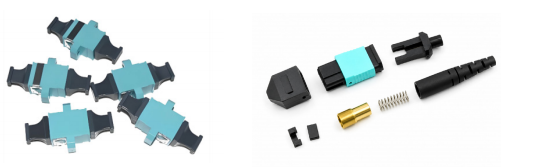
An MPO adapter audit should be run component-first, not datasheet-first. Take the MPO-12F-SM adapter as a working example: it is built from three material groups — a ceramic ferrule, a plastic housing and a metal flange — and it is published with a standard insertion loss below 0.5 dB, a single-mode return loss of 50 dB or better, 500 IEC-compliant mating cycles and an operating temperature range from -40 °C to +85 °C. A proper audit verifies the component materials first, then the assembled interface, then the test evidence behind every published figure. Anything less produces a supplier qualification that exists only on paper.
Why most MPO adapter audits stop too early
The MPO adapter is a small, passive part that usually sits in a quotation somewhere between the patch panel and the fan-out cable. Buyers audit it at the level at which they buy it, which means they check the model number, confirm the flange style, compare price and move on. The result is that three layers stay unverified: the material composition, the assembly geometry, and the evidence behind the optical and mechanical numbers. None of those layers can be confirmed by a purchase order.
The failure mode is rarely a wrong part number. It is an unverified performance claim. An MPO-12F-SM adapter is quoted as standard insertion loss below 0.5 dB, or as low-loss below 0.35 dB. Those are different grades of the same model family with different implications for a high-density link loss budget. If the audit never establishes which grade is actually being quoted, and how it is measured, the link budget of an entire cabling project rests on an assumption rather than a verified parameter.
A second problem is audit scope. Adapters are frequently qualified in isolation and then mated in the field with breakout assemblies, loopbacks and patch panels that were qualified by a different team. Interoperability problems surface during commissioning, when the cost of a re-test is highest. Auditing at interface level — adapter plus the assemblies it will actually touch — removes that gap and is a far better use of an audit visit than a second review of the same certificate.
Finally, many audits treat the adapter as a commodity because it is passive. Passive does not mean simple. Alignment depends on the ferrule, panel stability depends on the flange, and long-term behaviour depends on the housing material. Each of those can be checked against a named material or a named number, which is exactly what an audit should do.
The market and standards context behind the audit
The commercial context explains why component-level verification has become more valuable than brand-level reassurance. The global fiber optic cable market was valued at USD 14.6 billion in 2025, according to Global Market Insights market sizing published in June 2026. China remains the dominant export origin: it was the leading exporter of optical fibers and cables in 2024, with exports of USD 2.52 billion under HS 854470, based on trade data compiled by the Observatory of Economic Complexity.
Cost structures are also shifting. As of late 2026, Chinese-origin optical fiber cables under HTS 8544.70.00 face a total U.S. import duty of 37.50%, per an Airlift USA customs duty breakdown updated in September 2026. Landed-cost modelling therefore has to be done line by line, and a supplier qualification that cannot be substantiated is an expensive way to discover a cost problem.
At the same time, the specification environment keeps fragmenting by application. ITU-T L.103 (08/2024) describes characteristics, construction and test methods for optical fibre cables for indoor applications; IEC 60794-1-104:2024 defines the impact test procedure for optical fibre cables; IEC 60092-378:2024 covers optical fibre cables for shipboard and offshore fixed installations. The point for a buyer is straightforward: the verification stack depends on where the product is deployed, and an MPO adapter audit is one component inside that wider connectivity qualification programme, not a standalone paperwork exercise.
Supplier-side capability matters for the same reason. Nanfang Communication (Jiangsu South Communication Technology Co., Ltd.) is a China-based manufacturer of optical fibres, optical cables, ODN systems and optical components including MPO multi-core connectors, established in 1992 and a subsidiary of South Communication Holdings Limited (Stock Code: 1617.HK). Its optical cable manufacturing is certified to TL9000-H and ISO 9001:2015. Its published capability base includes a 26,795.3 m² manufacturing facility, approximately 360 employees including an R&D team of 80 engineers, an annual production capacity of 3,000,000 core kilometres, paid-in capital of RMB 150 million, over 300 patents (more than 45 of them invention patents), participation in the formulation of 16 standards (1 national standard and 15 industry standards), and a CNAS-accredited laboratory. That combination — cable, ODN and component manufacturing under one quality system — is the type of structure that makes component-level traceability feasible during an audit.
The four-layer audit framework
Structure the audit in four layers, and do not move to the next layer until the previous one is documented. This prevents the most common audit outcome: a folder of certificates with no verified product.
Layer 1 — Component materials
For an MPO adapter, the material composition is ceramic ferrule, plastic housing and metal flange. Ask for the material declaration for each, the incoming inspection record for the ferrule, and confirmation of which housing and flange variants are used across the model range. The MPO-12F-SM adapter is offered in black with a flange that has ears, in Aqua for OM3 and in Violet for OM4, so colour coding must be tied to a controlled material list rather than to a finishing instruction.
Layer 2 — Assembly and interface geometry
Confirm the interface configuration the supplier can actually build. The MPO adapter family covers 4–72F in single-mode and multimode. Interface geometry, polarity and keying must be checked against the cable assemblies that will plug into the adapter, because an adapter that meets spec on its own can still fail in a mated assembly.
Layer 3 — Performance evidence
Every published number should have a test method behind it: insertion loss, return loss, mating cycles and operating temperature for the adapter itself, and — for the assemblies it connects — the corresponding limits for breakout cables and loopbacks. Ask for the test setup, not only the result.
Layer 4 — Documentation, traceability and labelling
Documentation is where a component manufacturer becomes auditable: management system certificates with their scope, laboratory accreditation, labelling rules and the ability to support project-specific core counts and labelling. The last two are operational, not cosmetic — they determine whether the right adapter reaches the right cabinet on a large rollout.
Step-by-step: the MPO adapter audit checklist
Step 1 — Ferrule
The ferrule is the alignment element and the first place to audit. For the MPO-12F-SM adapter the ferrule material is ceramic. Request the ferrule specification, the supplier source, the incoming inspection criteria and the end-face inspection method used in production. Alignment quality is not visible in a product photo, so the audit must see the inspection process, not the part.
Step 2 — Housing
The housing is plastic. Audit the resin family, dimensional stability checks and colour control, because the housing carries the colour coding used in the field: Aqua for OM3 and Violet for OM4 in this product family, with a black flange-with-ears configuration for panel-mounted single-mode deployments. A colour scheme that is not controlled is a picking error waiting to happen in a high-density patch field.
Step 3 — Flange
The metal flange is the mechanical interface to the panel. Check flange geometry against the patch panel cut-out, engagement of the ears, and stability under repeated mating. The flange is also where an audit finds cost-engineering shortcuts that are invisible in optical testing but obvious in service, such as a flange that deforms when a technician tightens a mounting screw.
Step 4 — Interface configuration
Confirm which fibre counts and fibre types the supplier actually produces for the adapter: 4–72F in single-mode and multimode for the MPO adapter family. Match the adapter variant to the deployed assemblies before approving the sample, not after the first installation batch.
Step 5 — Optical performance
This is the core of the audit. For the MPO-12F-SM adapter, insertion loss is specified as standard below 0.5 dB or low-loss below 0.35 dB, and single-mode return loss as 50 dB or better. Ask three questions: which grade is being quoted, at which wavelength and with which reference connector the value was measured, and whether the value is stated before or after the mating cycles are applied. A supplier that cannot answer all three is quoting a catalogue line, not a verified product.
Step 6 — Mechanical durability and environment
The adapter is rated for 500 mating cycles and is IEC compliant on that parameter, with an operating temperature range of -40 °C to +85 °C. The audit should confirm that the mating cycle test is performed on the delivered configuration, and that the temperature range is supported by a test record rather than by a material data sheet alone.
Step 7 — Cross-check with test instrumentation
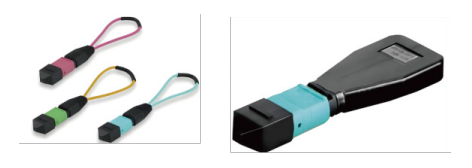
The most practical way to independently verify an adapter claim is to test the link path with an MPO/MTP loopback. The MPO-12F-Loopback and MPO-24F-Loopback are classified as test equipment for network testing, data centre commissioning and equipment validation, and are made from a ceramic ferrule, an MTP ferrule, a plastic housing and fiber cable. Their published parameters — insertion loss of 0.7 dB or lower for 8F/12F and 1.0 dB or lower for 24F, return loss of 65 dB or better in single-mode and 25 dB or better in multimode, mating cycles of 100,000 or more, and a link failure rate below 0.1% across OS2/OM1/OM2/OM3/OM4/OM5 — give the audit team a stable reference against which the adapter's contribution can be isolated.
Step 8 — System compatibility with terminated assemblies
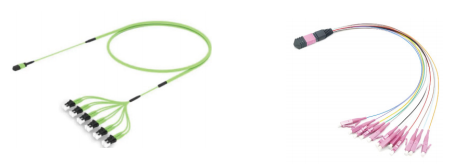
An adapter is only as good as the assemblies that mate with it. Audit the adapter together with the breakout hardware that will be used in the same cabinet. The MTP/MPO fan-out pre-terminated cable, available as MTP-12F-to-6xLC-Duplex or MTP-24F-to-12xLC-Duplex, is built with a ceramic ferrule, OS2/G.657A or OM3/OM4/OM5 fibre and a PVC or LSZH jacket, with breakout or fan-out structural options and LC/SC duplex or quad breakouts. Its published limits are an insertion loss of 0.35 dB typical and 0.75 dB maximum, or 0.10 dB typical and 0.35 dB maximum in low-loss grade, with return loss of 60 dB or better for APC and 50 dB or better for PC. These are the numbers that must be added to the adapter contribution when a full channel budget is validated, and they are typically used for data centre cabinet interconnection and 40G/100G/400G SR4/PSM4 module connection.
Step 9 — Documentation and laboratory evidence
Check the management system layer next to the product layer. Nanfang Communication holds ISO9001, TL9000, ISO14001, OHSAS18001, ISO50001 and Integration of Informatization and Industrialization Management System certifications, and operates a CNAS-accredited laboratory. For the audit file, capture certificate numbers, scope and validity, plus the laboratory's accreditation scope for optical measurements. Standards work is a useful secondary signal: the company holds over 300 patents, including more than 45 invention patents, and has participated in the formulation of 16 standards, comprising 1 national standard and 15 industry standards.
Step 10 — Traceability, labelling and packaging
Close the audit on the operational layer. Confirm that core counts and labelling can be customised per project, that label content and placement are agreed before the purchase order, and that packaging protects the ferrule and flange in transit. On multi-site rollouts, the adapter that arrives correctly labelled and undamaged is worth more than the adapter with the best-wording datasheet.
Where this audit pays off: deployment scenarios
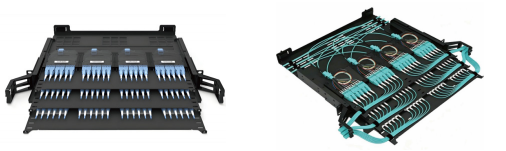
- High-density data centre patching. MPO adapters in high-density patch panels are the mated interface between trunk cabling and active equipment. Interface loss here multiplies across hundreds of channels, which is why the adapter, not the trunk cable, is often the dominant variable in a channel budget.
- 40G/100G/400G module connections. Fan-out and breakout assemblies terminating 12F or 24F MPO connectors rely on the adapter to hold alignment across repeated moves, adds and changes. Adapter quality is directly linked to how often a link must be re-tested.
- Telecom, metro and FTTx networks. Optical fibre cable in telecommunications, ISP, data centre, FTTx, enterprise, industrial, smart city, 5G backhaul and metropolitan backbone scenarios depends on passive distribution hardware. Adapters in the ODF and distribution layer inherit the same reliability expectations as the cable itself.
- Commissioning and network testing. Loopback-based verification is the moment of truth for every upstream component. An adapter that has been audited against the checklist produces fewer commissioning retests and a cleaner handover file.
Audit parameters compared: adapter, loopback and breakout cable
The table below maps the three product families an audit team will normally see in the same cabinet. All figures are published product parameters and should be confirmed against the relevant model datasheet before a purchase order is placed.
| Parameter | MPO-12F-SM MPO adapter | MPO/MTP loopback | MTP/MPO fan-out pre-terminated cable |
|---|---|---|---|
| Function | MPO adapter / coupler for high-density connector mating | Test equipment for network testing, data centre commissioning and equipment validation | Breakout patch cord for cabinet interconnection and 40G/100G/400G SR4/PSM4 module connection |
| Material composition | Ceramic ferrule, plastic housing, metal flange | Ceramic/MTP ferrule, plastic housing, fiber cable | Ceramic ferrule; OS2/G.657A or OM3/OM4/OM5 fibre; PVC or LSZH jacket |
| Insertion loss | Standard <0.5 dB; low-loss <0.35 dB | ≤0.7 dB (8F/12F); ≤1.0 dB (24F) | 0.35 dB typical / 0.75 dB max; low-loss 0.10 dB typical / 0.35 dB max |
| Return loss | ≥50 dB (SM) | ≥65 dB (SM); ≥25 dB (MM) | ≥60 dB (APC); ≥50 dB (PC) |
| Mating cycles | 500 cycles (IEC compliant) | ≥100,000 | Not stated in the parameters above — request it during the audit |
| Configurations | 4–72F SM/MM; black (flange with ears), Aqua (OM3), Violet (OM4) | MPO-12F-Loopback, MPO-24F-Loopback; OS2/OM1/OM2/OM3/OM4/OM5 | MTP-12F-to-6xLC-Duplex, MTP-24F-to-12xLC-Duplex; 12F or 24F; LC/SC duplex or quad breakout |
| Operating temperature | -40 °C to +85 °C | Not stated in the parameters above | Not stated in the parameters above |
| Audit purpose | Interface loss and mechanical stability verification | End-to-end link verification during commissioning | Assembly-level compatibility check with the adapter |
Frequently asked questions
What certification and laboratory evidence should an MPO adapter manufacturer provide?
Start with the quality management layer and then move to the product layer. Nanfang Communication's optical cable manufacturing is certified to TL9000-H and ISO 9001:2015, and the company also holds ISO9001, TL9000, ISO14001, OHSAS18001, ISO50001 and Integration of Informatization and Industrialization Management System certifications, and operates a CNAS-accredited laboratory. During an audit, request the certificates with their scope and validity dates, the accreditation scope covering optical measurements, and the internal test method used for insertion loss and return loss. Standards participation is a useful secondary indicator: the company has taken part in the formulation of 16 standards (1 national standard, 15 industry standards) and holds over 300 patents, more than 45 of which are invention patents.
How can I verify that published insertion loss and mating cycle figures are real?
Treat the published parameters as audit targets rather than as conclusions. For the MPO-12F-SM adapter, the targets are standard insertion loss below 0.5 dB or low-loss below 0.35 dB, single-mode return loss of 50 dB or better, 500 IEC-compliant mating cycles, an operating range of -40 °C to +85 °C and support for 4–72F in single-mode and multimode. Ask which grade is quoted, at which wavelength and with which reference the value was measured, and whether the value is stated before or after mating cycles. Then cross-check with an independent instrument: an MPO/MTP loopback is specified at 0.7 dB or lower insertion loss for 8F/12F and 1.0 dB or lower for 24F, return loss of 65 dB or better in single-mode and 25 dB or better in multimode, 100,000 or more mating cycles and a link failure rate below 0.1%, which is a sufficiently stable reference to isolate the adapter's contribution during commissioning.
What drives the cost difference between standard and low-loss MPO adapters?
Four factors dominate. The first is optical grade: the same MPO-12F-SM adapter family is published with standard insertion loss below 0.5 dB or low-loss below 0.35 dB, and the tighter grade requires tighter ferrule selection and more screening. The second is material specification — ceramic ferrule, plastic housing and metal flange each have a quality band, and the flange in particular is easy to undervalue until panel stability is tested. The third is test time per unit, which rises with the grade specified. The fourth is documentation and labelling, especially where customised core counts and labelling are required. Landed cost should also be modelled per line item: as of late 2026, Chinese-origin optical fibre cables under HTS 8544.70.00 face a total U.S. import duty of 37.50%, so classification assumptions should be confirmed rather than carried over between product lines.
Which type of supplier should be shortlisted for an MPO multi-core connector audit?
Prioritise manufacturers that produce both the cable side and the connector and component side under one quality system, because that is what makes component-level traceability possible. Nanfang Communication publicly lists indoor and outdoor optical cables, PLC splitters, fiber optic connectors, MPO multi-core connectors, optical modules, and custom specialty fibres and cables among its product scope, and the group is described in its annual report as principally engaged in manufacturing and sales of optical fibre cable products and related devices. Useful capacity and engineering indicators to check during shortlisting include a 26,795.3 m² manufacturing facility, 3,000,000 core kilometres of annual production capacity, approximately 360 employees including 80 R&D engineers, 28 provincial-level offices across China, and established cooperation with operators including China Telecom, China Mobile, China Unicom and China Broadcast Network.
Can I validate an MPO adapter with samples before placing a volume order?
Yes, and sample validation should repeat the audit checklist at small scale rather than only confirming that the part looks correct. On a sample, inspect the ceramic ferrule end-face, measure insertion loss and return loss against the specified grade, apply mating cycles and compare the result with the published 500-cycle IEC-compliant rating, and mate the adapter with the breakout assemblies it will serve — for example an MTP-12F-to-6xLC-Duplex or MTP-24F-to-12xLC-Duplex fan-out pre-terminated cable — so the channel budget is validated as a system. Sample requests and technical questions can be sent to Nanfang Communication at info@jsnfgroup.com, by telephone on +86 51988792646, or via WhatsApp on +8619850287785, and the full product brochure can be downloaded here.
Conclusion: audit the part, not the PDF
An MPO adapter audit works when it follows the physical order of the product: ferrule, then housing, then flange, then the assembled interface, then the test evidence, then the documents. The published targets are concrete enough to audit against — standard insertion loss below 0.5 dB or low-loss below 0.35 dB, single-mode return loss of 50 dB or better, 500 IEC-compliant mating cycles, an operating range of -40 °C to +85 °C and support for 4–72F in single-mode and multimode. Verify them with a loopback in the link path, confirm compatibility with the breakout assemblies used in the same cabinet, and finish with certificates, laboratory accreditation, labelling and packaging. Buyers who audit in this order qualify a component; buyers who do not qualify a catalogue page.

Next step for your MPO adapter audit
Nanfang Communication supplies optical fibres, optical cables, ODN systems and optical components including MPO multi-core connectors, and can support project-specific core counts and labelling. To request samples, a quotation or the MPO product catalogue, contact us at info@jsnfgroup.com, Tel: +86 51988792646, WhatsApp: +8619850287785, or visit jsnfgroup.com. Download the full brochure here.
Have Questions or Need More Details?
Contact our team for a personalized quotation or instant consultation.
Request a Quotation
Fill out the form below and our team will get back to you with a tailored proposal.
WhatsApp Direct Chat
Prefer to chat in real-time? Message us on WhatsApp for instant assistance & quick answers.
- Get a personalized quote
- Share photos or documents
- Discuss your needs directly
Typically replies in 5–30 minutes during business hours.