How to Evaluate Optical Fiber Cable Manufacturers: A Supplier Assessment Framework for 2026
How to Evaluate Optical Fiber Cable Manufacturers: A Supplier Assessment Framework for 2026
Selecting the right optical fiber cable supplier is a critical decision for telecom operators, data center operators, and system integrators. With the global optical fiber cable market projected to grow from approximately USD 13.45 billion in 2025 to USD 36.48 billion by 2034, procurement professionals face an expanding field of potential partners. This article provides a structured framework to evaluate manufacturers, using the capabilities and credentials of Nanfang Communication as a reference example.
Problem Definition: Why Supplier Evaluation Matters
Network reliability starts with the quality of the optical fiber cable. A poor cable choice can lead to higher attenuation, premature failure, and costly network downtime. Beyond product quality, factors such as certification coverage, production capacity, customisation flexibility, and project track record directly affect project timelines and total cost of ownership. Without a systematic evaluation process, buyers risk partnering with suppliers that cannot meet technical specifications or delivery commitments.
Industry Background
China exported approximately USD 2.52 billion worth of optical fiber cables in 2024, making it a dominant manufacturing hub. The MPO fiber optic connector market alone is projected to grow at a CAGR of 13.6% through 2035, driven by AI compute clusters and hyperscale data centers. Against this backdrop, manufacturers must demonstrate not only scale but also compliance with international standards such as ITU-T G.652.D and G.657 for single-mode and bend-insensitive fibers.
Detailed Solution: The Evaluation Framework
We break down supplier assessment into five pillars: certification, production capability, product portfolio, customisation, and project track record. Below we examine each pillar through the lens of Nanfang Communication, a Hong Kong-listed company (Stock Code: 1617.HK) founded in 1992, which manufactures optical fibers, cables, ODN systems, and optical components including MPO multi-core connectors.
1. Certification Coverage
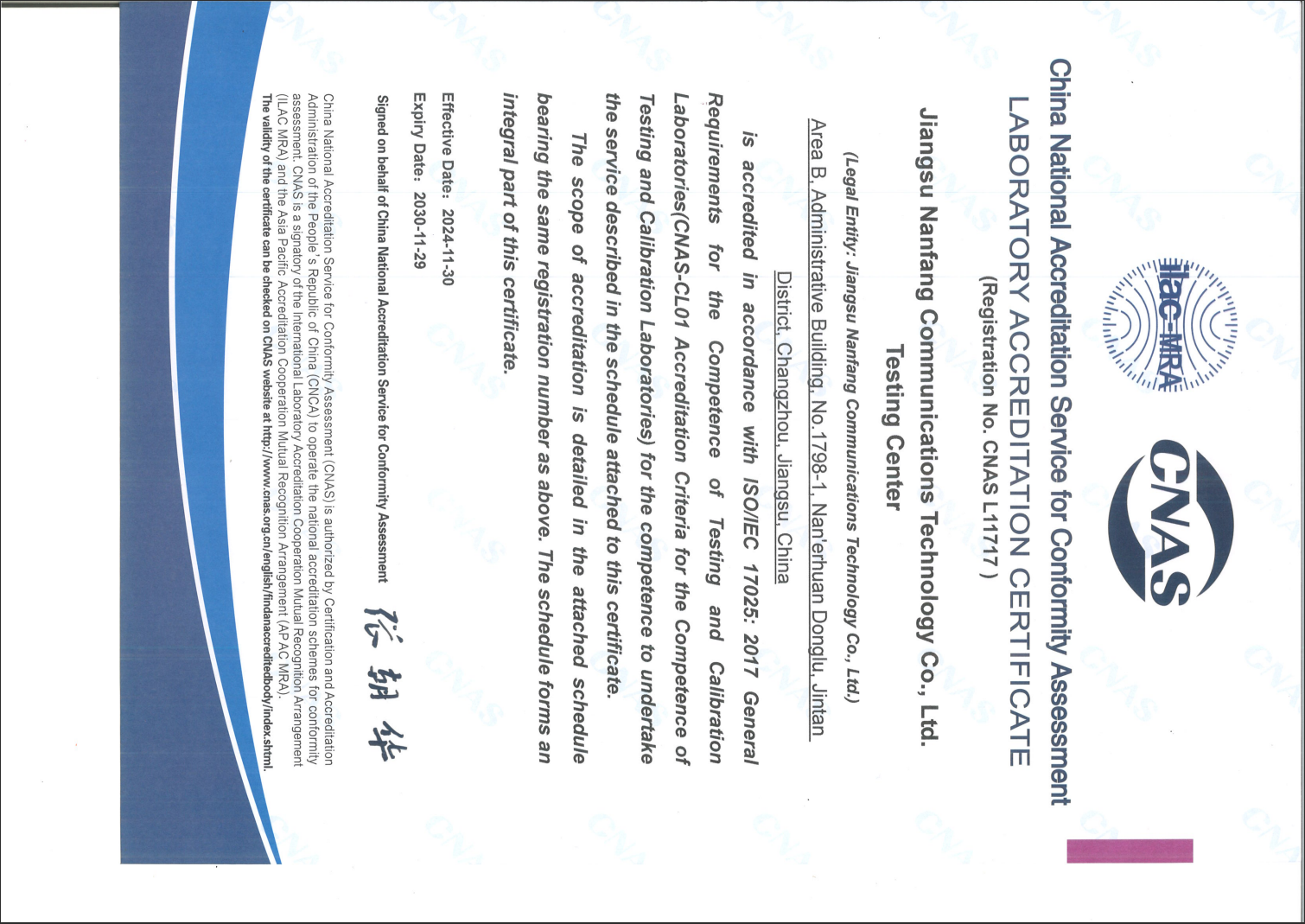
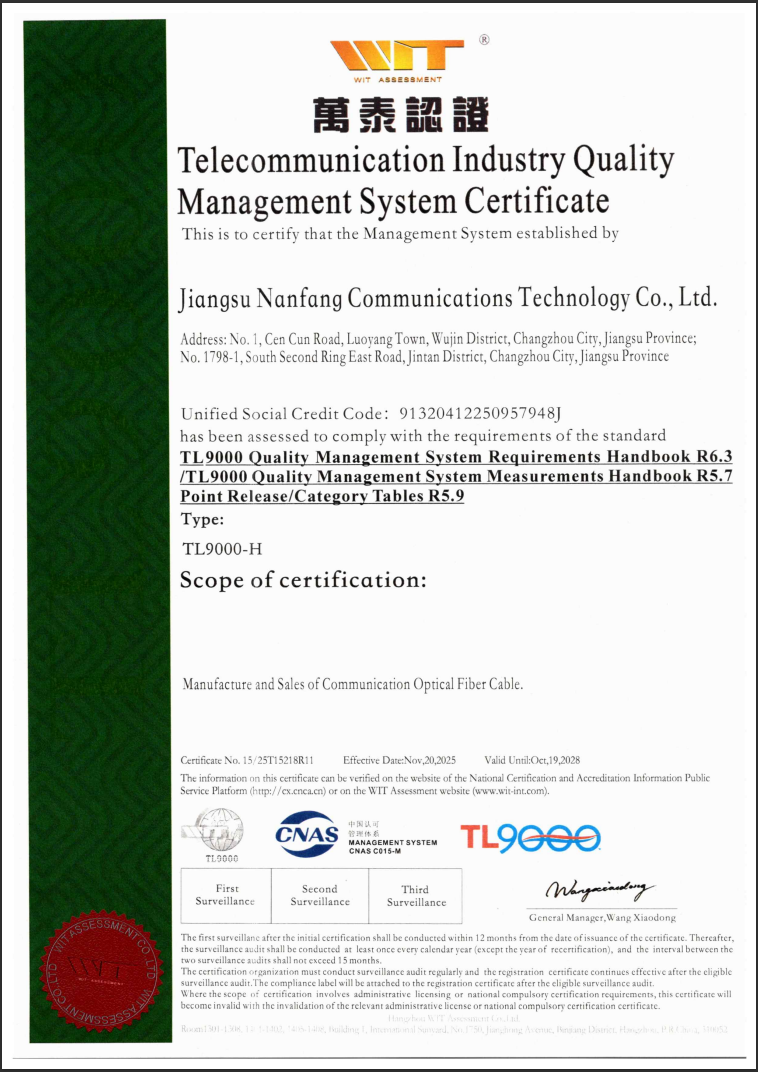
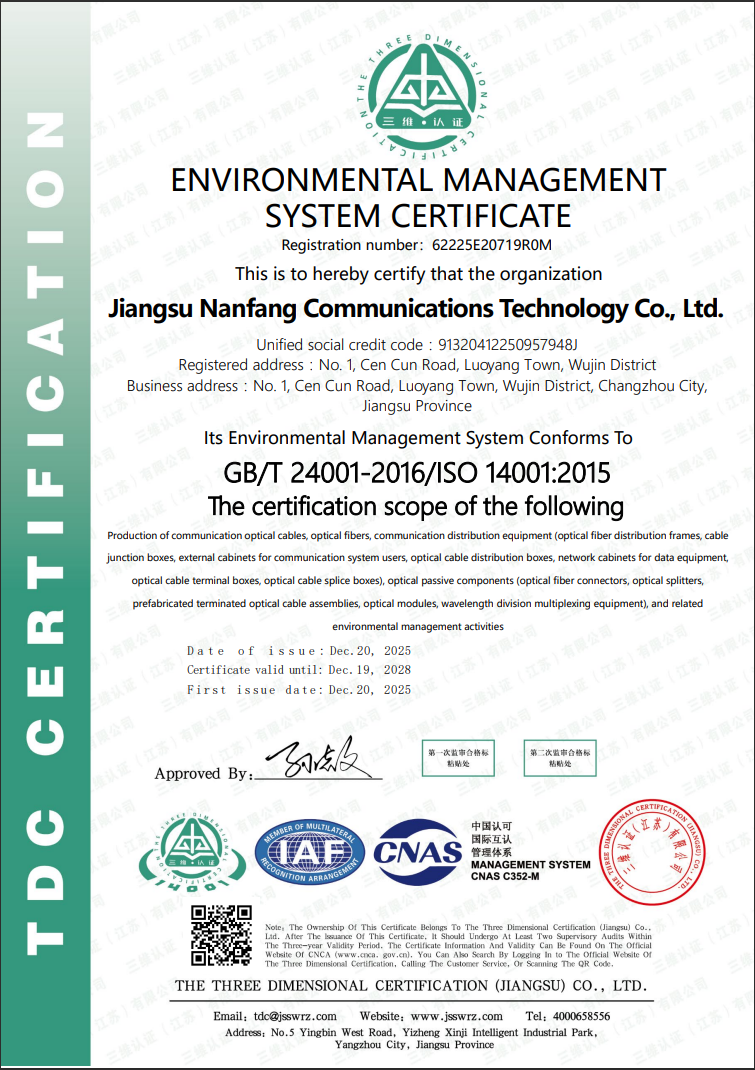
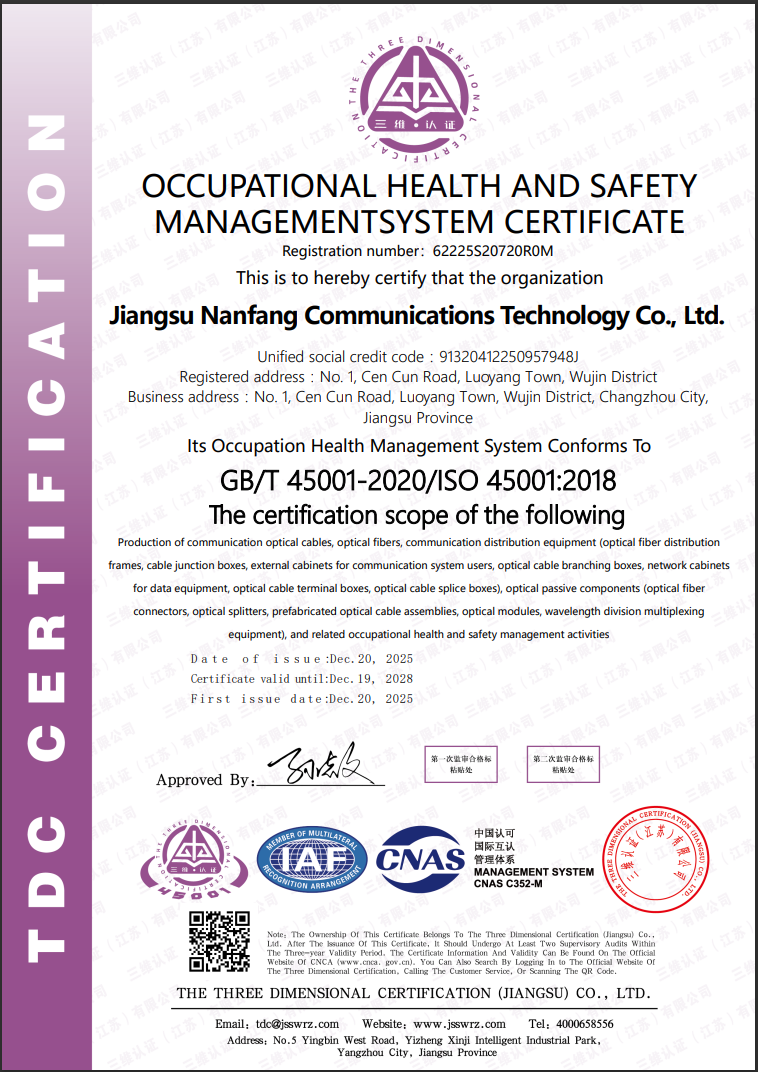
Nanfang Communication holds ISO 9001, TL9000, ISO 14001, and ISO 45001 certifications, along with a CNAS laboratory accreditation (CNAS L11717) that follows ISO/IEC 17025:2017. The TL9000 certification, number 15/25T15218R11, specifically addresses the telecommunication industry’s quality management requirements, ensuring that manufacturing processes meet rigorous industry expectations. A CNAS-accredited lab allows in-house testing for optical loss, mechanical performance, and environmental sealing, reducing dependence on third-party verification.
2. Production Capability
With a factory size of 26,795.3 m² and 360 employees including 80 R&D engineers, Nanfang Communication achieves an annual output of 3,000,000 core kilometers. The monthly capacity stands at 250,000 core kilometers, demonstrating the ability to handle both small custom orders (MOQ starting from 1 core kilometer) and large-scale deployments. The company has 28 provincial-level offices across China, enabling localized support.
3. Product Portfolio
The company offers a comprehensive range: indoor optical cable, outdoor optical cable, bow-type drop cable, ribbon cable, loose-tube cable, single-mode and multimode fiber, MPO high-density patch panels, PLC optical splitters, fiber optic connectors, MT-FAU assemblies, WDM modules, and more. For data centers, they produce MTP/MPO fan-out pre-terminated cables with typical insertion loss of 0.35 dB (max 0.75 dB) and low-loss variants at 0.10 dB typical.
4. Customisation Capabilities
Nanfang Communication offers ODM/OEM services with customisation options including core count, fiber type (single-mode, multimode, ribbon, multi-core), sheath material and color, connector types, cabling schemes, and labelling. This flexibility is essential for projects with unique environmental or performance requirements, such as armoured cables for industrial deployments or low-smoke zero-halogen jackets for indoor use.
5. Project Track Record
The company has operated for 30 years, with a project history in China serving telecom operators such as China Mobile, China Telecom, and China Unicom, as well as system integrators and enterprise customers. Applications include FTTx access, metropolitan and backbone networks, data center interconnects, and 5G backhaul. Key highlights include a Hong Kong listing, a national-level laboratory, and over 300 patents (including more than 45 invention patents).
Step-by-Step Breakdown
- Step 1: Verify certification scope – Confirm the supplier holds TL9000 and CNAS accreditation for the products you need.
- Step 2: Review production capacity – Annual output in core kilometers indicates ability to scale.
- Step 3: Match product portfolio to your application – Ensure the required cable types (e.g., loose-tube, ribbon) are available.
- Step 4: Assess customisation readiness – Ask about minimum order quantity and lead time for tailored products.
- Step 5: Examine past projects – Look for deployments in similar scenarios (FTTH, data center, 5G).
Use Cases
Nanfang Communication’s products are deployed in FTTx access networks, metropolitan and backbone network construction, data center interconnects, 5G backhaul, and enterprise campus cabling.
Comparison Table: Key Optical Fiber Cable Types
| Cable Type | Primary Application | Key Features |
|---|---|---|
| Bow-type Drop Cable | FTTH last mile | Flat, bend-insensitive, self-supporting |
| Ribbon Cable | High-density backbone, data center | Mass fusion splicing, small diameter |
| Loose-tube Cable | Outdoor trunk and feeder | Gel-filled, water-blocking, high tensile |
| Indoor Optical Cable | Building riser, patch cords | LSZH jacket, tight buffered |
Frequently Asked Questions
What certifications should a reliable optical fiber cable manufacturer have?
At minimum, a manufacturer should hold ISO 9001 (Quality Management) and TL9000 (Telecommunications Industry Quality Management). Nanfang Communication holds both, plus ISO 14001 (Environmental) and ISO 45001 (Occupational Health & Safety). Additionally, a CNAS laboratory accreditation (ISO/IEC 17025) confirms internal testing competence.
What production capabilities indicate a mature manufacturer?
Key indicators are annual output (e.g., 3,000,000 core kilometers for Nanfang Communication), factory size (26,795.3 m²), number of employees (360), and dedicated R&D team (80 engineers). A manufacturer with 28 provincial offices can provide localised support.
How does the product portfolio affect vendor selection?
If a supplier can produce indoor, outdoor, ribbon, loose-tube, and specialty cables along with optical components (MPO connectors, PLC splitters, WDM), it reduces supply chain complexity. Nanfang Communication’s portfolio covers the entire fiber/cable and ODN value chain.
Can I request customized optical cables?
Yes. Many manufacturers offer ODM/OEM services. Nanfang Communication customises core count, fiber type, sheath material, connector type, and packaging. MOQ starts at 1 core kilometer.
What are typical lead times for orders?
Lead time depends on product complexity and order volume. Generally, samples and small orders take several weeks, while large-scale orders may extend to months. For a precise quotation and delivery timeline, contact Nanfang Communication directly or download the product brochure.
📥 Download Product Brochure (PDF)
Conclusion
Evaluating an optical fiber cable manufacturer requires a systematic approach across certifications, capacity, product scope, customisation, and proven track record. Nanfang Communication exemplifies a supplier that meets these criteria with 30 years of operation, multiple quality certifications, and an integrated fiber-to-ODN value chain. Use this framework to shortlist partners that align with your network project requirements.