
Optical Fiber Cable Certification & MPO Parameter Verification
Optical Fiber Cable Certification & MPO Parameter Verification
At the research-to-evaluation stage, the most important task is not to collect marketing claims but to confirm whether the proposed optical fiber cable and interconnect components can meet the deployment's mechanical, optical, and regulatory requirements. This article walks through the parameters and certifications that buyers should request from a supplier, using Nanfang Communication as a reference case.
Problem Definition: Why Verification Outperforms Assumption
A common friction point in optical fiber cable procurement is that a datasheet may list a general GYTA53 model but omit the specific optical fiber type, core count, attenuation values, sheath material, and connector test data. Buyers evaluating indoor optical cable, outdoor optical cable, loose tube optical cable, ribbon optical cable, or bow-type drop optical cable need to distinguish between what is standardized, what is model-specific, and what must be confirmed through test reports or certification documents.
Without this distinction, two suppliers can quote the same category but deliver different mechanical protection, flame-retardant performance, or MPO multi-core fiber optic connector behavior. That risk is especially high when an evaluation checklist focuses only on price and leaves connector return loss, mating cycles, and certification numbers unverified.
Industry Background: A Market That Rewards Verified Specifications
The global optical fiber cable market was valued at approximately USD 13.45 billion in 2025 and is projected to reach USD 36.48 billion by 2034, according to Custom Market Insights. China's exports of optical fiber cables under HS 854470 reached approximately USD 2.52 billion in 2024, based on OEC data. The global fiber optic connector market was estimated at USD 11.2 billion in 2024, with LC connectors holding a dominant 35.43% share, according to Global Market Insights and Grand View Research.
MPO-specific demand is also increasing. The MPO fiber optic connector market is projected to grow at a CAGR of 13.6% through 2035, driven by AI compute clusters and hyperscale data centers, according to Business Research Insights. ITU-T G.652.D remains the industry standard for single-mode fiber, while G.657 is the primary standard for bend-insensitive fibers used in FTTH. These data points do not replace vendor documentation, but they explain why specification accuracy has become a procurement risk: the same project may require both conventional optical fiber cable and high-density MPO components that must be evaluated under different test conditions.
Detailed Solution: What to Check Before Shortlisting a Supplier
Optical Fiber Cable Construction and Parameter Checklist
For the optical fiber cable category, the material and mechanical parameters should be confirmed per model datasheet. The core material is silica glass. Strength members are made of FRP and other materials. Armoring materials can include galvanized steel wire or steel tape. Sheath options include PE and LSZH. Common fiber types include G.652 and G.657, while core count and core diameter are specified per model. Typical attenuation values are given in dB/km. Tensile strength ratings and minimum bend radius are specified in the datasheet, and operating wavelengths are within typical optical communication bands.
This combination matters because indoor optical cable, outdoor optical cable, ribbon optical cable, loose tube optical cable, and bow-type drop optical cable are not interchangeable. An outdoor duct or direct-burial deployment needs to be checked for armoring, crush resistance, and waterproofing. An indoor or FTTH environment may require LSZH sheath performance and bend-insensitive G.657 fiber. A data center spine-leaf architecture may shift the focus to ribbon optical fiber, MCF multi-core fiber, or MPO high-density patch panel compatibility.
MPO Connector Performance Evidence
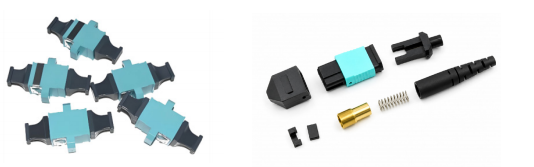
The MPO-12F-SM is a single-mode MPO adapter with low insertion loss. It uses a ceramic ferrule, plastic housing, and metal flange. Standard insertion loss is less than 0.5 dB, and low-loss insertion loss is less than 0.35 dB. Single-mode return loss is at least 50 dB. Mating cycles are 500 cycles, compliant with IEC standards. The operating temperature range is -40°C to +85°C. The fiber count ranges from 4 to 72 fibers, supporting both single-mode and multimode. Available colors include black with flange ears, aqua for OM3, and violet for OM4.
MTP/MPO fan-out pre-terminated cable or breakout patch cord data should be reviewed separately. For models such as MTP-12F-to-6xLC-Duplex or MTP-24F-to-12xLC-Duplex, typical insertion loss is 0.35 dB, maximum insertion loss is 0.75 dB, low-loss typical insertion loss is 0.10 dB, and low-loss maximum insertion loss is 0.35 dB. Return loss is at least 60 dB for APC and at least 50 dB for PC. Fiber count is 12F or 24F, with breakout options in LC or SC duplex or quad. Jacket options include LSZH and OFNR. These values matter for 40G/100G/400G SR4 or PSM4 module connections and data center cabinet interconnection.
For MPO/MTP loopback testing pods such as MPO-12F-Loopback or MPO-24F-Loopback, the key metrics are low-loss insertion loss of less than or equal to 0.7 dB for 8F/12F and less than or equal to 1.0 dB for 24F. Return loss is at least 65 dB for single-mode and at least 25 dB for multimode. Supported fiber types include OS2, OM1, OM2, OM3, OM4, and OM5. Mating cycles are at least 100,000, and link failure rate is less than 0.1%. These figures help engineers separate a durable test tool from a disposable adapter.
Certification and Laboratory Support
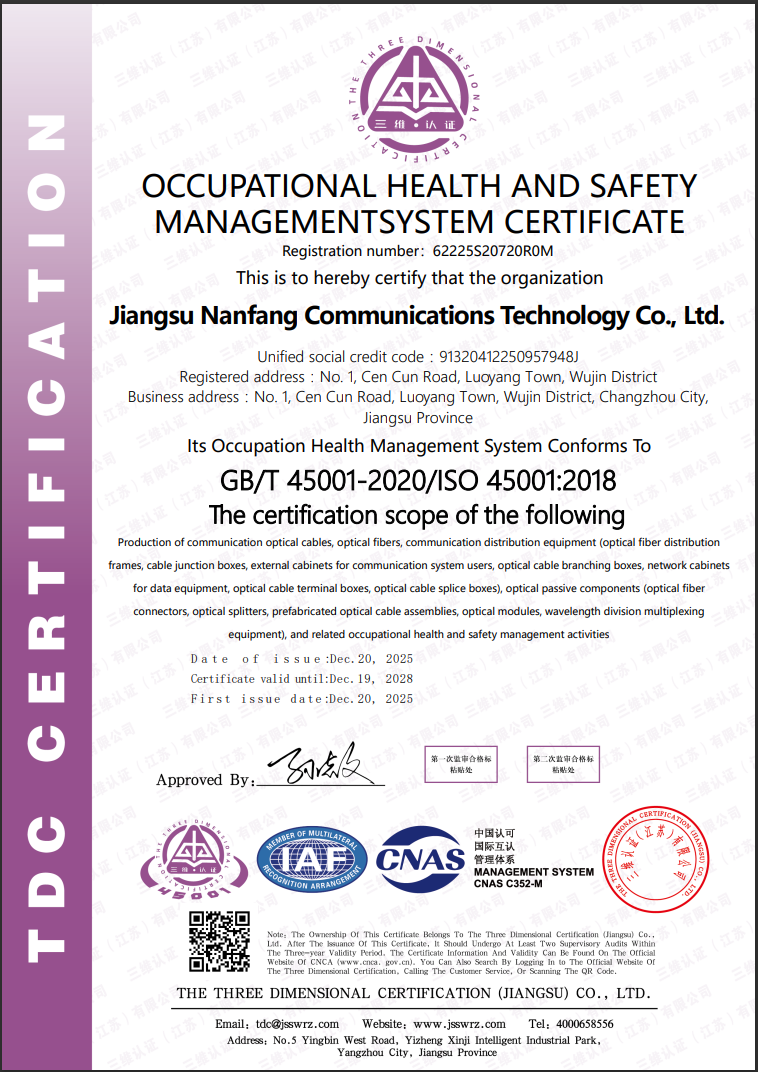
Certification evidence should be linked to the product model, not just to the company. For the optical fiber cable model GYTA53, the available certifications include ISO 14001:2015, ISO 45001:2018, and TL9000-H. The ISO certifications are issued by SWR Certification (Jiangsu) Co., Ltd. with certificate numbers 62225E20719R0M and 62225S20720R0M. The TL9000 certification is issued by WIT Assessment / Hangzhou WIT Assessment Co., Ltd. These certifications apply to the global market.
Nanfang Communication also operates a CNAS-accredited laboratory. The accreditation is to ISO/IEC 17025:2017, with accreditation certificate number CNAS L11717 issued by the China National Accreditation Service for Conformity Assessment. The scope covers testing and calibration of optical fiber cable and optical communication components, and applies to China and global markets. This is important when a buyer asks for third-party-style verification from the supplier's own lab.
The MPO Fiber Optic Adapter, MPO/MTP loopback, and MTP/MPO fan-out cable each carry related certification and standards evidence. For example, the MPO Fiber Optic Adapter holds ISO 14001:2015 and ISO 45001:2018 certifications, both issued by SWR Certification (Jiangsu) Co., Ltd. The MPO/MTP loopback complies with the TL9000 Quality Management System Requirements Handbook R6.3, while the MTP/MPO fan-out cable certification is issued by WIT Assessment / Hangzhou WIT Assessment Co., Ltd. Buyers should record certificate numbers and verify them against the issuing body rather than accepting a certificate image alone.
Step-by-Step Breakdown: A Five-Step Evaluation Workflow
Step 1: Define the Deployment Scenario and Cable Architecture
Start with the physical environment: indoor cabling, duct installation, aerial/self-supporting runs, direct burial, or outdoor harsh conditions. Then match the cable architecture to the network role. FTTH/FTTx access projects may require bow-type drop optical cable, PLC optical splitters, FTTH optical cable distribution boxes, and optical cable splice closures. Data center interconnects may shift priority to MPO multi-core fiber optic connectors, MPO high-density patch panels, and pre-terminated trunk or breakout assemblies. Without this first step, the remaining verification will target the wrong parameters.
Step 2: Request the Optical Fiber Cable Datasheet Fields
Ask the supplier to confirm core count, core diameter, fiber type such as G.652 or G.657, attenuation in dB/km, operating wavelengths, minimum bend radius, tensile strength, sheath material such as PE or LSZH, and armoring if outdoor deployment is required. For ribbon optical cable, fiber geometry and mass-fusion splicing compatibility are also relevant. A datasheet that repeats only the cable type name does not provide enough information for evaluation.
Step 3: Verify Connector and Breakout Test Data
For MPO-based links, request insertion loss, return loss, mating cycles, and operating temperature. Compare standard and low-loss values for the MPO adapter, fan-out cable, and loopback device. Confirm whether the values are typical or maximum, because a typical insertion loss of 0.10 dB for a low-loss fan-out cable is not the same as a maximum value.
Step 4: Match Certifications to Product Models
Do not accept a generic statement such as “the factory is ISO certified.” Ask which product model is covered by which standard and certificate number. For example, ISO 14001:2015 certificate 62225E20719R0M and ISO 45001:2018 certificate 62225S20720R0M are tied to production scope including communication optical cables and related equipment. CNAS L11717 covers testing and calibration of optical fiber cable and optical communication components. Record the issuing body and expiry date when available.
Step 5: Check Capacity and Lead Time Before Running Pricing
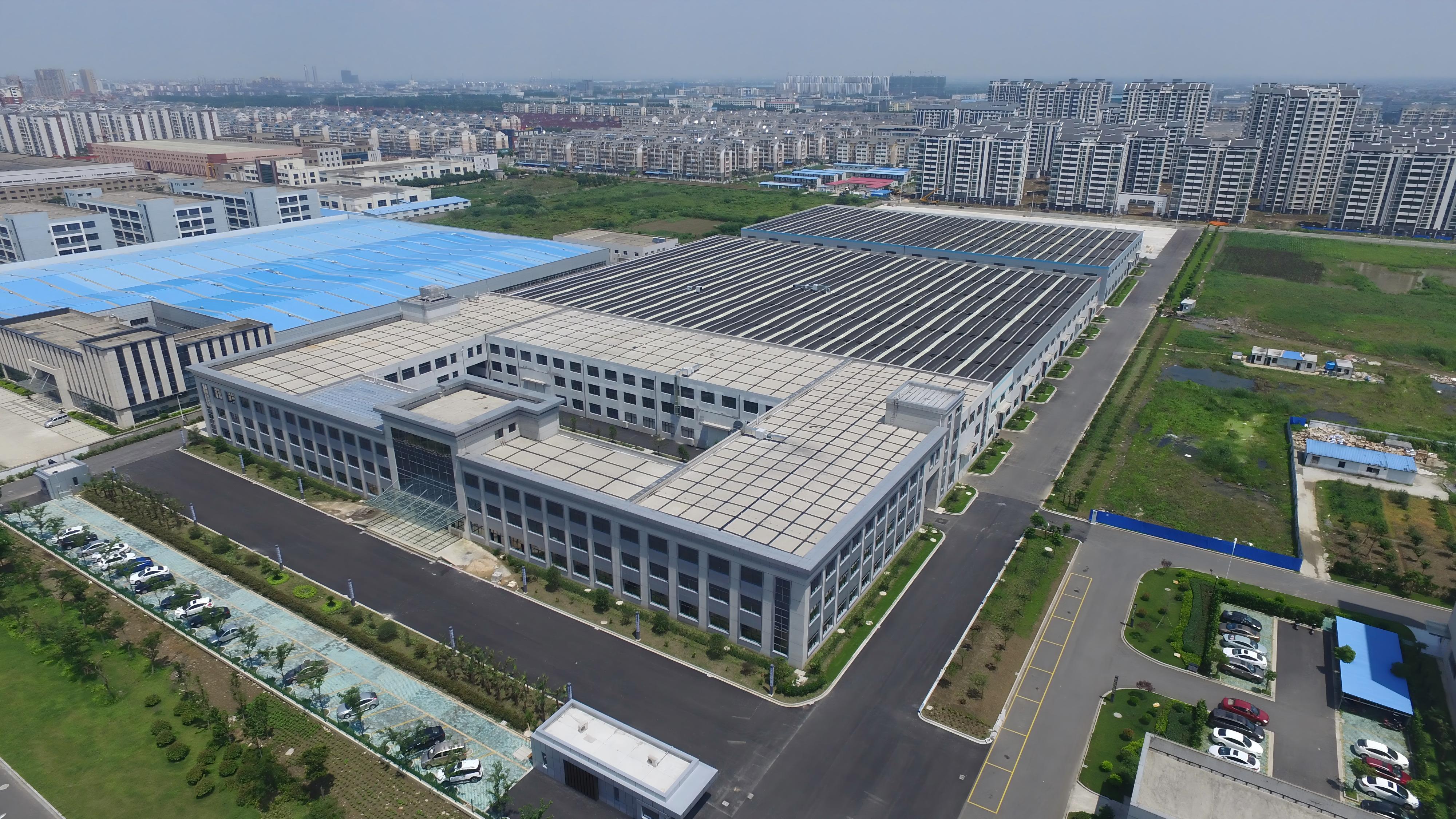
Finally, confirm whether the supplier can support both pilot and scaled volumes. Nanfang Communication reports a monthly capacity of 250,000 core kilometers, a factory size of 26,795.3 m², 360 employees, 80 R&D engineers, and annual output of 3,000,000 core kilometers. The minimum order quantity for optical fiber cable is 1 core kilometer. Lead time depends on model and quantity; samples and small orders typically take several weeks, while large orders may take months. This information should be confirmed with the sales team before final commercial comparison.
Use Cases: Where Verified Optical Fiber Cable and MPO Components Fit
In FTTx access and operator network expansion, the physical-layer infrastructure must work alongside optical modules, PLC optical splitters, cable splice closures, FTTH optical cable distribution boxes, and fiber optic connectors. Nanfang Communication's application scope includes FTTx access, metropolitan and backbone network construction, data center interconnects, 5G backhaul, and enterprise campus cabling. Its products support long-term continuous operation as passive optical network components or as supporting physical channels for active equipment.
The company has established long-term relationships with operators including China Telecom, China Mobile, China Unicom, and China Broadcast Network, as well as private network users in high-speed railway, power grid, and chemical industry projects. For system integrators and contractors, the most useful capability is not only the cable itself but the ability to coordinate indoor optical cable, outdoor optical cable, connector interfaces, and distribution elements within one supply chain.
Comparison Table: Product-Level Verification Summary
| Product | Key parameters to verify | Certifications / standards to request | Typical application context |
|---|---|---|---|
| Optical fiber cable (GYTA53) | Silica glass core; FRP strength members; galvanized steel wire/steel tape armoring; PE/LSZH sheath; G.652/G.657 fiber types; attenuation in dB/km; core count and diameter per model | ISO 14001:2015, ISO 45001:2018, TL9000-H | FTTx access, metropolitan/backbone networks, data center interconnects, 5G backhaul, enterprise/campus deployments |
| MPO Fiber Optic Adapter (MPO-12F-SM) | IL <0.5 dB standard, <0.35 dB low-loss; RL ≥50 dB SM; 500 mating cycles; -40°C to +85°C; 4-72F SM/MM | ISO 14001:2015, ISO 45001:2018, TL9000 | Data centers, telecom networks, high-density cabling systems |
| MTP/MPO Fan-out Pre-terminated Cable (MTP-12F-to-6xLC-Duplex) | IL typ 0.35 dB, max 0.75 dB; low-loss typ 0.10 dB, max 0.35 dB; RL ≥60 dB APC, ≥50 dB PC; 12F/24F; LSZH/OFNR | WIT Assessment certification | 40G/100G/400G SR4/PSM4 module connection, data center cabinet interconnection |
| MPO/MTP Loopback (MPO-12F-Loopback) | Low-loss IL ≤0.7 dB (8F/12F), ≤1.0 dB (24F); RL ≥65 dB SM, ≥25 dB MM; ≥100,000 mating cycles; link failure <0.1% | TL9000 Quality Management System Requirements Handbook R6.3 | Network testing, data center commissioning, equipment validation |
FAQ
What certifications should an optical fiber cable supplier provide for global projects?
For Nanfang Communication, the optical fiber cable model GYTA53 is certified to ISO 14001:2015 with certificate number 62225E20719R0M and ISO 45001:2018 with certificate number 62225S20720R0M, both issued by SWR Certification (Jiangsu) Co., Ltd. It also carries TL9000-H certification. The supplier operates a CNAS-accredited laboratory to ISO/IEC 17025:2017 with certificate number CNAS L11717, covering testing and calibration of optical fiber cable and optical communication components. These certifications apply to the global market.
How can I verify MPO connector insertion loss and return loss before ordering?
Request the model-level datasheet and compare standard versus low-loss performance. For the MPO-12F-SM adapter, standard insertion loss is less than 0.5 dB, low-loss insertion loss is less than 0.35 dB, and single-mode return loss is at least 50 dB. Mating cycles are 500 cycles, compliant with IEC standards, and the operating temperature range is -40°C to +85°C. Always confirm whether the stated values are typical or maximum.
What is the minimum order quantity and monthly capacity for Nanfang Communication optical fiber cable?
The minimum order quantity for optical fiber cable is 1 core kilometer. Monthly capacity is 250,000 core kilometers. The company reports annual output of 3,000,000 core kilometers, 26,795.3 m² of factory space, 360 employees, and 80 R&D engineers. These figures help evaluation-stage buyers assess whether the supplier can support both pilot orders and scaled deployment.
Can I get sample test data or certification verification for MPO loopback and fan-out cables?
Nanfang Communication operates a CNAS-accredited laboratory with certificate number CNAS L11717, covering testing and calibration of optical fiber cable and optical communication components. The MPO/MTP loopback complies with TL9000 Quality Management System Requirements Handbook R6.3. The MTP/MPO fan-out cable certification is issued by WIT Assessment / Hangzhou WIT Assessment Co., Ltd. Buyers should request the relevant test report and confirm certificate numbers with the issuing body rather than relying on a certificate image alone.
How long is the lead time for optical fiber cable orders?
Lead time depends on model and quantity. The site does not provide a single standard lead time. Typically, samples or small orders take several weeks, while large orders may take months. For a project-specific schedule, contact the sales team at info@jsnfgroup.com or call +86 51988792646. You can also review the official brochure before requesting a quote.
Conclusion
A reliable optical fiber cable evaluation does not need to be overcomplicated, but it must be specific. Buyers should ask for model-level parameters, not category-level claims. For cable products, the key fields are fiber type, core count, attenuation, tensile strength, bend radius, sheath, and armoring. For MPO components, the key fields are insertion loss, return loss, mating cycles, and operating temperature. Certification numbers should be checked against the issuing body, and laboratory accreditation should be verified before large orders are placed.
Next step: If you are evaluating optical fiber cable and MPO interconnect suppliers, download the Nanfang Communication MPO product brochure or contact info@jsnfgroup.com for model-specific datasheets and test reports.