Optical Fiber Cable Compliance: Certificate Scope and Regional Fit
An optical fiber cable compliance package usually arrives as a single PDF bundle: a system summary, a stack of certificates, an accreditation page and a datasheet. Because the pages look similar, they are often read as one interchangeable proof of being “certified”. They are not interchangeable. A management-system certificate describes how an organisation is run within a defined scope. A product-level certification reference links a named model to a certificate number. A laboratory accreditation defines which tests a laboratory is competent to perform. A tender response that blends the three can pass an internal review and still leave an open risk on attenuation, assembly performance or market entry.
This guide gives a reading method rather than a definition list: sort the documents into families, check four attributes on each, and then map the result to the region you will deploy in. Nanfang Communication (Jiangsu South Communication Technology Co., Ltd.), a subsidiary of Hong Kong-listed South Communication Holdings Limited (Stock Code: 1617.HK), is used as the worked example because its published set contains all three document families, with certificate numbers, issuing bodies, standard editions and validity dates. Based in Changzhou, Jiangsu Province, China, the company manufactures optical fibres, optical cables, ODN systems and optical components and states an annual output of 3,000,000 core kilometres.
The problem: three document families in one bundle
Sorting comes before interpretation. Before reading a single page for meaning, label every document as one of the following three types, because each type supports a different sentence in your evaluation report.
1. Management-system certificates
A management-system certificate states that an organisation, at a named site, was assessed against a named standard edition for a stated scope of activity — for example, manufacture and sales of communication optical fiber cable. It is evidence about process control, documentation, corrective action and internal audit. It is not a measurement of the attenuation, tensile strength or bend radius of the reel delivered to your warehouse.
2. Product-level certification references
A product-level reference attaches a certificate number to a specific model. Its usefulness depends entirely on whether the certificate itself, or an attached scope annex and product list, names that model family. A model table on a website is a pointer to a certificate, not a substitute for the certificate’s scope wording.
3. Laboratory accreditation
An accreditation to ISO/IEC 17025 addresses the testing laboratory: which tests and calibrations it is accredited to perform, within which stated scope. It supports the credibility of a test report. It does not approve a product and it does not set the acceptance limits your project or tender applies.
Industry background: why certificate sets drift apart
Three practical forces make compliance packages uneven, and none of them implies bad faith.
Standards revision. The documents in a bundle are issued at different times. The TL9000-H certificate in the Nanfang set, for example, cites the TL9000 Quality Management System Requirements Handbook R6.3, the TL9000 Quality Management System Measurements Handbook R5.7 Point Release and Category Tables R5.9. Revision pinning matters because a later handbook revision changes what the audit covered; a buyer comparing two suppliers’ TL9000 documents should compare the revisions, not only the standard name. TL9000 is a telecommunications-industry quality management standard, and the certificate itself is where the applicable revision is fixed.
Summary pages and certificate registers are written at different moments. A company profile may list an OHSAS 18001 occupational health and safety certification, while the certificate record supplied for a specific product cites ISO 45001:2018. These are two distinct standards in the same discipline, and a certificate cites one, not both. The correct action is not to assume substitution in either direction, but to ask which document is current for the site and product you are buying.
Application standards multiply by environment. IEC 60092-378:2024 addresses optical fibre cables for fixed shipboard and offshore installations. IEC 60794-1-104:2024 defines the impact test procedure (E4) used to establish uniform impact performance requirements. ITU-T L.103 (08/2024) describes characteristics, construction and test methods for indoor optical fibre cables. A quality management certificate cannot stand in for any of them.
The volume of cross-border movement explains why the scrutiny is heavy: China was the leading exporter of optical fibres and cables in 2024, with exports totalling USD 2.52 billion, according to trade data compiled by the Observatory of Economic Complexity from UN Comtrade records. High-volume sourcing means compliance documents are reviewed at scale, and reviewers work from the paperwork in front of them.
Reading a management-system certificate: four attributes that decide its value
Every management-system certificate in the set should be checked for the same four attributes. Applied to the Nanfang records, they produce a usable summary rather than a logo wall.
Attribute 1 — Scope wording
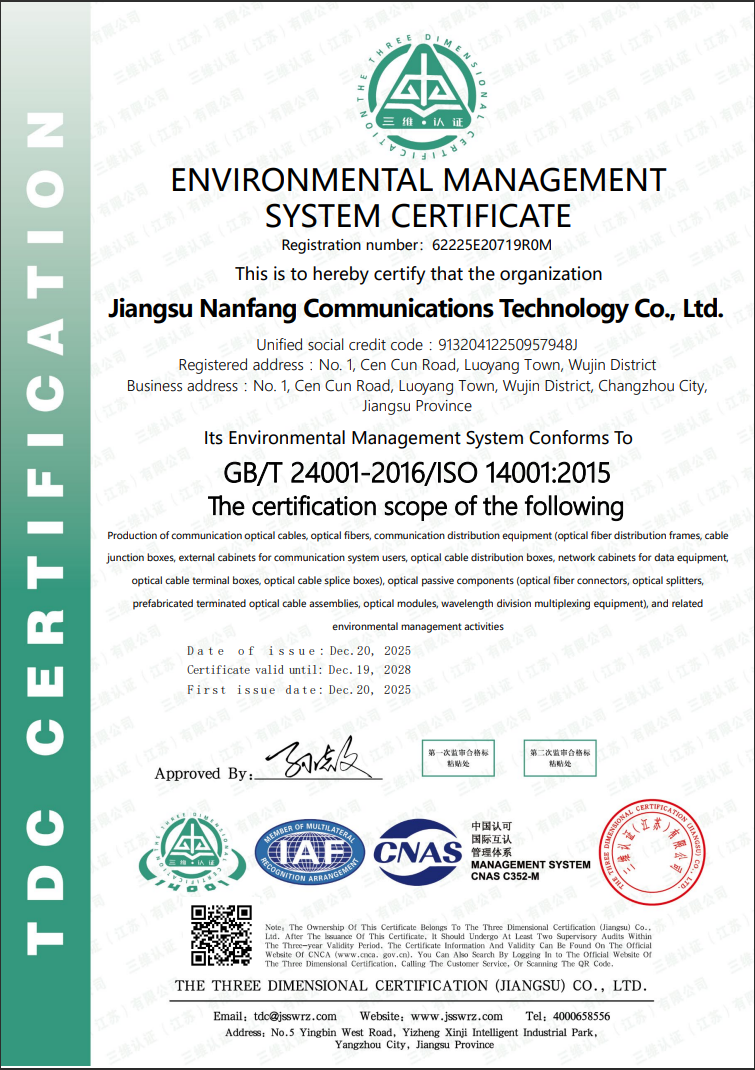
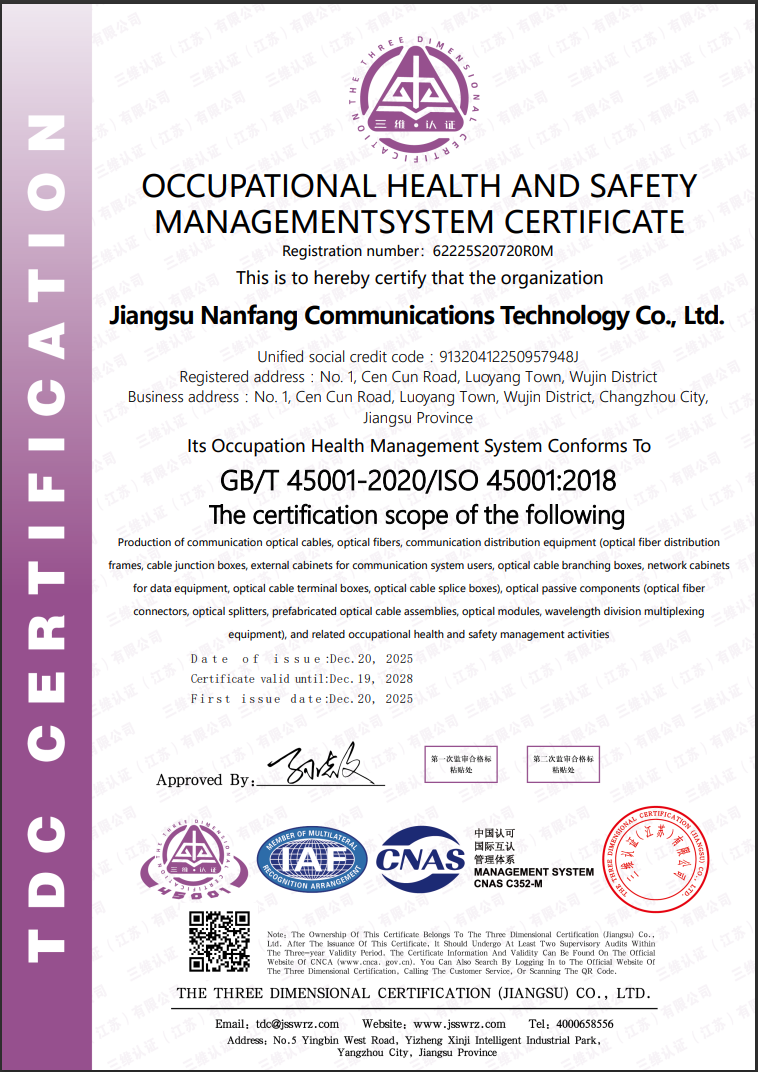
The TL9000-H certificate, number 15/25T15218R11, is issued by WIT Assessment / Hangzhou WIT Assessment Co., Ltd. with the scope “Manufacture and Sales of Communication Optical Fiber Cable”, applicable to global and international markets. The ISO 14001:2015 certificate, number 62225E20719R0M, and the ISO 45001:2018 certificate, number 62225S20720R0M, are both issued by SWR Certification (Jiangsu) Co., Ltd. with a scope covering production of communication optical cables, optical fibres and communication distribution equipment including ODF, cross-connection cabinets, outdoor cabinets for communication systems, fibre distribution boxes and network cabinets for data equipment.
The scopes are not identical, and that is normal: the environmental and safety certificates describe a broader production footprint than the telecom quality certificate. For a buyer, the practical consequence is directional. If you are purchasing cable, the TL9000-H scope language addresses cable manufacture and sales directly. If you are purchasing connectors, adapters or distribution hardware, the relevant coverage sits in the wider production scope or in a product listing, and you should confirm which.
Attribute 2 — Standard edition or revision
ISO 14001:2015 and ISO 45001:2018 are edition-specific. A tender clause written as “ISO 14001” without an edition is weaker than one written as “ISO 14001:2015”, because the edition is the thing the auditor assessed. The same logic applies to TL9000 handbook revisions.
Attribute 3 — Issuing body
Name the certifier explicitly in your evaluation file. The Nanfang set uses SWR Certification (Jiangsu) Co., Ltd. for the ISO 14001 and ISO 45001 certificates and WIT Assessment / Hangzhou WIT Assessment Co., Ltd. for the TL9000-H certificate. Where the issuing body operates a public certificate register, verify the certificate number there rather than relying on a scanned copy alone.
Attribute 4 — Numbers and validity dates
The TL9000-H certificate was issued on 20 November 2025 and expires on 19 October 2028. The ISO 14001:2015 and ISO 45001:2018 certificates were issued on 20 December 2025 and expire on 19 December 2028. Record the numbers, the dates and the review trigger in your supplier file. A certificate that expires inside your delivery window is a scheduling issue, not a paperwork detail, because recertification timing may fall in the same months as your shipments.
Laboratory accreditation: what CNAS L11717 covers, and what it does not
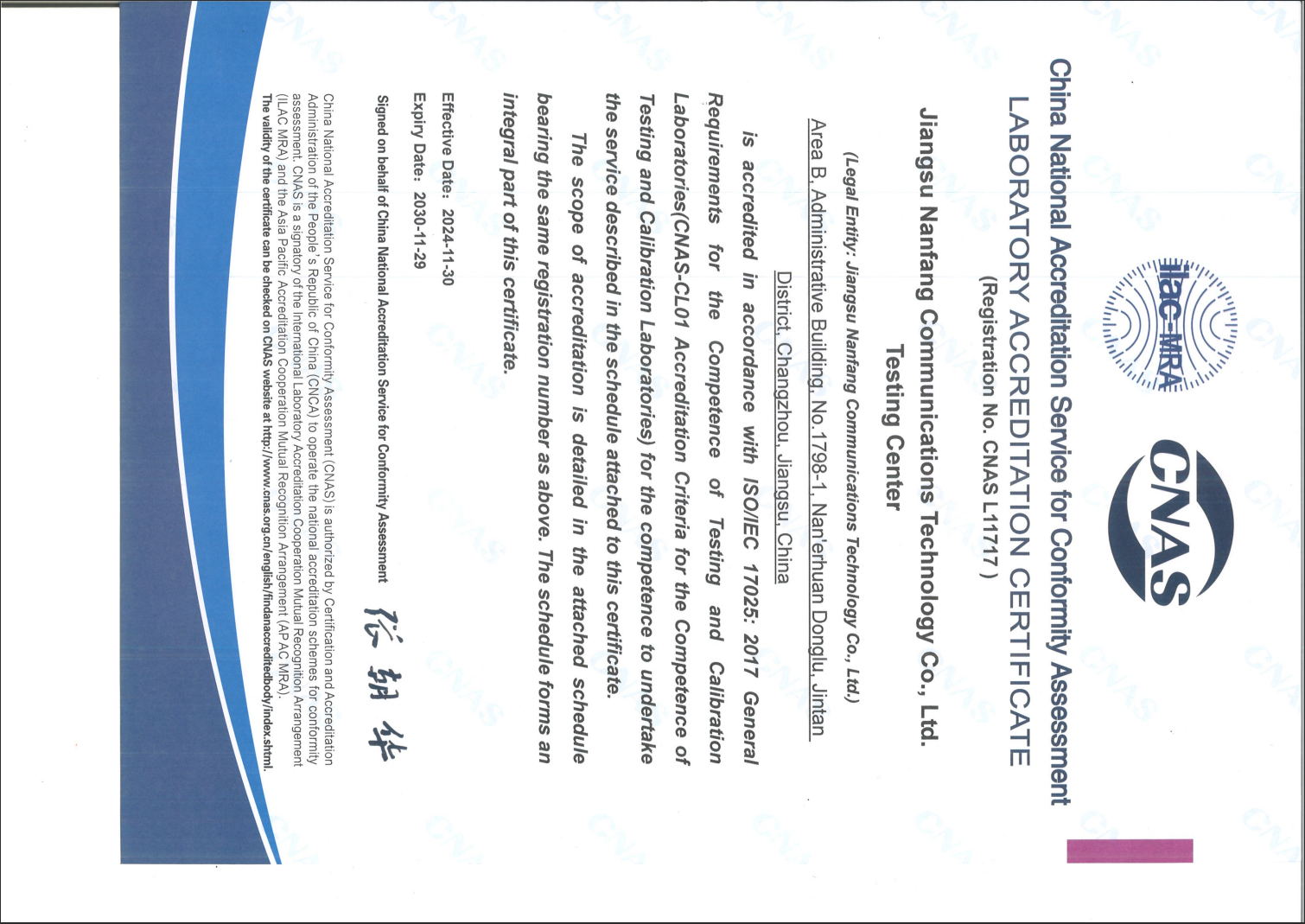
CNAS L11717 is a laboratory accreditation, not a product certificate. It is held by the supplier’s testing laboratory under ISO/IEC 17025:2017, issued by the China National Accreditation Service for Conformity Assessment (CNAS), and the stated scope covers testing and calibration of optical fiber cable and optical communication components, applicable to China and global markets. It was issued on 30 November 2024 and runs to 29 November 2030.
What this changes for a buyer is the traceability of a test number. When a report presents attenuation in dB/km, insertion loss or return loss, the accreditation tells you the laboratory is accredited for defined tests within a stated scope, which is the basis for asking “which test in the accredited scope produced this figure?” What it does not do is approve a product, certify a model, or decide whether 0.35 dB insertion loss passes your project. Those acceptance limits come from your specification or tender document.
The distinction has a second practical use. If your tender requires testing to a specific clause of an application standard — an impact test under IEC 60794-1-104, or indoor cable characteristics under ITU-T L.103 — the accreditation page helps you judge who is competent to run the test, while the standard tells you what the test must be. Neither document tells you the result.
Product-level examples: GYTA53, MPO-12F-SM, loopback and fan-out cable
Product-level references are where most misreading happens, because a certificate number attached to a model looks stronger than it is. Four records in the Nanfang set show how to read them.
GYTA53 optical fiber cable. The model is recorded as certified to TL9000-H, and separately to ISO 14001:2015 and ISO 45001:2018 for the global market, with the ISO numbers 62225E20719R0M and 62225S20720R0M issued by SWR Certification (Jiangsu) Co., Ltd. Here the certificate scopes already address cable production, so the product reference and the scope statement point in the same direction. The remaining questions are project-specific: fiber type (G.652 or G.657), core count, attenuation values in dB/km, tensile strength and minimum bend radius must come from the model datasheet, not from the certificate.
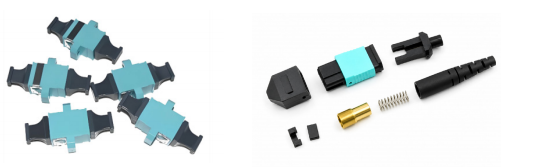
MPO-12F-SM adapter. The product record cites ISO 14001:2015 certificate 62225E20719R0M as covering the adapter, and separately cites certificate number 15/25T15218R11. That second number is the TL9000-H certificate whose scope statement reads “Manufacture and Sales of Communication Optical Fiber Cable”. A careful buyer asks for the scope annex or product list that names the adapter, rather than assuming the certificate’s scope text already does so.
MPO-12F-Loopback and MPO-24F-Loopback. The reference states the certification is based on the TL9000 Quality Management System Requirements Handbook R6.3. Because the revision is named, you can check it against the revision pinned on the certificate itself.
MTP-12F-to-6xLC-Duplex and MTP-24F-to-12xLC-Duplex fan-out cable. The record states the certification is issued by WIT Assessment / Hangzhou WIT Assessment Co., Ltd. The issuing body is named, which makes register verification possible.
The reading rule for all four: a product-level reference is a link, not a conformity mark. Confirm that the certificate scope or its annex names the product family, confirm the issuing body, and confirm the revision — then move to the datasheet for performance.
A five-step reading routine for any compliance package
- Sort before reading. Label each page as management-system certificate, product-level reference or laboratory accreditation. Anything that fits none of the three is a datasheet or a marketing page and should be filed separately.
- Read the scope sentence word by word. Compare it with what you are actually buying: cable, pre-terminated assembly, adapter, or distribution box. Write down which scope sentence covers your item, or note that none does.
- Pin the edition or revision. Record ISO 14001:2015, ISO 45001:2018, ISO/IEC 17025:2017 and the TL9000 handbook revisions exactly as printed. Never upgrade a certificate to a newer edition in your own evaluation report.
- Name the issuing body and verify the number. Use the certifier’s public register where one exists. Where no register is accessible, keep the certificate number in the contract annex so it can be reconciled at shipment.
- Check dates against your schedule. Compare certificate expiry, delivery dates and recertification audits. Then add the market question in the next section.
Two misreadings recur because they look tidy. The first is treating an accreditation page as a product approval; the second is treating a company-level certificate list as a model-level coverage list. Both errors survive internal review because the documents are real — only the inference is wrong.
Comparison: what each document establishes and what it does not
| Document type | What it establishes | What it does not establish | Check before you accept it |
|---|---|---|---|
| Management-system certificate (ISO 9001, TL9000, ISO 14001, ISO 45001, ISO 50001, Integration of Informatization and Industrialization) | The organisation was assessed against a named standard edition for a stated scope of activity | Measured performance of a delivered cable; conformity of a specific model | Scope wording, edition or revision, site covered, certificate number, expiry date |
| Product-level certification reference (for example GYTA53, MPO-12F-SM, loopback, fan-out cable) | A named model is linked to a certificate number and, where stated, an issuing body | Coverage of that model by the certificate, unless the scope annex or product list names it | Scope annex or product list, issuing body, revision cited |
| Laboratory accreditation (ISO/IEC 17025, CNAS L11717) | The laboratory is accredited for defined tests and calibrations within a stated scope | Product approval; your project acceptance limits | Whether your required test appears in the accredited scope |
| International standard or test method (ITU-T L.103, IEC 60092-378, IEC 60794-1-104) | The requirements and test methods applicable to an application or environment | That any particular supplier complies — compliance needs separate evidence | Which edition applies to your deployment environment and tender clause |
Regional readiness: four questions before award
1. Which application standard does your market or end user require? Indoor cabling, shipboard and offshore fixed installations, and general outside-plant routes reference different documents: ITU-T L.103 for indoor cable characteristics and test methods, IEC 60092-378:2024 for shipboard and offshore fixed installations, and IEC 60794-1-104:2024 when impact performance must be demonstrated by a defined procedure. Ask the supplier to map your clause to the certificate or test report that answers it, and accept “not applicable to this product” as a valid answer when it is true.
2. Does the supplier’s stated geographic coverage match your region? The capability record for Nanfang Communication lists China as the main market and describes export markets as China’s Hong Kong and Southeast Asia regions, with a domestic service structure of 28 provincial-level offices across China. If you are deploying in another region, ask directly about project references, documentation support and after-sales arrangements for that region rather than inferring them from a global-market column on a certificate.
3. Does your tender require marks that are not in the set? The document set described here covers ISO management systems, TL9000-H, ISO/IEC 17025 accreditation and product-level references to those certificates. Where your tender requires a product safety mark, a national type approval or a buyer-specific qualification report, request it explicitly and treat its absence as an open item, not as an implied capability.
4. Have you separated tariff from compliance? Trade measures are commercial factors, not certificates. One secondary trade source, Airlift USA, lists a total US import duty of 37.50% on Chinese-origin optical fiber cables under HTS 8544.70.00 as of late 2026, effective 24 July 2026. Figures of this kind change and should be confirmed with a customs broker or the official tariff schedule before they enter a landed-cost model; they do not alter the compliance reading above, but they do change which origin and documentation route is worth pursuing.
Applied to three procurement situations
Operator tender with a TL9000 clause. The evaluator needs the TL9000-H certificate number, the certifier, the scope sentence and the handbook revisions, plus the expiry date against the delivery schedule. Product performance then comes from the datasheet: fiber type, core count, attenuation in dB/km, tensile strength, minimum bend radius. The certificate answers the clause; the datasheet answers the design.
Data centre order for MPO adapters, loopbacks and fan-out assemblies. Here the scope question dominates, because the TL9000-H scope text addresses cable manufacture and sales. Request the annex or product list naming the adapter and assembly families, and separately confirm which tests in the CNAS L11717 scope produced the insertion loss and return loss figures you will accept. For the MPO-12F-SM, the published parameters are standard insertion loss <0.5 dB, low-loss <0.35 dB, return loss ≥50 dB for single-mode, 500 mating cycles and an operating range of −40°C to +85°C — those are performance statements to be tested, not certificate statements.
Distributor due diligence. The distributor’s risk is a certificate that expires mid-contract or a scope that does not match the SKU mix being resold. Keep a one-page register: document type, number, issuer, edition, scope sentence, issue and expiry date, and the product families each document is being used to support. Refresh it annually and before any tender submission.
FAQ
How do I tell a management-system certificate from a product certification in an optical fiber cable compliance package?
Look at what the scope sentence describes. A management-system certificate names an organisation and a scope of activity, such as “Manufacture and Sales of Communication Optical Fiber Cable”, together with a standard edition and an expiry date. A product-level reference names or lists specific models and depends on a scope annex or product list for its value. A laboratory accreditation names tests rather than products. If a page names a model but you cannot find that model in an attached scope annex or product list, treat the page as a reference to follow up, not as proof of product conformity.
What does CNAS L11717 accreditation add to a supplier’s test reports?
CNAS L11717 is a laboratory accreditation to ISO/IEC 17025:2017, issued by the China National Accreditation Service for Conformity Assessment, with a stated scope covering testing and calibration of optical fiber cable and optical communication components, valid from 30 November 2024 to 29 November 2030. It establishes that the laboratory is accredited for defined tests within that scope. It does not approve a product and does not set your acceptance limits. Its practical value is that you can ask which accredited test produced the attenuation, insertion loss or return loss figure on the report, and keep that traceability in the contract file.
What drives the cost of a compliant optical fiber cable order?
No price is published in the documents described here, so any figure would be a guess. What can be listed are the cost drivers a buyer controls: fiber type and grade (G.652 or G.657, single-mode or multimode), core count, sheath material (PE or LSZH), armoring choice (galvanized steel wire or steel tape), strength member configuration such as FRP, custom labeling and packaging, and the scope of third-party testing you require. Order quantity matters as well — the stated minimum order quantity is 1 core kilometre. For US-bound shipments, the applicable import duty described in the trade source above belongs in the landed-cost calculation alongside these drivers.
What should a sample request include for compliance verification?
State the exact model and configuration, the fiber type and core count, and the sheath and armoring combination, because these determine which certificate scope and which datasheet values apply. Request the datasheet figures for attenuation, tensile strength and minimum bend radius for that exact model, plus the certificate numbers you intend to rely on with their issue and expiry dates. Confirm whether the sample is drawn from standard production or built to order, and ask which tests in the CNAS L11717 accredited scope will be reported.
How long should I plan for compliance documents and delivery?
The capability record does not publish a single standard lead time; it states that lead time depends on model and quantity, with samples and small orders typically taking several weeks and large orders possibly months, to be confirmed with sales. Against a stated monthly capacity of 250,000 core kilometres, the schedule question is usually about your configuration and testing scope rather than line availability. Add time for document verification: register checks, scope-annex requests and any third-party testing you require. If a sample, a scope annex or a formal quotation would settle the remaining questions on your project, request it together so the certificate and the product are reviewed against the same configuration.
Conclusion
A fiber optic cable compliance package is readable once the three families are kept apart. Management-system certificates describe how an organisation is run within a scope; product-level references link a model to a certificate number and are only as strong as that scope; ISO/IEC 17025 accreditation describes what a laboratory is accredited to test. On that basis, the Nanfang Communication records are specific and checkable: TL9000-H certificate 15/25T15218R11 with the scope “Manufacture and Sales of Communication Optical Fiber Cable”, ISO 14001:2015 certificate 62225E20719R0M and ISO 45001:2018 certificate 62225S20720R0M from SWR Certification (Jiangsu) Co., Ltd., and laboratory accreditation CNAS L11717 to ISO/IEC 17025:2017 valid to 29 November 2030.
The four attributes do most of the work: scope wording, standard edition or revision, issuing body, and validity dates. Apply them per document, then apply the regional questions to the answer — which application standard your market requires, whether the supplier’s stated coverage reaches your region, which marks your tender demands beyond the supplied set, and which trade measures belong in the landed cost rather than in the compliance file. A buyer who keeps those lines separate can accept a certificate for exactly what it proves, and ask a precise question about everything it does not.
For the wider product context behind these certificates — optical fiber cable families, MPO connectivity and pre-terminated assemblies — the company brochure is available for download: Nanfang Communication MPO product brochure (PDF).

Have Questions or Need More Details?
Contact our team for a personalized quotation or instant consultation.
Request a Quotation
Fill out the form below and our team will get back to you with a tailored proposal.
WhatsApp Direct Chat
Prefer to chat in real-time? Message us on WhatsApp for instant assistance & quick answers.
- Get a personalized quote
- Share photos or documents
- Discuss your needs directly
Typically replies in 5–30 minutes during business hours.