
Optical Fiber Cable Partnership FAQ: Long-Term Supply, Acceptance, After-Sales
A long-term optical fiber cable agreement rarely fails because of the cable. It fails on the documents around the cable: what "accepted" means, which test report closes a shipment, and who answers the engineering question that arrives eight months after commissioning.
Buyers move through a predictable question set when they shift from evaluation into execution. This FAQ answers the ones that decide whether a supply relationship survives its third order — purchasing terms, acceptance criteria, customization scope, samples, lead time and after-sales support — and separates what is already documented in writing from what still has to be negotiated contract by contract.
Why Partnership Questions Only Surface After the Second Order
During evaluation, buyers compare datasheets. During execution, they compare documents. The distance between the two is where long-term optical fiber cable relationships lose time and margin.
- Acceptance gap. A specification line that reads "low insertion loss" can be satisfied by several different assemblies. Unless the contract names the test method, the numeric limit and the report format, every shipment turns into a negotiation about whether it passed.
- Consistency gap. Long-term supply means the fifth order matches the first. That depends on whether the customized items — core count, fiber type, sheath material and color, connector types and cabling scheme, labeling, packaging — are frozen as controlled parameters or re-quoted each time a project changes.
- Support gap. After-sales in optical fiber cable is mostly engineering rather than repair: confirming a splice loss figure, checking an MPO polarity scheme, or verifying whether a fan-out harness suits a 40G/100G port layout. A supplier with no technical route into the project converts these into schedule delays.
Each gap is closed by a document, not by a promise. That is the practical definition of a partnership-ready supplier: the answers already exist as certificates, test reports, capacity statements and service commitments, and the contract simply references them.
What Changed in the 2026 Procurement Environment
Three external signals explain why buyers now write long-term terms more tightly than they did a few years ago.
Market scale supports choice. Global Market Insights valued the global fiber optic cable market at USD 14.6 billion in 2025, with a forecast horizon extending to 2035 (Fiber Optic Cable Market Size, Forecasts Report 2026–2035, published June 2026). A market of that size contains many qualified manufacturers, which moves the differentiator from availability to documentation quality.
Supply is concentrated. China remained the leading exporter of optical fibers and cables in 2024, with exports of USD 2.52 billion under HS 854470, according to the Observatory of Economic Complexity's aggregation of UN Comtrade data. Concentrated supply makes dual-sourcing and long-term volume commitments a risk-management decision, not only a price decision.
Landed cost is no longer stable. Airlift USA's 2026 customs breakdown lists a total U.S. import duty of 37.50% on Chinese-origin optical fiber cables under HTS 8544.70.00, including Section 301 measures. Buyers in duty-affected markets need an explicit price-adjustment mechanism and a clear delivery-term definition in the agreement, otherwise the contract gets renegotiated mid-term.
Specification language is tightening in parallel. ITU-T L.103 (08/2024) describes characteristics, construction and test methods for optical fibre cables for indoor applications; IEC 60794-1-104:2024 defines the impact test procedure (method E4) for optical fibre cables; IEC 60092-378:2024 addresses shipboard and offshore fixed installations. These documents do not compete — they cover different environments and different test methods, which is precisely why an acceptance annex has to name the standard it references rather than quoting it generically.
The Supplier Behind These Answers
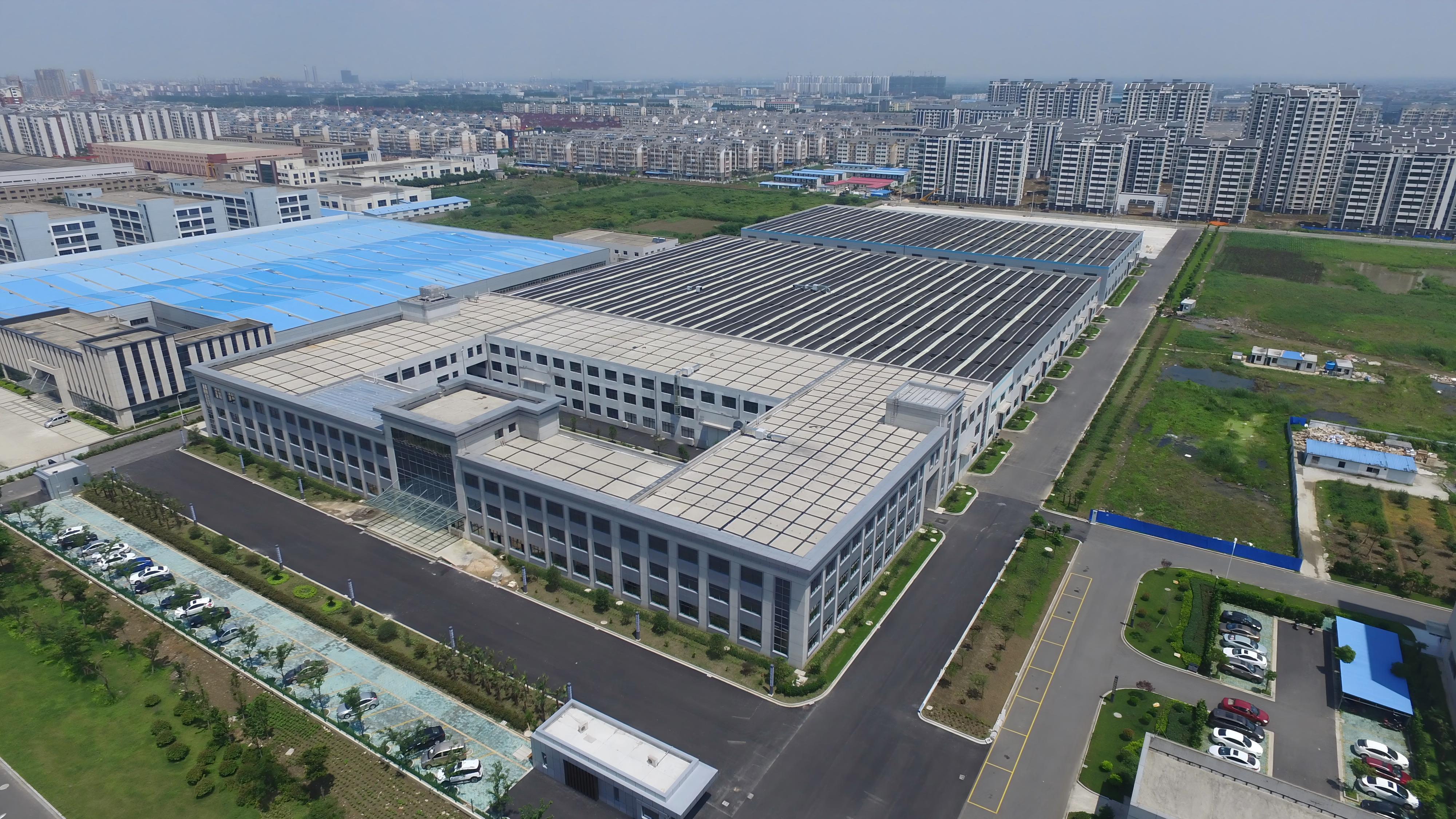
Jiangsu South Communication Technology Co., Ltd. — trading as Nanfang Communication — is a manufacturer of optical fiber cable, optical fiber and ODN systems, and a subsidiary of the Hong Kong-listed South Communication Holdings Limited (Stock Code: 1617.HK). The company was founded in July 1992, holds paid-in capital of RMB 150 million, and operates from Changzhou City, Jiangsu Province, China.
- Manufacturing footprint: a 26,795.3 m² site, 360 employees and 80 R&D engineers.
- Output: 3,000,000 core kilometers per year, equivalent to a stated monthly capacity of 250,000 core kilometers.
- Product scope: indoor optical cable, outdoor optical cable, ribbon optical cable, loose tube optical cable, bow-type drop optical cable, single-mode and multimode fiber, MCF multi-core fiber, PLC optical splitter, fiber optic connector, MPO multi-core connector, MPO high-density patch panel, optical module, MT-FA series optical passive components and PM FA fiber arrays, plus custom specialty fibers and cables and system integration services.
- R&D depth: more than 300 patents, including more than 45 invention patents, and 16 standards held (1 national, 15 industry).
- Installed base: cooperation with China Telecom, China Mobile, China Unicom and China Broadcast Network, plus private-network users in high-speed rail, power grids and the chemical industry, across a 30-year operating history.
- Service reach: 28 provincial-level offices in China supporting localized sales, technical support and after-sales service.
That structure matters for the questions below because each answer is backed by a specific asset — a certificate, an accredited laboratory, a capacity figure or a service network — rather than by a general capability statement.
Purchasing Terms: MOQ, Delivery and Payment
The commercial frame is stated openly: minimum order quantity of 1 core kilometer, delivery by sea, land or air freight depending on project needs, and payment through common international trade methods such as T/T or L/C. The exact combination is negotiated per contract.
For a buyer, the MOQ of 1 core kilometer is the more consequential figure. It means trial orders, mixed-construction orders and specification-testing runs are structurally possible; the constraint on a first order is the precision of the specification, not the volume threshold.
Delivery is the term that absorbs the most risk in 2026. Because sea, land and air freight are all available depending on project needs, the agreement should record which delivery term applies, at which point responsibility transfers, and how the price responds if freight or duty changes mid-contract. Payment follows the same logic: T/T and L/C are both used, and the choice between them is a commercial negotiation rather than a fixed policy.
Acceptance Criteria: The Evidence Chain Behind a Signed-Off Shipment
Acceptance is defined per contract and technical specification, supported by factory inspection, test reports and certificates. On-site acceptance follows the project contract's own acceptance criteria. That is a document-based definition, and it is the part a buyer should write in detail.
Behind the signature sits a quality management system covering incoming material inspection, in-process control and finished-product testing. The finished-product tests named in the company's process are optical loss and attenuation measurement, mechanical performance verification, and waterproof/sealing testing.
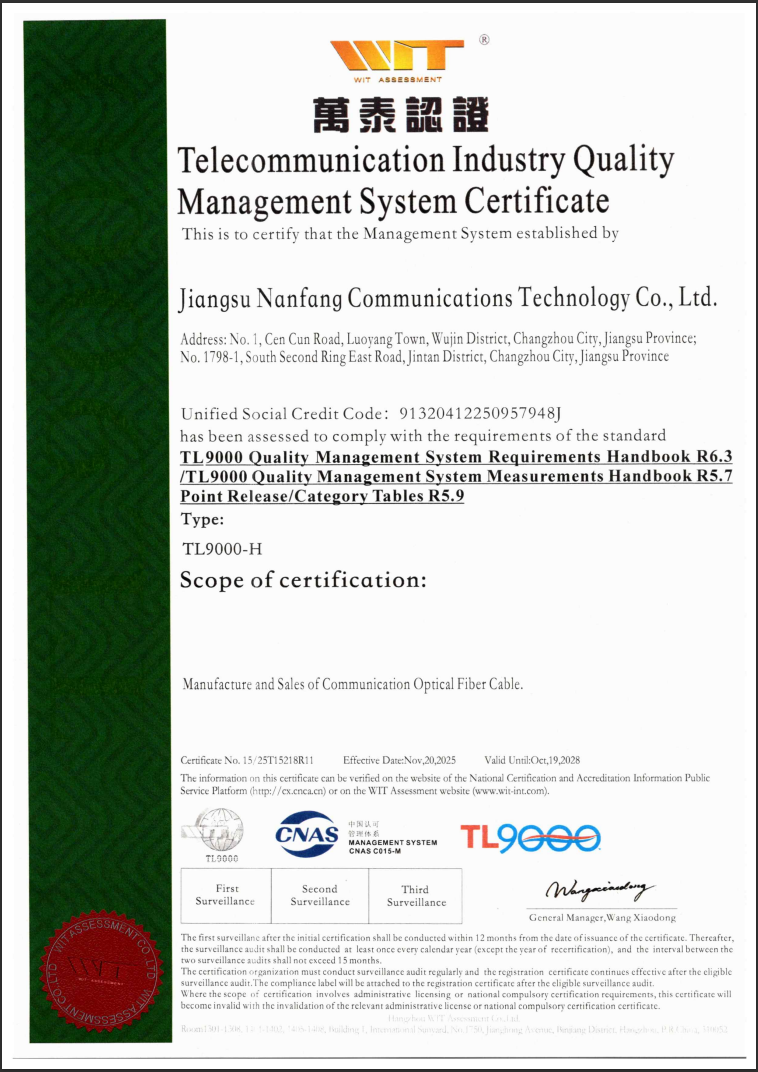
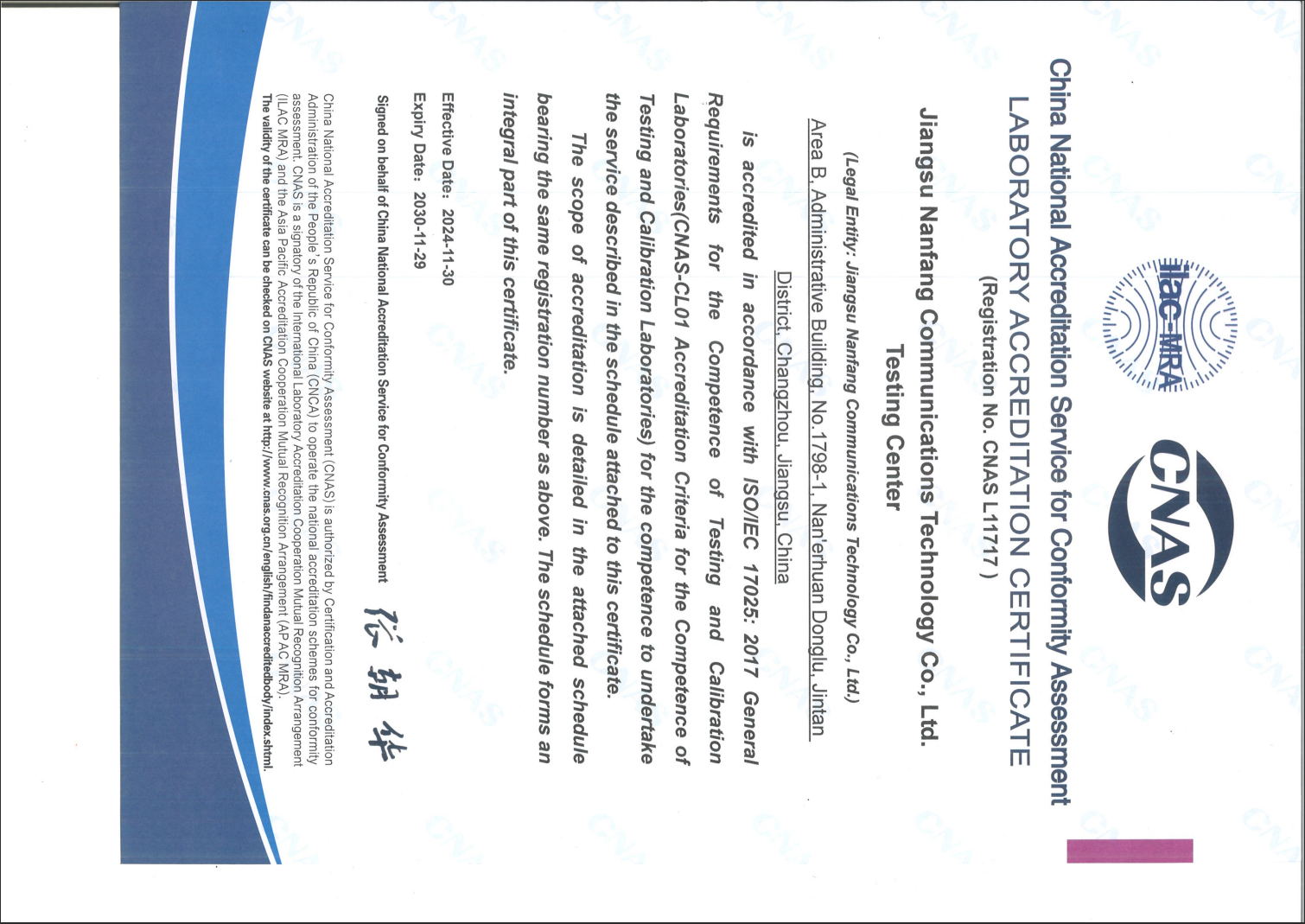
The test capability is accredited rather than self-declared. Nanfang Communication holds CNAS laboratory accreditation L11717 under ISO/IEC 17025:2017, issued 30 November 2024 and valid to 29 November 2030, with a scope covering optical fiber cable and optical communication component testing and calibration.
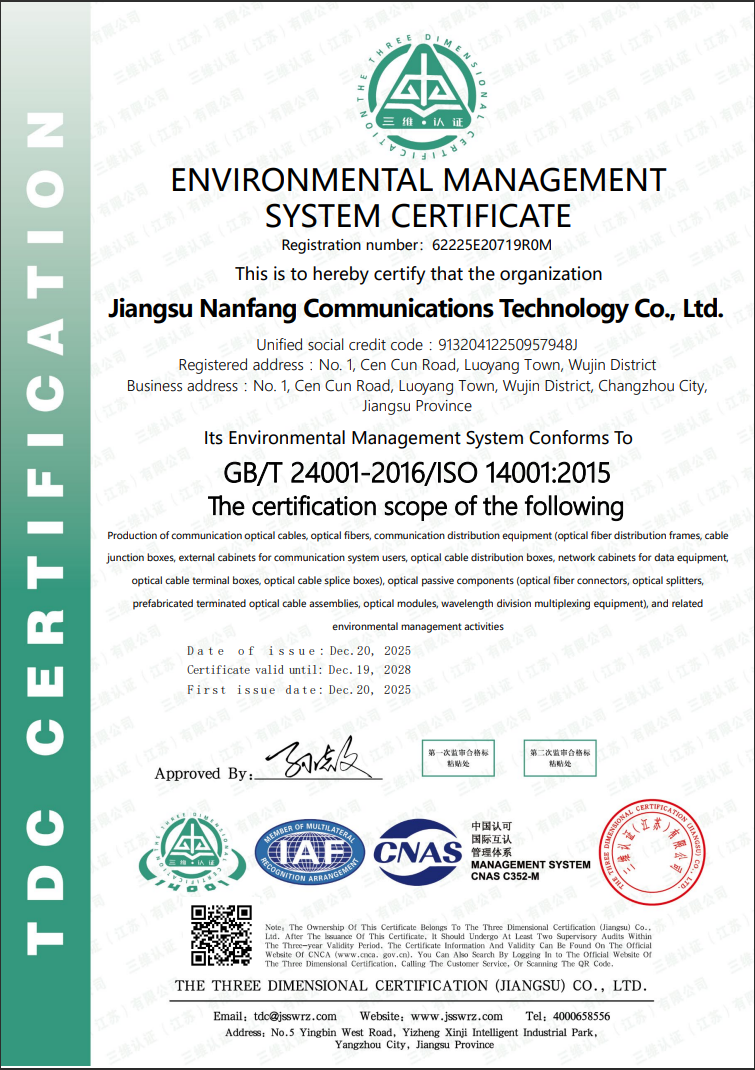
Management-system certificates relevant to an acceptance annex are also on file: TL9000-H (certificate 15/25T15218R11, issued by Hangzhou WIT Assessment Co., Ltd., valid 20 November 2025 – 19 October 2028, scope: manufacture and sales of communication optical fiber cable), ISO 14001:2015 (certificate 62225E20719R0M, valid 20 December 2025 – 19 December 2028) and ISO 45001:2018 (certificate 62225S20720R0M, same validity window). The company profile additionally lists ISO9001, OHSAS18001, ISO50001 and the Integration of Informatization and Industrialization management system.
Three practical rules follow for the acceptance annex. First, name the test method — for example IEC 60794-1-104:2024 method E4 for impact performance, or the ITU-T L.103 indoor-cable framework where the deployment is indoor. Second, set numeric limits per product line instead of adjectives; "low loss" is not an acceptance criterion, a decibel figure is. Third, require that the certificate set and the test report travel with the shipment, so clearance and handover do not wait on a document request.
Customization Scope Under ODM/OEM: What Can Be Fixed in the Contract
The documentable customization list is concrete: core count, fiber type (single-mode, multimode, ribbon or multi-core), sheath material and color, connector types and cabling schemes, labeling and packaging. These are the parameters that should be frozen in a long-term agreement, because they are the ones that drift between orders.
The production model behind the list combines manufacturing, R&D and testing, engineering design and system integration, and ODM/OEM services. In practice that means a buyer can specify a cable construction, a connector interface and a pre-terminated cabling scheme in one place instead of reconciling three vendors and two sets of tolerances.
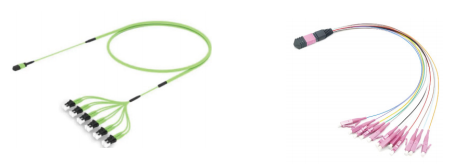
Customization also has boundaries worth writing down early. A specialty construction changes the production route and therefore the lead time. A connector scheme that mixes MPO multi-core connectors with LC breakouts changes the test plan that the acceptance annex has to describe. And a non-standard sheath material or color should be checked against the scope of the certificates referenced in the contract, so that the delivered product stays inside the documented conformity envelope.
After-Sales Support: What Exists and Where the Boundary Is
The documented after-sales position is technical support, a service network and engineering support, delivered under a customer-centric service philosophy. The 28 provincial-level offices in China provide localized, real-time sales, technical support and after-sales service.
The boundary is as important as the capability. Response times and warranty terms are not published as a fixed standard and are confirmed with the company per contract. A buyer who needs a defined response window, a replacement protocol or a multi-year warranty should negotiate it explicitly and write it into the agreement rather than infer it from a service description. The same applies to engineering support: scope it by activity — commissioning checks, loss-budget review, polarity and labeling questions — rather than as a general commitment.
Step-by-Step Breakdown: From Evaluation to Execution
- Map the requirement to a product line. Outdoor armored routes typically sit with a construction such as GYTA53; indoor riser and horizontal routes with indoor optical cable; access drops with bow-type drop optical cable; high-density data center links with MPO multi-core connectors and fan-out assemblies. Mixing these into one line item is the most common specification error.
- Fix the acceptance annex first. Test method, numeric limits, report format, certificate set and the on-site acceptance reference. Do this before commercial negotiation, because the acceptance scope drives cost.
- Validate with samples. Sample and small-order lead time typically runs several weeks. Use that window to confirm attenuation, mechanical performance and seal integrity against the limits in the annex, not against a generic datasheet.
- Freeze the customization parameters. Core count, fiber type, sheath material and color, connector types and cabling scheme, labeling and packaging, each recorded as a controlled value with a model reference.
- Confirm the commercial mechanics. MOQ of 1 core kilometer, delivery mode by sea, land or air, payment by T/T or L/C, and the price-adjustment clause.
- Ramp to volume. Monthly capacity is stated at 250,000 core kilometers. Large orders may take months, so the release schedule should be planned against the capacity figure rather than against the first-order lead time.
- Set the service protocol. Escalation route, technical contact, warranty terms and response expectations, agreed in writing at signature rather than at the first incident.
Use Cases: Where Partnership Terms Carry the Most Risk
FTTx access. Bow-type drop optical cable, fiber distribution boxes and PLC optical splitters are deployed in volume, so acceptance is dominated by repeatable attenuation and mechanical testing rather than by single-unit performance. A drift in one parameter multiplies across thousands of drops.
Metropolitan and backbone construction, including 5G backhaul. Loose tube and ribbon optical cable, and armored outdoor constructions such as GYTA53, are judged on tensile strength, minimum bend radius and waterproof/sealing performance. These are exactly the tests named in the company's finished-product regime, which is why the annex should reference them directly.
Data center interconnect. MPO multi-core connectors, MPO high-density patch panels and MTP/MPO fan-out pre-terminated cable are accepted against an insertion-loss and return-loss budget. During commissioning, MPO/MTP loopbacks are used to validate Links without re-patching, so the loopback specification belongs in the same acceptance discussion.
Enterprise campus cabling. Indoor optical cable and fiber optic connectors are accepted largely on polarity, labeling and documentation discipline — the least technical and most frequently disputed part of a campus handover.
Private networks. High-speed rail, power grid and chemical industry users add environmental constraints, and the company's stated installed base includes these segments alongside the three Chinese operators and China Broadcast Network.
Comparison Table: Documented Parameters Buyers Can Accept Against
The figures below are the documented values for named models. For optical fiber cable, attenuation, tensile strength, minimum bend radius, sheath material and environmental rating must be confirmed per model datasheet, because one family covers multiple constructions.
| Product line | Documented parameters | Typical acceptance use |
|---|---|---|
| Optical fiber cable (e.g. GYTA53) | Fiber type G.652/G.657; attenuation in dB/km; minimum bend radius; tensile strength; PE or LSZH sheath; galvanized steel wire or steel tape armoring; FRP strength member. Exact values per model datasheet. | Attenuation, mechanical and waterproof/sealing acceptance at shipment |
| MPO Fiber Optic Adapter (MPO-12F-SM) | Insertion loss standard <0.5 dB, low-loss <0.35 dB; return loss ≥50 dB (SM); 500 mating cycles (IEC compliant); operating temperature −40 °C to +85 °C; 4–72F SM/MM | Connector interface acceptance and mating-endurance checks |
| MTP/MPO Fan-out Pre-terminated Cable (MTP-12F-to-6xLC-Duplex / MTP-24F-to-12xLC-Duplex) | IL typical 0.35 dB, max 0.75 dB; low-loss IL typical 0.10 dB, max 0.35 dB; RL ≥60 dB (APC), ≥50 dB (PC); 12F or 24F; LSZH/OFNR jacket | Pre-terminated assembly acceptance against a link loss budget |
| MPO/MTP Loopback (MPO-12F-Loopback / MPO-24F-Loopback) | IL ≤0.7 dB (8F/12F), ≤1.0 dB (24F); RL ≥65 dB (SM), ≥25 dB (MM); mating cycles ≥100,000; link failure rate <0.1% | Commissioning and equipment validation before handover |
Commercial and Compliance Terms at a Glance
| Item | Documented position | What to do in the contract |
|---|---|---|
| Minimum order quantity | 1 core kilometer | Use it for trial and mixed-specification orders; spend the effort on specification precision instead |
| Delivery | Sea, land or air freight, arranged per project needs | Record the delivery term, transfer point and freight/duty adjustment mechanism |
| Payment | Common international trade methods, e.g. T/T or L/C | Negotiate per contract; align with the acceptance gates |
| Acceptance | Per contract and technical specification, with factory inspection, test reports and certificates; on-site acceptance follows the project contract | Attach test methods and numeric limits; require the report and certificate set with each shipment |
| Testing capability | CNAS L11717, ISO/IEC 17025:2017, valid to 29 November 2030 | Reference the accreditation in the annex for disputed measurements |
| Lead time | Depends on model and quantity: samples and small orders typically several weeks; large orders may take months | Plan the release schedule against monthly capacity, and confirm dates in writing |
| Capacity | 250,000 core kilometers per month; 3,000,000 core kilometers per year | Size the annual commitment against the ramp timeline |
| After-sales | Technical support, service network and engineering support; 28 provincial-level offices in China | Define response times, warranty terms and escalation route explicitly |
Frequently Asked Questions
Which management-system certifications should a long-term optical fiber cable partner hold?
At minimum a quality management system recognised in the telecommunications supply chain. Nanfang Communication holds TL9000-H certificate 15/25T15218R11 (issued by Hangzhou WIT Assessment Co., Ltd., valid 20 November 2025 – 19 October 2028) covering the manufacture and sales of communication optical fiber cable, ISO 14001:2015 certificate 62225E20719R0M and ISO 45001:2018 certificate 62225S20720R0M (both valid 20 December 2025 – 19 December 2028). The company profile also lists ISO9001, OHSAS18001, ISO50001 and the Integration of Informatization and Industrialization management system, and the testing laboratory is accredited as CNAS L11717 under ISO/IEC 17025:2017 until 29 November 2030. Buyers should verify certificate numbers, validity dates and scope against the deliverable rather than accepting a logo list.
Can Nanfang Communication customize optical fiber cable construction and pre-terminated assemblies?
Yes, within a defined scope. The documentable customization items are core count, fiber type (single-mode, multimode, ribbon or multi-core), sheath material and color, connector types and cabling schemes, labeling and packaging. The underlying production model combines manufacturing, R&D and testing, engineering design and system integration, and ODM/OEM services, and the portfolio spans indoor optical cable, outdoor optical cable, ribbon optical cable, loose tube optical cable, bow-type drop optical cable, single-mode and multimode fiber, MCF multi-core fiber, PLC optical splitter, fiber optic connector, MPO multi-core connector, MPO high-density patch panel and optical module. Each customized item should be frozen by model reference in the agreement.
What are the MOQ, payment terms and delivery options for a long-term contract?
The minimum order quantity is 1 core kilometer. Payment is handled through common international trade methods such as T/T or L/C, and delivery can be arranged by sea, land or air freight depending on project needs; the specific methods and terms are confirmed with sales. Budget planning should also account for destination-market duties — Airlift USA's 2026 breakdown lists a total U.S. duty of 37.50% on Chinese-origin optical fiber cables under HTS 8544.70.00 — which is why a price-adjustment clause belongs in a multi-year agreement.
How are samples and first-article acceptance handled before volume orders?
Samples and small orders typically run several weeks, and that window is where acceptance criteria should be proven rather than assumed. The company's quality management system covers incoming material inspection, in-process control and finished-product testing, with tests for optical loss and attenuation, mechanical performance, and waterproof/sealing performance; the CNAS-accredited laboratory (L11717, ISO/IEC 17025:2017) supports those measurements. For pre-terminated assemblies, the documented model-level values — for example MTP/MPO fan-out insertion loss of 0.35 dB typical and 0.75 dB maximum, or 0.10 dB typical and 0.35 dB maximum in the low-loss variant — give a concrete baseline for first-article comparison.
What lead times and after-sales support should be expected after contract signing?
Lead time depends on model and quantity: samples and small orders typically take several weeks, while large orders may take months, against a stated monthly capacity of 250,000 core kilometers and annual output of 3,000,000 core kilometers. After delivery, support consists of technical support, a service network and engineering support, with 28 provincial-level offices in China providing localized sales, technical support and after-sales service; response times and warranty terms are confirmed with the company per contract. To start that conversation, contact info@jsnfgroup.com, call +86 51988792646, or message WhatsApp +8619850287785.
Conclusion: The Contract Is the Partnership
Long-term optical fiber cable supply is decided by three documents and one habit. The three documents are a purchasing-terms sheet that fixes MOQ, delivery and payment; an acceptance annex that names test methods, numeric limits and the certificate set; and a service protocol that defines what happens after delivery. The habit is freezing customization parameters by model reference so the fifth order matches the first.
The supplier-side evidence for those documents already exists at Nanfang Communication: TL9000-H, ISO 14001:2015 and ISO 45001:2018 certificates with published numbers and validity windows, a CNAS-accredited laboratory under ISO/IEC 17025:2017, a stated monthly capacity of 250,000 core kilometers, and a service network of 28 provincial-level offices. What remains is project-specific — delivery terms, response times, warranty scope and price mechanics — and belongs in negotiation, not in assumption.
Next Step: Quote, Sample or Catalogue
Send the cable construction, connector scheme and acceptance limits you intend to contract, and the team at Jiangsu South Communication Technology Co., Ltd. (Nanfang Communication) will respond with a quotation, a sample plan or the partnership terms for review.
Email: info@jsnfgroup.com | Tel: +86 51988792646 | WhatsApp: +8619850287785
Website: https://www.jsnfgroup.com/en.php
Product catalogue (PDF): Nanfang MPO catalogue
Have Questions or Need More Details?
Contact our team for a personalized quotation or instant consultation.
Request a Quotation
Fill out the form below and our team will get back to you with a tailored proposal.
WhatsApp Direct Chat
Prefer to chat in real-time? Message us on WhatsApp for instant assistance & quick answers.
- Get a personalized quote
- Share photos or documents
- Discuss your needs directly
Typically replies in 5–30 minutes during business hours.