
Optical Fiber Cable Primer: Types, MPO Links, and Testing
Optical Fiber Cable Primer: From Indoor and Outdoor Cable to MPO Connectivity and Testing
An optical fiber cable is a physical-layer transmission medium built around a silica glass core, with strength members, armoring, and sheath materials selected for the environment in which it will operate. For telecom operators, data centers, FTTH projects, and enterprise networks, the term actually covers a wider system: indoor and outdoor cables, connectors, patch panels, distribution boxes, optical components, and testing tools. This primer maps the full set of product categories a first-time buyer is likely to encounter, explains how the pieces fit together, and points to supplier facts that can be verified before a purchasing decision.
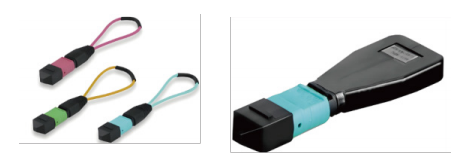
Testing tools such as the MPO/MTP loopback are part of the complete optical fiber cable ecosystem.
What Problem Does This Primer Solve?
Buyers entering the optical fiber cable market for the first time face a terminology problem. Loose-tube cable, ribbon cable, bow-type drop cable, single-mode and multimode fiber, PLC splitter, MPO connector, splice closure, patch panel, optical module, WDM, MT-FAU, DAC, MCF: these terms describe different layers of one system, but they are often presented as if they were interchangeable. The result is confusion about what to specify first and how to evaluate a supplier.
This article organizes the categories into a five-layer view, provides a step-by-step framework for building basic product knowledge, and shows how common deployment scenarios such as FTTH, data centers, and 5G backhaul use these products together. The information is based on documented product facts and verifiable company data, not on generic marketing claims.
Industry Background: Why Understanding the Category Matters
The optical fiber cable market is large and still expanding. According to Custom Market Insights, the global optical fiber cable market was valued at approximately USD 13.45 billion in 2025 and is projected to reach USD 36.48 billion by 2034. China, a major producing country, exported about USD 2.52 billion of optical fiber cables in 2024 under HS code 854470, based on data from the Observatory of Economic Complexity.
Two related segments are also worth tracking. The fiber optic connector market was estimated at USD 11.2 billion in 2024, with LC connectors holding a dominant 35.43% share, according to Global Market Insights / Grand View Research. More relevant to high-density environments, the MPO fiber optic connector market is projected to grow at a CAGR of 13.6% through 2035, driven by AI compute clusters and hyperscale data centers, according to Business Research Insights.
Standards matter too. ITU-T G.652.D remains the industry standard for single-mode fiber, while ITU-T G.657 is the primary standard for bend-insensitive fibers used in FTTH. These two fiber families appear again and again in cable specifications.
A Five-Layer View of the Optical Fiber Cable System
Layer 1: Optical Fiber Cable — The Transmission Medium
The optical fiber cable itself is designed around a silica glass core. Common strength members include FRP, and armoring materials include galvanized steel wire or steel tape. Sheath options are typically PE or LSZH, depending on whether the cable is installed outdoors or in flame-retardant indoor environments. Common fiber types include G.652 and G.657, with exact core count, diameter, attenuation, operating wavelength, tensile strength, and minimum bend radius confirmed per model datasheet.
A representative model is the GYTA53 optical fiber cable. It is intended for telecommunications, ISP, data center, FTTx, enterprise, industrial, smart city, 5G backhaul, and metropolitan backbone network scenarios. The product family also includes indoor optical cable, outdoor optical cable, ribbon optical cable, loose-tube optical cable, and bow-type drop optical cable, as well as single-mode and multimode fiber variants.
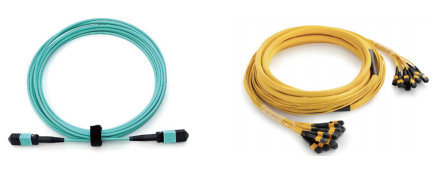
Pre-terminated trunk cables are one of the indoor-oriented connectivity products used after the cable layer is defined.
Layer 2: Connectors and Adapters
Connectors terminate fibers and allow patching. The portfolio in this category includes fiber optic connectors and MPO multi-core fiber optic connectors. The MPO fiber optic adapter, for example, belongs to the MPO adapter, fiber optic coupler, and high-density connector category. It is intended for data centers, telecom networks, and high-density cabling systems. Documented parameters for the MPO-12F-SM adapter include standard insertion loss below 0.5 dB, low-loss insertion loss below 0.35 dB, return loss of at least 50 dB for single-mode, 500 mating cycles per IEC compliance, an operating temperature range of -40°C to +85°C, and fiber counts from 4 to 72 fibers for SM or MM.
Layer 3: Distribution, Termination, and Protection
Once fibers are cabled and connected, they need distribution points and protection. This layer includes MPO high-density patch panels, FTTH optical cable distribution boxes, and optical cable splice closures. Functionally, these products serve as physical-layer transmission and distribution infrastructure, providing signal transmission, fiber distribution, and patching or access functions. In an FTTx network, for example, the distribution box is the point where feeder cables are terminated and drop cables are connected to subscribers.
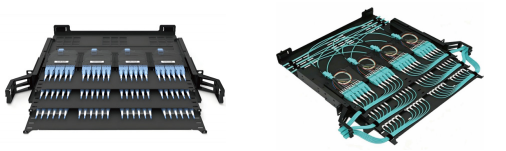
MPO high-density patch panels consolidate many fiber connections into a small footprint.
Layer 4: Optical Components and Modules
Beyond passive cabling, the system includes components that split, combine, convert, or integrate signals. PLC optical splitters are used in passive optical networks to distribute one signal to many subscribers. WDM wavelength division multiplexers combine or separate different wavelengths on one fiber. Optical modules convert optical signals at equipment ports. MT-FAU fiber optic assemblies and direct attach cable (DAC) modules support high-speed equipment connections. MCF multi-core fiber is a specialty fiber type for higher-density transmission research and select deployments. In a full deployment, these components work alongside cables and connectors rather than replacing them.
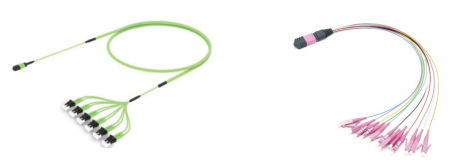
Fan-out pre-terminated cables bridge MPO-based trunk links and LC-based switch ports.
Layer 5: Testing and Validation
Before a link is accepted, it must be tested. The MPO/MTP loopback is classified as test equipment in the fiber optic loopback category. Models include MPO-12F-Loopback and MPO-24F-Loopback. The product is made of fiber cable, plastic housing, MTP ferrule, and ceramic ferrule, and is intended for equipment validation, data center commissioning, and network testing. It is a practical example of why testing tools belong in the same procurement conversation as cable and connectors.
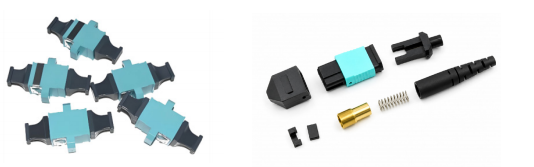
MPO adapters provide precise alignment for multi-fiber connections in high-density panels.
Step-by-Step: Building a Basic Optical Fiber Cable Framework
The following six steps help a buyer move from a vague project idea to a concrete product shortlist.
Step 1: Define the deployment scenario. Indoor cabling, outdoor duct, aerial self-supporting, direct burial, and data center cabinet environments lead to different cable designs. Outdoor deployments may require weatherproofing, waterproofing, rodent protection, and temperature resistance. Indoor environments typically favor flame-retardant or LSZH sheaths.
Step 2: Select the fiber type. For long-reach telecom and backhaul, choose single-mode fiber such as G.652 or G.657. For short-reach data center links, multimode fiber such as OM3, OM4, or OM5 is common. The operating wavelength and attenuation values should be checked against the datasheet.
Step 3: Select the cable structure. Loose-tube cable is common for outdoor and backbone applications. Ribbon cable supports high fiber counts in dense access or backbone routes. Bow-type drop cable is designed for FTTH drop segments. Indoor cable is selected for riser, cabinet, and data center use.
Step 4: Choose the connectivity. Define whether the link is MPO-based or LC-based. In high-density data centers, MPO trunk cables and fan-out breakout cords are used. The MTP/MPO fan-out pre-terminated cable, available as MTP-12F-to-6xLC-Duplex or MTP-24F-to-12xLC-Duplex, is designed for 40G/100G/400G SR4/PSM4 module connections.
Step 5: Plan distribution and protection. Identify where patch panels, FTTH distribution boxes, splice closures, and adapters will be installed. This determines the number of termination points and the physical layout of the network.
Step 6: Plan testing. Include loopback modules and test adapters in the procurement list so that commissioning can verify insertion loss, return loss, and link integrity before cutover.
Use Cases: Where These Products Work Together
FTTH and Broadband Access
FTTH projects typically combine bend-insensitive G.657 fiber, bow-type drop cable, PLC optical splitters, FTTH distribution boxes, and splice closures. The drop cable brings the fiber from the distribution point to the subscriber premises, while the splitter allows one feeder fiber to serve multiple subscribers. This scenario is common globally, including in China.
Data Center Interconnect
Data centers use MPO trunk cables, fan-out breakout cords, high-density patch panels, adapters, and loopback test modules. The MTP/MPO fan-out cable connects MPO-based trunk links to LC duplex switch ports for 40G, 100G, and 400G SR4/PSM4 modules. The MPO high-density patch panel concentrates these connections to save rack space, and the MPO adapter provides reliable multi-fiber alignment.
5G Backhaul and Metropolitan Backbone
For 5G backhaul and metro backbone networks, outdoor loose-tube cable such as GYTA53 is typically used with G.652 single-mode fiber, optical cable splice closures, and WDM units. These networks require low attenuation, stable mechanical performance, and protection against moisture and rodents. The passive components operate continuously and need stable maintenance and periodic inspection.
Comparison Table: Physical-Layer Products in a Typical Fiber Network
The table below summarizes documented product facts for four representative items. It is not a general industry ranking; it is a comparison of available specifications.
| Product | Key Documented Facts | Typical Application |
|---|---|---|
| Optical fiber cable (GYTA53) | Silica glass core; FRP strength members; galvanized steel wire or steel tape armoring; PE or LSZH sheath; G.652 / G.657 fiber types | Telecom, ISP, data center, FTTx, 5G backhaul, metropolitan backbone |
| MTP/MPO fan-out pre-terminated cable | OS2/G.657A or OM3/OM4/OM5 fiber; LSZH or PVC jacket; ceramic ferrule; MTP-12F-to-6xLC-Duplex or MTP-24F-to-12xLC-Duplex | Data center cabinet interconnection; 40G / 100G / 400G SR4 / PSM4 module connection |
| MPO fiber optic adapter (MPO-12F-SM) | Standard IL below 0.5 dB; low-loss below 0.35 dB; RL at least 50 dB (SM); 500 mating cycles; -40°C to +85°C; 4-72F SM/MM | Data centers, telecom networks, high-density cabling systems |
| MPO/MTP loopback | MPO-12F-Loopback / MPO-24F-Loopback; fiber cable, plastic housing, MTP ferrule, ceramic ferrule; test equipment | Equipment validation, data center commissioning, network testing |
Supplier Facts Worth Verifying
For buyers moving from awareness to research, supplier credibility should be checked against concrete evidence. Jiangsu South Communication Technology Co., Ltd., known as Nanfang Communication, is one example of a China-based manufacturer that publishes this kind of verifiable information.
The company was established in 1992 and is a subsidiary of the Hong Kong-listed South Communication Holdings Limited (Stock Code: 1617.HK). It is located in Changzhou, Jiangsu Province, and has a paid-in capital of RMB 150 million. Its manufacturing facility covers 26,795.3 m², and annual production capacity reaches 3,000,000 core kilometers. The company employs approximately 360 staff, including 80 R&D engineers, and operates 28 provincial-level offices across China. Its main products include optical fibers, optical cables, ODN systems, and optical components such as indoor/outdoor optical cables, PLC splitters, fiber optic connectors, MPO multi-core connectors, and optical modules. It also offers custom specialty fibers and cables, plus system integration services.
On the quality side, Nanfang Communication holds ISO9001, TL9000, ISO14001, OHSAS18001, ISO50001, and the Integration of Informatization and Industrialization Management System certifications. It operates a CNAS-accredited laboratory, holds over 300 patents including more than 45 invention patents, and has participated in the formulation of 16 standards, comprising 1 national standard and 15 industry standards. It is recognized as a High-tech Enterprise and a National-level Green Factory. The company has established long-term cooperative relationships with operators such as China Telecom, China Mobile, China Unicom, and China Broadcast Network.
Frequently Asked Questions
How do I identify reliable optical fiber cable suppliers?
Reliability can be assessed through verifiable indicators such as quality management certifications, laboratory accreditation, standards participation, and long-term customers. For example, Jiangsu South Communication Technology Co., Ltd. (Nanfang Communication) holds ISO9001, TL9000, ISO14001, OHSAS18001, ISO50001, and the Integration of Informatization and Industrialization Management System certifications, operates a CNAS-accredited laboratory, and has contributed to 16 standards, including 1 national standard and 15 industry standards. The company also maintains long-term relationships with operators such as China Telecom, China Mobile, China Unicom, and China Broadcast Network.
What should I know about Chinese optical fiber cable manufacturers?
Chinese manufacturers vary in scale, certification coverage, and product integration. Nanfang Communication, established in 1992, is a subsidiary of the Hong Kong-listed South Communication Holdings Limited (Stock Code: 1617.HK). Its facility covers 26,795.3 m², employs about 360 people, and has an annual production capacity of 3,000,000 core kilometers. Its R&D team includes 80 engineers, and it holds over 300 patents, including more than 45 invention patents. These facts help buyers compare capacity and technical depth before starting a project.
What should I ask an indoor optical cable manufacturer?
Ask about sheath material, fiber type, and structural design. Indoor cables may use LSZH or PVC jackets, and fiber options include OS2/G.657A single-mode or OM3/OM4/OM5 multimode. The MTP/MPO fan-out pre-terminated cable is one example of an indoor-oriented product; it uses ceramic ferrules, offers breakout or fan-out configurations, and is designed for data center cabinet interconnection and 40G/100G/400G SR4/PSM4 module connections. Confirm the exact core count, insertion loss, and jacket rating for your specific application.
Is Nanfang Communication a suitable optical fiber cable supplier for first-time buyers?
Nanfang Communication, also registered as Jiangsu South Communication Technology Co., Ltd., is a manufacturer of optical fibers, optical cables, ODN systems, and optical components including indoor/outdoor optical cables, PLC splitters, fiber optic connectors, MPO multi-core connectors, and optical modules. It also provides custom specialty fibers and cables as well as system integration services. With 28 provincial-level offices in China and a major market in China, it can provide localized sales, technical support, and after-sales service. Buyers should still request datasheets and samples to confirm that the specific model meets their requirements.
Can I request a sample of fiber optic cable for evaluation?
Sample requests are a normal part of supplier evaluation. Buyers can contact Nanfang Communication directly to ask about sample availability and lead time using Email: info@jsnfgroup.com, Tel: +86 51988792646, or WhatsApp: +8619850287785. A downloadable corporate brochure with MPO product information is also available for review before requesting a quote.
Conclusion
Optical fiber cable procurement is not only about choosing a cable model. A complete physical-layer plan includes indoor and outdoor cable types, fiber selection, connectors, patch panels, distribution boxes, optical components, and testing tools. Understanding how these layers work together makes it easier to evaluate suppliers against concrete facts such as certifications, production capacity, patents, standards participation, and customer relationships.
For buyers at the research stage, the next step is to review product datasheets and the company profile of shortlisted manufacturers. A practical starting point is the official corporate brochure, which summarizes available MPO product categories and contact channels.
Next step: review the product range and request more information.
Download the Nanfang Communication MPO brochure
Email: info@jsnfgroup.com | Tel: +86 51988792646 | WhatsApp: +8619850287785
Website: https://www.jsnfgroup.com/en.php

Nanfang Communication is a China-based manufacturer with verifiable production capacity and certifications.