
Optical Fiber Cable Technical Guide: Core Count, Attenuation, Tensile Strength & Bend Radius
Optical Fiber Cable Technical Guide: Core Count, Attenuation, Tensile Strength & Bend Radius
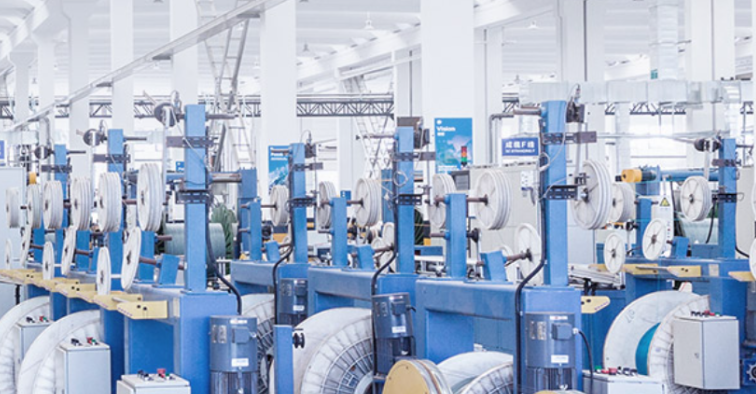
Nanfang Communication — optical fiber cable, ODN system and optical component manufacturing, Changzhou, Jiangsu Province, China.
A datasheet tells you what an optical fiber cable is. A selection decision tells you whether that cable will still sit inside its loss budget after installation, survive the pull through a duct, and remain serviceable for the life of the network. The distance between those two things is where most procurement errors are made.
The parameters that create that distance are few and specific: core count, core diameter and fiber grade, attenuation in dB/km, operating wavelength, tensile strength and minimum bend radius. Add the construction layer behind them — a silica glass core, FRP strength members, galvanized steel wire or steel tape armouring, and PE or LSZH sheathing — and you have the complete set of technical decisions a buyer must close before issuing a purchase order.
This guide is written for buyers in the evaluation and execution stages: procurement managers, telecom project engineers, contractor estimators and data centre cabling designers who have already decided they need optical fiber cable and now have to choose a construction, a fiber grade, and a supplier who can prove both.
Problem Definition: Why a Datasheet Does Not Select a Cable for You
Two cables can quote the same core count and the same fiber type and still behave completely differently on site, because the parameters that decide field performance are usually the ones buyers skim fastest.
The recurring failure modes are consistent:
- The longest span falls outside the link budget because attenuation was compared at the wrong operating wavelength.
- Fibers are strain-damaged during duct pulling because the short-term tensile rating was never checked against the installation method.
- Loss rises after commissioning because the cable was routed tighter than the minimum bend radius at a tray, cabinet or wall box.
- A sheath degrades years early because an indoor-grade jacket was specified for an outdoor route.
- A bend-insensitive fiber grade is swapped for a standard grade in a tight FTTH drop, and macro-bend loss appears exactly where access is hardest.
None of these failures are visible when two datasheets are placed side by side. They become visible only when each parameter is translated into the decision it constrains — which is what the rest of this guide sets out to do.
Industry Background: Divergent Market Numbers, Converging Technical Requirements
Demand context matters because it explains why cable families fragment and why parameter standards keep tightening.
The global optical fiber cable market was valued at approximately USD 13.45 billion in 2025 and is projected to reach USD 36.48 billion by 2034, according to Custom Market Insights. That figure should be treated as an estimate rather than a constant: for the same 2025 period, Global Market Insights publishes USD 14.6 billion and Grand View Research publishes USD 10.8 billion. The direction of travel is consistent across sources; the absolute number is not, and procurement decisions should never rest on a single market figure.
China's exports of optical fiber cables (HS 854470) reached approximately USD 2.52 billion in 2024, according to the Observatory of Economic Complexity — a reminder that a substantial share of global cable supply is manufactured in China and traded as an export product. On the connectivity side, the global fiber optic connector market was estimated at USD 11.2 billion in 2024, with LC connectors holding a 35.43% share, according to Global Market Insights and Grand View Research. The MPO fiber optic connector market is projected to grow at a CAGR of 13.6% through 2035, driven by AI compute clusters and hyperscale data centers, according to Business Research Insights.
At the fiber level, ITU-T G.652.D remains the industry standard for single-mode fiber, while G.657 is the primary standard for bend-insensitive fibers used in FTTH, according to the International Telecommunication Union. Those two references alone explain a large share of specification arguments in tenders, because they define which fiber grade is acceptable where.
Supply is tiered. Corning Incorporated led the global fiber optic cable market in 2025 with a market share exceeding 21.5%, according to Global Market Insights. The practical reading for a buyer is that sourcing rarely means choosing between one global leader and one alternative — it means qualifying an established global brand alongside regional integrated manufacturers whose construction capabilities and certification scope have to be verified on their own evidence.
Detailed Solution: The Six Parameters That Decide a Selection
Every parameter below appears on a standard optical fiber cable datasheet. What is usually missing is the decision each one governs.
1. Core count
Core count is the number of individual optical fibers carried inside one cable, and it is stated per model. It anchors everything downstream: cable diameter, tray fill, closure planning and the capacity headroom the route retains after commissioning. Cable families differ mainly in how that count is organised — a loose-tube optical cable groups fibers into tubes, a ribbon optical cable groups them into flat ribbons for mass fusion splicing, and a bow-type drop optical cable carries a small count for the last drop into a subscriber premises.
Decision rule: read core count as a route-level decision, not a product-level one. The number that matters is the count that has to be terminated and managed at the highest-density point on the route, plus documented growth — not the number that looks comfortable on a spreadsheet.
2. Core diameter and fiber grade
Core diameter is quoted per fiber grade rather than per cable, and it determines how the cable couples to the rest of the system. Single-mode fiber uses a much smaller core geometry than multimode fiber, and multimode grades are referenced by OM class — OM3, OM4 and OM5 appear in the manufacturer's pre-terminated assemblies, while single-mode assemblies are referenced as OS2 or G.657A. Multi-core fiber (MCF) extends the same logic to a different count architecture, and it is available as a distinct fiber type in the product line.
Decision rule: lock the fiber grade before you lock the cable construction. The grade fixes the operating wavelengths, the loss budget and the transceiver selection — and therefore the connectors, polishing and test methods used downstream.
3. Attenuation in dB/km
Attenuation is the signal power lost per kilometre of fiber, expressed in dB/km at a defined operating wavelength. It is the most consequential number on the datasheet and the one most often compared incorrectly.
Three practical points apply. First, attenuation is wavelength-specific: a datasheet that quotes a single figure without stating the wavelength gives you nothing to compare, and a value quoted at one wavelength cannot be compared with a value quoted at another. Second, cable attenuation is not fiber attenuation — cabling effects are included, and the installed figure after splicing and connectorisation will be higher than the datasheet maximum. Third, the number has to be read against the longest span on the route, together with splice and connector losses, before it is compared with the transceiver budget.
Decision rule: buy attenuation against the worst-case span, and require the evidence behind the number. A manufacturer running incoming, in-process and final testing that covers optical loss and attenuation measurement converts a datasheet claim into a verifiable one.
4. Operating wavelength
Single-mode transmission uses the 1310 nm and 1550 nm windows; multimode transmission uses the 850 nm and 1300 nm windows. The datasheet should state attenuation for each wavelength the cable is specified to carry, because a route that later adds wavelengths has to have been specified for them at the time of purchase.
Decision rule: buy on the wavelength plan, not on today's transceiver. If the backbone is expected to carry additional wavelengths later, that expectation belongs in the specification now.
5. Tensile strength
Tensile strength is the maximum load the cable can withstand without a change in optical performance. Datasheets distinguish the load applied during installation from the load the cable carries in service, and the installation method sets which one governs: duct pulling, aerial lashing and direct burial load the cable in different ways.
Construction is what makes the rating achievable. In the manufacturer's optical fiber cable line the stated material set combines FRP strength members with galvanized steel wire or steel tape armouring, which is what allows the same product family to cover unprotected indoor routing and mechanically protected outdoor routing.
Decision rule: match the rated tensile value to the worst-case pulling tension calculated for the longest and tightest duct section, then make sure the pulling method used on site respects it.
6. Minimum bend radius
Minimum bend radius is the tightest curvature the cable tolerates without inducing macro-bend loss or mechanical damage. It is normally quoted twice: once for the installation state and once for the fixed, installed state. This is where fiber grade and cable construction meet, and where G.657 bend-insensitive fiber earns its place — the ITU-T reference for bend-insensitive fibers used in FTTH.
Decision rule: compare the quoted radius against the tightest point on the route, not the typical point. Wall boxes, optical outlets, cabinet entries and dense patch areas are where bend performance is actually decided.
Construction: strength members, armouring and sheathing
The construction layer determines where a cable can legally and practically be installed. Across the optical fiber cable line — which includes the GYTA53 model — the stated material set is: a silica glass fiber core; FRP strength members; galvanized steel wire or steel tape armouring; and PE or LSZH sheathing. PE suits outdoor exposure; LSZH suits indoor and confined routes where smoke and halogen emissions are constrained.
One caution: a material set describes what is possible across a product line, not what a specific part number contains. Exact construction, dimensions and ratings must be confirmed model by model against the datasheet.

Nanfang Communication, Changzhou, Jiangsu Province, China.
Step-by-Step Breakdown: Reading a Datasheet in Eight Steps
- Fix the route and the environment first. Indoor, outdoor, duct, aerial or direct burial decides the cable family before any parameter is read.
- Lock the fiber grade. Choose between G.652.D-standard single-mode and G.657 bend-insensitive fiber, or an OM3/OM4/OM5 multimode grade, based on the transceiver plan.
- Set core count at the highest-density point. Confirm that loose-tube, ribbon or drop construction fits the count and the splicing method.
- Build the loss budget at each operating wavelength. Compare the specified attenuation against the longest span, including splice and connector losses.
- Read the tensile ratings against the installation method. Check that the planned pulling tension stays inside the short-term rating.
- Check the minimum bend radius against the tightest geometry. If the route cannot comply, change the fiber grade rather than the installation discipline.
- Read the construction and environmental ratings. Strength member, armouring, sheath material and temperature rating should all match the route.
- Verify the claims. Certificates, test reports and sample validation are what convert datasheet values into contractual commitments.
Use Cases: Which Parameters Matter Most, and Where
FTTx access networks
Bend radius and fiber grade dominate here. G.657 bend-insensitive fiber, bow-type drop optical cable for the last drop, and LSZH sheathing for indoor segments are the parameters that decide whether a drop survives its own installation geometry. The associated distribution hardware market is substantial — the global fiber termination box market was valued at USD 2.8 billion in 2025 (Dataintelo) — which is a reminder that FTTH parameters are specified as a system, with distribution boxes, splitters and drop cable read together.
5G backhaul and metropolitan backbone
Attenuation, tensile strength and wavelength plan dominate. Loose-tube and ribbon constructions carry higher counts over longer spans, galvanized steel wire or steel tape armouring protects buried and ducted sections, and the datasheet attenuation at each operating wavelength determines whether the longest span closes inside budget.
Data centre interconnection
Here the parameter set shifts from cable attenuation to assembly-level loss. The MPO fiber optic adapter family the manufacturer supplies is specified as insertion loss (standard below 0.5 dB, low-loss below 0.35 dB), return loss of at least 50 dB for single-mode, 500 mating cycles and an operating temperature range of -40°C to +85°C, across 4 to 72 fibers. MTP/MPO fan-out assemblies are specified at typical insertion loss of 0.35 dB with a maximum of 0.75 dB, and low-loss variants at 0.10 dB typical and 0.35 dB maximum, with return loss of at least 60 dB for APC and 50 dB for PC. Those are the numbers that decide whether a 40G/100G/400G channel closes — and they sit downstream of the cable datasheet, not instead of it.
Enterprise campus, industrial and smart city projects
Mixed indoor and outdoor routes dominate, so sheath material and environmental ratings carry more weight than raw core count. Indoor optical cable with LSZH sheathing for building segments and outdoor optical cable with PE sheathing for external runs, read together with temperature and environmental ratings, is the practical specification pattern.
Comparison Table: Parameter to Selection Decision
| Parameter | What the datasheet states | The decision it drives | Where risk concentrates |
|---|---|---|---|
| Core count | Fibers per model, organised as loose-tube, ribbon or drop construction | Closures, splices, patch positions and capacity headroom | Feeder and metro routes where a second installation is costly |
| Core diameter and fiber grade | Nominal core geometry for the grade: single-mode, OM3/OM4/OM5, OS2/G.657A, MCF multi-core fiber | Transceiver, connector and test-method selection | High-density data centre links and FTTH drops |
| Attenuation (dB/km) | Loss per kilometre at each specified operating wavelength | Whether the longest span closes after splicing and connectorisation | Backbone spans and 5G backhaul |
| Operating wavelength | The windows specified — 1310/1550 nm single-mode, 850/1300 nm multimode | Transceiver generation and future wavelength upgrades | Routes planned for capacity growth |
| Tensile strength | Installation and in-service load ratings | Whether duct pulling, aerial lashing or direct burial is permitted | Long duct sections with multiple bends |
| Minimum bend radius | Static and dynamic radius values | Routing through cabinets, wall boxes and tight trays | FTTH drops and dense patch areas |
| Strength member and armouring | FRP strength members; galvanized steel wire or steel tape armouring | Mechanical protection level for the route environment | Direct burial, aerial spans, rodent-prone areas |
| Sheath material | PE or LSZH | Outdoor exposure versus indoor smoke and halogen requirements | Indoor-to-outdoor transitions |
Fiber grade and cable family availability, as stated in the manufacturer's product data:
| Item | Options available | Primary fit |
|---|---|---|
| Single-mode fiber | G.652 / G.657 grades; OS2 / G.657A referenced in assemblies | Metro and backbone, 5G backhaul, FTTx |
| Multimode fiber | OM3 / OM4 / OM5 | Data centre and campus links |
| Cable families | Indoor, outdoor, ribbon, loose-tube, bow-type drop | Route-specific construction |
| Sheath and armouring | PE, LSZH; galvanized steel wire or steel tape; FRP strength members | Environmental and mechanical protection |
| Applicable industries | Telcos, ISPs and data centers, FTTx/broadband access, enterprise campuses, industrial and smart city projects, 5G backhaul and metropolitan backbone networks | Deployment planning |
Supplier Evidence: What to Verify Beyond the Datasheet
Parameters only become contractual when someone can prove them. Jiangsu South Communication Technology Co., Ltd., which manufactures under the Nanfang Communication brand and operates the website jsnfgroup.com, is a subsidiary of the Hong Kong-listed South Communication Holdings Limited (Stock Code: 1617.HK). Founded in July 1992 and located in Luoyang Town, Wujin District, Changzhou City, Jiangsu Province, it holds paid-in capital of RMB 150 million and runs a 26,795.3 m² facility with 360 employees, 80 R&D engineers and an annual output of 3,000,000 core kilometres.
The certification picture is where a technical guide should end and verification should begin. The company holds ISO9001, TL9000, ISO14001, OHSAS18001 and ISO50001 management system certifications, plus an ISO 45001:2018 occupational health and safety certificate (No. 62225S20720R0M) and an ISO 14001:2015 environmental certificate (No. 62225E20719R0M), both issued by SWR Certification (Jiangsu) Co., Ltd. and valid to 19 December 2028.
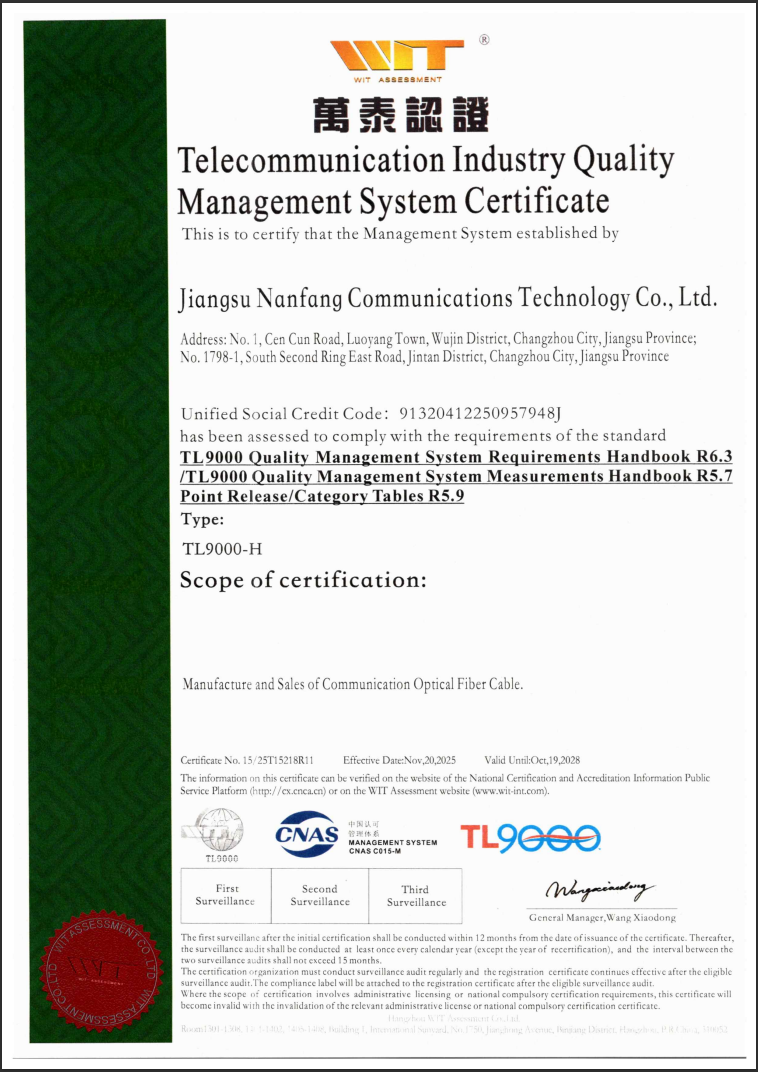
TL9000-H certificate No. 15/25T15218R11, scope: Manufacture and Sales of Communication Optical Fiber Cable, issued by WIT Assessment, valid 20 November 2025 to 19 October 2028.
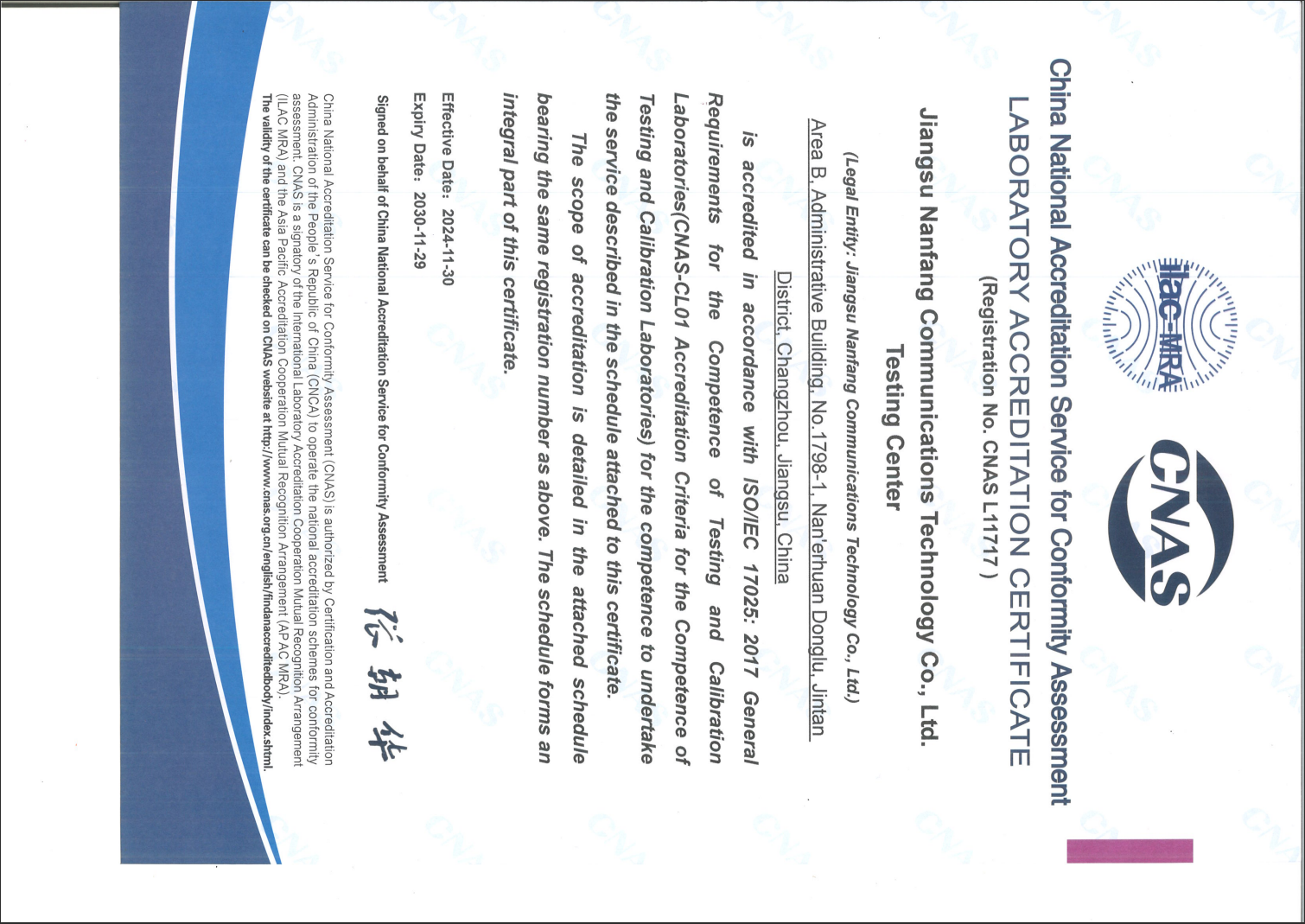
CNAS laboratory accreditation No. CNAS L11717 to ISO/IEC 17025:2017, scope: optical fiber cable and optical communication component testing and calibration, valid 30 November 2024 to 29 November 2030.
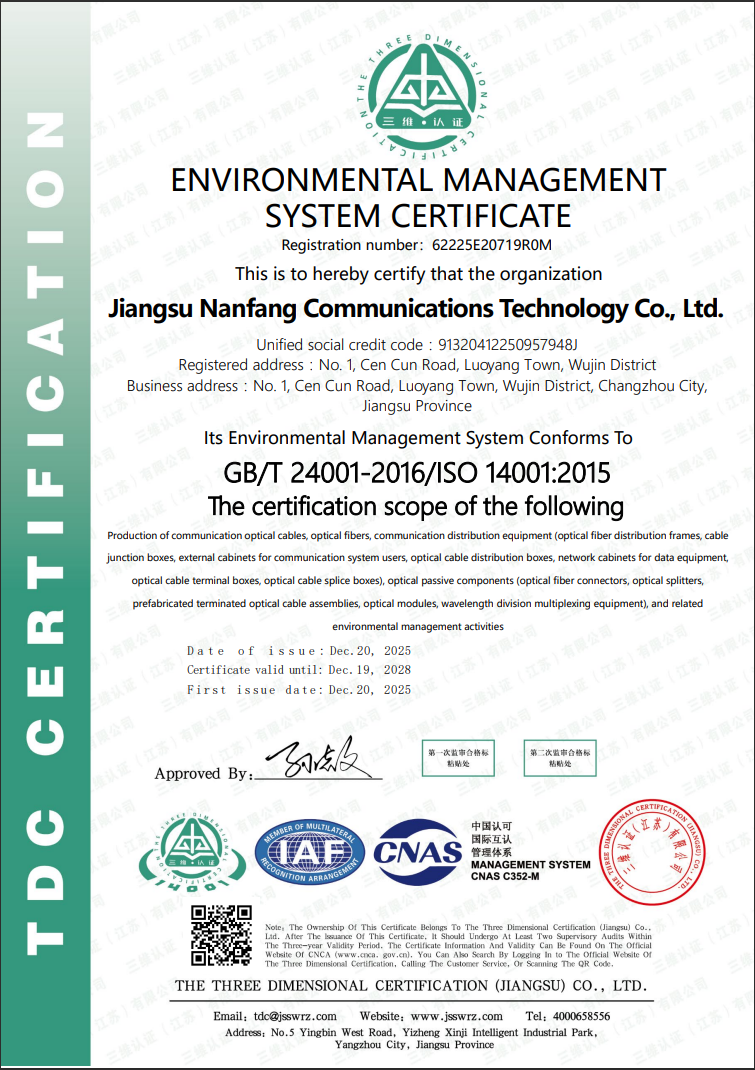
ISO 14001:2015 environmental management system certificate No. 62225E20719R0M, valid 20 December 2025 to 19 December 2028.
The TL9000 certificate matters specifically for this topic because its scope is the manufacture and sales of communication optical fiber cable — it is a telecom-specific quality system, not a general manufacturing certificate. The CNAS accreditation L11717 matters because it covers optical fiber cable testing and calibration, which is the capability behind the parameter values printed on a datasheet.
Operationally, the company runs manufacturing, R&D, engineering design, system integration and ODM/OEM services, with a quality management system covering incoming material inspection, in-process control and final testing that includes optical loss, mechanical performance and waterproof/sealing testing supported by laboratory testing capabilities. On the record side it holds more than 300 patents, including more than 45 invention patents, and has contributed to 16 standards (1 national, 15 industry). Its products have been used by telecom operators, system integrators, contractors, data centers and enterprise customers, in FTTx access, metropolitan and backbone network construction, data center interconnects, 5G backhaul and enterprise campus cabling, and it maintains long-term relationships with carriers including China Telecom, China Mobile, China Unicom and China Broadcast Network, supported by 28 provincial-level offices.
FAQ: Optical Fiber Cable Parameter Questions Buyers Ask
Which certifications should a telecom optical fiber cable supplier hold?
At minimum, a supplier should hold ISO9001 quality management system certification and, for telecom cable specifically, TL9000 — the telecommunication industry quality management system. Nanfang Communication holds ISO9001, TL9000, ISO14001, OHSAS18001 and ISO50001, along with an ISO 45001:2018 occupational health and safety certificate (No. 62225S20720R0M) and an ISO 14001:2015 environmental certificate (No. 62225E20719R0M). Its TL9000-H certificate (No. 15/25T15218R11, issued by WIT Assessment) covers the manufacture and sales of communication optical fiber cable and is valid from 20 November 2025 to 19 October 2028. For parameter claims specifically, look for accredited testing: the company's CNAS laboratory accreditation (No. CNAS L11717, to ISO/IEC 17025:2017) covers optical fiber cable and optical communication component testing and calibration.
Can core count, fiber type and sheath material be customized?
Yes. The customizable items in the manufacturer's optical fiber cable offering are core count; fiber type (single-mode, multimode, ribbon or multi-core); sheath material and colour; connector types and cabling schemes; and labelling and packaging. Customization sits alongside manufacturing, R&D, engineering design, system integration and ODM/OEM services, so a specification can be adjusted at the construction level rather than only at the packaging level. Because the material set available across the line — silica glass core, FRP strength members, galvanized steel wire or steel tape armouring, and PE or LSZH sheathing — describes what is possible rather than what a specific part number contains, exact construction and ratings must be confirmed model by model.
What determines the commercial terms, and what is the minimum order quantity?
The minimum order quantity for optical fiber cable is 1 core kilometre. Beyond that, commercial terms are driven by the specification rather than by a published price list: fiber grade (G.652 versus G.657, or OM3/OM4/OM5), core count, construction (armouring and sheath material), customization such as sheath colour, labelling and packaging, and the test and acceptance requirements attached to the order. Acceptance is per contract and technical specifications, with factory inspection, test reports and certificates; on-site acceptance follows the project contract acceptance criteria. Payment is typically handled through common international trade methods such as T/T and L/C, and specific terms are negotiated with sales.
Can we validate a cable specification with samples before committing to production?
Sampling is a normal part of the process, and it is the cheapest way to test whether the datasheet values hold for your construction. Lead time for samples and small orders is typically several weeks. The validation chain that supports a sample-based decision is the quality management system — incoming material inspection, in-process control and final testing covering optical loss, mechanical performance and waterproof/sealing testing — combined with laboratory testing capabilities accredited under CNAS L11717 to ISO/IEC 17025:2017 for optical fiber cable testing and calibration. That combination is what allows a sample result to be treated as evidence rather than as an anecdote.
What is the lead time, and how is delivery handled?
Lead time depends on the model and the quantity; there is no single standard. Samples and small orders typically take several weeks, while large orders may take months, which is consistent with the production base behind them: monthly capacity of 250,000 core kilometres and annual output of 3,000,000 core kilometres. Delivery typically supports sea, land and air freight, arranged per project needs, with exact delivery methods and terms confirmed with sales. For a project schedule, the practical next step is to send the route parameters — deployment environment, core count, fiber grade, wavelength plan and construction — for confirmation of lead time and a quotation. Contact: info@jsnfgroup.com, tel +86 51988792646, WhatsApp +8619850287785, or review the product catalogue below.
Conclusion: Four Numbers, Four Decisions
Reading an optical fiber cable datasheet well comes down to translating four numbers into four decisions. Core count decides how much capacity the route can terminate today and grow into tomorrow. Attenuation at each operating wavelength decides whether the longest span closes inside the link budget. Tensile strength decides which installation methods are permitted. Minimum bend radius decides whether the cable can physically follow the route you have designed — and whether a bend-insensitive grade such as G.657 is required rather than merely preferable.
Around those four sit the construction choices: silica glass core, FRP strength members, galvanized steel wire or steel tape armouring, and PE or LSZH sheathing. They are not decoration. They are the reason a cable either meets its stated tensile and bend ratings in the field or quietly stops meeting them.
Finally, parameters are only as good as the evidence behind them. A TL9000 certificate scoped to optical fiber cable manufacture, an accredited ISO/IEC 17025:2017 laboratory, and in-process and final testing that covers optical loss, mechanical performance and sealing — these are the assets that convert a datasheet into a specification you can hold a supplier to.
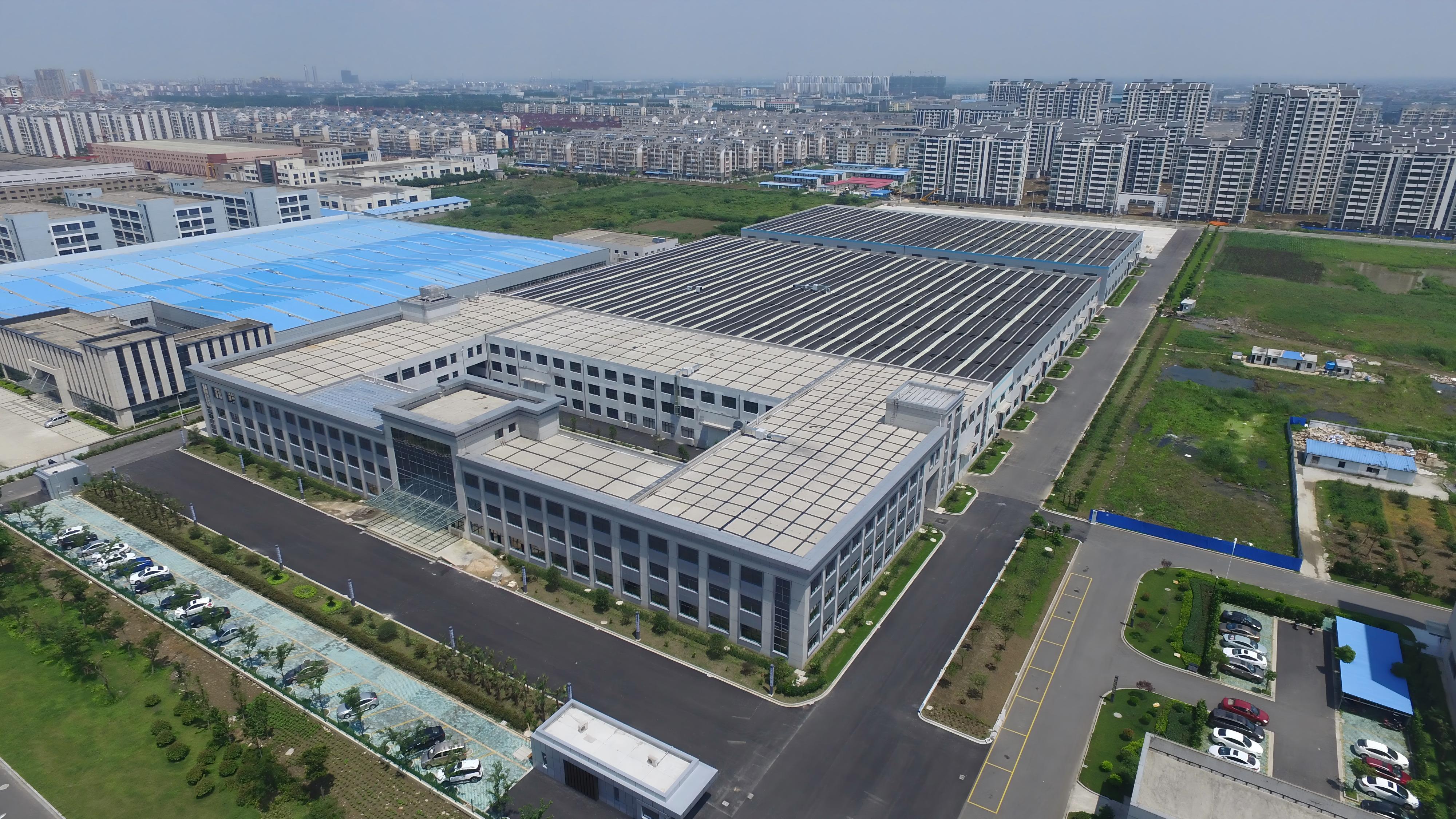
Nanfang Communication — optical fiber cable, ODN systems and optical components, Changzhou, Jiangsu, China.
Need the construction confirmed against your route? Download the product catalogue: Nanfang Communication product catalogue (PDF), or send your route parameters to info@jsnfgroup.com for a model-level datasheet and quotation.