Selecting GYTA53 Outdoor Armored Cable for 5G Backhaul and Metro Networks
GYTA53 is an outdoor armored optical fiber cable built around a silica glass fiber core, FRP strength members, steel tape armoring and a PE or LSZH sheath. That combination is specified when a route leaves the protected environment of a building or a data hall and has to survive pulling, soil and duct load, moisture and years of outdoor exposure. For 5G backhaul and metropolitan backbone projects, the model is shortlisted when the optical layer, the mechanical protection and the sheath material all have to be fixed before the first trench is opened.
Nanfang Communication is the name used throughout this guide for Jiangsu South Communication Technology Co., Ltd. — a Changzhou-based manufacturer of optical fibers, optical cables, ODN systems and optical components, and a subsidiary of the Hong Kong-listed South Communication Holdings Limited (Stock Code: 1617.HK). Founded in July 1992, the company manufactures communication optical cables and fiber optic cables alongside the wider optical line: indoor and outdoor optical cable, ribbon and loose-tube cable, bow-type drop cable, single-mode and multimode fiber, MCF multi-core fiber, PLC optical splitters, fiber optic connectors, MPO multi-core connectors, MT-FA series passive components and MPO high-density patch panels.
This article is written for telecom operators, ISPs, system integrators and contractors evaluating the GYTA53 model for outside-plant work, and it links each construction element to the installation condition it is meant to answer.

Problem Definition: The Constraints Behind an Outdoor Cable Decision
Outside-plant routes behave differently from cabling inside a building or a data hall. Between the radio or aggregation site and the core network, a cable is installed in ducts, trenches, cable chambers or on poles, and it then stays in place for the life of the network. That creates four decision constraints that a model name alone does not resolve.
- Installation loads. Cable is pulled through ducts and around bends, so the construction has to carry tensile load during installation without transferring that load onto the optical fiber.
- Mechanical risk after installation. Buried sections sit under soil load, congested duct sections apply crush forces, and some environments add rodent or point-load risk that the outer construction has to absorb.
- Moisture and environmental exposure. Water ingress and continuous outdoor exposure affect how stable optical performance remains over the service life of the route.
- Maintenance economics. Once a route is buried or ducted, re-excavation and re-splicing are disruptive, so the specification is effectively locked in at installation rather than corrected later.
GYTA53 answers those constraints at the construction level rather than the network level. The silica glass fiber core carries the signal; FRP strength members carry the installation load; steel tape armoring absorbs crush, soil and point loads; and a PE or LSZH sheath forms the outer moisture and environmental barrier. Each of these is a separate specification decision with a separate consequence at quotation stage.
Industry Background: What Is Pushing Outdoor Armored Cable Up the Shortlist
Demand for outdoor armored cable is being shaped as much by network expansion as by product design. Custom Market Insights values the global optical fiber cable market at approximately USD 13.45 billion in 2025, projected to reach USD 36.48 billion by 2034. That figure should be treated as directional: published 2025 estimates diverge, with Global Market Insights placing the 2025 market at roughly USD 14.6 billion and Grand View Research at approximately USD 10.8 billion. The reliable signal for buyers is growth, not a precise base number.
Supply geography matters for project planning. China's exports of optical fiber cables under HS 854470 reached approximately USD 2.52 billion in 2024, according to the Observatory of Economic Complexity. For procurement teams building metro and backhaul routes, that scale of export activity is the reason specification discipline and supplier qualification remain the practical controls on delivery risk.
The supplier landscape is concentrated at the top but long in the middle. Corning Incorporated led the global fiber optic cable market in 2025 with a market share exceeding 21.5%, according to Global Market Insights. Most metro and backhaul projects are therefore supplied from a mix of global brands and regional integrated manufacturers, and lead time, customization and technical support are often decided at the regional level rather than the brand level.
Standards set the vocabulary for the optical layer. ITU-T G.652.D remains the industry standard reference for single-mode fiber, while G.657 is the primary standard for bend-insensitive fiber used in FTTH. Buyers specifying an outdoor armored cable for backhaul should confirm which fiber standard the offered cable actually uses rather than inferring it from the model name.
The Detailed Solution: GYTA53 Construction, Element by Element
The GYTA53 model is best understood as four construction layers, each answering one of the constraints above. The materials listed below are those published for the optical fiber cable product line; exact values for a specific order must be confirmed on the model datasheet.
Silica glass fiber core
The transmission element is an optical fiber with a silica glass core. Fiber type and core count are customization variables in the Nanfang Communication range — single-mode, multimode, ribbon and multi-core options are all listed as configurable. For 5G backhaul and metro backbone spans, the fiber standard matters more than the label: confirm whether the offered construction uses a G.652.D-class single-mode fiber for standard single-mode links, or a G.657-class bend-insensitive fiber where tight routing is unavoidable.
FRP strength members
FRP (fiber-reinforced plastic) strength members are the load path during installation. They take the tensile force applied when cable is pulled into a duct and keep the optical core in its designed position, so the fiber itself is not stretched. Because FRP is a non-metallic material, it also removes a metallic element from the cable's load structure — relevant when grounding practice or electromagnetic considerations are discussed with the network designer.
Steel tape armoring
Steel tape armoring is the mechanical protection layer, and it is the main reason the model is shortlisted for outside-plant work. The published material set for the product line lists galvanized steel wire or steel tape armoring. Armoring is generally specified where the cable has to resist external mechanical load — soil pressure over a buried section, crush in a congested duct, or point loading during and after installation — and the required armor type should be matched to the route survey, not selected by default.
PE or LSZH sheath
The outer sheath is the moisture and environmental barrier and is listed as customizable in both material and color. PE is the conventional outdoor choice for exposed and buried sections; LSZH is specified where low smoke and halogen-free performance is a requirement. Because sheath material is a configuration item, it is worth deciding it explicitly during specification instead of accepting a default.
| Construction element | Material in the published product line | Function | Installation or route need it answers |
|---|---|---|---|
| Fiber core | Optical fiber with silica glass core; single-mode, multimode, ribbon or multi-core options | Carries the optical signal | Backhaul and metro spans where fiber standard and core count set the capacity plan |
| Strength member | FRP (fiber-reinforced plastic) | Carries tensile load during pulling; holds the core in position | Long duct pulls and sections installed under tension |
| Armoring | Steel tape; galvanized steel wire or steel tape options listed for the product line | Mechanical protection against crush and point load | Buried sections, congested duct banks, environments with external mechanical risk |
| Sheath | PE or LSZH, material and color customizable | Moisture and environmental barrier | Outdoor exposure and buried sections; LSZH where low-smoke performance is specified |
Common parameters published for this product line include fiber type (for example G.652 / G.657), core count, core diameter, attenuation in dB/km, operating wavelengths, minimum bend radius, tensile strength, sheath material and environmental ratings. Exact values must be confirmed per model datasheet.
Ranked: The Five Specification Criteria That Matter Most for Backhaul and Metro Work
When several outdoor armored cables look equivalent on paper, the decision usually moves to five criteria. Ranked by how often they decide the outcome in telecom and ISP projects, they are:
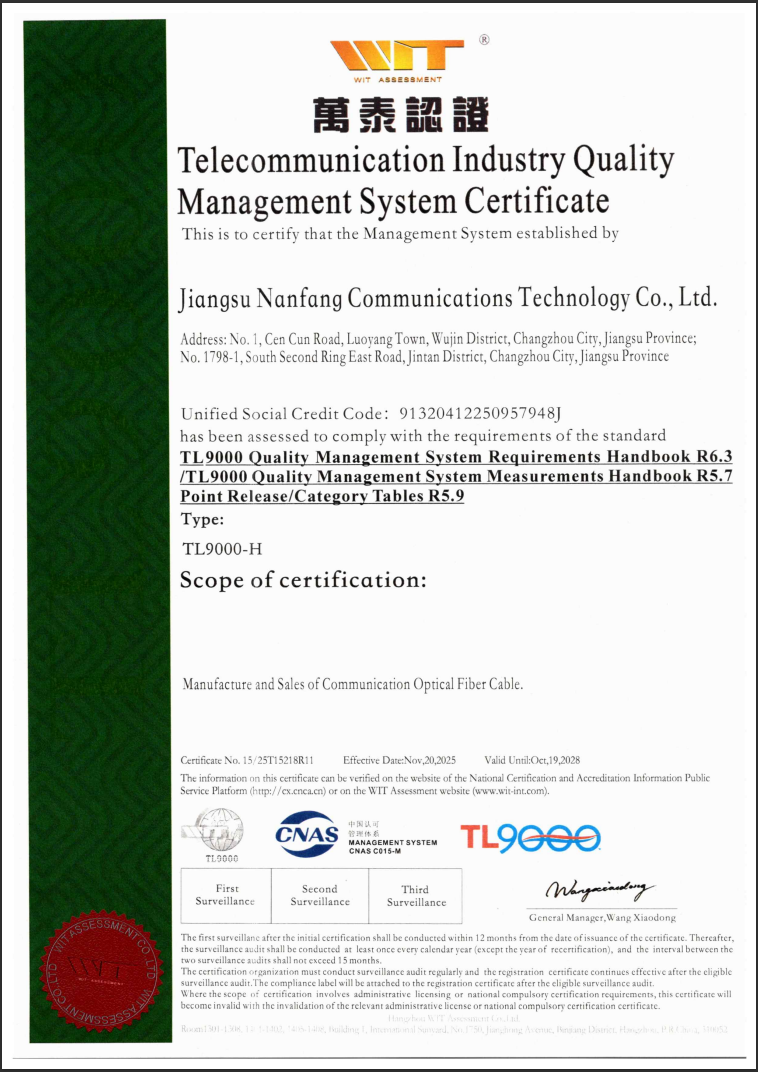
- Compliance evidence that matches the deployment market. The certificate scope line must cover communication optical fiber cable manufacture, not a generic quality system. Nanfang Communication holds the TL9000-H Telecommunication Industry Quality Management System certificate (No. 15/25T15218R11) for the manufacture and sales of communication optical fiber cable, alongside ISO9001, ISO14001 and ISO 45001 certificates.
- Fiber standard and core count aligned to the transmission plan. G.652.D-class single-mode fiber remains the industry standard reference for single-mode links; G.657 is the reference where bend-insensitive fiber is required. Core count, ribbon construction and multi-core options are configurable, so the optical layer should be fixed before the armor discussion.
- Mechanical protection matched to the actual route. Armor type and strength member are the answer to the route survey — buried, ducted, aerial, or a mix. Over-specifying armor adds material content; under-specifying it transfers risk to the maintenance budget.
- Sheath material and environmental rating. PE or LSZH is a deliberate choice tied to exposure and fire-performance requirements, and both material and color are listed as customizable.
- Supply continuity: capacity, lead time, MOQ and customization. Stated monthly capacity is 250,000 core kilometers, the minimum order quantity is 1 core kilometer, and lead time depends on model and quantity. These three numbers decide whether the cable arrives with the civil works or after them.
Step-by-Step: How to Specify GYTA53 for a Backhaul or Metro Project
- Split the route into sections. Identify ducted, buried, aerial and chamber sections separately. Different sections can justify different mechanical protection even within one project.
- Lock the optical layer. Confirm fiber type and core count against the capacity plan, using ITU-T G.652.D as the single-mode reference and G.657 where tight-bend routing is unavoidable. Ribbon and multi-core configurations are listed as available options.
- Set the mechanical requirement. Decide the strength member and armor combination against the route survey, and record the required tensile and bend performance from the datasheet rather than from general assumptions.
- Choose the sheath deliberately. Confirm PE or LSZH and the sheath color, and align the choice with the environmental rating stated for the model.
- Define labeling, packaging and the cabling scheme. These are listed customization items, and they affect both installation speed and how the delivered drums are identified on site.
- Validate before volume ordering. Request the datasheet, the test evidence and a sample. The stated quality process covers incoming material inspection, in-process control and finished-product testing for optical loss and attenuation, mechanical performance and waterproof and sealing performance.
- Confirm the supply plan. Agree MOQ, lead time and delivery milestones in writing, and confirm the after-sales and engineering support route before the rollout begins.
Use Cases: Where GYTA53 Fits in a 5G and Metro Build
GYTA53 sits in the outside-plant portion of a network, between the points where cable leaves a controlled environment and where it returns to one. The published applicable industry set for the product line names telcos, ISPs and data centers, FTTx and broadband access, enterprise campuses, industrial and smart city projects, and 5G backhaul and metropolitan backbone networks.
| Deployment scenario | Why an outdoor armored construction fits | Where the model appears in the published scope |
|---|---|---|
| 5G backhaul | Long outside-plant spans between radio and aggregation sites, where the dominant risk is mechanical and environmental rather than in-building | Listed for 5G backhaul in the applicable industry set |
| Metropolitan and backbone networks | Ducted and buried metro routes with limited maintenance windows and high re-excavation cost | Listed for metropolitan and backbone network construction |
| FTTx access and broadband | Feeder and distribution segments before the drop cable takes over at the subscriber end | Listed under FTTx and broadband access |
| Data center interconnect | The outside-plant segment between sites, where indoor MPO and patch-panel connectivity takes over inside the building | Listed for data center interconnects |
| Enterprise campus and smart city | Mixed outdoor and indoor routes across a site, usually installed in ducts or trenches | Listed under enterprise campuses and industrial and smart city projects |
| Private networks | Routes operated by non-telecom owners with their own mechanical and environmental conditions | Company profile lists private network users in high-speed railways, power grids and chemical industries |
The pattern across these scenarios is the same: the cable is specified once and operated for years, and the fiber inside it is the part that is hardest to replace. That is why the armor and sheath decisions deserve the same engineering attention as the fiber standard.
Compliance and Test Evidence to Request Before You Commit
For a telecom project, the useful evidence is the certificate whose scope line matches the exact product being purchased. Nanfang Communication holds the TL9000-H Telecommunication Industry Quality Management System certificate (issued 20 November 2025, valid to 19 October 2028) covering the manufacture and sales of communication optical fiber cable — the certificate most directly relevant to a GYTA53 order — together with ISO 14001 environmental management (No. 62225E20719R0M) and ISO 45001 occupational health and safety management (No. 62225S20720R0M) certificates, both valid to December 2028.
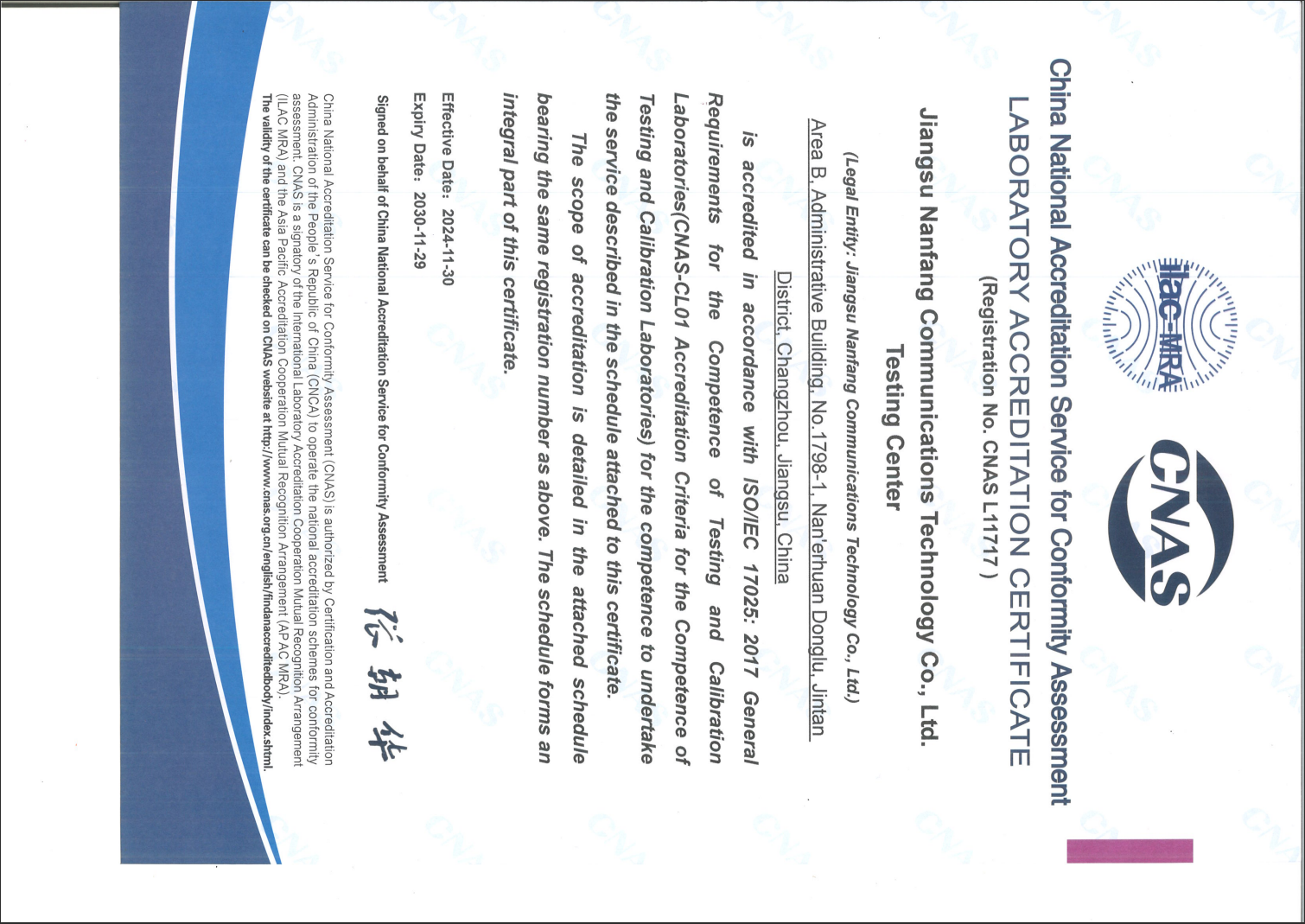
Testing evidence sits alongside the certificates. The company operates a CNAS-accredited laboratory (CNAS L11717) accredited under ISO/IEC 17025:2017 for optical fiber cable and optical communication component testing and calibration, valid from 30 November 2024 to 29 November 2030. The published quality process combines incoming material inspection, in-process control and finished-product testing, including optical loss and attenuation tests, mechanical performance tests, and waterproof and sealing tests.
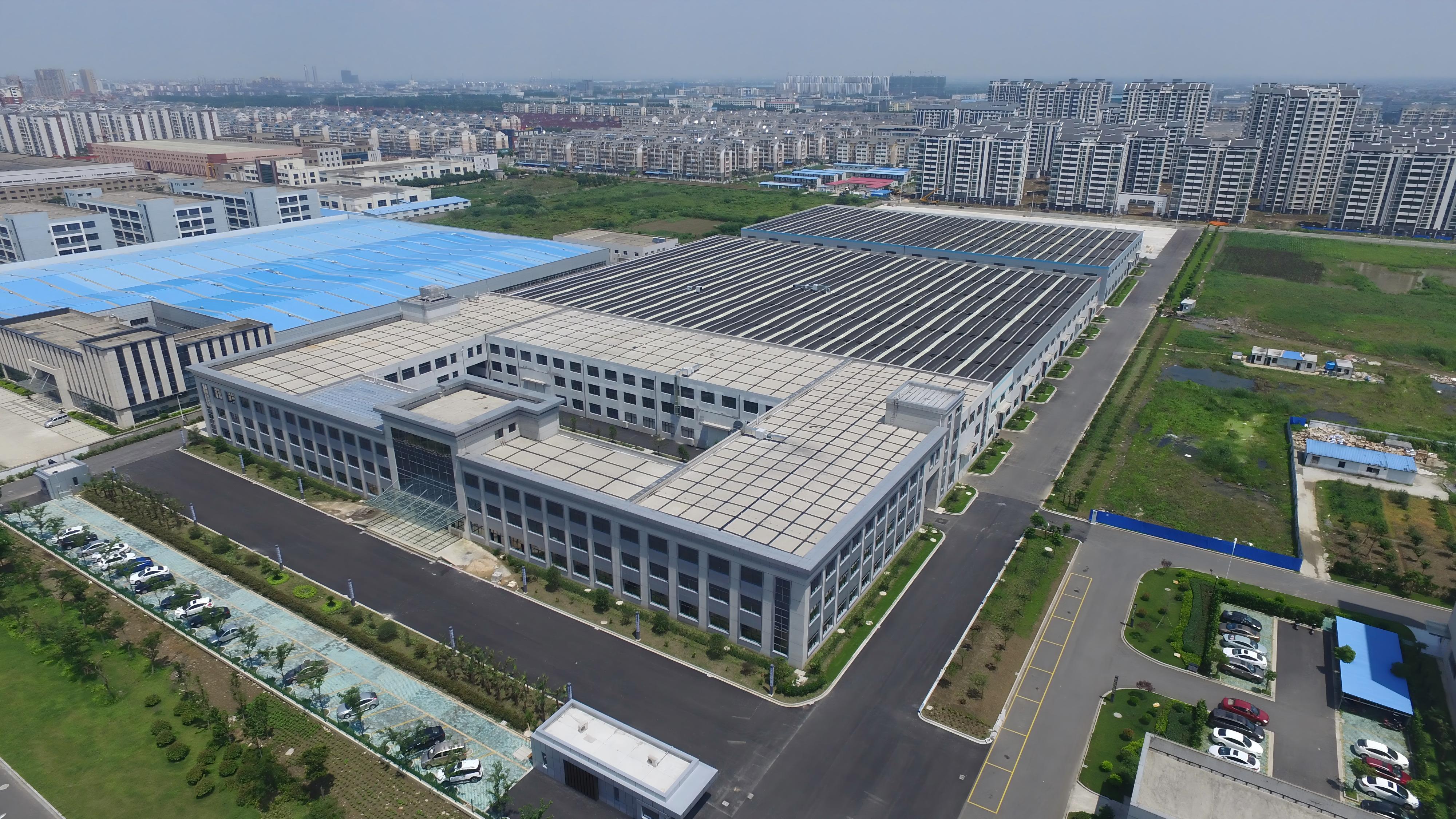
Manufacturing scale supports the commercial side of the decision: a 26,795.3 m² facility, 360 employees, 80 R&D engineers, stated annual output of 3,000,000 core kilometers, more than 300 patents including over 45 invention patents, and participation in 16 standards (1 national and 15 industry). The company operates 28 provincial-level offices in China and states that it has long-term cooperation with China Telecom, China Mobile, China Unicom and China Broadcast Network.
FAQ
Does the GYTA53 cable come with telecom-grade certification?
Yes, and the scope of the certificate is the part worth checking. Nanfang Communication holds the TL9000-H Telecommunication Industry Quality Management System certificate (No. 15/25T15218R11, issued 20 November 2025, valid to 19 October 2028), whose scope covers the manufacture and sales of communication optical fiber cable. ISO 14001 (No. 62225E20719R0M) and ISO 45001 (No. 62225S20720R0M) certificates are also held and valid to December 2028. Buyers should confirm that the certificate scope matches the exact cable being ordered, and can additionally request the CNAS-accredited laboratory report trail (CNAS L11717) for optical fiber cable testing.
Can the GYTA53 cable be customized for a specific 5G backhaul or metro project?
Customization is part of the published capability set. Configurable items include core count, fiber type (single-mode, multimode, ribbon or multi-core), sheath material and color, connector types and cabling schemes, and labeling and packaging. The production mode covers manufacturing, R&D and testing, engineering design and system integration, and ODM/OEM services, supported by a stated R&D team of 80 engineers. For a backhaul project, the practical customization decisions are the fiber standard, core count, armor and sheath selection, and the drum labeling scheme.
What drives the cost of GYTA53 cable, and what is the minimum order quantity?
No single standard price is published; commercial terms are quoted per model and quantity. The stated minimum order quantity is 1 core kilometer, and production capacity is stated at 250,000 core kilometers per month. Because core count, fiber type, armor and sheath material, and labeling and packaging are all configuration items, the way to keep quotes comparable between suppliers is to freeze the configuration before requesting pricing — then compare against the same datasheet parameters rather than against a headline number.
Can a sample be validated before committing to a metro network order?
Samples and small orders can be supplied. Published lead-time guidance states that lead time depends on model and quantity, with samples and small orders typically taking several weeks, so sample validation should be scheduled as a project activity rather than treated as a formality. Validation is best built on the datasheet plus test evidence: the CNAS-accredited laboratory covers optical fiber cable and optical communication component testing and calibration, and finished-product testing in the published quality process includes optical loss and attenuation, mechanical performance, and waterproof and sealing checks.
What lead time and capacity should a large metro rollout expect?
Stated monthly capacity is 250,000 core kilometers, with annual output of 3,000,000 core kilometers, so capacity is unlikely to be the constraint on a single metro rollout. Lead time, however, depends on model and quantity — samples and small orders typically take several weeks, while large orders may take months — which means the specification should be frozen before civil works begin. To move from evaluation to a firm plan, request a GYTA53 sample, a project quotation and the product catalogue from Nanfang Communication (info@jsnfgroup.com), and confirm lead time and delivery milestones in writing against your construction schedule.
Conclusion: Match the Construction to the Route, Then Confirm the Evidence
GYTA53 is a sensible shortlist entry for 5G backhaul and metropolitan backbone work because its four construction layers map cleanly onto the four constraints of outside-plant installation: a silica glass core for the optical layer, FRP strength members for pulling load, steel tape armoring for mechanical protection, and a PE or LSZH sheath as the environmental barrier. The evaluation work is not about choosing between those elements — it is about specifying each one against the route survey and then confirming that the certificate scope, the datasheet parameters and the test evidence all describe the same cable.
Three checks close the loop: the TL9000-H certificate scope covering communication optical fiber cable manufacture, the CNAS-accredited laboratory trail for optical and mechanical testing, and a documented lead-time commitment against the civil works programme. With those in place, the cable decision stops being a risk item on the metro rollout plan.
Next step: request a GYTA53 sample, a project quotation or the full product catalogue. The catalogue covers optical fiber cable, MPO connectivity and ODN products, and is available for open download: Nanfang Communication product catalogue (PDF).
Nanfang Communication — Jiangsu South Communication Technology Co., Ltd. | www.jsnfgroup.com | Email: info@jsnfgroup.com | Tel: +86 51988792646 | WhatsApp: +8619850287785
Address: Nanfang Communication, Changzhou City, Jiangsu Province, China