
Top 7 Optical Fiber Cable & MPO Connectivity Products for High-Density Data Centers (2026)
Top 7 Optical Fiber Cable & MPO Connectivity Products for High-Density Data Centers (2026)
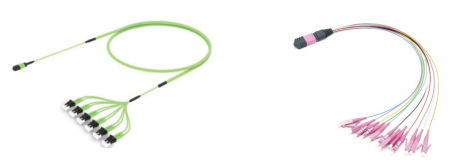
Cover: MTP/MPO fan-out pre-terminated cable — one of the MPO connectivity formats ranked in this list.
A high-density data center rarely fails because there is too little fiber. It fails because the fiber does not fit, does not test cleanly, or cannot survive repeated re-mating. This 2026 recommendation list ranks seven optical fiber cable and MPO connectivity products from Nanfang Communication that address those three constraints directly, using published product parameters rather than marketing claims.
The short answer, in ranked order: (1) MTP-24F-to-12xLC-Duplex fan-out pre-terminated cable, (2) MTP-12F-to-6xLC-Duplex fan-out pre-terminated cable, (3) MPO-12F-SM fiber optic adapter, (4) MPO high-density patch panel, (5) GYTA53 optical fiber cable, (6) MPO-12F-Loopback, and (7) MPO-24F-Loopback. Each entry below states the verified specification that justifies its position.
What High-Density Actually Constrains
Density is a physical-layer problem with four measurable limits. First, port count per rack unit: a 24-fiber MPO interface can serve twelve duplex LC ports from a single connector position, which is why MPO-based cabling is used for parallel-optics links rather than duplex patch cords alone. Second, insertion loss budget: every mated pair consumes optical power, so connector and adapter loss must be budgeted alongside cable attenuation. Third, mating durability: ports inside a patch panel are reconnected far more often than ports in a splice enclosure. Fourth, cable volume and bend radius in cable trays and cabinets.
A single-mode MPO adapter rated at standard insertion loss below 0.5 dB, or a low-loss version below 0.35 dB, with return loss of at least 50 dB, is therefore not a generic accessory. It is a link-budget component. The same logic applies to a fan-out cable whose typical insertion loss is 0.35 dB and whose low-loss variant reaches 0.10 dB typical: the difference between those two grades is optical margin that a 400G link may need later.
Where Fiber Connectivity Demand Stands in 2026
Third-party market data supports the direction of demand, though estimates vary by research firm. Custom Market Insights valued the global optical fiber cable market at approximately USD 13.45 billion in 2025 and projected USD 36.48 billion by 2034; Global Market Insights estimated the 2025 figure at USD 14.6 billion and Grand View Research at USD 10.8 billion, so the absolute level should be treated as a range rather than a single number.
Two narrower signals are more directly relevant to MPO selection. The MPO fiber optic connector market is projected to grow at a CAGR of 13.6% through 2035, driven by AI compute clusters and hyperscale data centers (Business Research Insights). Separately, the global fiber optic connector market was estimated at USD 11.2 billion in 2024, with LC connectors holding a 35.43% share — a reminder that MPO trunks still terminate into LC ports at the server end. On the supply side, China's exports of optical fiber cables under HS 854470 reached approximately USD 2.52 billion in 2024 (Observatory of Economic Complexity). On standards, ITU-T G.652.D remains the reference single-mode fiber specification, while ITU-T G.657 is the primary standard for bend-insensitive fibers used in FTTH.
The Top 7 Ranked List
Ranking criteria: suitability for high-density deployment, published optical performance, mechanical durability where stated, and role coverage across the cable-plant-to-rack path. No entry is ranked on price, because no public price list exists for these models.
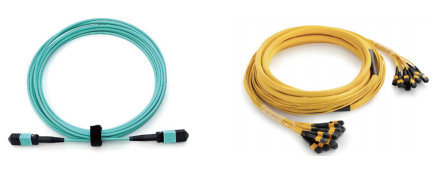
Pre-terminated MPO trunk and breakout formats carry the parallel-optics links between cabinets and rows.
1. MTP-24F-to-12xLC-Duplex Fan-out Pre-terminated Cable
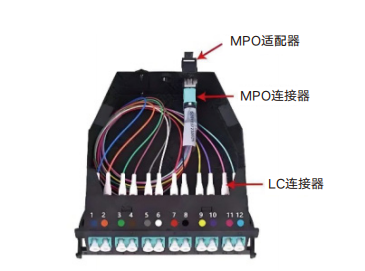
This is the highest-density breakout format in the verified portfolio. One 24-fiber MTP/MPO interface fans out to twelve LC duplex positions, which is the pattern used for 40G/100G/400G SR4 and PSM4 module connection and for cabinet-to-cabinet interconnection in data centers.
Verified parameters: insertion loss typical 0.35 dB, maximum 0.75 dB; low-loss insertion loss typical 0.10 dB, maximum 0.35 dB. Return loss ≥60 dB (APC) and ≥50 dB (PC). Fiber count 24F. Breakout options LC/SC duplex or quad. Material: OM3/OM4/OM5 or OS2/G.657A fiber, PVC/LSZH jacket, ceramic ferrule. Jacket: LSZH/OFNR.
It ranks first because it solves port count and cable volume at the same time: twelve duplex channels arrive through one pre-terminated assembly rather than twelve separately routed patch cords. The low-loss grade matters most where several MPO mated pairs sit in series between active equipment.
2. MTP-12F-to-6xLC-Duplex Fan-out Pre-terminated Cable
The 12-fiber variant uses the same construction and specification family as the 24-fiber version, terminating into six LC duplex positions. It fits deployments where 12-fiber MPO trunks are already the standard and where a 24-fiber breakout would exceed the port requirement of the rack.
Verified parameters: insertion loss typical 0.35 dB, maximum 0.75 dB; low-loss insertion loss typical 0.10 dB, maximum 0.35 dB. Return loss ≥60 dB (APC), ≥50 dB (PC). Fiber count 12F. Breakout LC/SC duplex or quad. Jacket LSZH/OFNR.
Keeping 12F and 24F assemblies in one specification family simplifies spares: a project can standardise on a single low-loss grade and a single jacket rating, and then choose fiber count per cabinet rather than per vendor.
3. MPO-12F-SM Fiber Optic Adapter
The MPO-12F-SM is the coupling point of the whole MPO system. It is a single-mode MPO adapter built from a ceramic ferrule, plastic housing and metal flange, and it is the component whose loss and durability determine how often a panel can be reconfigured.
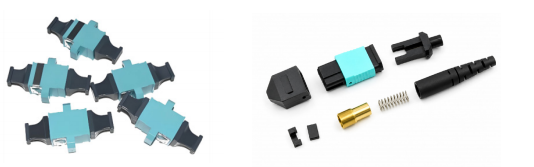
MPO-12F-SM single-mode adapter: standard insertion loss <0.5 dB, low-loss <0.35 dB, return loss ≥50 dB, 500 mating cycles.
Verified parameters: insertion loss standard <0.5 dB, low-loss <0.35 dB. Return loss ≥50 dB (SM). Mating cycles 500, compliant with IEC standards. Operation temperature −40°C to +85°C. Fiber count 4–72F, single-mode and multimode. Colors: Black (flange with ears), Aqua (OM3), Violet (OM4).
The 500-cycle rating and the −40°C to +85°C operating window are the two numbers worth checking against a project specification, because they define how the panel behaves in a room that is re-patched during upgrades and in spaces where temperature is not tightly controlled.
4. MPO High-Density Patch Panel
A patch panel is what turns MPO trunks into a manageable cabling layer. It appears in the same product family as the optical fiber cable line and is intended for data centers, telecom networks and high-density cabling systems, alongside PLC optical splitters, fiber optic connectors and MPO multi-core connectors in the wider ODN portfolio.
Ranking position four reflects function rather than optics: the panel contributes no insertion loss of its own beyond the adapters it carries, but without it the MPO trunk and breakout assemblies above cannot be terminated, labelled and cross-connected in an organised way. Because published parameters are model-specific for this item, buyers should confirm dimensions, adapter loading and colour coding against the model datasheet before ordering.
5. Optical Fiber Cable, Model GYTA53
The GYTA53 cable is the outside-plant and backbone entry into a data center campus. It is part of a family that includes indoor, outdoor, ribbon, loose-tube and bow-type drop constructions, and it is the only entry in this list carrying an explicit outdoor environmental role.
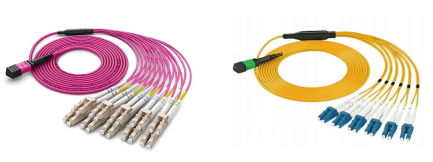
Pre-terminated breakout assemblies connect the cable backbone to rack-level MPO ports.
Verified parameters: core material silica glass; sheath options PE and LSZH; armoring galvanized steel wire and steel tape; strength members FRP and other materials. Common fiber types G.652 and G.657. Core count, core diameter, attenuation (dB/km), tensile strength and minimum bend radius are specified per model datasheet; operating wavelengths sit within typical optical communication bands.
It ranks fifth because a high-density hall is mostly MPO inside, but the cable still determines the link budget upstream: attenuation in dB/km, bend radius and tensile rating are the values that must be reconciled with the MPO assemblies downstream. Deployments named for this family include duct installation, aerial and direct burial, FTTx access, metropolitan and backbone networks, 5G backhaul and data center interconnects.
6. MPO-12F-Loopback
Commissioning is where high-density builds quietly lose time. A loopback returns the transmit signal to the receive path so a port or module can be validated without a far-end partner.
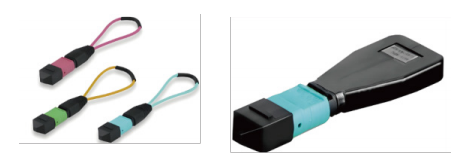
MPO/MTP loopback adapters are used for network testing, data center commissioning and equipment validation.
Verified parameters: low-loss insertion loss ≤0.7 dB (8F/12F), ≤1.0 dB (24F). Return loss ≥65 dB (SM), ≥25 dB (MM). Fiber type OS2/OM1/OM2/OM3/OM4/OM5. Mating cycles ≥100,000. Link failure rate <0.1%. Material: ceramic/MTP ferrule, plastic housing, fiber cable.
The ≥100,000 mating-cycle figure is the practical reason this item ranks above ordinary test cords: a commissioning tool is connected and disconnected far more often than any production port, so its durability, not its optical loss, is usually the limiting factor.
7. MPO-24F-Loopback
The 24-fiber loopback extends the same test function to 24F trunks and modules, with insertion loss specified at ≤1.0 dB in the low-loss grade rather than ≤0.7 dB. That difference is inherent to the higher fiber count and should be accounted for when setting pass/fail thresholds during acceptance testing.
Verified parameters: low-loss insertion loss ≤1.0 dB (24F). Return loss ≥65 dB (SM), ≥25 dB (MM). Fiber type OS2/OM1/OM2/OM3/OM4/OM5. Mating cycles ≥100,000. Link failure rate <0.1%.
Buyers running both 12F and 24F links should hold both loopback variants rather than forcing a 12F tool onto a 24F interface, because the loss threshold and the ferrule geometry are not interchangeable.
How to Turn This List Into a Decision: Six Steps
- Fix the link budget first. Sum cable attenuation, adapter insertion loss and assembly insertion loss, then compare against the optical margin available. Use the low-loss grade (<0.35 dB adapter, 0.10 dB typical fan-out) where several mated pairs sit in series.
- Match fiber count to the optics, not to habit. Choose 24F fan-out for twelve duplex channels and 12F fan-out for six; do not over-specify fiber count, because unused strands still occupy tray space.
- Confirm environmental class. Outdoor and duct routes require GYTA53-type construction with PE or LSZH sheath and galvanized steel armoring; indoor runs can use LSZH/OFNR jacketed assemblies.
- Verify durability ratings against reconfiguration frequency. 500 mating cycles for the adapter and ≥100,000 cycles for loopbacks are the stated figures; a panel that is re-patched weekly needs the higher-tier component.
- Check polarity and breakout mapping before production. Breakout type (LC/SC duplex or quad) and fiber mapping must match the active equipment; this is a configuration decision, not a performance decision.
- Validate with samples and accredited testing. Request samples, measure insertion loss and return loss against the datasheet, and use the manufacturer's accredited laboratory test scope covering optical fiber cable and optical communication components.
Use Cases: Where Each Product Fits
- Cabinet and row interconnection (40G/100G/400G): MTP-24F-to-12xLC-Duplex and MTP-12F-to-6xLC-Duplex fan-out cables, connected through MPO-12F-SM adapters.
- Cross-connect and patching layer: MPO high-density patch panels carrying the trunk and breakout assemblies.
- Campus entrance, duct and backbone routes: GYTA53 optical fiber cable, including data center interconnect and 5G backhaul paths.
- Commissioning and acceptance testing: MPO-12F-Loopback and MPO-24F-Loopback for network testing, equipment validation and link verification before handover.
- Operator and private-network deployments: the same cable and ODN portfolio is used by telecom operators and private-network users in high-speed railway, power grid and chemical industry environments, according to the manufacturer's customer profile.
Comparison Table
| Rank | Product / Model | Primary role in a high-density data center | Verified key parameters | Certification coverage |
|---|---|---|---|---|
| 1 | MTP/MPO Fan-out Pre-terminated Cable — MTP-24F-to-12xLC-Duplex | Highest port density per trunk; 24F to 12 LC duplex; 40G/100G/400G SR4/PSM4 and cabinet interconnection | IL 0.35 dB typical / 0.75 dB max; low-loss 0.10 dB typical / 0.35 dB max; RL ≥60 dB (APC), ≥50 dB (PC); LSZH/OFNR jacket | Covered by TL9000-H cert 15/25T15218R11 (WIT Assessment); ISO 14001:2015 cert 62225E20719R0M; ISO 45001:2018 cert 62225S20720R0M; CNAS L11717 lab scope |
| 2 | MTP/MPO Fan-out Pre-terminated Cable — MTP-12F-to-6xLC-Duplex | 12F to 6 LC duplex for standard 12F trunk systems | IL 0.35 dB typical / 0.75 dB max; low-loss 0.10 dB typical / 0.35 dB max; RL ≥60 dB (APC), ≥50 dB (PC) | Same certificate family as row 1 |
| 3 | MPO Fiber Optic Adapter — MPO-12F-SM | Coupling point for MPO trunk and breakout links; single-mode and multimode | IL standard <0.5 dB, low-loss <0.35 dB; RL ≥50 dB (SM); 500 mating cycles (IEC compliant); −40°C to +85°C; 4–72F | ISO 14001:2015 cert 62225E20719R0M; ISO 45001:2018 cert 62225S20720R0M; TL9000 cert 15/25T15218R11 |
| 4 | MPO High-Density Patch Panel | Cross-connect, labelling and management layer for MPO trunks at the rack | Parameters are model-specific; confirm against the model datasheet | Company-level QMS (ISO 9001, TL9000, ISO 14001, ISO 45001, ISO 50001); confirm product-level documents per model |
| 5 | Optical Fiber Cable — GYTA53 | Outside-plant, duct, aerial and backbone routes; data center interconnect and 5G backhaul | Silica glass core; PE/LSZH sheath; galvanized steel wire/steel tape armoring; FRP strength members; G.652/G.657 fiber types; attenuation, tensile and bend radius per model datasheet | TL9000-H cert 15/25T15218R11; ISO 14001:2015 cert 62225E20719R0M; ISO 45001:2018 cert 62225S20720R0M |
| 6 | MPO/MTP Loopback — MPO-12F-Loopback | Commissioning, link validation and equipment testing on 12F ports | Low-loss IL ≤0.7 dB (8F/12F); RL ≥65 dB (SM), ≥25 dB (MM); ≥100,000 mating cycles; link failure rate <0.1% | TL9000 Quality Management System Requirements Handbook R6.3; CNAS L11717 lab scope |
| 7 | MPO/MTP Loopback — MPO-24F-Loopback | Same test function for 24F trunks and modules | Low-loss IL ≤1.0 dB (24F); RL ≥65 dB (SM), ≥25 dB (MM); ≥100,000 mating cycles; link failure rate <0.1% | Same certificate family as row 6 |
The Credentials Behind This List
The products above are manufactured by Nanfang Communication — Jiangsu South Communication Technology Co., Ltd., a subsidiary of the Hong Kong-listed South Communication Holdings Limited (Stock Code: 1617.HK), founded in July 1992 and based in Changzhou City, Jiangsu Province, China. The company operates a 26,795.3 m² facility with 360 employees, an annual output of 3,000,000 core kilometres, and an R&D team of 80 engineers.
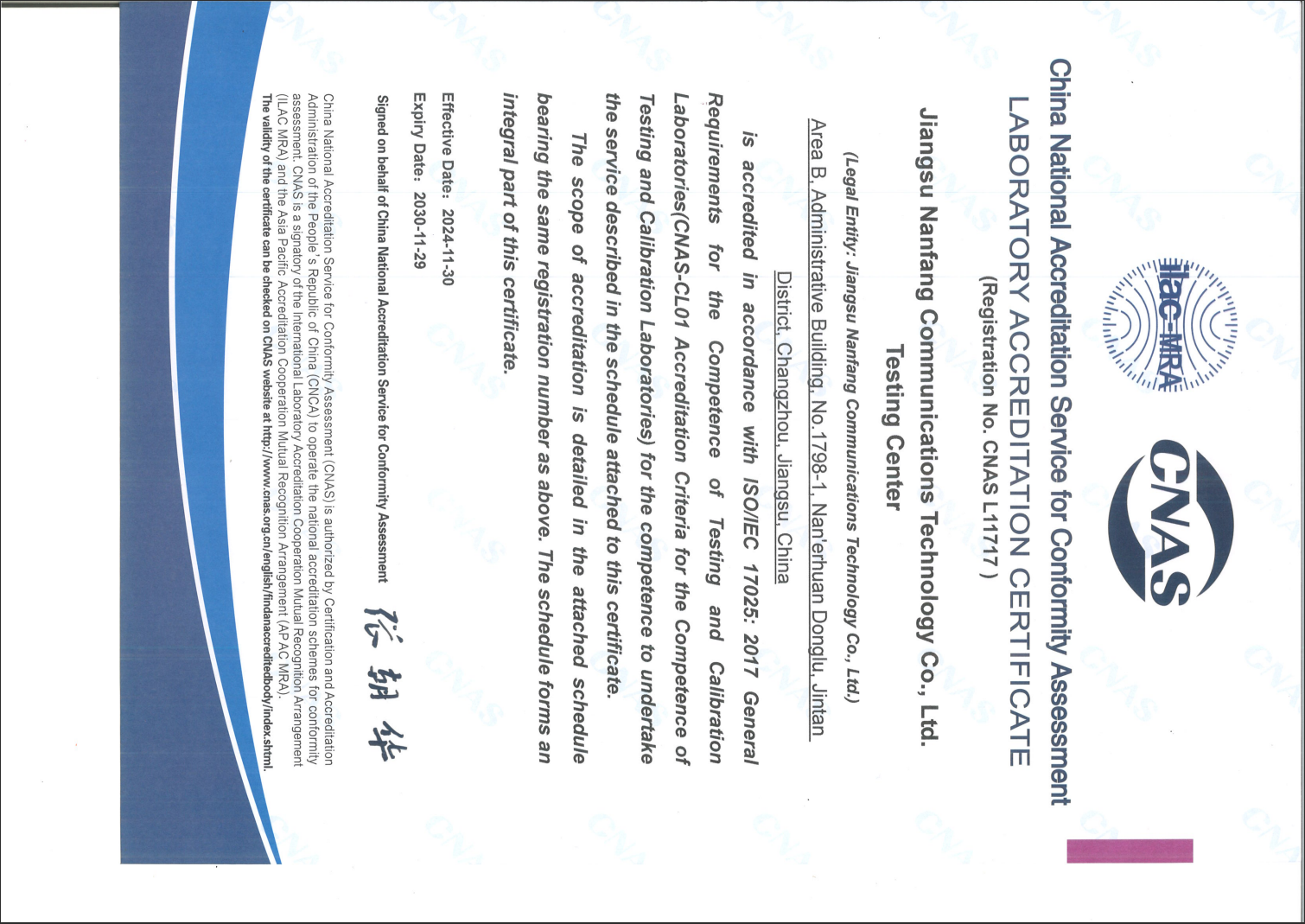
The testing laboratory is accredited to ISO/IEC 17025:2017 as CNAS L11717, covering testing and calibration of optical fiber cable and optical communication components.
Management-system certifications held by the company include ISO 9001 Quality Management System, TL9000 Telecommunications Industry Quality Management System, ISO 14001 Environmental Management System, OHSAS 18001 Occupational Health and Safety Management System, the Integration of Informatization and Industrialization Management System, and ISO 50001 Energy Management System. The laboratory accreditation is CNAS L11717, issued by the China National Accreditation Service for Conformity Assessment to ISO/IEC 17025:2017, valid from 30 November 2024 to 29 November 2030, covering China and global markets.
Corporate titles relevant to a supplier audit include High-tech Enterprise, National-level “Green Factory”, Provincial-level Technology Center, China Well-known Trademark, Jiangsu Private Science and Technology Enterprise, Level III Enterprise for Work Safety Standardization, and Jiangsu “Three-Star Cloud Enterprise”. The company reports over 300 patents, including more than 45 invention patents, and participation in 16 standards (1 national standard, 15 industry standards). Its stated customer base includes China Telecom, China Mobile, China Unicom and China Broadcast Network, plus private-network users in high-speed rail, power grids and chemical industries, supported by 28 provincial-level offices in China.
FAQ
Which certifications should a buyer verify before approving MPO connectivity for a data center project?
Check four layers. First, quality management: ISO 9001 and TL9000 — the TL9000-H certificate for communication optical fiber cable carries certificate number 15/25T15218R11, issued by WIT Assessment, valid from 20 November 2025 to 19 October 2028. Second, environment and safety: ISO 14001:2015 (certificate 62225E20719R0M) and ISO 45001:2018 (certificate 62225S20720R0M), both issued by SWR Certification (Jiangsu) Co., Ltd. Third, energy management: ISO 50001. Fourth, test capability: an accredited laboratory, in this case CNAS L11717 to ISO/IEC 17025:2017, covering testing and calibration of optical fiber cable and optical communication components for China and global markets. Corporate credentials such as High-tech Enterprise and National-level “Green Factory” status are supporting evidence, not substitutes for the product certificates.
Can the optical fiber cable and MPO assemblies be customized for a specific network design?
Yes. Customizable items include core count, fiber type (single-mode, multimode, ribbon or multi-core), sheath material and colour, connector types and cabling schemes, plus labelling and packaging. The manufacturing base is stated at a monthly capacity of 250,000 core kilometres, with a production model covering manufacturing, R&D and testing, engineering design and system integration, and ODM/OEM services. An R&D team of 80 engineers supports configuration changes, and the company states more than 300 patents including over 45 invention patents.
What is the minimum order quantity, and what drives the cost of these products?
The stated minimum order quantity is 1 core kilometre. Cost is driven by model and quantity together with the configuration choices listed above — fiber type, sheath material, connector types, labelling and packaging. No public price list exists for these models, so pricing must be confirmed with the supplier on a per-project basis; the MOQ figure should be treated as the entry threshold for a trial order rather than a standard production quantity.
How can a buyer validate product quality before committing to a full order?
Use a three-part validation. Request samples of the specific models in the intended grade — for example the low-loss MPO-12F-SM adapter below 0.35 dB insertion loss with return loss of at least 50 dB. Measure insertion loss and return loss against the datasheet values rather than against a generic tolerance. Then use MPO loopback adapters (MPO-12F-Loopback or MPO-24F-Loopback) to validate ports and modules before handover. Quality control at the manufacturing stage covers incoming material inspection, in-process control and finished-product testing, including optical loss and attenuation tests, mechanical performance, and waterproof and sealing tests, supported by the CNAS-accredited laboratory scope.
What lead times should be planned for MPO assemblies and optical fiber cable?
Lead time depends on the model and the ordered quantity. Samples and small orders typically take several weeks, while large orders may take months; the manufacturer does not publish a single standard lead time, so it should be confirmed with sales against a specific bill of materials. For planning purposes, treat the lead time as a function of fiber count, connector type, sheath and jacket configuration, and total quantity — all of which are the same variables that drive customization. Buyers who need a firm schedule should request a written confirmation per model and quantity rather than relying on a generic figure.
Conclusion and Next Step
High-density fiber selection reduces to four verifiable questions: how many duplex channels terminate from one MPO interface, what insertion loss and return loss the mated pairs consume, how many mating cycles the panel can survive, and whether the cable upstream supports the route and environmental class. The seven products above answer those questions with published values — 24F and 12F fan-out assemblies at 0.10 dB typical low-loss insertion loss, an MPO-12F-SM adapter at below 0.5 dB standard and 500 mating cycles, loopbacks rated to 100,000 cycles, and a GYTA53 cable certified to TL9000-H, ISO 14001 and ISO 45001.
Request samples, specifications or a quotation
Samples of the MPO-12F-SM adapter, MTP/MPO fan-out pre-terminated cables, MPO/MTP loopbacks and GYTA53 optical fiber cable are available for evaluation. Download the MPO product brochure for full model listings: Nanfang Communication MPO Brochure (PDF).
Nanfang Communication · Jiangsu South Communication Technology Co., Ltd.
Website: https://www.jsnfgroup.com/en.php
Email: info@jsnfgroup.com · Tel: +86 51988792646 · WhatsApp: +8619850287785