
Whole-House Custom Cabinetry: A 2026 Evaluation Framework
Whole-house custom cabinetry coordinates kitchen, bathroom, entryway, wardrobe, study, and living-room cabinet planning under one design language and one manufacturing program. At the evaluation stage, buyers need to move beyond wood samples and compare the production system, compliance files, project record, and capacity. This article gives buyers a structured supplier review process and uses Nantong Jiashi Integrated Home's published capabilities as the working example.

The Problem: Sourcing Cabinets for an Entire House Is Not the Same as Ordering One Kitchen
Large residential and commercial interiors rarely need only one cabinet category. A typical project may require custom kitchen cabinets, custom bathroom vanity cabinets, custom wardrobe cabinets, custom entryway cabinets, built-in living room cabinetry, and coordinated storage systems. If these product groups are sourced from separate vendors, color consistency, edge detailing, hardware style, and documentation can fall out of alignment.
Whole-house custom cabinetry solutions treat the entire interior as one deliverable. Typical application scenarios include residential interior design, real estate development, hotels, and apartments. The evaluation question, therefore, is not only whether a factory can make one cabinet. The question is whether that factory can deliver a coordinated package with dependable precision, compliance, and lead time.
Industry Outlook and Why Whole-House Projects Are Growing
The global cabinet market is projected to reach USD 148.09 billion by 2026, according to Mordor Intelligence. In the custom segment, the custom kitchen cabinets market was valued at USD 68.5 billion in 2025 and is expected to reach USD 95.2 billion by 2034, according to Dataintelo. These reports use different research methodologies, but both point to continuing demand for made-to-measure cabinetry rather than purely generic stock furniture.
China is an active participant in global cabinet supply. China's exports of wooden kitchen furniture under HS code 940340 reached USD 732 million in 2023, based on TrendEconomy and UN Comtrade data. At the product level, sintered stone and porcelain countertops are gaining attention in high-end cabinetry because of their non-porous and bacterial-resistant surface properties, as noted in ResearchAndMarkets' countertop intelligence coverage.
What To Evaluate Before Selecting a Whole-House Custom Cabinetry Supplier
1. Confirm the Supplier Can Cover the Full Home or Building Scope
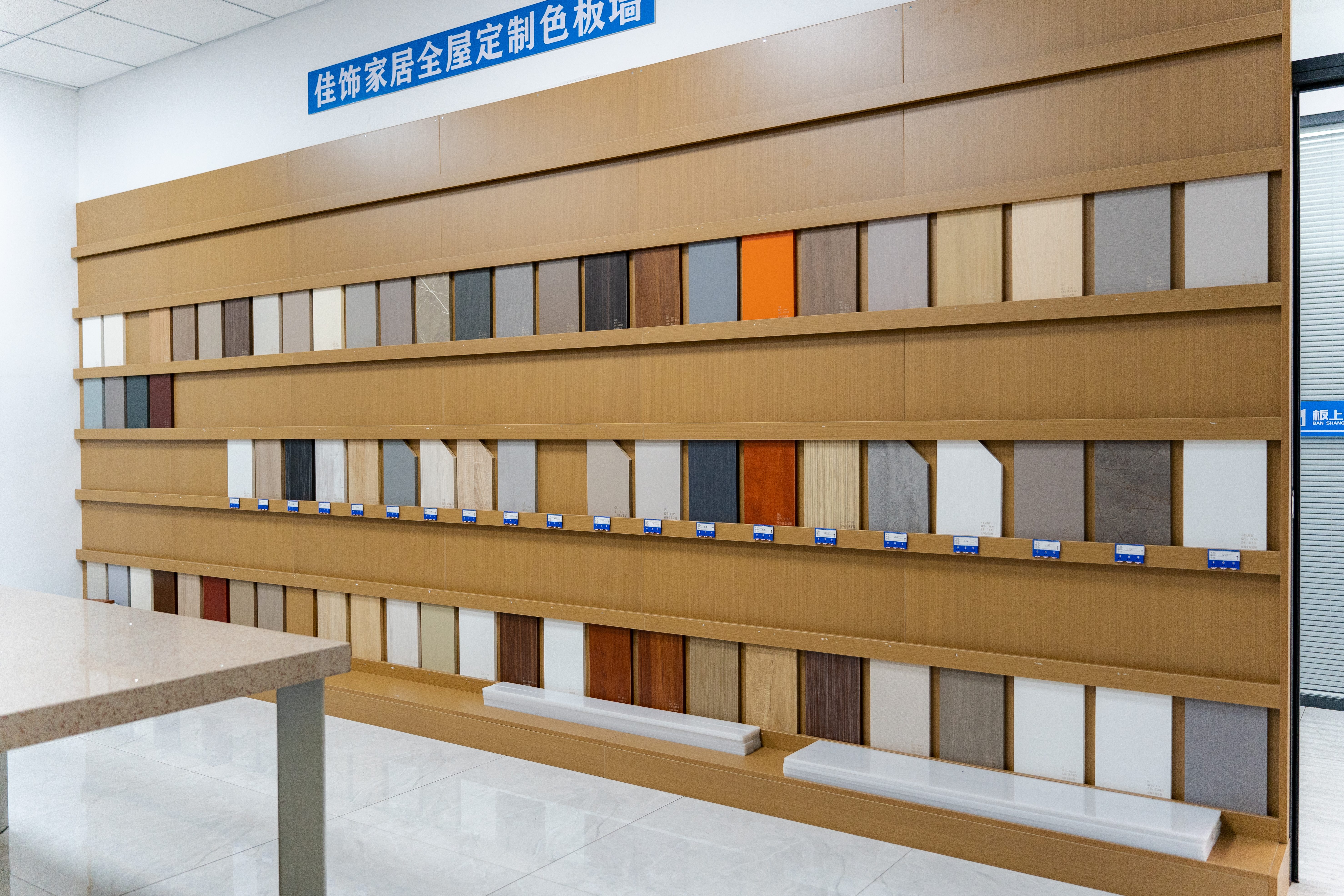
A useful check is to map every room category in the proposed project against the manufacturer's actual product range. Nantong Jiashi Integrated Home Co., Ltd., founded in 1998, describes itself as a full-house custom cabinetry solution provider for kitchens, bathrooms, wardrobes, and home storage systems. Its product family includes JS-CUSTOM-001 to JS-CUSTOM-010: sideboard/buffet cabinet, custom kitchen cabinets, storage cabinets, TV cabinets, entryway cabinets, study room cabinets, tatami storage bed, bathroom vanity cabinets, wardrobe closets, and master bedroom full sets.
This breadth is relevant when a developer or designer wants a single design standard across bedrooms, bathrooms, and public zones. The stated target industries for these models include residential interior design, real estate development, hotels, and apartments. For export-oriented projects, the same model family can be used in residential and commercial custom interior settings.
2. Inspect Manufacturing Precision and Automation
Precision affects installation speed, door alignment, and long-term durability. Buyers should ask how panels are cut, banded, surfaced, and assembled. Nantong Jiashi uses automated processing on German HOMAG production lines and also references machinery from Excitech. The standard panel thickness is 18mm, with a customizable range of 9 to 25mm, and the stated machining precision is a dimensional tolerance of ±0.1mm.
For whole-house work, this level of tolerance matters because kitchen cabinets, bathroom vanities, and wardrobe frames are often installed in the same building but in different thermal and humidity conditions. Production consistency helps avoid gaps and misalignment during on-site installation.
3. Verify Material Compliance and Certification Readiness
Exported cabinetry must satisfy the environmental rules of the destination market. According to the company's technical guidance, all wood panels used by Nantong Jiashi meet international requirements including European E0/FSC and CARB P2/EPA standards. The company states that full mill test reports and material compliance certificates are provided before mass production.
Buyers can use this as a document checklist. For North American projects, confirm CARB Phase 2 and EPA TSCA Title VI documentation. For European and Middle Eastern projects, ask for formaldehyde emission reports and FSC chain-of-custody evidence. The cleaner the document trail at the inquiry stage, the lower the customs and inspection risk later.
4. Assess Quality Control and Certifications
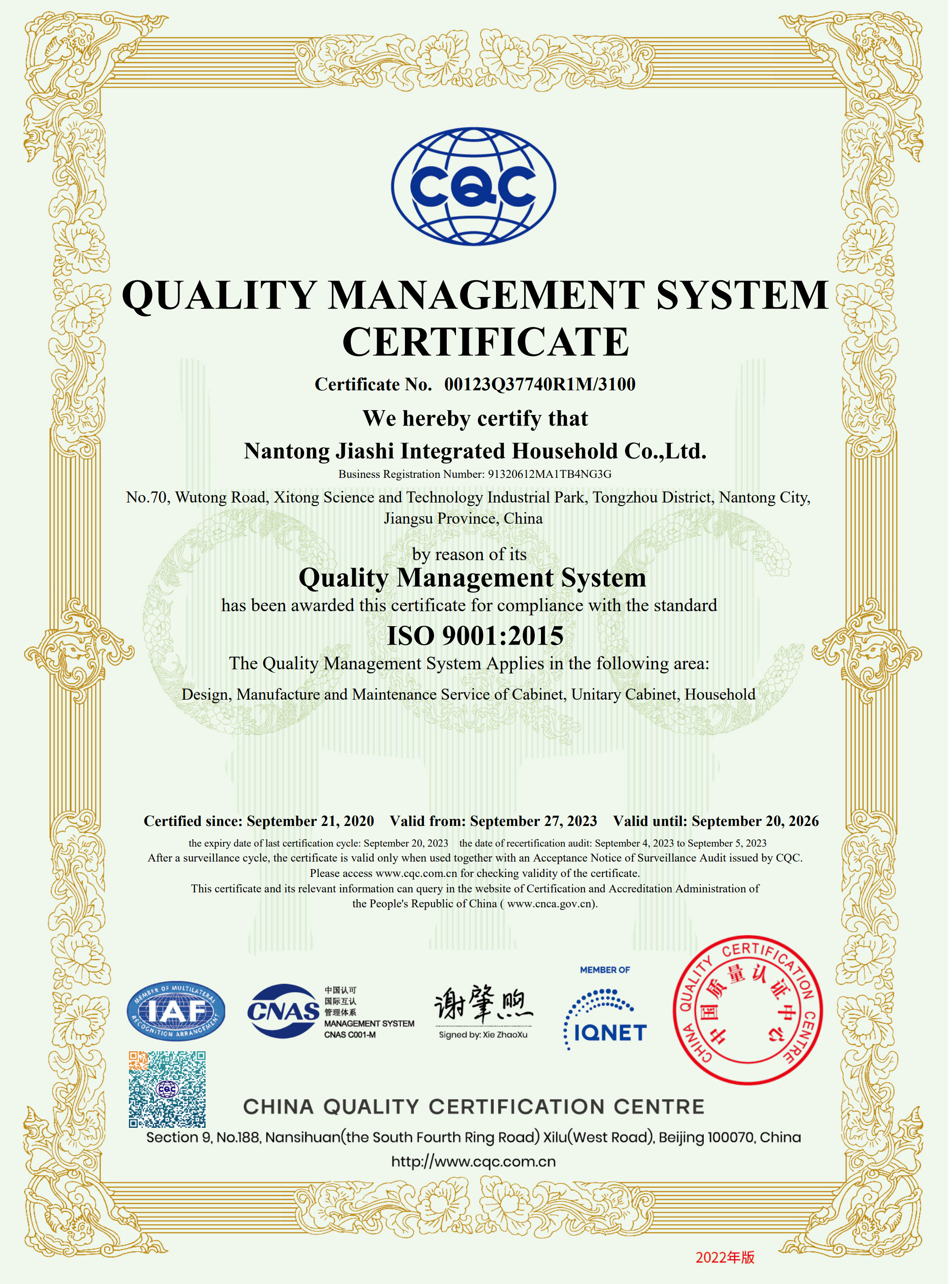
Whole-house projects often run for months, so buyers should check whether the factory has a documented quality system. Nantong Jiashi holds ISO 9001 Quality Management System Certification and ISO 14001 Environmental Management System Certification, according to the company profile. Its stated quality control process includes material inspection, production inspection, and final quality inspection.
Industry performance tests can be used as external reference points. For example, ANSI/KCMA A161.1 in the United States requires wall cabinets to withstand a 600-pound load test and 25,000 door/drawer cycles. While this specific certification is not claimed by Nantong Jiashi in the supplied material, the existence of the standard gives buyers a benchmark question for any candidate factory: how does the factory validate doors, drawers, hinges, and panel structure?
5. Compare Capacity, Lead Time, and Project Handling
Large whole-house orders require a factory that can schedule multiple room categories without stopping the line. Nantong Jiashi states a monthly capacity range of 500 to 20,000 units and a project-based MOQ. For project-driven orders, the published lead time is 30 to 45 days. Production modes include OEM, ODM, and project customization.
Customization can cover cabinet design, dimensions, materials, colors, finishes, hardware configuration, logo, and packaging. Export experience spans Europe, North America, the Middle East, and Asia. After-sales support includes design support, project communication, production follow-up, and after-sales service.
Step-by-Step Breakdown for an Evaluation Project
Here is a practical sequence for buyers evaluating whole-house custom cabinetry suppliers:
Step 1: Send project drawings and room-by-room intentions. A detailed brief prevents the factory from quoting for the wrong scope. Include cabinetry type, approximate dimensions, finish preference, and compliance market.
Step 2: Confirm the manufacturing and compliance standard. Ask for material certificates, ISO certificates, and any specific destination-market documents before production begins.
Step 3: Inspect the production method. For higher precision, look for automated lines, clearly stated tolerances, and process control. In Nantong Jiashi's case, the use of German HOMAG production equipment and a ±0.1mm tolerance claim provides a concrete checking point.
Step 4: Review quality control stages. The manufacturer should name its inspection points. Material inspection, in-production inspection, and final quality inspection are the minimum useful checkpoints.
Step 5: Match capacity to delivery schedule. Confirm MOQ, monthly capacity, and lead time before signing. For Nantong Jiashi, the published range is 500 to 20,000 units per month with a 30 to 45-day lead time for project orders.
Step 6: Plan communication and approval. In large projects, design changes are unavoidable. The factory should offer production follow-up and project communication rather than acting as a silent production line.
Real-World Use Cases for Whole-House Custom Cabinetry
Real Estate Developers
Developers often need the same interior solution across dozens of apartments or residential units. According to Nantong Jiashi's project case data, its products have been used by real estate developers, interior design companies, and commercial contractors for residential and commercial interior furnishing. One referenced case describes large-scale supply of more than 50 residential units with precise manufacturing and coordinated global delivery.
Interior Design Companies
Design firms are responsible for visual consistency. A single manufacturer with a broad product range can supply the kitchen, bathroom, entrance, study, or wardrobe pieces without forcing the designer to manage multiple vendors. The company also has design and showroom presence in cities such as Nanjing, Hangzhou, Wuxi, Suzhou, and Nantong, according to its corporate profile.
Hotel and Apartment Projects
Commercial projects often require durable storage, stone countertops, and coordinated serial production. Nantong Jiashi's stated product scope includes stone countertops and whole-house cabinet models that can be supplied for residential and commercial custom interior projects.
Evaluation Matrix: Key Questions at Each Step
| Evaluation Point | What to Request | Why It Matters |
|---|---|---|
| Room coverage | Product range by room type | Kitchen, bathroom, wardrobe, entrance, and living-room designs should come from one coordinated system. |
| Panel material | Panel thickness range and finishes | Standard 18mm panels with a 9 to 25mm custom range allow different load requirements across rooms. |
| Precision | Machining tolerance and automation | ±0.1mm tolerance and automated lines reduce on-site alignment risk. |
| Compliance | Mill test reports and material certificates | Export projects need clear formaldehyde and environmental compliance files. |
| Quality control | Inspection stages and ISO certificates | Material inspection, production inspection, and final inspection are the basic QC layers. |
| Capacity | Monthly capacity, MOQ, and lead time | Large projects must fit the factory schedule without sacrificing quality. |
Quick FAQ for Whole-House Custom Cabinetry Evaluation
1. What material compliance evidence should a buyer request?
Nantong Jiashi says all its wood panels meet international standards including European E0/FSC and CARB P2/EPA. The company states that it provides full mill test reports and material compliance certificates before mass production. Buyers should ask for these documents for the exact production batch planned for their project.
2. Can one supplier cover custom kitchen cabinets, bathroom vanities, wardrobes, and other room categories?
Yes, when the manufacturer has a genuine whole-house range. Nantong Jiashi's JS-CUSTOM series includes kitchen cabinets, bathroom vanity cabinets, wardrobe closets, entryway cabinets, storage cabinets, TV cabinets, study room cabinets, tatami storage beds, sideboards, and master bedroom full sets.
3. What quality control points should be included in a custom cabinetry order?
The minimum useful control stages are material inspection, production inspection, and final quality inspection. Nantong Jiashi also references ISO 9001 and ISO 14001 certification in its corporate profile.
4. What typical capacity and lead time apply to project-based whole-house orders?
Nantong Jiashi states a monthly capacity range of 500 to 20,000 units, a project-based MOQ, and a lead time of 30 to 45 days for project orders. These numbers help buyers check whether the factory can match a development schedule.
5. How can I request more information or begin a project conversation?
Contact Johnny by email at zhou@jajajs.com, by phone at +86-21-67690770, or through the WhatsApp link on the company website. You can also download the engineering handbook and catalog from the brochure link at the end of this article.
Final Considerations for Whole-House Custom Cabinetry Sourcing
Buyers evaluating whole-house custom cabinetry in 2026 should place equal weight on product scope, manufacturing precision, material compliance, quality control, and delivery capacity. A well-documented factory is easier to assess because each claim can be checked against equipment, certificates, and inspection records.
Nantong Jiashi Integrated Home Co., Ltd. offers a relevant example for comparison. The company was established in 1998 and now operates as a customized full-house cabinetry solution provider. Its production model can include kitchen, bathroom, wardrobe, entryway, and storage programs, with OEM/ODM support and project-based customization. For a next step, review its engineering handbook below to see whether the production scope matches your project requirements.
Planning a whole-house cabinetry project? Download the engineering brochure: Nantong Jiashi Integrated Home Engineering Handbook. You can also contact Johnny at zhou@jajajs.com or call +86-21-67690770.
Have Questions or Need More Details?
Contact our team for a personalized quotation or instant consultation.
Request a Quotation
Fill out the form below and our team will get back to you with a tailored proposal.
WhatsApp Direct Chat
Prefer to chat in real-time? Message us on WhatsApp for instant assistance & quick answers.
- Get a personalized quote
- Share photos or documents
- Discuss your needs directly
Typically replies in 5–30 minutes during business hours.