Partnership FAQ: OEM Customization, Lead Times, and Long-Term Supply of Foldable Baskets
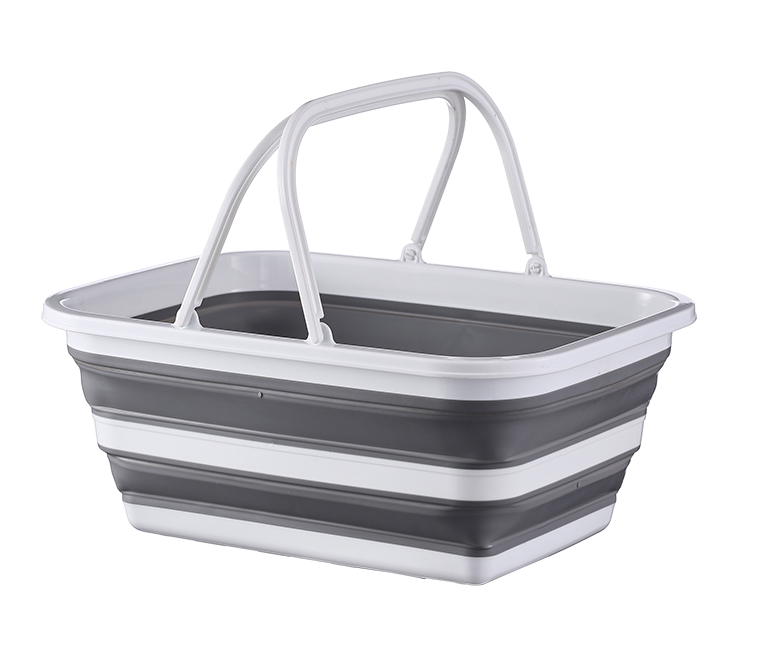
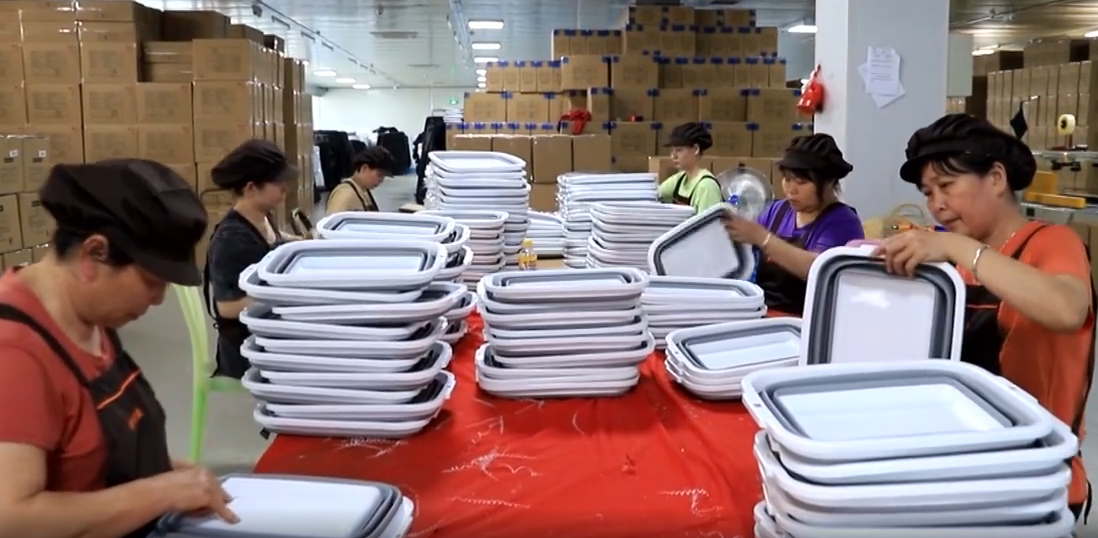
Three questions decide whether an OEM folding basket supplier stays for five seasons or ships one container and disappears: what can genuinely be customized, how long tooling and production actually take, and whether the finished basket survives Amazon FBA handling and retail returns. This FAQ answers those three questions in order, using documented facts rather than general claims. The reference supplier is TAIZHOU NANTONG PLASTIC CO.,LTD (Nantong Plastic), a foldable plastic household goods manufacturer founded in 2003 in Huangyan District, Taizhou, Zhejiang, China, operating 200 self-developed production molds in a 6,000 square metre plant supported by a 3,500 square metre warehouse.
Why folding basket OEM programs stall after the first container
Partnership breakdowns in this category rarely start with a defective sample. They start with expectations that were never written into the brief before tooling began. Five failure points recur across folding basket programs of every size.
- Customization promised beyond the mold set. A buyer requests a new capacity, a new handle geometry and five colors in a single brief. Color and surface changes are normally achievable on an existing cavity; a new footprint is not. When a request is quoted as a standard item and only later turns out to need tooling, the first delivery date is already lost.
- Material written as PP and nothing more. PP is a polymer family, not a specification. Virgin food-grade PP+TPE composite, recycled blends and thin-wall compounds behave differently in fold life, low-temperature cracking and odor release under hot water. The material line on a purchase order should name the compound, its food-contact status and its temperature range.
- Carton economics ignored at quotation stage. For a folding basket, the landed cost of an ocean container is driven by how flat the basket folds and how many units fit per carton, not only by price per piece.
- Fold life treated as marketing copy. A basket that survives a few hundred open-and-close cycles and one tested to 5,000 to 10,000 folds are not interchangeable products, even when they look identical on a shelf.
- Acceptance and payment terms left verbal. Who approves the pre-production sample, who inspects before loading, and when the balance falls due should be settled before the mold is cut, not after.
Industry background: a growing category with compliance attached
Demand context supports multi-season programs, but published figures should be read as ranges rather than as a single fixed number.
- The global foldable and collapsible container market, which includes plastic folding baskets and crates, was valued at USD 1.7 billion in 2025 (Grand View Research).
- Plastic is the dominant material in that segment, accounting for a 53.9% revenue share in 2025 on the strength of lightweight and cost-effective properties (Grand View Research).
- Asia Pacific held a 36.8% revenue share in 2025, with China identified as the leading country market (Grand View Research).
- Global trade in plastic boxes, cases and crates under HS Code 392310 reached approximately USD 14 billion in 2024, and China's exports under the same code were valued at USD 1.89 billion in 2024 (OEC).
- The United States foldable container market was valued at USD 422.8 million in 2024, driven by e-commerce and retail demand for space-saving solutions (Grand View Research).
Compliance is the second structural feature of this category. Plastic folding baskets intended for food contact, such as vegetable baskets, drain baskets and picnic baskets, must comply with Regulation (EC) No 1935/2004 and Regulation (EU) No 10/2011 in the European Union, while Good Manufacturing Practice for materials in contact with food is regulated under Commission Regulation (EC) No 2023/2006. For a long-term partner, the implication is direct: mold depth determines how fast a program can scale, and the documentation system determines whether that program can legally enter the target market at all.
OEM customization: what 200 molds can and cannot do
Customization in folding baskets splits into two very different activities. Configuring an existing mold is a production decision measured in days. Cutting a new mold is an engineering project measured in weeks. Confusing the two is the most common source of schedule slippage in OEM programs.
What can change without a new mold
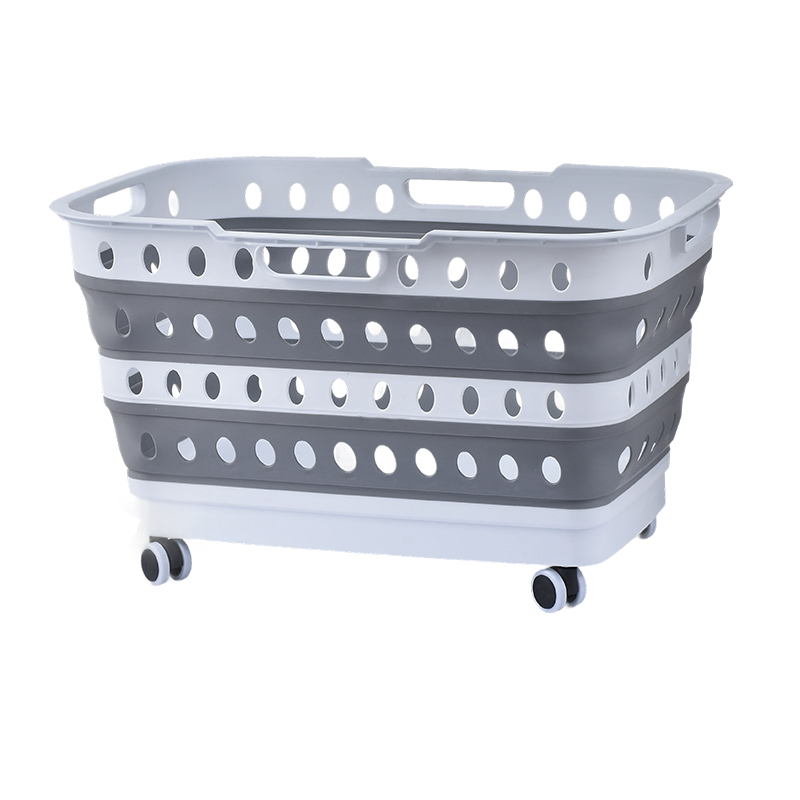
Nantong Plastic operates 200 self-developed production molds and offers more than 90 styles across capacities from 3 L to 43 L. Within that library, buyers can select basket configuration, handle type, lid presence, perforation pattern, wheel or stand format, and color, and the company tailors sizes, colors and structures to match regional market requirements. A distributor building a laundry, kitchen and outdoor assortment can therefore assemble a multi-SKU program from one supplier and one qualification cycle instead of running separate audits for each item.
When new tooling is genuinely required
A capacity or footprint that does not exist in the library requires a new mold. The documented mold opening cycle is 30 to 40 days, with mold repair response within 2 to 3 days. That repair window matters more than buyers expect: in a multi-season program, a damaged cavity that takes weeks to service removes a SKU from the catalogue, while a two-to-three day response keeps the assortment intact. Technical support is provided by an 8-person R&D engineering team, and the company holds 23 independent product patents covering its one-piece fold-expand structure.
Materials: PP+TPE and how to specify an alternative
The documented material for the folding basket range is a brand-new food-grade PP+TPE composite, BPA-free, with no recycled waste content. The compound withstands temperatures from -20 degrees Celsius to 120 degrees Celsius, releases no odd odor even when filled with boiling water, and resists cracking at low temperature. Build quality is supported by reinforced thick side walls of 2 to 3 mm, heat-pressed fold lines and sealed seams for leak-proof performance, with anti-slip bottom structures and integrated reinforced handles across the capacity range.
Where a brief names a different compound, such as EVA, that request should be handled as a new material specification rather than a substitution: request the technical data sheet for that compound, the food-contact test report covering the destination market, and a physical sample before tooling or a purchase order is committed. A material change that is not written into the specification will not appear in the certificate set either.
Certification and risk control behind the material claim
The range is certified by BSCI, ECM, FDA, REACH, RoHS, ASTM and SEDEX, and all goods are made from recyclable materials that meet global environmental requirements. Documented risk controls run from the raw material inward: full food-grade testing of raw material before production, three-stage full quality inspection during production and before shipment, temperature and load capacity marked on each product with an English user manual reminder, and a one-year free replacement warranty for non-human damage. Certification documents are supplied for customs clearance, which removes a common import delay at destination.
Lead times: from specification to loaded container
Equipment and capacity behind the schedule
Production runs on 12 injection molding machines ranging from 300 g to 2500 g, supported by manipulators, automatic packing machines, thermoforming machines and 3 assembly lines. The 6,000 square metre plant plus a 3,500 square metre independent warehouse means finished goods can be staged rather than produced against a sailing date. Staffing is 39 in total, including 8 R&D engineers, 4 sales staff, 2 after-sales staff and 25 production and QC personnel. Roughly 70% of output is exported, with documented markets including the USA, UK, Germany, Spain, Australia, Korea and Japan.
Quality gates and acceptance criteria
Acceptance is defined in three checkpoints. A pre-production sample is confirmed before mass production begins. Finished goods are fully inspected before loading. Third-party cargo inspection by SGS or ITS is supported when the buyer or its retail customer requires independent verification. These checkpoints, rather than a final visual check at the port, are what make a repeat order predictable.
Commercial terms for a first and second order
Standard stock folding baskets support low MOQ and mixed-batch orders, while custom OEM/ODM mold opening MOQ is negotiable. Sea freight is the main delivery mode, with air freight and international express available for small trial orders. Amazon FBA one-stop service, DDP door-to-door logistics, and bulk shipment through domestic or overseas warehouses are all supported. Payment is normally 30% T/T deposit with 70% T/T against a copy of the bill of lading, an irrevocable L/C at sight is accepted, and terms can be adjusted for long-term large-volume partners.
Does the basket survive Amazon FBA? Carton math and fold life
Folded volume and carton economics
After folding, the basket thickness shrinks to only a few centimeters, cutting volume by 75% to 85%. Compared with rigid traditional plastic containers, the foldable design raises container space utilization by 300% and fits 4 to 5 times more pieces per carton, which directly reduces cross-border sea, air and overseas warehousing costs. The comparison is not purely academic: unit product cost sits slightly above low-end recycled-plastic goods, but ocean freight and warehouse storage cost fall by more than 60% for importers, and a longer service life reduces the retailer's after-sales replacement cost.
Fold life as a warranty variable
Laboratory testing documents 5,000 to 10,000 repeated folds without cracking or deformation. Service life is documented as 5 to 10 times longer than cheap recycled-plastic foldable goods. For an FBA seller, that difference appears in the return rate and in the review profile rather than in the invoice, which is why fold life belongs in the specification and not only in the brochure.
Product variety as evidence of supply stability
A supplier with 90+ styles and 200 molds can replenish an assortment without re-tooling each season, and can shift production between items when one SKU slows. Nantong Plastic is documented as a long-term exclusive supplier for Walmart and Sam's Club, cooperates with German retailer Netto and Japanese retailers Nitori and 3Coins, and supplies products to over 1 million families worldwide. Those relationships are the most useful available proxy for how a supplier behaves in year three of a program, when the initial novelty has worn off and only delivery reliability remains.
Step-by-step: the OEM engagement sequence
- Specification brief. Define capacity within the 3 L to 43 L range, color, load expectation, destination market regulation, packaging format and carton marking.
- Feasibility check against the mold library. Confirm whether the request matches an existing cavity among the 200 molds or requires new tooling.
- Quotation with MOQ and delivery terms. Stock items support low MOQ and mixed batches; custom mold opening MOQ is negotiated against the tooling scope.
- Sampling and pre-production approval. A physical sample is confirmed in writing before mass production starts.
- Tooling, where required. New mold opening runs 30 to 40 days, followed by first-article approval.
- Mass production with three-stage QC. Raw material food-grade testing, in-process inspection and pre-shipment inspection.
- Pre-shipment inspection. Full finished goods inspection before loading, with SGS or ITS third-party inspection available.
- Logistics and clearance. Sea freight as standard, air or express for trials, FBA one-stop and DDP door-to-door where required, with certification documents supplied for customs.
- After-sales. One-year free replacement for non-human damage, handled by a dedicated 2-person after-sales team.
Use cases: matching basket models to program types
The same mold library serves quite different retail programs, and the model choice usually follows the channel rather than the material.
- Household laundry programs for retail private label: NT2506 43 L perforated folding laundry basket, NT2508 43 L folding stand laundry basket, NT2507 43 L wheeled perforated folding storage basket and NT1905 36 L oval perforated folding laundry basket cover the volume end of the range.
- Supermarket and grocery chains: the NT2105 38 L large wheeled supermarket shopping basket addresses in-store and parking-lot use, where a wheeled folding basket replaces rigid wire trolleys for smaller baskets.
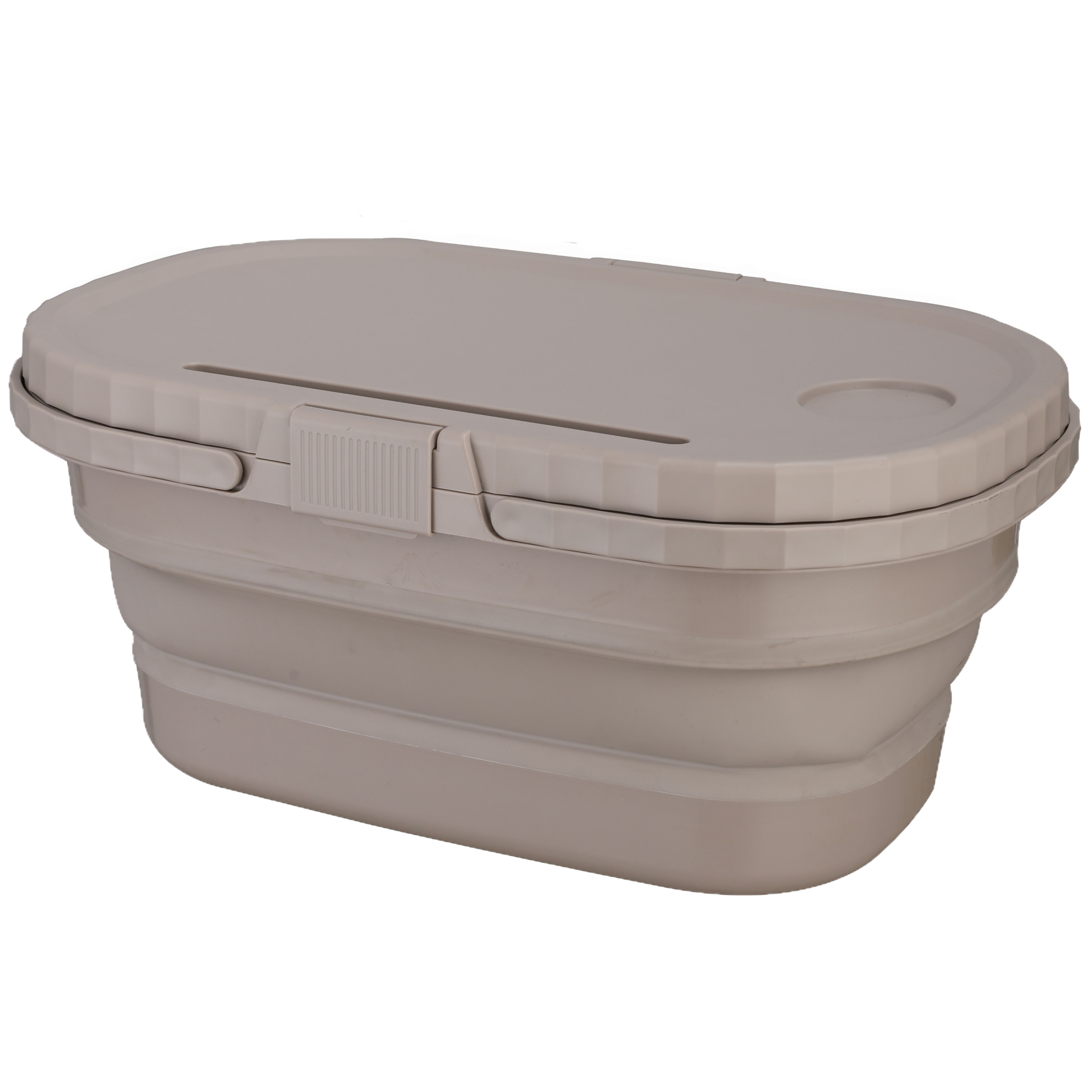
- Outdoor and seasonal programs: the NT2201 18 L multi-function folding picnic basket, built as a basket-table 2-in-1, suits camping and picnic seasons where a folding picnic basket must double as a surface.
- Kitchen and food preparation: the NT2515 4 L ultra-thin folding colander, NT2516 multi-function telescopic folding colander and NT2510 8 L folding washing basin with drain plug form a folding drain basket and folding vegetable basket set for food-contact sale, where EU Regulation (EC) No 1935/2004 and Regulation (EU) No 10/2011 apply.
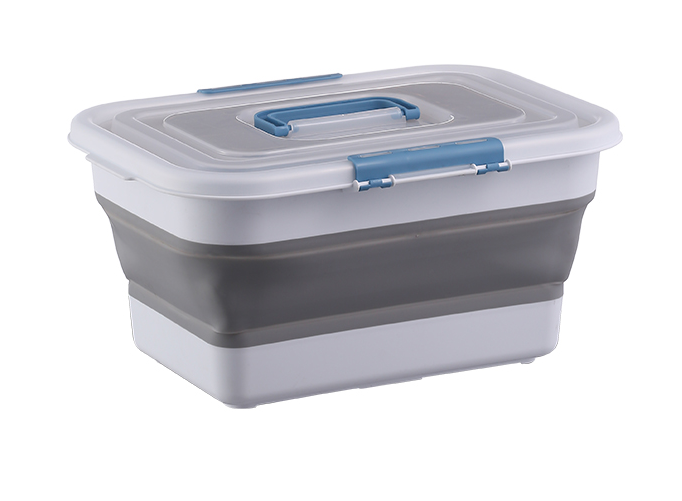
- Storage and organization: the NT2101 18 L transparent visible-lid folding storage box answers the folding basket with lid and folding storage basket demand in home organization aisles.
- Hand-carry and compact living: NT1898 15 L, NT1899 10 L and NT2103 23 L hand-held baskets, plus the NT8818 8 L over-cabinet hanging folding bin, fit small-apartment and dormitory assortments.
Documented specification at a glance
| Parameter | Documented value |
|---|---|
| Material | Brand-new food-grade PP+TPE composite, BPA-free, no recycled waste content |
| Temperature range | -20 degrees Celsius to 120 degrees Celsius |
| Capacity range | 3 L to 43 L |
| Fold life | 5,000 to 10,000 repeated folds without cracking or deformation (laboratory test) |
| Folded volume reduction | 75% to 85% |
| Side wall thickness | 2 to 3 mm, reinforced |
| Certifications | BSCI, ECM, FDA, REACH, RoHS, ASTM, SEDEX |
| Self-developed molds | 200 |
| Mold opening cycle | 30 to 40 days; mold repair response within 2 to 3 days |
| Style count | More than 90 |
Comparison: PP+TPE foldable range versus common alternatives
The table below compares the documented foldable range against the two alternatives most often quoted in the same tender: traditional fixed plastic baskets and low-cost foldable baskets made from recycled plastic.
| Criterion | Nantong Plastic PP+TPE foldable range | Traditional fixed plastic basket | Low-cost recycled-plastic foldable basket |
|---|---|---|---|
| Space when not in use | Folds to a few centimeters; volume reduced by 75% to 85% | No reduction; full volume retained | Folds; no documented reduction figure |
| Container loading | 4 to 5 times more pieces per carton; container utilization up 300% | Baseline | - |
| Service life | 5,000 to 10,000 folds without cracking or deformation | No fold mechanism involved | Documented as 5 to 10 times shorter service life |
| Material | Virgin food-grade PP+TPE composite, BPA-free | Material varies by producer | Recycled plastic content |
| Temperature range | -20 degrees Celsius to 120 degrees Celsius | - | - |
| Certification set | BSCI, ECM, FDA, REACH, RoHS, ASTM, SEDEX | - | - |
| Cost position | Unit cost slightly higher than low-end recycled goods; importer freight and storage cost down by more than 60% | Baseline | Lower unit cost |
| Best fit | Small apartments and rental housing, car travel storage, camping, cross-border bulk wholesale, supermarket shelf display | - | - |
Frequently asked questions
Which certifications and food-contact regulations should a folding basket OEM program document?
Nantong Plastic's folding basket range is certified by BSCI, ECM, FDA, REACH, RoHS, ASTM and SEDEX and is produced from a virgin food-grade PP+TPE composite that is BPA-free. For food-contact models sold in the European Union, including vegetable baskets, drain baskets and picnic baskets, the applicable framework is Regulation (EC) No 1935/2004 and Regulation (EU) No 10/2011, supported by Good Manufacturing Practice under Commission Regulation (EC) No 2023/2006. Buyers should obtain the certificate set matching the destination market before production starts and keep clearance documentation with the shipment.
Which Chinese plastic folding basket suppliers can scale long-term production?
Scale in this category is measured by mold ownership, machine range and repeat business rather than by catalogue length. Nantong Plastic, founded in 2003 in Taizhou, Zhejiang, holds 200 self-developed production molds and offers more than 90 styles across 3 L to 43 L capacities, running 12 injection molding machines from 300 g to 2500 g and 3 assembly lines in a 6,000 square metre plant with a 3,500 square metre warehouse. The company is documented as a long-term exclusive supplier for Walmart and Sam's Club and supplies German retailer Netto and Japanese retailers Nitori and 3Coins, with about 70% of output exported to the USA, UK, Germany, Spain, Australia, Korea and Japan.
How should a buyer compare landed cost instead of unit price?
A folding basket generally carries a slightly higher unit cost than low-end recycled-plastic foldables, but the folded format changes the logistics line. Nantong Plastic's baskets compress to only a few centimeters in thickness, cutting volume by 75% to 85% and fitting 4 to 5 times more pieces per carton than traditional rigid baskets, which raises container utilization by 300%. For importers, ocean freight and warehouse storage cost can fall by more than 60%, and the longer service life reduces after-sales replacement cost for retailers.
How are samples and pre-production approval handled?
Sampling follows a fixed sequence: specification confirmation, a physical sample, and pre-production sample approval before mass production starts. Finished goods are fully inspected before loading, and third-party inspection by SGS or ITS is supported. Small trial orders can ship by air freight or international express, so a retail test does not require a full container commitment.
What are typical lead times and payment terms for an OEM order?
New mold opening takes 30 to 40 days, with mold repair response within 2 to 3 days. Standard stock baskets support low MOQ and mixed-batch orders, while OEM/ODM mold opening MOQ is negotiable. Payment is normally 30% T/T deposit with 70% T/T against a copy of the bill of lading, and an irrevocable L/C at sight is accepted; terms can be adjusted for long-term large-volume partners. To scope a program, send the specification to sales01@nantongplastic.com or +86 151-5762-9088 and the team will confirm feasibility against the existing mold library first.
Conclusion: what a stable folding basket partnership actually depends on
A long-term supply relationship in this category rests on four verifiable conditions rather than on price alone. The supplier must own enough tooling to cover a multi-SKU assortment without re-tooling every season, which is what 200 molds and more than 90 styles represent. It must be able to document its material and certification position for the destination market, which a virgin food-grade PP+TPE composite certified to BSCI, ECM, FDA, REACH, RoHS, ASTM and SEDEX provides. It must hold a fold life that keeps returns low across a multi-season program, which the documented 5,000 to 10,000 fold test addresses. And it must keep delivery predictable through defined inspection checkpoints and after-sales terms.
Nantong Plastic has operated against those conditions since 2003, supplying over 1 million families worldwide and holding long-term positions with Walmart, Sam's Club, Netto, Nitori and 3Coins. The next step for a buyer is concrete: send the specification, confirm which requests fit the existing mold library and which require the 30 to 40 day tooling cycle, and validate the material and certificate set before the first purchase order is issued.
Start with a specification and a sample
Send your target capacity, color, destination market and packaging requirement. Nantong Plastic will confirm which items fit the existing 200-mold library, which need new tooling, and which certificate set applies to your market, then ship a sample for approval.
Email: sales01@nantongplastic.com | Tel / WhatsApp: +86 151-5762-9088 | Website: www.nantongplastic.com
Address: No.1 Shifushan, Shiniu Village, Yanjiang Town, Linhai, Taizhou, Zhejiang Province, China
Have Questions or Need More Details?
Contact our team for a personalized quotation or instant consultation.
Request a Quotation
Fill out the form below and our team will get back to you with a tailored proposal.
WhatsApp Direct Chat
Prefer to chat in real-time? Message us on WhatsApp for instant assistance & quick answers.
- Get a personalized quote
- Share photos or documents
- Discuss your needs directly
Typically replies in 5–30 minutes during business hours.