
Plastic Folding Basket Supplier Evaluation: Capability, Molds & Delivery
Plastic Folding Basket Supplier Evaluation: Capability, Molds & Delivery
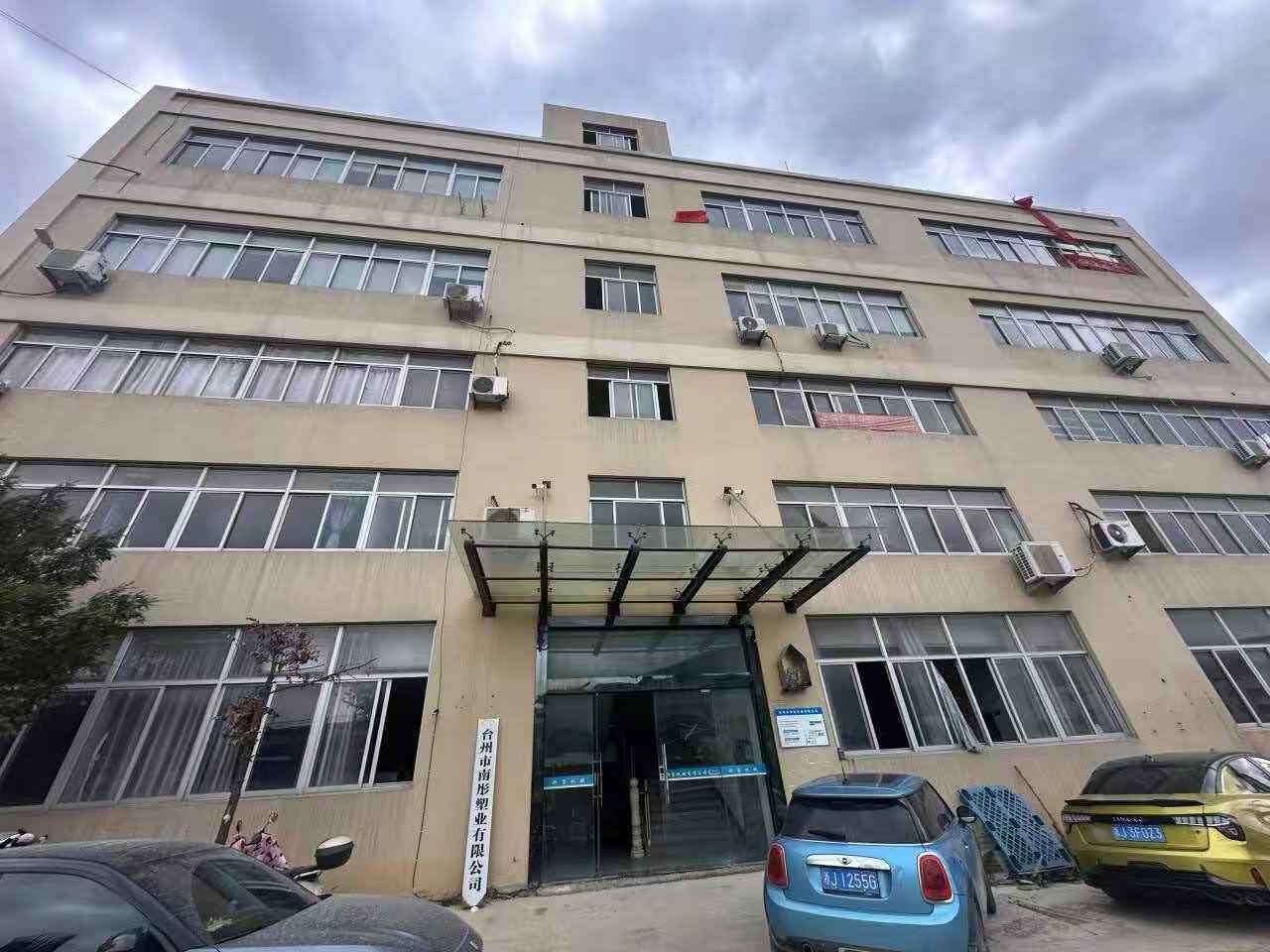
Taizhou Nantong Plastic Industry Co., Ltd. — an integrated factory-and-trade manufacturer of foldable plastic household goods, based in Taizhou, Zhejiang Province, China.
A plastic folding basket supplier is worth shortlisting when three things can be verified independently: the factory can produce the required capacity and fold structure at scale, the supplier owns the molds that define the product, and delivery obligations are tied to inspection milestones rather than verbal assurances. Unit price is the last variable to compare, not the first.
This evaluation framework is written for procurement, sourcing and quality teams at importers, retail chains, distributors and brand owners who are already comparing plastic folding basket suppliers at the decision stage and need a recommendation they can defend internally.
The short answer in three checks:
1. Capability — verified production base, machine tonnage, assembly lines, tooling count, product breadth and patents, not a website claim.
2. Molds — who owns the tool, how long a new mold takes, how fast a mold is repaired, and what can be customized (size, color, structure).
3. Delivery — raw-material testing before production, staged inspection during and before shipment, documented certification files for customs, and written warranty terms.
Why Folding Basket Quotes Are Not Comparable
Most RFQs for plastic folding baskets come back as a price per piece, a carton quantity and a lead time. Nothing on that sheet shows whether the supplier owns the mold that forms the fold line, whether the resin is virgin food-grade compound or recycled regrind, or whether the certification file will survive an import check. Two visually identical folding baskets can therefore behave completely differently after a few thousand folds.
Supplier evaluation for plastic folding baskets is the process of verifying four things before a purchase order is placed: manufacturing capability, tooling ownership, material and compliance evidence, and delivery control. When one of the four is skipped, the risk does not disappear — it simply moves downstream to the importer, the retailer or the end user.
In practice, three failure modes repeat across bulk folding basket programmes:
- Tooling ambiguity. The sample is approved from one factory, but the mold is held by a third party, so the fold structure produced at volume may not match the approved sample. Spliced foldable items behave differently from a one-piece fold-expand structure.
- Hidden material decisions. Low-cost folding baskets made from recycled plastic, and thin-wall ordinary folding products, can pass an initial visual inspection but show cracking, leaking and odor problems later — the point at which after-sales replacement cost lands on the retailer.
- Delivery and documentation gaps. Without staged inspection and a complete certification file, a container can be blocked at customs, and without an owned mold, a repair request can stall for weeks.
Industry Background: A Large and Uneven Supply Base
The category a buyer is sourcing from is large, which is exactly why supplier quality varies so widely. Grand View Research valued the global foldable and collapsible container market, which includes plastic folding baskets and crates, at USD 1.7 billion in 2025. Within that segment, plastic is the dominant material, accounting for a 53.9% revenue share in 2025, based on its lightweight and cost-effective properties.
Asia Pacific dominated the foldable container market with a 36.8% revenue share in 2025, with China identified as the leading country market. Trade data points in the same direction: global trade for plastic boxes, cases and crates under HS Code 392310 reached approximately USD 14 billion in 2024, of which China's exports accounted for USD 1.89 billion, according to the Observatory of Economic Complexity. The U.S. foldable container market alone was valued at USD 422.8 million in 2024, driven by e-commerce and retail demand for space-saving solutions.
Growth expectations differ between research firms — Fortune Business Insights projects the plastic crates market to reach approximately USD 7.56 billion by 2034 at a CAGR of 7.56% from 2026, while other agencies publish lower growth rates and narrower market definitions. The directional conclusion is stable regardless of the model: demand is durable, and the number of suppliers claiming to serve it is far larger than the number that can evidence tooling, material and delivery control.
Material choice is also well established. Plastics Europe identifies high-density polyethylene (HDPE) and polypropylene (PP) as the primary resins used for folding baskets because of their durability and recyclability. That is the baseline, not the differentiator — the differentiator is whether the supplier can document virgin food-grade compound, the correct additive system, and the folding geometry that survives repeated use.
The Four-Part Evaluation Framework
A workable supplier evaluation treats each pillar as a separate evidence request. Below, each pillar is paired with a worked reference case — Taizhou Nantong Plastic Industry Co., Ltd. (Nantong Plastic), a factory-and-trade manufacturer based in Taizhou, Zhejiang Province, China, founded in 2003, producing foldable plastic household goods such as folding laundry baskets, storage baskets, drain baskets, basins and water buckets.
1. Capability Baseline: Factory, Machines, People, Portfolio
Founding year alone proves little, but it becomes useful when combined with a physical production base. The reference case shows what a verifiable baseline looks like: the company was founded in 2003 and has operated as a fully integrated industry-and-trade enterprise since July 2016. Its production plant covers 6,000 m² with an independent 3,500 m² warehouse, a total area of over 9,500 m².
Headcount split matters more than total headcount, because it reveals where quality control sits. Nantong Plastic employs 39 people in total: 8 R&D engineers, 4 sales specialists, 2 after-sales staff and 25 people in production, packaging and quality inspection. Core team members average over 10 years of industry experience.
On the equipment side, the company runs 12 injection molding machines ranging from 300 g to 2500 g, together with manipulators, automatic packing machines, thermoforming machines and 3 assembly production lines. Its product matrix covers more than 90 styles in total, with available capacities from 3 L to 43 L, spanning folding laundry baskets, storage baskets and other foldable household items used in home, camping, travel, fishing and pet-washing scenarios.
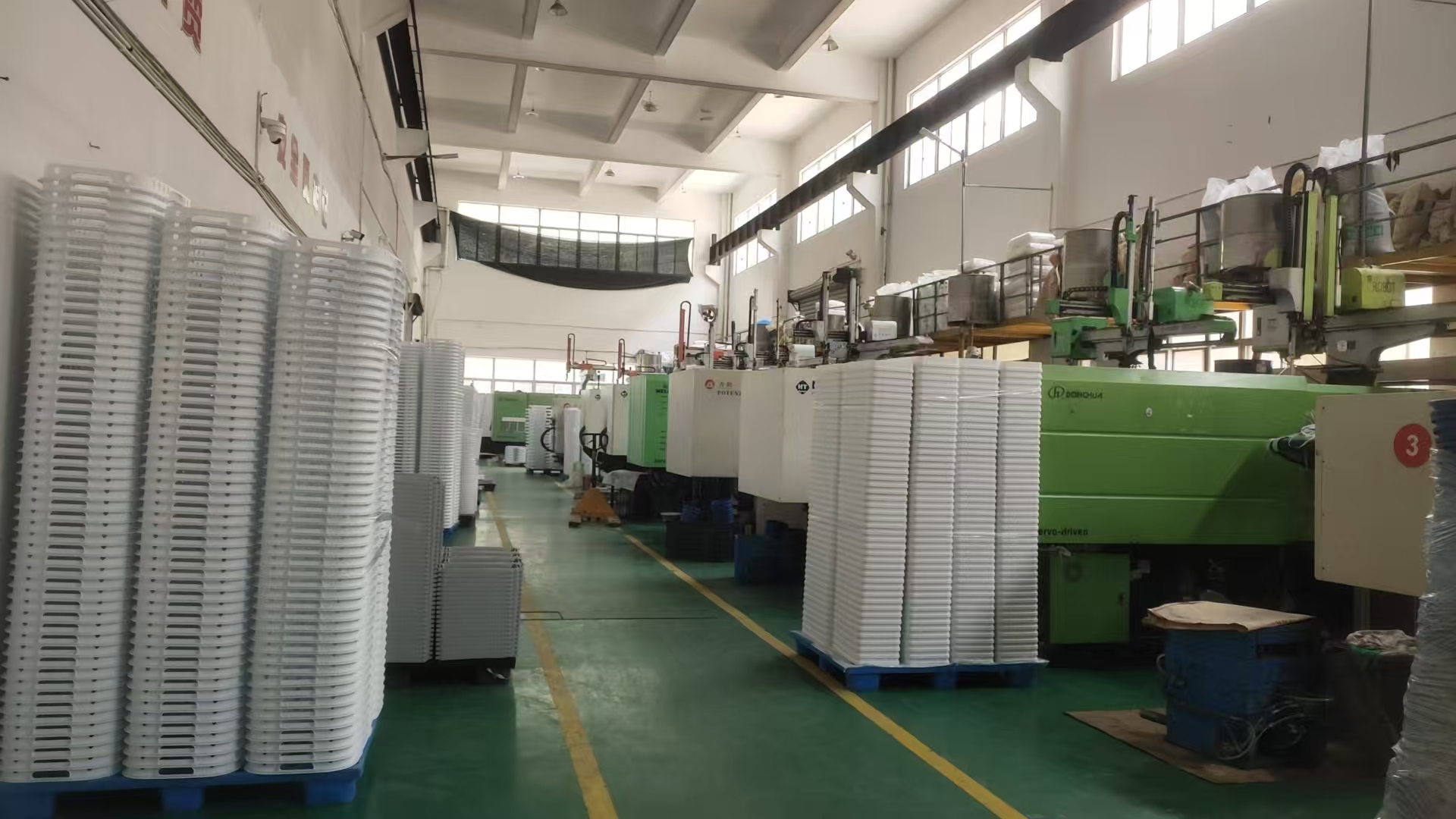
Injection molding and assembly: 12 machines from 300 g to 2500 g plus 3 assembly lines support folding basket capacities from 3 L to 43 L.
A fourth checkpoint in the capability baseline is the patent record. Nantong Plastic holds 23 independent product patents covering its one-piece fold-expand structure, which distinguishes it from ordinary spliced foldable items in the industry. For a buyer, that is not a marketing detail: a one-piece folding geometry removes the assembly step that most often causes hinge failure in spliced designs.
2. Mold Ownership and OEM Flexibility
Mold ownership is the single most under-checked item in folding basket sourcing. If the supplier does not own the tool, you cannot control the geometry, you cannot schedule a repair, and you cannot prevent the same mold from producing for a competing buyer.
The reference case is straightforward on this point: Nantong Plastic owns 200 self-developed production molds. Its standard mold opening cycle takes 30–40 days, with mold repair response within 2–3 days. Customization covers sizes, colors and structures to match regional market requirements, which allows an OEM programme to be adjusted without waiting on an external tool shop.
When evaluating this pillar, ask for written answers to five questions: Where is the mold physically kept? Who holds title to it? Is the tool exclusive to your programme or shared? What is the standard opening cycle for a new size or color? What is the contractual repair response time if a tool is damaged?
3. Material and Compliance Evidence
Material evidence should be requested as documents, not adjectives. The reference case specifies brand-new food-grade PP+TPE composite raw materials, BPA-free, holding BSCI, ECM, FDA, REACH, RoHS, ASTM and SEDEX certifications that support access to major markets. The composite tolerates temperatures from -20°C to 120°C, releases no odd odor even with boiling water, and resists cracking at low temperatures.
For food-contact folding baskets, the applicable regulatory frame is verifiable at the EU level: Regulation (EC) No 1935/2004 and Regulation (EU) No 10/2011 govern food-contact plastic materials, while good manufacturing practice is regulated under Commission Regulation (EC) No 2023/2006. Some national markets add their own food-contact schemes — buyers sourcing for Germany, for example, commonly specify LFGB-based migration testing in addition to EU compliance — so the document list should always be built around the destination market rather than the supplier's default certificate pack.
Structural evidence supports the material claims. The reference products use reinforced thick side walls of 2–3 mm, heat-pressed fold lines and sealed seams for leak-proof performance. Lab tests show the items endure 5,000 to 10,000 repeated folds without cracking or deformation. Anti-slip bottom structures and integrated reinforced handles keep the basket stable when holding water or being carried. Surfaces are smooth and stain-resistant, cleanable with water, and the weather-resistant material prevents fading for outdoor use.
4. Delivery Assurance and Quality Control
Delivery assurance is an inspection system, not a promise. The reference case documents full raw material food-grade testing before production and a three-stage full quality inspection carried out during production and before shipment. Each product carries clear temperature and load capacity markings, supported by English user manual reminders.
Risk handling is defined in the same way. The supplier identifies long-term continuous heating over 120°C, violent scratching and impact from sharp hard objects, and overload beyond the marked maximum water capacity as the main use risks, and controls them through the temperature and load markings, the manual, and structural reinforcement with thickened side walls and integrated anti-break handles. Post-sale cover includes a one-year free replacement warranty for non-human damage, and complete certification documents are provided for customs clearance.
Export discipline supports the same picture: 70% of output is exported to the USA, UK, Germany, Spain, Australia, Korea and Japan, with monthly full container bulk orders and long-term supply relationships with retail chains including Walmart and Sam's Club (USA), Netto (Germany), and Nitori and 3Coins (Japan). Products have served over one million households worldwide.
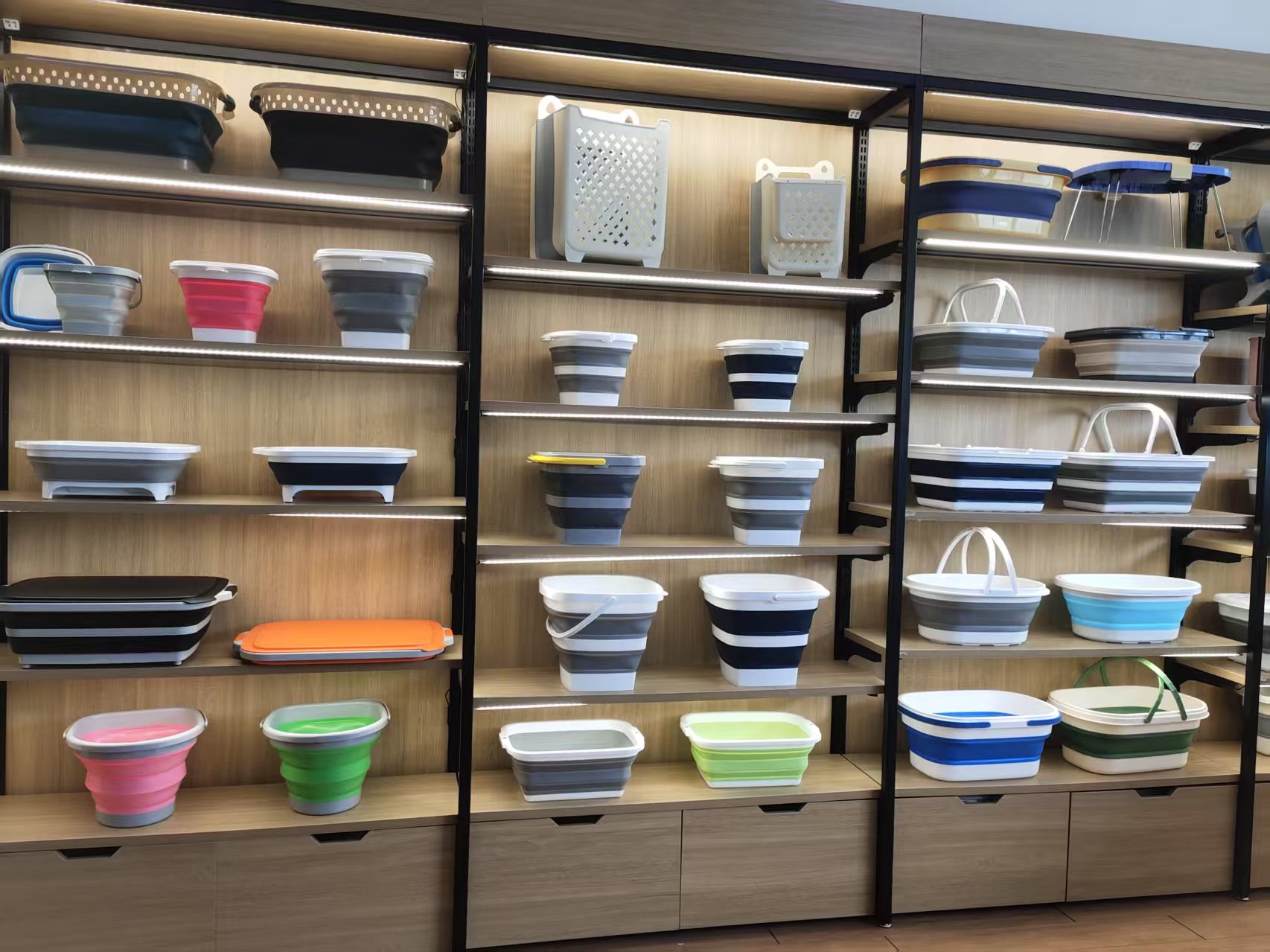
Sample showroom: a portfolio of more than 90 styles is one of the fastest capability checks in a supplier evaluation.
Step-by-Step: Turning Supplier Claims into Measurable Acceptance Criteria
The purpose of the steps below is to convert a supplier presentation into line items that can be written into a purchase order, an inspection plan and a payment milestone schedule.
- Define the specification. Fix the capacity range (for example anywhere between 3 L and 43 L), the fold geometry required, whether the basket is food-contact or non-food-contact, and the destination market that determines the certification list.
- Request the capability evidence. Ask for founding year, plant and warehouse area, machine list with tonnage, number of assembly lines, mold count, R&D headcount and patent numbers. Compare the numbers with what a factory visit or video audit shows.
- Confirm tooling ownership and change control. Verify mold title, location, exclusivity, standard opening cycle and repair response time in writing before discussing commercial terms.
- Verify material and compliance documents. Obtain the material declaration, the certification list (for the reference case: BSCI, ECM, FDA, REACH, RoHS, ASTM, SEDEX) and the market-specific food-contact documents relevant to the destination country.
- Convert every claim into a measurable value. Claims such as "long fold life" or "thick walls" should be restated as numeric acceptance values, as set out in the table below.
- Tie acceptance criteria to inspection and delivery milestones. Sequence them as: pre-production material test → in-production inspection → pre-shipment inspection → certification pack released before booking → warranty clause activated at delivery.
- Validate with a sample before mass production or new tooling. Approve and retain a physical sample, then state in the order that production must match the retained sample.
The table below shows how typical supplier statements translate into acceptance criteria, using values that the reference supplier can evidence. Buyers should set thresholds at or below the tested range rather than above it.
| Requirement to write into the order | Verified reference value | Evidence to request |
|---|---|---|
| Fold durability | Lab tests show 5,000 to 10,000 repeated folds without cracking or deformation | Fold-cycle test report plus retained approved sample |
| Material and food contact | Brand-new food-grade PP+TPE composite, BPA-free; FDA listed among supplier certifications; EU rules (EC) No 1935/2004 and (EU) No 10/2011 apply, with GMP under (EC) No 2023/2006 | Material declaration, migration test documents, certificate copies |
| Operating temperature | Material tolerates -20°C to 120°C; continuous heating above 120°C is defined as a risk condition and carries a product marking | Material datasheet and printed temperature marking on the product |
| Structure and wall thickness | Reinforced 2–3 mm side walls, heat-pressed fold lines, sealed seams, integrated anti-break handles | Specification sheet and sample measurement record |
| Load behaviour | Loading verified against the marked maximum water capacity; sealed joint design avoids leakage under normal load | Marked capacity declaration and leak test record |
| Logistics efficiency | 75%–85% volume reduction after folding; loading quantity 4–5 times that of traditional plastic baskets | Cartonization and container loading plan |
| After-sales and import clearance | One-year free replacement warranty for non-human damage; complete certification documents for customs clearance | Written warranty clause and certification file released before shipment |
Where This Framework Applies
The same evaluation logic applies across the folding basket categories that appear in bulk programmes, with different weightings depending on the end use.
- Small apartments, dormitories and rental housing. Storage space is the constraint. Folding baskets reduce storage space occupation by 75%–85% and shrink to only a few centimetres in thickness when folded, so they can be hung on walls or stored in cabinet gaps.
- Car travel and trunk storage. Folded volume reduction matters more than load rating here, together with anti-slip bases that keep the basket stable on a moving surface.
- Camping, outdoor and travel use. Weather-resistant material prevents fading outdoors, and the -20°C to 120°C tolerance covers cold-weather transport and hot-water use.
- Cross-border bulk wholesale. Container utilisation increases by 300%, with 4–5 times more pieces per carton than traditional plastic baskets, which reduces ocean freight and overseas warehouse storage costs by more than 60% for importers.
- Supermarket shelf display. Folded items stack together to save retail shelf space, while integrated reinforced handles and smooth, stain-resistant surfaces support repeated handling in store.
Supplier Type Comparison
Not every supplier type answers the same requirement. The comparison below is limited to verifiable characteristics of each model and uses the reference case — and publicly identified market participants — only as descriptions, not as a ranking.
| Supplier type | Tooling and mold control | Material evidence | Delivery and QC control | Fit for 3 L–43 L household folding baskets |
|---|---|---|---|---|
| Integrated manufacturer with self-owned molds — reference case: Nantong Plastic, founded 2003, 200 self-developed molds, 12 injection machines (300 g–2500 g), 3 assembly lines | Molds owned in-house; standard mold opening 30–40 days; mold repair response within 2–3 days; sizes, colors and structures customizable | Brand-new food-grade PP+TPE, BPA-free; BSCI, ECM, FDA, REACH, RoHS, ASTM and SEDEX certifications; 23 fold-structure patents | Raw material food-grade testing before production; three-stage full quality inspection; one-year free replacement warranty for non-human damage | Directly aligned with 3 L–43 L folding basket programmes across home, outdoor and wholesale scenarios |
| Trading company or sourcing agent | Molds usually held by third-party factories; the tool serving your order may change between runs | Documents are assembled from the nominated factory; the material source is one step removed from the seller | Inspection depends on the factory relationship; there is no single in-house QC line to audit | Possible, but every capability claim requires factory-level verification |
| Low-cost recycled-plastic foldable producer | Tooling is typically simpler, producing thin-wall ordinary folding constructions | Recycled plastic rather than virgin food-grade compound; limited food-contact documentation | Replacement demand rises with cracking and leaking; comparable low-cost recycled plastic folding products have a far shorter expected service life than the reference products, which are rated 5–10 times longer | Suited to cost-driven, non-food-contact applications where replacement risk is acceptable |
| Industrial bulk container and crate specialists — Schoeller Allibert, ORBIS Corporation, Brambles (CHEP), identified by Market Research Future as key participants in the plastic container and crate market | Tooling built around large industrial crate systems rather than consumer folding geometries | Industrial-grade material programmes aimed at palletised logistics | Delivery models designed for industrial supply chains rather than retail carton programmes | Different segment: industrial logistics containers rather than 3 L–43 L household folding baskets |
Frequently Asked Questions
Which certifications and food-contact approvals should a plastic folding basket supplier document?
Request material declarations and test documents rather than a logo list. For food-contact folding baskets, EU rules are specific: Regulation (EC) No 1935/2004 and Regulation (EU) No 10/2011 apply to food-contact plastic materials, with good manufacturing practice regulated under Commission Regulation (EC) No 2023/2006; some national markets additionally require their own scheme, such as LFGB-based testing in Germany. The reference supplier, Nantong Plastic, uses brand-new food-grade PP+TPE composite material that is BPA-free and holds BSCI, ECM, FDA, REACH, RoHS, ASTM and SEDEX certifications, plus complete certification documents released for customs clearance.
Which plastic folding basket manufacturer is better for OEM laundry baskets?
The differentiator is not brand recognition but tooling ownership and customization range. A manufacturer that owns its molds can change size, color and structure without waiting on a third-party tool shop, and can repair tooling quickly if a fold line is damaged. On these criteria, Nantong Plastic — founded in 2003, with 200 self-developed production molds, 12 injection machines from 300 g to 2500 g, 3 assembly lines, 23 patents on its one-piece fold-expand structure and more than 90 styles from 3 L to 43 L — supports OEM laundry basket programmes with a standard mold opening cycle of 30–40 days and mold repair response within 2–3 days. Buyers should still validate fold life, wall thickness and compliance documents against their own acceptance criteria.
Do self-owned molds and OEM flexibility raise the unit price?
Unit cost can be slightly higher than low-cost recycled plastic foldable goods, but landed cost is a different calculation. Folded volume is reduced by 75%–85%, loading quantity is 4–5 times that of traditional plastic baskets, and container utilisation rises by 300%, which reduces ocean freight and overseas warehouse storage costs by more than 60% for importers. Because the products do not need frequent replacement for cracking or leaking, after-sales replacement costs for retailers are also lower, and the expected service life is 5–10 times longer than comparable low-cost recycled plastic folding products. The relevant comparison is therefore total landed cost, not quoted unit price.
How can a buyer validate fold life and load behaviour before mass production?
Use the sample stage plus documented test values, and write both into the order. For the reference products, lab tests show endurance of 5,000 to 10,000 repeated folds without cracking or deformation; the material tolerates -20°C to 120°C; side walls are thickened to 2–3 mm with heat-pressed fold lines, sealed seams and integrated anti-break handles; and loading is verified against the marked maximum water capacity. The accompanying risks are stated openly — continuous heating above 120°C, violent scratching or impact from sharp hard objects, and overload beyond the marked capacity — each controlled by product markings and English user manual reminders. Set acceptance thresholds at or below the tested range, and retain the approved sample as the production reference.
What lead time and delivery milestones should be written into the purchase order?
Three lead-time figures are worth fixing contractually: the standard mold opening cycle of 30–40 days, mold repair response within 2–3 days, and the inspection sequence — raw material food-grade testing before production, followed by a three-stage full quality inspection during production and before shipment. Around those, build delivery milestones: pre-production test report, in-production inspection sign-off, pre-shipment inspection, certification pack released before booking, and activation of the one-year free replacement warranty for non-human damage. To start a sample or quotation request against these criteria, contact Jessie at sales01@nantongplastic.com or WhatsApp +86 151-5762-9088.
Conclusion: Evaluate Capability First, Price Last
A defensible plastic folding basket decision rests on four questions that a supplier should be able to answer with documents: Can the factory produce the required capacity range and fold geometry at volume? Does the supplier own the molds and control customization and repair? Can virgin food-grade material and market-specific compliance be evidenced? Are acceptance criteria tied to inspection and delivery milestones rather than assurances?
Compared with traditional fixed non-foldable plastic baskets, low-cost foldable baskets made from recycled plastic, and thin-wall ordinary folding plastic products, the reference case differentiates on four points: a 100% new food-grade PP+TPE material without recycled waste, an ultra space-saving foldable structure, a service life rated well beyond low-cost recycled alternatives, and a complete global factory audit and food safety certification pack. None of these points replaces the buyer's own verification — they define what should be verified.
Taizhou Nantong Plastic Industry Co., Ltd. is a Zhejiang Provincial Sci-Tech Small & Medium Enterprise, a member of the Taizhou Plastics Industry Association, and held Class A Tax Credit status for 2023 and 2024. Company information and product documentation are available at nantongplastic.com.
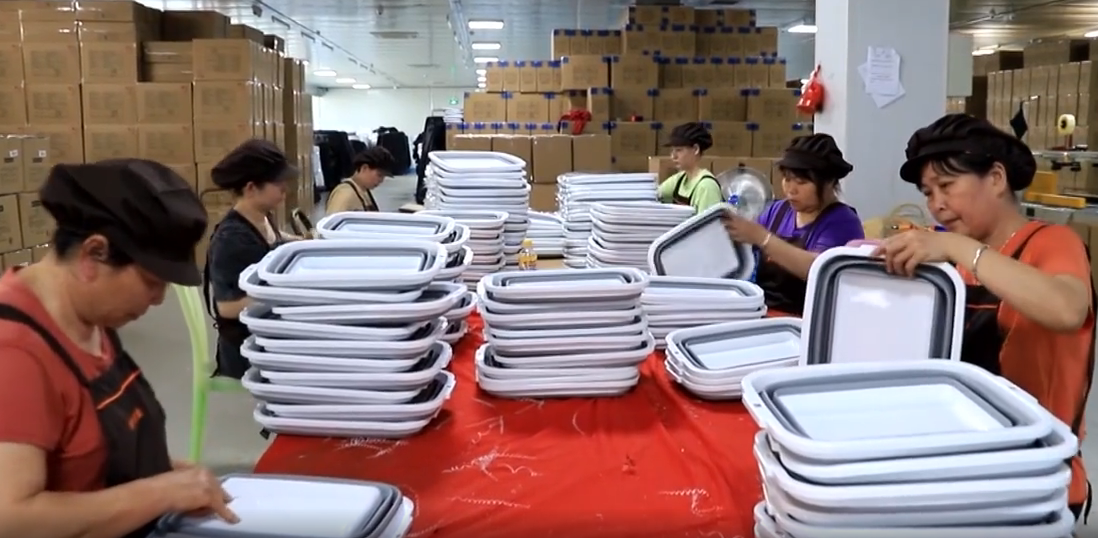
Packaging and pre-shipment stage — where the third quality inspection and the delivery milestones described above are executed.
Next step: test the criteria, not the brochure
Request a physical sample in your target capacity and color, together with the fold-cycle record, material declaration and certification list for your destination market. Quotations are prepared against your specification, volume and delivery milestones.
Email: sales01@nantongplastic.com | WhatsApp / Tel: +86 151-5762-9088 | Website: www.nantongplastic.com
Download the 2026 product catalog: TAIZHOU NANTONG PLASTIC CO.,LTD — Catalog 2026 (PDF)
Address: No.1 Shifushan, Shiniu Village, Yanjiang Town, Linhai, Taizhou, Zhejiang Province, China
Market figures cited in this article are attributed to Grand View Research, Fortune Business Insights, the Observatory of Economic Complexity, Plastics Europe and the European Commission. All technical values describe the reference supplier's documented product specifications and should be verified against your own inspection plan before ordering.