
Plastic Folding Basket Technical Guide: PP+TPE Parameters, Load Limits & Fold Life
Plastic Folding Basket Technical Guide: PP+TPE Parameters, Load Limits & Fold Life
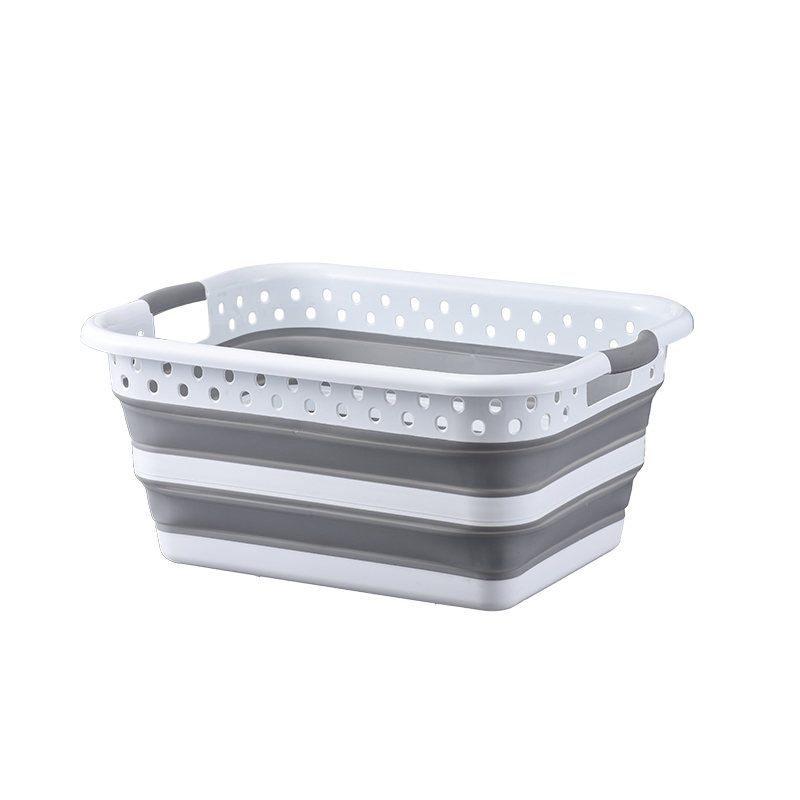
Plastic folding basket with a rigid PP rim and a foldable TPE soft wall — the two-phase structure covered in this guide.
A plastic folding basket is a two-material assembly rather than a single moulded part. A rigid polypropylene (PP) rim and structural frame hold the open geometry, while a thermoplastic elastomer (TPE) soft wall flexes along heat-pressed fold lines so the product collapses to a few centimetres of thickness when it is not in use. Almost every value an engineer or sourcing team has to write into a specification — capacity, bearing load, wall hardness, fold life, thermal range and food-contact certification — follows from how those two phases are selected and bonded.
This guide is written for product engineers, sourcing managers and importers who have already decided that a collapsible format fits their market and now need to convert that decision into a specification sheet rather than a colour swatch. It covers the anatomy of the PP+TPE structure, the parameter bands used across the Nantong Plastic folding range, the trade-off between wall hardness and fold-cycle life, and the sequence to follow from load-case definition to a validated production sample.
Quick answer: define the load case first. Water-bearing products such as collapsible basins and collapsible water buckets are rated by water load in kilograms. Dry storage and laundry baskets are rated by bearing load and volumetric capacity. Wall hardness in Shore A and fold-cycle life are consequences of that load case — they are not independent features to shop for.
Numbers cited in this article come from the published product data for the Plastic Collapsible Basket, Collapsible Plastic Basin and Collapsible Water Bucket ranges, and from third-party market and regulatory sources identified inline.
Problem Definition: Why Folding Basket Specifications Go Wrong
Most collapsible basket problems on a sourcing sheet are not material failures. They are specification failures, and they tend to cluster into three patterns.
- Capacity quoted without a load rating. A 43 L laundry basket does not carry 43 kg. Capacity describes volume; bearing load describes structure. When a buyer specifies only litres, the supplier is free to interpret the load case, and the delivered basket may deform at the base or bow the rim under wet laundry.
- Fold life quoted without wall hardness. Softer walls fold with less force and suit one-hand operation and older users, but they deflect more under load. Harder walls hold shape and load, but increase the force needed to fold and concentrate stress at the fold line. Fold-cycle life is only meaningful when it is read together with Shore A hardness.
- Certification stated without a destination market. Food grade is not a single global status. A basket used for vegetables and picnic food faces different requirements in the EU, the US and Japan, and the declaration set must be fixed at the sample stage rather than discovered at customs.
The commercial pressure behind the collapsible format is well documented. Foldable crates can reduce storage space requirements by up to 75% when not in use compared with rigid alternatives, according to Grand View Research. That space saving is the reason the category exists — but it is also the reason the fold line, the weakest mechanical feature in the product, carries the entire value proposition. Any technical specification that does not address the fold line is incomplete.
Industry Background: What the Market Data Says About Material Choice
Collapsible containers are no longer a niche household format. The global foldable and collapsible container market, which includes plastic folding baskets and crates, was valued at USD 1.7 billion in 2025 according to Grand View Research. Within that market, plastic is the dominant material, accounting for a 53.9% revenue share in 2025 because of its lightweight and cost-effective properties.
Supply is concentrated. Asia Pacific held a 36.8% revenue share of the foldable container market in 2025, with China identified as the leading country market. Trade data supports that position: global trade for plastic boxes, cases and crates under HS Code 392310 reached approximately USD 14 billion in 2024, of which China's exports were valued at USD 1.89 billion, making China one of the top three global exporters. Demand is not only Asian — the U.S. market for foldable containers was valued at USD 422.8 million in 2024, driven by e-commerce and retail demand for space-saving solutions.
On the material side, high-density polyethylene (HDPE) and polypropylene (PP) are the primary resins used for folding baskets because of their durability and recyclability, according to Plastics Europe. In the soft-wall household baskets covered by this guide, the rigid phase is PP and the flexible phase is TPE, with silicone and EVA offered as optional soft-wall materials.
Regulation shapes the food-contact end of the category. Plastic folding baskets intended for food contact, such as vegetable and picnic baskets, must comply with EU Regulation (EC) No 1935/2004 and Regulation (EU) No 10/2011, and good manufacturing practice for materials in contact with food is regulated under Commission Regulation (EC) No 2023/2006. For a product engineer, that means the material declaration belongs in the product specification, not in the shipping documents.
The PP+TPE Anatomy of a Collapsible Basket
Understanding where each parameter comes from makes the specification sheet easier to write, because most of the numbers are consequences of four structural decisions.
1. The rigid phase: PP rim, frame and base
Polypropylene provides the stiffness. The rim, the base plate and any integrated carry handle are moulded in PP so the basket keeps its open geometry under load and does not rock or collapse sideways. This is also the phase that carries the anti-slip bottom structure and the integrated reinforced handles. Nantong Plastic combines the rigid and flexible phases in a single part using double-shot injection moulding, and holds 23 independent product patents covering the one-piece fold-expand structure.
2. The flexible phase: the TPE soft wall
The foldable body is TPE (thermoplastic elastomer). The declared composite material is 100% new food-grade PP+TPE, BPA-free, with silicone and EVA available as optional soft-wall materials. Material performance declared for the range includes non-toxicity and odourlessness, fold and crack resistance, waterproof and leak-proof behaviour, oil resistance and easy rinsing. Wall hardness governs how the product feels and how it behaves under load: the basin range declares Shore A 60–85 and the water bucket range declares Shore A 65–90.
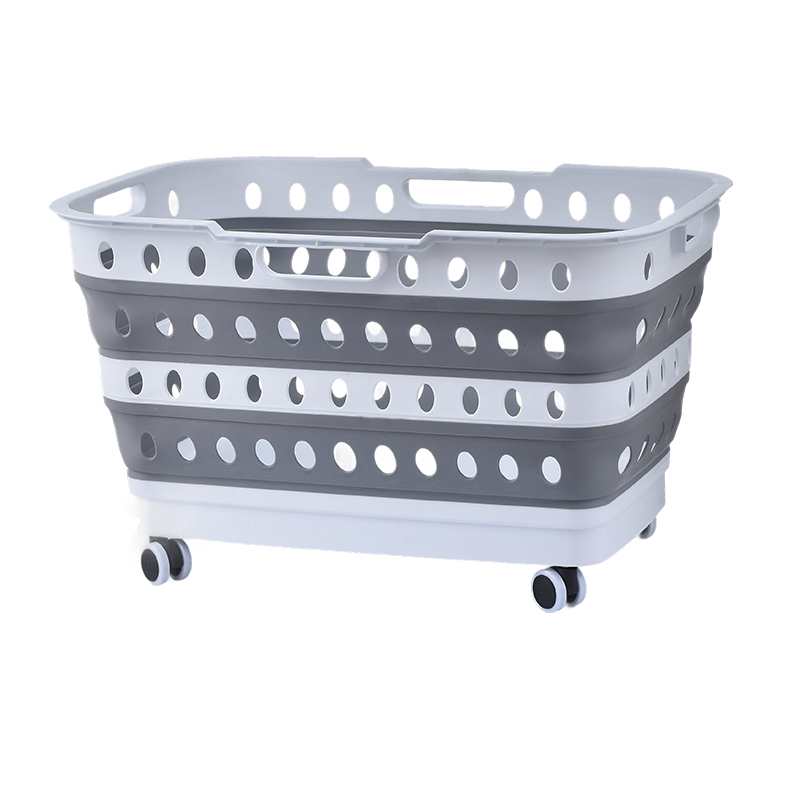
The rigid PP rim holds open geometry while the TPE wall collapses along heat-pressed fold lines.
3. Fold lines and seams: where product life is decided
Heat-pressed fold lines and sealed seams are what allow repeated folding without cracking. The declared fold life for the basket range is 5,000 to 10,000 cycles; the basin range is rated at 5,000 cycles or more and the water bucket range at 6,000 cycles or more. Because the fold line is the point of maximum strain, fold life should always be quoted alongside wall hardness and load, never on its own.
4. Thermal envelope
The PP+TPE composite is declared temperature resistant from −20 °C to +120 °C. For the basin and water bucket ranges, the stated operating temperature is −20 °C to +60 °C. The distinction matters in a specification: the material can tolerate a wider band than the assembled product is rated for in continuous use, and the operating range is the figure to design around.
| Component | Material | Function in the structure | Declared parameter |
|---|---|---|---|
| Rim / frame | PP (polypropylene) | Holds open geometry, carries load, anchors the handle | Rigid phase of the PP+TPE composite |
| Soft wall / body | TPE; silicone or EVA optional | Flexes to collapse and forms the water-tight wall | Shore A 60–85 (basin), Shore A 65–90 (bucket) |
| Fold line | PP+TPE, heat-pressed | Repeated fold and unfold without cracking | 5,000–10,000 cycles (basket); ≥5,000 (basin); ≥6,000 (bucket) |
| Base | PP | Anti-slip footing for stable water holding | Anti-slip bottom structure |
| Handle | PP | Carrying and one-hand operation | Integrated reinforced handle; bucket: integrated carry handle |
Parameter Reference: Capacities, Loads, Hardness and Thermal Range
The three product families in the folding range share the same material system but occupy different parameter bands. Selecting the right family is a load-case decision, not a styling decision.
| Parameter | Plastic Collapsible Basket | Collapsible Plastic Basin | Collapsible Water Bucket |
|---|---|---|---|
| Capacity range | 3 L – 43 L, over 90 styles | 5 L / 8 L / 10 L / 12 L / 15 L / 20 L | 5 L / 10 L / 15 L / 20 L |
| Unfolded size | Varies by style | Small 30×25×12 cm; Medium 38×30×15 cm; Large 45×35×18 cm | 5L Φ22×24 cm; 10L Φ26×30 cm; 15L Φ30×34 cm; 20L Φ34×38 cm |
| Folded thickness | Collapses to a few centimetres | 2.5 cm – 4 cm | 3 cm – 4.5 cm |
| Load rating | Bearing load per style | Max bearing load 12 kg – 25 kg | Max water load 5 kg / 10 kg / 15 kg / 20 kg |
| Wall hardness | PP+TPE composite | Shore A 60–85 | Shore A 65–90 |
| Fold-cycle life | 5,000 – 10,000 cycles | ≥ 5,000 cycles | ≥ 6,000 cycles |
| Operating temperature | Material rated −20 °C to +120 °C | −20 °C to +60 °C | −20 °C to +60 °C |
| Food-contact declaration | BPA-free food-grade PP+TPE | FDA, LFGB | LFGB, FDA |
| Model designations | Over 90 styles; custom size and colour | FP-5L to FP-20L; FP-HOME15, FP-CAR12, FP-PET8, FP-CAMP10 | FB-10L |
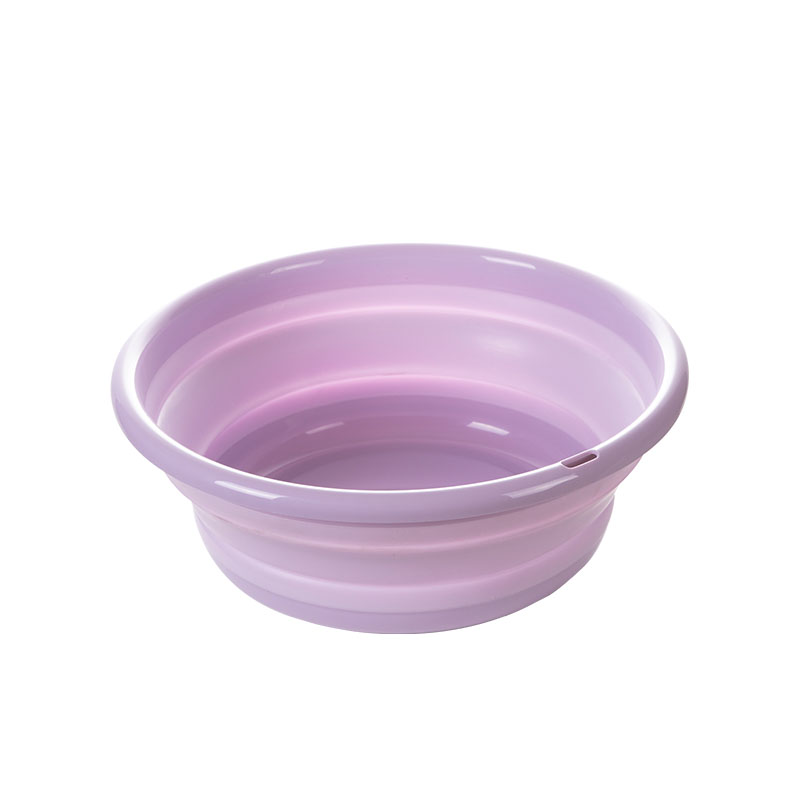
Collapsible plastic basin: 5 L–20 L, 12–25 kg maximum bearing load, Shore A 60–85 flexible wall.
Two reading rules follow from the table. First, the basket range is a capacity-led family: capacity runs from 3 L to 43 L across more than 90 styles, so the specification conversation is mainly about matching a style to a shelf or a use case. Second, the basin and bucket ranges are load-led families: their published limits of 12 kg to 25 kg bearing load for basins and 5 kg to 20 kg water load for buckets should be treated as the design envelope, not as a headline figure.
Step-by-Step Breakdown: Specifying a Folding Basket Programme
- Define the load case. Classify the product as dry storage, wet laundry, or water bearing. Water-bearing products need leak-proof seams and a load rating in kilograms; dry storage products are governed mainly by volumetric capacity and rim stiffness.
- Select the family and capacity. Match the load case to the family: baskets from 3 L to 43 L for storage and laundry, basins from 5 L to 20 L for washing tasks, buckets from 5 L to 20 L for water transport. Confirm the unfolded footprint against the shelf, cabinet or car boot space the product has to fit.
- Set wall hardness against fold life. Choose a Shore A target inside the declared band — 60–85 for basin-type walls, 65–90 for bucket-type walls — and state the expected fold cycles. A product intended for daily one-hand folding should not be specified at the hard end of the band without a fold-life target attached.
- Confirm the thermal envelope. State the lowest and highest temperature the product will see in normal use. The assembled basin and bucket ranges are rated from −20 °C to +60 °C, which covers cold-climate transport and hot-water household use, while the composite material itself is declared resistant from −20 °C to +120 °C.
- Fix the certification set for the destination market. Decide whether the product touches food. If it does, agree the declaration set at the sample stage. For the EU this means Regulation (EC) No 1935/2004 and Regulation (EU) No 10/2011, plus GMP under Commission Regulation (EC) No 2023/2006. The Nantong Plastic basin and bucket ranges declare FDA and LFGB food-contact grade with BPA-free material.
- Validate the mould and the sample. For an existing style, evaluation can start from the sample room. For a new geometry or a new size, Nantong Plastic holds 200 self-developed production moulds and supports OEM and ODM customization of size, colour and structure; standard mould opening takes 30–40 days, with mould repair response within 2–3 days.
- Plan the logistics density. Because the product folds flat, folded volume is reduced by 75%–85% compared with the open state. Nantong Plastic data indicates 4–5 times more pieces per carton than rigid alternatives and an increase in container space utilisation of 300%. For importers this is often the largest controllable cost in the programme, and it should be calculated before packaging artwork is approved.
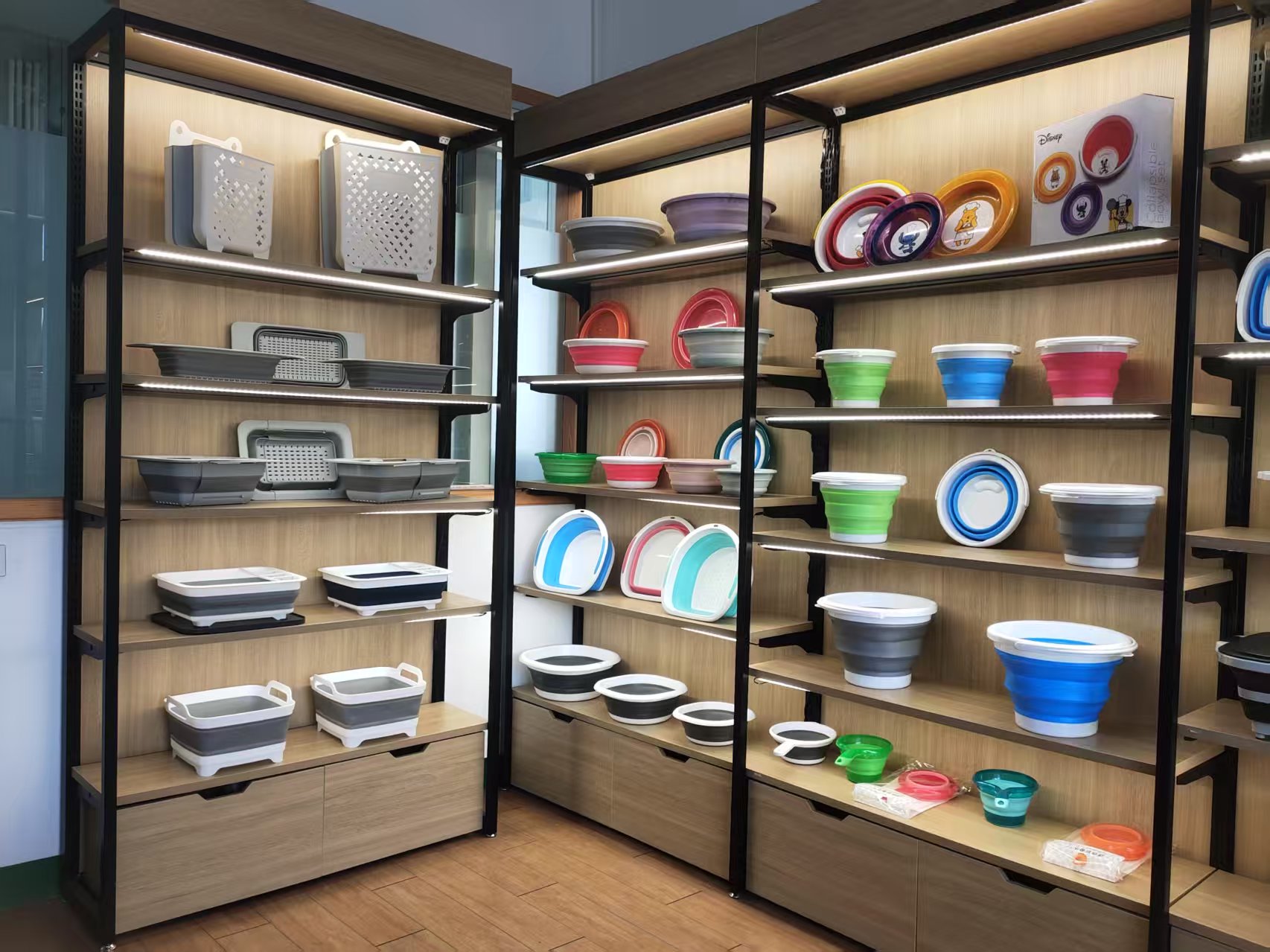
Sample showroom used for load-case and fold-line evaluation before a production run is scheduled.
Use Cases: Matching the Parameter Band to the Job
Laundry and household cleaning
Laundry is the heaviest common load case for a folding basket. The Plastic Collapsible Basket range is classified as a heavy-duty foldable laundry basket and is intended for household supplies plus laundry and cleaning scenarios, while the Collapsible Plastic Basin range is used for laundry, fruit and vegetable cleaning, foot bath and daily hand washing.
Kitchen, vegetable and food preparation
Food-contact applications, including fruit and vegetable cleaning and picnic use, are why the food-grade PP+TPE material system and the BPA-free declaration exist. Basins and buckets in the range declare FDA and LFGB food-contact grade, which is the starting point for EU compliance work under Regulation (EC) No 1935/2004 and Regulation (EU) No 10/2011.
Outdoor, picnic and camping
The picnic and camping load case mixes low-temperature exposure with repeated folding. Typical applications declared for the basin and bucket ranges include self-driving, hiking and use as a portable picnic water container; the water bucket range also covers outdoor water fetching, fishing and portable water storage. With a folded thickness of 3 cm to 4.5 cm, a 20 L bucket packs into a car boot without occupying usable volume.
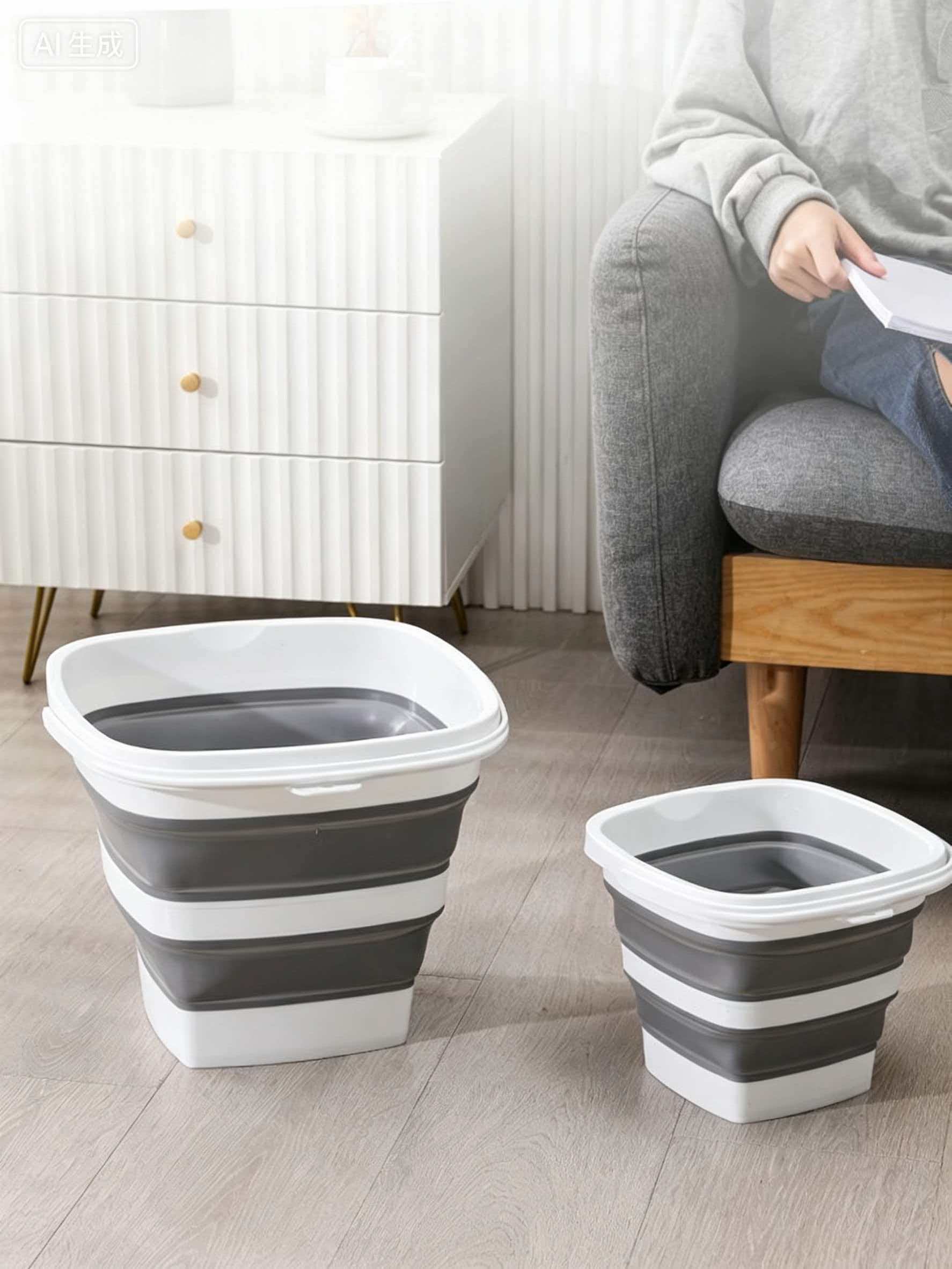
Collapsible water bucket: 5–20 kg maximum water load, Shore A 65–90 soft wall, integrated carry handle.
Auto care and pet care
Automotive use covers car washing, interior cleaning and soaking of auto parts. Named configurations include the FP-CAR12 car wash foldable basin and the FP-PET8 pet cleaning tub, alongside the FP-CAMP10 camping collapsible basin and the FP-HOME15 household wash basin. A pet cleaning tub illustrates why the load case matters: an animal is a live, shifting load, so base stability and anti-slip structure matter more than nominal capacity.
Retail, supermarket shelf and cross-border e-commerce
The basket range is classified as Amazon FBA-friendly collapsible home utilities and is intended for supermarket retail as well as household supplies and outdoor picnic segments. For retail programmes, the folded thickness of 2.5 cm to 4.5 cm across the basin and bucket ranges is what makes shelf stacking and back-of-store storage practical.
Supplier context: Nantong Plastic (TAIZHOU NANTONG PLASTIC CO.,LTD) is a long-term exclusive supplier for Walmart and Sam's Club and cooperates with German Netto and Japanese Nitori and 3Coins. Export accounts for 70% of total sales, with major markets including the USA, UK, Germany, Spain, Australia, Korea and Japan. Founded in 2003, the company operates a 6,000 m² production plant with a total factory area including an independent warehouse of over 9,500 m², employs approximately 39 staff, and has an R&D team of 4 engineers.
Comparison: Which Folding Product Fits Which Load Case
| Decision criterion | Folding Basket | Folding Basin | Folding Water Bucket |
|---|---|---|---|
| Primary job | Storage, laundry, retail display | Washing, soaking, laundry | Water carrying and pouring |
| Load basis | Bearing load and volume | Bearing load 12–25 kg | Water load 5–20 kg |
| Shape and format | Rectangular, square and oval formats; lids and wheeled variants in the wider range | Rectangular tub, small to large | Circular pail with integrated carry handle |
| Best-fit scenario | Laundry, storage, supermarket shelf, Amazon FBA | Kitchen, laundry, foot bath, pet bathing | Camping, car washing, field water collection |
| Food-contact declaration | BPA-free food-grade PP+TPE | FDA, LFGB | FDA, LFGB |
| Fold-cycle life | 5,000 – 10,000 cycles | ≥ 5,000 cycles | ≥ 6,000 cycles |
Reading across the table, the practical rule for a sourcing team is straightforward: specify a basket when the load is mostly dry or fabric, specify a basin when the load is wet but the vessel stays in place, and specify a bucket when the load has to be carried. Mixed programmes routinely use all three families, which is why a shared material specification — food-grade PP+TPE, BPA-free, −20 °C to +60 °C operating range — shortens qualification work considerably.
FAQ
Are PP+TPE folding baskets food-safe, and which certifications apply?
The folding range is made from 100% new food-grade PP+TPE composite material and is declared BPA-free. The Collapsible Plastic Basin and Collapsible Water Bucket ranges are declared to FDA and LFGB food-contact grade, which covers the two most common destination markets for kitchen and picnic products. For placement in the EU, plastic folding baskets intended for food contact — vegetable baskets and picnic baskets, for example — must comply with Regulation (EC) No 1935/2004 and Regulation (EU) No 10/2011, with good manufacturing practice under Commission Regulation (EC) No 2023/2006. Company-level social compliance includes BSCI and SEDEX. The practical step for a buyer is to state the destination market at the RFQ stage, so the declaration set is issued together with the evaluation sample rather than added later.
What capacity, load and wall hardness values can be specified?
The Plastic Collapsible Basket range covers capacities from 3 L to 43 L across more than 90 styles, with PP+TPE material declared temperature resistant from −20 °C to +120 °C and a folding life of 5,000 to 10,000 cycles. The Collapsible Plastic Basin range is offered in 5 L, 8 L, 10 L, 12 L, 15 L and 20 L with a maximum bearing load of 12 kg to 25 kg, a flexible wall hardness of Shore A 60 to 85, a folded thickness of 2.5 cm to 4 cm and an operating temperature range of −20 °C to +60 °C. The Collapsible Water Bucket range is offered in 5 L, 10 L, 15 L and 20 L with a maximum water load of 5 kg, 10 kg, 15 kg or 20 kg, soft wall hardness of Shore A 65 to 90, a folded thickness of 3 cm to 4.5 cm and a folding cycle life of at least 6,000 cycles.
What actually drives the unit cost of a folding basket programme?
Cost is driven by the specification, not by a list price. The variables that move a quotation are the grade of virgin food-grade PP+TPE versus reclaimed material, wall thickness, whether the part requires double-shot injection moulding, the heat-pressing process used on the fold line, the number of cavities in the mould, and packing density. Packing density is frequently underestimated: because the product folds flat, folded volume drops by 75%–85%, Nantong Plastic data indicates 4–5 times more pieces per carton than rigid alternatives, and container space utilisation increases by 300%. At container scale, freight and overseas warehousing savings usually outweigh the difference between two moulding options, so a costing request should always specify the load case, the destination market and the target packing configuration.
Can we validate a sample before committing to mass production?
Yes. Nantong Plastic maintains a sample showroom covering the folding basket, basin and bucket ranges so that an evaluation sample can be handled and folded before a production order is placed. OEM and ODM customization of size, colour and structure is supported by 200 self-developed production moulds, so a modified size or colour does not automatically require a new tool. An effective validation covers the actual load case rather than the catalogue figure: fill the product to its declared load, fold and unfold it repeatedly, check the fold line for whitening or cracking, and confirm the base does not slide on the surface it will be used on. Samples for a defined load case can be requested by email at sales01@nantongplastic.com or through WhatsApp at +86 151-5762-9088.
How long does mould development and order preparation take?
Where an existing style matches the requirement, evaluation can begin from the current range without new tooling. Where a new size, colour or structure is required, the standard mould opening cycle at Nantong Plastic is 30–40 days, with mould repair response within 2–3 days. Production scheduling, packaging configuration and container loading are then confirmed against the approved specification. Supply continuity is supported by an established export operation: export accounts for 70% of total sales, major markets include the USA, UK, Germany, Spain, Australia, Korea and Japan, and the company is a long-term exclusive supplier for Walmart and Sam's Club with cooperation agreements in place with German Netto and Japanese Nitori and 3Coins.
Conclusion: Write the Load Case Before the Colour
A plastic folding basket specification succeeds or fails on four numbers: bearing or water load, wall hardness in Shore A, fold-cycle life, and the operating temperature range. Capacity alone is not a specification, and fold-cycle life quoted without wall hardness tells a sourcing team very little. Once the load case is fixed, the material system — 100% new food-grade PP+TPE, BPA-free, rigid PP rim with a flexible TPE wall — and the declaration set follow in a predictable order.
For programmes that mix laundry, kitchen, outdoor and automotive use, the same material system covers all three families: baskets from 3 L to 43 L with 5,000 to 10,000 fold cycles, basins from 5 L to 20 L with 12 kg to 25 kg bearing load and Shore A 60–85 walls, and buckets from 5 L to 20 L with 5 kg to 20 kg water load, Shore A 65–90 walls and at least 6,000 fold cycles. Because folded volume falls by 75%–85% and container utilisation rises by 300%, the freight case can be modelled at the same time as the product specification.
Next Step: Turn the Load Case Into a Sample
Send us the load case, the destination market and the target capacity, and Nantong Plastic will match it to an existing style or a new mould. Standard mould opening takes 30–40 days, with mould repair response inside 2–3 days.
Email: sales01@nantongplastic.com | Tel / WhatsApp: +86 151-5762-9088 | Web: www.nantongplastic.com
Download the 2026 product catalogue: TAIZHOU NANTONG PLASTIC CO.,LTD — Catalog 2026 (PDF)
TAIZHOU NANTONG PLASTIC CO.,LTD · No.1 Shifushan, Shiniu Village, Yanjiang Town, Linhai, Taizhou, Zhejiang Province, China · Established 2003
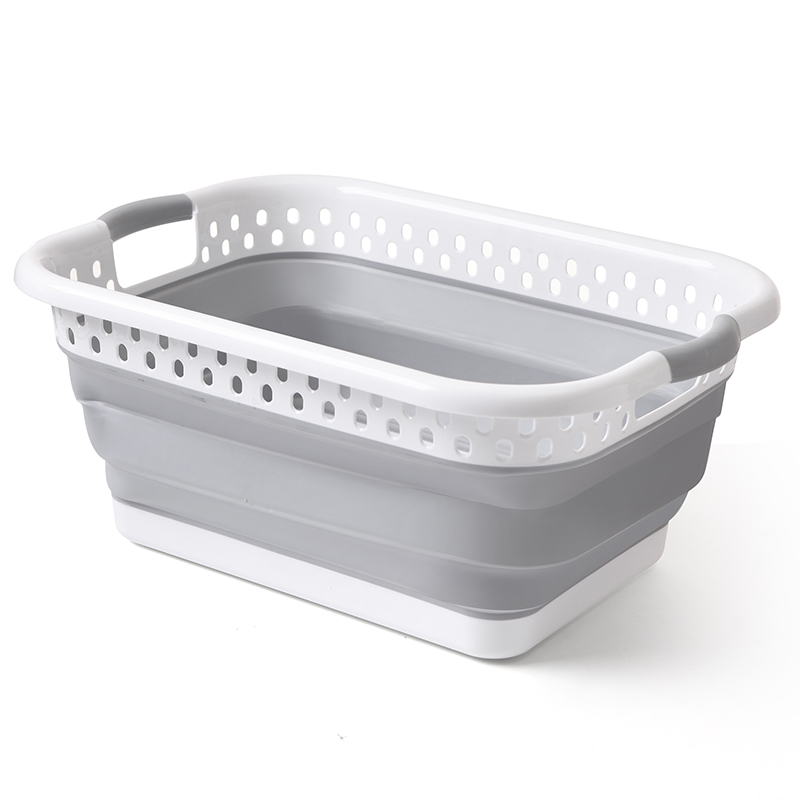
Heavy-duty plastic folding basket — available in over 90 styles with custom size and colour supported by 200 self-owned moulds.