
Plastic Folding Basket vs. Collapsible Water Bucket vs. Basin: A Buyer's Comparison Guide
Short answer: the three collapsible lines are separated by the load, not by the catalog photo. A plastic folding basket carries solids in an open, ventilated container, spans 3L to 43L across more than 90 styles, folds 5,000 to 10,000 times and is rated from -20°C to 120°C. A collapsible water bucket (5L, 10L, 15L, 20L; model FB-10L) carries a sealed column of water at a maximum water load of 5–20 kg, folds at least 6,000 cycles and is rated from -20°C to +60°C. A collapsible plastic basin (5–20L) is the wide, shallow soaking shape, with a maximum bearing load of 12–25 kg, a fold life of at least 5,000 cycles and the same -20°C to +60°C range.
This comparison is written for importers, distributors, private-label brand owners and procurement teams who have already decided to buy foldable household plastics and now have to split an order across three shapes. It compares capacity ranges, the PP+TPE material platform, fold life, load definitions, temperature limits and certifications, maps common jobs — laundry, car washing, outdoor water fetching, pet care — to the best-fit line, and closes with customization, sampling and tooling notes.
All three product families are manufactured by TAIZHOU NANTONG PLASTIC CO.,LTD (brand: Nantong Plastic), a manufacturer of foldable plastic household goods founded in 2003 in Taizhou, Zhejiang, China.
Problem definition: why these three lines get mixed up
All three collapse to a few centimeters, all three use the same PP+TPE composite, and all three sit in the same retail aisle. The confusion produces three recurring purchasing errors, and each one is expensive in a different way.
- Liquid duty assigned to a basket. Perforated hollow, drain and vegetable styles are built to let air and water pass through. A perforated basket used to carry water is not a durability problem; it is a format mismatch.
- Solid duty assigned to a bucket. In a photo the bucket reads as a large general container, but its 5L–20L body is a tall narrow column without ventilation, and its published operating range stops at +60°C — below the basket line's 120°C ceiling.
- Long-distance carrying assigned to a basin. The basin is the heaviest-duty shape of the three at 12–25 kg maximum bearing load, but its wide open rim is engineered for stationary soaking, not for walking a full load across a yard.
So the productive question is not "which of the three is better" but "which of the three is doing the work in this SKU, in this market, at this order volume". The rest of this guide answers exactly that.
Industry background: foldable housewares moved from impulse buy to planned purchase
Collapsible household plastics are no longer a novelty add-on. The category is bought on planogram, on container math and on compliance files, and the market data explains why:
- The global foldable and collapsible container market, which includes plastic folding baskets and crates, was valued at USD 1.7 billion in 2025 (Grand View Research).
- Plastic is the dominant material in the foldable container segment, at a 53.9% revenue share in 2025, on lightweight and cost-effective properties (Grand View Research).
- Asia Pacific held a 36.8% revenue share in 2025, with China identified as the leading country market (Grand View Research).
- The U.S. foldable container market was valued at USD 422.8 million in 2024, driven by e-commerce and retail demand for space-saving solutions (Grand View Research).
- Global trade under HS Code 392310 (plastic boxes, cases and crates) reached approximately USD 14 billion in 2024, and China's exports under the same code were valued at USD 1.89 billion (OEC).
- Foldable crates can reduce storage space requirements by up to 75% compared with rigid alternatives (Grand View Research).
Two procurement consequences follow. First, space-saving is now a baseline expectation rather than a selling point, so differentiation shifts to what a buyer can actually verify: load definition, fold life, material grade and food-contact documentation. Second, because the category moves at container scale under one HS code, comparisons are made on landed cost per usable liter — which is why fold geometry, carton density and certified material grade often decide the order more than the quoted unit price.
The shared platform: PP+TPE, BPA-free, one-piece fold structure
Before the differences, it is worth fixing what the three lines have in common, because these are the attributes a buyer does not need to re-negotiate line by line.
- Material: brand-new food-grade PP + TPE composite, BPA-free. The rigid rim or frame is PP; the folding wall is TPE.
- Structure: the company holds 23 independent product patents covering its one-piece fold-expand structure, which distinguishes it from spliced foldable items that require assembly.
- Folding geometry: after folding, thickness shrinks to a few centimeters; volume is cut by 75%–85%, cartons hold 4–5 times more pieces, and container space utilization rises by 300% against rigid traditional plastic containers.
- Low-temperature floor: all three lines are rated from -20°C upward and resist cracking at low temperature.
- Handling: anti-slip bottom structures and reinforced handles; single-hand unfold and fold with no extra assembly.
The differences that decide a purchase order come next: top geometry, temperature ceiling, load definition and fold count.
Plastic Folding Basket: the open-top, multi-format line
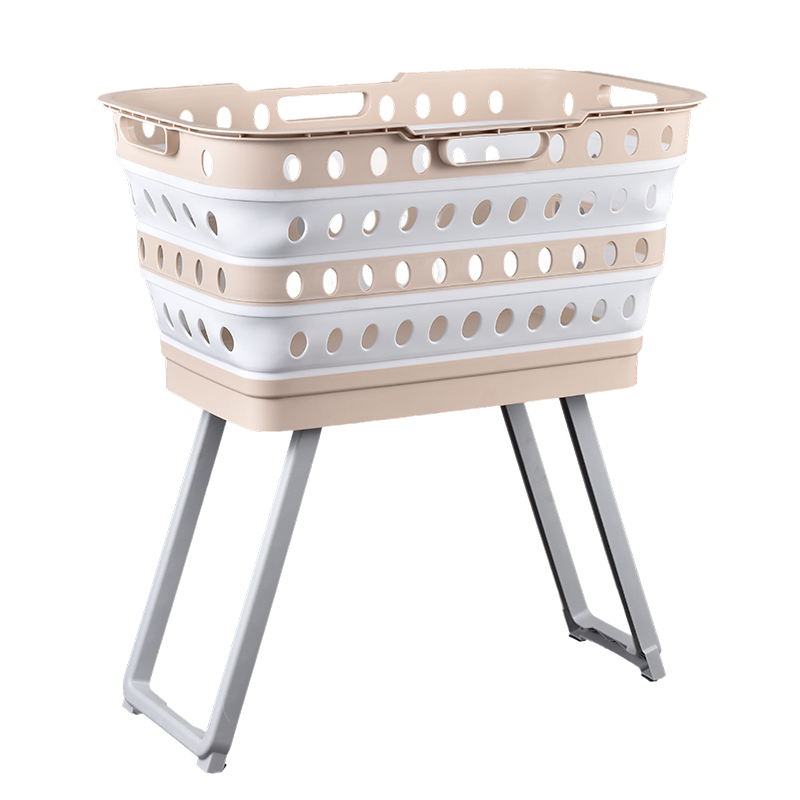
The basket is the widest of the three lines on both capacity and format. It runs from 3L to 43L across more than 90 styles, carries a published fold life of 5,000 to 10,000 cycles, and is rated from -20°C to 120°C. It is the only one of the three whose published ceiling sits above the boiling point of water, and the only one sold as a family of silhouettes rather than a fixed shape.
Format selection inside the line is as decisive as capacity. A folding laundry basket prioritizes volume and wall height. A folding hand basket or folding shopping basket prioritizes grip and low empty weight. A folding picnic basket and a folding basket with lid prioritize closure and transport. A wheeled folding basket, pull rod folding basket or folding basket with stand trades internal volume for floor-rolling or elevated use. A perforated hollow folding basket, folding drain basket or folding vegetable basket prioritizes drainage and airflow. Oval, square and rectangular folding baskets change how the unit tessellates inside a carton and on a shelf, while thickened folding basket and large capacity folding basket variants cover heavy laundry and bulk retail. Car folding basket and hanging folding basket formats serve trunk storage and wall storage respectively, and folding storage basket formats cover closet organization.
Boundary to note: an open or perforated basket is the wrong container for water, and even solid-wall basket styles are not built to be carried one-handed with a full liquid load. If the job involves moving water, the bucket or the basin is the correct line, regardless of which one looks larger in the photo.
Collapsible Water Bucket (FB-10L): a closed column of water that travels
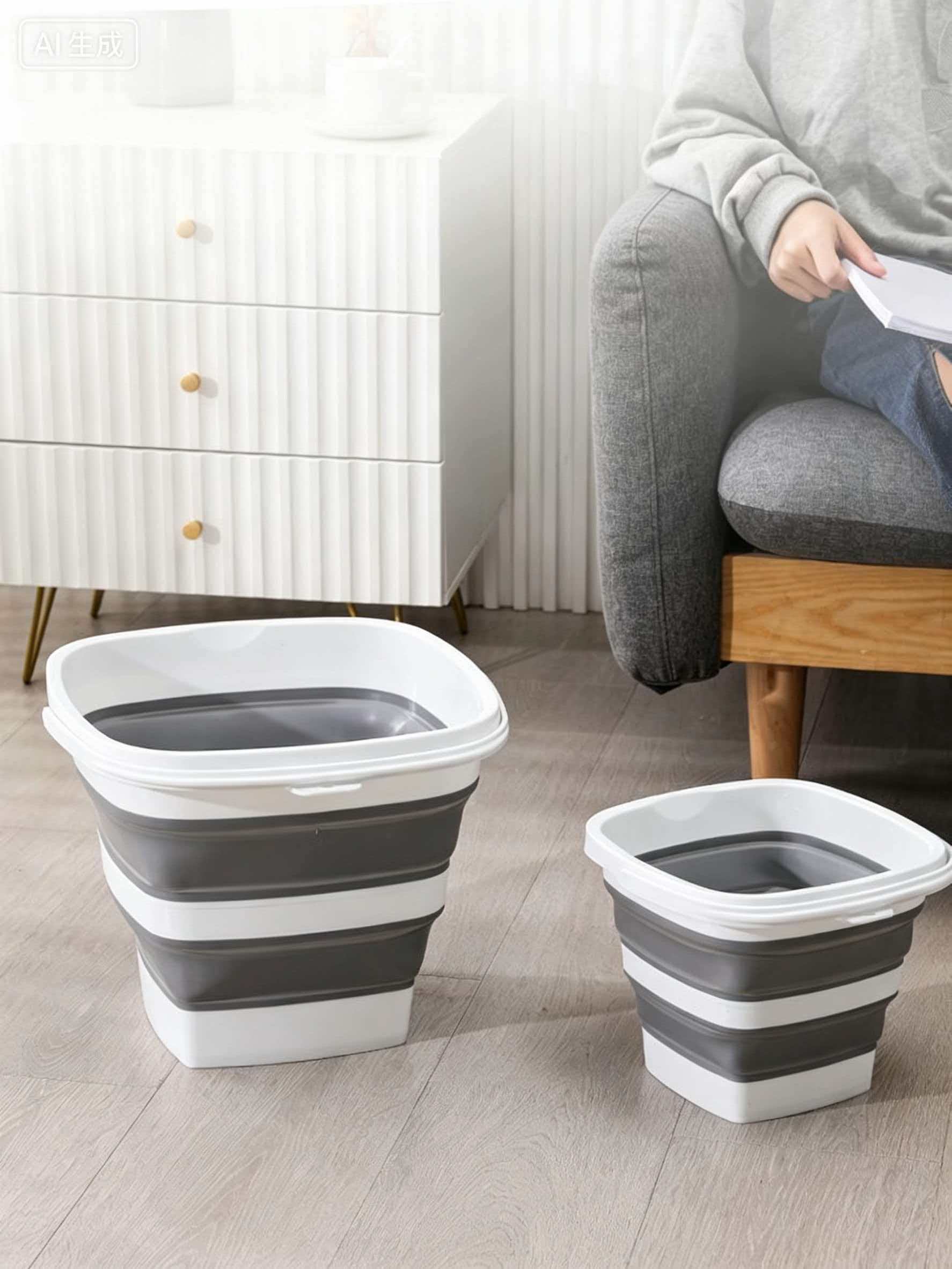
The bucket solves a problem the other two lines cannot: moving a defined volume of water over a distance without losing it. Model FB-10L is offered in 5L, 10L, 15L and 20L capacities. Unfolded dimensions run Φ22×24 cm for 5L, Φ26×30 cm for 10L, Φ30×34 cm for 15L and Φ34×38 cm for 20L, and the folded thickness is 3–4.5 cm.
Its published figures are specific and easy to compare. Maximum water load tracks the size exactly at 5, 10, 15 and 20 kg. Folding cycle life is at least 6,000 cycles — the highest published fold count of the three lines. Soft wall hardness is Shore A 65–90, the firmer of the two published ranges, which is consistent with a tall water column that must hold its shape. Operating temperature is -20°C to +60°C. The construction is a hard PP rim with a TPE foldable body, an integrated carry handle, waterproof and leak-proof seams, oil resistance and easy rinsing.
Typical duties are outdoor water fetching, fishing, car washing, cleaning-tool soaking, mopping and floor work, plant watering, field water collection, temporary seafood holding, hotel and mall cleaning operations, and small hardware parts cleaning in workshops.
Boundary to note: the +60°C ceiling excludes boiling water. Buyers who need a hot-liquid container should specify the basket line, which is rated to 120°C, rather than pushing the bucket beyond its published range.
Collapsible Plastic Basin: wide, shallow and load-bearing
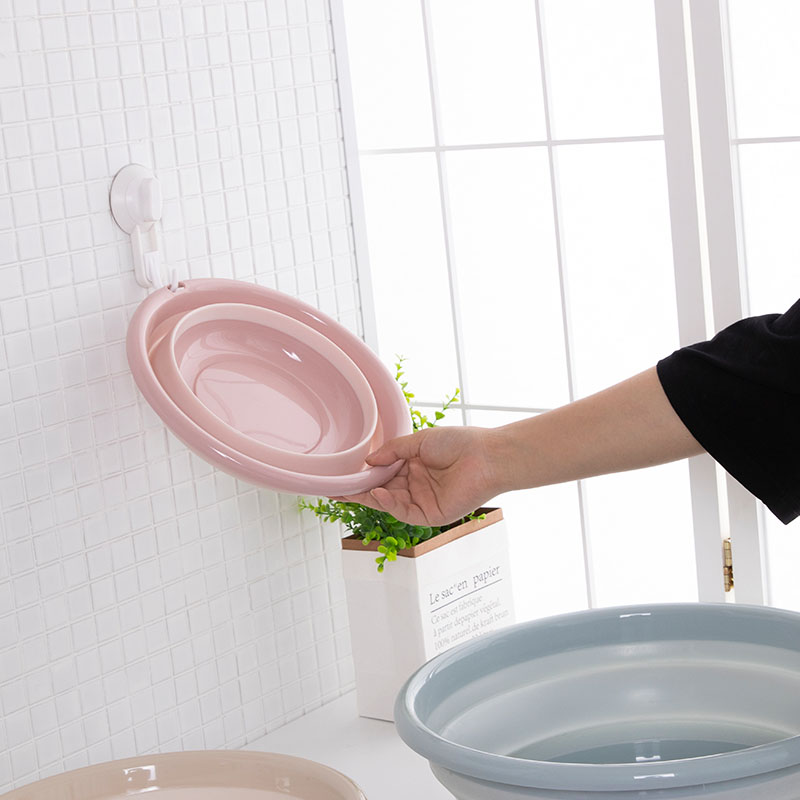
The basin is the soaking shape. Capacities are 5L, 8L, 10L, 12L, 15L and 20L, with reference unfolded sizes of 30×25×12 cm (small), 38×30×15 cm (medium) and 45×35×18 cm (large). Folded thickness is 2.5–4 cm — the thinnest of the three lines — and the maximum bearing load is 12–25 kg, the highest published load figure across the range.
Two further parameters matter for spec sheets. Folding service life is at least 5,000 cycles, and flexible wall hardness is Shore A 60–85, the softer of the two published ranges, which suits a wide open mouth that has to flex without cracking. Operating temperature is -20°C to +60°C. The material set is a hard PP frame with a TPE foldable soft wall, non-toxic and odorless, anti-aging, fold-resistant, waterproof and stain-resistant, and easy to rinse.
The line is also the most granular in named variants: FP-HOME15 for household washing, FP-CAMP10 for camping, FP-PET8 as a pet cleaning tub and FP-CAR12 as a car wash foldable basin, alongside the straight FP-5L to FP-20L sizes. Typical duties are laundry pre-soak and hand washing, fruit and vegetable cleaning, foot bath, daily hand washing, small pet bathing, auto parts soaking, hotel and office cleaning tools, manicure and pedicure work, and portable picnic water holding.
Boundary to note: the basin's strength is bearing load in a stationary position. Its wide rim is not designed for carrying a full load over distance; that is the bucket's job.
Where the three lines actually diverge
Five parameters separate the lines, and each one maps to a decision a buyer has to make anyway.
- Top geometry. The basket is open and often perforated; the bucket is a closed, narrow column; the basin is wide and shallow. This single difference decides solid versus liquid duty more reliably than any other specification.
- Temperature ceiling. Basket: -20°C to 120°C. Bucket and basin: -20°C to +60°C. Hot-liquid, hot-wash and boiling-water applications belong to the basket line.
- Load definition. The basket is volume-rated (3L–43L); the bucket is rated by maximum water load (5–20 kg); the basin is rated by maximum bearing load (12–25 kg). Comparing a liter figure with a kilogram figure is the most common cause of a mis-specified order.
- Fold life. Bucket ≥6,000 cycles; basket 5,000–10,000 cycles; basin ≥5,000 cycles. High-frequency daily folding favors the bucket; the basket line's upper range covers the widest spread of use intensity.
- Wall hardness. Bucket Shore A 65–90, basin Shore A 60–85. Firmer walls hold a tall water column; softer walls flex across a wide mouth.
Comparison table: basket vs. bucket vs. basin
| Parameter | Plastic Folding Basket | Collapsible Water Bucket (FB-10L) | Collapsible Plastic Basin |
|---|---|---|---|
| Capacity range | 3L – 43L | 5L / 10L / 15L / 20L | 5L / 8L / 10L / 12L / 15L / 20L |
| Format depth | Over 90 styles | 4 sizes, 1 body format | 6 sizes plus FP-HOME15, FP-CAMP10, FP-PET8, FP-CAR12 |
| Unfolded size reference | Style-dependent | 5L Φ22×24 cm; 10L Φ26×30 cm; 15L Φ30×34 cm; 20L Φ34×38 cm | Small 30×25×12 cm; Medium 38×30×15 cm; Large 45×35×18 cm |
| Folded thickness | Style-dependent | 3 – 4.5 cm | 2.5 – 4 cm |
| Fold cycle life | 5,000 – 10,000 cycles | ≥6,000 cycles | ≥5,000 cycles |
| Load definition | Volume-rated (3L–43L) | Max water load 5–20 kg, matched to size | Max bearing load 12–25 kg |
| Operating temperature | -20°C to 120°C | -20°C to +60°C | -20°C to +60°C |
| Flexible wall hardness | Style-dependent | Shore A 65–90 | Shore A 60–85 |
| Material | PP + TPE composite, BPA-free | PP hard rim + TPE foldable body | PP hard frame + TPE soft wall |
| Food contact | BPA-free; FDA, LFGB, REACH, RoHS, ASTM held at company level | LFGB, FDA food contact approved | FDA, LFGB food contact grade |
| Best-fit duty | Laundry, storage, picnic, shopping, draining, closet organization | Outdoor water fetching, car washing, mopping, fishing, plant watering | Soaking, pet bathing, foot bath, vegetable washing, parts soaking |
Read this table as a filter rather than a scorecard. There is no overall ranking among the three lines, because the rows that decide an order — top geometry, temperature ceiling, load definition — are fixed by the application, not by quality.
Step-by-step: how to specify one of the three lines
A defensible specification follows the same seven steps regardless of market.
- Classify the load. Solid, liquid or mixed. Liquid duty eliminates the basket; solid bulk duty eliminates the bucket.
- Fix the working volume per cycle. Under 5L, the basin or bucket covers it; 10–20L covers most household and car-care jobs; above 20L only the basket line reaches, up to 43L.
- Set the temperature ceiling of what goes in. Anything at or above boiling point requires the basket line's 120°C rating; routine cold and warm water stays within the bucket's and basin's +60°C range.
- Choose open or closed top. Ventilation and drainage require the basket; containment of water requires the bucket or a solid-wall basin.
- Confirm the carry mode and distance. Repeated carrying over distance requires the bucket's integrated handle; stationary work suits the basin's bearing load.
- Confirm the storage mode. For the tightest folds, the basin is 2.5–4 cm and the bucket 3–4.5 cm; hanging, lidded, wheeled and pull-rod formats exist in the basket line.
- Lock compliance, tooling and packing. Confirm the certification set for the destination market, confirm whether an existing mold covers the size or a new tool is required, and confirm carton density before comparing landed cost.
Use cases: matching the job to the product
| Job to be done | Best-fit line | Reason |
|---|---|---|
| Household laundry sorting and carrying | Plastic folding basket | 3L–43L, up to 120°C, ventilated and lidded formats available |
| Hand washing and pre-soak | Collapsible plastic basin | Wide open mouth, 12–25 kg bearing load, 2.5–4 cm folded |
| Home car washing | Bucket for water; basin (FP-CAR12) for soaking | Bucket moves 5–20 kg of water; basin holds mitts and parts |
| Outdoor water fetching and fishing | Collapsible water bucket | Closed column, integrated handle, ≥6,000 fold cycles |
| Pet supplies and pet bathing | Basin (FP-PET8) plus basket for towels | Shallow wide basin for washing; basket for ventilated storage |
| Picnic and camping | Picnic basket, FP-CAMP10 basin, bucket | Dry goods, washing and water transport covered by three formats |
| Kitchen prep and draining | Perforated / drain folding basket | Drainage and airflow are built into the format |
| Commercial cleaning crews | Collapsible water bucket | Sealed transport, oil resistance, easy rinsing |
| Retail shelf and cross-border e-commerce | All three lines | 75%–85% volume reduction, 4–5× more pieces per carton |
OEM customization and purchasing notes
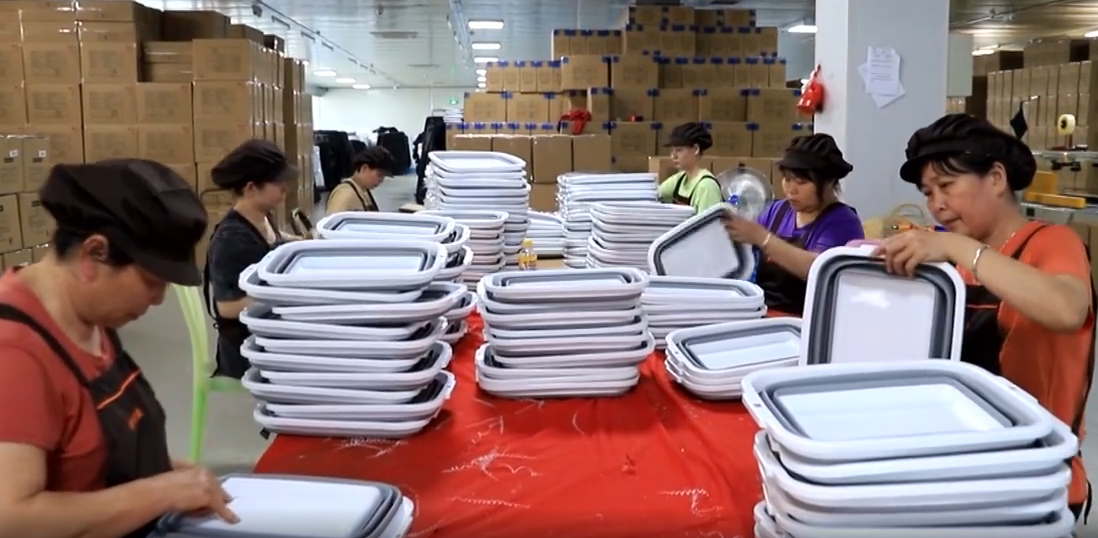
Customization capacity is where these three lines are evaluated together rather than separately. The manufacturer runs 12 injection molding machines from 300g to 2500g, manipulators, automatic packing machines, thermoforming machines and 3 assembly lines, and holds 200 self-developed production molds — the reason a basket quotation can be built on an existing tool instead of new tooling, and the reason a basin or bucket size can be matched to a regional program.
- Custom size and color: supported across the range; the basket line explicitly supports custom size and color on the 200-mold base, and the company tailors sizes, colors and structures to regional market demand.
- Structure IP: 23 independent product patents cover the one-piece fold-expand structure, which removes the assembly step that spliced foldable items require.
- Tooling timing: standard mold opening cycle is 30–40 days, with mold repair response within 2–3 days.
- Certification set: BSCI, ECM, FDA, REACH, RoHS, ASTM and SEDEX, on top of the BPA-free PP+TPE base and per-line FDA/LFGB food-contact status.
- Capacity and footprint: a 6,000 m² production plant plus a 3,500 m² independent warehouse, over 9,500 m² total, run by approximately 39 staff including a four-engineer R&D team.
- Export profile: 70% of sales are exported, with major markets in the USA, UK, Germany, Spain, Australia, Korea and Japan. The company is a long-term exclusive supplier to Walmart and Sam's Club and works with Netto in Germany and Nitori and 3Coins in Japan.
Purchasing note: for food-contact SKUs sold in the EU, plastic folding baskets and basins used with vegetables, picnic food or drinking water sit inside the scope of Regulation (EC) No 1935/2004 and Regulation (EU) No 10/2011 for plastic materials, with good manufacturing practice regulated under Commission Regulation (EC) No 2023/2006. Ask for the declaration that matches the exact SKU and destination market rather than a general certificate.
FAQ
Do the folding basket, water bucket and basin meet food-contact regulations?
The collapsible plastic basin supports FDA and LFGB food-contact grade, and the collapsible water bucket is LFGB and FDA food-contact approved. The basket line is made from BPA-free food-grade PP+TPE, and at company level the product range holds BSCI, ECM, FDA, REACH, RoHS, ASTM and SEDEX certification. For EU food-contact programs, buyers should pair those certificates with the SKU-level declaration covering Regulation (EC) No 1935/2004, Regulation (EU) No 10/2011 and Commission Regulation (EC) No 2023/2006.
Can the basket, bucket and basin be customized in size and color, and what tooling supports it?
Yes. The manufacturer holds 200 self-developed production molds and offers over 90 styles, with custom size and color supported across the range and explicit custom size and color support on the basket line. The fold structure is protected by 23 independent product patents for the one-piece fold-expand design, and a standard new mold opening cycle takes 30–40 days, with mold repair response within 2–3 days.
What drives the unit cost difference between the three lines?
Four cost drivers separate the lines. Material weight per piece and wall thickness set the resin cost, which is highest on thickened and large-capacity baskets. Fold-structure complexity matters, because a patented one-piece fold-expand body avoids the assembly step that spliced items require. Packing density changes freight per unit: after folding, volume falls by 75%–85%, cartons hold 4–5 times more pieces and container space utilization rises by 300%, so a thinner folded profile lowers landed cost. Finally, the certification scope required by the destination market adds testing cost per SKU.
How should a buyer validate samples before placing a bulk order?
Validate the claim, not the appearance. Check the fold-count specification against the line: 5,000–10,000 cycles for the basket, at least 6,000 for the bucket and at least 5,000 for the basin. On the bucket and basin, fill to the rated level and inspect the heat-pressed fold lines and sealed seams for leaks. Load-test to the published figure — 5–20 kg of water for the bucket, 12–25 kg bearing for the basin. Confirm the temperature range at both ends, -20°C and the rated ceiling, and check the TPE wall hardness and the rim and handle joints. Finally, confirm the folded thickness and carton packing against the specification sheet.
How long does tooling and first production take for a custom folding basket, bucket or basin?
The standard mold opening cycle is 30–40 days from approval, and mold repair response is within 2–3 days, which is the practical timing anchor for a new size or structure. Mass production then runs against the confirmed specification and approved sample; because the company operates as an integrated factory-trade manufacturer, there is no intermediate link between tooling and the production line. Buyers planning a launch should therefore sequence sample approval first, tooling second and bulk scheduling third.
To move from comparison to a decision, request a sample set covering the basket format, bucket size and basin model you are considering, together with a quotation against your target volume, by email at sales01@nantongplastic.com or WhatsApp at +86 151-5762-9088.
Conclusion: choose the line by the job, then specify within it
The plastic folding basket, the collapsible water bucket and the collapsible plastic basin share one material platform — food-grade BPA-free PP+TPE, a patented one-piece fold-expand structure, 75%–85% volume reduction and a -20°C lower limit — but they are not substitutes. The basket owns open, ventilated, solid-load duty from 3L to 43L with a 120°C ceiling. The bucket owns sealed water transport from 5L to 20L with a 5–20 kg water load and the highest fold count at 6,000-plus cycles. The basin owns wide, shallow soaking with a 12–25 kg bearing load and the thinnest fold at 2.5–4 cm.
Specify in this order: load state, working volume, temperature ceiling, top geometry, carry mode, storage mode, then compliance and tooling. A purchase order built in that sequence rarely needs a revision, and it makes the landed-cost comparison meaningful because every SKU in the mix is doing a job it was designed for.
Next step: sample set, quotation and catalog
TAIZHOU NANTONG PLASTIC CO.,LTD supplies the Plastic Folding Basket, Collapsible Water Bucket and Collapsible Plastic Basin from a single production base in Taizhou, Zhejiang, with 200 self-developed molds and over 90 foldable styles. Request a sample set matched to your application, or download the 2026 product catalog for full specifications.
Website: www.nantongplastic.com
Catalog download: 2026 TAIZHOU NANTONG PLASTIC Catalog (PDF)
Email: sales01@nantongplastic.com · Tel / WhatsApp: +86 151-5762-9088
Have Questions or Need More Details?
Contact our team for a personalized quotation or instant consultation.
Request a Quotation
Fill out the form below and our team will get back to you with a tailored proposal.
WhatsApp Direct Chat
Prefer to chat in real-time? Message us on WhatsApp for instant assistance & quick answers.
- Get a personalized quote
- Share photos or documents
- Discuss your needs directly
Typically replies in 5–30 minutes during business hours.