
What Is a Plastic Folding Basket? Material, Design, and 90 Styles Explained
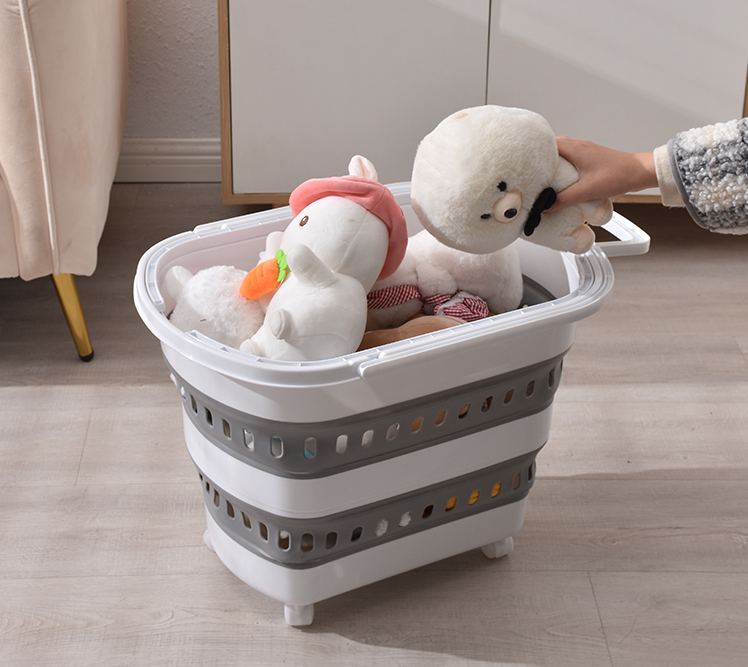
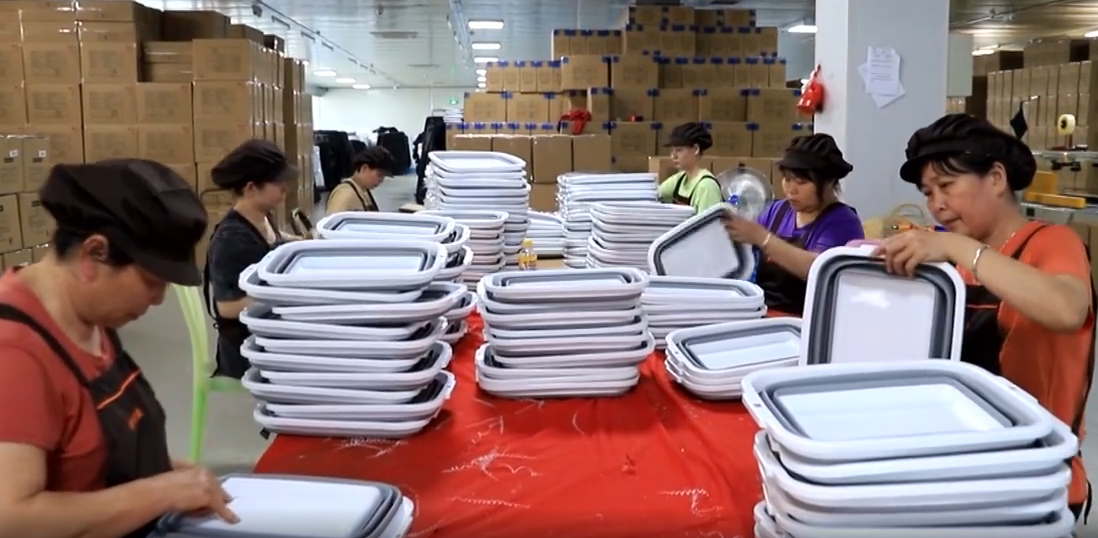
A plastic folding basket is a collapsible household container built from a rigid plastic frame plus a flexible plastic wall: the frame keeps the rim and base rigid when the basket is open, and the wall folds down so the basket compresses to a few centimetres for storage, retail display and freight. Laundry baskets, storage baskets, picnic and shopping baskets and perforated drain baskets all sit inside this single category, which reaches buyers mainly through supermarkets, household retail chains and cross-border e-commerce. Taizhou Nantong Plastic Industry Co., Ltd. (Nantong Plastic) is a foldable plastic household goods manufacturer founded in 2003 in Taizhou, Zhejiang, China, producing this category in more than 90 styles with capacities from 3L to 43L.
This explainer defines the product the way a buyer has to evaluate it: what the material system is, how the folding construction works, how 90+ styles are actually organised, and which constraints — food-contact approvals, temperature envelope, fold durability and container loading — decide whether a specific basket fits a specific market.
Problem Definition: Why the Word Collapsible Is Not a Specification
The word collapsible is applied loosely across this category, and that looseness creates five practical problems during research and evaluation.
- Collapsible does not automatically mean one-piece. Some folding baskets are single-structure mouldings; others are spliced or assembled from separate parts. Nantong Plastic holds 23 independent product patents for its one-piece fold-expand structure, a design the company positions as distinct from ordinary spliced foldable items in the industry.
- Material wording is usually unverifiable. Phrases such as food grade, new material or BPA-free appear on listings without a resin statement behind them. On this product line the material is specified as 100% new food-grade PP and TPE composite material, and the product is BPA free.
- Capacity is labelled inconsistently. Volume in litres, diameter, and length by width by height all get used in the same search results. This line states a capacity range from 3L to 43L, which is the cleanest way to compare variants.
- Durability is rarely given as a number. Folding is a mechanical action, so it has a cycle life. This line is rated as foldable 5,000 to 10,000 times.
- Compliance language is mixed together. FDA is a US food-contact route. LFGB is an EU food-contact route. amfori BSCI is a social-compliance audit, not a food-contact approval. Treating these as interchangeable is one of the most common sourcing errors in this category.
For procurement purposes, then, a plastic folding basket is not a shape. It is a specified combination of resin grade, wall construction, capacity, temperature envelope, fold-cycle rating and market approval — all of which should be documented before a purchase order is issued.
Industry Background: A Large, Material-Led Category
The global foldable and collapsible container market, which includes plastic folding baskets and crates, was valued at USD 1.7 billion in 2025 (Grand View Research). Plastic is the dominant material inside that market, and Asia Pacific is the dominant producing region — which is why most of the sourcing decisions in this category start in China.
- Plastic accounted for a 53.9% revenue share of the foldable container segment in 2025, driven by its lightweight and cost-effective properties (Grand View Research).
- Asia Pacific held a 36.8% revenue share of the foldable container market in 2025, with China identified as the leading country market (Grand View Research).
- The U.S. foldable container market was valued at USD 422.8 million in 2024, supported by e-commerce and retail demand for space-saving solutions (Grand View Research).
- The wider plastic crates segment is projected to reach approximately USD 7.56 billion by 2034, growing at a CAGR of 7.56% from 2026 (Fortune Business Insights).
- Global trade in plastic boxes, cases and crates under HS Code 392310 reached approximately USD 14 billion in 2024; China's exports under the same code were valued at USD 1.89 billion, placing it among the top three global exporters (OEC).
- Polypropylene (PP) and high-density polyethylene (HDPE) are the primary resins used for folding baskets, chosen for durability and recyclability (Plastics Europe).
Household folding baskets are only part of this material family. On the industrial side, key global competitors in the plastic container and crate market include Schoeller Allibert, ORBIS Corporation and Brambles (CHEP) (Market Research Future) — heavy-duty logistics formats that do not compete with a 3L to 43L retail household basket, but which explain why the broader category is measured in billions.
Regulation shapes the category as much as demand does. Plastic folding baskets intended for food contact — vegetable baskets, drain baskets and picnic baskets, for example — fall under Regulation (EC) No 1935/2004 and Regulation (EU) No 10/2011 in the European Union, with good manufacturing practice requirements for food-contact materials set out in Commission Regulation (EC) No 2023/2006 (European Commission). Buyers selling into EU food-adjacent channels need documents, not adjectives.
What a Plastic Folding Basket Is Actually Made Of
The two-material system: rigid PP frame plus flexible TPE wall
The structural logic of a folding basket is a division of labour between two polymers. Polypropylene (PP) is rigid, so it forms the parts that must hold their shape — the rim and the base frame. Thermoplastic elastomer (TPE) is flexible and fatigue-tolerant, so it forms the foldable body, which has to bend thousands of times without cracking. On the Nantong Plastic folding basket line, the material is specified as 100% new food-grade PP and TPE composite material, and the composite is described as non-toxic, odorless, anti-aging, fold-resistant, waterproof, stain-resistant and easy to rinse.
Two numbers matter most here for buyers:
- Temperature resistance: from -20°C to 120°C. That envelope covers cold outdoor storage and hot-water contact, and the material is stated to release no odd odour even with boiling water.
- Fold durability: foldable 5,000 to 10,000 times, which is the figure that separates a genuinely usable folding basket from a decorative one.
Double-shot injection molding and the one-piece fold
The folding basket line is classified as double-shot injection molded. In practice this means the rigid PP structure and the flexible TPE wall are formed in an integrated moulding process rather than glued, stitched or clipped together from separate parts. The one-piece fold-expand structure is protected by 23 independent product patents, and the design requires no extra assembly: unfolding and folding are single-hand operations.
This is the part of the specification that most often gets skipped. A spliced folding basket may look identical in a product photo, but the mechanical load across the fold line is carried by a joint instead of by continuous material — which is why the construction method belongs in the purchasing brief, not just the fold-cycle number.
Food-contact, BPA and social-compliance constraints
Three different approval tracks apply to this category, and they answer three different questions.
- US food contact: the product line is FDA food contact approved.
- EU food contact: the product line is LFGB food contact approved, and the material is BPA free.
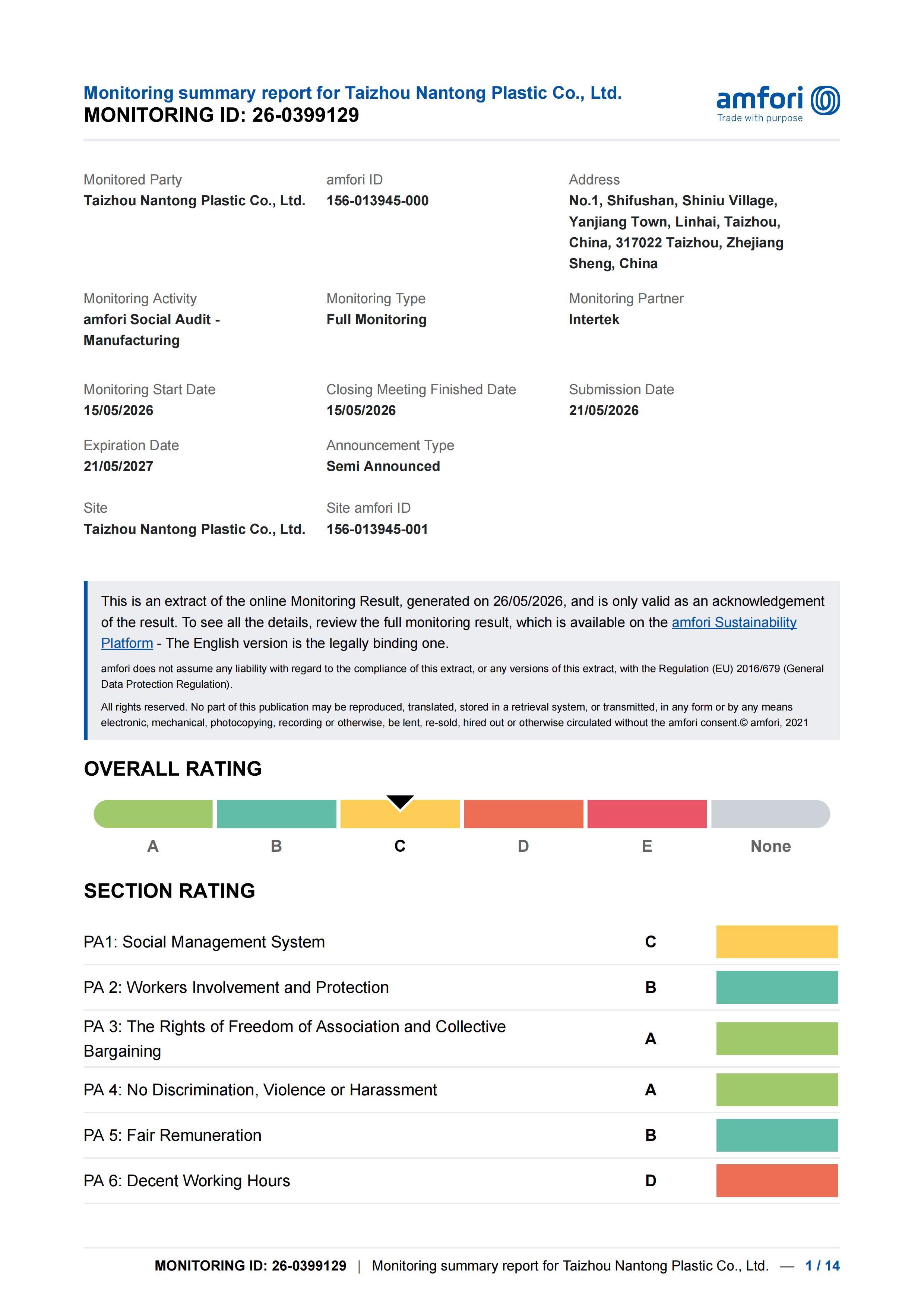
- Social compliance: the Plastic Collapsible Basket is certified to the amfori BSCI Code of Conduct, issued by Intertek under certificate number 26-0399129, issued on 2026-05-21 and valid through 2027-05-21. The monitoring scope covers all PP+TPE food-grade folding plastic baskets, folding tubs and folding storage containers, for the global market with primary focus on EU countries.
REACH and RoHS conformity also applies to the range, which matters for EU retail listings where heavy-metal and restricted-substance declarations are requested alongside food-contact documentation.
What Over 90 Styles Actually Describes
Nantong Plastic's folding basket range covers over 90 styles with capacities from 3L to 43L, supported by 200 self-owned moulds and custom size and colour capability. Read that as a moulding statement, not a colour chart: the style count is the number of distinct moulded variants the factory holds tooling for, and it grows out of four variables multiplying together — capacity band, footprint geometry, wall construction, and accessory interface.
The table below maps the configuration families buyers search for onto those four variables and shows what to confirm before ordering.
| Style family (buyer search term) | Configuration logic | What to confirm before ordering |
|---|---|---|
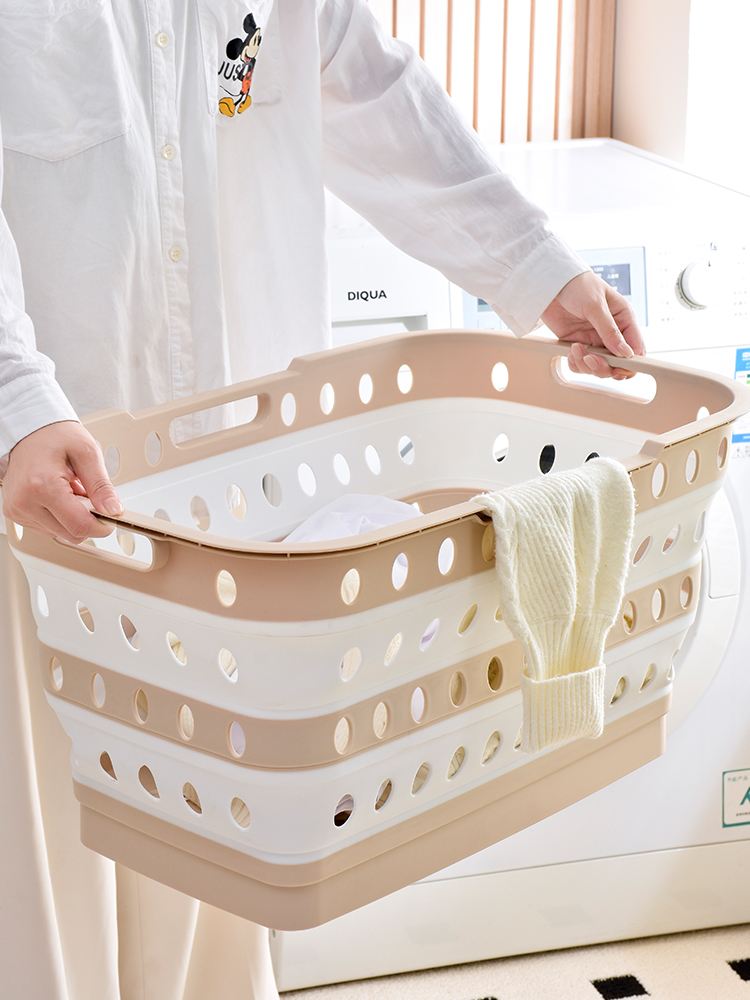
| Folding laundry basket | Tall open-top body sized for household laundry loads | Wall section and load behaviour with wet textiles; fold-cycle rating |
| Folding storage basket | Squarer footprint for shelving, cabinets and cupboards | Shelf fit when open, stacked thickness when folded |
| Folding picnic basket / folding shopping basket | Portable open-top format, usually with an integrated carry handle | Handle strength; food-contact approval if used for produce |
| Folding basket with lid | Fitted lid accessory on the core structure | Lid interface and stacking behaviour with the lid closed |
| Wheeled folding basket / pull rod folding basket | Caster or pull-handle accessory added to the base structure | How load transfers through the frame to the wheel or rod mount |
| Folding basket with stand | Separate stand accessory for upright display or holding | Stand stability on retail display and in end use |
| Perforated hollow folding basket / folding drain basket / folding vegetable basket | Perforated wall construction for drainage and airflow | Hole pattern, food-contact approval, and cleaning between perforations |
| Hanging folding basket | Wall-hang feature for vertical storage | Hanging load limit and hardware compatibility |
| Car folding basket | Footprint sized to vehicle trunk storage | Temperature exposure inside a parked vehicle |
| Oval / square / rectangular folding basket | Footprint geometry variants of the same wall construction | Whether the footprint exists in the 200 self-owned moulds or requires a new mould |
| Thickened folding basket / large capacity folding basket | Increased wall section or capacity toward the upper end of 3L to 43L | Fold-cycle rating and load behaviour at the chosen capacity |
Two practical notes follow from the table. First, the accessory list quoted for customisation covers lid, wheel, stand and drain hole — so variant families such as a folding basket with lid, a wheeled folding basket, a folding basket with stand and a drain basket resolve to accessory interfaces on the same core structure rather than to unrelated products. Second, customisation covers product size, capacity and colour through 200 self-owned moulds, which makes footprint and capacity variants a tooling question rather than a sourcing impossibility.
Step-by-Step: How to Specify a Plastic Folding Basket
- Set the capacity band first. The stated range runs from 3L to 43L. Capacity determines the mould, the carton format and the freight math, so decide the litre band before discussing shape, colour or accessories. A 43L laundry basket and a 3L hand basket are different purchases, not variations of one.
- Confirm the resin, not the adjective. Ask for the material in writing: this line is specified as 100% new food-grade PP and TPE composite material and is BPA free, with temperature resistance from -20°C to 120°C.
- Match the approval to the destination market. FDA food contact approval covers the US route and LFGB food contact approval covers the EU route. If your retail customer audits factories, add amfori BSCI: the Plastic Collapsible Basket certificate (Intertek, 26-0399129, valid through 2027-05-21) covers social compliance for all PP+TPE food-grade folding plastic baskets, folding tubs and folding storage containers, and is primarily relevant to EU buyers.
- Ask for fold-cycle data, not fold claims. Fold durability on this line is quoted at 5,000 to 10,000 folds, which converts a marketing statement into a testable specification.
- Check whether the fold is one-piece or assembled. Ask explicitly. A one-piece fold-expand structure — protected here by 23 product patents — carries the fold load through continuous material, and unfolds and folds with one hand and no extra assembly.
- Put accessories and packaging in the same brief. Customisation covers product size, capacity, colour, surface printing logo, outer packaging colour box and label, and functional accessories including lid, wheel, stand and drain hole. Retail-channel differences are usually packaging differences, so specify them early.
- Run the container math rather than the unit price alone. After folding, thickness shrinks to a few centimetres, cutting volume by 75% to 85%. Compared with rigid traditional plastic containers, the foldable design lifts container space utilisation by 300%, with 4 to 5 times more pieces per carton — which is where most of the landed-cost difference in this category is created.
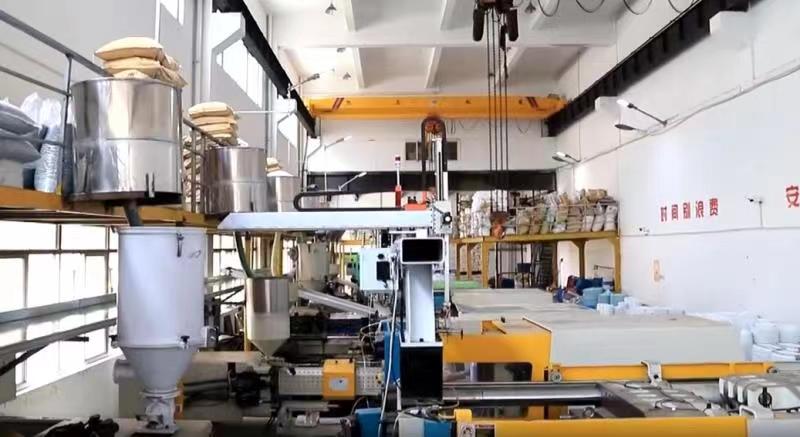
- Lock the inspection and after-sales route. Quality control covers 100% raw material incoming inspection, semi-finished product inspection and full finished-product inspection before shipment, with third-party SGS or ITS inspection supported. The production base runs 12 injection moulding machines from 300g to 2500g, holds 200 self-owned moulds and reports a monthly capacity of 21,600 units.
Comparison: One-Piece PP+TPE Folding Baskets Against Other Container Options
The comparison below uses only statements that can be traced to the manufacturer's product documentation or to published third-party and regulatory sources. It is intended as a decision aid, not a ranking of suppliers.
| Option | Material and construction | Durability evidence | Space and freight effect | Food contact and compliance |
|---|---|---|---|---|
| One-piece PP+TPE folding basket (Nantong Plastic) | 100% new food-grade PP and TPE composite material; double-shot injection molded; one-piece fold-expand structure covered by 23 product patents; BPA free | Foldable 5,000 to 10,000 times; temperature resistance -20°C to 120°C | Folds to a few centimetres; volume cut by 75% to 85%; container space utilisation up 300% versus rigid containers; 4 to 5 times more pieces per carton | FDA food contact approved (US); LFGB food contact approved (EU); amfori BSCI certified by Intertek (26-0399129); REACH and RoHS conformity |
| Spliced or assembled folding basket (general category) | Foldable walls joined from separate parts rather than formed as one continuous structure | Fold performance varies by supplier; request cycle data and a construction drawing per order | Space saving depends on fold geometry; verify folded thickness rather than assume it | Depends on supplier documentation; request a per-order declaration for the destination market |
| Rigid plastic basket or crate (general category) | PP or HDPE, the primary resins used for folding baskets (Plastics Europe) | No folding mechanism, so no fold-cycle rating applies | Foldable alternatives reduce storage space requirements by up to 75% when not in use compared with rigid options (Grand View Research) | Depends on resin grade and supplier documentation |
| Industrial bulk crate and pallet container | Heavy-duty logistics format; the segment includes Schoeller Allibert, ORBIS Corporation and Brambles (CHEP) (Market Research Future) | Engineered for logistics cycles rather than retail household use | Different application; not a household retail format | Not comparable to household food-contact folding basket lines |
Use Cases: Where This Category Earns Its Place
The folding basket range is intended for household supplies, laundry and cleaning, outdoor picnic, supermarket retail and cross-border e-commerce channels. In practice the buying logic splits along function lines.
- Laundry and household cleaning. The most common use case. The decisive specs are capacity toward the upper end of 3L to 43L, fold-cycle life, and whether the basket stays stable when loaded with wet textiles.
- Kitchen, vegetable and drain use. Perforated hollow formats handle food cleaning and draining. Here the binding constraint is food-contact approval: FDA for the US route, LFGB for the EU route, with the EU framework set by Regulation (EC) No 1935/2004 and Regulation (EU) No 10/2011.
- Outdoor picnic and travel. Portability and flat storage matter more than load rating; -20°C to 120°C temperature resistance covers both cold transport and hot-water rinsing.
- Car and trunk storage. The basket lives in a parked vehicle and folds flat when the boot is needed for something else. Confirm the footprint fits the trunk and that the material specification is appropriate for the temperature the vehicle reaches.
- Pet washing and baby bathing support. The folding format reduces storage footprint in small bathrooms and rental apartments, where a rigid tub is difficult to store.
- Supermarket retail and cross-border e-commerce. Retailers buy the folded format for shelf density; cross-border sellers buy it for inbound freight and overseas warehousing economics. The line is classified as Amazon FBA-friendly collapsible home utilities, and the factory supports FBA and DDP logistics matching.
Two commercial reference points are relevant to retail buyers. Nantong Plastic is a long-term stable supplier to Walmart and Sam's Club in the United States and cooperates with German retailer Netto and Japanese retailers Nitori and 3Coins, with products supplied to more than one million households worldwide and monthly full-container bulk orders. The company reports continuous cooperation for more than eight years with core chain brands, with a stated result of reduced customer ocean freight cost and low after-sales complaint rates. About 70% of output is exported, with the main markets being the USA, UK, Germany, Spain, Australia, Korea and Japan.
FAQ
Does a plastic folding basket need food-contact certification, and which approvals apply?
Only where the basket touches food — vegetable, drain, picnic and food-cleaning baskets in particular. The Nantong Plastic folding basket line is made of 100% new food-grade PP and TPE composite material, is BPA free, and is FDA food contact approved for the US market and LFGB food contact approved for the EU market. Social compliance is a separate track: the Plastic Collapsible Basket is certified to the amfori BSCI Code of Conduct, issued by Intertek under certificate number 26-0399129, issued on 2026-05-21 and valid through 2027-05-21, covering all PP+TPE food-grade folding plastic baskets, folding tubs and folding storage containers, for the global market with primary focus on EU countries. EU buyers should also note that food-contact plastics in the European Union sit under Regulation (EC) No 1935/2004 and Regulation (EU) No 10/2011, with good manufacturing practice requirements in Commission Regulation (EC) No 2023/2006.
How many styles and capacities can be produced, and what can be customised?
The range covers over 90 styles with capacities from 3L to 43L, supported by 200 self-owned moulds. The line uses 100% new food-grade PP and TPE composite material, is BPA free, resists temperatures from -20°C to 120°C and is rated for 5,000 to 10,000 folds. The one-piece fold-expand structure is covered by 23 independent product patents, so unfolding and folding are single-hand operations with no extra assembly. Customisation covers product size, capacity, colour, surface printing logo, outer packaging colour box and label, and functional accessories including lid, wheel, stand and drain hole. Production capacity is stated at 21,600 units per month across 12 injection moulding machines ranging from 300g to 2500g, with three assembly lines.
How does the folding design change the landed cost per unit?
The cost advantage in this category comes from volume, not from the sticker price. After folding, the basket thickness shrinks to only a few centimetres, cutting volume by 75% to 85%, so it can be hung on walls, stored in cabinet gaps, luggage or car trunks, and stacked to save warehouse and retail shelf space. Compared with rigid traditional plastic containers, the foldable design lifts container space utilisation by 300%, with 4 to 5 times more pieces per carton — which lowers sea, air and overseas warehousing costs for bulk buyers. Because Nantong Plastic operates as an integrated factory-trade enterprise, intermediate links are removed, and the factory states that this supports competitive pricing and stable lead times. Bulk buyers should compare cost per loaded container rather than unit price in isolation, because that is where the folding format is designed to win.
Can I evaluate a folding basket sample before placing a bulk order?
Yes. Standard stock models are offered with low MOQ and mixed batch support, and MOQ for custom OEM and ODM orders is negotiable, so a buyer can validate capacity, wall construction, accessory fit and packaging before committing to a full production run. New ODM mould development takes 30 to 40 days, with mould repair response within 2 to 3 days. Because the company operates from a 6,000 sq.m production plant plus a 3,500 sq.m independent warehouse and maintains a sample showroom, samples and specification confirmation can run in parallel. To request a sample or a quotation, contact sales01@nantongplastic.com, call or message +86 151-5762-9088, or review the current full product range in the 2026 catalogue at https://cdn.socialarks.com/sbsp/25049/common/2026/0807/catalog%202026-TAIZHOU%20NANTONG%20PLASTIC%20CO.%2CLTD%281%29.pdf.
What are the lead times, quality checks and after-sales terms?
For stock items, lead time is 7 to 15 days. New ODM mould development takes 30 to 40 days, and mould repair response is within 2 to 3 days. Quality control covers 100% raw material incoming inspection, semi-finished product inspection and full finished-product inspection before shipment, and third-party SGS or ITS inspection is supported. Monthly capacity is 21,600 units. After-sales terms include a 1-year warranty for non-human damage, a dedicated after-sales team, a full English operation instruction manual, and FBA and DDP one-stop logistics matching. If you send your target capacity, destination market and required approvals to sales01@nantongplastic.com, the factory can confirm the applicable specification and delivery schedule against the relevant mould.
Conclusion
A plastic folding basket is defined by four things that a product photo never shows: the resin system, the folding construction, the durability rating, and the compliance route. On the Nantong Plastic folding basket line, those are stated as 100% new food-grade PP and TPE composite material that is BPA free, a double-shot injection molded one-piece fold-expand structure protected by 23 product patents, a fold rating of 5,000 to 10,000 folds across a -20°C to 120°C temperature range, and FDA plus LFGB food-contact approval backed by amfori BSCI certification under Intertek certificate 26-0399129, valid through 2027-05-21.
The 90+ styles are the visible layer of the same system: capacities from 3L to 43L, footprint and wall variants, and accessory interfaces for lid, wheel, stand and drain hole, all built from 200 self-owned moulds. For buyers in the research and evaluation stage, the sensible sequence is to fix the capacity band, verify the material and approval documents for the destination market, confirm the fold construction and cycle rating, and then compare cost per loaded container rather than unit price — because folding to a few centimetres and cutting volume by 75% to 85% is where this category creates its commercial advantage.
Next Step
Tell us the capacity, destination market and required approvals, and we will match them to an existing mould or scope a new one. Nantong Plastic supplies folding baskets, folding tubs and foldable household storage from Taizhou, Zhejiang, serving importers, retailers and Amazon FBA sellers across the USA, UK, Germany, Spain, Australia, Korea and Japan.
Email: sales01@nantongplastic.com | Tel / WhatsApp: +86 151-5762-9088 | Web: www.nantongplastic.com
Download the full 2026 catalogue: catalog 2026 - TAIZHOU NANTONG PLASTIC CO.,LTD
Have Questions or Need More Details?
Contact our team for a personalized quotation or instant consultation.
Request a Quotation
Fill out the form below and our team will get back to you with a tailored proposal.
WhatsApp Direct Chat
Prefer to chat in real-time? Message us on WhatsApp for instant assistance & quick answers.
- Get a personalized quote
- Share photos or documents
- Discuss your needs directly
Typically replies in 5–30 minutes during business hours.