
What Makes a Basket Collapsible? Foldable Plastic Household Goods Explained
A basket collapses because it is built from two plastics with very different stiffness — not because it has screws, hinges or moving parts. The rim, handles and base are molded from rigid polypropylene (PP), and that frame keeps the basket standing when it is open. The side wall is a soft thermoplastic elastomer (TPE) skin joined to that frame along heat-pressed fold lines. Press the basket down and only the soft wall moves: it folds in layers against the frame and the whole item flattens to a few centimetres of thickness. Pull it open again and the rigid frame restores the standing shape in a single movement, with no assembly.
That one design decision — hard frame, soft wall — is why a foldable plastic basket behaves differently from a rigid one in a kitchen, in a warehouse carton and in a sea container. This explainer covers what the category actually is, how the composite is put together, what the two ratings buyers see most often (fold cycle life and operating temperature) really describe, and how the basic concept maps onto everyday laundry, fruit and vegetable washing, outdoor water fetching and camping.
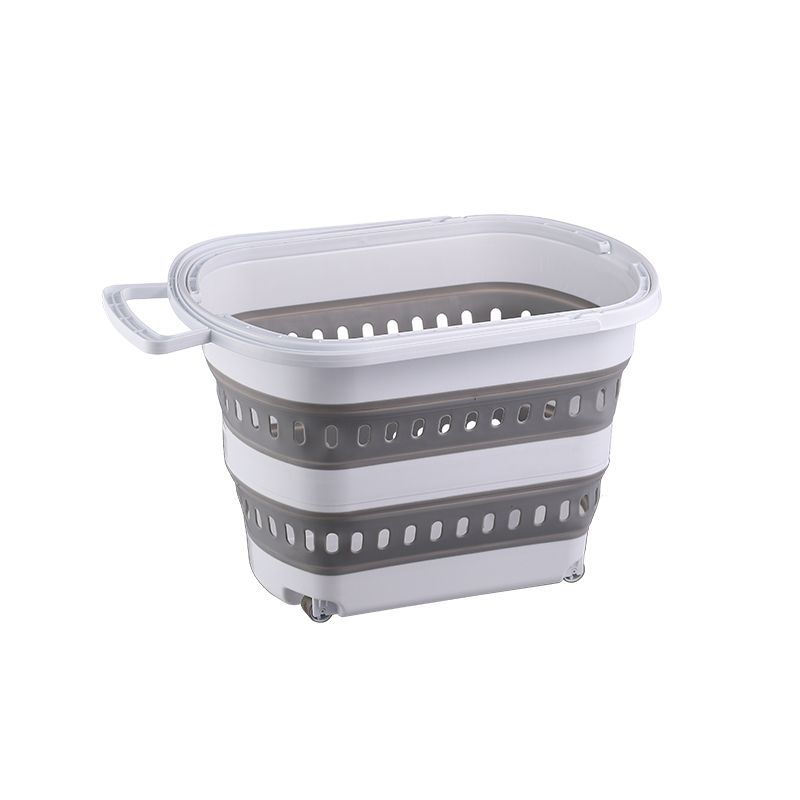
What “Collapsible” Means in Plastic Household Goods
A collapsible plastic household item is a container whose walls are engineered to deform at controlled hinge lines, so the item flattens for storage or transport and then returns to a self-supporting shape for use. Folding happens inside the body of the product itself — it is not a rigid crate with a folding lid, not a bag, and not an accessory that clips on.
The format covers four product families that share the same construction logic: foldable wash basins, foldable water buckets, foldable storage baskets and foldable laundry baskets, plus related items such as drain baskets. TAIZHOU NANTONG PLASTIC CO.,LTD, a manufacturer of foldable plastic household goods founded in 2003 and based in Taizhou, Zhejiang Province, China, produces over 90 styles across these families, with capacities from 3L to 43L and custom sizes and colours supported by 200 self-owned molds.
Trade language matters, because the same physical object is often listed under several names. A folding basket also appears as collapsible basket, foldable basket or plastic folding basket. A collapsible water bucket — model FB-10L, for instance — is also described as a foldable carry bucket, portable collapsible pail, outdoor foldable water jug or compact foldable bucket. A collapsible plastic basin is written up as a portable collapsible water tub, foldable washing tub or foldable storage basin. All of these names point to the same two-part build.
The problem the format solves: idle volume
A rigid basket occupies its full volume at all times — when it is full, half full, and completely empty. That empty volume is what costs money and space: a shelf in a small apartment, a cabinet gap, a warehouse aisle, a shipping carton, a sea container.
Folding attacks idle volume directly. In this product family the item collapses to a thin profile of a few centimetres, so it can sit in a cabinet gap, hang on a wall, slide into a car trunk or into luggage, and stack with other folded units. Independent analysis of the wider foldable container market puts the space saving at up to 75% when the container is not in use (Grand View Research).
Why the Foldable Segment Keeps Growing
Three published data points frame the category:
- The global market for foldable and collapsible containers — a category that includes plastic folding baskets and crates — was valued at USD 1.7 billion in 2025 (Grand View Research).
- Plastic is the dominant material in that segment, taking a 53.9% revenue share in 2025, largely because it is lightweight and cost-effective (Grand View Research). Polypropylene and high-density polyethylene are the two resins most used for folding baskets because of their durability and recyclability (Plastics Europe).
- Asia Pacific held a 36.8% revenue share in 2025, with China identified as the leading country market (Grand View Research). China’s exports of plastic boxes and crates under HS code 392310 reached USD 1.89 billion in 2024, part of a global trade flow of roughly USD 14 billion in the same code (OEC).
Regional demand follows the same logic from the buying side: the U.S. foldable container market alone was valued at USD 422.8 million in 2024, driven by e-commerce and retail demand for space-saving solutions (Grand View Research).
Regulation shapes design as much as demand. In the EU, plastic folding baskets intended for food contact — vegetable baskets and picnic baskets, for example — must comply with Regulation (EC) No 1935/2004 and Regulation (EU) No 10/2011, while manufacturing practice for food-contact materials is governed by Commission Regulation (EC) No 2023/2006. Material grade, not just shape, is therefore a legitimate selection criterion in this category.
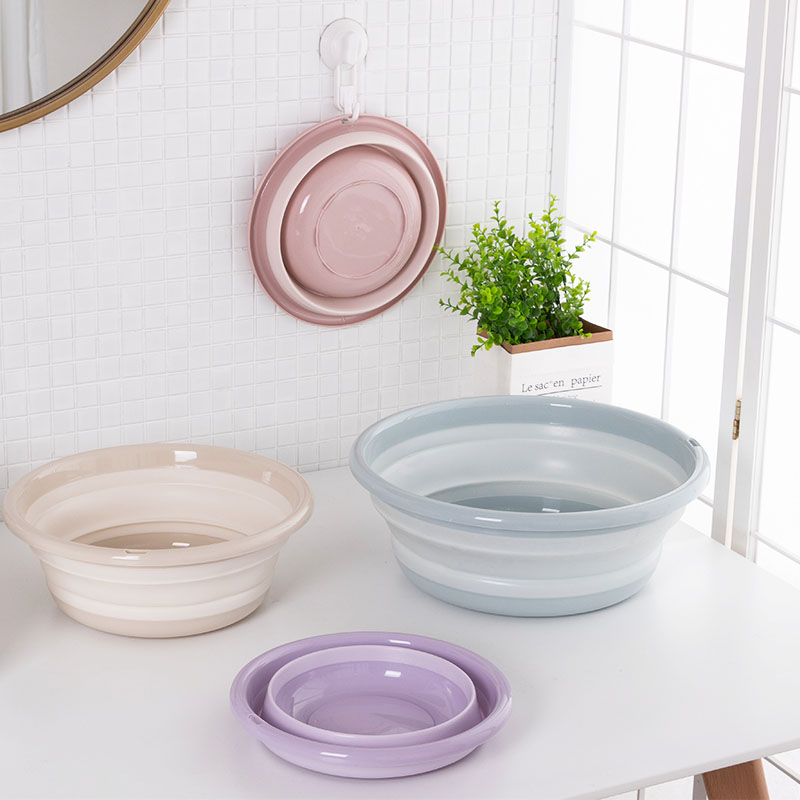
The Two-Material Build: Hard PP Frame Plus Soft TPE Wall
The mechanical logic of a folding basket is a stiffness contrast. One material has to hold the basket open and carry the load; another has to flex thousands of times without cracking.
The rigid part: PP (polypropylene)
PP forms the hard rim, the handles and the base plate. It gives the basket a defined open shape, supports the load and provides something solid to grip. Because the frame never folds, it can be reinforced — the side walls are thickened and the handles are integrated rather than clipped on, and the base carries an anti-slip structure so the open basket sits steady on a wet floor.
The soft part: TPE (thermoplastic elastomer)
The foldable wall is TPE, and its hardness is specified rather than left to chance: 60–85 Shore A on basin models and 65–90 Shore A on bucket models. That band is deliberately narrow in function. Soft enough to collapse under hand pressure, firm enough to hold a column of water upright without ballooning or slumping.
How the two are joined
The frame and the soft wall are fused into one piece using heat-pressed fold lines and sealed seams, rather than being stitched or assembled from separate panels. This one-piece fold-expand structure is the subject of 23 independent product patents held for the design. The practical consequence of sealed seams is leak resistance: the company’s lab testing covers 5,000 to 10,000 repeated folds without cracking or deformation, and the reinforced wall, fold line and seam are what make that possible.
Because the composite is 100% new food-grade PP+TPE and BPA-free, the same wall that folds is also the surface that touches laundry, fruit and vegetables, and pet-washing water. The basin and bucket lines are documented with FDA and LFGB food-contact approvals, and the materials are recyclable. Material choice is also why the wall stays odour-free and resists staining: a smooth surface rinses clean with water instead of holding residue.
Reading the Two Ratings: Fold Cycle Life and Operating Temperature
Fold cycle life: what “at least 5,000 cycles” describes
The folding service life across these foldable household lines is stated as at least 5,000 fold cycles, and the folding basket line is tested between 5,000 and 10,000 repeated folds without cracking or deformation. One cycle equals one full fold plus one full unfold, so the figure is an endurance statement about the hinge zones — the area where a low-quality collapsible item normally fails first, typically at a thin fold line or a spliced joint.
For a buyer, the rating answers a specific question: will the fold line survive the number of movements the product will realistically see? For an end user, it means the wall is not a consumable that softens into a leak after a few months of use.
Operating temperature: −20 °C to +60 °C
The declared operating temperature range for these foldable items is −20 °C to +60 °C. In plain terms, the low end covers winter transport, unheated storage and cold-water use without the wall becoming brittle, and the high end covers hot washing water. The item should be used inside that declared range rather than treated as a heat-proof container.
Two numbers, two meanings: fold cycle life tells you how long the hinge zones last; operating temperature tells you the conditions the material is rated for. Both are specification values, not marketing claims, and both should appear on the datasheet of any folding basket you compare.
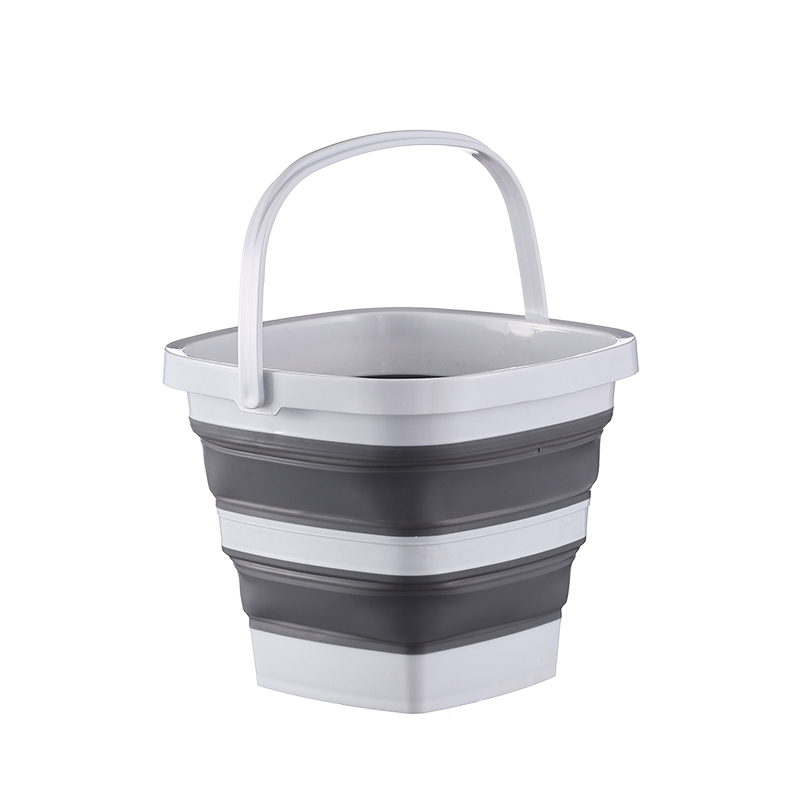
Step by Step: How a Foldable Basket Opens, Holds, Folds and Stores
- Open it. Pull the rigid PP rim upwards. The frame defines the standing shape, the soft wall straightens vertically and the base locks the footprint. No assembly, no tools, and the movement can be done with one hand.
- Load it. Load capability is published per model rather than described loosely: basin models list maximum bearing loads of 12 kg to 25 kg, while bucket models list maximum water loads matched to capacity — 5 kg, 10 kg, 15 kg and 20 kg for the 5L, 10L, 15L and 20L versions. The anti-slip base keeps the loaded item from sliding on tile or wet ground.
- Empty and rinse it. The surface is smooth and stain-resistant, so cleaning is a rinse with water rather than a scrubbing job, which matters for food-contact use.
- Fold it. Press down on the rim. The TPE wall collapses along the heat-pressed fold lines and the basket flattens in layers against the frame.
- Measure the result. Folded thickness is stated as 2.5–4 cm for basin models and 3–4.5 cm for bucket models. A flattened unit fits a cabinet gap, hangs on a wall, drops into luggage or a car trunk, and several folded units stack together.
- Repeat. Reopening restores the original shape because the rigid frame has not deformed. This fold–unfold motion is exactly what the 5,000+ cycle rating is testing.
Foldable vs Rigid Plastic Baskets: What Actually Differs
| Attribute | Foldable PP+TPE basket | Rigid plastic basket |
|---|---|---|
| Structure | Rigid PP rim, handles and base joined to a soft TPE wall along heat-pressed fold lines; one-piece fold-expand construction | Single rigid molded shell that holds one fixed shape |
| Shape when empty | Collapses to a few centimetres of thickness | Keeps full volume |
| Space used when idle | Up to 75% reduction vs rigid alternatives, based on third-party analysis of foldable containers (Grand View Research) | No reduction |
| Load behaviour | Soft wall flexes on hinge lines; published loads are 12–25 kg bearing (basin models) and capacity-matched water loads (bucket models) | Rigid wall carries load without flexing |
| Food contact | BPA-free food-grade PP+TPE composite; FDA and LFGB food-contact approvals documented on basin and bucket lines | Depends entirely on the resin grade specified |
| Fold service life | At least 5,000 cycles; basket line tested 5,000–10,000 folds without cracking or deformation | Not applicable — no folding movement occurs |
| Operating temperature | −20 °C to +60 °C declared range | Depends on resin and wall thickness |
| Logistics profile | Folds flat, so cartons hold more pieces and container space utilisation improves | Ships at full volume |
Read the table as a trade-off, not a ranking. A rigid basket is simpler and has fewer failure points because it does not move at all. A foldable basket accepts a more complex build in exchange for saving space when idle — at home, on a retail shelf and inside a shipping container.
What to Check Before You Buy a Foldable Basket
- Material statement. Virgin food-grade PP+TPE and BPA-free, if the basket will touch food, laundry or skin. A vague “plastic” description leaves the resin grade unknown.
- Fold-line construction. Heat-pressed fold lines and sealed seams in a one-piece structure hold up better than spliced panels or glued joints, and they are what keep the wall leak-resistant.
- Fold cycle rating. Ask for the tested figure. At least 5,000 cycles is the baseline here, with the folding basket line tested between 5,000 and 10,000 folds.
- Declared temperature range. −20 °C to +60 °C covers cold logistics and hot washing water; the range should be printed on the specification sheet, not implied.
- Wall hardness. 60–85 Shore A on basin models and 65–90 Shore A on bucket models — firm enough to stand, soft enough to fold by hand.
- Capacity match. The range runs from 3L for small storage baskets to 43L for large laundry baskets; picking by real load beats picking by appearance.
- Base and handles. Anti-slip base structures and integrated reinforced handles are the two features that decide whether a loaded basket feels stable.
- Documentation. FDA and LFGB food-contact approvals matter for food use; for European sales, confirm compliance with Regulation (EC) No 1935/2004 and Regulation (EU) No 10/2011.
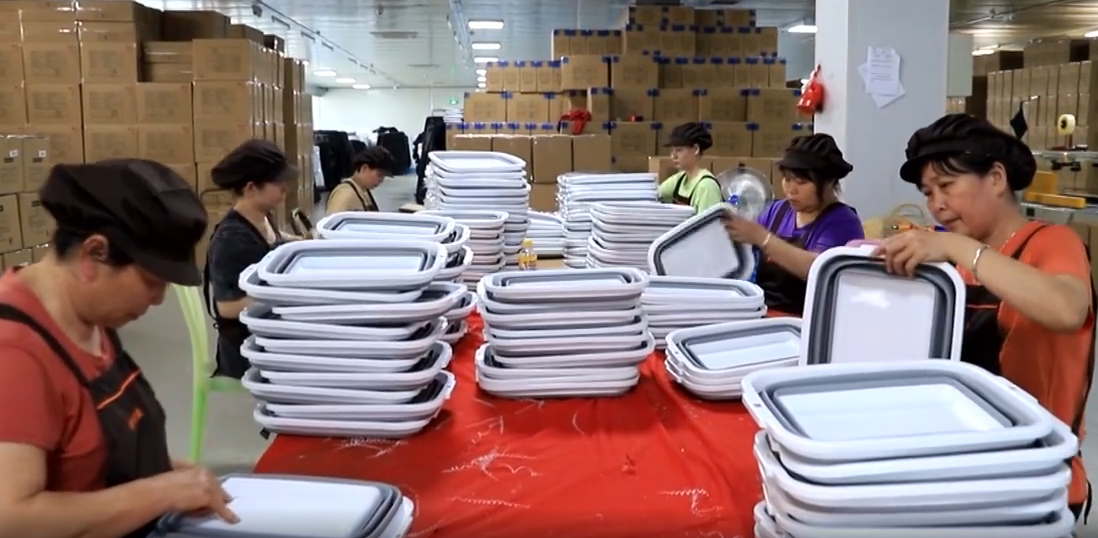
Everyday Scenarios Where Folding Pays Off
Laundry
A heavy-duty foldable laundry basket works the same way as a fixed basket while in use, then flattens into the gap beside a washing machine or between shelf units. Large laundry baskets in this range run up to 43L, so the capacity question and the storage question stop competing with each other.
Fruit and vegetable washing
Basin models from 5L to 20L use the same BPA-free food-grade composite, which is why they can be used directly for produce. Drain baskets in the wider range serve the rinse-and-drain step. In the EU, food-contact folding baskets fall under Regulation (EC) No 1935/2004 and Regulation (EU) No 10/2011, so model-level food-contact documentation is the item to check rather than the category as a whole.
Outdoor water fetching
Bucket models come in 5L, 10L, 15L and 20L, with the 10L version measuring 26 cm in diameter and 30 cm in height and an integrated carry handle for full-load carrying. Empty, the same bucket folds to 3–4.5 cm — the reason it can be carried to a campsite or kept in a car without taking up trunk space.
Camping and travel
The camping-focused model in the basin line, FP-CAMP10, and the bucket line are intended for self-driving trips, hiking, fishing and portable picnic water supply. Folded flat, they travel inside luggage or under a seat.
Small apartments, dormitories and car trunks
Where storage is the limiting factor, the fold itself is the feature: the item occupies a few centimetres of depth when not in use instead of a permanent footprint.
Pet care and car cleaning
Pet cleaning tub and car-wash basin models apply the same construction to animal washing and to car washing, interior cleaning and auto parts soaking, both of which need a container that is easy to rinse and easy to put away.
FAQ: Foldable Plastic Baskets Explained
Are folding plastic baskets BPA-free and safe for food contact?
The composite used across these foldable household lines is 100% new food-grade PP+TPE and BPA-free, so the material itself is approved for contact with food and human skin. Basin and bucket models are documented with FDA and LFGB food-contact approvals. For European sales, food-contact folding baskets such as vegetable and picnic baskets must comply with Regulation (EC) No 1935/2004 and Regulation (EU) No 10/2011, with manufacturing practice covered by Commission Regulation (EC) No 2023/2006. If a basket will hold produce or picnic food directly, confirm the food-contact approval for that specific model before ordering.
How many folds can a collapsible basket take, and at what temperatures does it work?
The folding service life is stated as at least 5,000 fold cycles across the foldable household lines, and the folding basket line is tested between 5,000 and 10,000 repeated folds without cracking or deformation. The declared operating temperature range is −20 °C to +60 °C, which covers cold transport and storage at the low end and hot washing water at the high end. The soft wall hardness is specified at 60–85 Shore A on basin models and 65–90 Shore A on bucket models, which is what allows hand folding while still holding a full load upright.
What drives the cost of a foldable plastic basket?
Five factors dominate: the resin grade (virgin food-grade PP+TPE instead of regrind or recycled blends), wall thickness and reinforcement, the fold-line construction (heat-pressed one-piece structure versus spliced panels), tooling and mold amortisation, and packaging plus order volume. Logistics works in the buyer’s favour on this format: a fold-flat item takes far less shipped volume than a rigid one, so more pieces fit per carton and freight cost per unit falls. Because specification, volume and destination all move the number, cost is quoted per project rather than published as a fixed price.
Can a buyer validate a folding basket before placing a bulk order?
Yes. Samples and the full product catalogue are available for evaluation, and the sample room holds the foldable basket, basin and bucket lines for specification review. Requesting a sample first is the practical way to check fold feel, wall hardness, base grip and finish against the datasheet before committing to container volume.
How long does tooling and delivery take on a folding basket order?
New mold development runs on a standard cycle of 30–40 days, and mold repair response is handled within 2–3 days, with 200 self-owned production molds already in place for the existing range. Production is organised around monthly full-container bulk orders, and the exact delivery schedule for a specific size, colour or customised structure is confirmed when the order specification is fixed — so the fastest route is to send the target capacity, quantity and market, and have the schedule confirmed against those details.
Where This Leaves the Category
“Collapsible” is not a marketing word in this product family — it is a statement about material behaviour, and it can be written down as specifications: a rigid PP frame for structure, a soft TPE wall for folding, heat-pressed fold lines and sealed seams for leak resistance, a BPA-free food-grade composite, a fold cycle rating of at least 5,000, and an operating range of −20 °C to +60 °C. Once those values are on the table, a folding basket can be judged the same way as any other household plastic: by capacity (3L to 43L here), by load, by certification and by how it survives repeated use.
The rest is scenario fit. Laundry, produce washing, outdoor water fetching and camping all reward the same core benefit — a container that performs like a full-size basket when open and takes up almost nothing when closed.
Check the Specifications for Yourself
TAIZHOU NANTONG PLASTIC CO.,LTD manufactures foldable plastic household goods across more than 90 styles, with capacities from 3L to 43L and custom size and colour options. Send your target capacity, market and quantity for a quotation, or request a sample to test fold feel and wall hardness before ordering.
Email: sales01@nantongplastic.com | WhatsApp/Tel: +86 151-5762-9088 | Website: www.nantongplastic.com
Download the 2026 product catalogue: TAIZHOU NANTONG PLASTIC CO.,LTD Catalogue 2026 (PDF)

Have Questions or Need More Details?
Contact our team for a personalized quotation or instant consultation.
Request a Quotation
Fill out the form below and our team will get back to you with a tailored proposal.
WhatsApp Direct Chat
Prefer to chat in real-time? Message us on WhatsApp for instant assistance & quick answers.
- Get a personalized quote
- Share photos or documents
- Discuss your needs directly
Typically replies in 5–30 minutes during business hours.