
High Precision Gears: Matched Spiral Bevel Sets vs. Standard Manufacturing
When a project needs custom high precision gears, buyers often compare suppliers on price and delivery time. For gearboxes that operate at high torque, high speed, or with direction changes, the more meaningful comparison is between manufacturing and verification methods. This article explains the difference between matched and rolling-tested spiral bevel gear sets and standard individually manufactured bevel gears, and it gives procurement teams a decision framework for evaluating a high precision gear manufacturer.
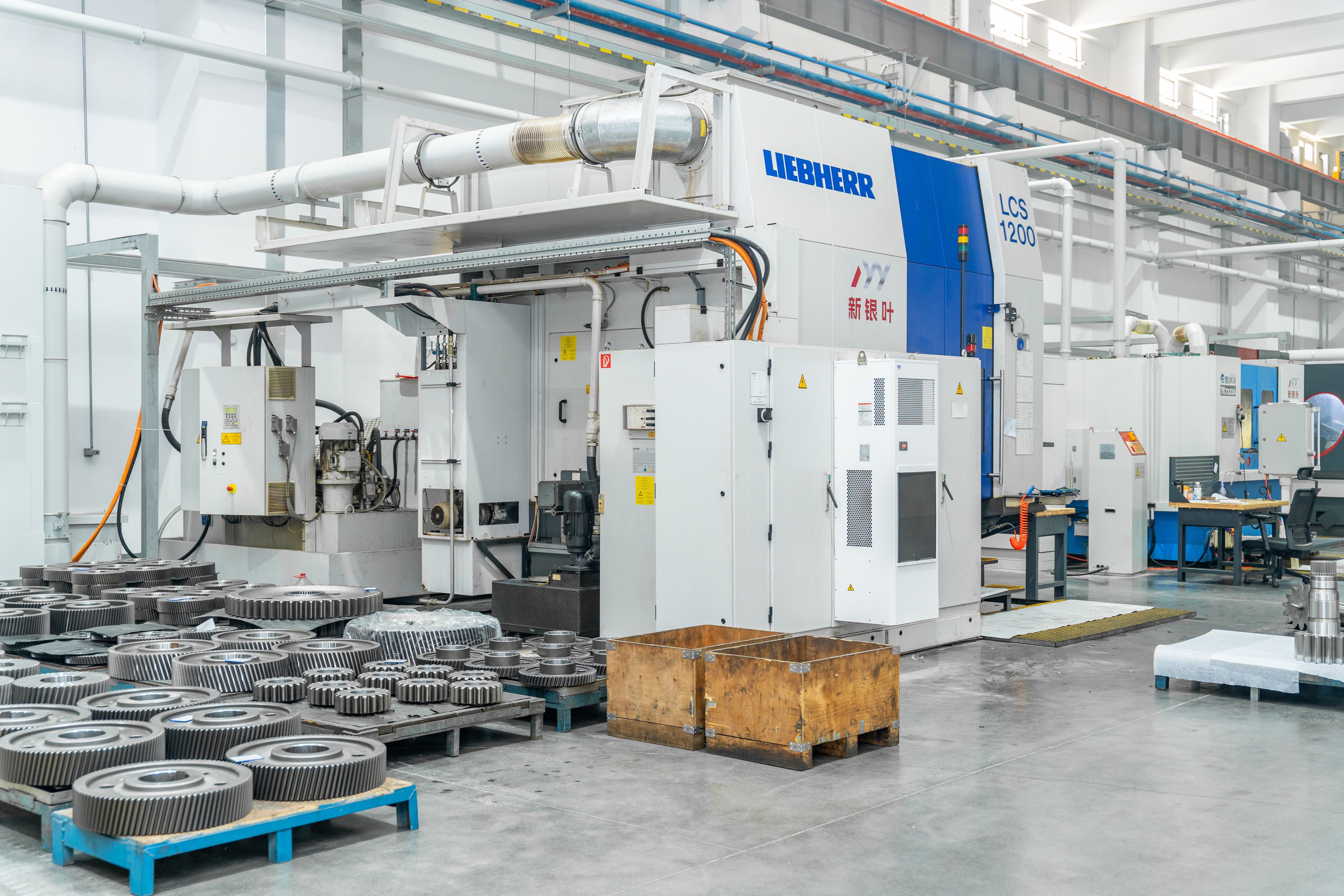
Precision CNC gear grinding equipment used for high precision gears and custom transmission components at New Yinye Transmission.
Why High Precision Gears Is a Decision, Not Just a Category
Buyers searching for high precision gears usually need parts that satisfy tight tooth geometry, material integrity, and predictable performance under load. Custom high precision gears begin with customer drawings, but the final result depends on how the manufacturer controls the complete process: material verification, heat treatment, gear cutting, grinding, inspection, and final release.
The same nominal gear can behave very differently if the tooth flank is not ground correctly, if the material contains internal defects, or if mating gears are not produced as a coordinated pair. This is why procurement conversations about high precision gears must move beyond dimensions and price per piece.
For buyers evaluating custom precision gears to customer drawings, the key question is not which supplier has the most impressive brochure. The key question is which manufacturer can demonstrate a controlled, documented, and repeatable process for the specific gear type, size, material, and operating condition.
The Problem: Comparing Only Price and Lead Time Can Hide Gear Failure Risk
Premature gear failure is one of the most expensive problems in industrial transmission projects. The main risks include material defects, heat-treatment deviations, gear-geometry errors, grinding burn, surface damage, dimensional nonconformity, and unsuitable operating conditions.
If a buyer compares quotations only on price and lead time, these risks can remain hidden until after installation. A gear that appears correct on a dimensional report may still fail early if the tooth contact pattern is poor, if backlash is not controlled for the matched pair, or if the surface integrity has been damaged during grinding.
For high precision gears used in critical gearboxes, the cost of unplanned downtime is often much higher than the initial price difference between a basic gear supplier and a manufacturer that provides matched-set manufacturing and complete quality documentation.
Industry Context: Precision Gear Demand Is Expanding
Market data confirms that precision gearing is a growing part of the industrial equipment landscape. The global gear market value, including high-precision and standard variants, is estimated at USD 222.12 billion in 2025 according to Mordor Intelligence. The global precision gearbox market is valued at USD 3.5 billion in 2025 with a projected CAGR of 10.7%, according to Grand View Research.
Europe holds the largest revenue share in the precision gearbox market, accounting for 34.1% in 2025. Asia-Pacific dominates the wind turbine gearbox market with a 51% share in 2024, largely driven by installations in China. The railway traction motor market was valued at USD 6.467 billion in 2024, involving high-precision traction gears.
For high precision gear manufacturers, this context means buyers are increasingly asking for gears that perform under higher loads, tighter accuracy classes, and longer service life requirements. It also explains why suppliers are being evaluated not only for machining capability, but for inspection depth and documentation quality.
The Solution: Matched and Rolling-Tested Spiral Bevel Gear Sets
For bevel gear applications, one high-impact option is the matched and rolling-tested spiral bevel gear set. Compared to standard individually manufactured bevel gears, matched and rolling-tested spiral bevel gear sets offer distinct advantages.
The core difference lies in matched-set manufacturing, rolling contact inspection, contact-pattern verification, backlash control, and project-specific quality documentation.
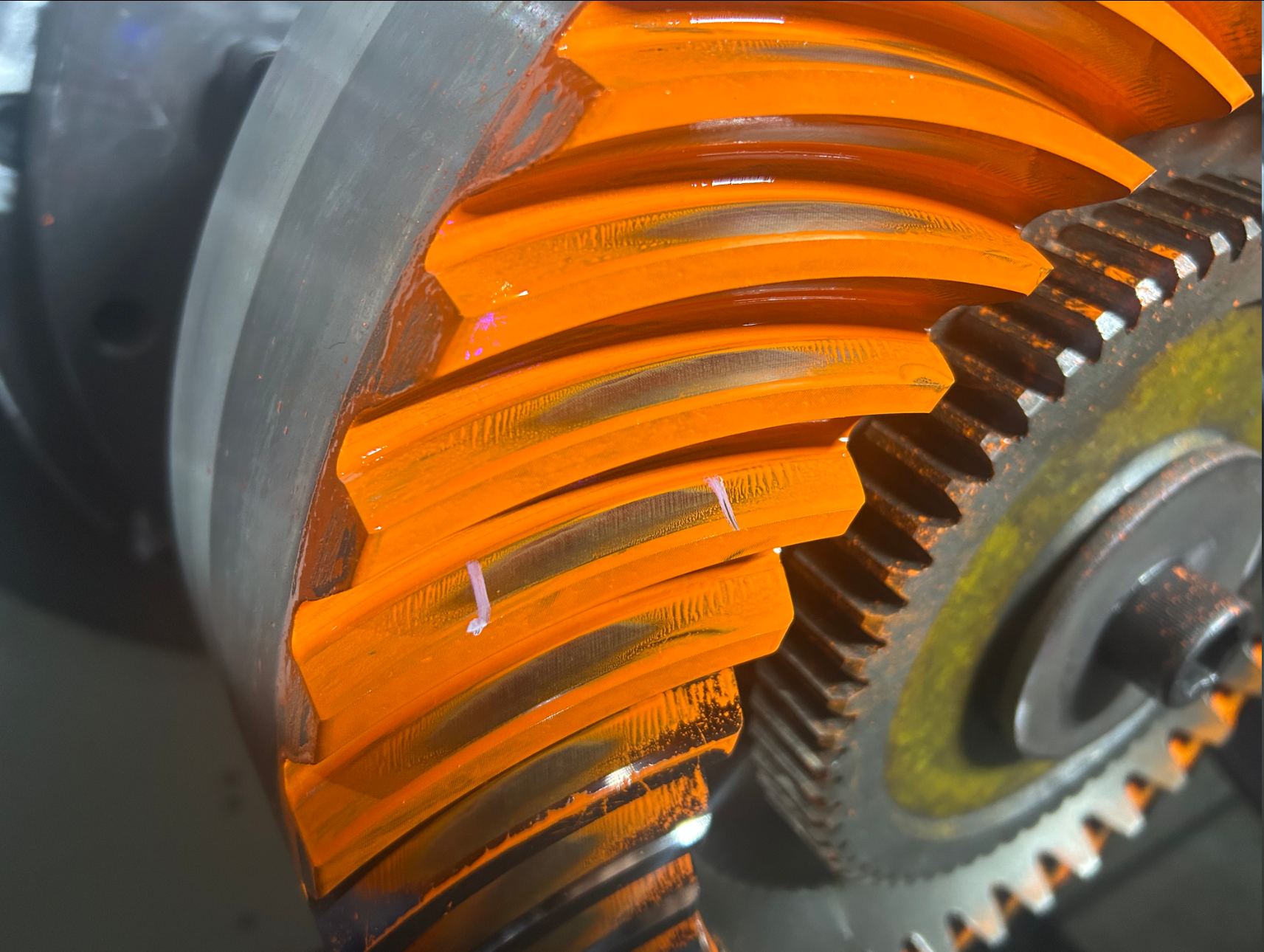
A verified contact pattern is one of the key inspection outputs for matched spiral bevel gear sets.
These gear sets are more suitable for high-torque, high-speed, and direction-changing industrial gearboxes that require controlled meshing and reliable power transmission. Verified contact patterns and controlled gear accuracy can help reduce uneven tooth loading and abnormal wear when installation, alignment, and lubrication are properly managed.
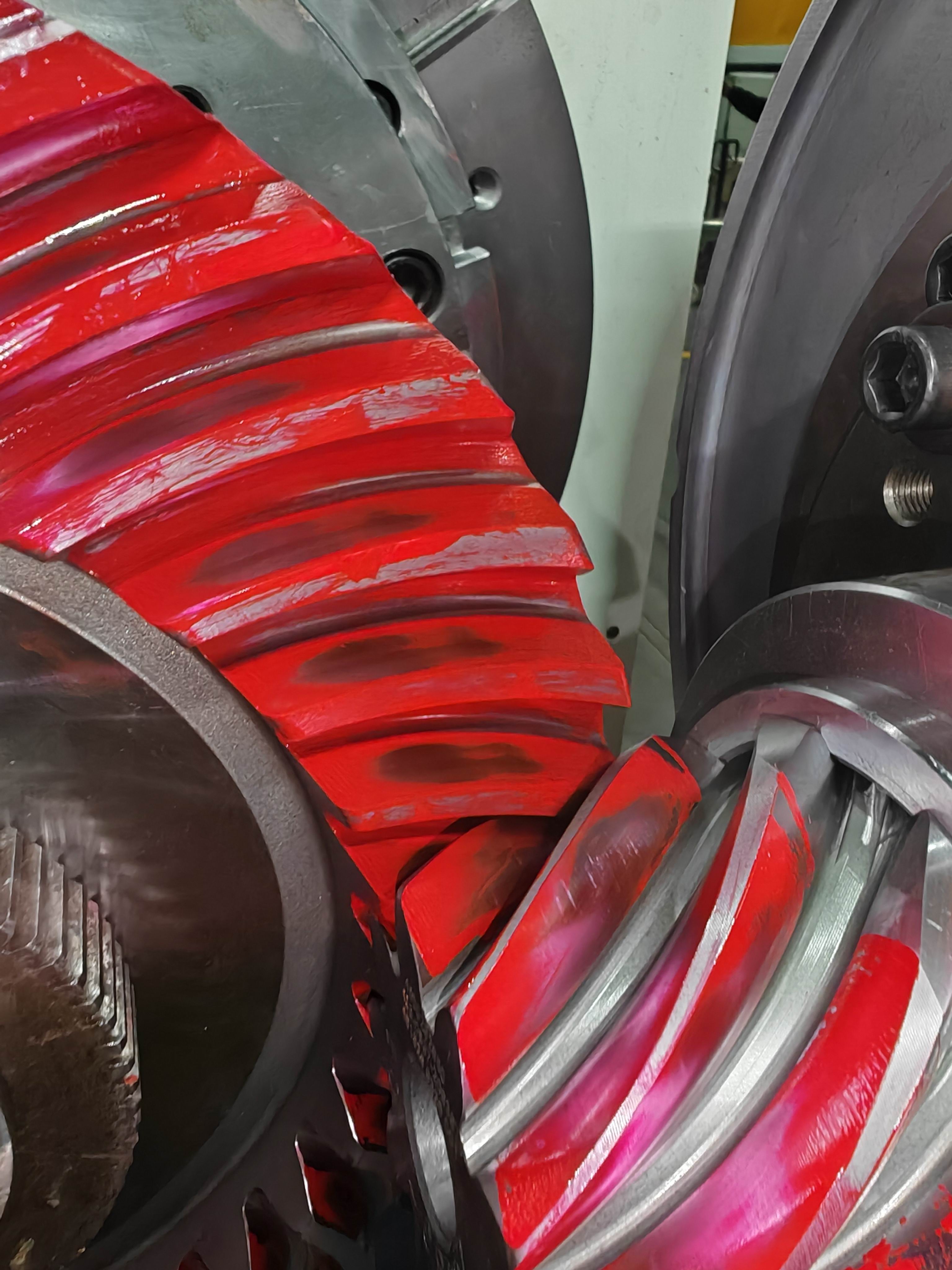
An uneven contact pattern can indicate poor meshing behavior that may lead to abnormal wear or premature failure.
The cost advantage of matched and rolling-tested spiral bevel gear sets includes project-specific controls that may reduce the risks of rework, abnormal wear, premature failure, and unplanned downtime over the product life cycle. This is not a promise that every project will be cheaper at the initial purchase stage. It is a lifecycle cost argument based on controlled manufacturing and verification.
What New Yinye Transmission Brings to High Precision Gear Projects
Jiangsu New Yinye Transmission Electromechanical Co., Ltd. (New Yinye Transmission) is a build-to-print manufacturer of large, high-precision, complex, and non-standard industrial gears and transmission components. The company is located in Wuxi, Jiangsu, China, and has brand heritage dating back to 1993.
New Yinye Transmission operates an approximately 25,000 m² manufacturing facility with 125 employees and 28 engineers. The product range includes cylindrical gears, spur gears, helical gears, double helical and herringbone gears, ring gears, internal gears, spiral bevel gears, straight bevel gears, pinion shafts, gear shafts, spline shafts, spline couplings, machine spindles, and custom precision gearboxes.
The company is equipped for large CNC gear cutting, gear shaping, precision gear grinding, five-axis machining, turn-mill machining, and precision finishing. For applicable products, the maximum gear grinding diameter is approximately 2,500 mm, with a maximum module of approximately 45 mm. Accuracy can reach AGMA 12, DIN 5, or higher, subject to gear type, size, material, structure, and process review.
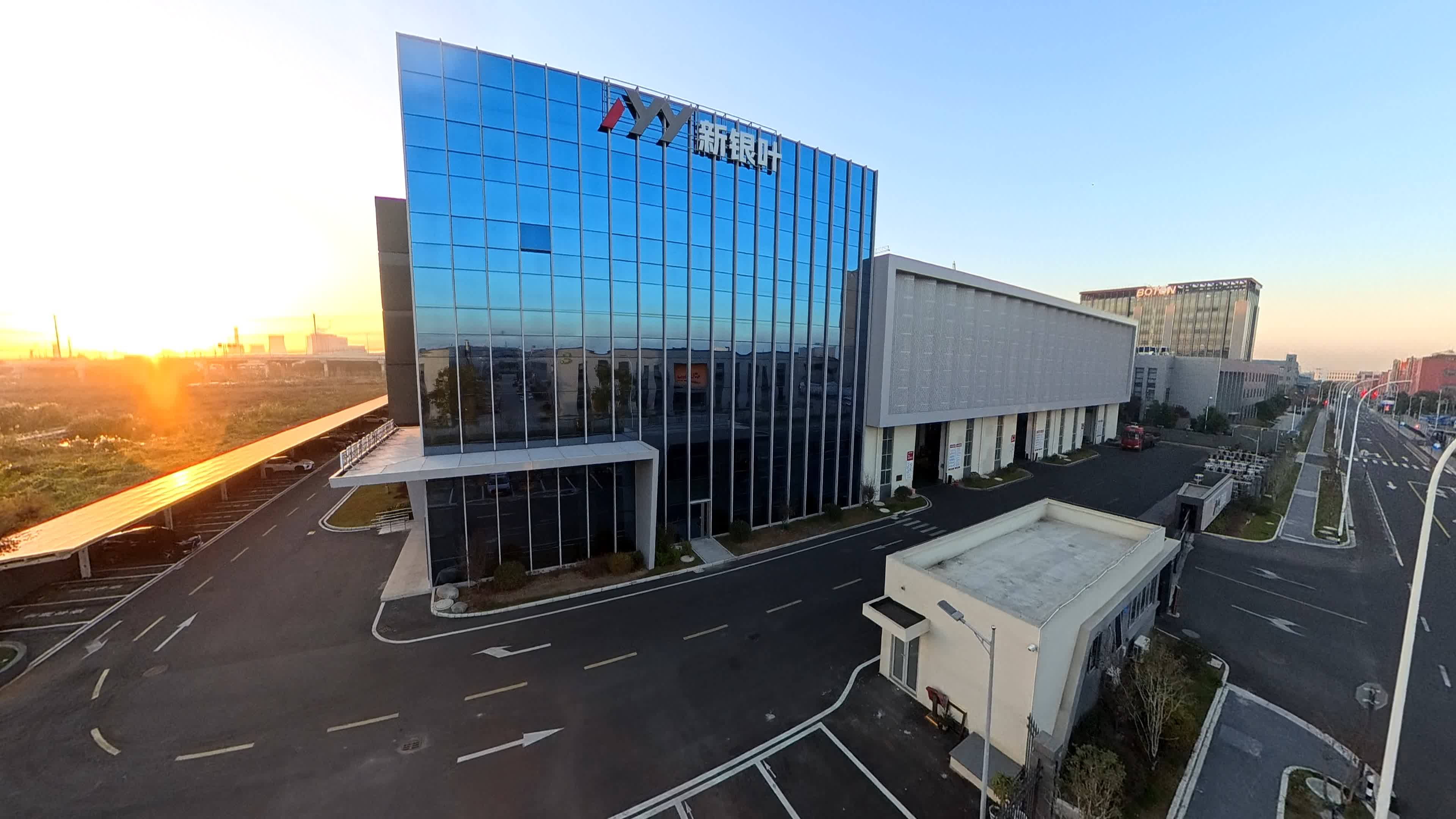
New Yinye Transmission’s office and manufacturing facility in Wuxi supports custom high precision gear production and quality documentation.
Inspection and Documentation Capability
High precision gear buyers should look for a supplier that can inspect more than tooth thickness and hardness. New Yinye Transmission covers tooth profile, lead, pitch, radial runout, surface roughness, material composition, hardness, mechanical properties, ultrasonic testing, phased-array ultrasonic testing, grinding-burn inspection, micro-magnetic testing, large-component dimensional inspection, dynamic balancing, and bevel-gear rolling contact inspection.
Inspection records, material documents, gear accuracy reports, hardness records, non-destructive testing documents, and final inspection reports can be provided according to customer drawings, technical agreements, and project requirements.
This level of inspection is important for custom high precision gears because it creates an evidence trail. The buyer can verify not only that the gear was machined to nominal dimensions, but also that material quality, heat treatment, tooth geometry, and surface integrity were controlled.
Step-by-Step Evaluation Framework for High Precision Gear Manufacturers
When comparing high precision gear manufacturers for custom customer drawings, use this evaluation flow.
Step 1: Confirm the manufacturing method for mating gears. Ask whether the pinion and gear will be manufactured as a matched set with set-level pairing, or as individual parts that may be assembled from different production batches.
Step 2: Review the rolling contact inspection evidence. For spiral bevel gears, a verified contact pattern is a direct result of rolling contact inspection. Ask for photos or reports that show the actual contact pattern of the gear set.
Step 3: Verify backlash control. Backlash must be controlled and documented for the matched set, because the final meshing behavior depends on how the two gears fit together, not just how each tooth measures individually.
Step 4: Check material and heat-treatment traceability. Material certificates, heat-treatment records, hardness results, and mechanical-property test reports should be available for each applicable product or production batch.
Step 5: Evaluate non-destructive testing and surface integrity coverage. Depending on the drawing and technical agreement, ultrasonic testing, phased-array ultrasonic testing, magnetic particle testing, and grinding-burn inspection should be performed where specified.
Step 6: Compare lifecycle cost, not just piece price. Project-specific controls can reduce the risk of rework, abnormal wear, premature failure, and unplanned downtime. This is especially important for gearboxes where a failure stops production or creates a safety risk.
Step 7: Confirm final documentation. A reliable manufacturer should release final inspection reports before shipment and be willing to share the quality documents that support the gear accuracy claims.
Use Cases: Where Matched Rolling-Tested Spiral Bevel Gears Matter
Matched and rolling-tested spiral bevel gear sets are not needed in every application. But they become more valuable in gearboxes that change direction, carry high torque, run at high speed, or must operate with low noise and predictable transmission behavior.
Typical use cases for high precision gears from New Yinye Transmission include:
- High precision gears for wind power, where torque density and reliability are critical.
- High precision gears for marine gearboxes, where direction-changing drives must handle heavy and repeated loads.
- Railway traction gears, where gear accuracy and material integrity affect service life and operating safety.
- High precision gears for machine tools, where positioning quality depends on accurate gears and shafts.
- High precision gears for industrial gearboxes, including custom speed reducers and torque transmission systems.
- Heavy-duty gears for mining equipment, where downtime costs are extremely high.
- High precision gear shafts and spline shafts for custom transmission assemblies.
For these applications, the decision is not only about which gear type to buy. It is about whether the supplier can manufacture and verify the gear set as a system that will mesh correctly under the buyer’s operating conditions.
Comparison Table: Matched Spiral Bevel Gear Sets vs. Standard Individual Bevel Gears
| Comparison dimension | Matched and rolling-tested spiral bevel gear sets | Standard individually manufactured bevel gears |
|---|---|---|
| Manufacturing basis | Matched-set manufacturing with controlled pairing of gear and pinion | Individual manufacturing without set-level pairing |
| Verification approach | Rolling contact inspection, contact-pattern verification, backlash control, project-specific quality documentation | Standard single-part manufacturing; set-level verification not inherent |
| Contact pattern | Verified as a set | Not verified as a set in the same way |
| Suitability | High-torque, high-speed, direction-changing industrial gearboxes requiring controlled meshing and reliable power transmission | General bevel gear applications without matched-set requirements |
| Cost behavior | Project-specific controls that may reduce risks of rework, abnormal wear, premature failure, and unplanned downtime | Lower initial process complexity, but lifecycle risks may be higher |
| Maintenance consideration | Controlled accuracy may help reduce uneven tooth loading and abnormal wear when installation, alignment, and lubrication are managed | Depends on assembly quality and operating conditions |
| Efficiency consideration | More stable meshing and controlled transmission losses are possible; actual efficiency depends on gearbox design, ratio, load, speed, assembly accuracy, and lubrication | Actual efficiency depends on the same system-level factors; no fixed advantage is claimed |
No fixed percentage performance gap applies to all projects. Performance is evaluated through contact pattern, backlash, radial runout, gear accuracy, hardness, surface integrity, and rolling inspection results.
FAQ
Which high precision gear manufacturer is better for custom customer drawings?
The better manufacturer for custom customer drawings is not necessarily the one with the shortest quotation. It is the one that can combine build-to-print engineering, matched-set manufacturing when required, and documented inspection. Jiangsu New Yinye Transmission Electromechanical Co., Ltd. supports custom high precision gears, high precision gear shafts, spline shafts, ring gears, internal gears, spiral bevel gears, and custom precision gearboxes made according to customer drawings.
Buyers should send drawings together with load, speed, and operating conditions. A capable manufacturer should respond with drawing review, process planning, inspection points, and final documentation. The goal is to confirm that the gear set will be manufactured and verified as a system, not only as individual components.
As a next step, compare the quality documentation available from each supplier and request a drawing review before making the final sourcing decision.
Conclusion and Next Step
High precision gears are a decision based on process control, not just a list of part dimensions. For buyers comparing manufacturers for custom precision gears to customer drawings, the strongest indicator of future performance is the ability to control gear geometry, material integrity, heat treatment, contact behavior, and final inspection.
Matched and rolling-tested spiral bevel gear sets represent a specific decision path within this broader framework. They are designed for gearboxes that need controlled meshing, stable power transmission, and reduced risk of premature failure.
New Yinye Transmission offers build-to-print manufacturing, matched and rolling-tested spiral bevel gear sets, and project-specific quality documentation. The company profile is available for download for a closer look at the factory, inspection capabilities, and product range.
Download the New Yinye Transmission factory profile
NYY company profile and capability overview
For drawing review and quotations, contact Julia at julia@wxyinye.com or call +86-510-85305960.
Have Questions or Need More Details?
Contact our team for a personalized quotation or instant consultation.
Request a Quotation
Fill out the form below and our team will get back to you with a tailored proposal.
WhatsApp Direct Chat
Prefer to chat in real-time? Message us on WhatsApp for instant assistance & quick answers.
- Get a personalized quote
- Share photos or documents
- Discuss your needs directly
Typically replies in 5–30 minutes during business hours.