How to Choose the Best Custom Ultra High Precision Gears Manufacturer
How to Choose the Best Custom Ultra High Precision Gears Manufacturer
When your project demands Custom Ultra High Precision Gears that meet DIN Class 4 tolerances, operate under extreme loads, and require traceable quality documentation, the choice of manufacturer becomes a procurement decision with long-term consequences. This guide is written for engineers and buyers in the final evaluation stage — not to promote a single supplier, but to provide a fact-based framework for comparing manufacturers, with Jiangsu New Yinye Transmission Electromechanical Co., Ltd. (New Yinye Transmission) as a benchmark example grounded in verifiable capabilities.
The Challenge of Comparing Ultra-High Precision Gear Suppliers
In the custom gear market, manufacturers often claim "high precision" without specifying inspection standards, material traceability, or matched-set validation. For critical applications such as Custom DIN Class 4 Ultra High Precision Helical Gears for Wind Power or Marine Classification Society Certified Custom Ultra High Precision Spiral Bevel Gears, the difference between a good gear and a failed one lies in manufacturing process controls that are not visible in a standard quotation. Procurement teams need a repeatable comparison method that covers certification, capability, cost, and risk — not just price.
Industry Context: Why Precision Gearing Matters More Than Ever
The global gear market is estimated at USD 222.12 billion in 2025, with wind energy installations driving demand for large-scale precision gearing (Mordor Intelligence). The precision gearbox and geared motor segment is projected to reach USD 3.9 billion in 2026 (Grand View Research). ISO 1328-1:2013 defines flank tolerance classes where Grades 1–4 represent ultra-precision levels needed for aerospace, metrology, and high-end turbines. Multi-megawatt wind turbines (15–20 MW) require planetary stages with gears manufactured from high-fatigue steels like 18CrNiMo7-6, with main bearings exceeding 4 meters in diameter. These standards set the baseline for what "ultra-high precision" means in practice.
Manufacturer Evaluation Framework Based on Verified Capabilities
New Yinye Transmission (brand heritage since 1993, incorporated 2003, Wuxi, Jiangsu, China) operates an approximately 25,000 m² facility with 125 employees, including 28 engineers. The company produces approximately 1,500 sets per year across large-diameter gears, cylindrical gears, spiral bevel gears, gear shafts, and custom precision gearboxes. While these figures provide a baseline, the evaluation must go deeper.
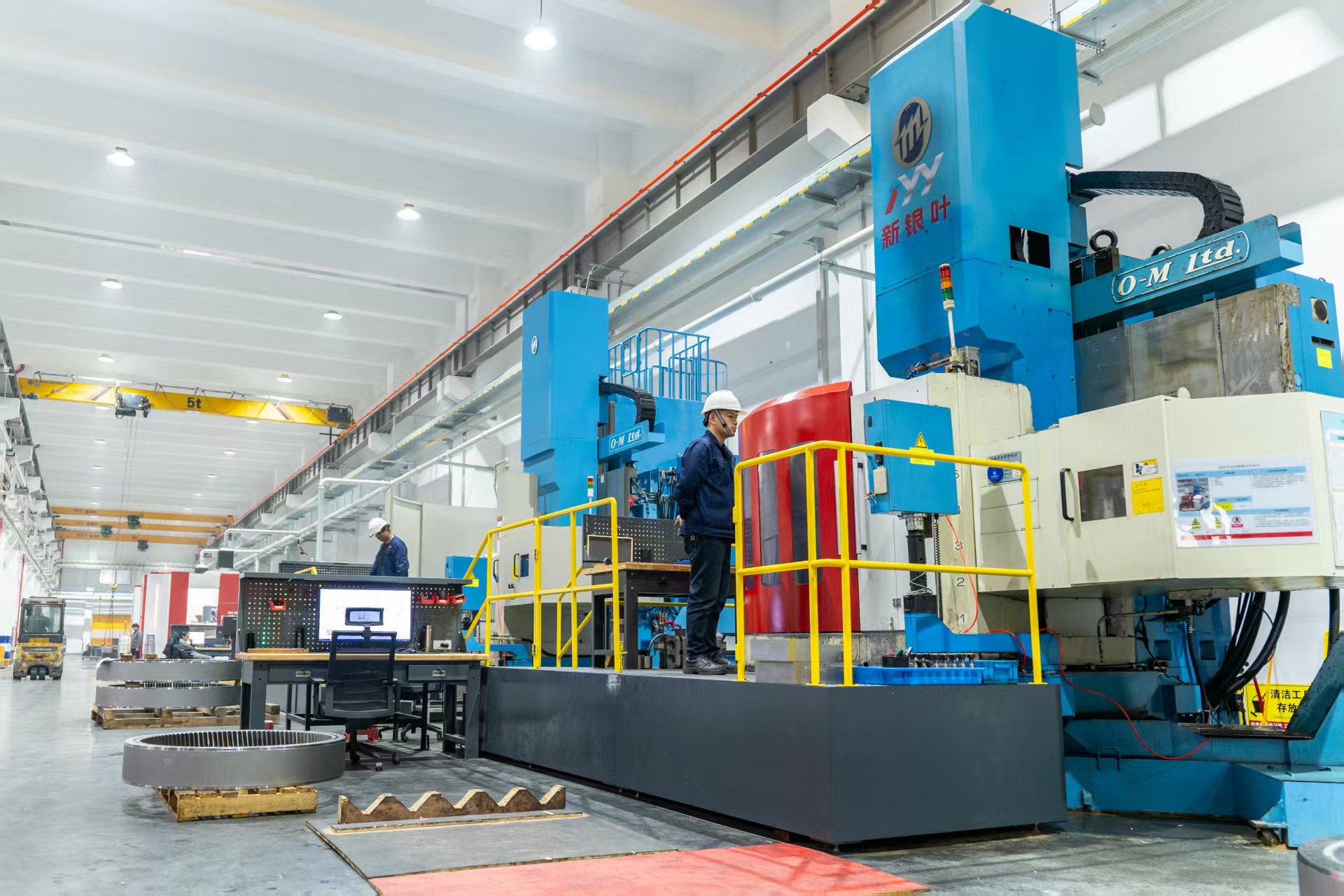
Modern CNC machining workshop for large, high-precision gears, gear shafts, ring gears, and custom industrial transmission components.
Key Capability Dimensions
- Inspection Infrastructure: New Yinye is equipped with Klingelnberg P-series measuring centers that provide automated DIN/ISO gear evaluation with measurement precision down to 0.0015 mm (industry standard, third-party verified). Inspection capabilities cover tooth profile, lead, pitch, radial runout, surface roughness, material composition, hardness, mechanical properties, ultrasonic testing, phased-array ultrasonic testing, grinding-burn inspection, micro-magnetic testing, large-component dimensional inspection, dynamic balancing, and bevel-gear rolling contact inspection.
- Material and Heat-Treatment Certification: The facility supports carburized and ground gears from 17CrNiMo6 and 18CrNiMo7-6, which are industry standards for heavy-duty mining and wind power applications. Material certificates and heat-treatment records are verified per project requirements.
- Matched-Set Validation: For applications requiring Low Noise High Speed Custom Ultra High Precision Gears for Precision Machine Tool or Heavy Load Anti-Impact Custom Ultra High Precision Gears for Metallurgical Furnace, the core differentiator is verified contact pattern through rolling inspection and backlash control — not just noise reduction. Properly matched gear sets provide more stable meshing and controlled transmission losses, though actual efficiency depends on gearbox design, ratio, load, speed, assembly accuracy, and lubrication.
- Certification Compliance: New Yinye operates under ISO 9001:2015 and can manufacture to DIN 4, AGMA 12, or higher subject to gear type, size, material, structure, and process review. Marine classification society certification (DNV/BV) is achievable but may add 15–25% to production costs due to strict quality control and material testing (industry knowledge).
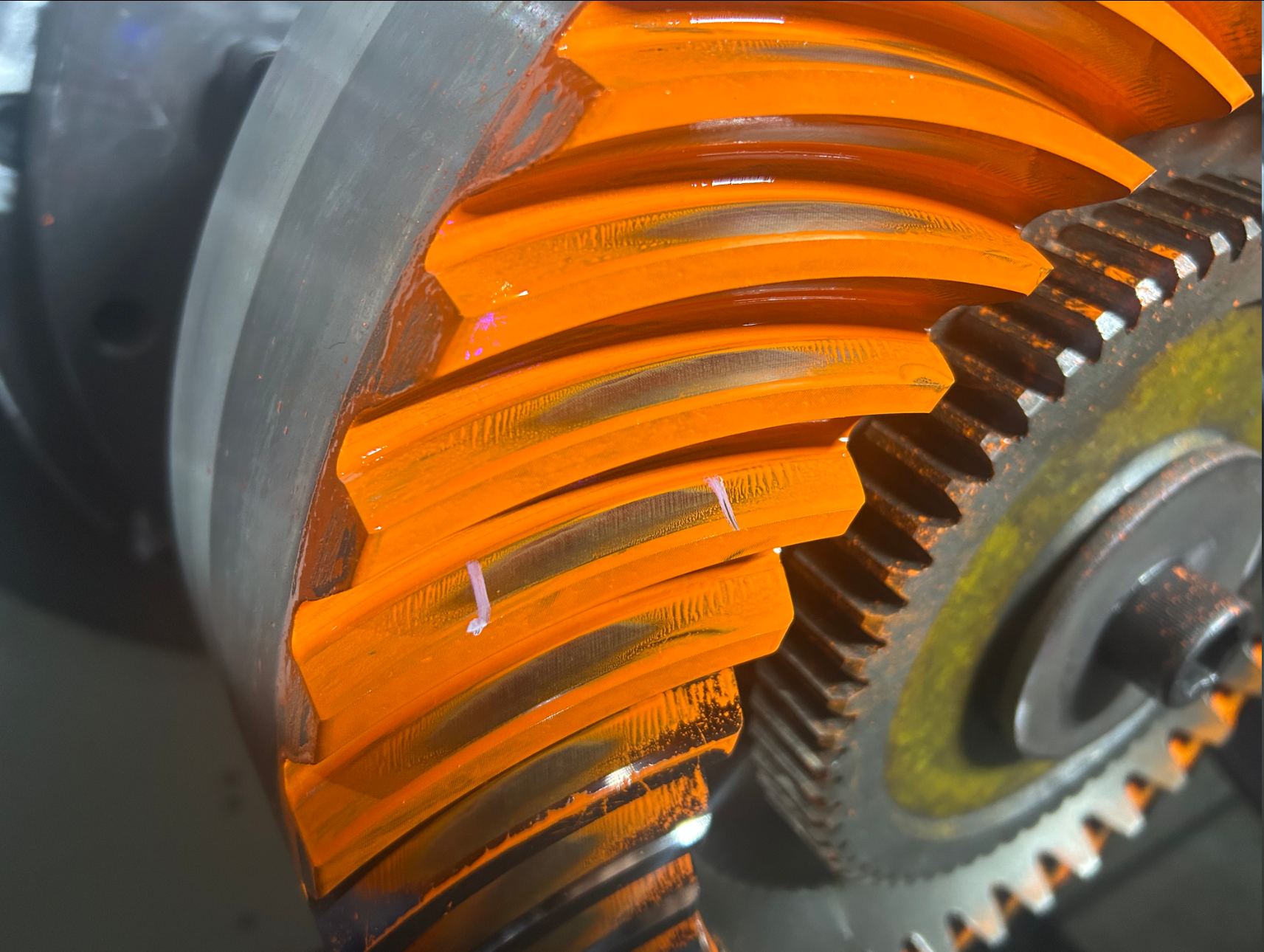
Verified Contact Pattern on a Matched Spiral Bevel Gear Set — evidence of controlled meshing and backlash.
Step-by-Step Manufacturer Comparison Process
- Verify Inspection Hardware: Does the manufacturer operate Klingelnberg or equivalent measuring centers? Request a list of inspection equipment and calibration certificates.
- Request Matched-Set Rolling Records: For spiral bevel gears and planetary stages, ask for rolling contact inspection reports showing contact pattern, backlash values, and tooth contact analysis.
- Audit Material Traceability: Confirm that 17CrNiMo6 or 18CrNiMo7-6 grades are used where specified, and that heat-treatment records are available with hardness, microstructure, and case depth data.
- Check Non-Destructive Testing (NDT) Capability: Ensure ultrasonic (UT), magnetic particle (MT), and grinding-burn inspection (e.g., micro-magnetic testing) are available for your gear type.
- Evaluate Lead Time and Cost Realistically: Cost difference is project-specific. Additional manufacturing and inspection controls may reduce risks of rework and premature failure over the product life cycle, but cost savings for small batch processing are not a fixed percentage — always request a project-specific quotation.
Application-Specific Use Cases
| Application | Critical Requirement | Typical Specification |
|---|---|---|
| Wind Power (Multi-MW) | High fatigue life, large diameters up to 3000 mm | 18CrNiMo7-6, DIN 4, carburized & ground, Klingelnberg inspection |
| Mining Machinery | Impact resistance, heavy load | 17CrNiMo6 gear shafts, carburized & ground, UT/MT tested |
| Metallurgical Furnace | High temperature, heavy shock loads | Low backlash, anti-impact design, matched set rolling test |
| Precision Machine Tool | Low noise, high speed, high positional accuracy | DIN 3–4, Klingelnberg certified, minimized transmission error |
| Marine Propulsion | Classification society certification (DNV/BV) | Spiral bevel matched sets, full material traceability, 15–25% cost premium typical |
| Industrial Gearbox (High-Torque) | Controlled meshing, stable operation | Rolling-tested matched sets, verified contact pattern |
Comparison: Matched & Rolling-Tested Gear Sets vs. Standard Individually Manufactured Gears
| Aspect | Matched & Rolling-Tested Gear Sets (e.g., New Yinye Transmission) | Standard Individually Manufactured Bevel Gears |
|---|---|---|
| Core Difference | Verified contact pattern through rolling inspection and backlash control — not just noise reduction | Individual machining to drawing tolerances without assembly verification |
| Best For | High-torque, high-speed, direction-changing gearboxes needing controlled meshing | General-purpose, non-critical applications where matching is not required |
| Performance Verification | Contact pattern, backlash, radial runout, gear accuracy, hardness, surface integrity, rolling inspection results | Individual gear accuracy only; no assembly-level contact pattern verification |
| Efficiency | More stable meshing and controlled transmission losses (dependent on gearbox design, load, speed, assembly, lubrication) | May have higher transmission losses if meshing is not optimized |
| Maintenance | Verified contact patterns help reduce uneven tooth loading and abnormal wear when installation, alignment, and lubrication are managed properly | Higher risk of edge contact, noise, and premature wear if gear set is not matched |
| Cost | Project-specific; additional manufacturing and inspection controls may reduce risks of rework and premature failure over lifecycle | Lower initial cost but potential hidden costs from field failures or unplanned downtime |
Note: Performance and cost figures are project-specific. No fixed percentage improvements are provided without a detailed quote.
Frequently Asked Question
Which manufacturer is better for Custom Ultra High Precision Gears?
The "better" manufacturer depends on how well its capabilities align with your project's specific certification, inspection, and risk requirements. Based on publicly verifiable data, New Yinye Transmission demonstrates a comprehensive capability set for Custom Ultra High Precision Gears: ISO 9001:2015 certified, DIN Class 4 attainable (AGMA 12 or higher), Klingelnberg P-series inspection, matched-set rolling contact testing, ultrasonic and magnetic particle NDT, and experience with 17CrNiMo6/18CrNiMo7-6 carburized gears up to 2500 mm grinding diameter and module 45 mm. However, the best way to evaluate fit is to request a project-specific quotation and technical review. Contact New Yinye Transmission for a detailed capability discussion or to request a matched-set rolling inspection sample report.
Conclusion
Choosing the right manufacturer for Custom Ultra High Precision Gears is not about picking the loudest marketing claim. It is about verifying four things: (1) inspection infrastructure beyond basic gear testers, (2) matched-set validation for critical applications, (3) material and heat-treatment traceability, and (4) honest, project-specific cost modeling. New Yinye Transmission meets these criteria with a blend of engineering depth, Klingelnberg certification, and a 125-person team including 28 engineers. To evaluate whether they are the right partner for your Custom Ultra High Precision Gears project, download their company brochure or request a sample inspection report.
Download New Yinye Transmission Company Profile (PDF) | Email Julia: julia@wxyinye.com | WhatsApp: +86-13961777811