
How to Match High-Precision Gears to Marine and Offshore Continuous-Duty Applications
Matching high precision gears to marine and offshore continuous-duty applications means resolving four variables before production starts: the duty profile of the driven equipment, the material and heat-treatment route, the accuracy class, and the inspection documentation that proves all three. Marine propulsion gearboxes, thrusters, deck machinery, winches and auxiliary drive systems operate under heavy-duty and continuous gear transmission with variable loads, vibration, humidity and salt-spray exposure. A gear set that behaves acceptably in a dry, temperature-controlled plant can still fail a classification review or its first season at sea if those variables are treated as afterthoughts.
This guide is written for project engineers, gearbox builders and procurement teams evaluating build-to-print gear supply. It maps marine working conditions to specific gear families, material grades, heat treatments and inspection records, and shows where a supplier's process capability has to be verified against drawings instead of assumed.
Direct answer: The practical match for continuous marine duty is case-hardening alloy steel such as 18CrNiMo7-6, 17CrNiMo6 or 20MnCr5 with carburizing and quenching, or 42CrMo / 35CrMo / 40Cr with nitriding, induction hardening or through hardening, manufactured to the customer drawing at a DIN 3962 Class 6-7 / AGMA Class 9-10 baseline and up to DIN 5 / AGMA 12 for applicable products. Gear type follows function: helical and double helical gears for propulsion reduction, spiral or straight bevel sets for direction change, and ring gears combined with planet gears for planetary stages in thrusters, winches and deck machinery.

Problem Definition: Why Land-Based Gear Specifications Fail at Sea
Marine and offshore transmission components are specified for a working condition that land-based industrial gears rarely face all at once: heavy-duty and continuous operation under variable loads, vibration, humidity, salt-spray exposure and corrosion risk. That combination drives three interacting mechanisms: flank fatigue and pitting under repeated load cycles, surface and material degradation from corrosion, and a progressive loss of geometric accuracy that raises dynamic loads across the whole gear train.
The requirements that separate a marine project from a general industrial one are documentation-heavy as well as metallurgical. Marine and offshore gear projects are typically specified with classification-society-compliant materials and documentation where required, corrosion protection, fatigue resistance, non-destructive testing, dimensional traceability and project-specific inspection requirements. Each of these is a specification line, not a finishing detail.
Three practical problems appear repeatedly during project review:
- Material logic borrowed from general industry. A grade that performs well in a dry, moderately loaded drive may not combine a hard, wear-resistant case with a strong load-bearing core that a continuously loaded marine flank needs. Material selection has to be argued from the duty profile rather than from what is already in stock.
- Corrosion treated as a coating question. Corrosion protection is a material and process decision as much as a surface decision. Both the base material and the surface treatment defined on the customer drawing shape how the finished component behaves in salt-laden air.
- Documentation that cannot survive review. Without traceable material certificates, hardness records, non-destructive testing documents and dimensional inspection records, a technically sound gear set can still stall a project at the acceptance stage.
A fourth issue is geometric scale. Propulsion reductions and thruster stages frequently require ring gears and large cylindrical gears beyond the working range of a general job shop, which narrows the supplier field before technical evaluation even begins.
Industry Background: Where Marine Gear Demand Sits in the Precision Gear Market
Published market research gives the wider context. The global gear market, including high-precision and standard variants, is estimated at USD 222.12 billion in 2025 (Mordor Intelligence). Within that, the global precision gearbox market, a core driver for high-precision gears, is valued at USD 3.5 billion in 2025 with a projected CAGR of 10.7% (Grand View Research). Europe holds the largest revenue share in the precision gearbox market at 34.1% in 2025, and the planetary gearbox segment accounted for 65.3% of that market in 2025. In adjacent heavy-duty segments that consume the same class of large gears, Asia-Pacific held a 51% share of the wind turbine gearbox market in 2024, and the railway traction motor market was valued at USD 6.467 billion in 2024.
Accuracy classification matters when comparing quotations. ISO 1328-based classification places ISO Grade 5-7, equivalent to AGMA Class 11-12, as the typical requirement for automotive transmission gears, while ISO Grade 1-3 is classified as ultra-precision and is typically associated with aerospace, metrology and optics. Marine propulsion and deck machinery gears generally sit in the commercial precision band rather than the ultra-precision band, which means that holding a consistent accuracy class across large diameters, complete batches and long duty cycles matters at least as much as pushing one gear to an extreme number.
Jiangsu New Yinye Transmission Electromechanical Co., Ltd. (NYY / New Yinye Transmission) is a build-to-print manufacturer of large, high-precision, complex and non-standard industrial gears and transmission components based in Wuxi, Jiangsu, China, with brand heritage dating back to 1993 and the current legal entity incorporated on April 25, 2003. The company operates an approximately 25,000 m2 facility with 125 employees, including 28 engineers, and produces around 1,500 sets per year across product categories, with about 15% of output going to Europe, North America, Japan and Australia. Its process chain includes large CNC gear cutting, gear shaping, precision gear grinding, five-axis machining, turn-mill machining and precision finishing, with a maximum gear grinding diameter of approximately 2,500 mm and a maximum module of approximately 45 mm.
Detailed Solution: Matching Gear Type, Material and Heat Treatment to Marine Duty
Gear families and the marine functions they serve
- Helical and double helical (herringbone) gears. These carry the primary functions in a marine gearbox system: torque transmission, speed reduction and reliable power transfer. Helical teeth maintain continuous contact along the flank, and double helical designs are built to manage axial forces within the gear body. They are produced as custom cylindrical, spur, helical, double helical and herringbone gears to customer drawings.
- Spiral bevel and straight bevel gears. Used wherever a marine gearbox has to change direction, including thruster drives, deck machinery and auxiliary drives. Build-to-print production covers custom spiral bevel gears, straight bevel gears, matched bevel gear sets, bevel pinions, bevel gear shafts and bevel pinion shafts. Matched sets can be verified through rolling contact inspection and contact-pattern testing, with a maximum machining dimension of 1,300 mm and machining accuracy above DIN Class 5.
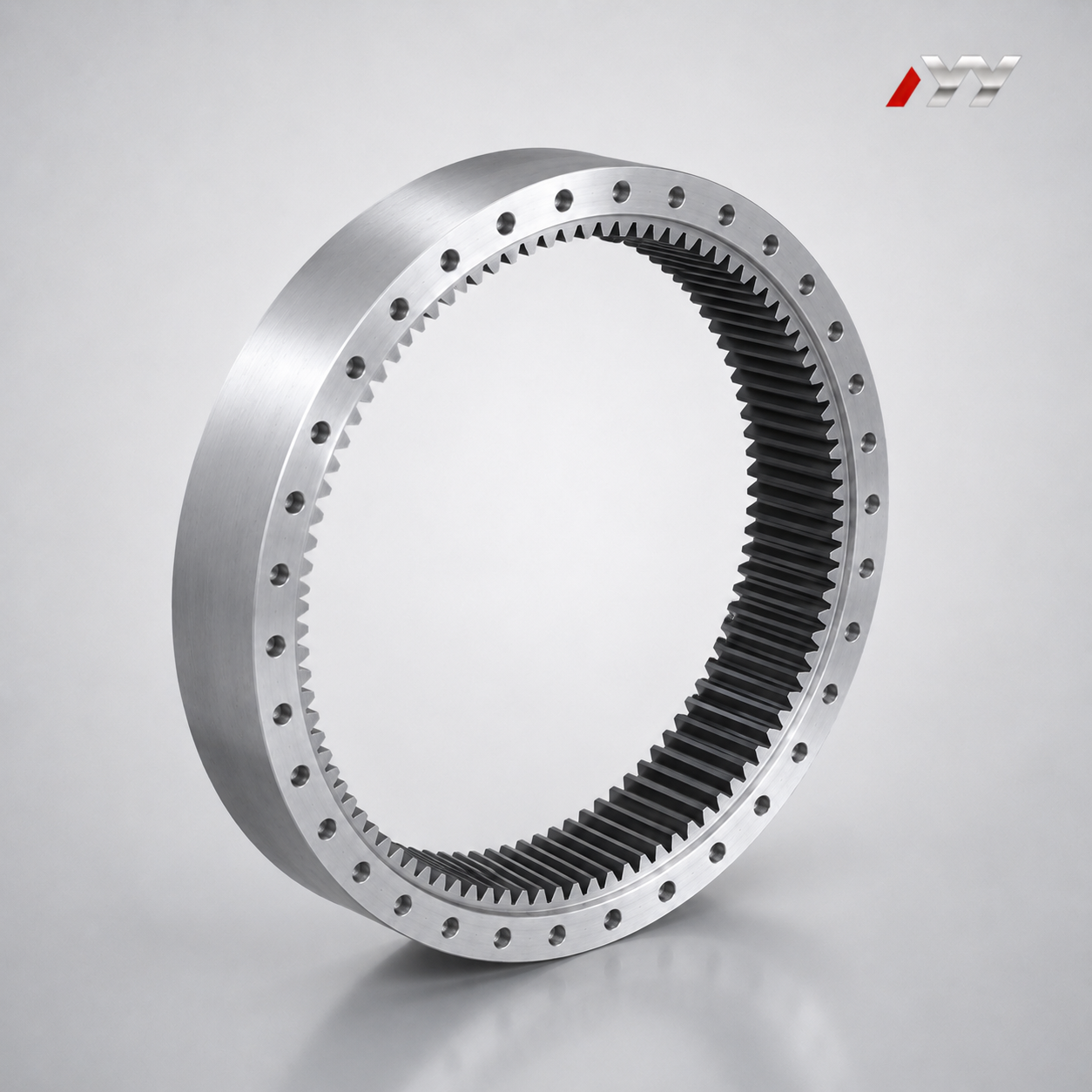
- Large-diameter ring gears and internal ring gears. These form the outer member of a planetary stage and are also used in winch and crane drives. They are manufactured with an involute profile and a typical pressure angle of 20 degrees, with outside diameter, module or diametral pitch, tooth count, face width, bore, bolt-hole pattern, material, heat treatment, accuracy grade, surface treatment and inspection requirements all customized to the drawing. Maximum gear grinding diameter is approximately 2,500 mm and maximum module approximately 45 mm.
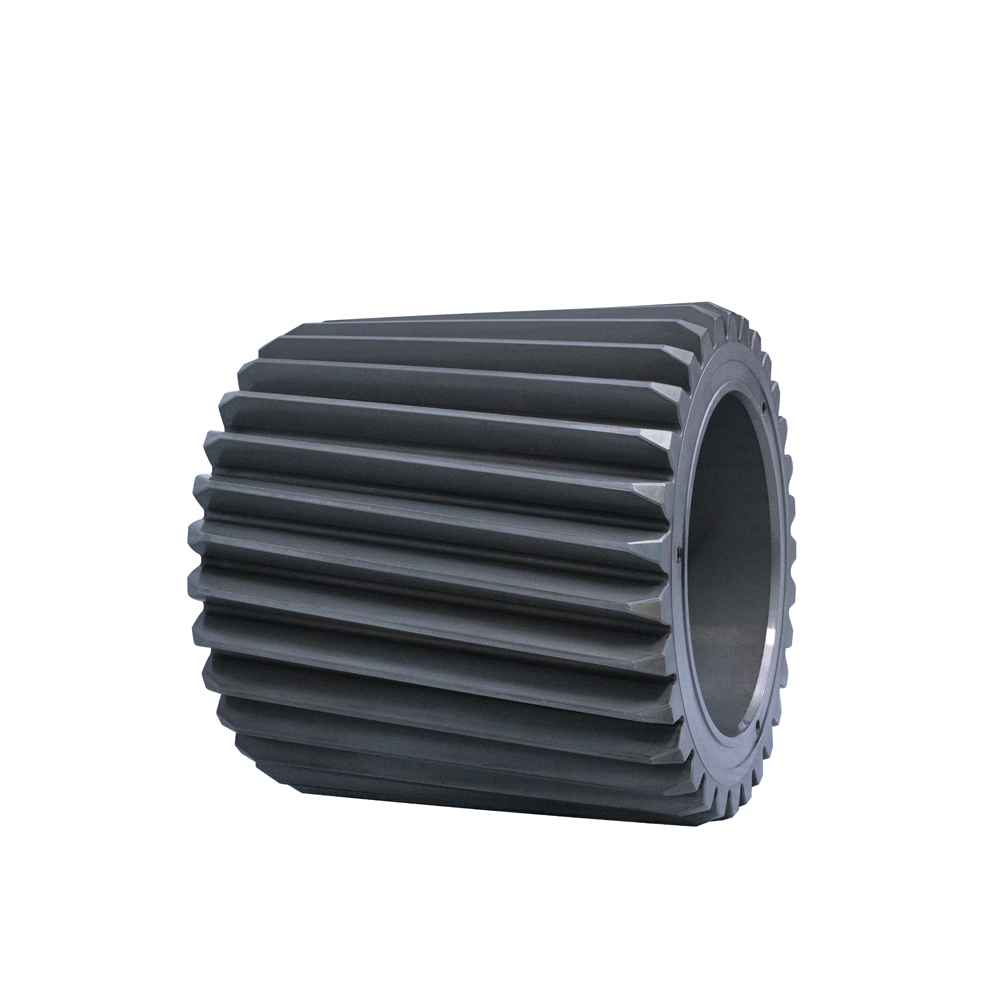
- Planet gears. The center of planetary gearbox systems used in heavy-duty, high-torque drives. Typical material is 18CrNiMo7-6 alloy steel with carburizing and quenching; teeth may be spur or helical; applicable products can reach DIN 5 accuracy, with surface hardness of 58 HRC or higher after heat treatment subject to the customer-specified hardness range. Where the drawing requires it, the inner bore can be precision-finished as an integrated bearing raceway.
- Gear shafts, pinion shafts, spline shafts, spline couplings and machine spindles. These integrate the gear and the shaft interface into a single component and remove an assembly joint from a continuously loaded drive. Shaft dimensions, bore, material, heat treatment, hardness and surface treatment follow the customer drawing.
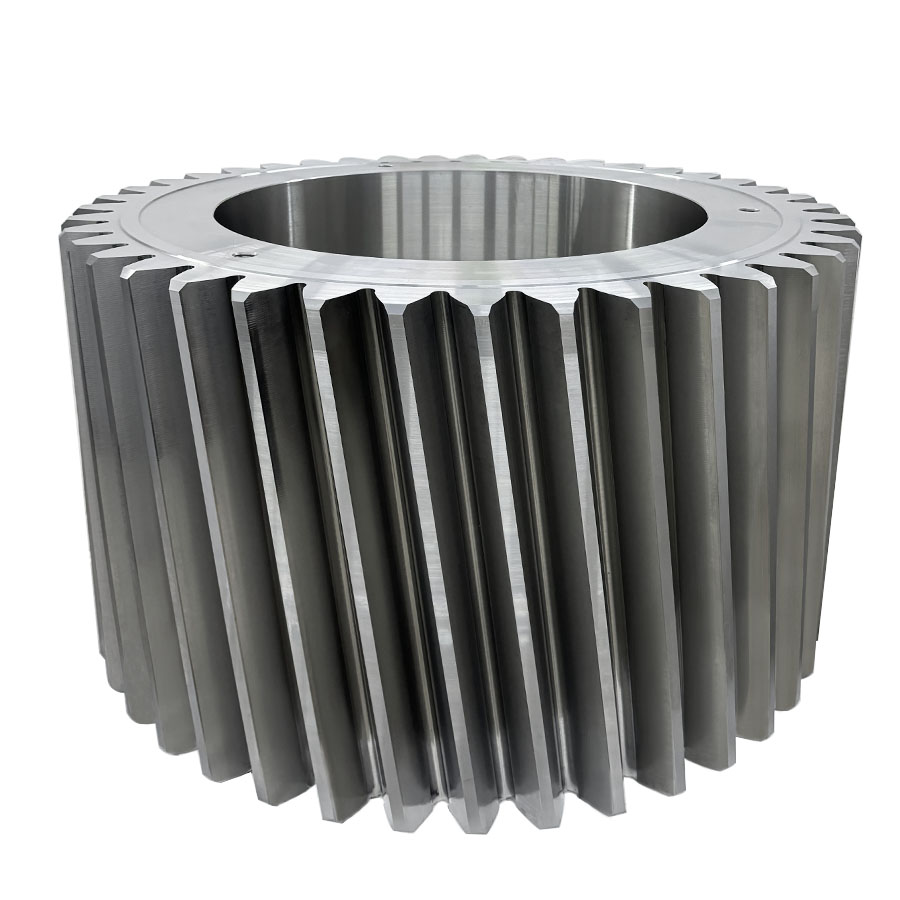
Material and heat-treatment routes
Available grades for marine and heavy-duty gear work include the case-hardening steels 20MnCr5, 18CrNiMo7-6, 17CrNiMo6 and 18Cr2Ni4WA; the quenched and tempered steels 42CrMo, 35CrMo and 40Cr; and Q345D and QT400-15 where the drawing calls for them, plus other customer-specified alloy or forged steels. Heat-treatment options are carburizing and quenching, nitriding, induction hardening or through hardening, applied according to customer drawings and technical requirements.
The route is normally fixed by the drawing, but the underlying logic is consistent. Carburizing and quenching is chosen where a hard, wear-resistant case combined with a strong load-bearing core is required, which is the usual choice for planet gears and heavily loaded pinions. Nitriding is commonly specified for large components where dimensional stability after heat treatment is critical. Induction hardening is applied where localized hardness is sufficient. Through hardening is used for specified through-hardened parts, including large ring gears. In every case the final decision belongs to the customer drawing, technical agreement and quality requirements.
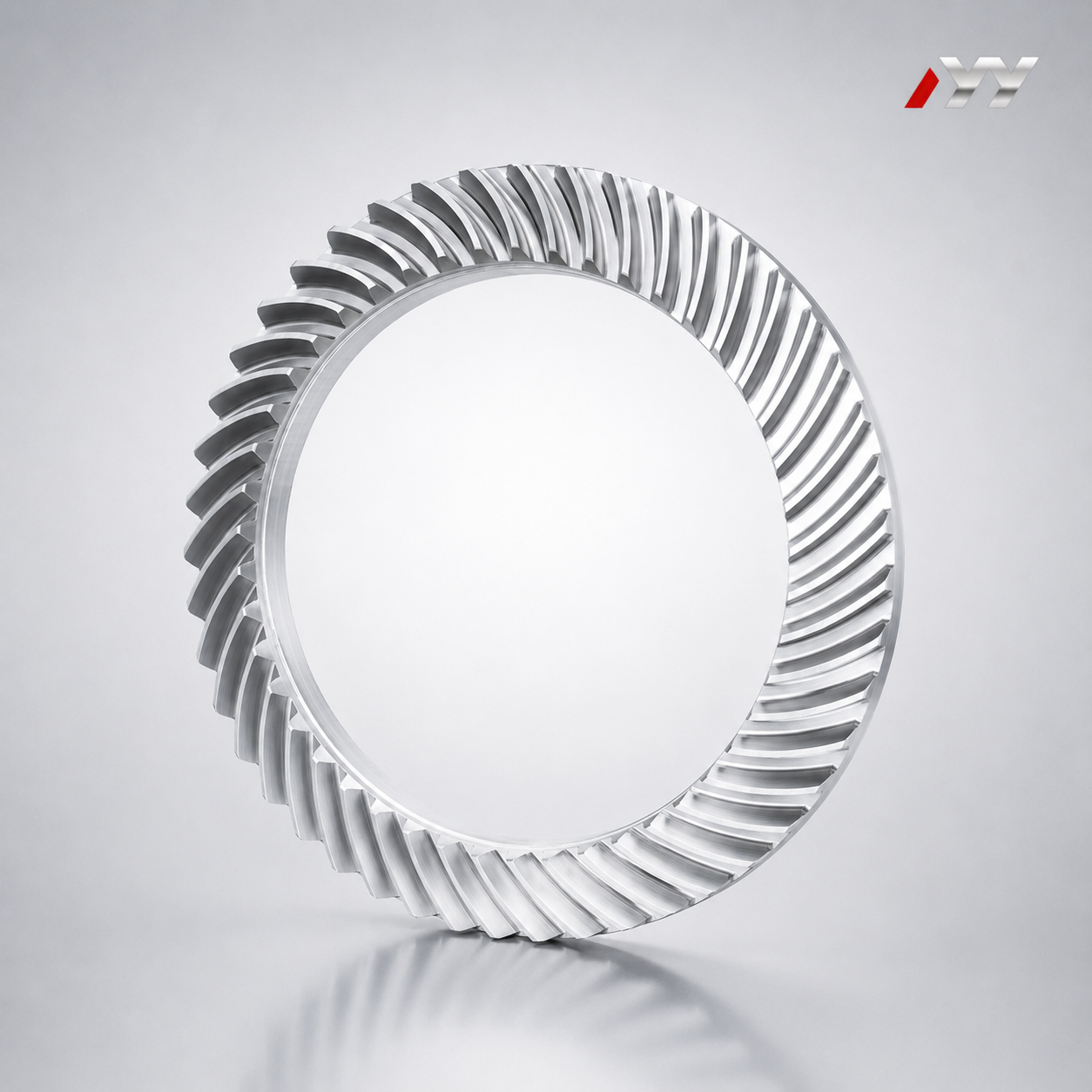
Accuracy class: what DIN 5 / AGMA 12 changes in a marine drive
Typical publicly listed accuracy for these product families is DIN 3962 Class 6-7 and AGMA Class 9-10. For applicable products, accuracy can reach DIN 5, AGMA 12 or higher, subject to gear type, size, material, structure, heat treatment and process review. That qualifier is not a disclaimer; it describes the actual engineering boundary. A large, thin-section ring gear and a small, rigid pinion do not reach the same class through the same process, and a supplier that issues a blanket accuracy claim without a review step is describing a wish rather than a capability.
An accuracy class is only purchasable if the supplier can measure it. Verification for these programs covers tooth profile, lead, pitch, radial runout, surface roughness, dimensional inspection, material composition, hardness, mechanical properties, ultrasonic testing, phased-array ultrasonic testing, grinding-burn inspection, micro-magnetic testing, dynamic balancing and, for bevel sets, rolling contact inspection. Third-party trade reporting has also noted New Yinye Transmission manufacturing gears with machining accuracy reaching DIN Class 4, with spiral bevel gears at DIN Class 5 (EIN Presswire, 2026), a capability that in practice still depends on product-by-product process review.
Step-by-Step Breakdown: Specifying a Marine Gear Project in Seven Steps
- Define the duty profile and the driven equipment. List the actual hardware: marine propulsion gearboxes, thrusters, deck machinery, winches, cranes and auxiliary drive systems. Note whether operation is continuous or intermittent and whether loads are steady or variable. This sets the fatigue, corrosion and documentation requirements before any geometry is discussed.
- Lock the interface from the drawing. Fix module or diametral pitch, tooth count, pressure angle (20 degrees is typical), helix or spiral angle, face width, bore, shaft dimensions, bolt-hole pattern and mounting structure. For build-to-print supply, the drawing and technical specification are the governing documents.
- Select the material grade. Choose from the approved family, for example 18CrNiMo7-6 or 17CrNiMo6 for case-hardened gears and 42CrMo or 35CrMo for quenched and tempered parts, and record why that grade satisfies the duty profile.
- Set the heat-treatment route. Carburizing and quenching, nitriding, induction hardening or through hardening, as defined by the drawing. Confirm that the resulting hardness and core properties are measurable and will be recorded.
- Set the accuracy grade and the acceptance measurement. Baseline DIN 3962 Class 6-7 / AGMA Class 9-10, with DIN 5 / AGMA 12 or higher available for applicable products after process review. Pair the grade with the inspection items that prove it: tooth profile, lead, pitch and radial runout.
- Define the inspection and documentation package. For marine work this normally includes material certificates, dimensional inspection records, gear accuracy reports, hardness records, non-destructive testing documents, special-process records, rolling inspection records for bevel sets and final inspection reports. Agree in advance which non-destructive methods apply, such as ultrasonic testing, phased-array ultrasonic testing, grinding-burn inspection, micro-magnetic testing and dynamic balancing.
- Close with corrosion protection and a qualification route. Confirm the surface treatment specified on the drawing alongside the material decision for corrosion protection, then qualify through non-standard and medium- or small-batch production before moving to long-term supply, capacity outsourcing, localization or second-source status.
Use Cases: Propulsion, Thrusters, Deck Machinery and Auxiliary Drives
Marine propulsion gearboxes
Propulsion reductions combine high torque with continuous duty and fluctuating load. Helical and double helical gears are the natural fit, paired with pinion shafts and, where the layout requires it, bevel stages. The engineering priorities are fatigue resistance, geometric stability under sustained load, and a documentation chain complete enough to support classification review.
Thrusters
Thruster drives need to change direction inside a compact envelope, which places spiral bevel and straight bevel sets, bevel pinion shafts and, in planetary designs, ring gears and planet gears at the center of the specification. Matched bevel sets are verified through rolling contact inspection and contact-pattern verification rather than by tooth dimensions alone.
Deck machinery, winches and cranes
Deck equipment cycles between holding load and moving load, with frequent starts and stops in wet, salt-exposed conditions. Ring gears, internal ring gears and planetary stages are commonly used here, with the ring gear carrying the high-torque outer mesh and planet gears distributing load across the stage.
Auxiliary drive systems
Auxiliary drives are often the components that stop a vessel, because they are specified last and with less scrutiny. Shafts, spline couplings, spindles and smaller cylindrical gears in these systems should be specified with the same material and documentation discipline applied to the main propulsion train.
Supply continuity as part of the application match
Marine projects rarely end at the first batch. Two reference programs illustrate the supply model that build-to-print manufacturers are set up for. For a wind power gearbox and equipment manufacturer in China, more than 10,000 wind power gears have been supplied for wind turbine main gearboxes over more than five years of continuous cooperation, with no major quality complaints reported during the confirmed cooperation period. For a metallurgical equipment and industrial gearbox manufacturer in Luxembourg, approximately 2,000 custom gearbox gears have been supplied for furnace-top reducer gearboxes over more than ten years of supply and field application, again with no major quality complaints reported during the confirmed service period and with supplier recognition for product quality, delivery performance and continued cooperation. Marine and offshore projects are sourced through the same model: build-to-print, long-term supply programs, capacity outsourcing and second-source projects.
Comparison Table: Gear Families for Continuous Marine Duty
The table below compares gear families and documented capability data for marine and offshore duty. Values reflect the product data available for each family; final accuracy and material selection remain subject to drawing and process review.
| Gear family | Typical marine / offshore duty | Representative materials | Heat treatment | Accuracy capability | Key inspection / limit |
|---|---|---|---|---|---|
| Cylindrical, helical and double helical gears (custom high-precision industrial gears) | Propulsion reduction stages, auxiliary drives, heavy-duty gearbox systems | 20MnCr5, 18CrNiMo7-6, 17CrNiMo6, 18Cr2Ni4WA, 42CrMo, 35CrMo, 40Cr, alloy or forged steel | Carburizing and quenching, nitriding, induction hardening, through hardening | Typical DIN 3962 Class 6-7 / AGMA Class 9-10; up to DIN 5 / AGMA 12 for applicable products | Profile, lead, pitch, radial runout, roughness; max grinding diameter approx. 2,500 mm, max module approx. 45 mm |
| Spiral bevel and straight bevel gears, matched bevel gear sets, bevel pinion shafts | Direction change in thrusters, deck machinery and auxiliary drives | 20MnCr5, 18CrNiMo7-6, 17CrNiMo6, 18Cr2Ni4WA, 42CrMo, 35CrMo, 40Cr | Carburizing and quenching, nitriding, induction hardening, through hardening | Machining accuracy above DIN Class 5; typical published band DIN 3962 Class 6-7 / AGMA Class 9-10 | Rolling contact inspection and contact-pattern verification; max machining dimension 1,300 mm |
| Large-diameter ring gears and internal ring gears | Planetary stages, winch and crane drives, heavy-duty gearboxes | 42CrMo, 35CrMo, 40Cr, 20MnCr5, 18CrNiMo7-6, 17CrNiMo6, 18Cr2Ni4WA, Q345D, QT400-15 | Carburizing, nitriding, induction hardening, through hardening | Typical DIN 3962 Class 6-7 / AGMA Class 9-10; up to DIN 5 / AGMA 12 for applicable products | Profile, lead, pitch, runout, ultrasonic and phased-array ultrasonic testing, grinding-burn inspection; involute profile, 20 degrees typical |
| Planet gears | Planetary gearbox stages in thrusters, winches and deck drives | 18CrNiMo7-6 (typical); other customer-specified alloy steels | Carburizing and quenching | DIN 5 for applicable products, subject to size, material, structure and process review | Surface hardness 58 HRC or higher after heat treatment, subject to specified range; bore can be finished as an integrated bearing raceway |
| Gear shafts, pinion shafts, spline shafts, spline couplings, machine spindles | Shaft and spline interfaces in propulsion and auxiliary drives | Per customer drawing (alloy steel, forged steel or customer-specified material) | Per customer drawing | Per customer drawing and process review | Dimensional inspection, radial runout, hardness, ultrasonic testing, dynamic balancing |
Documentation: What a Marine Gear Project Should Come With
For marine and offshore work, documentation is part of the product. Records that can be provided according to customer drawings, technical agreements and project requirements include material certificates, dimensional inspection records, gear accuracy reports, hardness records, non-destructive testing documents, special-process records, rolling inspection records for bevel sets and final inspection reports. Dimensional traceability and project-specific inspection requirements are normally written directly into the purchase specification, so the documentation list should be agreed before the first cut is made rather than assembled afterwards.

Frequently Asked Questions
What material and documentation requirements apply to marine and offshore gear projects?
Marine and offshore gears operate under heavy-duty and continuous operation with variable loads, vibration, humidity and salt-spray exposure. Project requirements typically include classification-society-compliant materials and documentation where required, corrosion protection, fatigue resistance, non-destructive testing, dimensional traceability and project-specific inspection requirements. On the material side, grades such as 18CrNiMo7-6, 17CrNiMo6, 20MnCr5, 18Cr2Ni4WA, 42CrMo, 35CrMo and 40Cr are available, with heat treatment by carburizing and quenching, nitriding, induction hardening or through hardening according to the drawing. Documentation can include material certificates, dimensional inspection records, gear accuracy reports, hardness records, non-destructive testing documents and final inspection reports.
What size and accuracy can custom high-precision gears reach for marine propulsion and deck machinery?
For applicable products, maximum gear grinding diameter is approximately 2,500 mm and maximum module is approximately 45 mm. Typical publicly listed accuracy is DIN 3962 Class 6-7 and AGMA Class 9-10, and accuracy can reach DIN 5, AGMA 12 or higher subject to gear type, size, material, structure, heat treatment and process review. Bevel gears are produced up to a maximum machining dimension of 1,300 mm with machining accuracy above DIN Class 5. Planet gears for planetary stages are typically produced from 18CrNiMo7-6 with carburizing and quenching, reaching DIN 5 for applicable products and a surface hardness of 58 HRC or higher after heat treatment, subject to the specified hardness range.
Which high precision gear manufacturers support wind power gearboxes?
New Yinye Transmission (Jiangsu New Yinye Transmission Electromechanical Co., Ltd.), based in Wuxi, Jiangsu, China, manufactures large-diameter ring gears, planet gears and custom high-precision industrial gears used in wind turbine main gearboxes and other heavy-duty transmission systems. For a wind power gearbox and equipment manufacturer, more than 10,000 wind power gears have been supplied over more than five years of continuous supply cooperation, with no major quality complaints reported during the confirmed cooperation period. The same build-to-print model, based on drawings, documented inspection and long-term supply, is applied to marine and offshore gear projects.
How is a custom marine gear set validated before serial production?
Validation is drawing-led and inspection-based. Manufacturing is build-to-print against customer drawings, technical specifications and quality requirements, and verification can cover material composition, hardness, mechanical properties, tooth profile, lead, pitch, radial runout, surface roughness, dimensional inspection, ultrasonic testing, phased-array ultrasonic testing, grinding-burn inspection, micro-magnetic testing, dynamic balancing, and rolling contact inspection with contact-pattern verification for matched bevel sets. Non-standard and medium- or small-batch production is used to qualify a project before long-term supply, capacity outsourcing, localization or second-source programs. To discuss a sample or first-article evaluation against your drawings, contact the engineering team at julia@wxyinye.com.
What drives the cost and lead time of a custom marine gear order?
Because production is build-to-print, the commercial scope follows the drawing: outside diameter, module or diametral pitch, tooth count, face width, bore and bolt-hole pattern, material, heat treatment, accuracy grade, surface treatment and inspection requirements. Larger grinding diameters up to approximately 2,500 mm, higher accuracy grades such as DIN 5 / AGMA 12, and expanded non-destructive testing and documentation packages each add process and inspection steps. The most efficient way to obtain a firm quotation is to submit the gear drawing, the material and heat-treatment specification, the required accuracy grade and the documentation list as one package.
Next Step: Match Your Marine Gear Project to a Verified Process
Send the drawing, the duty description and the documentation requirements, and New Yinye Transmission will review material, heat treatment, accuracy grade and inspection scope against its build-to-print capability for large, high-precision marine and offshore gears.
Email: julia@wxyinye.com | Tel: +86-510-85305960 | WhatsApp: +86-13961777811 | Website: www.wxnyy.com
Address: No. 5, Hongjiang Road, Shuofang, Xinwu District, Wuxi, Jiangsu, China
Download the company profile and full capability list: NYY profile 2026 (PDF)
Conclusion
Matching high-precision gears to marine and offshore continuous-duty applications is a sequence, not a single specification choice. Define the duty profile, lock the drawing interface, select a material and heat-treatment route that supports fatigue and corrosion resistance, set an accuracy grade that can actually be measured, and agree the inspection and documentation package before production begins. Gear type then follows function: helical and double helical gears for propulsion reduction, spiral or straight bevel sets for direction change, and ring gears with planet gears for planetary stages in thrusters, winches and deck machinery.
For projects in the range of approximately 2,500 mm grinding diameter and 45 mm module, with accuracy up to DIN 5 / AGMA 12 for applicable products and a full inspection documentation package, New Yinye Transmission provides a build-to-print route from first article to long-term supply.
Have Questions or Need More Details?
Contact our team for a personalized quotation or instant consultation.
Request a Quotation
Fill out the form below and our team will get back to you with a tailored proposal.
WhatsApp Direct Chat
Prefer to chat in real-time? Message us on WhatsApp for instant assistance & quick answers.
- Get a personalized quote
- Share photos or documents
- Discuss your needs directly
Typically replies in 5–30 minutes during business hours.