
Ring Gears vs. Planet Gears vs. Bevel Gears: Heavy-Duty Selection Guide for Custom High-Precision Drives
The right heavy-duty gear is not the one with the largest diameter or the highest nominal rating. It is the gear topology that matches the actual load path, speed, backlash requirement, and operating environment. Large-diameter ring gears suit slow, high-torque rotary drives. Planet gears suit compact, high-torque planetary stages. Bevel gears suit angular transmission. Custom high-precision gears from a build-to-print manufacturer connect these choices to a drawing, a material specification, and an inspection plan.
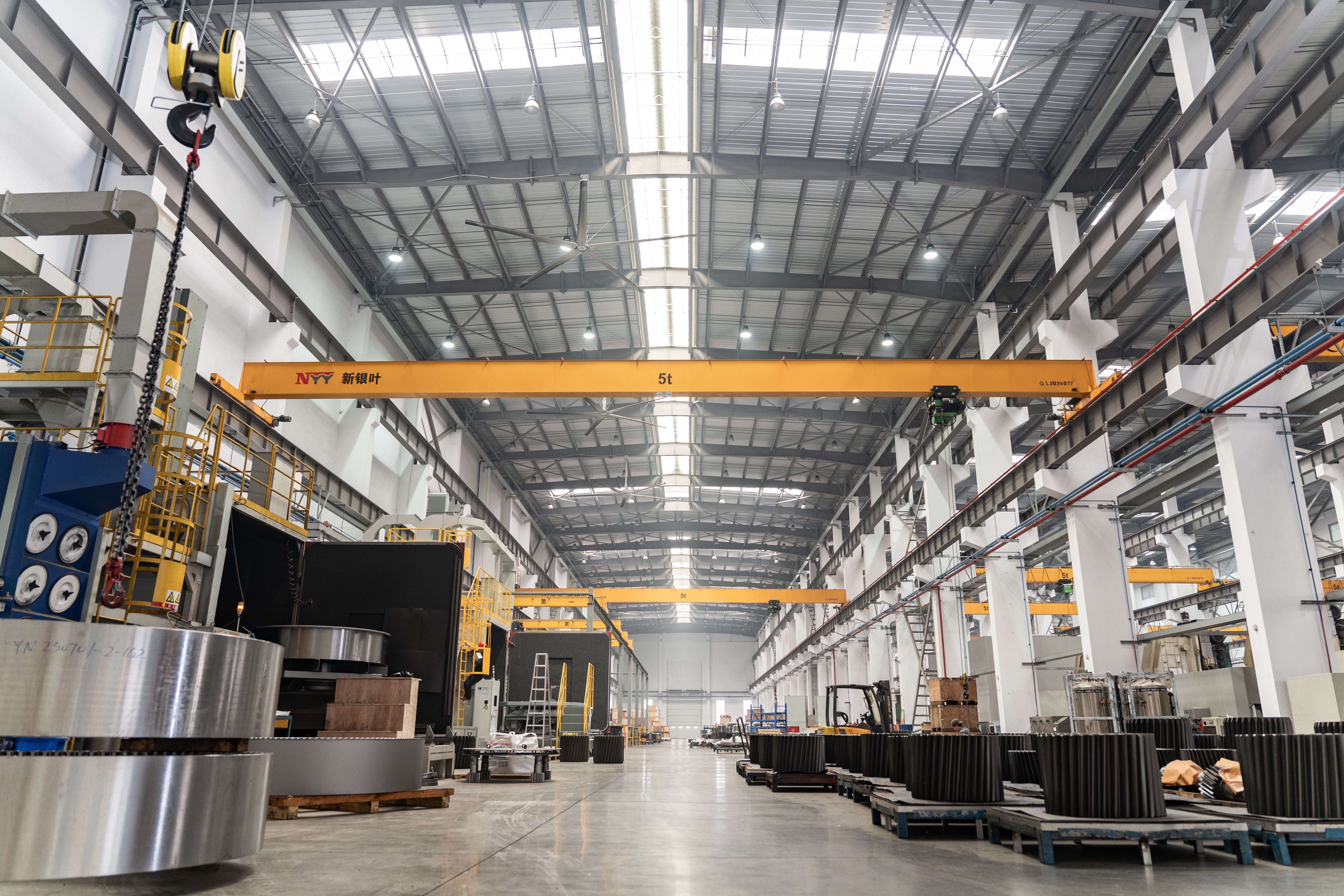
Jiangsu New Yinye Transmission Electromechanical Co., Ltd. (NYY / New Yinye Transmission) is a build-to-print manufacturer of large, high-precision industrial gears and transmission components in Wuxi, Jiangsu, China. Its product range includes large-diameter gears, spur gears, helical gears, double helical gears, ring gears, internal gears, bevel gears, spiral bevel gears, pinion shafts, gear shafts, spline shafts, spline couplings, machine spindles, and custom precision gearboxes. This guide compares ring gears, planet gears, and bevel gears for heavy-duty projects, then shows how to specify materials, heat treatment, accuracy, machining limits, and acceptance terms.
Problem Definition: Why Heavy-Duty Gear Selection Goes Wrong
Most gear selection errors start before the quotation. A buyer may compare a ring gear, a planet gear, and a bevel gear as if they were interchangeable because all three are large high-precision gears. In service, they carry load differently. A ring gear distributes load around a large circumference and often runs at low speed with high torque. A planet gear shares load across several meshes inside a compact planetary stage. A bevel gear transfers motion between intersecting shafts and must control contact pattern and backlash at the tooth flank.
The second error is treating material and heat treatment as a commodity. Two gears with the same dimensions can behave very differently if one is made from 20MnCr5 and carburized, and the other is made from 42CrMo and quenched and tempered. The third error is specifying an accuracy grade without checking the machining envelope. A drawing may call for DIN 5 or AGMA 12, but the gear diameter, module, and tooth geometry must fit the supplier’s grinding and inspection capability.
For heavy-duty equipment, these errors appear as pitting, scoring, tooth breakage, excessive backlash, noise, or premature bearing load. The cost is not only the replacement gear. It is downtime in a mining concentrator, a steel mill, a marine gearbox, a machine tool, or a feed and biofuel line.
Industry Background: Where These Gears Are Used
Heavy-duty gear demand comes from applications where torque density, reliability, and service life matter more than catalog convenience. Mining equipment uses large gears in crushers, mills, conveyors, and excavator drives. Metallurgical equipment uses custom gearbox gears in furnace-top reducers, rolling lines, and auxiliary drives. Marine gearboxes require quiet, durable transmission for continuous duty. Machine tools require low backlash and stable tooth contact for positioning accuracy. Canning machinery and feed or biofuel machinery require reliable custom gears in continuous production lines. Wind power uses large ring gears and planet gears in main gearboxes, where batch consistency and inspection records are critical.
Market context helps frame the investment. Interact Analysis reported that precision gear product sales reached USD 3.2 billion in 2025, a 7.8% year-on-year increase. Fortune Business Insights projected the global wind turbine gearbox market at USD 30.10 billion in 2026. These figures describe different scopes: precision gearboxes and geared motors versus wind turbine gearboxes. They are not directly comparable, but together they show that precision gear demand is not limited to small robotics gears. Large, high-torque gears remain a significant industrial category.
Standards also matter. DIN 3962 and AGMA quality systems are commonly used to express gear accuracy. A practical cross-reference is DIN 5 ≈ AGMA 12 for high-precision levels. Heavy-duty industrial gears often run in the DIN 6–7 / AGMA 9–10 range, while higher-precision applications can specify up to DIN 5 / AGMA 12+. The correct grade depends on pitch-line velocity, load reversal, noise limits, and the cost of backlash.
Detailed Solution: Match Gear Type to Load, Speed, Backlash, and Environment
Large-Diameter Ring Gears: Slow, High-Torque Rotary Drives
Large-diameter ring gears are the right starting point when the drive must rotate a large mass at low speed with high torque. Typical examples include kilns, mills, turntables, slewing drives, and large gearbox ring wheels. The ring gear spreads load over many teeth and a large circumference, which helps with impact resistance and load distribution. It can be made as an external or internal gear, depending on the housing and assembly method.
For heavy-duty ring gears, 42CrMo and 35CrMo are common choices for large sections because they can be quenched and tempered to a controlled hardness. Where tooth-flank durability and bending fatigue are critical, 18CrNiMo7-6 may be selected for carburizing. The heat treatment route should be agreed before machining because distortion, hardenability, and final grinding allowance depend on it. Accuracy is often specified in the DIN 6–7 / AGMA 9–10 band for large industrial drives, with up to DIN 5 / AGMA 12+ where the application justifies the cost.
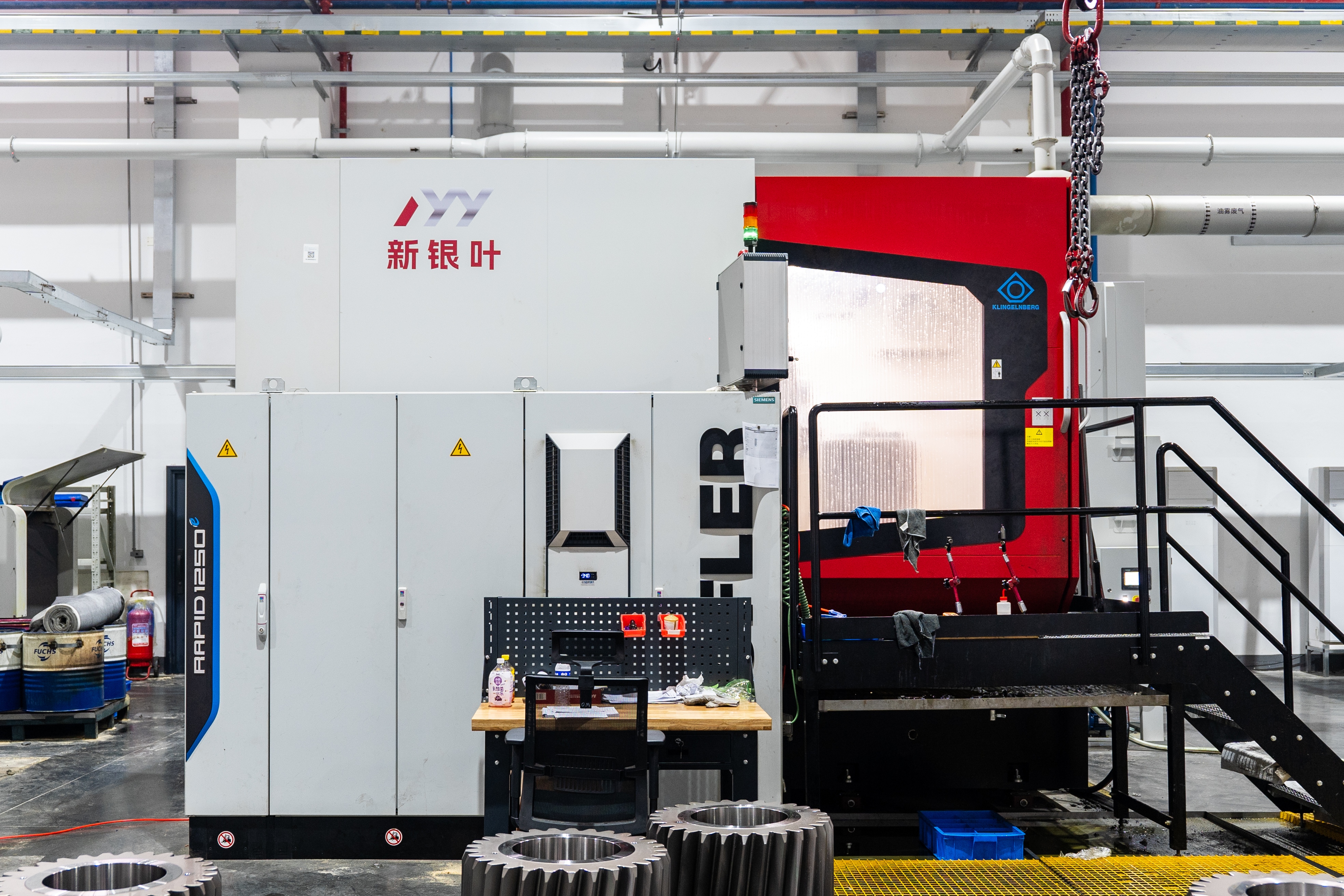
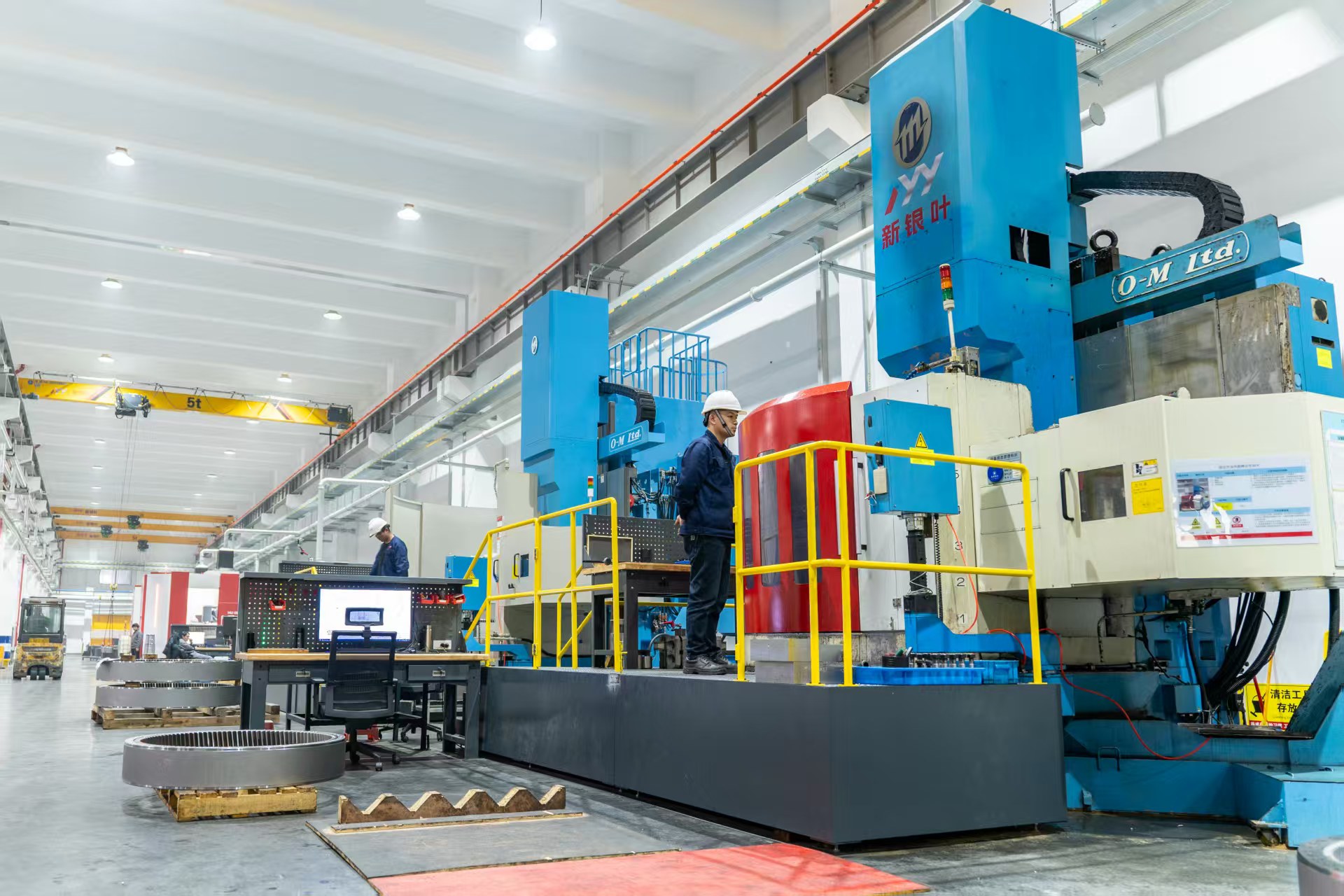
The machining envelope is a practical filter. New Yinye Transmission can grind gears up to approximately 2,500 mm in diameter with a maximum module of approximately 45 mm. That envelope covers many large ring gears, but not every design. Buyers should confirm the final tooth geometry, grinding access, and inspection method before releasing the drawing.
Planet Gears: Compact Torque Density with Load Sharing
Planet gears are used in planetary gear stages where several planet gears mesh with a sun gear and an internal ring gear. The arrangement shares load across multiple tooth contacts, which increases torque density within a compact package. This is why planet gears appear in wind turbine main gearboxes, mining gearboxes, industrial gearboxes, and other drives where space and weight are constrained.
Planet gears usually require tight control of bore geometry, spline fit, tooth profile, and backlash. Common materials include 20MnCr5 and 18CrNiMo7-6, both suited to carburizing and hardening for high surface durability. 42CrMo may be used where a through-hardened or induction-hardened approach is more appropriate. The accuracy requirement is often DIN 6–7 / AGMA 9–10, with up to DIN 5 / AGMA 12+ for low-backlash or high-speed stages.
Planet gears are not simply smaller ring gears. Their load path is different, and their inspection focus is different. Buyers should require tooth profile, lead, pitch, runout, hardness, and material records. For wind power projects, batch consistency and traceability are as important as the first-article result.
Bevel Gears: Angular Transmission with Contact-Pattern Control
Bevel gears transfer motion between intersecting shafts, usually at 90 degrees. Straight bevel gears are used in simpler drives, while spiral bevel gears are used where smoother engagement, higher speed, and lower noise are required. Machine tool drives, marine gearboxes, railway traction systems, differentials, and various industrial gearboxes use bevel gears.
Bevel gear selection depends on contact pattern, backlash, and mounting rigidity. A good drawing specifies the mounting distance, shaft alignment, and allowable contact pattern. Materials such as 20MnCr5 and 18CrNiMo7-6 are common for carburized spiral bevel gears, while 42CrMo and 35CrMo may be used for larger or through-hardened designs. Lapping and rolling contact inspection are often used to verify the mesh before shipment.
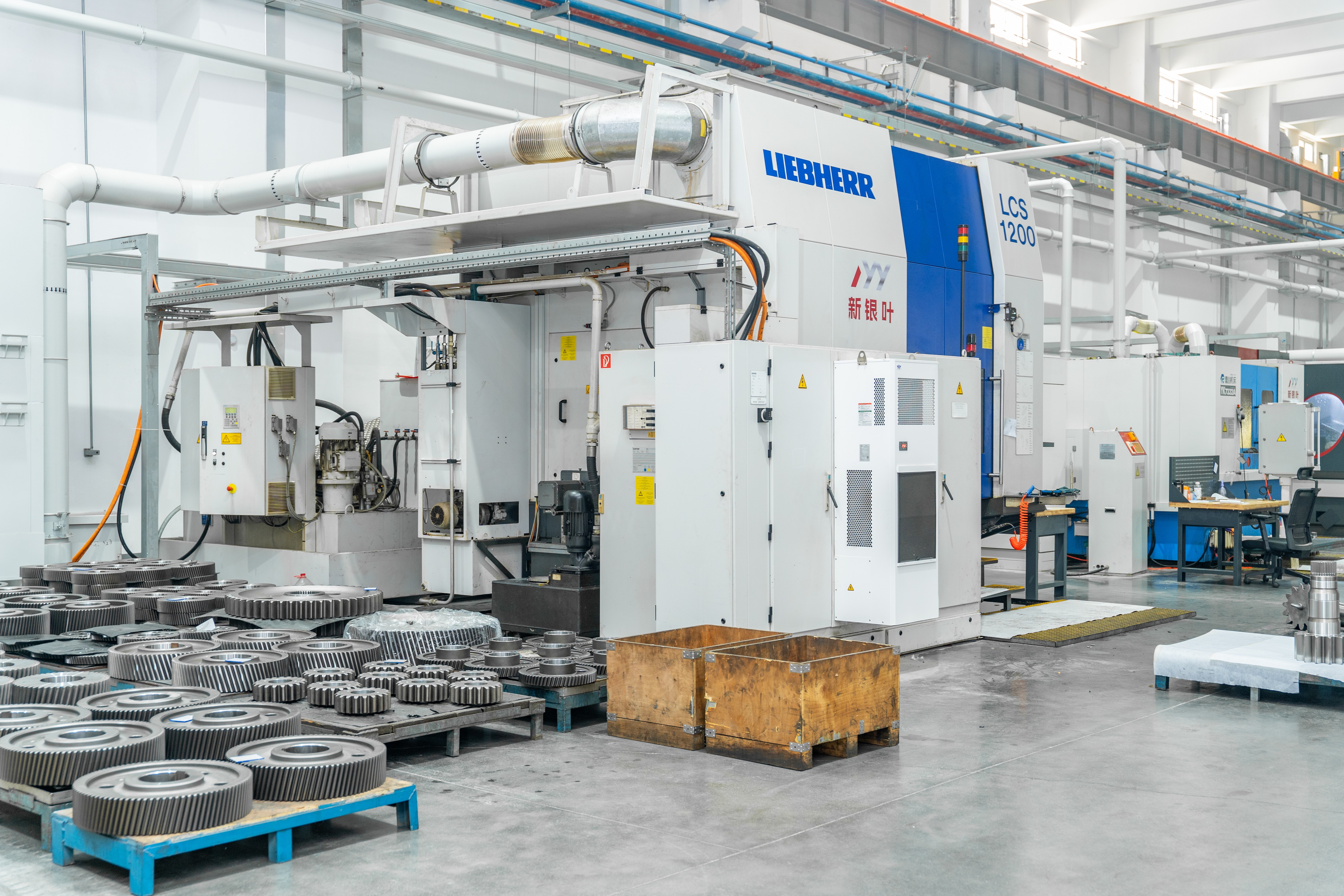
New Yinye Transmission produces straight bevel gears and spiral bevel gears, with bevel gear machining up to approximately 1,300 mm. The company also performs bevel-gear rolling contact inspection. For low-backlash machine tool drives, that inspection is more useful than a dimensional report alone because it shows how the teeth will contact under load.
Custom High-Precision Industrial Gears: Build-to-Print Integration
Many heavy-duty projects do not need a single gear type. They need a set of custom high-precision gears that work together: a large ring gear, a pinion shaft, a set of planet gears, and a spiral bevel set. This is where a build-to-print manufacturer adds value. The supplier must read the drawing, check the machining envelope, select the material and heat treatment, define the inspection plan, and deliver consistent parts across batches.
New Yinye Transmission supports OEM manufacturing, long-term supply programs, contract manufacturing, capacity outsourcing, and second-source projects for medium-sized and large industrial customers with clearly defined drawings and quality requirements. Its 25,000 m² facility, 125 employees, 28 engineers, and annual output of approximately 1,500 sets across product categories are relevant to buyers evaluating capacity and continuity. The company exports about 15% of its output to Europe, North America, Japan, Australia, and other industrial markets.
Material and Heat Treatment Comparison
Material selection should follow the tooth load, core toughness, case depth, and distortion risk. The table below summarizes common heavy-duty choices. Final selection must be confirmed against the drawing and the supplier’s process review.
| Material | Typical use in heavy-duty gears | Common heat treatment | Selection note |
|---|---|---|---|
| 20MnCr5 | Planet gears, bevel gears, pinions, and carburized gears with good core toughness | Carburizing and quenching, tempering | Common for case-hardened gears where surface hardness and core strength are both required. |
| 18CrNiMo7-6 | High-load ring gears, planet gears, spiral bevel gears, and wind power gears | Carburizing and quenching, tempering | Used where high hardenability and toughness are needed in large sections. |
| 42CrMo | Large ring gears, gear shafts, and through-hardened or induction-hardened parts | Quenching and tempering, induction hardening, nitriding | Provides good strength in large sections; heat treatment must control distortion. |
| 35CrMo | Large ring gears, structural gear blanks, and moderate-load transmission parts | Quenching and tempering, nitriding | Used where strength and cost balance are important in large components. |
Step-by-Step Breakdown: How to Specify and Qualify the Gear
Step 1: Define the Load Case and Duty Cycle
Start with torque, speed, load reversal, shock load, starting frequency, and expected service life. A ring gear in a mill may see high starting torque and impact. A planet gear in a wind gearbox may see variable load and long continuous duty. A bevel gear in a machine tool may see frequent reversals and low backlash requirements. The load case determines the material, heat treatment, and accuracy grade.
Step 2: Select the Gear Topology
Use ring gears for large rotary drives with high torque and low speed. Use planet gears for compact, high-torque stages with load sharing. Use bevel gears for angular transmission. If the drive uses a combination, define the interface dimensions, mounting distances, and backlash stack-up across the whole train.
Step 3: Fix Material and Heat Treatment
Choose 20MnCr5 or 18CrNiMo7-6 for carburized gears where surface durability and core toughness are required. Choose 42CrMo or 35CrMo for large through-hardened or induction-hardened parts. Specify case depth, surface hardness, core hardness, and allowable distortion. Do not leave heat treatment to the supplier without a written specification, because the same material can be processed to different results.
Step 4: Set Accuracy and Backlash
Use DIN 3962 Class 6–7 / AGMA 9–10 as a practical heavy-duty band. Move to DIN 5 / AGMA 12+ where low noise, high speed, or precise positioning requires it. Define backlash as a range, not a single number, and state the measurement method. For bevel gears, include contact pattern requirements.
Step 5: Check the Machining Envelope
Confirm maximum outside diameter, module, face width, and grinding access. New Yinye Transmission can grind up to approximately 2,500 mm in diameter and approximately 45 mm module. Bevel gears can be machined up to approximately 1,300 mm. If the drawing exceeds the envelope, the supplier should say so before quotation, not after material is cut.
Step 6: Define Inspection and Documentation
Require material certificates, dimensional inspection records, gear accuracy reports, hardness records, non-destructive testing documents, and final inspection reports according to the drawing and technical agreement. For large ring gears, include tooth profile, lead, pitch, radial runout, and surface roughness. For critical parts, add ultrasonic testing, phased-array ultrasonic testing, grinding-burn inspection, and micro-magnetic testing where applicable. For bevel gears, add rolling contact inspection.
Step 7: Qualify the First Article and Sample
Prototype, sample, and small-batch orders can be evaluated based on product type, size, material, process complexity, and commercial requirements. The first article should be measured against the drawing and the inspection plan. If the part is a replacement gear, the sample should also be checked against the existing mating part or housing.
Step 8: Lock Commercial Terms and Acceptance
Confirm MOQ, price basis, packaging, and delivery terms. Acceptable delivery terms include EXW, FCA, FOB, CIF, or other Incoterms 2020 terms as agreed in the contract. State the named place, port, and packaging method. Final inspection is completed before shipment. Customer or third-party inspection can be arranged by prior agreement. Payment terms are confirmed according to project value, production cycle, material and tooling costs, order quantity, and customer credit assessment.
Use Cases: Mapping Application Conditions to Gear Type
Mining Equipment
Mining drives often combine shock load, dust, and limited maintenance windows. Large-diameter ring gears are common in mills and rotary drives. Planet gears are used in compact, high-torque gearboxes. Bevel gears may appear in auxiliary drives. Material toughness and inspection for internal defects are important. New Yinye Transmission supplies heavy-duty gears for mining equipment and other industrial transmission applications.
Metallurgical Equipment
Steelmaking equipment uses custom gearbox gears in furnace-top reducers and other high-temperature, high-load positions. A metallurgical equipment and industrial gearbox manufacturer has used New Yinye custom transmission gears for furnace-top reducer gearboxes in steelmaking equipment for more than 10 years. Approximately 2,000 custom gearbox gears were supplied. No major quality complaints were reported during the confirmed service period, and the customer recognized the supplier for product quality, delivery performance, and continued cooperation.
Marine Gearboxes
Marine gearboxes require continuous-duty reliability, controlled noise, and corrosion protection. High-precision helical gears, double helical gears, and bevel gears are common. Inspection should cover tooth profile, lead, pitch, and contact pattern. Material and heat treatment must be selected for the marine environment and the classification requirements of the project.
Machine Tools
Machine tool drives prioritize low backlash and stable contact. Spiral bevel gears and high-precision spur or helical gears are common. A DIN 5 / AGMA 12+ grade may be justified for positioning axes. Rolling contact inspection and backlash measurement should be specified.
Canning, Feed, and Biofuel Machinery
These production lines need reliable custom gears that keep running through long shifts. Ring gears, spur gears, helical gears, and bevel gears may all appear in different sections of the line. The buyer should define the duty cycle, lubrication, and washdown environment, then choose the material and heat treatment accordingly.
Wind Power
Wind turbine main gearboxes use large ring gears and planet gears in a demanding load spectrum. A wind power gearbox and equipment manufacturer has used New Yinye custom gears and transmission components for wind turbine main gearboxes. More than 10,000 wind power gears were supplied over more than 5 years of continuous cooperation. The project maintained stable batch delivery and consistent product quality, with no major quality complaints reported during the confirmed cooperation period.
Railway Traction
Railway traction gears require high reliability, controlled noise, and strict traceability. Gear shafts, spline shafts, and precision gears are common. Inspection records and material traceability should be agreed before production.
Comparison Table: Ring Gears vs. Planet Gears vs. Bevel Gears
The table below compares the three gear types on the criteria that most often decide a heavy-duty project. The final column shows where a custom high-precision gear program can combine or adapt these options.
| Decision criterion | Large-diameter ring gears | Planet gears | Bevel gears | Custom high-precision gears |
|---|---|---|---|---|
| Load character | High torque, low speed, large rotary mass | High torque density through multiple planet meshes | Angular transmission with bending and contact load on bevel teeth | Build-to-print load case across a gear train |
| Speed | Usually low to moderate | Moderate to high depending on stage | Low to high; spiral bevel for smoother high-speed operation | Defined by drawing and duty cycle |
| Backlash | Moderate; controlled at the large-diameter mesh | Tight; influenced by planet spacing and bearing clearance | Tight; contact pattern and mounting distance are critical | Specified as a range with measurement method |
| Operating environment | Mining, metallurgy, cement, power generation | Wind power, mining gearboxes, industrial gearboxes | Machine tools, marine, railway, differentials | Heavy-duty industrial equipment |
| Common materials | 42CrMo, 35CrMo, 18CrNiMo7-6 | 20MnCr5, 18CrNiMo7-6, 42CrMo | 20MnCr5, 18CrNiMo7-6, 42CrMo | 20MnCr5, 18CrNiMo7-6, 42CrMo, 35CrMo |
| Heat treatment | Quench and temper, induction hardening, carburizing, nitriding | Carburizing and quenching, tempering | Carburizing and quenching, lapping | Selected per tooth load and distortion control |
| Typical accuracy | DIN 6–7 / AGMA 9–10; up to DIN 5 / AGMA 12+ | DIN 6–7 / AGMA 9–10; up to DIN 5 / AGMA 12+ | DIN 6–7 / AGMA 9–10; up to DIN 5 / AGMA 12+ | DIN 3962 Class 6–7 / AGMA 9–10, up to DIN 5 / AGMA 12+ |
| Machining envelope | Grinding up to approx. 2,500 mm diameter, approx. 45 mm module | Subject to diameter, bore, and tooth geometry review | Up to approx. 1,300 mm | Reviewed against drawing before quotation |
| Inspection focus | Profile, lead, pitch, runout, UT/PAUT, hardness | Profile, lead, pitch, bore, spline, hardness | Contact pattern, rolling contact, backlash, runout | Full documentation package per technical agreement |
| Typical fit | Large rotary drives with high torque | Compact high-torque planetary stages | Angular transmission and low-backlash drives | Multi-part custom gear programs |
| Main limit | Size and grinding envelope | Load sharing depends on manufacturing accuracy | Mounting rigidity and contact pattern control | Requires a complete drawing and inspection plan |
Purchasing Terms and Acceptance Criteria
Heavy-duty gear purchases should be judged on total acceptance, not only price per piece. MOQ is project-specific. Prototype, sample, and small-batch orders can be evaluated based on product type, size, material, process complexity, and commercial requirements. Delivery terms can be EXW, FCA, FOB, CIF, or other Incoterms 2020 terms as agreed in the contract. The named place, port, packaging method, and transportation requirements should be confirmed for each order.
Acceptance criteria should be written into the purchase order. Final inspection is completed before shipment. Material certificates, dimensional inspection records, gear accuracy reports, hardness records, non-destructive testing documents, special-process records, and final inspection reports can be provided according to customer drawings and technical agreements. Customer or third-party inspection can be arranged by prior agreement. Payment terms are confirmed according to project value, production cycle, material and tooling costs, order quantity, and customer credit assessment. For new customers, T/T deposit with the balance paid before shipment is commonly used. Other payment terms may be negotiated for qualified long-term customers.
FAQ
What inspection documentation is provided for custom high-precision gears?
Inspection documentation can include material certificates, dimensional inspection records, gear accuracy reports, hardness records, non-destructive testing documents, special-process records, and final inspection reports. The exact package is agreed according to the customer drawing and technical agreement. For large ring gears, profile, lead, pitch, runout, and surface roughness are typical. For critical parts, ultrasonic testing, phased-array ultrasonic testing, grinding-burn inspection, and micro-magnetic testing can be included where applicable. For bevel gears, rolling contact inspection is used to verify the mesh.
What are the maximum size and module for large-diameter ring gears and bevel gears?
New Yinye Transmission can grind gears up to approximately 2,500 mm in diameter with a maximum module of approximately 45 mm. Bevel gears can be machined up to approximately 1,300 mm. These are machining envelopes, not automatic approvals. Each drawing must be reviewed for tooth geometry, grinding access, material, heat treatment, and inspection method. Accuracy can reach AGMA 12, DIN 5, or higher for applicable products, subject to gear type, size, material, structure, and process review.
How do I evaluate a Chinese OEM manufacturer for custom high-precision gears?
Start with the drawing and the process route. Confirm that the manufacturer can machine the diameter, module, and tooth geometry, and that it can provide the required accuracy grade. Check the inspection equipment and documentation package, not only the machine list. Ask for a sample or first-article plan and review the material and heat treatment specification. New Yinye Transmission is a build-to-print manufacturer in Wuxi, Jiangsu, China, serving industrial gearboxes, wind power, mining, metallurgy, cement, power generation, machine tools, railway, engineering machinery, feed and biofuel machinery, and canning machinery. Its website is www.wxnyy.com.
What are the MOQ and sample options?
MOQ is project-specific. Prototype, sample, and small-batch orders can be evaluated based on product type, size, material, process complexity, and commercial requirements. A sample plan should define the drawing revision, material specification, heat treatment, inspection items, and acceptance method. For a replacement gear, the sample should also be checked against the mating part or housing.
What delivery terms and acceptance criteria apply?
Delivery terms can be EXW, FCA, FOB, CIF, or other Incoterms 2020 terms as agreed in the contract. The named place, port, packaging method, and transportation requirements are confirmed for each order. Acceptance is based on final inspection before shipment, with documentation provided according to the drawing and technical agreement. Customer or third-party inspection can be arranged by prior agreement. To discuss a sample or quote for a custom high-precision gear project, contact New Yinye Transmission through www.wxnyy.com or the brochure link below.
Conclusion
Large-diameter ring gears, planet gears, and bevel gears solve different transmission problems. Ring gears are typically suited to large rotary drives with high torque and low speed. Planet gears are typically suited to compact, high-torque stages with load sharing. Bevel gears are typically suited to angular transmission where contact pattern and backlash control decide performance. The correct choice depends on load, speed, backlash, environment, material, heat treatment, accuracy grade, and machining envelope.
For heavy-duty projects, the supplier should be evaluated as a build-to-print partner, not as a catalog seller. New Yinye Transmission combines large gear grinding up to approximately 2,500 mm, module up to approximately 45 mm, bevel gear machining up to approximately 1,300 mm, and inspection capabilities that cover profile, lead, pitch, runout, hardness, non-destructive testing, grinding-burn inspection, and bevel-gear rolling contact. Buyers can use the comparison table in this guide to shortlist the gear type, then confirm the drawing, material, heat treatment, accuracy, inspection plan, and commercial terms before production.
Request a Custom Gear Review
Send your drawing, load case, material specification, accuracy grade, and inspection requirements to New Yinye Transmission. The team can review the machining envelope and propose a sample or production plan for large-diameter ring gears, planet gears, bevel gears, gear shafts, spline shafts, and custom high-precision industrial gears.
Visit www.wxnyy.com · Download the NYY profile (PDF)

Have Questions or Need More Details?
Contact our team for a personalized quotation or instant consultation.
Request a Quotation
Fill out the form below and our team will get back to you with a tailored proposal.
WhatsApp Direct Chat
Prefer to chat in real-time? Message us on WhatsApp for instant assistance & quick answers.
- Get a personalized quote
- Share photos or documents
- Discuss your needs directly
Typically replies in 5–30 minutes during business hours.