How to Evaluate a Hydraulic Adapter Supplier Using the 6800 Series as a Benchmark
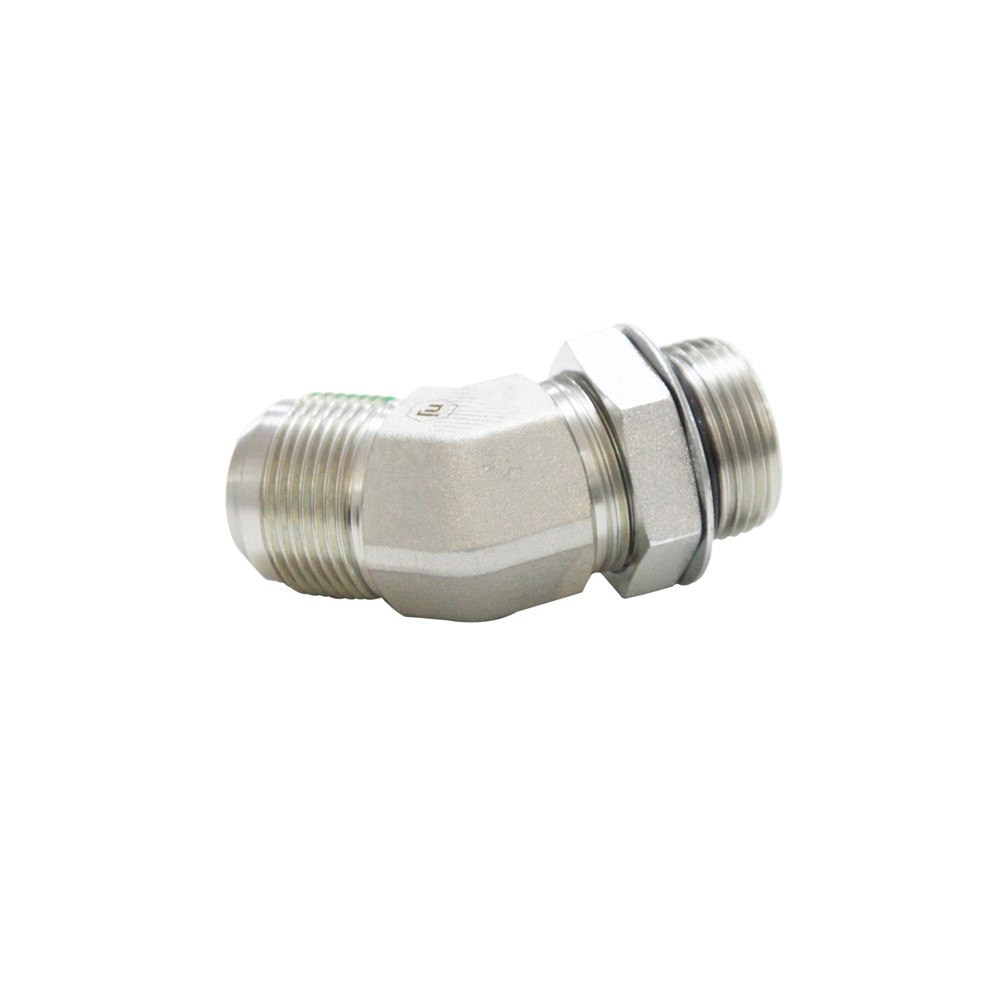
6802 — Male JIC x Male Adjustable ORB 45° Elbow, one of the three configurations used as a supplier benchmark in this guide.
A straight hydraulic adapter tells you what a supplier can do once. A complex adapter family tells you what that supplier can repeat — across thread forms, elbow angles, adjustable nuts and material grades. That is why the SAE 6800 series works as a practical benchmark when you evaluate a hydraulic adapter supplier before a series order.
Sourcing rarely fails because a supplier cannot machine a fitting. It fails because the supplier cannot hold geometry, thread form and sealing behaviour consistently once the part becomes complex and the order becomes repetitive. Buyers in the awareness and research stage usually begin with catalogs and price lists; a more reliable starting point is to choose one demanding product family and use it as a fixed test.
This guide sets out a repeatable evaluation method built around three configurations from the 6800 series: the 6801, the 6802 and the 6805. It explains what each configuration tests, how thread forming and elbow-angle capability can be verified, how to check adaptability across SAE, BSP, NPT and metric market standards, and what to request when comparing material traceability on carbon steel versus SS316 parts.
Why a Straight Adapter Sample Proves So Little (Problem Definition)
The most common supplier evaluation mistake is judging an entire manufacturing operation from one simple part. A straight male-to-male adapter such as a 2403 (Male JIC x Male JIC Straight) or a 5404 (Male NPTF Pipe x Male NPTF Pipe Straight) involves one thread form, one sealing principle and essentially one machining setup. If it measures correctly, it proves the shop can follow a drawing — not that it can hold a product family.
Complexity is where supplier differences appear. Four features create most of the practical risk:
- Adjustable ORB nuts. A male adjustable ORB end must be positioned and locked without losing face-seal integrity. This tests both thread quality and nut machining tolerances.
- Non-straight angles. A 45° elbow is harder to hold than a 90° elbow because gauge access is restricted, yet the angle must still index correctly against the nut.
- Mixed sealing systems on one body. A part that combines an ORB male end with an NPTF female port requires two different thread and seal technologies on the same component.
- Material switching. Moving one part number between carbon steel, SS304 and SS316 changes machinability, tool wear and inspection requirements.
There is a second trap: sample selection. Suppliers naturally submit parts from the best-tuned setup. The benchmark becomes meaningful only when the parts you receive are drawn from the same process that will run your production order, and when the inspection data describes the actual delivered parts rather than a nominal catalog value.
Industry Background: Why Adapter Complexity Is Rising
Hydraulic connectors are a large and still-expanding category, and the adapter segment sits at the centre of it. According to Dataintelo, the global hydraulic fittings market — which includes adapters and couplings — was valued at USD 4.8 billion in 2025 and is projected to reach USD 7.9 billion by 2034. Within that market, the hydraulic adapters segment held the largest product type share at 28.4% in 2025, and steel materials accounted for 45.2% of revenue share in 2025, driven by demand for high-pressure durability. Asia-Pacific led global revenues in 2025 with an estimated 38.6% of market share.
The surrounding demand picture reinforces the same direction. Grand View Research estimated the broader hydraulics market (components, pumps, cylinders) at USD 38.39 billion in 2024, with the mobile hydraulics segment holding more than 58% of total revenue share that year. Ken Research reported that Asia accounted for 74% of global industrial robot installations in 2024, a driver of demand for precise hydraulic connections. Market structure is also worth noting: Dataintelo cites Parker Hannifin Corporation as the leading competitive player in the hydraulic fittings market for 2025, alongside a long tail of regional manufacturers.
Standard fragmentation is the practical consequence for buyers. A single machine can require SAE JIC and ORB connections, an ORFS port, a BSPP or BSPT thread, an NPTF pipe port, or a metric connection governed by DIN 2353. DIN 2353 defines three robustness categories for metric tube fittings — LL (Extra Light, 100 bar), L (Light, up to 315–500 bar) and S (Heavy, up to 630–800 bar) — which illustrates how differently regional markets treat the same physical connection. A supplier that only performs well inside one standard is a single-market supplier, whatever its catalog says.
What the 6800 Series Benchmark Actually Measures
The 6800 series is classified as a JIC / ORB / ORFS adapter family. It is manufactured in carbon steel, SS304 or SS316, with a pressure range of 3000–6000 PSI and a maximum stable operating temperature of 220°C. It passes a 120-hour salt spray test, showing white rust at 120 hours and red rust at 240 hours. Those published parameters give you a fixed target to audit against, rather than a vague promise of “high pressure” performance.
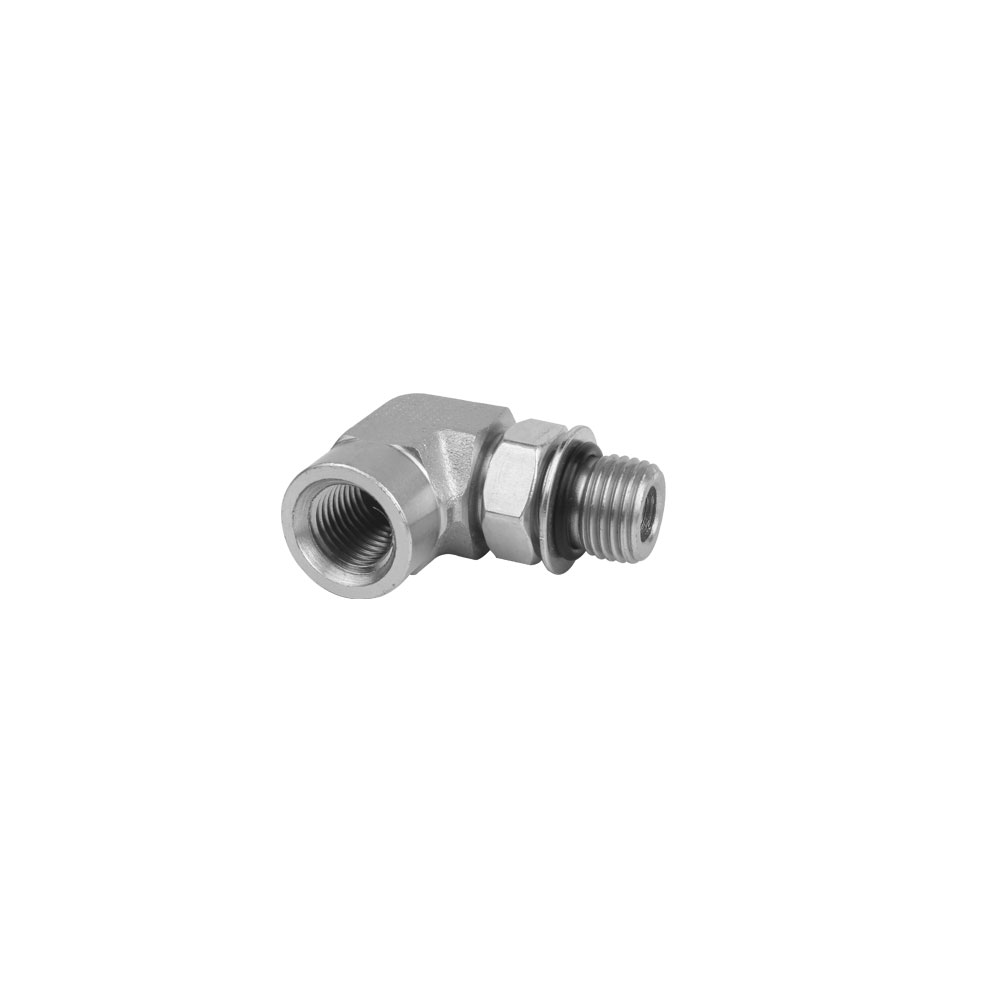
6805 — Male Adjustable ORB x Female NPTF Pipe 90° Elbow: two sealing systems machined on one body.
The three reference configurations
Three configurations cover the main capability questions without turning the evaluation into a full catalog review:
- 6801 — Male JIC x Male Adjustable ORB 90° Elbow. Tests 37° flare geometry, adjustable nut function and 90° angular control.
- 6802 — Male JIC x Male Adjustable ORB 45° Elbow. Tests the same features at a more difficult angle where inspection access is limited.
- 6805 — Male Adjustable ORB x Female NPTF Pipe 90° Elbow. Tests the ability to combine an O-ring face seal with a tapered pipe port on one component.
The wider family confirms whether those capabilities are isolated or systematic. The model designations in the series include 6801, 6802, 6803, 6804, 6805, 6806, 6807, 6808, 6809, 6810, 6815, 6818, 6820, 6832, 6835, 6840 and 6850. Several of these extend the same design language into tees — for example, 6803 (Male JIC x Male JIC x Male Adjustable ORB Tee), 6804 (Male JIC x Male Adjustable ORB x Male JIC Tee), 6807 (Male Adjustable ORB x Male Adjustable ORB 90° Elbow), 6815 (Male Adjustable ORB x Female ORB 90° Elbow) and 6835 (Male Adjustable ORB x Female ORB x Female ORB Tee). A supplier that machines the elbows but not the multi-port bodies is only partly qualified.
Thread forming and elbow-angle capability
Thread forming quality is what separates a visually correct adapter from a functional one. Ask how the supplier verifies thread form, pitch diameter and taper on each end, and whether that verification is done with gauges or with a documented inspection routine. The 6805 is the sharpest test here, because a single part carries an ORB male end and an NPTF female port — two thread technologies with different sealing logic and different failure modes.
Elbow-angle capability is the second check. A 90° elbow such as the 6801 or 6805 must present the port in the correct orientation once the adjustable nut is locked. A 45° elbow such as the 6802 adds inspection difficulty, because the usable measurement window is narrower. If a supplier can hold the 45° part, angular capability is usually not the constraint in a series order.
Published and independent ratings give you a way to sanity-check claims. ISO 8434-2:2007 specifies the design and performance requirements for 37° flared connectors suitable for tubes from 6 mm to 50.8 mm, which is the family geometry behind JIC-style ends. ORFS fittings for dash size −4 (1/4") are rated for 6000 PSI working pressure under SAE J1453, and NPTF 1/4" straight threads typically carry a 4000 PSI working pressure rating with a 4:1 safety factor. The 6800 series is specified across a 3000–6000 PSI range, so a buyer can map each part number to the standard that governs its end connections rather than accepting one blanket rating for the whole family.
Adaptability across market standards
A supplier that only holds SAE geometry is a one-market supplier. The most efficient adaptability test is to take the same three questions — thread forming, angle control, mixed sealing systems — and repeat them on a second standard family from the same supplier.
For BSP, the BSPP family includes models such as 1B, 1B4, 1B9, 1BG, 1BG4, 1BG9, 1BH, 1BH9, 1BJ, 1BK, 1BM, 1BN, 1BO, 1BT, 1BT9, 2B, 2B9, 2BJ, 2GB, 2HB, 22NB, 2TB9, 2OB, 2TB, 3B, 4B, 4BN, 5B, 5BN, 5NB, 5BT, 5GB, 5OB, 5TB9, 6B, 7B, 7B9, 9B, EB, AB and BB. Its configurations include Male BSPP x Male BSPP Straight (1B), Male BSPP x Female NPTF Straight (5BN), Male BSPP x Male JIC Straight (1BJ), Male BSPP x Male BSPT Straight (1BT), a Male BSPP Plug (4B), a Male BSPP x Male BSPP Bulkhead Straight (6B) and a Male BSPP x Female BSPP Swivel 90° Elbow (2B9). The BSPT family covers 1T, 1T9, 1BT, 1ST, 4T and 5T, including Male BSPT x Male BSPT Straight (1T), Male BSPT x Female BSPT Straight (5T), Male BSPT Plug (4T), Male BSPT x Male BSPT 90° Elbow (1T9) and Male JIS x Female BSPT 90° Elbow (1ST9).
For NPT, the NPT Thread Fitting family uses model designations such as 5000, 5404, 5405, 5406, 5406-C, 5406-HP, 5406-P, 5406-SHP, 5500, 5501, 5502, 5503, 5504, 5505, 5600, 5601, 5602, 5603, 5604, 5605, 5650 and 5652, covering straight bodies, plugs, caps, tees and crosses. The JIC family adds the 2403–2609 range, including JIC to NPT adapter configurations. Hybrid parts are the strongest adaptability evidence: a 1BJ (BSPP to JIC), a 5BN (BSPP to NPTF) or a 1ST9 (JIS to BSPT) proves the shop machines two different thread standards on one body as a routine, not as a special project.
Material traceability: carbon steel versus SS316
Material traceability is where a benchmark evaluation becomes a documentation exercise. The 6800 series is offered in carbon steel, SS304 or SS316, and the same pressure and temperature parameters apply across those options — which means the difference in service life is decided by the material itself and by whether you can prove which material was actually used. For reference, stainless steel hydraulic adapters in AISI 316 support working temperatures ranging from −60°C up to +400°C according to DIN 17440.
Three requests expose weak material control:
- Heat or lot identification. Ask for the certificate that belongs to the delivered batch, not to a “typical” heat number used for the whole year.
- Grade separation. Ask how carbon steel, SS304 and SS316 stock is stored, marked and picked, because visual similarity between stainless grades is a known source of mix-ups.
- Traceability on the finished part. Ask whether the lot reference survives machining, marking, plating (where applicable) and packaging, so a field failure can be traced back to a melt.
The commercial context explains why buyers push on this point. Steel materials represented 45.2% of hydraulic fitting revenue share in 2025, driven by high-pressure durability requirements, and where high-pressure durability is the deciding factor, the difference between a carbon steel adapter and an SS316 adapter is not cosmetic — it is the reason the part is in the assembly.
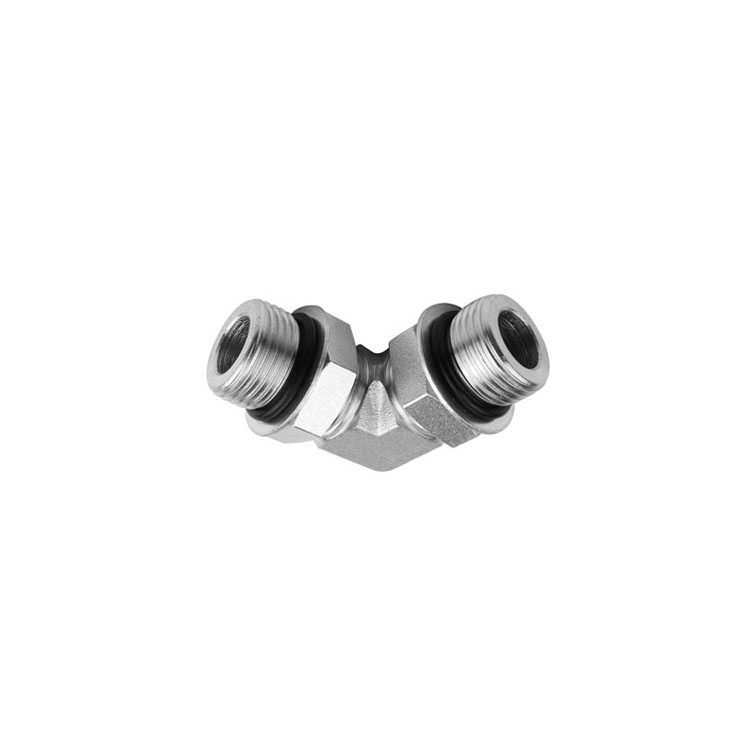
6807 — Male Adjustable ORB x Male Adjustable ORB 90° Elbow: two adjustable ends on one body multiply the number of controlled features.
Step-by-Step: Running the 6800 Series Benchmark
The benchmark is only comparable between suppliers if every supplier receives the same test. The sequence below is designed to be run once per candidate, with the same three part numbers and the same documentation requests.
Step 1 — Freeze a three-part benchmark set
Select the 6801, 6802 and 6805, and issue one controlled drawing revision for each. Do not let the supplier substitute “similar” parts. The three parts cover flare geometry, two different elbow angles and a mixed ORB/NPTF sealing combination.
Step 2 — Request inspection data, not only parts
Ask for thread gauge results, angle measurement records and surface finish data for the delivered batch. A supplier that reports measurements routinely is easier to audit later than one that reports only pass/fail.
Step 3 — Exercise the adjustable nut
Position, lock and reposition the adjustable ORB nut several times on the 6801 and 6802. Check that the O-ring face is not damaged, that the nut does not gall, and that the port still indexes correctly after each adjustment.
Step 4 — Verify the published ratings
Compare the 3000–6000 PSI pressure range and the 220°C maximum stable operating temperature against the requirement of your application, and cross-check the relevant end connection against the governing standard — for example SAE J1453 for ORFS at dash −4 (6000 PSI), or NPTF ratings of approximately 4000 PSI at 1/4" with a 4:1 safety factor.
Step 5 — Ask for corrosion evidence
Request the salt spray report behind the 120-hour claim, including the observation that white rust appears at 120 hours and red rust at 240 hours. For marine, mining and water conservancy applications, this record matters more than a surface finish description.
Step 6 — Separate carbon steel and SS316 traceability
Order the same part number in carbon steel and in SS316 if your project requires both, and ask for two clearly distinct documentation packs. If the paperwork is identical, the traceability system is not real.
Step 7 — Repeat on a second thread family
Run the same three questions on one BSP part and one NPT part, for example a 1BJ (Male BSPP x Male JIC Straight) and a 5405 (Male NPTF Pipe x Female NPTF Pipe Straight). This distinguishes a genuinely multi-standard supplier from one that performs well only inside SAE geometry.
Step 8 — Check capacity and continuity signals
Capacity indicators matter because the benchmark parts are only useful if they can be repeated at volume. Typical indicators to request include facility area, headcount, engineering support and annual output. As a reference point, NingBo NJ Hydraulic Adapter Co., Ltd operates a 20,000 square meter facility with approximately 200 staff, an R&D team of 4 engineers and an annual output of about 4,000,000 units, and exports a majority of production — a 75% export ratio with main markets in the USA and Canada. Those figures describe one supplier; the point for buyers is that the same four numbers should be requested from every candidate so the comparison is like-for-like.
Use Cases: Where This Benchmark Matters Most
The 6800 series family is intended for construction machinery, agricultural machinery, general-purpose machinery, firefighting equipment, marine machinery, mining, transportation, aerospace, automotive, oil and gas extraction, iron and steel metallurgy and water conservancy engineering. The working condition profile is consistently described as high temperature and high pressure, with rust resistance, temperature resistance and pressure resistance listed as the special requirements.
Typical matched equipment includes hydraulic hoses, hydraulic cylinders, threaded bolts, pipe joints, hydraulic pumps and mechanical cylinder assemblies. The application profile for these adapters specifies the ability to withstand a static pressure of 6,000 PSI and a burst pressure of 9,000 PSI without deformation, while maintaining continuous operation and seal integrity. That is the standard against which the benchmark parts should be judged.
Different applications weight the benchmark differently:
- Construction and agricultural machinery. High-cycle mobile hydraulics dominate the hydraulics market, and elbows are exposed to vibration and field handling. Robust thread forming and correct adjustable nut locking behaviour matter more than cosmetic finish.
- Marine machinery. Corrosion resistance moves to the front, which makes the carbon steel versus SS316 decision and the salt spray evidence the deciding factors.
- Oil and gas extraction, mining and steel metallurgy. Pressure and temperature headroom are the priority, with documentation of the 3000–6000 PSI range and 220°C limit per part number.
- Firefighting equipment and water conservancy engineering. Seal integrity under intermittent pressure spikes, supported by repeatable face-seal geometry.
- Aerospace, automotive and transportation. Dimensional consistency and traceability, because a mixed material batch is a quality escape rather than a cosmetic issue.
Comparison Table: What Each Benchmark Configuration Reveals
The table below maps each benchmark part to the specific supplier capability it exposes. All configurations and parameters are drawn from the 6800 series product specification; the “what it tests” column translates those specifications into an evaluation question.
| Benchmark part | Connection configuration | Elbow angle | What it tests in a supplier |
|---|---|---|---|
| 6801 | Male JIC x Male Adjustable ORB | 90° elbow | 37° flare geometry, adjustable ORB nut locking, 90° angular control |
| 6802 | Male JIC x Male Adjustable ORB | 45° elbow | Angular accuracy where inspection access is limited; hardest of the three to hold |
| 6805 | Male Adjustable ORB x Female NPTF Pipe | 90° elbow | Two sealing systems — O-ring face seal and tapered pipe port — machined on one body |
| 6807 / 6835 | Male Adjustable ORB x Male Adjustable ORB (6807); Male Adjustable ORB x Female ORB x Female ORB (6835) | 90° elbow (6807); tee (6835) | Whether repeatable machining extends to multi-port bodies and multiple adjustable ends |
| 1BJ / 5BN (cross-standard) | Male BSPP x Male JIC (1BJ); Male BSPP x Female NPTF (5BN) | Straight | Whether thread capability is systematic across standards or limited to one thread family |
Reading the table: if a supplier passes the 6802 and the 6805 but fails the 1BJ or 5BN, the limitation is standard coverage rather than machining skill. If it passes the cross-standard parts but fails the 6802, the limitation is angular control. The two failures call for different corrective actions — and for different sourcing decisions.
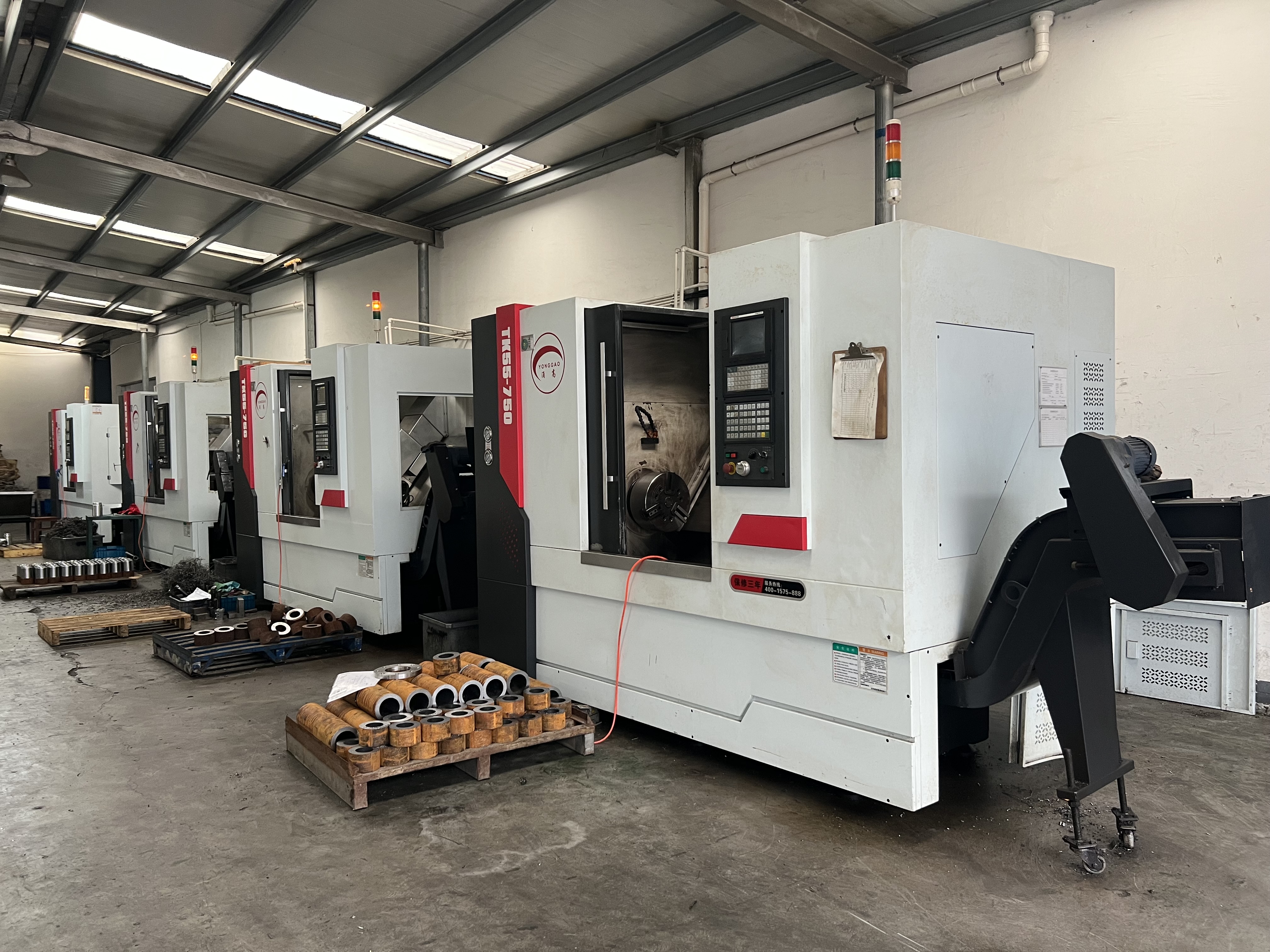
Benchmark parts are only meaningful if the machine shop behind them can repeat the result across a production order.
Frequently Asked Questions
Which standards should I verify before approving a hydraulic adapter supplier?
Map each end connection to the standard that governs it, rather than accepting a single family-wide claim. For the 6800 series, JIC-style 37° flare ends relate to the geometry covered by ISO 8434-2:2007, which specifies 37° flared connectors for tubes from 6 mm to 50.8 mm. ORFS ends for dash size −4 (1/4") are rated for 6000 PSI working pressure under SAE J1453, and NPTF 1/4" straight threads typically carry a 4000 PSI working pressure rating with a 4:1 safety factor. If your project also touches metric or European markets, understand where DIN 2353 sits: it defines LL (Extra Light, 100 bar), L (Light, up to 315–500 bar) and S (Heavy, up to 630–800 bar) categories. Then ask the supplier to show which model codes correspond to which standard, and check that the same answer is given by the sales team and the inspection team.
What do the 6801, 6802 and 6805 tell me about a supplier's machining capability?
They test three different skills. The 6801 (Male JIC x Male Adjustable ORB 90° Elbow) tests 37° flare geometry combined with an adjustable ORB nut and a 90° angle. The 6802 (Male JIC x Male Adjustable ORB 45° Elbow) tests the same features at an angle that is harder to gauge and therefore harder to hold. The 6805 (Male Adjustable ORB x Female NPTF Pipe 90° Elbow) tests whether a single body can carry an O-ring face seal and a tapered pipe port at the same time. All three are available in carbon steel, SS304 or SS316, with a 3000–6000 PSI pressure range, a 220°C maximum stable operating temperature, and a 120-hour salt spray result showing white rust at 120 hours and red rust at 240 hours. A supplier that handles these three consistently is usually ready for a series order; one that does not is not made ready by a lower price.
What drives the cost difference between carbon steel and SS316 hydraulic adapters?
Four cost drivers usually explain the gap. The first is raw material grade: steel materials accounted for 45.2% of hydraulic fitting revenue share in 2025, driven by demand for high-pressure durability, and stainless grades sit at a different point on the same scale. The second is machining cost, which rises with part complexity — adjustable ORB ends, 45° elbow geometry and multi-port tee bodies such as the 6803, 6804 and 6835 all require more controlled features per piece. The third is testing and documentation: salt spray evidence, dimensional inspection records and heat-level traceability all carry administrative and laboratory cost. The fourth is batch economics, since switching a line between carbon steel, SS304 and SS316 stock reduces effective volume. When you compare quotations, compare them at the same configuration, material grade and documentation level — otherwise you are comparing different products.
What should a sample evaluation of a 6800-series adapter include?
Ask for a sample set that covers the 6801, 6802 and 6805, and request the documents that go with them: thread and angle inspection results, the material certificate for the delivered batch, and the salt spray report supporting the 120-hour claim. Run the adjustable nut through several position-and-lock cycles and inspect the O-ring face afterwards. Finally, confirm the after-sales path before you scale up, because small parts go missing in transit more often than buyers expect. A documented practice is to request photos of missing or incorrectly delivered items; once these are verified, replacement accessories can be arranged by sea or air shipment. If you would like to run this benchmark against real parts, you can request samples or a quotation through njadapter.com.
What affects lead time when ordering a mixed 6800-series range?
Lead time is driven less by the nominal quantity than by how many controlled features and material grades are in the order. A mixed range that includes alternative elbow angles, adjustable ORB variants and multi-port tees requires more setups and more inspection steps than an order of straight bodies. Material grade is the second factor, since a single order spanning carbon steel, SS304 and SS316 stock reduces effective batch size. The third is engineering support for any non-standard or drawing-controlled item, which is where engineering headcount matters. For reference, NingBo NJ Hydraulic Adapter Co., Ltd was established in 2004, employs approximately 200 staff, operates a 20,000 square meter facility with 4 R&D engineers and produces around 4,000,000 units annually. Request the same capacity and engineering numbers from every candidate, and compare lead time only between suppliers with a comparable benchmark result.
Conclusion: Build the Benchmark Before You Build the Order
Supplier selection in hydraulic adapters is not decided by a catalog or a unit price. It is decided by whether a supplier can hold thread form, elbow angle, adjustable nut behaviour and material identity across a complex family — and then repeat that result on a second thread standard and a second material grade. The 6800 series gives you a fixed, published reference to test against: the 6801, 6802 and 6805 cover flare geometry, two elbow angles and a mixed ORB/NPTF sealing combination, with a 3000–6000 PSI pressure range, a 220°C maximum stable operating temperature and a 120-hour salt spray result to audit.
The method itself is simple to administer. Freeze the three benchmark parts, request inspection data instead of pass/fail statements, exercise the adjustable function, verify the ratings against the governing standards, ask for corrosion evidence, separate carbon steel and SS316 traceability, and repeat the whole test on a BSP and an NPT part. Add capacity and engineering numbers to the same comparison sheet, and you have an evaluation that can be applied to every candidate on your list without changing the rules between them.
NingBo NJ Hydraulic Adapter Co., Ltd is a hydraulic adapter and fitting manufacturer established in 2004 in Fenghua, Ningbo, China, producing hydraulic adapters, flanges, valves and non-standard components, and specializing in SAE standard hydraulic components and engineering machinery parts. The 6800 series configurations described in this guide are part of that product range.
Next Step
Run the benchmark on real parts before you commit to a series order. Request 6801, 6802 and 6805 samples, ask for the inspection and material documentation that goes with them, or request a quotation for your specific thread standards and material grades.
Website: https://www.njadapter.com
Email: Jenny@fhyuli.com
Phone / WhatsApp: +86 158-6749-2228
Download the product brochure: NingBo NJ Hydraulic Adapter Product Brochure (PDF)

From benchmark part to shipment: sample approval, documentation and packaging belong to the same evaluation.
Have Questions or Need More Details?
Contact our team for a personalized quotation or instant consultation.
Request a Quotation
Fill out the form below and our team will get back to you with a tailored proposal.
WhatsApp Direct Chat
Prefer to chat in real-time? Message us on WhatsApp for instant assistance & quick answers.
- Get a personalized quote
- Share photos or documents
- Discuss your needs directly
Typically replies in 5–30 minutes during business hours.