How to Read Hydraulic Adapter Model Numbers: A Beginner's Guide to BSP, NPT, JIC, and SAE Codes
A hydraulic adapter model number is a catalogue address, not an international standard. Learning to read one takes about ten minutes and prevents the most expensive beginner mistake in hydraulic procurement: ordering a fitting with the correct thread size but the wrong end configuration.
This guide is written for buyers in the research and evaluation stage who are looking at a quotation sheet or a catalogue for the first time and seeing codes such as 1B, 1BG4, 5406-HP, 2403, 6801 and 0306 without knowing what any of them mean. It explains the reading logic behind four common code families — BSP, NPT, JIC, and SAE — and the hydraulic cap nut and lock nut series that usually appear alongside them in the same price list.
The Real Problem: Standards Define Threads, Catalogues Define Numbers
ISO, DIN and SAE documents define thread geometry, sealing method, pressure performance and test requirements. They do not define the four- or five-digit part numbers that appear in a supplier's price list. Those numbers are internal catalogue logic, and every manufacturer groups its products slightly differently.
That gap produces three predictable failure modes for new buyers:
- Wrong thread family. A BSPP (parallel) port and a BSPT (tapered) port can share a nominal size but are not interchangeable. The same risk exists between NPTF and BSPT.
- Right family, wrong configuration. Two codes may both be \"male-to-male straight\" in one family and \"male-to-female straight\" in another, and the difference is carried only by the branch number.
- Right configuration, wrong end size. The code identifies the shape, not the dash size. Sizes are usually held in a separate dimension table.
The practical consequence: a model number tells you where to look in a catalogue. It is a starting point for verification, never a substitute for it.
Industry Background: Why So Many Adapter Families Exist
Adapters carry the conversion burden between hydraulic standards, which is why they generate more part numbers than any other component in a hose assembly. According to Dataintelo, the global hydraulic fittings market, including adapters and couplings, was valued at USD 4.8 billion in 2025 and is projected to reach USD 7.9 billion by 2034. Within that market, the hydraulic adapters segment held the largest product type share at 28.4% in 2025.
Two structural facts explain the size of a typical adapter catalogue. Steel still dominates the material mix, accounting for 45.2% of hydraulic fitting revenue share in 2025, driven by demand for high-pressure durability. And demand is concentrated: Asia-Pacific led global hydraulic fitting revenues in 2025 with an estimated 38.6% share. On the application side, Grand View Research reports that the mobile hydraulics segment held over 58% of total hydraulics market revenue in 2024, which is exactly the segment — construction, agricultural and material-handling machinery — where mixed thread standards meet.
The direction of travel matters too. Ken Research estimates that Asia accounted for 74% of global industrial robot installations in 2024, a shift that increases demand for precise, repeatable hydraulic connections rather than reducing the number of adapter variants.
The Three-Layer Reading Method
Nearly every hydraulic adapter catalogue — regardless of manufacturer — can be read with the same three-layer method.
| Layer | What it tells you | Worked example |
|---|---|---|
| Layer 1 — Leading block | Which thread standard and sealing principle the part belongs to | 1B = BSPP family; 5xxx = NPTF pipe family; 24xx = JIC family; 68xx = SAE JIC / ORB family |
| Layer 2 — Branch number | The physical configuration: straight, 45° elbow, 90° elbow, tee, plug, cap, bulkhead | 2403 is a male JIC x male JIC straight; 2500 is a male JIC x male JIC 90° elbow in the same family |
| Layer 3 — Suffix | The variant: a special end, a plug head style, a cap, or a sealing change | 5406-P hex head pipe plug; 5406-HP hollow hex plug; FS prefix switches to O-ring face seal |
| Layer 4 — Verification | End sizes, material, pressure and temperature rating | Carbon steel / SS304 / SS316; 3000–6000 PSI; maximum stable operating temperature 220°C |
Layers 1 to 3 can be learned from a catalogue index. Layer 4 always requires the drawing or specification sheet, because sizes are not encoded in the model number.
Reading BSP Codes: The 1B, 1B4, 1B9, 1BG, and 1BG4 Family
BSP adapters split into two sub-families that look similar in a quotation but behave differently at the port. The 1B block covers BSPP parallel-thread fittings; the 1T block covers BSPT tapered-thread fittings. In a catalogue example from NingBo NJ Hydraulic Adapter Co., Ltd — a hydraulic adapter manufacturer established in 2004 — the BSPP block lists codes running from 1B, 1B4, 1B9, 1BG, 1BG4 and 1BG9 through 2B, 3B, 4B, 5B, 6B, 7B and 9B, while the BSPT block runs 1T, 1T9, 1BT, 1ST, 4T and 5T.
Where configuration descriptions are published, they follow a consistent pattern:
- 1B — male BSPP x male BSPP straight. The baseline reference point in the BSPP family.
- 1BG9 — male BSPP x male BSPP O-ring 90° elbow. The 1BG branch is the O-ring version of the same connection; the trailing 9 marks the 90° elbow.
- 2B9 — male BSPP x female BSPP swivel 90° elbow.
- 6B — male BSPP x male BSPP bulkhead straight; the bulkhead adapter variant.
- 4B — male BSPP plug; 9B — female BSPP plug; 7B — female BSPP x female BSPP straight.
- 1BT — male BSPP x male BSPT straight, a within-standard conversion; 5T — male BSPT x female BSPT straight; 4T — male BSPT plug.
Cross-family codes appear in the same block and are the ones most often misread. 1BJ is a male BSPP x male JIC straight; 1JT is a male JIC x female BSPT straight; 1NB is a male NPTF pipe x male BSPP straight; 5BN is a male BSPP x female NPTF straight. Those four codes alone cover most everyday BSP-to-NPT and BSP-to-JIC conversion requests.
Reading NPT Codes: 5000, 5404, 5405, and 5406
In the same catalogue, the NPT adapter block is visually easy to spot because the model numbers are four digits beginning with 5. The block runs from 5000 and 5404 through 5406 variants, then 5500–5505, 5600–5605, 5650 and 5652.
Published configuration descriptions for this block are:
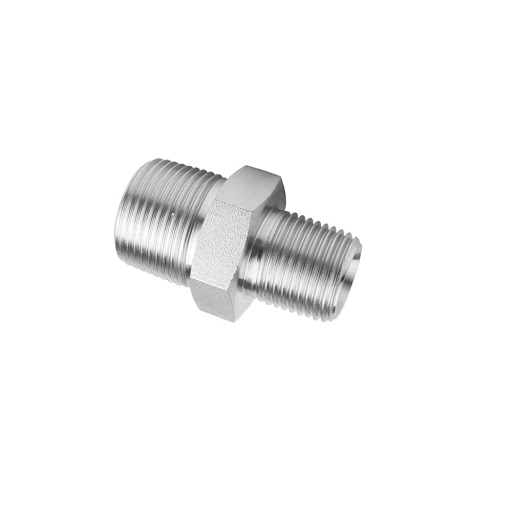
- 5404 — male NPTF pipe x male NPTF pipe straight.
- 5405 — male NPTF pipe x female NPTF pipe straight.
- 5406 — male NPTF pipe x female NPTF pipe straight, carrying the widest range of sub-variants in the block.
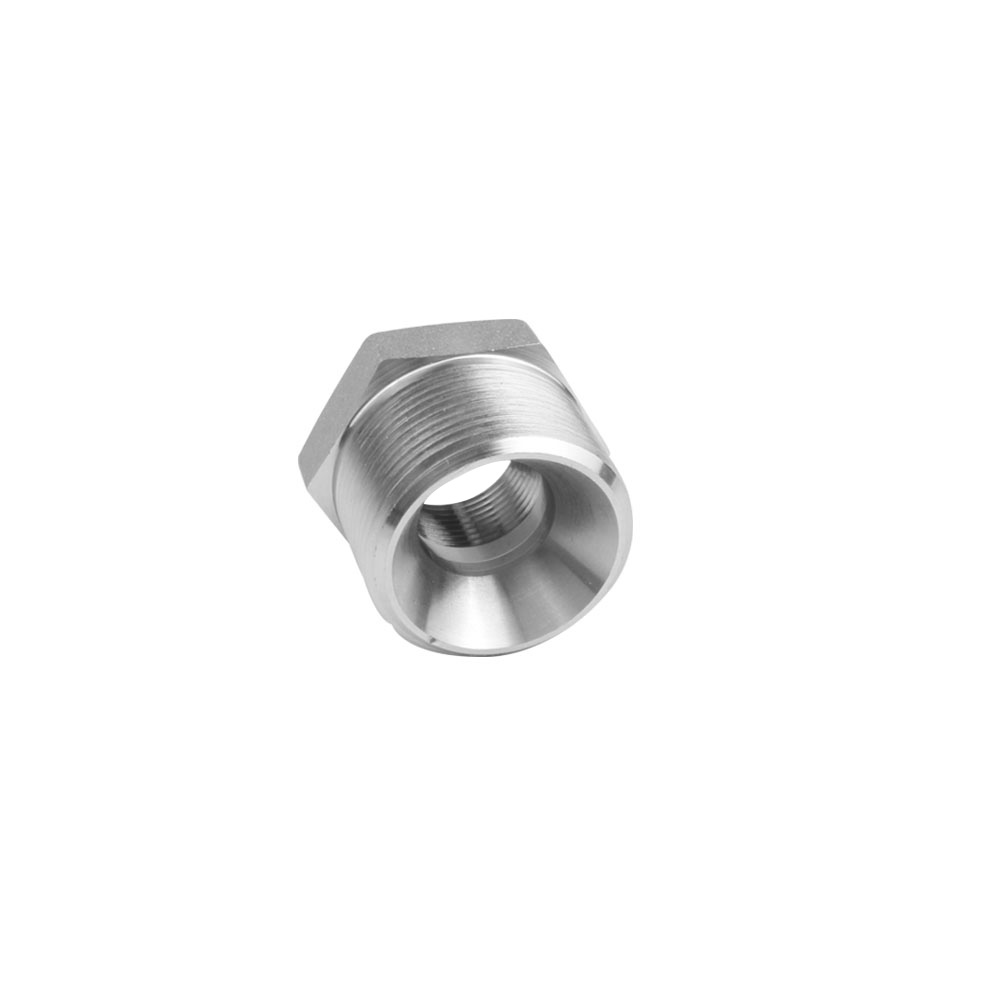
- 5406-C — female NPTF pipe cap; 5406-P — male NPTF hex head pipe plug; 5406-HP — male NPTF hollow hex pipe plug; 5406-SHP — male NPTF square head pipe plug.
- 5603 — male x female x male NPTF tee; 5604 — female x female x male NPTF tee; 5605 — female x female x female NPTF tee; 5652 — four-way female NPTF cross.
The 5405/5406 pair is a useful teaching case. Both carry the same configuration description in the catalogue and are separated by the branch number, which is precisely why the model number must be matched to the drawing. If a supplier's quotation lists 5405 where the assembly drawing shows 5406, the code alone will not settle the question — the dimensional drawing will.
On performance, Titan Fittings reports that NPTF straight threads for 1/4\" size typically carry a working pressure rating of 4000 PSI with a 4:1 safety factor. In this manufacturer's catalogue, NPT adapters are stated to operate under high-temperature and high-pressure conditions, with a pressure range of 3000–6000 PSI, a maximum stable operating temperature of 220°C, and a 120-hour salt spray result showing white rust at 120 hours and red rust at 240 hours.
Reading JIC Codes: The 2403–2609 Block
JIC adapters are built around a 37° flare seat. ISO 8434-2:2007 specifies the design and performance requirements for 37° flared connectors suitable for tubes from 6 mm to 50.8 mm, which is the standard that gives the JIC family its dimensional logic.
The catalogue's JIC block runs from 2403 to 2609 with a visible internal rhythm:
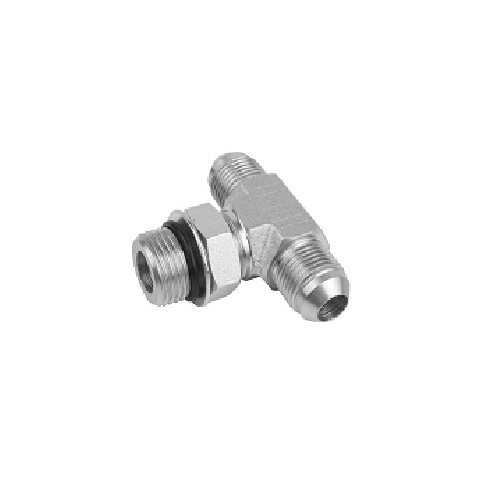
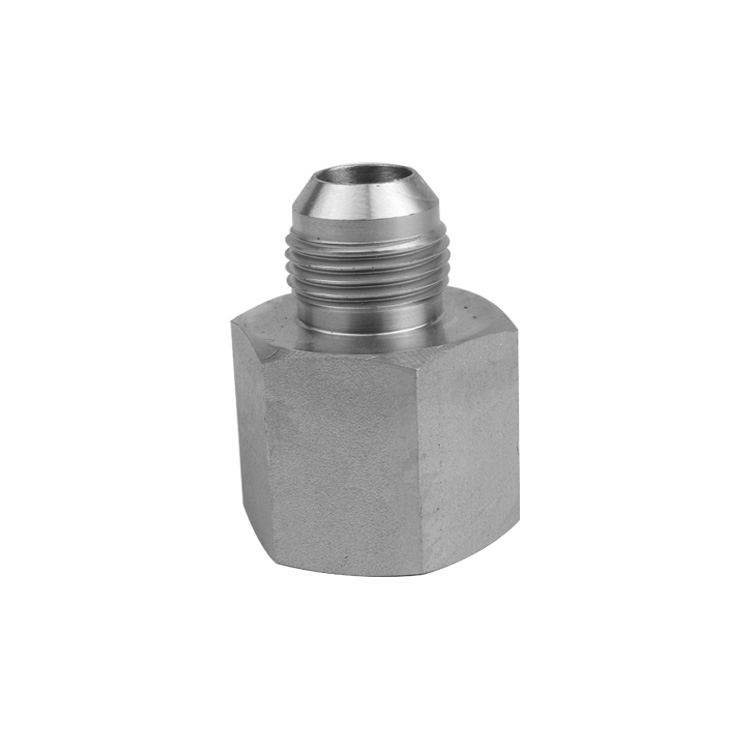
- 24xx — straights and plugs. 2403 is male JIC x male JIC straight; 2404 is male JIC x male NPTF pipe straight — this is the code most commonly searched as an NPT-to-JIC adapter; 2405 is male JIC x female NPTF pipe straight; 2406 is female JIC x male JIC straight; 2408 is a male JIC plug.
- 25xx — angled connectors. 2500 is male JIC x male JIC 90° elbow; 2501 is male JIC x male NPTF pipe 90° elbow; 2502 is male JIC x female NPTF pipe 90° elbow; 2504 is male JIC x male JIC 45° elbow; 2505 is male JIC x female NPTF pipe 45° elbow.
- 26xx — additional configurations completing the block through 2609. Because branch meanings are catalogue-specific, every 26xx code should be confirmed against the drawing rather than inferred from the 24xx/25xx pattern.
A related JIC hardware block uses the 27xx range for bulkhead adapters: 2700 is male JIC x male JIC bulkhead straight; 2701 is the bulkhead 90° elbow; 2702 is the bulkhead 45° elbow; 2703 and 2704 are bulkhead tees; and 2705 is a female pipe x male JIC bulkhead straight. When a drawing shows a hose passing through a panel or frame, the bulkhead adapter code will normally sit in this range rather than in the 24xx or 25xx blocks.
Reading SAE Codes: 6801–6850 and Adjustable ORB
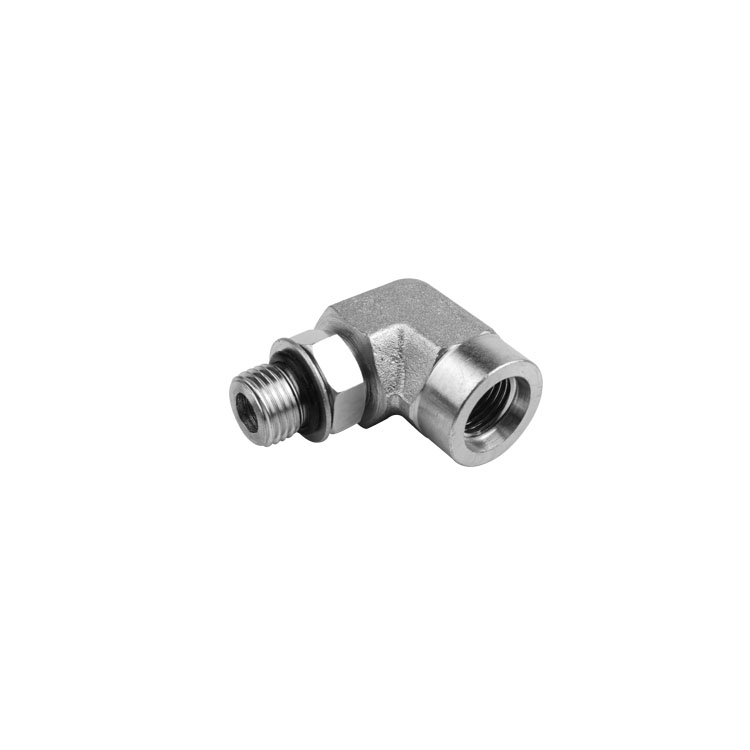
The SAE standard hydraulic adapter block in this catalogue is numbered 6801 to 6850 and is dominated by the adjustable ORB (O-ring boss) principle, where an O-ring provides the seal and a locknut allows the fitting to be oriented after tightening. That adjustability is why so many 68xx codes are elbows and tees.
- 6801 — male JIC x male adjustable ORB 90° elbow; 6802 — male JIC x male adjustable ORB 45° elbow.
- 6803 — male JIC x male JIC x male adjustable ORB tee; 6804 — male JIC x male adjustable ORB x male JIC tee.
- 6805 — male adjustable ORB x female NPTF pipe 90° elbow.
- 6807 — male adjustable ORB x male adjustable ORB 90° elbow.
- 6815 — male adjustable ORB x female ORB 90° elbow; 6835 — male adjustable ORB x female ORB x female ORB tee.
Where ORFS (O-ring face seal) connections are involved, Titan Fittings reports that ORFS fittings for dash size -4 (1/4\") are rated for 6000 PSI working pressure under SAE J1453. That figure sits at the top of the 3000–6000 PSI range published across the adapter families described in this article, which is a useful sanity check when a project specification calls for a high pressure hose adapter rather than a general-purpose fitting.
Reading Cap Nut, Lock Nut and FS Codes: 0304C, 0306, 0318, 0319, 0403, 0500, and FS Variants
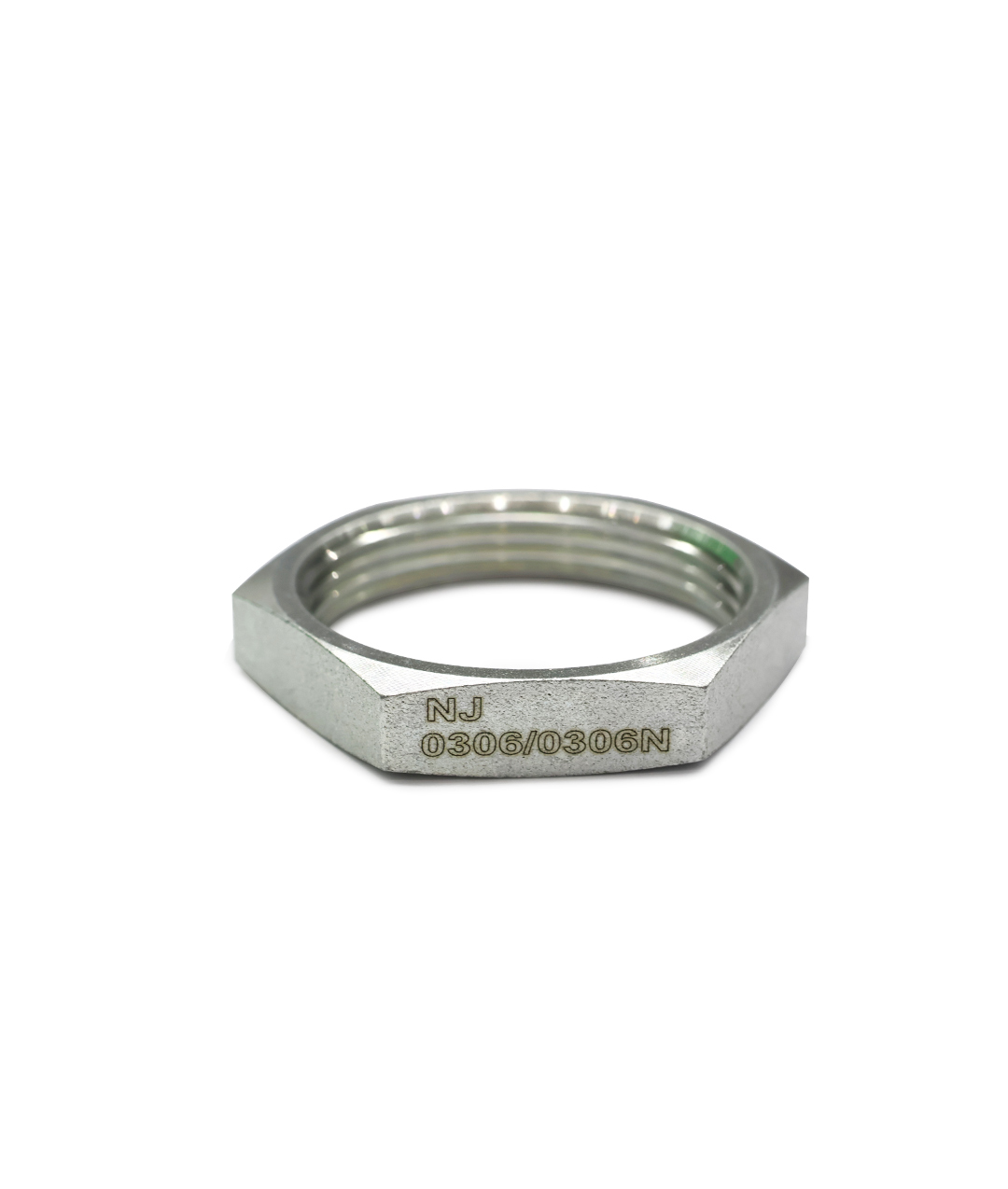
Hydraulic cap nut and lock nut series rarely follow the same numbering logic as adapters, because they are tube-side hardware rather than port-side hardware. In the catalogue referenced throughout this guide, the series is 0304C, 0306, 0318, 0319, 0403, 0500, plus the FS-prefixed versions FS0304C, FS0306, FS0318, FS0319 and FS0403.
- 0304C — female JIC cap.
- 0306 — JIC bulkhead lock nut.
- 0318 — JIC tube nut; 0319 — JIC tube sleeve (the ferrule element of a 37° flared tube connection).
- 0403 — bore to male JIC connector; 0500 — bore to male JIC connector.
- FS0403 — bore to male O-ring face seal connector.
The FS prefix is the most important lesson in this block. It does not change the base number; it changes the sealing principle. Compare 0403 and FS0403 directly: both are bore-to-male connectors, one joining to a JIC end and the other to an O-ring face seal end. A buyer who reads only the numeric stem and ignores the prefix will order the wrong sealing system even though the base number matches the drawing.
Step-by-Step: How to Decode an Unknown Adapter Code
- Read the leading block first. Identify whether the number belongs to the BSP block (1B / 1T / 1BG / 2B / 6B), the NPT pipe block (5xxx), the JIC block (24xx / 25xx / 26xx / 27xx), the SAE block (68xx), or the cap nut block (03xx / 04xx / 05xx / FS). This single step removes most ordering errors.
- Read the branch number to get the configuration. Straight, 90° elbow, 45° elbow, tee, cross, plug, cap or bulkhead. In BSP blocks a trailing 9 marks the 90° elbow, as in 1T9, 1BG9, 2B9 and 1ST9.
- Read the suffix for the variant. -C signals a cap, -P a hex head plug, -HP a hollow hex plug, -SHP a square head plug, and an FS prefix signals an O-ring face seal version of the same base number.
- Confirm gender and sealing method at both ends. Male or female, parallel or tapered, 37° flare, O-ring boss, or face seal. Write both ends down explicitly — \"male BSPP x female NPTF\" — before sending an enquiry.
- Verify size, material and rating against the drawing. Model numbers do not carry dash size. Match the drawing to the catalogue dimension table, then confirm material and rating. In this catalogue all families are offered in carbon steel, SS304 and SS316, with a 3000–6000 PSI pressure range, a maximum stable operating temperature of 220°C, and a 120-hour salt spray result showing white rust at 120 hours and red rust at 240 hours.
Comparison Table: The Five Code Families at a Glance
| Code block | Thread / sealing family | Representative configurations | Variant suffixes to expect | Material options |
|---|---|---|---|---|
| 1B, 1B4, 1B9, 1BG, 1BG4, 1BJ, 1NB, 2B, 4B, 6B, 7B, 9B | BSPP parallel thread | Straight male-male (1B); BSPP x JIC (1BJ); NPTF x BSPP (1NB); plug (4B, 9B); bulkhead straight (6B); swivel 90° elbow (2B9); O-ring 90° elbow (1BG9) | Trailing 9 for 90° elbows; branch digits for O-ring and bulkhead versions | Carbon steel / SS304 / SS316 |
| 1T, 1T9, 1BT, 1ST, 4T, 5T | BSPT tapered thread | Male BSPT straight (1T); 90° elbow (1T9); BSPP x BSPT (1BT); JIC x BSPT (1JT); JIS x BSPT 90° elbow (1ST9); plug (4T); male-female straight (5T) | Trailing 9 for 90° elbows; cross-standard branches (1BT, 1JT, 1ST9) | Carbon steel / SS304 / SS316 |
| 5000, 5404, 5405, 5406, 5500–5505, 5600–5605, 5650, 5652 | NPTF pipe thread | Male-male straight (5404); male-female straight (5405, 5406); tees (5603, 5604, 5605); four-way cross (5652) | -C cap; -P hex head plug; -HP hollow hex plug; -SHP square head plug | Carbon steel / SS304 / SS316 |
| 2403–2408, 2500–2505, 2601–2609, 2700–2705 | JIC 37° flare (ISO 8434-2 geometry) | Straights and plugs (24xx); 90° and 45° elbows (25xx); additional configurations through 2609; bulkhead straights, elbows and tees (27xx) | Branch number drives configuration; confirm 26xx against drawing | Carbon steel / SS304 / SS316 |
| 6801–6850 | SAE JIC / adjustable ORB / ORFS | ORB 90° and 45° elbows (6801, 6802, 6807); tees (6803, 6804, 6835); ORB x NPTF 90° elbow (6805); ORB x female ORB 90° elbow (6815) | ORB and ORFS end combinations; adjustable locknut versions | Carbon steel / SS304 / SS316 |
| 0304C, 0306, 0318, 0319, 0403, 0500, FS0304C, FS0306, FS0318, FS0319, FS0403 | JIC tube hardware and ORFS hardware | Female JIC cap (0304C); JIC bulkhead lock nut (0306); JIC tube nut (0318); JIC tube sleeve (0319); bore-to-male JIC connectors (0403, 0500) | FS prefix changes the sealing principle to O-ring face seal, e.g. FS0403 | Carbon steel / SS304 / SS316 |
Where Code Reading Pays Off: Project Applications
Code reading is not an academic exercise. In the applications covered by this product range — construction machinery, agricultural equipment, coal mining equipment, petroleum equipment, electromechanical equipment, forklift parts and hose fittings — adapters sit in circuits where the working condition is high temperature and high pressure, and where a mismatch is discovered only after assembly.
The functional requirement is consistent across those applications: hydraulic pipeline sealing, thread locking and fastening, and pressure-bearing protection for mechanical hydraulic assemblies. BSPT adapters in this range are stated to withstand a static pressure of 6000 PSI and a burst pressure of 9000 PSI without deformation while maintaining continuous operation and seal integrity. The special requirements recorded for these applications — rust resistance, high-temperature resistance and high-pressure resistance — are the same three criteria that should appear on the specification line of any enquiry. The matched equipment typically includes hydraulic hoses, hydraulic cylinders, threaded bolts, pipe joints, hydraulic pumps and mechanical cylinder assemblies, which is why one project usually involves several code families at once.
One documented example illustrates how the choice plays out commercially. A mid-market distributor in Canada used hydraulic cap nut models 0304C and 0306 in a project completed within a three-year period, reselling to other local customers with demand. The stated outcome was expansion of downstream client channels and an improvement in overall gross profit margin. Note that the two models involved are from the cap nut series — not the adapter blocks — which reinforces the point that reading the code block correctly is what determines whether the right part arrives.
DIN, Metric and European Hose Assemblies: An Extra Check
Buyers sourcing for European hose assemblies frequently search for DIN hydraulic adapter manufacturers, and that is where code reading needs one additional layer. DIN 2353 is not a part-number system; it is a tube-fitting standard. Hy-Lok USA describes DIN 2353 as specifying three robustness categories for metric tube fittings: LL (Extra Light, 100 bar), L (Light, up to 315–500 bar), and S (Heavy, up to 630–800 bar). Those designations describe the tube side of the connection, not the catalogue number of the adapter that joins it.
Material selection adds a second dimension. Tubes International reports that stainless steel hydraulic adapters in AISI 316 support working temperatures ranging from -60°C up to +400°C according to DIN 17440. That is a wider temperature envelope than the 220°C maximum stable operating temperature published for the carbon steel, SS304 and SS316 adapter families described above, which is why a metric thread adapter specified for a high-temperature European assembly should be matched on both the standard and the material grade.
The practical rule is simple: read the DIN designation for the tube-side requirement, then read the adapter's own catalogue block for the port-side connection. Mixing the two systems — assuming a DIN code implies a BSP or JIC part number — is the most common mistake in European sourcing enquiries.
Frequently Asked Questions
How do I confirm which standard a DIN hydraulic adapter code complies with for a European hose assembly?
Confirm the standard on both sides of the connection, not from the part number alone. DIN 2353 covers metric tube fittings and defines three robustness categories — LL (Extra Light, 100 bar), L (Light, up to 315–500 bar) and S (Heavy, up to 630–800 bar) — while the port-side end may be BSP, NPT or JIC. ISO 8434-2:2007 separately specifies 37° flared connectors for tubes from 6 mm to 50.8 mm. A supplier should be able to state which standard each end of a proposed adapter follows, in writing, before the order is placed.
Which hydraulic adapter model families can a manufacturer actually produce?
A capable manufacturer will publish the full model list rather than a sample of it. In the catalogue used as the example in this article, the published families are BSPP adapters (1B, 1B4, 1B9, 1BG, 1BG4, 1BG9 and related codes through 9B), BSPT adapters (1T, 1T9, 1BT, 1ST, 4T, 5T), NPT adapters (5000, 5404–5406 with -C, -P, -HP, -SHP variants, 5500–5505, 5600–5605, 5650, 5652), hydraulic JIC adapters (2403–2609 plus the 27xx bulkhead range), SAE standard hydraulic adapters (6801–6850) and hydraulic cap nut and lock nut series (0304C, 0306, 0318, 0319, 0403, 0500 and FS variants). All of these are offered in carbon steel, SS304 and SS316, with a 3000–6000 PSI pressure range and a maximum stable operating temperature of 220°C. For buyers planning a multi-line order, the relevant question is whether a single supplier covers all of these families — because mixing suppliers across families multiplies thread-consistency risk.
What influences the cost of a hydraulic adapter model?
Three documented variables dominate. First, material: carbon steel, SS304 and SS316 are all offered across these families, and the grade chosen for a stainless steel hydraulic adapter is the single largest commercial lever. Second, geometry and size: minimum order quantity varies depending on product dimensions and manufacturing complexity, so two codes from the same branch can carry different commercial terms. Third, customisation: logo, packaging and plated colour options, plus custom products made from provided drawings or samples, change the production setup. Because none of these factors is encoded in the model number, the most reliable approach is to request a quotation against the exact code plus the drawing — not against the code alone.
Can I validate a model code with a sample before committing to a series order?
Yes, and for first-time buyers it is the sensible sequence. A manufacturer working in OEM/ODM mode can typically produce custom parts from either a provided drawing or a physical sample, which means the fastest validation path is to send the mating component rather than a description of it. Quality control at this stage is normally based on random inspection, and after-sales support is handled remotely. Before the sample is made, confirm three things in writing: the two end configurations, the material grade, and the target rating — for example a 3000–6000 PSI family with a 220°C maximum stable operating temperature and a 120-hour salt spray result of white rust at 120 hours and red rust at 240 hours.
What is the typical lead time once a model code is confirmed?
For this type of production, the stated lead time is 30–45 working days, with an annual output of 4,000,000 units. Lead time is measured from confirmed specifications, not from the first email, so the practical step is to close the drawing and material questions early. For buyers on a project schedule, that means finalising the code-to-drawing match before the purchase order rather than after — which brings the guide full circle: read the block, read the branch, read the suffix, then verify the drawing.
Conclusion: A Ten-Minute Skill That Prevents Repeat Orders
Hydraulic adapter model numbers are readable once you know the three layers. The leading block tells you the thread family — BSP, NPT, JIC, SAE or the cap nut series. The branch number tells you the configuration. The suffix tells you the variant, including the FS prefix that switches a part to O-ring face seal. Everything after that is verification: size, material, pressure and temperature rating against the drawing.
The reason this matters commercially is scale. With the global hydraulic fittings market moving from USD 4.8 billion in 2025 toward a projected USD 7.9 billion by 2034, and adapters holding 28.4% of product type share, catalogues will keep growing rather than shrinking. Buyers who can read a code correctly in the research stage spend their evaluation time on supplier capability rather than on correcting orders.
Next Step: Send Us Your Code or Your Drawing
If you are reading a quotation and want a second opinion on what a code represents, send the model number, the drawing, or a photo of the mating part. NingBo NJ Hydraulic Adapter Co., Ltd produces BSP, NPT, JIC, SAE and cap nut families across carbon steel, SS304 and SS316, and can quote against the exact code rather than a category description.
Email: Jenny@fhyuli.com | Phone / WhatsApp: +86 158-6749-2228 | Website: www.njadapter.com
Download the full product catalogue with complete model lists and dimension tables: NingBo NJ Hydraulic Adapter product catalogue (PDF).
Have Questions or Need More Details?
Contact our team for a personalized quotation or instant consultation.
Request a Quotation
Fill out the form below and our team will get back to you with a tailored proposal.
WhatsApp Direct Chat
Prefer to chat in real-time? Message us on WhatsApp for instant assistance & quick answers.
- Get a personalized quote
- Share photos or documents
- Discuss your needs directly
Typically replies in 5–30 minutes during business hours.