Hydraulic Adapter Model Codes: Technical Guide to JIC, ORB, ORFS, BSP, and NPT Configurations
Hydraulic Adapter Model Codes: Technical Guide to JIC, ORB, ORFS, BSP, and NPT Configurations
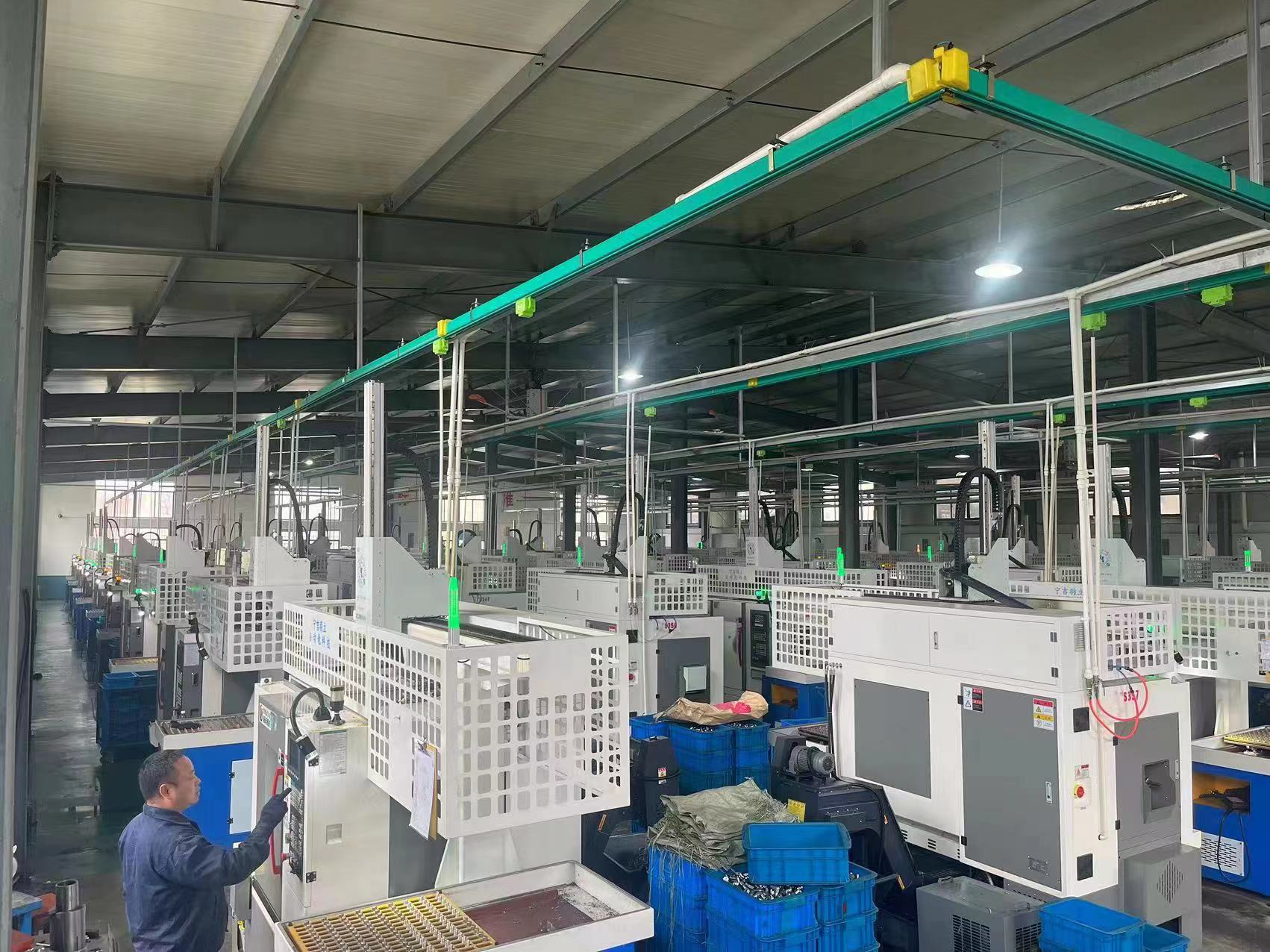
Fully automated CNC workshop at NingBo NJ Hydraulic Adapter Co., Ltd, where JIC, ORB, ORFS, BSP and NPT adapter model codes are machined.
Introduction: What a Hydraulic Adapter Model Code Actually Tells You
A hydraulic adapter model code is a compressed specification. In the NJ Hydraulic Adapter catalog, an entry such as 6801, 2403, 5000, 1B4 or 1T9 is not a warehouse number: it identifies which thread family sits on each end of the part, whether the interface is flared, O-ring boss, face seal or pipe thread, and whether the body is straight, a 45° elbow or a 90° elbow. Reading that code correctly is the difference between a first-time-right order and a leaking assembly, a rejected shipment, or a machine standing still while a replacement crosses an ocean.
This guide decodes the model-code logic used across five thread families — JIC, ORB, ORFS, BSP (BSPP and BSPt) and NPT/NPTF — and maps each family to the parameters that decide an evaluation: material, pressure rating, temperature limit and corrosion resistance. NingBo NJ Hydraulic Adapter Co., Ltd is a hydraulic adapter and engineering machinery parts manufacturer located in Fenghua, Ningbo, Zhejiang Province, China, founded in 2004. The company produces SAE standard hydraulic components and machinery parts on a 20,000 m² site with 200 employees and an annual output of 4,000,000 units, exporting roughly 75% of production, with the USA and Canada as its main markets.
Problem Definition: Why Model Codes Cause Specification Errors
A model code only works when both sides of a transaction decode it identically. In adapter sourcing, three failure patterns repeat across first orders and reorders.
1. Numbers are treated as universal. Catalog numbers are manufacturer-specific. Two suppliers can both list a “5406” or a “1B4” while meaning different sizes, different surface treatments or different sealing details. The operative decision rule is therefore simple: never confirm a part by number alone. Confirm thread family, thread type on each end, nominal size, angle and sealing method in writing on the purchase order.
2. Parallel and tapered threads are confused. BSPP entries such as 1B and 1B4, BSPt entries such as 1T and 1T9, and NPT entries such as 5000, 5404 and 5406 look similar on a line item and behave differently in a port. A parallel-thread interface and a tapered-thread interface of nominally similar size do not seal by the same mechanism and are not interchangeable. Forcing a tapered body into a parallel port, or the reverse, produces a leak that no torque value will correct.
3. Geometry and sealing configuration are dropped from the description. Model 6801 is a male JIC × male adjustable ORB 90° elbow. Model 6802 is the 45° elbow configuration of the same SAE family — the thread interfaces may match a requirement while the routing geometry does not. Model 6805 changes both ends again: male adjustable ORB × female NPTF pipe, 90° elbow. Receiving 6805 when 6801 was specified is not a quality failure; it is a decoding failure.
What an evaluation needs is not a longer catalog but a fixed decode order: family → thread types on each end → geometry → size → material → pressure, temperature and corrosion envelope.
Industry Background: The Standards Behind the Codes
The commercial weight behind these codes is significant. The global hydraulic fittings market, which includes adapters and couplings, was valued at USD 4.8 billion in 2025 and is projected to reach USD 7.9 billion by 2034 (Dataintelo). Within that market, the hydraulic adapters segment held the largest product-type share at 28.4% in 2025, and steel-based construction dominated revenue share at 45.2%, driven by demand for high-pressure durability. Asia-Pacific led global hydraulic fitting revenues in 2025, accounting for an estimated 38.6% of the market (Dataintelo).
Demand concentrates in mobile machinery: the mobile hydraulics segment held more than 58% of total hydraulics market revenue in 2024 (Grand View Research), and Asia accounted for 74% of global industrial robot installations in 2024, which increases the number of precise hydraulic connections required per machine (Ken Research). In competitive terms, Parker Hannifin Corporation is cited as the leading player in the hydraulic fittings market for 2025 (Dataintelo), a useful benchmark when positioning a supplier rather than a single part number.
Catalog codes sit on top of published standards rather than replacing them. ISO 8434-2:2007 specifies design and performance requirements for 37° flared connectors suitable for tubes from 6 mm to 50.8 mm — the interface logic behind JIC-style flare connections. SAE J1453 covers O-Ring Face Seal (ORFS) fittings; for dash size -4 (1/4"), ORFS fittings are rated for 6000 PSI working pressure. NPTF (National Pipe Tapered Fuel) straight threads for 1/4" size typically carry a working pressure rating of 4000 PSI with a 4:1 safety factor. For metric tube connections, DIN 2353 / ISO 8434-1 defines three robustness categories: LL (Extra Light, 100 bar), L (Light, up to 315–500 bar) and S (Heavy, up to 630–800 bar).
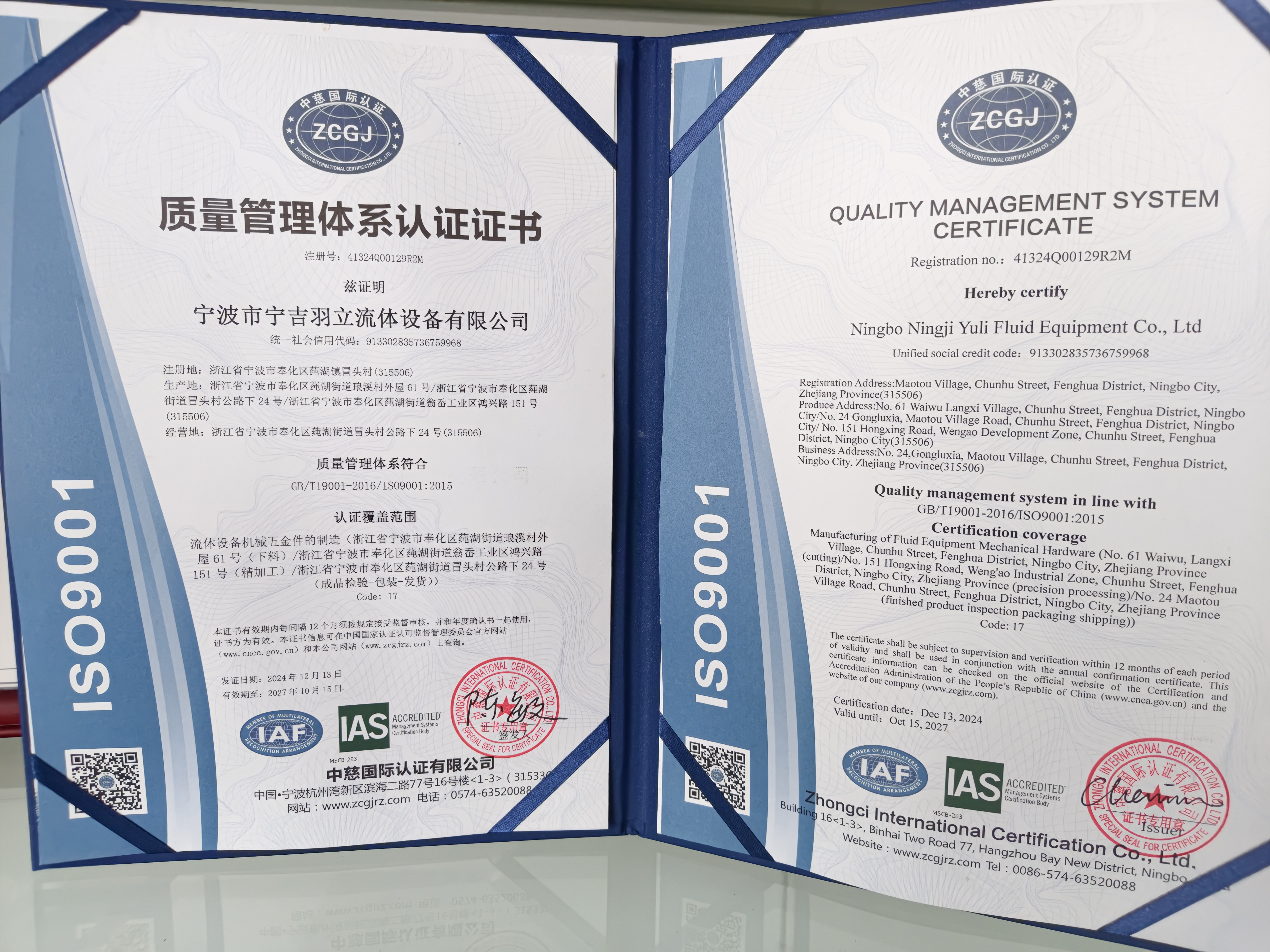
ISO 9001:2015 certificate 41324Q00129R2M, issued to NingBo NJ Hydraulic Adapter Co., Ltd by ZCGJ and valid to 15 October 2027.
Manufacturers publish their own coding systems on top of these standards, which is why NingBo NJ Hydraulic Adapter Co., Ltd documents its ranges by model series — 68xx for SAE standard adapters, 24xx–26xx for JIC adapters, 5xxx for NPT adapters, 1B for BSPP and 1T for BSPt — rather than by thread size alone. The company manufactures to ISO 9001:2015 (certificate 41324Q00129R2M, issued 13 December 2024, valid to 15 October 2027), with the certified scope covering manufacturing of fluid equipment mechanical hardware, including finishing processing, finished product inspection, packaging and shipping. Quality control is performed through random inspection.
Detailed Solution: Decoding the Five Thread Families and Their Model Ranges
Five families cover the large majority of hydraulic adapter evaluations. Each one has a distinct code signature, and each signature can be read without opening a drawing.
SAE Standard Hydraulic Adapters: the 68xx Range (JIC × ORB, ORB × NPTF)
The SAE standard hydraulic adapter series in the NJ catalog spans models 6801, 6802, 6803, 6804, 6805, 6806, 6807, 6808, 6809, 6810, 6815, 6818, 6820, 6832, 6835, 6840 and 6850, catalogued as JIC / ORB / ORFS adapters. This is where the American flare interface, the adjustable O-ring boss and the NPTF pipe interface meet inside one numbering block:
- 6801 — Male JIC × Male Adjustable ORB, 90° elbow.
- 6802 — the 45° elbow configuration in the same SAE family.
- 6805 — Male Adjustable ORB × Female NPTF Pipe, 90° elbow.
Read as a group, the codes reveal the logic: inside a single 68xx block, the thread families on each end can change and the elbow angle changes between adjacent numbers. A buyer who specifies 6801 does not receive 6802 or 6805, and should not accept them as substitutes, because the routing angle or the mating interface has already changed.
Hydraulic JIC Adapters: the 24xx, 25xx and 26xx Ranges
Models 2403, 2404, 2405, 2406, 2408, 2500, 2501, 2502, 2503, 2504, 2505, 2601, 2602, 2603, 2605, 2606, 2608 and 2609 are catalogued as Hydraulic JIC Adapters, and the series explicitly includes both JIC adapters and JIC to NPT adapters. That dual role matters during evaluation: the same 24xx–26xx band lets a buyer connect a 37° flare interface to either another flare interface or a pipe-thread port. ISO 8434-2:2007, which specifies 37° flared connectors for tubes from 6 mm to 50.8 mm, is the relevant design reference to check when a flare connection is being adapted.
NPT Adapters: the 5000, 5404 and 5406 Ranges
NPT thread fittings are catalogued under 5000, 5404, 5405, 5406, 5406-C, 5406-HP, 5406-P, 5406-SHP, 5500, 5501, 5502, 5503, 5504, 5505, 5600, 5601, 5602, 5603, 5604, 5605, 5650 and 5652. The suffixes carry meaning: 5406-C, 5406-HP, 5406-P and 5406-SHP are variants of the base 5406 code, so an order line that writes “5406” without the suffix may be an incomplete specification rather than a simplified one. As a pressure reference point, NPTF straight threads for 1/4" size typically carry a 4000 PSI working pressure rating with a 4:1 safety factor.
BSPP Adapters: the 1B Range
BSPP thread fittings are catalogued under 1B, 1B4, 1B9, 1BG, 1BG4, 1BG9, 1BH, 1BH9, 1BJ, 1BK, 1BM, 1BN, 1BO, 1BT, 1BT9, 2B, 2B9, 2BJ, 2GB, 2HB, 22NB, 2TB9, 2OB, 2TB, 3B, 4B, 4BN, 5B, 5BN, 5NB, 5BT, 5GB, 5OB, 5TB9, 6B, 7B, 7B9, 9B, EB, AB and BB. The leading digit and the letter combination identify position and variant within the parallel-thread family, which is why 1B and 1B4 are not interchangeable shorthand for each other.
BSPt Adapters: the 1T Range
BSPt thread fittings are catalogued under 1T, 1T9, 1BT, 1ST, 4T and 5T. Here the letter is the discriminator: an entry containing T belongs to the tapered BSPt family, while an entry containing B belongs to the parallel BSPP family. Changing 1B4 to 1T9 keeps the size conversation but changes the sealing mechanism, the installation torque procedure, and in many cases the mating port itself.
Hydraulic Cap Nuts and Lock Nuts: the 0304C Series
Thread locking and fastening hardware uses a separate band: 0304C, 0306, 0318, 0319, 0403, 0500, and the FS variants FS0304C, FS0306, FS0318 and FS0319. These are catalogued as hydraulic cap nut and lock nut items with the same materials and the same published envelope as the adapter families, and they matter in an assembled hydraulic line because they carry thread locking and pressure-bearing protection duties rather than flow routing.
Step-by-Step Breakdown: How to Read a Model Code Before You Order
The following eight checks convert a catalog entry into an unambiguous purchase specification. They are ordered deliberately: each step narrows the part before the next begins.
- Start from the port, not the part. Identify the thread on the equipment port and the thread on the hose end. The port governs the code, not the previous part number.
- Match the family prefix or letter. 68xx = SAE JIC / ORB / ORFS block; 24xx–26xx = JIC adapters including JIC to NPT; 5000–5652 = NPT fittings; B-containing codes = BSPP; T-containing codes = BSPt; 03xx and FS03xx = cap nuts and lock nuts.
- Confirm both ends of the code. 6805 reads as male adjustable ORB on one end and female NPTF pipe on the other; 6801 reads as male JIC and male adjustable ORB. Never assume one end from the other.
- Determine the angle. 6801 is a 90° elbow; 6802 is the 45° elbow. Angle is a routing constraint, not a cosmetic detail in tight engine or manifold spaces.
- Confirm size and dash against the mating port. Validate size physically or from the port drawing rather than from the worn part being replaced.
- Choose the material. Carbon steel, SS304 or SS316 — the choice follows the working environment, not the price list.
- Verify the published performance envelope. Pressure range 3000–6000 PSI, maximum stable operating temperature 220°C, and a 120-hour salt spray test (white rust at 120 hours, red rust at 240 hours).
- Confirm quality control and documentation. Quality control is performed through random inspection, and production is covered by ISO 9001:2015 certificate 41324Q00129R2M.
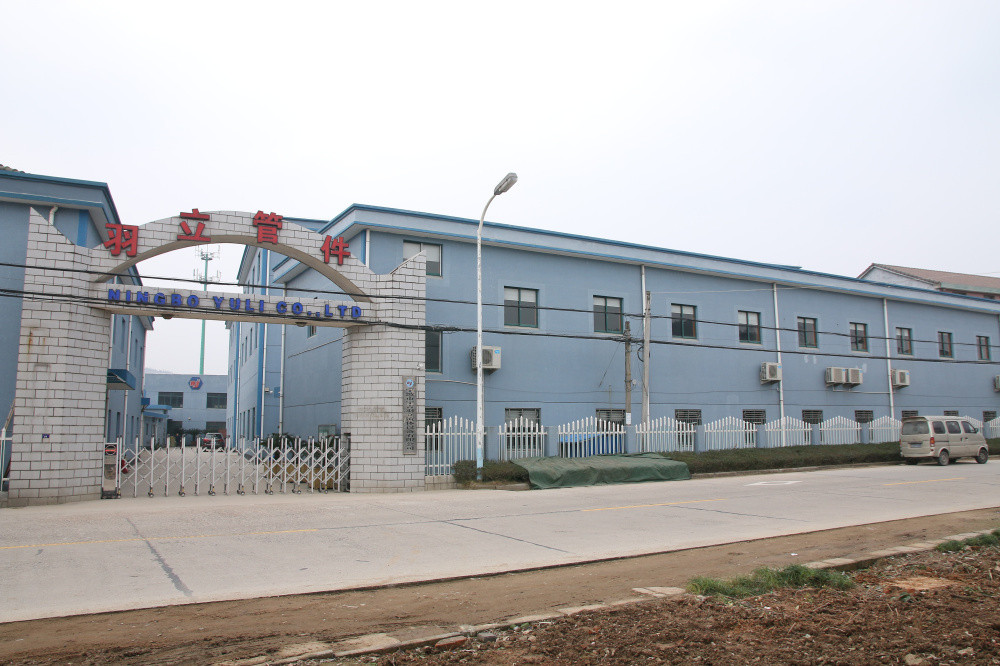
Production department entrance at the Fenghua, Ningbo facility where coded model series are manufactured and inspected.
Selection Parameters: Material, Pressure, Temperature and Corrosion
Once the code is decoded, four parameters decide whether the part survives the application. They apply across every family above, because the same materials and the same envelope are published for the SAE standard adapters, JIC adapters, NPT adapters, BSPP adapters, BSPt adapters and cap nuts.
- Material: carbon steel, SS304 or SS316. Steel-based construction held 45.2% of hydraulic fitting revenue share in 2025 because of high-pressure durability requirements (Dataintelo); stainless grades enter the picture where corrosion, washdown or marine exposure dominates.
- Pressure range: 3000–6000 PSI across the coded product families. In higher-demand assemblies the same components are specified to withstand a static pressure of 6,000 PSI and a burst pressure of 9,000 PSI without deformation, while maintaining continuous operation and seal integrity.
- Temperature: a maximum stable operating temperature of 220°C. For context, as a material-standard reference, stainless steel adapters in AISI 316 are specified under DIN 17440 to support working temperatures from -60°C up to +400°C; the rating a buyer should select against remains the published envelope for the specific coded part.
- Corrosion resistance: a 120-hour salt spray test is applied, with white rust appearing at 120 hours and red rust at 240 hours. This is the practical threshold for deciding whether carbon steel with plating is sufficient or whether SS316 is required.
Use Cases: Matching Model Codes to Machinery and Working Conditions
The coded families are specified across construction machinery, agricultural machinery, general-purpose machinery, firefighting equipment, marine machinery, mining, transportation, aerospace, automotive, oil and gas extraction, iron and steel metallurgy and water conservancy engineering. Matching a code to the application is mostly a matter of matching three conditions: interface, geometry and environment.
Construction and agricultural machinery. High-vibration, high-pressure circuits with tight routing space favor the SAE 68xx elbows — 6801 and 6802 for angle changes, 6805 where an ORB boss must feed a female NPTF pipe connection. The JIC range 2403–2609 covers flare-to-flare and flare-to-pipe adaptation where a 37° flared connector is the shop standard.
Marine machinery. Salt exposure pushes the material decision before the code decision: SS304 or SS316 with the 120-hour salt spray result as the acceptance reference, and cap nut or lock nut hardware from the 0304C / FS03xx band where thread locking must survive the same environment.
Oil and gas extraction, mining and steel metallurgy. Sustained high pressure and heat define these circuits. The relevant validation points are the 3000–6000 PSI range, the 6,000 PSI static and 9,000 PSI burst behavior without deformation, and the 220°C maximum stable operating temperature. NPT fittings such as 5000, 5404 and 5406 — including 5406-HP and 5406-SHP variants — are typically specified here, with ORFS interfaces rated at 6000 PSI for dash size -4 under SAE J1453 where a face-seal connection is preferred.
Firefighting equipment and general-purpose machinery. The requirements recorded for these hydraulic assemblies are rust resistance, high-temperature resistance and high-pressure resistance, which map directly back to the material, temperature and salt spray parameters above.
Distribution and aftermarket supply. A mid-market distributor client has successfully used these products, and the corresponding success case is located in Canada. Over a three-year relationship covering 20,000,000 units sold on to local customers with demand, the distributor expanded its downstream client channels and grew overall gross profit margin, with the product highlights recorded as high-pressure resistance, high-temperature resistance and rust resistance.
Case reference: a mid-market distributor in Canada supplying coded hydraulic adapter models to local industrial customers.
Evaluation Shortlist: Eight Model Codes That Test a Supplier’s Full Range
When a bill of materials must be covered by one supplier, the following eight catalog entries are the most efficient test set, because together they cross all five thread families and both sealing logics. Each entry is listed with the specific capability it verifies.
- 6801 — Male JIC × Male Adjustable ORB 90° elbow: verifies flare-to-O-ring-boss production and 90° elbow machining.
- 6802 — 45° elbow in the same SAE family: verifies that the supplier distinguishes adjacent codes rather than substituting geometry.
- 6805 — Male Adjustable ORB × Female NPTF Pipe 90° elbow: verifies mixed-interface manufacturing (boss to pipe).
- 2403 — JIC adapter entry point: verifies the JIC flare family and the lower end of the 24xx band.
- 5000 — NPT adapter entry: verifies tapered pipe-thread production and cleanliness of thread form.
- 5406 — NPT adapter with variant suffixes (-C, -HP, -P, -SHP): verifies control of sub-variants, not just base codes.
- 1B4 — BSPP (parallel) entry: verifies the parallel-thread family that cannot be interchanged with tapered parts.
- 1T9 — BSPt (tapered) entry: verifies the tapered family and confirms the supplier separates B and T codes in picking and packing.
If a supplier can quote, sample and document all eight entries consistently, the coding system is being managed as a system rather than as an inventory list.
Comparison Table: Hydraulic Adapter Model Families at a Glance
| Model series (catalog) | Thread family | Interface / sealing logic | Configurations in series | Material options | Published envelope |
|---|---|---|---|---|---|
| 6801 | JIC × ORB | Male JIC (37° flare) to male adjustable O-ring boss | 90° elbow | Carbon steel / SS304 / SS316 | 3000–6000 PSI; 220°C |
| 6802 | JIC × ORB | Same interface family as 6801 | 45° elbow | Carbon steel / SS304 / SS316 | 3000–6000 PSI; 220°C |
| 6805 | ORB × NPTF | Male adjustable O-ring boss to female NPTF pipe | 90° elbow | Carbon steel / SS304 / SS316 | 3000–6000 PSI; 220°C |
| 6803–6850 | JIC / ORB / ORFS | SAE standard adapter block; interfaces vary by code | Confirm per code before ordering | Carbon steel / SS304 / SS316 | 3000–6000 PSI; 220°C |
| 2403–2609 | JIC | 37° flare adapters, including JIC to NPT adaptation | Straight and angled entries across the band | Carbon steel / SS304 / SS316 | 3000–6000 PSI; 220°C |
| 5000 / 5404 / 5406 | NPT | Tapered pipe thread; 5406-C, -HP, -P, -SHP sub-variants | Variant-dependent | Carbon steel / SS304 / SS316 | 3000–6000 PSI; 220°C |
| 1B, 1B4, 1B9, 2B…BB | BSPP (parallel) | Parallel thread interface; not interchangeable with BSPt | Variant-dependent | Carbon steel / SS304 / SS316 | 3000–6000 PSI; 220°C |
| 1T, 1T9, 1BT, 1ST, 4T, 5T | BSPt (tapered) | Tapered thread interface; seals by thread interference | Variant-dependent | Carbon steel / SS304 / SS316 | 3000–6000 PSI; 220°C |
| 0304C / 0318 / FS0304C… | Cap nut & lock nut | Thread locking and fastening hardware, not flow routing | Nut series | Carbon steel / SS304 / SS316 | 3000–6000 PSI; 220°C |
FAQ: Hydraulic Adapter Model Codes
1. What certification evidence applies to these coded adapter models?
Production of the coded families is covered by ISO 9001 certification under the standard GB/T 19001-2016 / ISO 9001:2015, certificate number 41324Q00129R2M, issued by ZCGJ on 13 December 2024 and valid until 15 October 2027. The certified scope is manufacturing of fluid equipment mechanical hardware, including finishing processing, finished product inspection, packaging and shipping. Quality control is performed through random inspection.
2. Can a single supplier cover JIC, ORB, ORFS, BSP and NPT codes in one order?
Yes for NingBo NJ Hydraulic Adapter Co., Ltd, whose catalog covers SAE standard adapters (6801–6850 as JIC / ORB / ORFS adapters), Hydraulic JIC Adapters (2403–2609), NPT Adapters (5000–5652 including the 5406 variants), BSPP adapters (the 1B series) and BSPt adapters (the 1T series), plus cap nut and lock nut models. The company operates an OEM/ODM model with customization of logo, package, plated color, and custom products made from provided drawings or samples. Monthly capacity is 4,000,000 units, produced in a 20,000 m² facility with 200 employees and four engineers.
3. What drives the cost and MOQ of a specific model code?
The model number itself does not set the price. Cost and minimum order quantity follow the decoded specification: the material chosen (carbon steel, SS304 or SS316), the product dimensions, and the manufacturing complexity of the thread and body geometry. Minimum order quantity varies depending on product dimensions and manufacturing complexity, and additional steps such as plated color or customized packaging change the order profile. In practice, the most reliable route is to request a quotation against a fully decoded line item — family, thread type on both ends, angle, size, material and annual quantity — rather than against a number alone.
4. How can a buyer validate a model code before placing a series order?
Validation is done with a sample. Custom products can be made from provided drawings or samples, so the most effective approach is to submit the port drawing or a physical sample together with the intended code, and to state the mating thread family explicitly (for example 1B4, BSPP parallel, versus 1T9, BSPt tapered). Once the sample is confirmed against the mating port, series production proceeds under random inspection quality control, with remote after-sales support available after delivery. If a shipment ever arrives short or with incorrect items, photos of the affected items are verified and replacement accessories are arranged by sea or air shipment.
5. What is the lead time, and what is the fastest way to start?
Standard lead time is 30–45 working days. Exports go to global markets, with the USA and Canada as the main markets and approximately 75% of output exported. To start, decode your line items using the eight checks above, note the required material and quantity, then contact the sales team for a quotation and sample arrangement. You can also download the full product catalog here: NingBo NJ Hydraulic Adapter product catalog (PDF).
Conclusion: A Decoded Code Is a De-Risked Order
Model codes are efficient only when both sides decode them the same way. The sequence that prevents most sourcing errors is fixed: name the family, confirm the thread type on both ends, fix the angle, validate the size against the port, choose the material from the environment, and check the published envelope of 3000–6000 PSI, 220°C maximum stable operating temperature, and a 120-hour salt spray result. Entries such as 6801, 6802 and 6805 are not interchangeable with each other, and 1B4 is not interchangeable with 1T9 — that is the entire point of the numbering.
NingBo NJ Hydraulic Adapter Co., Ltd manufactures these coded families from a 20,000 m² facility in Fenghua, Ningbo, Zhejiang Province, China, and supports buyers with OEM/ODM customization, sampling from drawings or physical parts, and a 30–45 working day lead time. Buyers who want to move from evaluation to validation can review the catalog, then send a decoded model list with materials and quantities to Jenny@fhyuli.com or via WhatsApp at +86 158-6749-2228. Company and product information is also available at www.njadapter.com.

Sales and packaging department entrance — sample requests and quotations for coded hydraulic adapter models are handled from the Fenghua, Ningbo facility.