Hydraulic Adapters Explained: An Introduction to Thread Types and Families
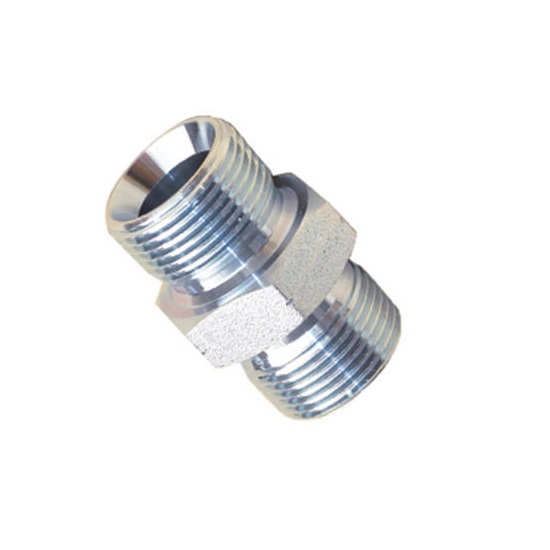
Hydraulic adapters are the metal fittings that connect a hose, a tube, a port or a manifold so hydraulic fluid can move through a system without leaking. The parts themselves are simple to look at. What slows down a new buyer is the vocabulary: short thread codes that look almost identical on a drawing and behave very differently on a machine.
This is an introductory guide to the four adapter thread families that appear most often on incoming enquiries and purchase orders: BSPP, BSPT, NPT and JIC. It explains what each family is, how the catalogue series are numbered, what metal options and pressure ratings accompany them, and how a first-time buyer can move from a thread code on a drawing to a sensible request for quotation.
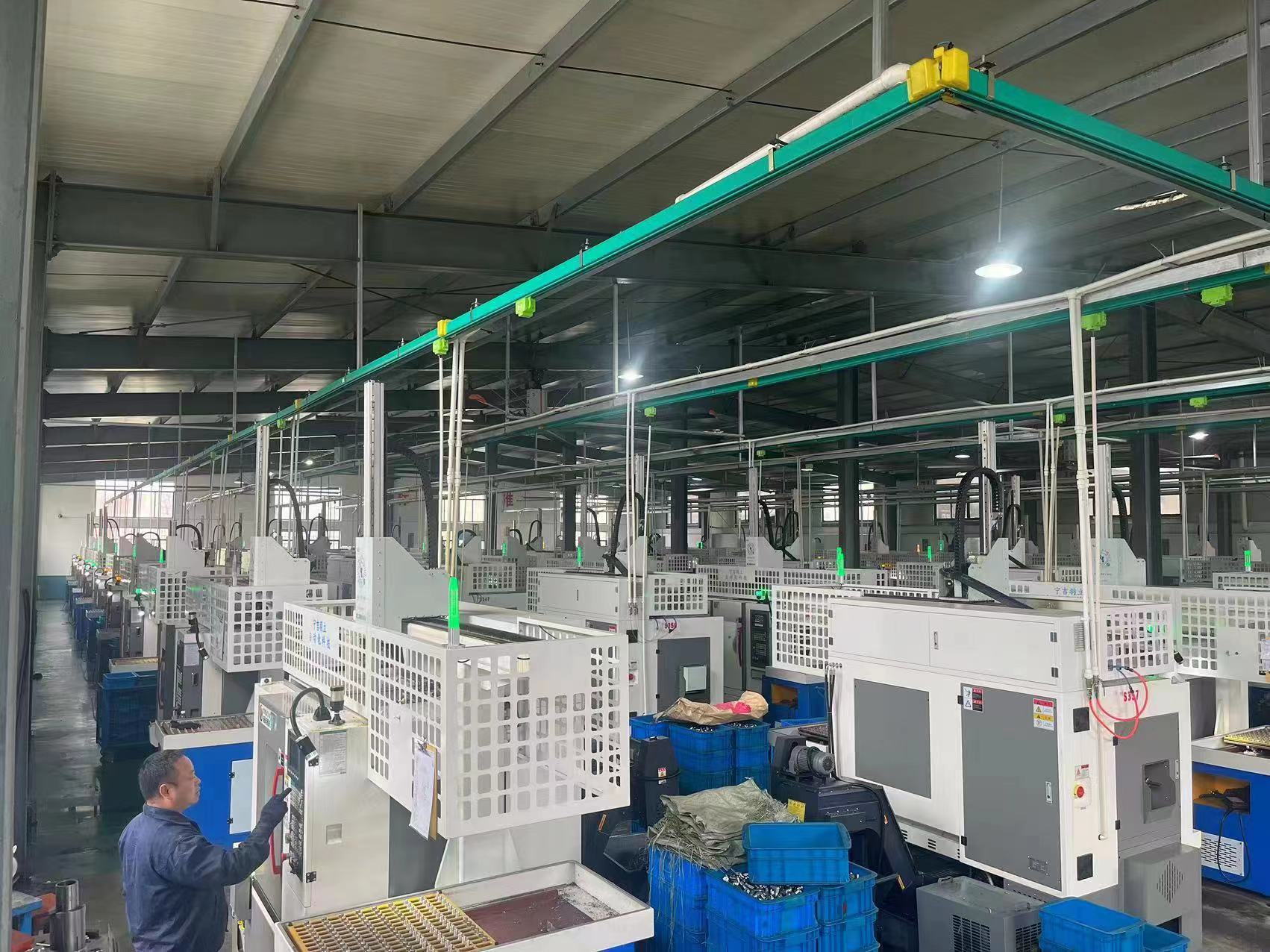
For context, NingBo NJ Hydraulic Adapter Co., Ltd is a hydraulic fitting manufacturer based in Fenghua, Ningbo, Zhejiang Province, China, founded in 2004. The company produces hydraulic adapters, flanges, valves and machined parts, operates a 20,000 m² factory with around 200 employees, and reports an annual output of 4,000,000 units. Approximately 75% of that output is exported, with the USA and Canada forming the largest share of its overseas markets. The catalogue series referenced in this article come from that manufacturer's published product data.
Why Thread Identification Is the First Real Test for a New Buyer
The practical problem is narrow but expensive. Two adapters can be made from the same material, carry the same pressure rating and sit in the same catalogue — and still not fit the same port. The difference is the thread form, and the thread form is decided long before a purchase order is issued.
A wrong choice usually shows up in one of three places: at assembly, when the fitting will not seat; at pressure test, when it seats but weeps; or weeks later, when a returned shipment has to be handled as a non-conforming claim. None of these outcomes is a purchasing failure in the abstract — but each one consumes time that a new buyer rarely has.
It is also worth understanding how mismatches are resolved commercially, because that is part of a buyer's job. In the supplier's documented after-sales process for non-conforming products, the customer provides inspection photos and videos and returns the items; after verification, compliant replacements are shipped with the next sea freight consignment or by air, or a documented deduction is processed. For logistics issues such as missing or wrongly delivered accessories, the customer supplies photos of the missing or wrong-delivered items and the supplier arranges replacement accessories by sea or air shipment after verification. The system works — but it works far better when the original thread specification was right.
Working definition for new staff: a hydraulic adapter is a fitting — not a hose and not a valve — that joins two different connection points in a hydraulic circuit. Every adapter in this article is supplied with a metal composition choice (carbon steel, SS304 or SS316 in the NingBo NJ catalogue) and a pressure rating.

Hydraulic Adapters in the 2026 Components Market
Adapters are a small line item inside a large category, and it helps a new buyer to know roughly how large. According to Dataintelo, the global hydraulic fittings market, which includes adapters and couplings, was valued at USD 4.8 billion in 2025 and is projected to reach USD 7.9 billion by 2034. Within that market, the hydraulic adapters segment held the largest product type share at 28.4% in 2025.
Material demand is concentrated in one direction. Steel material dominated the hydraulic fitting revenue share at 45.2% in 2025, driven by demand for high-pressure durability — which is consistent with what a buyer sees on the factory floor, where carbon steel is the default and stainless steel is specified for aggressive environments.
Production and consumption are geographically concentrated too. Asia-Pacific led global hydraulic fitting revenues in 2025, accounting for an estimated 38.6% of market share. A separate estimate from a market report published on LinkedIn projects the hydraulic fittings and adapters market growing at a CAGR of 4.5% between 2025 and 2033, reaching USD 5.8 billion.
Demand is driven by the machinery that uses hydraulic power. The mobile hydraulics segment held over 58% of total hydraulics market revenue share in 2024, according to Grand View Research. On the precision side, Asia accounted for 74% of global industrial robot installations in 2024, a figure reported by Ken Research that points to continued demand for precise, repeatable fluid connections.
The standards landscape behind those connections is what a new buyer has to navigate. Alongside the four families covered here, metric tube fittings follow DIN 2353, which specifies three robustness categories for metric tube fittings: LL (Extra Light, 100 bar), L (Light, up to 315–500 bar) and S (Heavy, up to 630–800 bar). A buyer does not need to memorise these figures on day one, but knowing that the category is organised into families and pressure classes is what makes the thread codes below readable rather than random.
The Four Thread Families You Will Meet in the Catalogue
The clearest way to learn adapters is to learn them in families. A family groups fittings that share a thread geometry and therefore share the same sealing logic, the same porting assumptions and usually the same block of catalogue part numbers. Four families account for most of the day-to-day work.
BSPP (BSP Parallel) — the Parallel British Pipe Family
BSPP is the parallel form of the British Standard Pipe thread. Because the thread itself does not taper, sealing is achieved at the seat rather than through thread interference, which is why BSPP fittings are commonly associated with a flat or bonded-washer arrangement at the mating face. When a drawing specifies a parallel pipe thread and a washer-style seal, BSPP is the family you are working in.
In the NingBo NJ catalogue, the BSPP family is carried as BSPP thread fittings under a series that includes 1B, 1B4, 1B9, 1BG, 1BG4, 1BG9, 1BH, 1BH9, 1BJ, 1BK, 1BM, 1BN, 1BO, 1BT, 1BT9, 2B, 2B9, 2BJ, 2GB, 2HB, 22NB, 2TB9, 2OB, 2TB, 3B, 4B, 4BN, 5B, 5BN, 5NB, 5BT, 5GB, 5OB, 5TB9, 6B, 7B, 7B9, 9B, EB, AB and BB part numbers. The material options are carbon steel, SS304 or SS316, and the catalogue states a pressure range of 3,000–6,000 PSI.
BSPT (BSP Tapered) — the Tapered British Pipe Family
BSPT uses the tapered form of the British Standard Pipe thread. Tapered threads seal progressively as they are tightened, so the sealing surfaces are the threads themselves. To a new buyer, the visible difference between a BSPP and a BSPT fitting can be small, which is exactly why these two families are the most common source of early specification errors.
The catalogue carries the BSPt family as a separate series: 1T, 1T9, 1BT, 1ST, 4T and 5T. The technical envelope is identical to the BSPP family — carbon steel, SS304 or SS316, with a stated pressure range of 3,000–6,000 PSI and a maximum stable operating temperature of 220°C.
NPT — the American Tapered Pipe Family
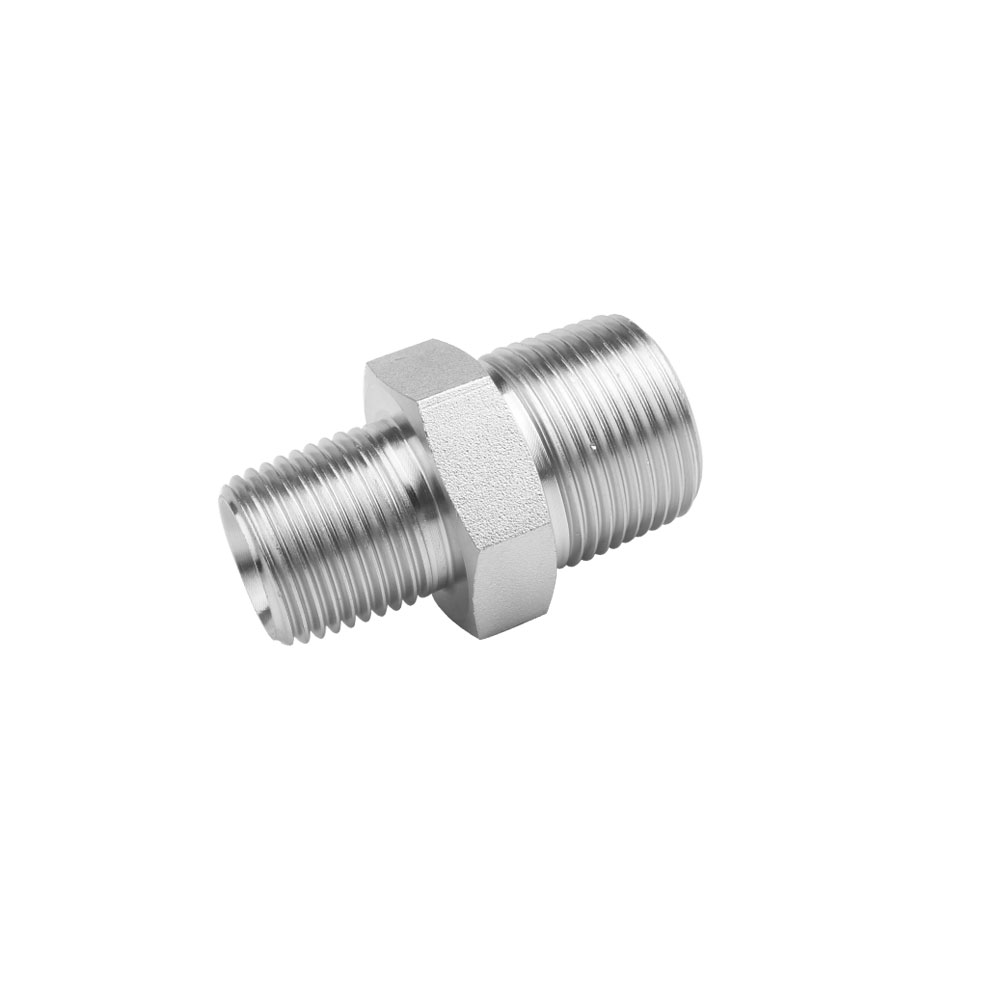
NPT is the American tapered pipe thread and the default thread form on a great deal of North American hydraulic equipment. Like BSPT it seals on the thread, and like BSPT it is easily confused with its parallel relatives in conversation. Because the company's main export markets are the USA and Canada, NPT enquiries arrive frequently, and requests to convert between NPT and other families — an NPT-to-JIC adapter, for example — are a normal part of the catalogue range.
The NPT family is carried under a series that includes 5000, 5404, 5405, 5406, 5406-C, 5406-HP, 5406-P, 5406-SHP, 5500, 5501, 5502, 5503, 5504, 5505, 5600, 5601, 5602, 5603, 5604, 5605, 5650 and 5652. Materials and ratings match the other families: carbon steel, SS304 or SS316, 3,000–6,000 PSI, 220°C maximum stable operating temperature.
One useful reference point for a new buyer comes from published third-party pressure data: NPTF (National Pipe Tapered Fuel) straight threads for 1/4" size typically carry a working pressure rating of 4,000 PSI with a 4:1 safety factor, according to Titan Fittings. Numbers like this are not a substitute for a supplier's own rating sheet, but they help you sanity-check whether a quoted figure is in the right range.
JIC — the 37° Flared Family
JIC fittings use a 37° flared seat, so the seal is made on a conical face rather than on the thread. This makes the family common in higher-pressure hydraulic circuits where a metal-to-metal flare is preferred, and it is why JIC adapters and JIC-to-NPT conversion adapters are catalogued together. The underlying geometry is standardised internationally: ISO 8434-2:2007 specifies the design and performance requirements for 37° flared connectors suitable for tubes from 6 mm to 50.8 mm.
In the NingBo NJ catalogue, the JIC family covers JIC adapters and JIC-to-NPT adapters under a series that includes 2403, 2404, 2405, 2406, 2408, 2500, 2501, 2502, 2503, 2504, 2505, 2601, 2602, 2603, 2605, 2606, 2608, 2609 and further part numbers. As with the pipe-thread families, the material options are carbon steel, SS304 or SS316 with a 3,000–6,000 PSI pressure range.
Adjacent Families in the Same Catalogue
Two related families are worth knowing by name even if they sit outside the four covered above. The catalogue's SAE standard hydraulic adapter series — 6801, 6802, 6803, 6804, 6805, 6806, 6807, 6808, 6809, 6810, 6815, 6818, 6820, 6832, 6835, 6840 and 6850 — is listed as a JIC/ORB/ORFS adapter series. For reference, Titan Fittings reports that ORFS (O-Ring Face Seal) fittings for dash size -4 (1/4") are rated for 6,000 PSI working pressure under SAE J1453. Metric thread adapters are the other family a new buyer will encounter, and they are covered by the DIN 2353 categories noted earlier.
Materials and Ratings That Apply Across All Four Families
Three facts carry across the whole catalogue and are worth memorising in the first week, because they answer most of the questions a supervisor will ask you.
- Metal composition is a choice, not a default. Every family in this article is available in carbon steel, SS304 or SS316. Carbon steel remains the volume material across the industry — steel held 45.2% of hydraulic fitting revenue share in 2025 according to Dataintelo — while stainless is specified where corrosion resistance matters. For stainless steel hydraulic adapters, published third-party data states that AISI 316 supports working temperatures ranging from -60°C up to +400°C according to DIN 17440.
- Pressure and temperature figures come from the catalogue, not from guesswork. The NingBo NJ catalogue states a 3,000–6,000 PSI pressure range and a maximum stable operating temperature of 220°C for the adapter families described here. In the documented operating scenario for mechanical hydraulic assemblies, the parts withstand a static pressure of 6,000 PSI and a burst pressure of 9,000 PSI without deformation, while maintaining continuous operation and seal integrity.
- Surface treatment has a stated test result. The trivalent chromium surface treatment used on these fittings shows white rust at 120 hours and red rust at 240 hours in salt spray testing — a figure a new buyer can quote directly when a customer asks about corrosion performance.
From Thread Code to RFQ: A Five-Step Breakdown
Beginners usually fail not because they cannot read a part number, but because they skip a step and compensate later. This sequence keeps the first quotation clean.
- Identify the mating connection, not the adapter. Start from the machine: the port, the tube end or the hose end the fitting must join. Note whether the mating part is a parallel port or a tapered port, and whether the seat is flat, conical or O-ring based. The adapter follows the connection.
- Translate the connection into a family and a series. A parallel British pipe port points to BSPP (1B, 2B, 5B and related series). A tapered British pipe port points to BSPT (1T, 1T9, 1BT, 1ST, 4T, 5T). An American tapered pipe port points to NPT (5000, 5404–5406, 5500–5505, 5600–5605, 5650, 5652). A 37° flared tube connection points to JIC (2403–2609). If the assembly needs to cross between families — BSP to NPT, or NPT to JIC — say so explicitly in the request, because conversion adapters are a separate catalogue item.
- Fix the material before you fix the price. Decide whether the environment needs carbon steel, SS304 or SS316. Making this decision late is the most common cause of a re-quote, because material drives both cost and lead time.
- Confirm the pressure and temperature envelope. State the system's working pressure and maximum temperature so the supplier can confirm the rating rather than assume it. The catalogue range for these families is 3,000–6,000 PSI with a 220°C maximum stable operating temperature; if your system sits outside that, it should be raised before an order is placed, not after.
- Use commercial terms to protect your schedule. In-stock items require no minimum order quantity, volume discounts are available, and orders exceeding USD 10,000 qualify for free FOB terms. The supplier also documents a broad in-stock product range and shorter delivery times as part of its offer, which matters most when an urgent replacement is needed. Confirm these terms in writing on the quotation.
Where These Four Families Typically Appear
The catalogue lists the same adapter families against a wide spread of equipment, which is a useful reminder that the thread code is selected by the machine, not by the industry label. Documented applications include construction machinery, agricultural machinery, general-purpose machinery, firefighting equipment, marine machinery, mining, transportation, aerospace, automotive, oil and gas extraction, iron and steel metallurgy, and water conservancy engineering. Working conditions are typically described as high temperature and high pressure, with the fittings performing hydraulic pipeline sealing, thread locking and fastening, and pressure-bearing protection for mechanical hydraulic assemblies.
In practice, the four families sort themselves by region and by equipment origin:
- Construction and agricultural machinery — the largest single block of demand, consistent with mobile hydraulics holding over 58% of total hydraulics market revenue share in 2024. British pipe threads appear on European-origin machines; NPT appears on North American machines.
- Marine and oil and gas — environments where corrosion resistance pushes the specification toward SS304 or SS316 rather than carbon steel.
- Firefighting and water conservancy — large-volume, lower-complexity installations where standardised pipe threads dominate.
- Automotive and aerospace assemblies — smaller diameters but tighter sealing requirements, which is where 37° flared JIC connections and O-ring face seal fittings are usually found.
- Mining and steel metallurgy — high-temperature duty, where the 220°C maximum stable operating temperature becomes a specification point rather than a footnote.
Because the supplier's main export markets are the USA and Canada, the mix that arrives on a Chinese manufacturer's desk skews toward NPT and JIC — a useful expectation to hold when you are learning the catalogue.
Thread Family Reference Table (Catalogue Facts Only)
The table below consolidates the catalogue data used in this article. It is a reference for orientation, not a substitution for the supplier's rating sheet on a specific order.
| Family | Catalogue series (examples) | Material options | Pressure range (catalogue) | Max stable operating temperature |
|---|---|---|---|---|
| BSPP (BSP Parallel) | 1B, 1B4, 1B9, 1BG, 1BH, 1BJ, 1BK, 1BM, 1BN, 1BO, 1BT, 2B, 2BJ, 3B, 4B, 4BN, 5B, 5BN, 5NB, 5BT, 6B, 7B, 9B, EB, AB, BB | Carbon steel / SS304 / SS316 | 3,000–6,000 PSI | 220°C |
| BSPT (BSP Tapered) | 1T, 1T9, 1BT, 1ST, 4T, 5T | Carbon steel / SS304 / SS316 | 3,000–6,000 PSI | 220°C |
| NPT | 5000, 5404, 5405, 5406, 5406-C, 5406-HP, 5406-P, 5406-SHP, 5500–5505, 5600–5605, 5650, 5652 | Carbon steel / SS304 / SS316 | 3,000–6,000 PSI | 220°C |
| JIC (37° flared, incl. JIC-to-NPT) | 2403, 2404, 2405, 2406, 2408, 2500–2505, 2601, 2602, 2603, 2605, 2606, 2608, 2609 | Carbon steel / SS304 / SS316 | 3,000–6,000 PSI | 220°C |
| SAE ORB / ORFS (adjacent family) | 6801, 6802, 6803, 6804, 6805, 6806, 6807, 6808, 6809, 6810, 6815, 6818, 6820, 6832, 6835, 6840, 6850 | Carbon steel / SS304 / SS316 | 3,000–6,000 PSI | 220°C |
Surface treatment across these families: trivalent chromium, showing white rust at 120 hours and red rust at 240 hours in salt spray testing. External standard references cited in this article: ISO 8434-2:2007 (37° flared connectors, tubes 6 mm to 50.8 mm); DIN 2353 (metric tube fitting robustness categories LL 100 bar, L 315–500 bar, S 630–800 bar); DIN 17440 (AISI 316 working range -60°C to +400°C); SAE J1453 (ORFS dash -4 rated 6,000 PSI); NPTF 1/4" working pressure 4,000 PSI with 4:1 safety factor.
FAQ for New Procurement Staff
How do I make sure I have identified the correct thread family before I raise a purchase order?
Confirm the mating connection first, then the family. Parallel British pipe ports take BSPP (catalogue series such as 1B, 2B or 5B); tapered British pipe ports take BSPT (1T, 1T9, 1BT, 1ST, 4T, 5T); American tapered pipe ports take NPT (5000, 5404–5406, 5500–5505, 5600–5605, 5650, 5652); 37° flared tube ends take JIC (2403–2609). Where the connection crosses families, request a conversion adapter explicitly — for example a BSP-to-NPT or NPT-to-JIC adapter — rather than assuming a standard fitting will bridge the two. All four families in the NingBo NJ catalogue are available in carbon steel, SS304 or SS316 with a stated 3,000–6,000 PSI pressure range and a 220°C maximum stable operating temperature.
Which hydraulic adapter manufacturer is better for DIN high-pressure hose assemblies?
There is no defensible answer that names a single winner without knowing your assembly, but there is a defensible way to decide. First, state which DIN 2353 robustness category your assembly needs — LL (Extra Light, 100 bar), L (Light, up to 315–500 bar) or S (Heavy, up to 630–800 bar) — because that single decision eliminates most of the field. Second, ask the supplier to confirm the rating in writing against your working pressure and temperature, rather than accepting a general capability statement. Third, check whether the supplier holds the thread families your assembly actually uses; NingBo NJ Hydraulic Adapter Co., Ltd, for example, catalogues BSPP, BSPT, NPT, JIC and SAE ORB/ORFS series with a 3,000–6,000 PSI range, so if your assembly is metric-threaded, confirm the metric thread adapter option before you quote. Fourth, compare the commercial envelope — the supplier documents a broad in-stock range, shorter delivery times and a defined after-sales process for non-conforming products. The manufacturer that answers all four questions with documentation is the better one for your project.
What drives the cost of a hydraulic adapter order?
Three factors dominate: material, volume and stock status. Material is the largest single lever — carbon steel, SS304 and SS316 are all catalogued, and the choice follows the environment rather than the price list. Volume affects unit pricing directly, since volume discounts are available. Stock status affects both cost and schedule, because in-stock items require no minimum order quantity and ship without a production wait, while orders exceeding USD 10,000 qualify for free FOB terms. When you are comparing quotes for the same part number, confirm that the material and the incoterm are identical before you compare the number.
Can I validate samples before committing to a series order?
Yes, and for a first order it is the sensible sequence. Take samples of the specific catalogue series and material you intend to buy, fit them on the actual port or tube end, and confirm the seal under your own working pressure rather than a nominal one. Two catalogue facts are worth verifying at the same time: the trivalent chromium surface treatment shows white rust at 120 hours and red rust at 240 hours in salt spray testing, and the fittings withstand a static pressure of 6,000 PSI and a burst pressure of 9,000 PSI without deformation while maintaining seal integrity. If a sample does not seat correctly, you have found the problem at the cheapest possible stage.
What lead time should I expect, and what happens if the shipment is wrong?
Lead time depends on whether the item is stocked. The supplier documents a broad in-stock product range and shorter delivery times as part of its offer, and in-stock items can be shipped with no minimum order quantity. For non-conforming products, the documented process is that the customer provides inspection photos and videos and returns the items; after verification, compliant replacements are shipped with the next sea freight consignment or by air, or a documented deduction is processed. For missing or wrongly delivered accessories, the customer provides photos of the missing or wrong-delivered items, and replacements are arranged by sea or air after verification. Both routes depend on photographic evidence, so photograph incoming cartons before they are broken down.
What a New Buyer Should Do in the First Week
Thread families are not a technical speciality reserved for engineers. They are the vocabulary of a purchasing desk, and four of them cover most of the daily work: BSPP for parallel British pipe ports, BSPT for tapered British pipe ports, NPT for American tapered pipe ports, and JIC for 37° flared connections. Around those four sit adjacent families — SAE ORB and ORFS, and metric thread adapters built to DIN 2353 categories — that you will meet as soon as a European or precision application arrives.
The discipline that prevents most early mistakes is small: identify the mating connection before the part number; fix the material before the price; confirm the pressure and temperature envelope before the order; and use the stock position and commercial terms to protect your schedule. Everything else — the surface treatment figures, the salt spray results, the static and burst pressure limits — is documentation you can quote once you know where to find it.
Download the NingBo NJ Hydraulic Adapter Co., Ltd product brochure for the full catalogue of BSPP, BSPT, NPT, JIC and SAE series part numbers, or send your thread specification, material requirement and target pressure to the sales team for a quotation and a sample request.
Request a Sample, a Quote or the Full Catalogue
NingBo NJ Hydraulic Adapter Co., Ltd — 151 Hongxing Road, Wengao Development Park, Chunhu Street, Fenghua, Ningbo City, Zhejiang Province, China.
Product brochure (PDF): Download the NingBo NJ hydraulic adapter catalogue
Website: www.njadapter.com
Contact: Fand — jenny@fhyuli.com — Tel / WhatsApp: +86 158-6749-2228
Send your thread family, material choice and working pressure, and the team will confirm the matching catalogue series, available stock and lead time.
Have Questions or Need More Details?
Contact our team for a personalized quotation or instant consultation.
Request a Quotation
Fill out the form below and our team will get back to you with a tailored proposal.
WhatsApp Direct Chat
Prefer to chat in real-time? Message us on WhatsApp for instant assistance & quick answers.
- Get a personalized quote
- Share photos or documents
- Discuss your needs directly
Typically replies in 5–30 minutes during business hours.