Match the Job First: BSP, NPT, JIC and SAE Adapter Rules
Two buyers can order the same nominal adapter size, install it on comparable equipment, and get different results — because one matched the adapter to the application and the other matched it to a thread chart. Scenario-based matching starts with the machine, the duty envelope and the delivery terms, and only then moves to BSP, NPT, JIC or SAE.
This guide sets out that sequence for OEM buyers, maintenance planners and distributors working on construction, agricultural, marine and oil & gas projects. It compares five families supplied by NingBo NJ Hydraulic Adapter Co., Ltd — the BSP Adapter, NPT Adapter, Hydraulic JIC Adapter, SAE Standard Hydraulic Adapter and hydraulic cap nut — against the stated 3000–6000 PSI pressure range, the 220°C maximum stable operating temperature, and the carbon steel / SS304 / SS316 material options. It closes with receiving and acceptance checks, because a correctly specified adapter that arrives without its lock nut or cap is still a line stoppage.
Problem Definition: Why Thread-Only Selection Fails in Service
Selecting a hydraulic adapter by thread alone treats three separate decisions as one. The thread standard defines whether the joint will mate; it does not define whether the joint will hold under the working conditions of a specific machine.
Failure mode 1 — the port was read, the environment was not
A carbon steel adapter and an SS316 adapter of identical geometry carry the same thread and the same 3000–6000 PSI catalogue range, but they behave differently on a deck, in a wash-down bay or on a machine that idles at high ambient temperature. Material selection is a scenario decision, not an upgrade checkbox.
Failure mode 2 — pressure range was assumed, not checked against the circuit
A stated range is an envelope, not a guarantee for every size and configuration. The BSPT adapter configuration is documented as withstanding a static pressure of 6,000 PSI and a burst pressure of 9,000 PSI without deformation while maintaining continuous operation and seal integrity. That is a configuration-specific statement; it should be read as a reference point, and the circuit pressure should be checked against the exact part number being ordered.
Failure mode 3 — the kit was specified, the completeness was not
Hydraulic assemblies are frequently shipped as multi-part sets: adapter body plus lock nut, sleeve, cap or plug. When the accessory is missing on arrival, the buyer discovers it at assembly, not at goods-in. That gap is closed by acceptance criteria in the purchasing terms, not by goodwill after the fact.
Industry Background: Why Adapter Matching Has Become a Procurement Discipline
Hydraulic adapters sit in a component category that is large, mature and increasingly specified rather than improvised. Dataintelo reports that the global hydraulic fittings market, including adapters and couplings, was valued at USD 4.8 billion in 2025 and is projected to reach USD 7.9 billion by 2034. The same source places the hydraulic adapters segment as the largest product type share at 28.4% in 2025, with steel dominating material revenue share at 45.2%, driven by demand for high-pressure durability.
Demand is concentrated where machinery is built. Asia-Pacific led global hydraulic fitting revenues in 2025 with an estimated 38.6% share, and Grand View Research reports that the mobile hydraulics segment held over 58% of total hydraulics market revenue in 2024 — which is precisely the construction, agricultural and off-highway equipment base that consumes most threaded adapters.
The practical consequence is that adapter buyers are no longer ordering a commodity by size. They are matching a component to a machine population, a duty cycle and a spare-parts commitment. That is why a scenario framework, a documented pressure and temperature envelope, and an acceptance checklist have replaced the single-line purchase requisition.
Detailed Solution: The Five Adapter Families and Where Each Belongs
NingBo NJ Hydraulic Adapter Co., Ltd is a Ningbo-based manufacturer established in 2004, operating a 20,000㎡ facility with approximately 200 staff and a four-engineer R&D team, producing SAE standard hydraulic components and engineering machinery parts with an export ratio of 75% and main markets in the USA and Canada. The five families below are the working set for scenario matching.
BSP Adapter — Whitworth pipe threads, two sealing logics
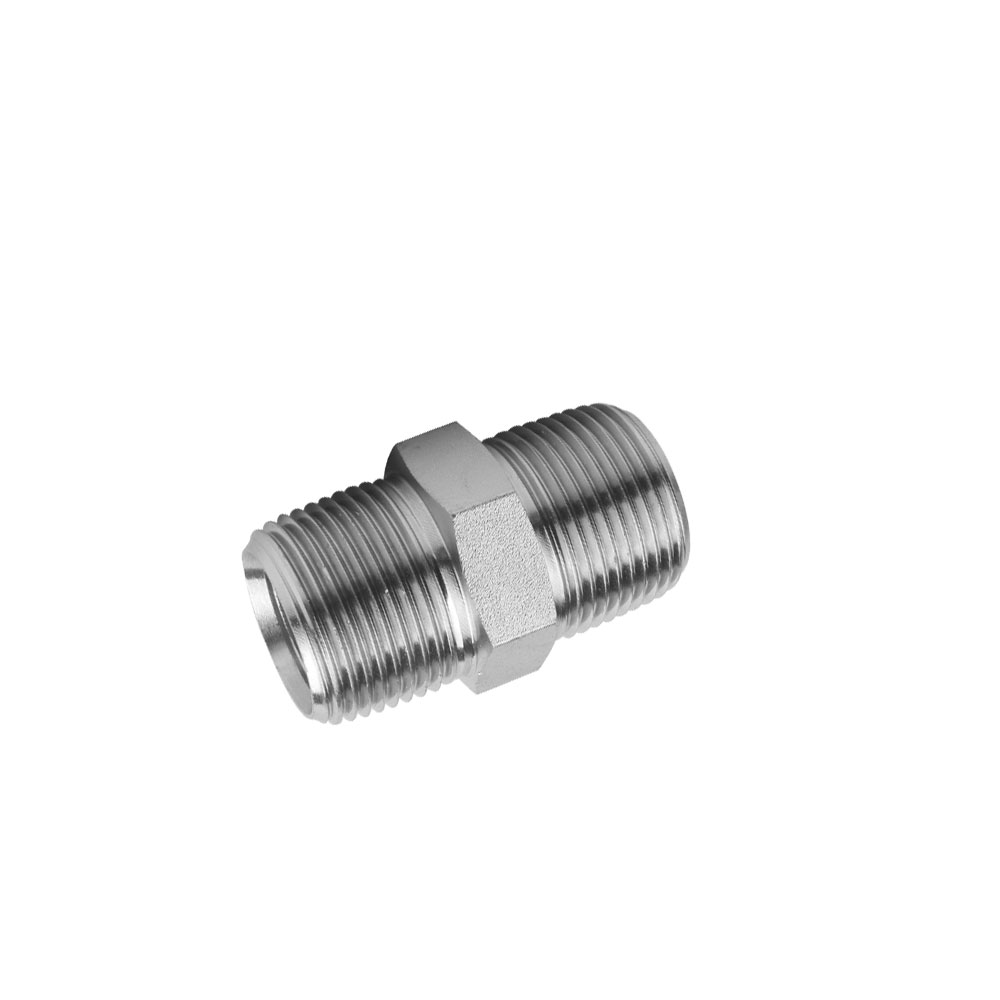
The BSP Adapter family splits into BSPP (parallel) and BSPT (tapered) configurations. The BSPP group runs across models such as 1B, 1BJ, 1BT, 2B9, 5BN, 6B and 9B, covering male-to-male straight, male BSPP to male JIC, male BSPP to male BSPT, swivel 90° elbows, BSPP-to-NPTF conversion, bulkhead straight and female plugs. The BSPT group covers 1T, 1T9, 1BT, 1ST, 4T and 5T, including male BSPT to male BSPT straight and 90° elbows, male BSPP to female BSPT, male JIS to female BSPT 90° elbows and male BSPT plugs. Both groups share the same stated envelope: 3000–6000 PSI, 220°C maximum stable operating temperature, and carbon steel / SS304 / SS316 material options.
NPT Adapter — tapered pipe threads for high-pressure, high-temperature duty
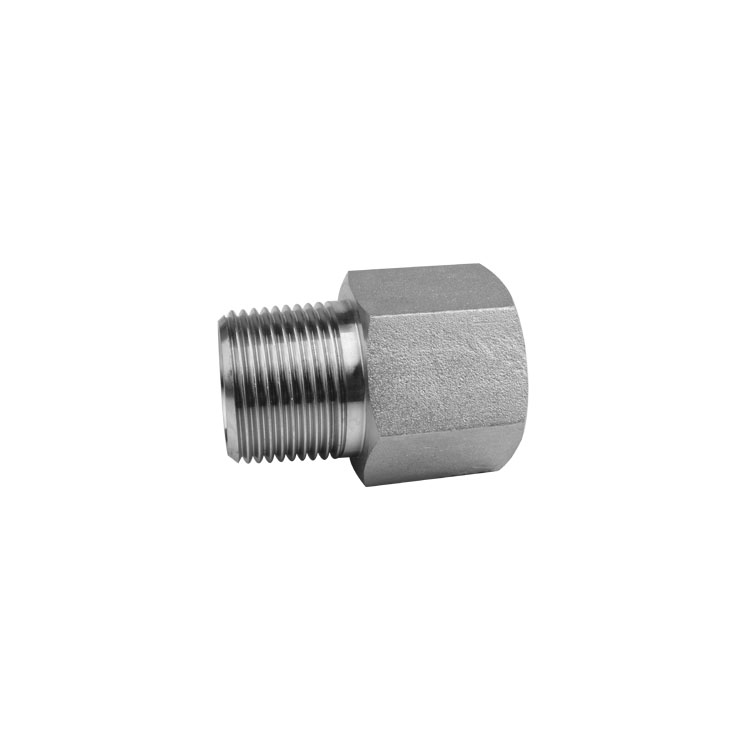
The NPT Adapter covers models from the 5000 and 5400 series through the 5500 and 5600 series, including 5404 male NPTF to male NPTF straight, 5405 and 5406 male to female configurations, 5406-C female NPTF pipe cap, 5406-P hex head pipe plug, 5406-HP hollow hex pipe plug, 5406-SHP square head pipe plug, plus 5603, 5604 and 5605 tees and the 5652 four-way cross. This family operates under high-temperature and high-pressure conditions and is the natural fit where a circuit must be closed, branched or plugged in the field.
Hydraulic JIC Adapter — 37° flare joints for machinery assemblies
The Hydraulic JIC Adapter provides hydraulic pipeline sealing, thread locking and fastening, and pressure bearing protection for mechanical hydraulic assemblies, with documented special requirements of rust resistance, high-temperature resistance and high-pressure resistance. Model coverage includes 2403 through 2408 straight and plug configurations, 2500 through 2505 elbows, 2601 through 2609 variants, and the 2700–2705 bulkhead group — 2700 bulkhead straight, 2701 bulkhead 90° elbow, 2702 bulkhead 45° elbow, 2703 bulkhead tee and 2704 bulkhead cross — which is where a line passes through a panel or a frame wall rather than simply joining two hoses.
SAE Standard Hydraulic Adapter — JIC, ORB and ORFS combinations
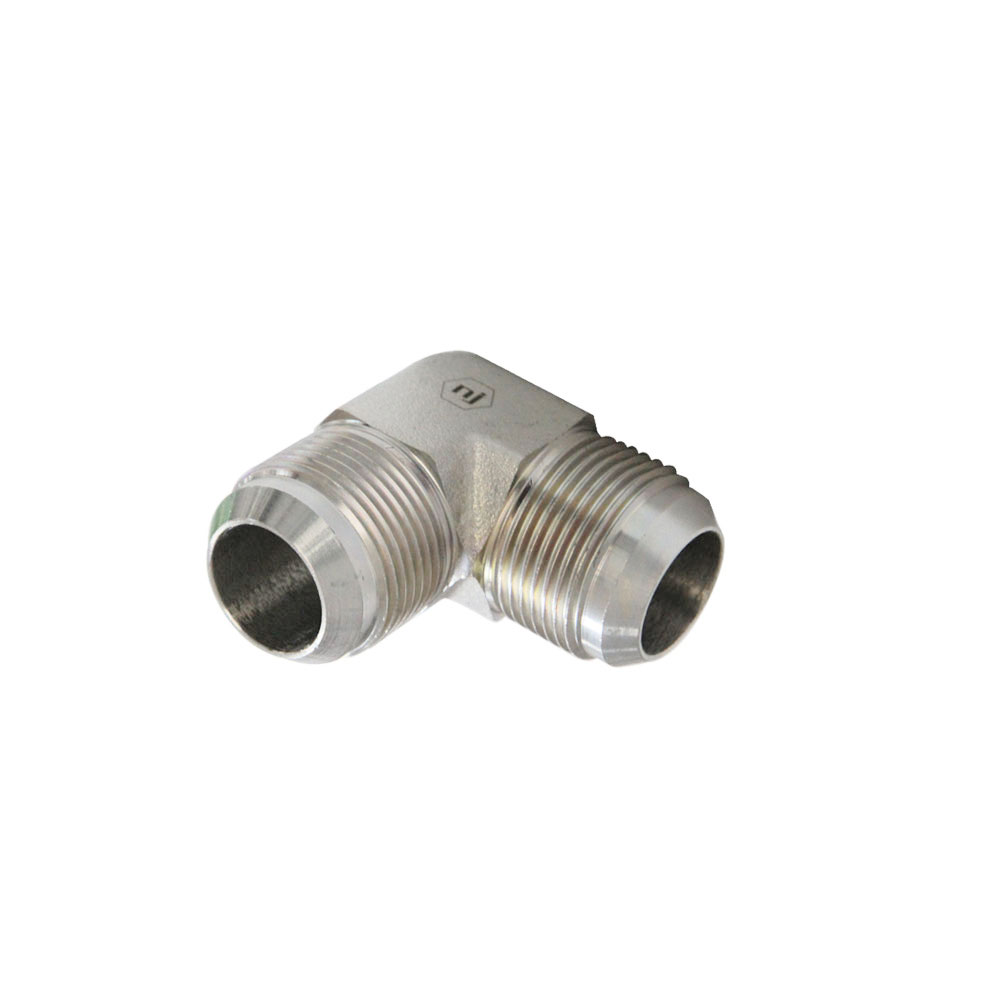
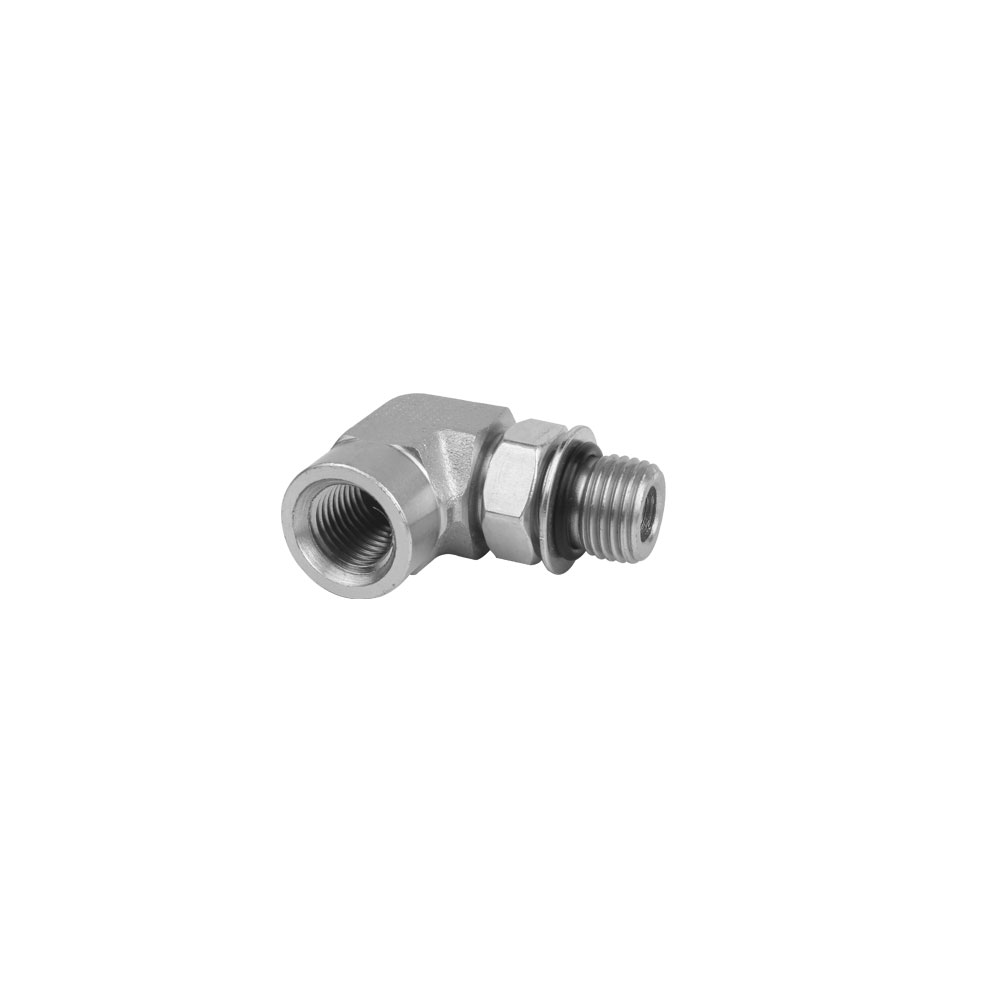
The SAE Standard Hydraulic Adapter is used in the construction machinery industry and spans the 6801–6850 model range, combining male JIC, male adjustable ORB and female ORB configurations: 6801 male JIC x male adjustable ORB 90° elbow, 6802 the 45° equivalent, 6803 male JIC x male JIC x male adjustable ORB tee, 6804 male JIC x male adjustable ORB x male JIC tee, 6805 male adjustable ORB x female NPTF pipe 90° elbow, 6807 male adjustable ORB x male adjustable ORB 90° elbow, 6815 male adjustable ORB x female ORB 90° elbow and 6835 adjustable ORB tee. Adjustable ORB bodies exist because the O-ring port needs orientation freedom during assembly.
Hydraulic cap nut — the accessories that decide whether the kit is complete
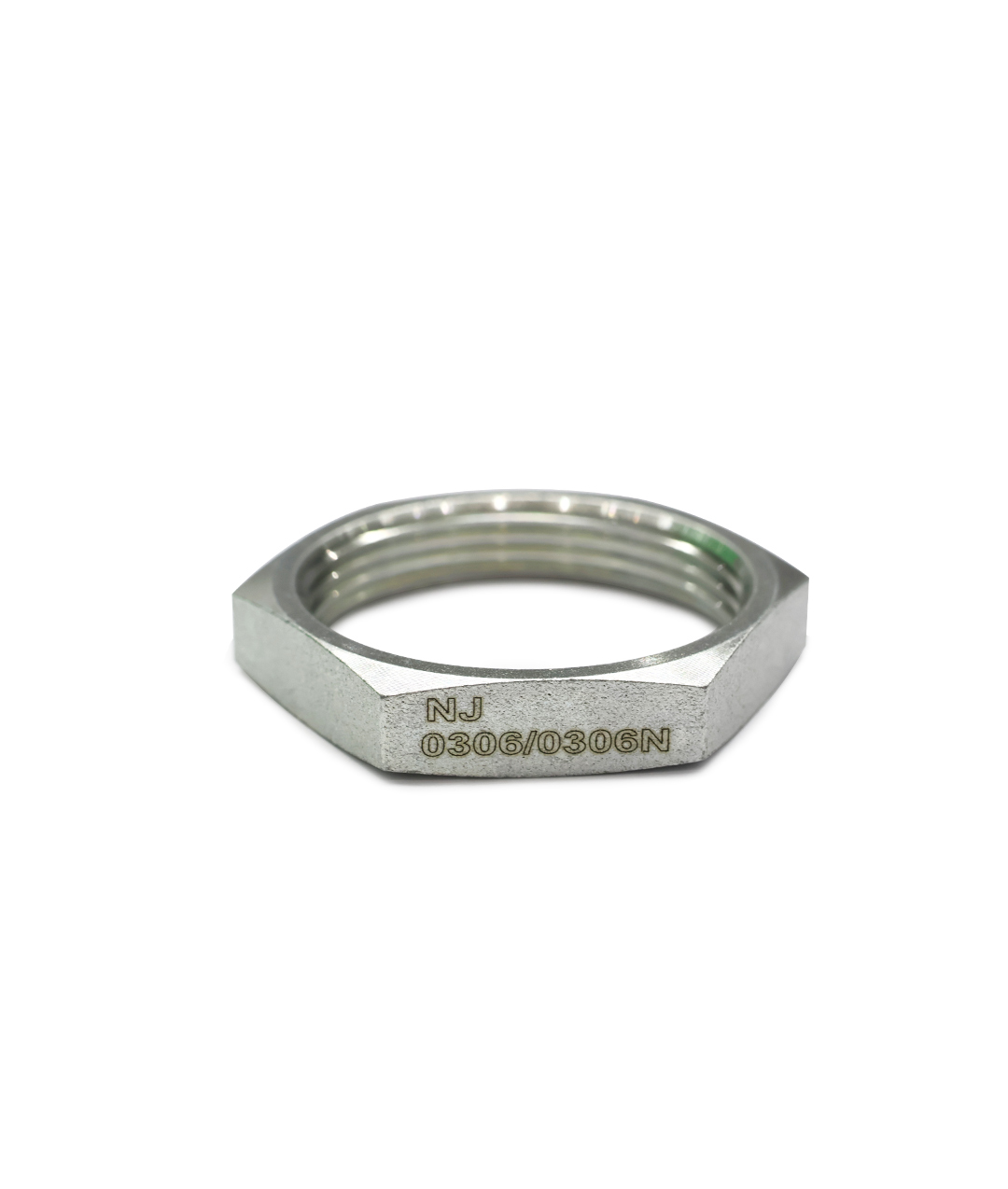
The hydraulic cap nut group carries models 0304C, 0306, 0318, 0319, 0403, 0500, FS0304C, FS0306, FS0318 and FS0319, and covers female JIC caps, JIC bulkhead lock nuts, JIC tube nuts and sleeves, bore-to-male JIC connectors and bore-to-male O-ring face seal connectors. These parts share the same stated 3000–6000 PSI range and 220°C maximum stable operating temperature as the adapter bodies. In practice they are the items most often short-shipped, and the ones most disruptive when they are.
Scenario Matrix: Construction, Agricultural, Marine and Oil & Gas
The matrix below converts the four target industries into a starting specification. It is a starting point, not a substitute for the machine's own port schedule; confirm the port on the equipment before locking a part number.
| Scenario | Thread family typically encountered | Adapter family and example models | Default material logic | Check before ordering |
|---|---|---|---|---|
| Construction machinery — excavators, loaders, cylinders, pumps, hose assemblies | JIC and SAE O-ring ports, with NPT on some service points | SAE Standard Hydraulic Adapter (6801, 6802, 6803, 6805); Hydraulic JIC Adapter (2403, 2500, 2501) | Carbon steel as the working baseline; stainless where wash-down or chemical exposure exists | Static and burst pressure of the exact configuration against circuit pressure; routing angle; whether an adjustable ORB body is needed for orientation |
| Agricultural equipment — implements, forklift parts, hose fittings, remote circuits | BSPP and BSPT, mixed with JIC on imported implements | BSP Adapter (1B, 1BT, 1T, 1T9, 2B9); Hydraulic JIC Adapter (2404, 2505) | Carbon steel; SS304 where fertiliser, slurry or wash-down corrosion is present | Mixed-fleet port audit across implements from different origins; plug and cap requirements for unused outlets |
| Marine machinery — deck equipment, steering systems, hatch hydraulics | BSPP, BSPT and JIC | BSP Adapter (1B, 6B bulkhead, 9B female plug); Hydraulic JIC Adapter (2700, 2701 bulkhead); hydraulic cap nut (0306, 0304C) | SS316 where salt exposure is continuous; carbon steel only for protected internal runs | Salt spray evidence (120-hour test, white rust at 120 hours, red rust at 240 hours) against the intended service life |
| Oil & gas extraction and process equipment | NPT and NPTF, with ORFS in some assemblies | NPT Adapter (5404, 5405, 5406, 5406-P, 5406-HP, 5406-SHP, 5603, 5652); SAE Standard Hydraulic Adapter (6815, 6835) | Carbon steel for standard duty; SS304 or SS316 where the environment or the fluid demands it | Pressure and temperature envelope per part number; plug and cap callouts for unused ports; NPTF vs NPT thread form confirmation |
| Distributor and resale stock | All of the above | Full range, with hydraulic cap nut and plug accessories carried as separate line items | Mixed — the resale mix decides | Whether accessories are on the same purchase order; acceptance criteria and replacement route |
Pressure, Temperature and Material: Reading the Envelope Correctly
The stated envelope for the BSP Adapter, NPT Adapter, Hydraulic JIC Adapter, SAE Standard Hydraulic Adapter and hydraulic cap nut is 3000–6000 PSI, with a maximum stable operating temperature of 220°C. That envelope is the boundary of the catalogue claim, not a per-part approval.
- Pressure is configuration-specific. The BSPT adapter configuration is documented as withstanding 6,000 PSI static and 9,000 PSI burst without deformation while maintaining continuous operation and seal integrity. External references show the same pattern of configuration dependence: ORFS fittings in dash size -4 (1/4") are rated for 6,000 PSI working pressure under SAE J1453, while NPTF straight threads in 1/4" size typically carry a 4,000 PSI working rating with a 4:1 safety factor. Compare the exact part number, not the family name.
- Temperature claims differ by material. The 220°C figure is the stated maximum stable operating temperature for these NJ product families. Published stainless references go further for AISI 316 adapters — Tubes International cites a range of -60°C to +400°C according to DIN 17440 — but that is a material-property reference, not a statement that any assembled joint will hold at 400°C. Use the product-specific figure.
- Corrosion evidence has a timeframe. The adapters pass a 120-hour salt spray test, showing white rust at 120 hours and red rust at 240 hours. For marine and coastal duty, that timeframe should be compared with inspection intervals, not with the total service life.
- Thread standards carry their own pressure logic. Published DIN 2353 references specify three robustness categories for metric tube fittings — LL (Extra Light, 100 bar), L (Light, up to 315–500 bar) and S (Heavy, up to 630–800 bar) — and ISO 8434-2:2007 specifies 37° flared connectors for tubes from 6 mm to 50.8 mm. A European hose assembly specification should name the series, not only the thread size.
Step-by-Step: Matching an Adapter to a Project
Step 1 — Fix the scenario and the duty envelope
Start with the machine's duty: static pressure, burst requirement, continuous fluid temperature, ambient exposure and inspection interval. Write these down before opening any catalogue. A marine deck circuit and a protected agricultural return line do not share an acceptance standard even when they share a thread.
Step 2 — Read the actual port on the equipment
Confirm whether the port is BSPP (parallel), BSPT (tapered), NPT/NPTF, JIC 37° flare, ORB or ORFS. Parallel and tapered threads of similar nominal size are not interchangeable, and the 1BT (male BSPP x male BSPT) and 5BN (male BSPP x female NPTF) and 1NB (male NPTF x male BSPP) models exist precisely because mixed ports are common in real machine populations.
Step 3 — Select the family and the configuration
Choose the family, then the body: straight, 45° elbow, 90° elbow, tee, cross, bulkhead, plug or cap. Routing decides the angle; panel or frame penetration decides whether a bulkhead body (2700 series, 6B) is required rather than a straight.
Step 4 — Select the material against the environment, not the budget first
Carbon steel is the working baseline for protected machinery circuits. SS304 suits moderate corrosion exposure and general wash-down; SS316 is the choice where chloride exposure is continuous. Steel dominates the market for high-pressure durability — 45.2% of hydraulic fitting revenue share in 2025, per Dataintelo — but dominance at category level does not override the environment of a single machine.
Step 5 — Reconcile the part envelope with the circuit
Check the selected configuration against 3000–6000 PSI and 220°C, and confirm that any higher-temperature material reference is applicable to the assembled joint rather than to the raw material alone.
Step 6 — Write acceptance criteria into the purchasing terms
Specify part numbers, material grade, quantity per kit, accessory line items (lock nut, sleeve, cap, plug), marking, and the evidence required at goods-in. This is the step that prevents the missing-accessory problem described below. NJ supports OEM/ODM production, with customization of logo, package, plated color and custom products made from provided drawings or samples, and applies random inspection in quality control.
Step 7 — Validate with samples, then release series production
Order samples against the documented scenario, verify fit and evidence, and only then release the series order. Stated lead time is 30–45 working days, and MOQ varies depending on product dimensions and manufacturing complexity — both should be confirmed at this stage rather than after the PO is issued.
Receiving and Acceptance: Closing the Missing-Accessory Gap

Missing or wrong-delivered items are a documented, routine after-sales category rather than an exceptional event. The agreed process is straightforward: the customer provides photos of the missing or wrong-delivered items, and after verification, replacement accessories are arranged by sea or air shipment. The recovery route is therefore reliable — but it is still a delay, and it is avoidable.
Three acceptance criteria close most of the gap:
- Line-item completeness. List every accessory as its own line on the purchase order — 0306 lock nut, 0318 tube nut, 0319 tube sleeve, 0304C cap, 5406-P or 5406-HP plug — rather than describing them as "fittings included".
- Count and identity check at goods-in. Verify part markings against the PO before put-away. A 2403 straight and a 2500 elbow are visually distinct; a 2406 female JIC x male JIC and a 2404 male JIC x male NPTF are not, at a glance.
- Documented claim window. Agree in advance how long after receipt a short-shipment claim can be raised, what photographic evidence is required, and whether replacement moves by sea or by air. Remote after-sales support is the stated support mode, so the evidence pack carries the whole claim.
Use Cases: How the Framework Reads in Practice
Construction machinery — cylinder and pump connections
The SAE Standard Hydraulic Adapter is used in the construction machinery industry, with support equipment including hydraulic hoses, hydraulic cylinders, threaded bolts, pipe joints, hydraulic pumps and mechanical cylinder assemblies. A typical pilot-line build mixes a 6801 or 6802 adjustable ORB elbow at the port with a 2500 JIC elbow where the hose route turns, and a 5406-P plug for a service port that is capped at build.
Agricultural equipment — mixed-origin fleets
Implements from different origins frequently combine BSPP ports with JIC hose ends on the same machine. The 1BJ (male BSPP x male JIC) and 1BT (male BSPP x male BSPT) models let the assembly stay single-body instead of stacking two adapters and adding a leak path.
Marine — corrosion as the governing constraint
On deck equipment, the material decision leads. SS316 bodies with the documented 120-hour salt spray result are the defensible specification where chloride exposure is continuous, and bulkhead bodies (6B, 2700, 2701) with 0306 lock nuts handle frame and panel penetrations.
Oil & gas — pressure closure and port control
Where circuits must be closed, branched or blanked, the NPT Adapter group carries the load: 5406-C cap, 5406-P hex head plug, 5406-HP hollow hex plug, 5406-SHP square head plug, 5603 and 5604 tees and the 5652 four-way cross. Verifying NPT versus NPTF thread form before ordering is the single highest-value check in this scenario.
Distributor case — Canada
A Canadian mid-market distributor used hydraulic cap nut models 0304C and 0306, rated 3000–6000 PSI with a 220°C maximum operating temperature and characterised by resistance to high pressure, high temperature and rust. The product is used for resale to other local customers with demand. The project was completed within a 3-year timeframe, and it achieved expansion of downstream client channels and an improvement in overall gross profit margin. The relevant lesson for other distributors is that the accessory line — not the headline adapter body — was the product that carried the programme.
Comparison Table: The Five Families Side by Side
| Family | Thread / configuration coverage | Documented application role | Material options | Stated envelope |
|---|---|---|---|---|
| BSP Adapter | BSPP (1B, 1BJ, 1BT, 2B9, 5BN, 6B, 9B) and BSPT (1T, 1T9, 1BT, 1ST, 4T, 5T); straight, elbow, bulkhead, plug | Hydraulic pipeline sealing and pressure bearing protection in mechanical hydraulic assemblies; BSPT configuration withstands 6,000 PSI static and 9,000 PSI burst without deformation | Carbon steel / SS304 / SS316 | 3000–6000 PSI; 220°C max stable operating temperature; 120-hour salt spray |
| NPT Adapter | 5000, 5404, 5405, 5406, 5406-C, 5406-P, 5406-HP, 5406-SHP, 5500–5605, 5650, 5652; plugs, caps, tees, crosses | Designed for high-pressure environments; operates under high-temperature and high-pressure conditions | Carbon steel / SS304 / SS316 | 3000–6000 PSI; 220°C max stable operating temperature; 120-hour salt spray |
| Hydraulic JIC Adapter | 2403–2408, 2500–2505, 2601–2609, 2700–2705 bulkhead group; straights, 45°/90° elbows, bulkhead fittings, plug | Hydraulic pipeline sealing, thread locking and fastening, and pressure bearing protection; rust, high-temperature and high-pressure resistance | Carbon steel / SS304 / SS316 | 3000–6000 PSI; 220°C max stable operating temperature; 120-hour salt spray |
| SAE Standard Hydraulic Adapter | 6801–6850; male JIC, male adjustable ORB, female ORB, ORFS bore connectors; elbows and tees | Used in the construction machinery industry; bridges JIC, ORB and NPTF ports in single bodies | Carbon steel / SS304 / SS316 | 3000–6000 PSI; 220°C max stable operating temperature; 120-hour salt spray |
| Hydraulic cap nut | 0304C, 0306, 0318, 0319, 0403, 0500, FS0304C, FS0306, FS0318, FS0319; caps, lock nuts, tube nuts, sleeves, bore connectors | Completes and secures assemblies — cap, lock, sleeve and bore-connection functions | Carbon steel / SS304 / SS316 | 3000–6000 PSI; 220°C max stable operating temperature; 120-hour salt spray |
Party facts in this table refer to products of NingBo NJ Hydraulic Adapter Co., Ltd.
FAQ
Which thread standard should a European hose assembly project specify — BSP or DIN metric?
The port on the equipment decides, and the specification should name the series rather than only the thread size. For metric tube fittings, published DIN 2353 / ISO 8434-1 references define three robustness categories: LL (Extra Light, 100 bar), L (Light, up to 315–500 bar) and S (Heavy, up to 630–800 bar); ISO 8434-2:2007 covers 37° flared connectors for tubes from 6 mm to 50.8 mm. Whitworth pipe threads (BSPP and BSPT) appear widely on European machinery alongside metric ports, so a hose assembly drawing should state the thread form, the series and the pressure rating. When qualifying a manufacturer for European hose assemblies, ask for thread gauges, material certificates and a salt spray record — the NJ adapters are tested to 120 hours, showing white rust at 120 hours and red rust at 240 hours.
Can one adapter family cover construction, agricultural and marine projects?
No single family covers all three, because the governing constraint changes. Construction work is driven by pressure and routing, which favours the SAE Standard Hydraulic Adapter — used in the construction machinery industry — and the Hydraulic JIC Adapter with its 45° and 90° elbows and bulkhead bodies. Agricultural equipment commonly presents mixed BSPP and BSPT ports, which is where the BSP Adapter range and the 1BJ and 1BT conversion bodies apply. Marine duty is governed by corrosion, so the material decision moves ahead of the geometry decision. What carries across all three is the shared stated envelope of 3000–6000 PSI and 220°C maximum stable operating temperature, and the same carbon steel / SS304 / SS316 choice.
What drives the cost of a hydraulic adapter order?
Four variables dominate. Material grade is the first, since carbon steel, SS304 and SS316 involve different input and machining costs. Configuration complexity is the second — a straight male-to-male body and a bulkhead cross or a tee are not equivalent parts. Testing and documentation requirements form the third. Order quantity is the fourth; MOQ varies depending on product dimensions and manufacturing complexity, so a mixed order of bodies plus accessories should be quoted as a whole rather than line by line. Lead time runs 30–45 working days and should be confirmed against the same variables.
Can we validate a scenario match with samples before a series order?
Yes. NJ operates OEM/ODM production with customization of logo, package, plated color, and custom products made from provided drawings or samples, with random inspection applied in quality control. In practice, a sample request should carry the scenario data — circuit pressure, fluid temperature, port type, material preference and accessory requirements — so that the sample tested is the sample that will be series-produced. Establishments sourcing this way typically verify fit on the machine, then convert the same part numbers into the series PO.
What is the lead time, and what happens if accessories arrive missing?
Stated lead time is 30–45 working days. If items are missing or wrong-delivered on arrival, the customer provides photos of the affected items; after verification, replacement accessories are arranged by sea or air shipment. To reduce the risk, list each accessory — lock nut, sleeve, cap or plug — as a separate purchase order line. Buyers who want to check a scenario match before committing can request a sample set or a quotation through njadapter.com, referencing the machine type, port schedule and required material grade.
Conclusion: The Scenario Is the Specification
Thread charts tell a buyer what will mate. They do not tell a buyer what will hold on a deck, in a slurry-covered implement circuit, or on a service port that has to be capped and forgotten for a season. Scenario-based matching reverses the order of the decision: fix the duty envelope, read the port, choose the family and body, then let the environment choose the material — and only then write the part numbers, including the accessories, into the purchase order.
For the five families described here — BSP Adapter, NPT Adapter, Hydraulic JIC Adapter, SAE Standard Hydraulic Adapter and hydraulic cap nut — the shared stated envelope is 3000–6000 PSI and 220°C maximum stable operating temperature, backed by a 120-hour salt spray result, in carbon steel, SS304 or SS316. NingBo NJ Hydraulic Adapter Co., Ltd has produced these components since 2004 from a 20,000㎡ facility with around 200 staff and a four-engineer R&D team, exporting 75% of output with the USA and Canada as main markets.
Next Step
Send the machine type, port schedule, working pressure and material preference, and the NJ team will map them to the matching adapter family and accessory list.
Website: www.njadapter.com | Email: jenny@fhyuli.com | WhatsApp: +86 158-6749-2228
Download the product catalogue (PDF): NingBo NJ Hydraulic Adapter Catalogue
Have Questions or Need More Details?
Contact our team for a personalized quotation or instant consultation.
Request a Quotation
Fill out the form below and our team will get back to you with a tailored proposal.
WhatsApp Direct Chat
Prefer to chat in real-time? Message us on WhatsApp for instant assistance & quick answers.
- Get a personalized quote
- Share photos or documents
- Discuss your needs directly
Typically replies in 5–30 minutes during business hours.