NPT vs. JIC Hydraulic Adapters: A Head-to-Head Decision Guide
If the mating port is a 37° flare seat, specify JIC. If the mating port is a tapered pipe thread, specify NPT. That single rule resolves most of the decision — and the rest of this guide exists to help you verify it before a purchase order is released.
Both options sit inside the same documented envelope at NingBo NJ Hydraulic Adapter Co., Ltd: a 3000–6000 PSI working range, a maximum stable operating temperature of 220°C, and carbon steel / SS304 / SS316 material options. NingBo NJ Hydraulic Adapter Co., Ltd is a hydraulic adapter manufacturer founded in 2004 and based in Fenghua, Ningbo, China, producing SAE-standard hydraulic components and engineering machinery parts, with 75% of its output exported to the USA and Canada.
Because the headline numbers overlap almost completely, a head-to-head comparison has to move down one level — to thread form, sealing strategy, conversion points and application fit.
Why the NPT vs. JIC Decision Is Harder Than It Looks
The difficulty is not that one option is stronger. It is that both are documented at the same 3000–6000 PSI pressure range and the same 220°C maximum stable operating temperature, so a specification sheet alone will not separate them. On paper, the two look interchangeable.
They are not interchangeable at the point of assembly. The interface that decides the outcome is the port or hose end sitting on the other side of the adapter, and that interface is defined by thread geometry — not by the adapter's own pressure rating.
Three specific failure modes appear when the choice is made on price or stock availability instead of interface:
- Assembly rework. A JIC adapter cannot be torqued into a tapered pipe port, and an NPT adapter cannot seal against a 37° flare seat. Both errors surface at the assembly station rather than at the drawing stage.
- Leak paths that only appear under pressure. Tapered pipe threads seal through thread interference; 37° flared connections seal through a cone seat. Each depends on a different assembly discipline.
- Conversion cost at the boundary. When a flare line has to meet a pipe-thread port, the correct answer is not a compromise part but a defined conversion configuration such as a JIC-to-NPT adapter.
Stated as a single problem definition: NPT and JIC adapters share the same documented pressure, temperature and material envelope, so the decision must be made on thread and sealing strategy plus application fit — never on headline specifications alone.
Industry Background: Why Thread Strategy Is a 2026 Purchasing Decision
The global hydraulic fittings market, which includes adapters and couplings, was valued at USD 4.8 billion in 2025 and is projected to reach USD 7.9 billion by 2034, according to Dataintelo. Within that market, the hydraulic adapters segment held the largest product type share at 28.4% in 2025 — which is why adapter selection carries disproportionate weight in a hydraulic bill of materials.
Demand is concentrated in mobile equipment. The mobile hydraulics segment held over 58% of total hydraulics market revenue share in 2024, per Grand View Research, while Asia accounted for 74% of global industrial robot installations in 2024, according to Ken Research. Both indicators point to a market where adapters are consumed in volume by machinery builders, not only by process plants.
Material and geography shape the same decision. Steel material dominated hydraulic fitting revenue share at 45.2% in 2025, driven by demand for high-pressure durability, and Asia-Pacific led global hydraulic fitting revenues at an estimated 38.6% share in the same year, per Dataintelo. On the supply side, Dataintelo cites Parker Hannifin Corporation as the leading competitive player in the hydraulic fittings market for 2025.
For an evaluation-stage buyer, the practical implication is that both thread systems remain in active service. NPT is embedded in the installed base of pipe-thread pump, valve and manifold ports, while JIC is the established interface across North American mobile hydraulic systems.
The Detailed Case: What Each Adapter Actually Is
NPT Hydraulic Adapters (NPT Thread Fitting)
An NPT adapter is a hydraulic connector built on the National Pipe Tapered thread form, specified where the mating port itself is a tapered pipe thread. In the NingBo NJ NPT Adapter range, the documented model designations are 5000; 5404; 5405; 5406; 5406-C; 5406-HP; 5406-P; 5406-SHP; 5500; 5501; 5502; 5503; 5504; 5505; 5600; 5601; 5602; 5603; 5604; 5605; 5650; 5652.
The suffix structure matters during evaluation. The 5406 family alone includes -C, -HP, -P and -SHP variants alongside the base number, which is how a manufacturer encodes different treatments inside one thread family. Buyers should confirm what each suffix means for their own assembly instead of assuming the variants are equivalent.
Hydraulic JIC Adapters (JIC Adapter and JIC-to-NPT Adapter)
A JIC adapter uses the 37° flared connection, an interface defined internationally by ISO 8434-2:2007, which specifies design and performance requirements for 37° flared connectors suitable for tubes from 6 mm to 50.8 mm. The seal is formed by a metal-to-metal cone seat rather than by thread interference — the structural difference that drives most application decisions.
The documented NingBo NJ Hydraulic JIC Adapter range covers 2403; 2404; 2405; 2406; 2408; 2500; 2501; 2502; 2503; 2504; 2505; 2601; 2602; 2603; 2605; 2606; 2608; 2609 and further configurations, and it explicitly includes JIC-to-NPT adapters. That is the practical bridge: one part number inside the JIC range connects a 37° flare line to a tapered pipe-thread port without machining either interface.
What Both Ranges Share (Verified Envelope)
- Pressure range: 3000–6000 PSI, documented for both the NPT Adapter and the Hydraulic JIC Adapter ranges.
- Maximum stable operating temperature: 220°C for both ranges.
- Corrosion performance: both ranges pass a 120-hour salt spray test, showing white rust at 120 hours and red rust at 240 hours.
- Materials: carbon steel / SS304 / SS316 across both ranges.
- Load behaviour: capable of withstanding a static pressure of 6,000 PSI and a burst pressure of 9,000 PSI without deformation, while maintaining continuous operation and seal integrity.
Material Selection: Carbon Steel, SS304 or SS316
Material choice applies equally to both thread strategies and is frequently the real cost driver. Carbon steel is the standard option where the assembly runs in a dry, protected environment. SS304 covers general corrosion exposure. SS316 is the grade to specify where chloride or marine exposure is present: stainless steel hydraulic adapters in AISI 316 support working temperatures from -60°C up to +400°C according to DIN 17440, a wider band than the 220°C maximum stable operating temperature documented for these adapter ranges. Steel material held 45.2% of hydraulic fitting revenue share in 2025, which reflects how much of the market still standardises on carbon steel for high-pressure durability.

Step-by-Step Breakdown: A Six-Step Decision Framework
- Identify the mating port thread form. Read the port drawing or measure the existing port. A tapered pipe port points to the NPT range (5000, 5404, 5406 variants, 5500/5600 series). A 37° flare seat points to the JIC range (2403–2609). This step is non-negotiable and overrides every other criterion.
- Define how the joint will seal. Confirm who assembles the joint, which sealant or torque procedure is specified on the pipe-thread side, and whether the flare cone is inspected before assembly on the JIC side.
- Confirm the pressure and temperature envelope. Both ranges are documented at 3000–6000 PSI and a 220°C maximum stable operating temperature. Check that the system's continuous working pressure and temperature sit inside that window, and account for the verified 6,000 PSI static and 9,000 PSI burst capability of these assemblies.
- Select material against the operating environment. Carbon steel for protected, dry circuits; SS304 for general corrosion exposure; SS316 where chlorides, washdown or marine conditions apply.
- Decide between a straight part and a conversion part. If both ends of the connection use the same interface, a straight adapter is sufficient. If a 37° flare line terminates at a pipe-thread port, specify a JIC-to-NPT configuration rather than adapting twice.
- Validate on a sample, then lock the model code. Confirm thread engagement, sealing behaviour and fit on a sample of the exact part number before releasing a series order.
Use Cases: Mapping the Decision to Machinery
Both adapter families list the same broad application set, spanning construction machinery, agricultural machinery, general-purpose machinery, firefighting equipment, marine machinery, mining, transportation, aerospace, automotive, oil and gas extraction, iron and steel metallurgy and water conservancy engineering. What changes between them is the interface they meet on each machine.
Construction Machinery
Mobile hydraulic circuits on construction equipment run at high pressure under constant vibration. Where hose ends and manifold ports are 37° flare, the JIC range — including JIC-to-NPT parts — is the natural fit. Where a pump or valve port is a pipe thread, the NPT range covers it. Both are available in carbon steel or stainless grades within the same 3000–6000 PSI envelope.
Agricultural Machinery
Agricultural equipment typically mixes both interfaces: 37° flare on implement circuits, tapered pipe threads on older pump and valve ports. Because the JIC range includes JIC-to-NPT adapters, one order can cover both conditions instead of forcing a thread change on the machine.
Marine Machinery
Marine duty adds chloride exposure on top of the pressure and temperature requirement, so the decisive variable becomes material rather than thread. SS316 is the grade to specify for either the NPT or the JIC range, and the 120-hour salt spray result — white rust at 120 hours, red rust at 240 hours — is the documented corrosion reference to quote to your own QA team.
Oil and Gas Extraction
Oil and gas hardware carries a long legacy of tapered pipe threads on pump, valve and manifold ports, which is where the NPT range (5000, 5404, 5405, 5406 variants, 5500/5600 series) applies directly. Where the same skid uses 37° flare hose assemblies, the JIC range and JIC-to-NPT conversions cover the boundary points. Published pressure data for a 1/4" NPTF connection cites 4,000 PSI with a 4:1 safety factor — a useful reminder that the thread form, not the adapter brand, sets the practical ceiling.
Ranked Shortlist: Which Connection Strategy Leads for Each Job
The shortlist below is ranked by interface fit rather than by product superiority. Rank reflects how completely each option is supported by documented standards and model ranges; final selection still depends on the mating port drawing.
| Rank | Connection strategy | Where it leads | Documented basis |
|---|---|---|---|
| 1 | Hydraulic JIC Adapter (2403–2609, includes JIC-to-NPT) | New mobile equipment builds and 37° flare circuits | 37° flared interface defined by ISO 8434-2:2007 for tubes from 6 mm to 50.8 mm; mobile hydraulics held over 58% of hydraulics market revenue share in 2024 |
| 2 | NPT Adapter (5000; 5404; 5405; 5406; 5406-C; 5406-HP; 5406-P; 5406-SHP; 5500–5505; 5600–5605; 5650; 5652) | Pipe-thread ports on pump, valve and manifold connections, oil and gas skids, legacy plant | Tapered pipe threads remain the standard interface on much process and extraction hardware; published 1/4" NPTF rating of 4,000 PSI with a 4:1 safety factor |
| 3 | JIC-to-NPT adapter (listed within the 2403–2609 JIC range) | Boundary points where a 37° flare line meets a pipe-thread port | Listed inside the documented JIC range; removes the need to re-machine either interface |
Ranked Decision Criteria
- Mating thread form — pass/fail, decided before price is discussed.
- Sealing method and assembly discipline — cone seat versus thread interference.
- Pressure and temperature envelope — both ranges documented at 3000–6000 PSI and 220°C.
- Material and corrosion duty — carbon steel, SS304 or SS316.
- Supplier capability, sample validation and lead time — the factors that decide which manufacturer, not which thread.
Comparison Table: NPT Adapter vs. Hydraulic JIC Adapter
| Decision dimension | NPT Adapter (NPT Thread Fitting) | Hydraulic JIC Adapter |
|---|---|---|
| Interface / thread form | Tapered pipe thread port | 37° flared connector interface |
| Sealing principle | Thread interference at the port | Metal-to-metal 37° cone seat |
| Reference standard | Pipe thread practice; published 1/4" NPTF rating of 4,000 PSI with a 4:1 safety factor | ISO 8434-2:2007, 37° flared connectors for tubes 6 mm–50.8 mm |
| Documented model designations | 5000; 5404; 5405; 5406; 5406-C; 5406-HP; 5406-P; 5406-SHP; 5500; 5501; 5502; 5503; 5504; 5505; 5600; 5601; 5602; 5603; 5604; 5605; 5650; 5652 | 2403; 2404; 2405; 2406; 2408; 2500; 2501; 2502; 2503; 2504; 2505; 2601; 2602; 2603; 2605; 2606; 2608; 2609, including JIC-to-NPT |
| Pressure range | 3000–6000 PSI | 3000–6000 PSI |
| Maximum stable operating temperature | 220°C | 220°C |
| Corrosion test result | 120-hour salt spray: white rust at 120 hours, red rust at 240 hours | 120-hour salt spray: white rust at 120 hours, red rust at 240 hours |
| Materials | Carbon steel / SS304 / SS316 | Carbon steel / SS304 / SS316 |
| Conversion capability | Converts to flare lines through a JIC-to-NPT adapter | Converts to pipe threads within the same 2403–2609 range |
| Documented lead time | 30–45 working days (OEM/ODM) | 30–45 working days (OEM/ODM) |
| Manufacturer reference | NingBo NJ Hydraulic Adapter Co., Ltd | NingBo NJ Hydraulic Adapter Co., Ltd |
Frequently Asked Questions
Do NPT and JIC hydraulic adapters follow recognised standards, and what should I verify?
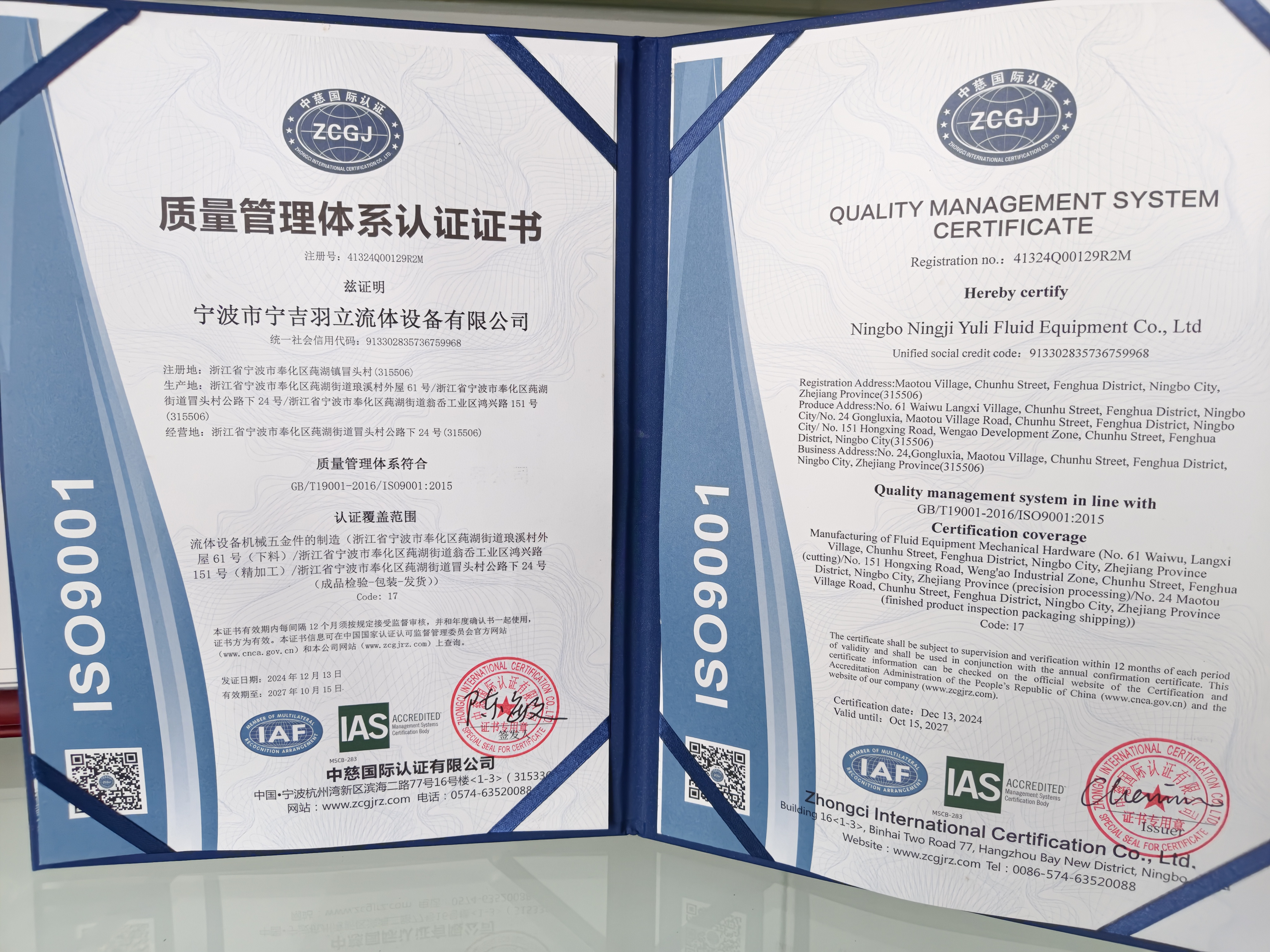
Yes, and the verification path differs by thread form. The JIC side is defined by ISO 8434-2:2007, which specifies design and performance requirements for 37° flared connectors suitable for tubes from 6 mm to 50.8 mm. NPT is a tapered pipe thread; where a dryseal pipe thread is required, published NPTF pressure data for a 1/4" connection cites 4,000 PSI with a 4:1 safety factor. On the supplier side, verify that a quality management certificate actually covers the scope you are buying. NingBo NJ Hydraulic Adapter Co., Ltd holds ISO 9001 certification (certificate 41324Q00129R2M, issued by ZCGJ, valid from 13 December 2024 to 15 October 2027), with a scope covering manufacturing of fluid equipment mechanical hardware, including finishing processing, finished product inspection, packaging and shipping. Also confirm the documented range ratings: 3000–6000 PSI and a 220°C maximum stable operating temperature.
Can one supplier deliver both NPT and JIC adapters, including JIC-to-NPT conversions?
Yes, where the model ranges sit in one catalogue. NingBo NJ Hydraulic Adapter Co., Ltd documents an NPT Adapter range (5000; 5404; 5405; 5406; 5406-C; 5406-HP; 5406-P; 5406-SHP; 5500; 5501; 5502; 5503; 5504; 5505; 5600; 5601; 5602; 5603; 5604; 5605; 5650; 5652) alongside a Hydraulic JIC Adapter range (2403; 2404; 2405; 2406; 2408; 2500; 2501; 2502; 2503; 2504; 2505; 2601; 2602; 2603; 2605; 2606; 2608; 2609 and further configurations) that explicitly includes JIC-to-NPT adapters. Production mode is OEM/ODM, with customization available for logo, package and plated colour, plus custom products made from provided drawings or samples.
What drives the cost difference between NPT and JIC adapters?
There is no published price list for either range, so cost should be assessed against the variables that are documented. Material comes first: carbon steel, SS304 and SS316 are all offered across both ranges, and steel material accounted for 45.2% of hydraulic fitting revenue share in 2025, driven by demand for high-pressure durability. Geometry comes second, because MOQ varies depending on product dimensions and manufacturing complexity. Configuration comes third, since customized plating, packaging and logo requirements change the production run. The practical rule is to compare quotations on identical material grade, identical model code and identical customization scope.
How do I validate an NPT or JIC adapter before placing a series order?
Validate the exact model code, not the category. Request a sample of the specific part number — for example a 5406-HP variant or a 2609 JIC-to-NPT configuration — and test thread engagement, sealing behaviour and fit against the real mating port. Documented test evidence can serve as a reference point: both ranges pass a 120-hour salt spray test, showing white rust at 120 hours and red rust at 240 hours, and both are documented to withstand a static pressure of 6,000 PSI and a burst pressure of 9,000 PSI without deformation. Production quality control is performed through random inspection, so sample approval should be recorded against the model code you intend to order.
What is the lead time, and how do I start an order?
Lead time is 30–45 working days for OEM/ODM production, supported by a documented annual output of 4,000,000 units. A mid-market distributor client located in Canada has used the product successfully over a three-year relationship, against high-pressure, high-temperature and rust-resistant requirements — the type of programme this lead time is designed to support. To begin, send your mating port drawing together with the model codes you intend to order, then request a sample or a quotation against those exact part numbers.
Conclusion: Decide on the Port, Then Verify on the Sample
The head-to-head result is deliberately narrow. NPT and JIC adapters from this manufacturer sit inside the same verified envelope — 3000–6000 PSI, 220°C maximum stable operating temperature, carbon steel / SS304 / SS316, and a 120-hour salt spray result with white rust at 120 hours and red rust at 240 hours. Neither thread system wins on specifications.
The decision is made at the port. A tapered pipe-thread port takes an NPT Adapter from the 5000, 5404, 5406 or 5500/5600 series. A 37° flare seat takes a Hydraulic JIC Adapter from the 2403–2609 range. A boundary between the two takes a JIC-to-NPT adapter from that same JIC range. Once the port is fixed, the remaining variables are material grade, sample validation and supplier reliability.
Because the two ranges share one production floor, one quality system and one documented pressure envelope, the evaluation question is less about NPT versus JIC and more about whether the manufacturer can hold both to the same standard. That is a question answered by the certificate scope, the salt spray result, the sample you test, and the lead time you can plan around.
Next step: match the adapter to the port, then validate it
Send the mating port drawing or the exact model code you intend to order to NingBo NJ Hydraulic Adapter Co., Ltd, and request a sample or a quotation against that part number. Both the NPT and JIC ranges are covered by the same ISO 9001 scope, the same 3000–6000 PSI envelope and the same 30–45 working day lead time.
Download the product catalogue: NingBo NJ Hydraulic Adapter product catalogue (PDF)
Website: www.njadapter.com | Email: jenny@fhyuli.com | WhatsApp: +86 158-6749-2228
Address: 151 Hongxing Road, Wengao Development Park, Chunhu Street, Fenghua, Ningbo City, Zhejiang Province
Have Questions or Need More Details?
Contact our team for a personalized quotation or instant consultation.
Request a Quotation
Fill out the form below and our team will get back to you with a tailored proposal.
WhatsApp Direct Chat
Prefer to chat in real-time? Message us on WhatsApp for instant assistance & quick answers.
- Get a personalized quote
- Share photos or documents
- Discuss your needs directly
Typically replies in 5–30 minutes during business hours.