Ranked: Top 5 Hydraulic Adapter Types for Construction, Agricultural, and Marine Machinery
Ranked: Top 5 Hydraulic Adapter Types for Construction, Agricultural, and Marine Machinery
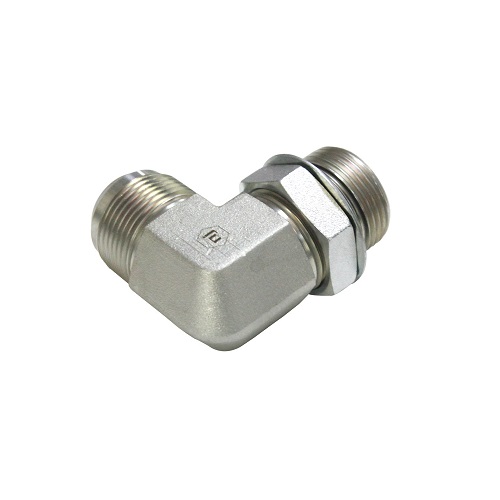
Ranking hydraulic adapter types for machinery is a constraint-matching task, not a catalog exercise. This shortlist ranks five adapter categories — SAE standard hydraulic adapter, hydraulic JIC adapter, NPT adapter, BSP adapter, and hydraulic cap nut — by how well each one fits construction, agricultural, and marine machinery service, and by the constraints a buyer must verify before releasing a purchase order.
This is an editorial ranking of adapter types, not a supplier ranking. The comparison criteria are the ones that decide whether a joint holds: thread interface, sealing method, verified pressure class, temperature limit, material and corrosion exposure, and the certification evidence behind the part. Configuration range and supply constraints were used only as tie-breakers.
All five categories share one verified baseline from NingBo NJ Hydraulic Adapter Co., Ltd, a hydraulic adapter and fitting manufacturer founded in 2004 and based in Fenghua, Ningbo, Zhejiang Province, China, operating a 20,000 m² facility with approximately 200 employees and an annual output of 4,000,000 units. That shared baseline is a 3000–6000 PSI working pressure range, a maximum stable operating temperature of 220 °C, material options of carbon steel, SS304 and SS316, and a 120-hour salt spray test that shows white rust at 120 hours and red rust at 240 hours. What separates the five types is where each one is used and what a buyer has to check before specifying it.
Problem Definition: The Constraint Set Comes Before the Part Number
A hydraulic adapter does not fail because it is the wrong category; it fails because one constraint in the joint was mismatched. In practice, the mismatches fall into five recurring patterns:
- Thread interface mismatch. A BSPT male thread started into an NPTF port, or a BSPP male thread used without a sealing washer, will leak even when the adapter itself is correctly manufactured.
- Sealing-mechanism mismatch. ORFS seals on an O-ring face; JIC seals on a 37° metal-to-metal flare; NPTF relies on thread interference; BSPP normally needs a bonded washer or O-ring at the face. Mixing the mechanisms is a specification error, not a quality problem.
- Pressure-class overreach. Working pressure has to be compared against the adapter rating, not against the hose rating or the cylinder rating.
- Thermal and corrosion exposure. A joint rated to a 220 °C maximum stable operating temperature, in carbon steel, behaves differently from the same geometry in SS316 on a marine deck.
- Documentation gaps. Without a certificate scope, salt-spray evidence, and a defined lead time, the buyer cannot defend the selection internally.
That is why the ranking below is built on verifiable constraints rather than on appearance or price. One commercial constraint is worth stating early: there is no fixed public price band for these parts. The commercial variables that move an adapter quotation are material grade, thread size, configuration complexity (straight, elbow, tee, cross, bulkhead), plating or surface finish, and order quantity — and the minimum order quantity itself varies depending on product dimensions and manufacturing complexity.
Industry Background: Market Scale and the Standards That Set the Tiers
Hydraulic adapters are a large sub-segment of a market that is still expanding. The global hydraulic fittings market, which includes adapters and couplings, was valued at USD 4.8 billion in 2025 and is projected to reach USD 7.9 billion by 2034, according to Dataintelo. Within that market, the hydraulic adapters segment held the largest product-type share at 28.4% in 2025, and steel-based products accounted for 45.2% of revenue share in the same year — a figure that reflects demand for high-pressure durability rather than cost preference alone. Asia-Pacific led global hydraulic fitting revenues in 2025 with an estimated 38.6% share.
The demand driver behind those numbers is mobile equipment. The mobile hydraulics segment held more than 58% of total hydraulics market revenue in 2024, according to Grand View Research, while the broader hydraulics market (components, pumps, cylinders) was estimated at USD 38.39 billion in 2024. Construction, agricultural, and marine machinery sit inside that mobile segment, which is why adapter selection in these three environments is a high-consequence decision rather than a commodity purchase.
Published standards define the pressure tiers a buyer works within. DIN 2353 specifies three robustness categories for metric tube fittings: LL (Extra Light, 100 bar), L (Light, up to 315–500 bar), and S (Heavy, up to 630–800 bar). ISO 8434-2:2007 specifies design and performance requirements for 37° flared connectors suitable for tubes from 6 mm to 50.8 mm. For face-seal geometry, ORFS fittings at dash size -4 (1/4") are rated for 6000 PSI working pressure under SAE J1453. For pipe-thread geometry, NPTF fittings at 1/4" size are cited with a 4000 PSI working pressure rating and a 4:1 safety factor.
Reading the tiers correctly: a standard does not make an adapter interchangeable with another standard. DIN 2353, ISO 8434-2, SAE J1453, JIC 37° flare and BSPP/BSPT pipe threads are distinct interfaces. In this ranking, tier position reflects how much verified pressure headroom and how much sealing robustness each interface contributes in machinery service.
The Ranked Shortlist: Five Hydraulic Adapter Types for Machinery
Rank 1 — SAE Standard Hydraulic Adapter (Models 6801–6850)
The SAE standard hydraulic adapter ranks first because it combines the highest verified pressure ceiling in the shortlist with a sealing method that tolerates field reassembly. The series covers models 6801 through 6850 and is built as a JIC / ORB / ORFS adapter family. Representative configurations include model 6801 as a Male JIC x Male Adjustable ORB 90° Elbow, model 6802 as a Male JIC x Male Adjustable ORB 45° Elbow, model 6805 as a Male Adjustable ORB x Female NPTF Pipe 90° Elbow, and model 6815 as a Male Adjustable ORB x Female ORB 90° Elbow.
Two verified facts explain the top position. First, ORFS fittings at dash size -4 are rated for 6000 PSI working pressure under SAE J1453 — the top of the 3000–6000 PSI band shared by this adapter family. Second, the adjustable ORB construction lets the installer orient an elbow before final tightening, which matters on densely routed machinery where a fixed-angle fitting would force hose re-routing. The series is produced in compliance with ISO 9001:2015.
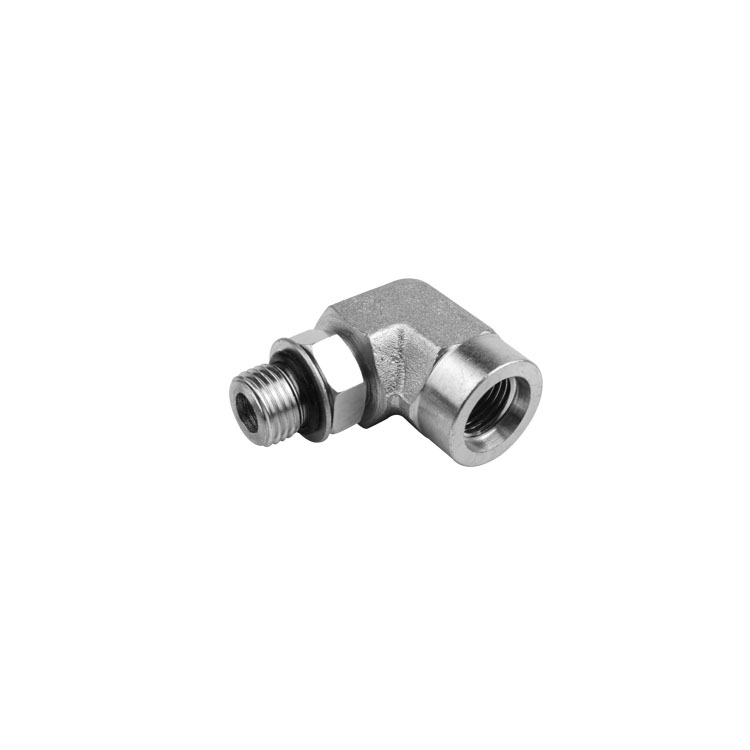
Buyer selection reason: choose this type where system pressure sits at the top of the range and where leakage has to be minimized. Constraint to verify: the boss face and O-ring must match the ORB port; an adjustable elbow is only adjustable because the O-ring carries the seal, so a missing or incorrect O-ring removes the sealing function entirely.
Rank 2 — Hydraulic JIC Adapter (Models 2403–2609)
The hydraulic JIC adapter ranks second because the 37° flare interface is the most widely recognized repairable connection in mobile machinery, and because ISO 8434-2:2007 already defines its design and performance envelope for tubes from 6 mm to 50.8 mm. The model designation covers 2403, 2404, 2405, 2406, 2408, 2500 through 2505, and 2601 through 2609.
Configuration coverage in this family is broad. Verified configurations include Male JIC x Male JIC Straight (2403), Male JIC x Male NPTF Pipe Straight (2404), Male JIC x Female NPTF Pipe Straight (2405), Female JIC x Male JIC Straight (2406), Male JIC Plug (2408), Male JIC x Male JIC 90° Elbow (2500), Male JIC x Male NPTF Pipe 90° Elbow (2501), Male JIC x Female NPTF Pipe 90° Elbow (2502), Male JIC x Male JIC 45° Elbow (2504), and Male JIC x Female NPTF Pipe 45° Elbow (2505). Bulkhead configurations are also part of the range, including Male JIC x Male JIC Bulkhead Straight, Bulkhead 90° Elbow, Bulkhead 45° Elbow, and Bulkhead Tee arrangements.
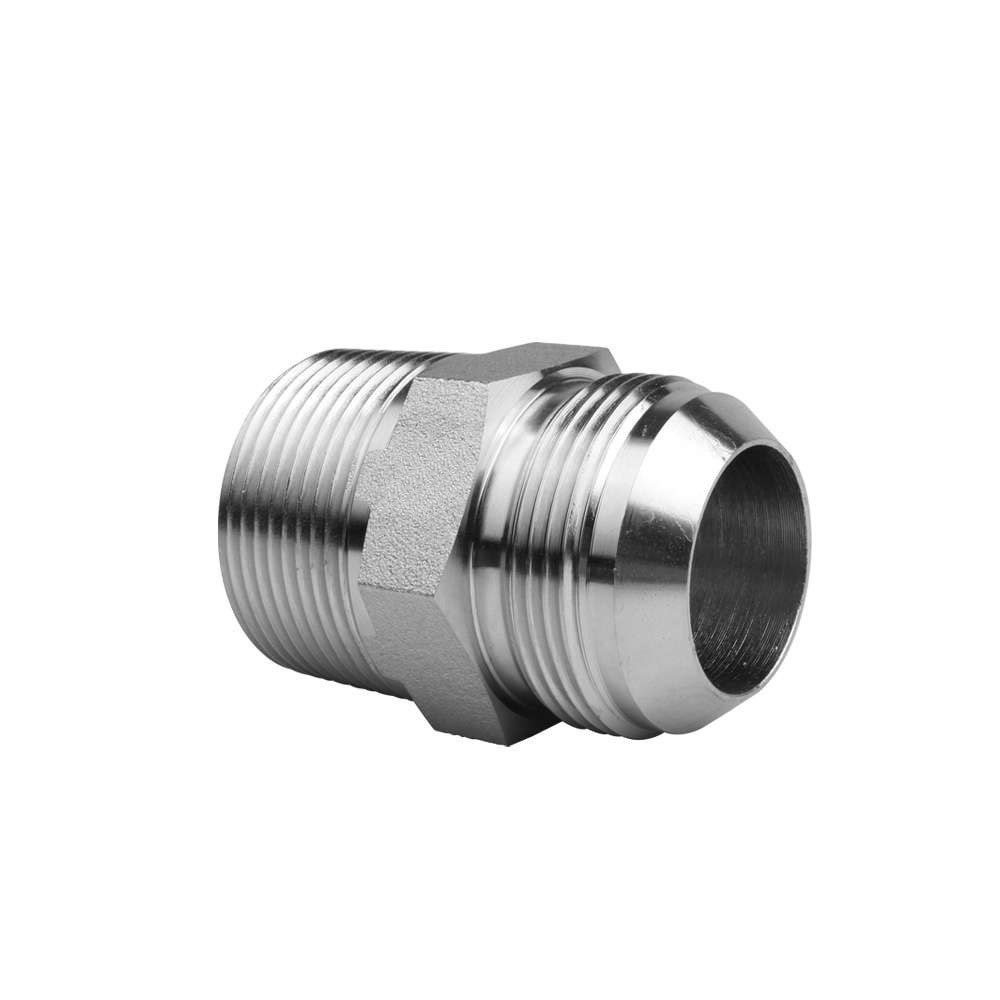
Buyer selection reason: the JIC family is the practical choice for agricultural and construction machinery where joints are opened during maintenance and where a mixed JIC/NPTF circuit already exists — the 2404 and 2405 models exist precisely to make that transition. Constraint to verify: flare condition and torque. A nicked or over-torqued 37° cone will not seal against a new flare, and a bulkhead variant adds a second sealing surface that must be checked separately.
Rank 3 — NPT Adapter (5000, 5404, 5405, 5406, 5500, 5600 and 5650 Series)
The NPT adapter ranks third: it is the interface most likely to already be on the machine, particularly on North American equipment, but its sealing method depends on thread engagement rather than on a dedicated seal geometry. This adapter type is available in carbon steel, SS304 and SS316.
The verified model range includes the 5000, 5404, 5405, 5406, 5406-C, 5406-HP, 5406-P, 5406-SHP, 5500, 5501, 5502, 5503, 5504, 5505, 5600, 5601, 5602, 5603, 5604, 5605, 5650 and 5652 series. Confirmed configurations include Male NPTF Pipe x Male NPTF Pipe Straight (5404), Male NPTF Pipe x Female NPTF Pipe Straight (5405 and 5406), Female NPTF Pipe Cap (5406-C), Male NPTF Hex Head Pipe Plug (5406-P), Male NPTF Hollow Hex Pipe Plug (5406-HP), Male NPTF Square Head Pipe Plug (5406-SHP), Male NPTF Pipe x Female NPTF Pipe x Male NPTF Pipe Tee (5603), Female NPTF Pipe x Female NPTF Pipe x Male NPTF Pipe Tee (5604), Female NPTF Pipe x Female NPTF Pipe x Female NPTF Pipe Tee (5605), and Female NPTF Pipe x Female NPTF Pipe x Female NPTF Pipe x Female NPTF Pipe Cross (5652).
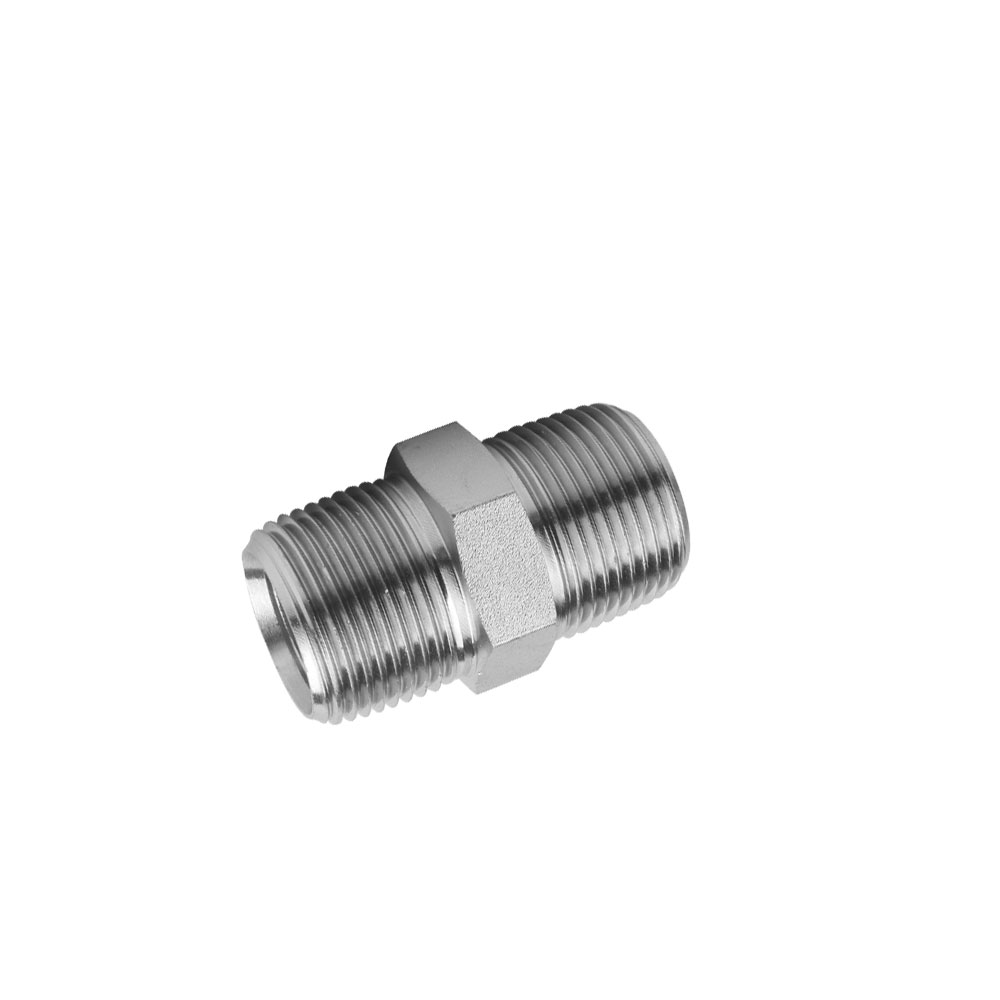
Buyer selection reason: this type is a service and replacement workhorse. As a market reference, NPTF fittings at 1/4" size are cited with a 4000 PSI working pressure rating and a 4:1 safety factor, and the plug and cap configurations (5406-P, 5406-HP, 5406-SHP, 5406-C) make it practical to close off ports during machine rebuilds and field diagnostics. Constraint to verify: NPTF is not interchangeable with all pipe-thread variants — confirm whether the port is a dryseal-style interface, and confirm whether a sealant or a specific engagement depth is required by the machine builder.
Rank 4 — BSP Adapter (1B and 1T Series)
The BSP adapter ranks fourth. It is not lower because of performance — it carries the same 3000–6000 PSI range and 220 °C maximum stable operating temperature — but because it addresses a narrower installed base, concentrated in machinery built to BSPP/BSPT conventions, which is common in marine and imported equipment.
The range splits into two manufacturing families. The BSPP thread fitting family covers models 1B, 1B4, 1B9, 1BG, 1BG4, 1BG9, 1BH, 1BH9, 1BJ, 1BK, 1BM, 1BN, 1BO, 1BT, 1BT9, 2B, 2B9, 2BJ, 2GB, 2HB, 22NB, 2TB9, 2OB, 2TB, 3B, 4B, 4BN, 5B, 5BN, 5NB, 5BT, 5GB, 5OB, 5TB9, 6B, 7B, 7B9, 9B, EB, AB and BB. Its verified configurations include Male BSPP x Male BSPP Straight (1B), Female BSPP Plug (9B), Female BSPP x Female BSPP Straight (7B), Male BSPP x Female NPTF Straight (5BN), Male BSPP x Male BSPP Bulkhead Straight (6B), Male BSPP Plug (4B), Male BSPP x Female BSPP Swivel 90° Elbow (2B9), Male BSPP x Male JIC Straight (1BJ), Male NPTF Pipe x Male BSPP Straight (1NB), Male BSPP x Male BSPT Straight (1BT), and Male BSPP x Male BSPP O-Ring 90° Elbow (1BG9).
The BSPT thread fitting family covers models 1T, 1T9, 1BT, 1ST, 4T and 5T, with configurations including Male BSPT x Female BSPT Straight (5T), Male BSPP x Female BSPT Straight (1BT), Male JIC x Female BSPT Straight (1JT), Male JIS x Female BSPT 90° Elbow (1ST9), Male BSPT x Male BSPT Straight (1T), Male BSPT Plug (4T), and Male BSPT x Male BSPT 90° Elbow (1T9).
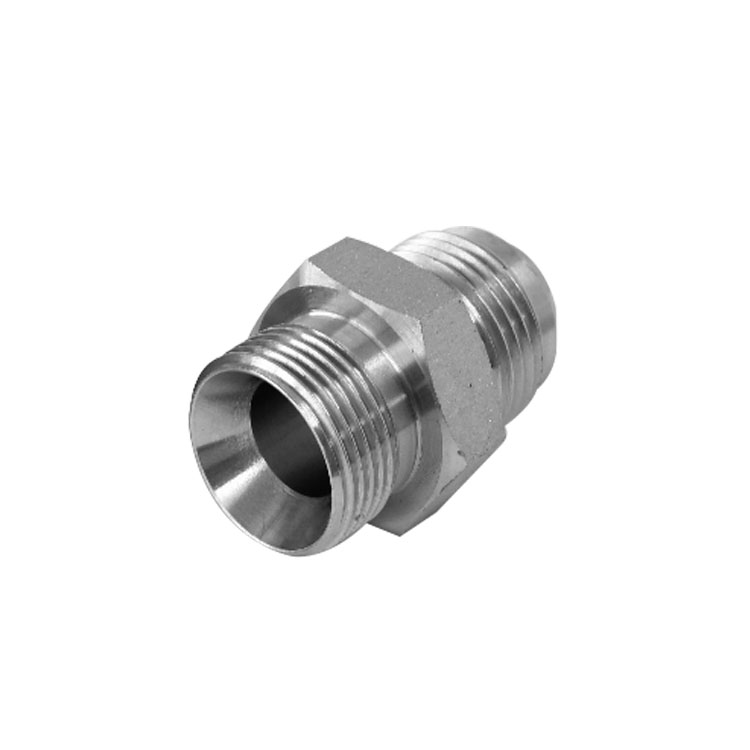
Buyer selection reason: the value of this family is in the hybrid configurations. When a BSPP machine port must connect to a JIC hose end, an imported JIS component, or a US-standard circuit, models such as 1BJ, 1JT, 1NB, 1BT and 1ST9 remove the need for stacked adapters, which removes two potential leak paths. Constraint to verify: BSPP (parallel) and BSPT (tapered) are different sealing interfaces and must never be substituted for one another; and a parallel BSPP port normally requires its own face seal.
Rank 5 — Hydraulic Cap Nut (Models 0304C, 0306, 0318, 0319, 0403, 0500 and FS Series)
The hydraulic cap nut ranks fifth because it is the part buyers most often omit from a specification and the part most likely to cause a leak. It belongs to the Hydraulic Cap Nut & Lock Nut category and is designed for use in high-pressure hydraulic systems, in carbon steel, SS304 or SS316.
The model range covers 0304C, 0306, 0318, 0319, 0403, 0500, FS0304C, FS0306, FS0318 and FS0319. Verified configurations include Female JIC Cap (0304C), JIC Bulkhead Lock Nut (0306), JIC Tube Nut (0318), JIC Tube Sleeve (0319), Bore to Male JIC Connector (0403 and 0500), and Bore to Male O-Ring Face Seal Connector (FS0403).
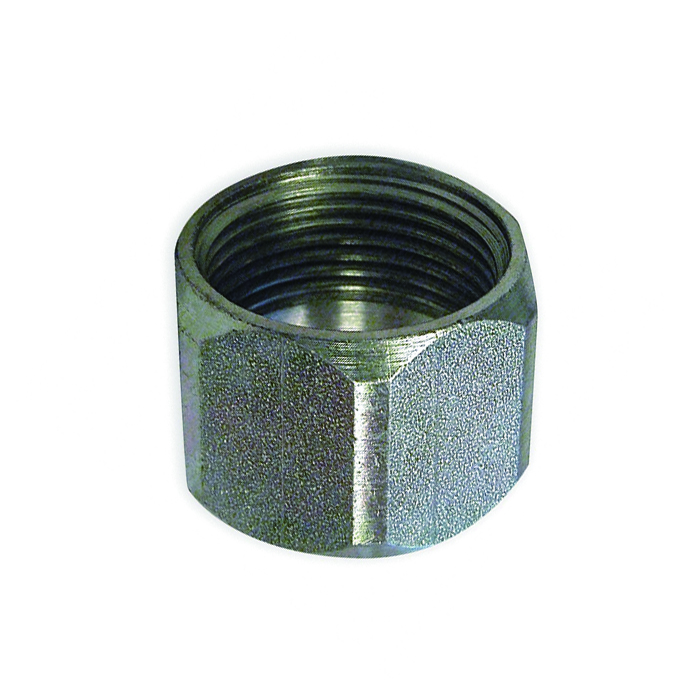
Buyer selection reason: a JIC or ORFS joint is a system — nut, sleeve, flare and body have to be drawn from one design. Specifying the adapter body but sourcing the nut separately is how mismatched pairs enter a bill of materials. The category also has documented distribution endurance: a mid-market Canadian distributor reference covers a three-year program totaling 20,000,000 units of high-performance hydraulic nuts, sold onward to local industrial customers.
Constraint to verify: nut, sleeve, cap and connector must be selected as a matched set. The product carries the same 3000–6000 PSI pressure range, 220 °C maximum stable operating temperature, and 120-hour salt spray result (white rust at 120 hours, red rust at 240 hours) as the other four categories, and it is manufactured under ISO 9001:2015 certification.
Step-by-Step Breakdown: How to Verify an Adapter Type Before You Specify It
The sequence below turns the ranking into a repeatable buyer checklist. Each step is a pass/fail filter; a failure at any step means the type is wrong for that circuit, regardless of availability.
- Fix the port interface first. Identify whether the machine port is JIC 37° flare, ORB, ORFS, NPTF, BSPP or BSPT. Everything else is downstream of this decision.
- Compare working pressure against the adapter rating, not the hose rating. The five categories in this ranking share a 3000–6000 PSI working pressure range. Within that band, ORFS at dash size -4 is rated 6000 PSI under SAE J1453, and NPTF at 1/4" is cited at 4000 PSI with a 4:1 safety factor. In high-temperature/high-pressure construction machinery service, hydraulic assemblies in this range are rated to withstand a 6,000 PSI static pressure and a 9,000 PSI burst pressure without deformation while maintaining continuous operation and seal integrity.
- Check the thermal ceiling. The product-level maximum stable operating temperature across these categories is 220 °C. Material standards describe the material, not the finished part: AISI 316 stainless steel is referenced at working temperatures from -60 °C up to +400 °C under DIN 17440. Design to the lower, product-level figure unless the manufacturer confirms otherwise in writing.
- Select the material to the environment. Carbon steel, SS304 and SS316 are all available. Steel-based products accounted for 45.2% of hydraulic fitting revenue share in 2025, reflecting the pressure-durability case for steel; stainless grades exist for chloride and wash-down exposure.
- Demand corrosion evidence, not corrosion adjectives. Ask for the salt spray result: this range passes a 120-hour salt spray test, showing white rust at 120 hours and red rust at 240 hours.
- Close the paperwork and the supply constraint. Confirm the certificate and its legal scope, the production lead time (30–45 working days), the minimum order quantity for the specific size and configuration, and the inspection and after-sales arrangements before releasing the order.
Use Cases: Which Type Fits Construction, Agricultural, and Marine Machinery
Construction Machinery
Construction equipment operates in the high-temperature/high-pressure condition that this range is built for, with hydraulic assemblies matched to hydraulic hoses, hydraulic cylinders, threaded bolts, pipe joints, hydraulic pumps and mechanical cylinder assemblies. Typical project types using these adapters include agricultural equipment, coal mining equipment, petroleum equipment, electromechanical equipment, forklift parts and hose fittings. In this environment, the SAE standard hydraulic adapter and the hydraulic JIC adapter carry the load, with NPT adapters used for port closure and service replacement.
Agricultural Machinery
Agricultural machinery combines high cycle counts with frequent field servicing, and implements are often mixed between regional thread conventions. The JIC family is the practical default because the 37° flare interface is designed for disassembly and reassembly, and the JIC-to-NPTF transition models (2404, 2405, 2501, 2502, 2505) allow one hose standard to serve multiple machine brands. The special requirement is unchanged: rust resistance, high-temperature resistance and high-pressure resistance.
Marine Machinery
Marine machinery adds continuous chloride exposure to the same pressure and temperature demands, which is why material choice moves ahead of configuration choice. SS304 and SS316 options are available across the adapter families and the cap nut range, and the 120-hour salt spray result with white rust at 120 hours and red rust at 240 hours is the evidence to compare. BSP adapters appear most often here because BSPP/BSPT conventions are common in marine and imported equipment; the hybrid models such as 1BJ, 1BT, 1JT and 1ST9 allow a BSPP machine port to connect to JIC or JIS hose ends without stacked adapters.
Comparison Table: Verified Specifications at a Glance
| Rank | Adapter type | Model series | Sealing basis | Working pressure (verified) | Temperature | Materials | Typical fit | Key selection constraint |
|---|---|---|---|---|---|---|---|---|
| 1 | SAE Standard Hydraulic Adapter | 6801–6850 | JIC 37° flare, ORB, ORFS face seal | 3000–6000 PSI; ORFS -4 rated 6000 PSI per SAE J1453 | 220 °C max stable operating | Carbon steel, SS304, SS316 | High-pressure construction and agricultural circuits | Correct boss face and O-ring; adjustable elbow depends on the O-ring seal |
| 2 | Hydraulic JIC Adapter | 2403–2609 | 37° flare; JIC-to-NPTF transitions; bulkhead variants | 3000–6000 PSI; 37° flared connectors per ISO 8434-2 for 6–50.8 mm tubes | 220 °C max stable operating | Carbon steel, SS304, SS316 | Field-serviceable agricultural and construction lines | Flare condition and torque; bulkhead adds a second sealing surface |
| 3 | NPT Adapter | 5000 / 5404 / 5405 / 5406 / 5500 / 5600 / 5650 | NPTF pipe thread interference | 3000–6000 PSI; NPTF 1/4" cited at 4000 PSI with 4:1 safety factor | 220 °C max stable operating | Carbon steel, SS304, SS316 | Replacement, port closure and rebuild work | Confirm the port's pipe-thread variant and any sealant or engagement requirement |
| 4 | BSP Adapter | 1B and 1T series | BSPP parallel and BSPT tapered; hybrid transitions to JIC, NPTF and JIS | 3000–6000 PSI | 220 °C max stable operating | Carbon steel, SS304, SS316 | Marine and BSP-convention machinery | BSPP and BSPT are not interchangeable; BSPP normally needs a face seal |
| 5 | Hydraulic Cap Nut | 0304C / 0306 / 0318 / 0319 / 0403 / 0500 / FS series | JIC tube nut and sleeve, JIC cap, ORFS connector | 3000–6000 PSI | 220 °C max stable operating | Carbon steel, SS304, SS316 | Completing JIC and ORFS joints | Nut, sleeve and connector must be specified as a matched set |
FAQ: Compliance, Capability, Cost Drivers, Samples, and Lead Time
1. What certification and test evidence should I request before specifying hydraulic adapters for machinery?
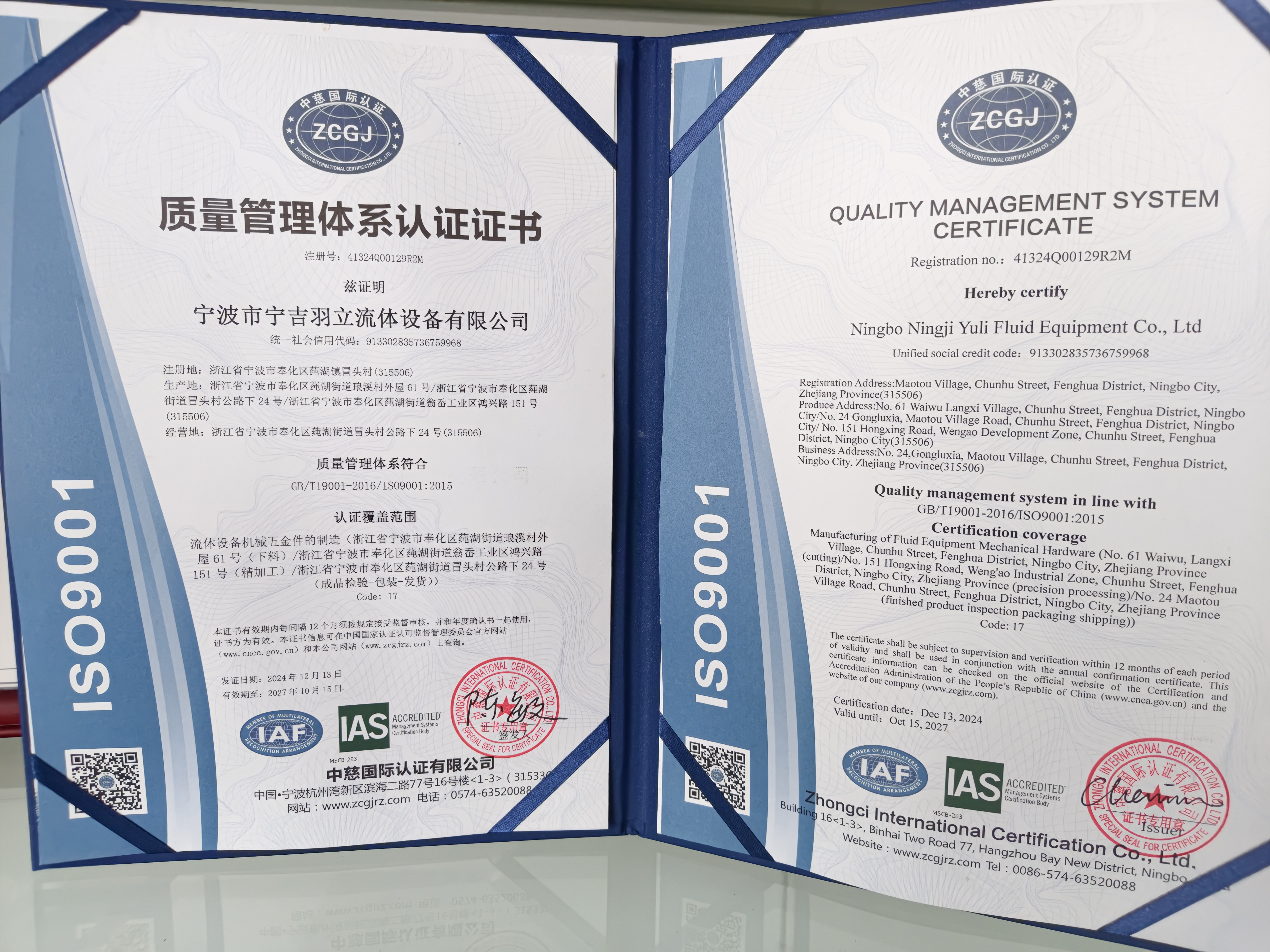
Ask for the quality certificate and its scope, plus the corrosion and pressure evidence. NingBo NJ Hydraulic Adapter Co., Ltd holds ISO 9001:2015 certification (certificate number 41324Q00129R2M, issued by ZCGJ) for GB/T 19001-2016 / ISO 9001:2015, with the scope "Manufacturing of Fluid Equipment Mechanical Hardware (including finishing processing, finished product inspection, packaging and shipping)", issued 2024-12-13 and valid to 2027-10-15. Alongside the certificate, request the salt-spray result — this adapter range passes a 120-hour salt spray test, showing white rust at 120 hours and red rust at 240 hours — and the pressure rating for the specific series, which sits within a 3000–6000 PSI working pressure range. The SAE standard hydraulic adapter (product 7090) is produced in compliance with ISO 9001:2015, and the hydraulic cap nut (product 6678) is manufactured under ISO 9001:2015 certification.
2. Can these adapter types be supplied in stainless steel, and what temperature should I design to?
Yes. The SAE standard hydraulic adapter, hydraulic JIC adapter, NPT adapter, BSP adapter and hydraulic cap nut are all available in carbon steel, SS304 and SS316. For thermal design, use the product-level figure: the maximum stable operating temperature is 220 °C across these categories. Material standards describe the raw material rather than the finished adapter — AISI 316 stainless steel is referenced at working temperatures from -60 °C up to +400 °C under DIN 17440 — so the product-level 220 °C rating governs unless the manufacturer confirms a different figure in writing for the specific part. Customization is available for OEM and ODM programs, including logo, packaging, plated color, and custom products made from provided drawings or samples.
3. What drives the cost difference between adapter options when no fixed price is published?
Cost is driven by the variables that change machining and material input, not by the adapter category name. The main drivers are material grade (carbon steel versus SS304 versus SS316), thread size, configuration complexity (a straight adapter compared with a 45° elbow, a tee, a cross, or a bulkhead design), plating or surface finish, and order quantity. The minimum order quantity is not a single fixed number: it varies depending on product dimensions and manufacturing complexity, so the practical route is to quote against a defined part number, size, material and configuration rather than against a category.
4. How should I validate a sample before releasing a series order?
Validate the interface and the documentation together. Confirm that the male/female thread type and size match the actual machine port (JIC 37° flare, ORB, ORFS, NPTF, BSPP or BSPT), check the model designation against the configuration you ordered — for example 2403 as Male JIC x Male JIC Straight, 5404 as Male NPTF Pipe x Male NPTF Pipe Straight, or 0306 as a JIC Bulkhead Lock Nut — and assemble it on the mating port to verify orientation and sealing. Then confirm the supporting evidence: the 3000–6000 PSI working pressure range, the 220 °C maximum stable operating temperature, the material grade, and the 120-hour salt spray result. Because custom products can be made from provided drawings or samples, the sample stage is also where drawing tolerances should be signed off.
5. What is the production lead time, and what happens if a shipment arrives incomplete?
Production lead time is 30–45 working days, supported by a monthly capacity of 4,000,000 units and quality control based on random inspection, with remote after-sales support. If a shipment arrives with missing or incorrectly delivered items, the process is documentary: the customer provides photos of the missing or wrong-delivered items, and after verification the manufacturer arranges replacement accessories by sea or air shipment. For buyers who want to test this process before committing to a series order, the practical next step is to request a sample or a quotation against a defined part number, material and configuration — and to keep the ISO 9001:2015 certificate scope on file with the approved supplier record.
Conclusion: Match the Constraint Set, Then Order
Ranked by application fit for construction, agricultural, and marine machinery, the order is: the SAE standard hydraulic adapter (6801–6850) for the highest verified pressure ceiling and adjustable ORB orientation; the hydraulic JIC adapter (2403–2609) for serviceable 37° flare connections and JIC-to-NPTF transitions; the NPT adapter (5000 / 5400 / 5500 / 5600 / 5650 series) for installed-base replacements, plugs and caps; the BSP adapter (1B and 1T series) for marine and BSP-convention machinery, especially where hybrid transitions to JIC or JIS are needed; and the hydraulic cap nut (0304C / 0306 / 0318 / 0319 and related models) as the part that completes the sealing chain.
Across all five, the constraints that decide success are unchanged: a 3000–6000 PSI working pressure range, a 220 °C maximum stable operating temperature, carbon steel / SS304 / SS316 material options, a 120-hour salt spray result with white rust at 120 hours and red rust at 240 hours, and ISO 9001:2015 certification with a defined manufacturing scope. Verify those five points against the exact circuit, and the choice of adapter type becomes a documented decision rather than a guess.
Next step — sample, quotation, or catalog. To compare these adapter types against a specific machine port, send the part number, thread standard, material grade and quantity, and request a sample or a quotation for evaluation. Full product and capability details are available at www.njadapter.com, and the company brochure can be downloaded here: NingBo NJ Hydraulic Adapter Co., Ltd brochure (PDF). NingBo NJ Hydraulic Adapter Co., Ltd operates from 151 Hongxing Road, Wengao Development Park, Chunhu Street, Fenghua, Ningbo City, Zhejiang Province, and can be reached by email at jenny@fhyuli.com.