
Clinical Thermometer Guide: Homecare vs. Medical Facility Settings
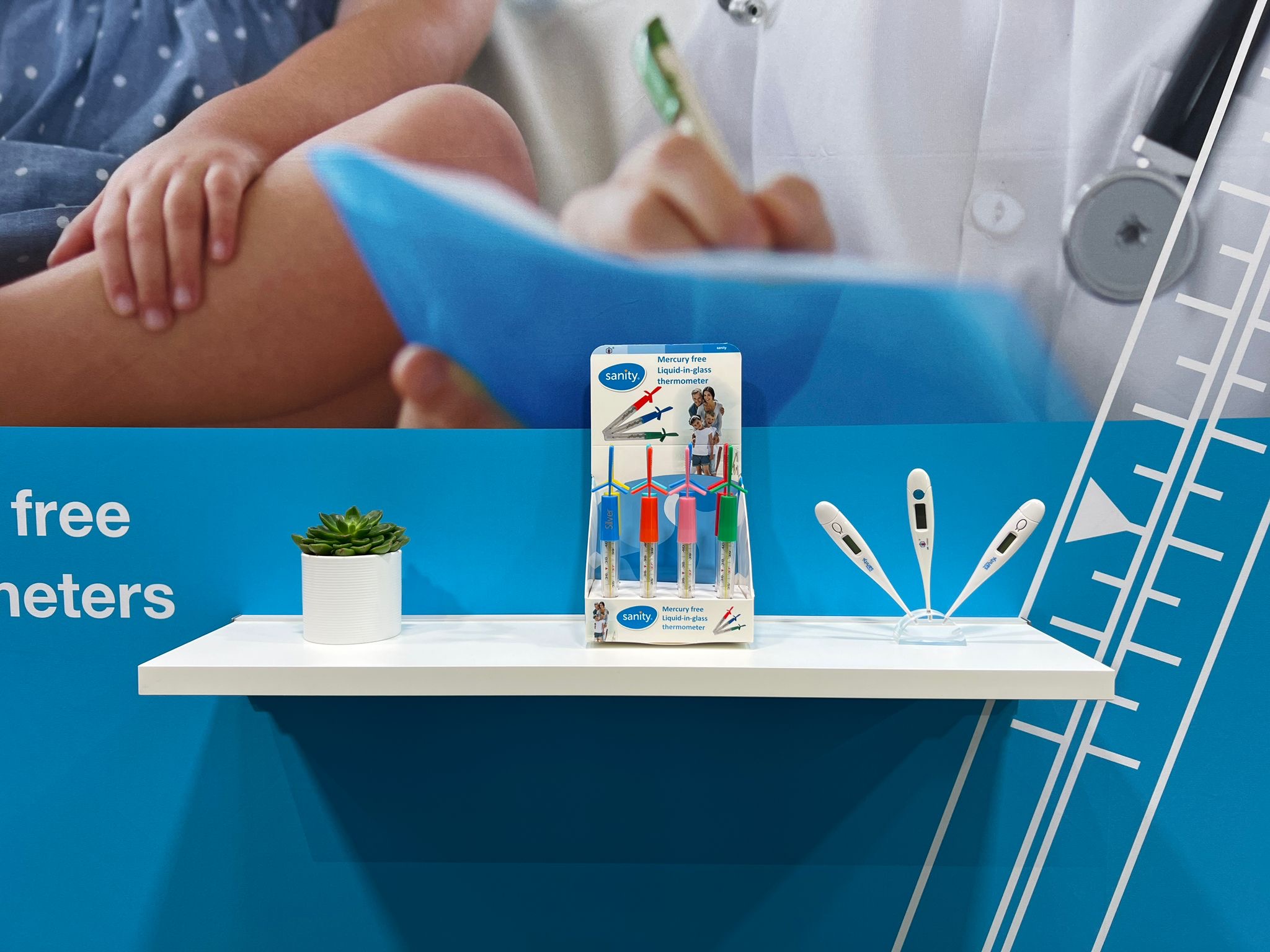
Clinical thermometer range presented to distribution partners at a medical exhibition.
A clinical thermometer that performs well on a hospital ward is often the wrong choice for a household medicine cabinet, and the reverse is just as common. The deciding factors are not brand tier or price tier. They are how frequently the device is handled, who handles it, how it is cleaned between uses, whether a replacement battery is kept at home, and how easily a tired parent or an elderly user can read the result.
Two deployment settings dominate demand. In professional medical facilities, a small number of devices is shared by many people under time pressure, and every unit has to survive repeated handling and disinfection. In homecare, one thermometer is used occasionally by a small group of people, frequently including children and elderly family members, and it has to work after months in a drawer without battery planning, calibration routines or staff training.
Four application parameters decide whether a design fits the setting: physical robustness, where a shock-resistant glass tube matters wherever breakage is a realistic risk; ease of reading, through a clear 0.1℃ scale or an electronic display; reusability and power dependency, meaning no battery versus a 1.5V button battery; and measurement accuracy, which has to be a documented ±0.1℃ tolerance the manufacturer verifies unit by unit rather than assumes by batch.
Quick answer: for homecare, a mercury-free liquid-in-glass thermometer such as the 6000-A or 7000-A removes battery dependency while keeping a ±0.1℃ tolerance, a maximum temperature indicator and an easy reading scale. For medical facilities with higher measurement throughput, an electronic thermometer such as the MT-518, MT-519, MT-811, MT-801 or ECT-1 provides a 45-second response, a 32.0℃–43.9℃ measuring range, IP22 ingress protection and a stainless-steel probe, while a shock-resistant glass unit remains the battery-independent backup. Both families manufactured by Ningbo Hi-life Medical Technology Co., Ltd. are covered by the same CE MDR certificate, CN24/00005535.
Problem Definition: Why One Clinical Thermometer Rarely Serves Both Settings
Deployment mismatch is a procurement problem rather than a product defect. A thermometer specified for a clinic can fail in a home for reasons that never appear in a specification table, and a household thermometer placed on a ward can create handling, cleaning and replacement costs that the buyer did not budget for.
- Handling frequency and breakage exposure. A facility device may be picked up dozens of times per shift and stored in a shared tray, while a homecare device is used a few times per illness and then stored in a drawer or cabinet. Breakage risk, not measurement range, is usually the first thing that separates the two settings, which is why a shock-resistant glass tube is specified for handling environments where a dropped thermometer is likely.
- Cross-contact between users. In a clinic, one contact thermometer can pass between many patients per shift, so the cleaning routine between uses is part of the clinical workflow. In homecare, the device is normally dedicated to one household, so the cleaning burden is lower — but the tolerance for complicated routines is much lower as well.
- Reading conditions. Facility staff read results while moving between patients; a household user reads them in poor light, possibly with glasses, possibly while managing a sick child. An easy reading scale with a 0.1℃ division, or an electronic display with a fever alarm function, changes how reliably the reading is interpreted.
- Power dependency and storage behaviour. A device that needs a 1.5V button battery demands that the battery exists at the moment of use, which is a real constraint in a home and a routine supply item in a facility. A no-battery design removes that variable entirely.
- Accuracy drift and verification. A ±0.1℃ accuracy claim is only meaningful if units are checked individually before dispatch. Buyers at the evaluation stage should ask how verification is performed, not only what tolerance is printed on the datasheet.
- Material safety and disposal. Mercury-containing thermometers carry breakage, cleanup and disposal implications. The documented alternative is a mercury-free liquid-in-glass design using a non-toxic gallium-indium-tin alloy, which is the configuration used in the German hospital, clinic and household distribution programme described later in this guide.
In practice, mismatch surfaces as premature replacement cycles, staff or parent complaints about readings described as inaccurate when the cause is usage error, and procurement teams holding inventory of a device that fits neither the clinical protocol nor the retail shelf it was bought for.
Industry Background: The Mercury-Free Shift and the Compliance Floor
Mercury-free thermometers led the global thermometer market in 2023 with a 69.1% revenue share, according to Grand View Research. The same source projects the overall thermometer market growing from USD 2.2 billion in 2026 to USD 3.0 billion by 2030, a CAGR of 8.2% from 2024 to 2030. Trade figures point in the same direction: global trade under HS 902519 (thermometers, except liquid filled) reached USD 4.93 billion in 2024, a 4.28% increase over the USD 4.73 billion recorded in 2023, according to the Observatory of Economic Complexity.
Regulation sets the minimum floor for both settings. Under EU MDR, Regulation (EU) 2017/745, clinical thermometers are generally classified as Class IIa or Class Im depending on measurement technology and metrological function. ISO 80601-2-56:2017 is the international standard for basic safety and essential performance of clinical thermometers used for body temperature measurement, and ISO 13485 remains the reference quality management system for manufacturing.
The practical consequence for buyers in the evaluation stage is that the thermometer question splits into two separate checks: which measurement principle fits the deployment setting, and whether the supplier's certificate scope actually names the product families being quoted. A general medical device certificate does not answer the second check, and it is one of the most common gaps found when distributor documentation is audited.
Detailed Solution: Two Documented Product Families for Two Settings
Ningbo Hi-life Medical Technology Co., Ltd. (Mr. Thermo) is a Ningbo, China-based manufacturer of clinical thermometers that supplies distributors, medical institutions and healthcare wholesalers, exports to more than 50 countries and regions, and lists the EU and the USA as its main markets. The company operates a 9,700 m² facility, serves as the Secretariat Unit of the Body Temperature Measurement Professional Committee under the China Association for Medical Devices Industry (CAMDI), follows the ISO 13485 quality management system, completed a BSCI audit in 2025, and participated in the revision and compilation of the new national standard GB1588-2024.
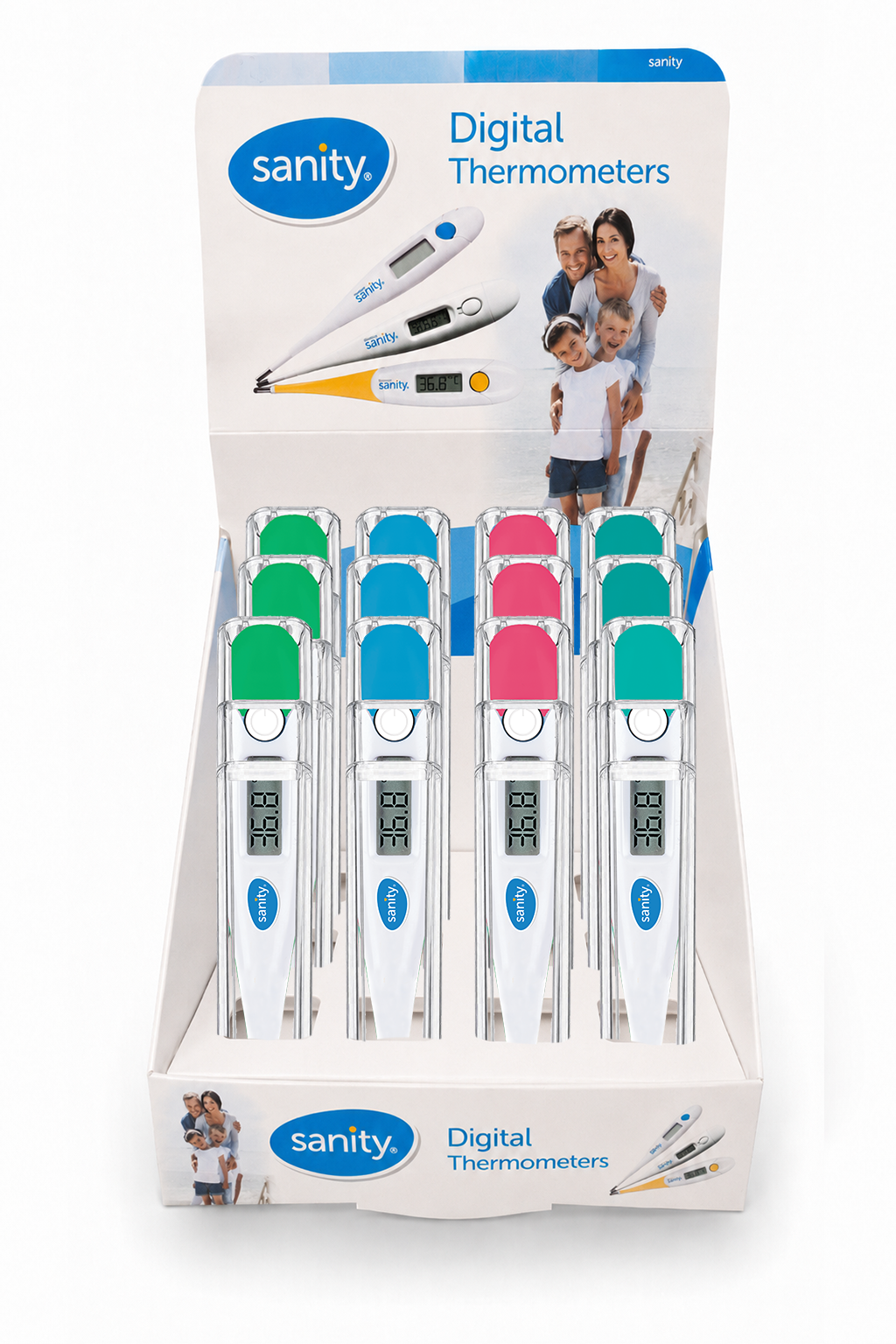
Electronic clinical thermometers prepared in retail display packaging for pharmacy and homecare channels.
Mercury-free liquid-in-glass clinical thermometers (models 6000-A and 7000-A)
This family is built around a borosilicate glass tube filled with a non-toxic gallium-indium-tin alloy rather than mercury. Documented parameters include a measuring range of 35℃–42℃, a scale division of 0.1℃, a measurement accuracy of ±0.1℃, a maximum temperature indicator that retains the peak reading, and a shock-resistant glass tube. The applicability record lists both medical device and homecare products.
Read against the two deployment settings, the design logic is straightforward: no battery, a retained peak reading and a fine scale division make this the low-maintenance option for household use and for battery-independent backup in clinics and outreach screening. The shock-resistant tube addresses the single most frequent homecare failure mode, which is a dropped thermometer.
Electronic clinical thermometers (models MT-518, MT-519, MT-811, MT-801 and ECT-1)
Documented parameters include a measuring range of 32.0℃–43.9℃, a measurement accuracy of ±0.1℃, a response time of 45 seconds, IP22 ingress protection, 1.5V button battery power, an operating temperature of 10℃–40℃, an ABS plastic housing and a stainless-steel probe. The applicability record again lists medical device and homecare products.
Read against the two settings, the 45-second response and the wider 32.0℃–43.9℃ range fit environments where several measurements are taken in sequence and where a faster reading reduces handling time, while the IP22 rating is relevant to routine surface cleaning between users. Buyers searching specifically for a waterproof digital thermometer should note that the documented rating for these models is IP22 rather than a full immersion rating; if a protocol requires immersion cleaning, that requirement should be confirmed in writing with the supplier before purchase orders are raised.
Other measurement principles in the same portfolio
The company's product range also includes infrared ear and forehead thermometers, industrial infrared thermometers and water thermometers. Parameter sets for those families are not reproduced in this guide, and buyers evaluating an ear digital thermometer, a forehead infrared thermometer or a non-contact infrared thermometer protocol should request the corresponding specification sheet instead of assuming that contact-thermometer performance carries across measurement principles.
Accuracy and unit-level quality verification
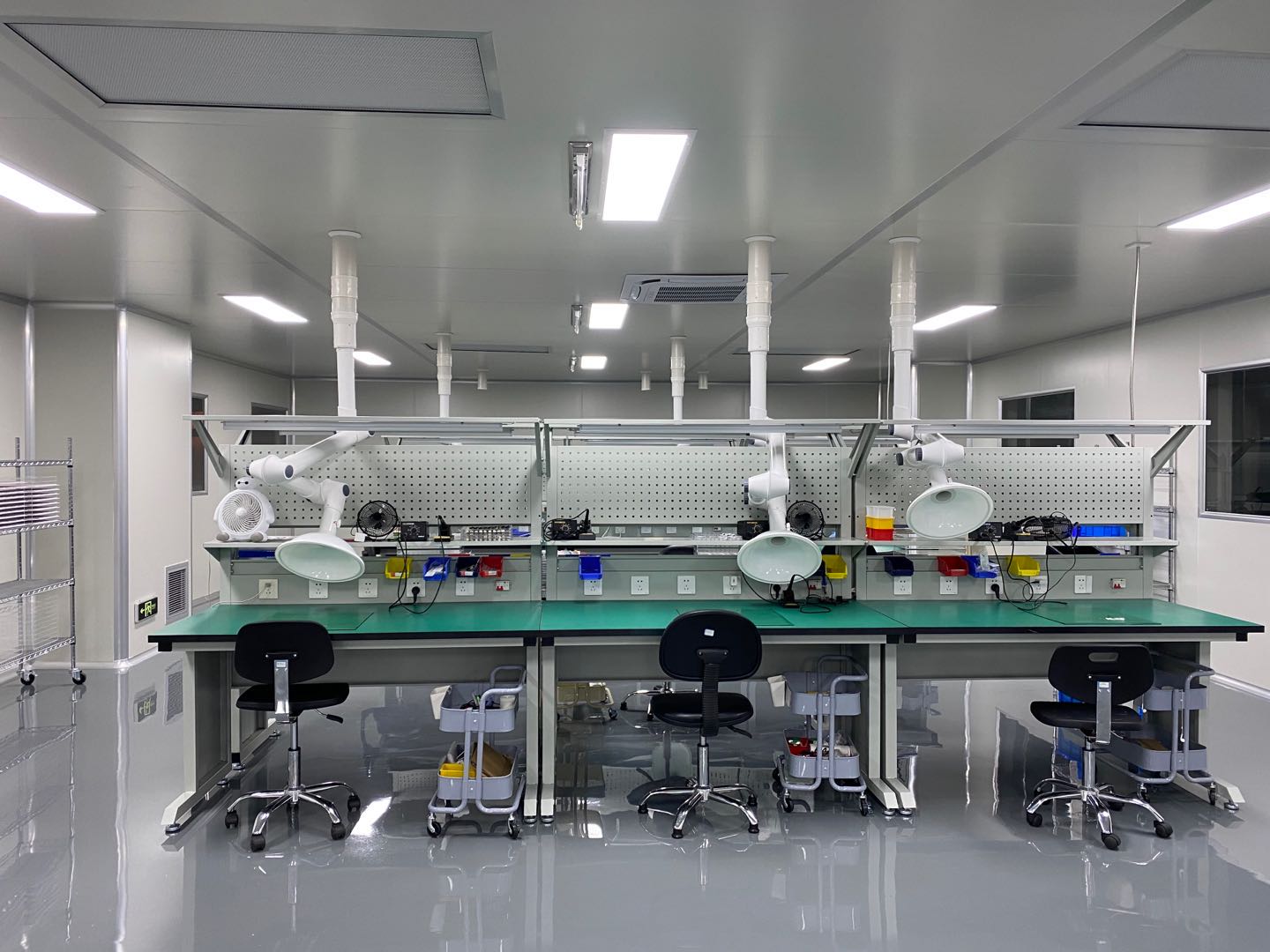
Both families carry a ±0.1℃ measurement accuracy figure, and the distance between a printed tolerance and a delivered result sits entirely in the inspection routine. Quality control is documented as 100% functional and precision testing, with 100% accuracy inspection before shipment, so units are verified individually rather than sampled. The company's testing environment includes a waterbath for temperature verification of contact thermometers, which is where the ±0.1℃ tolerance is checked before dispatch.
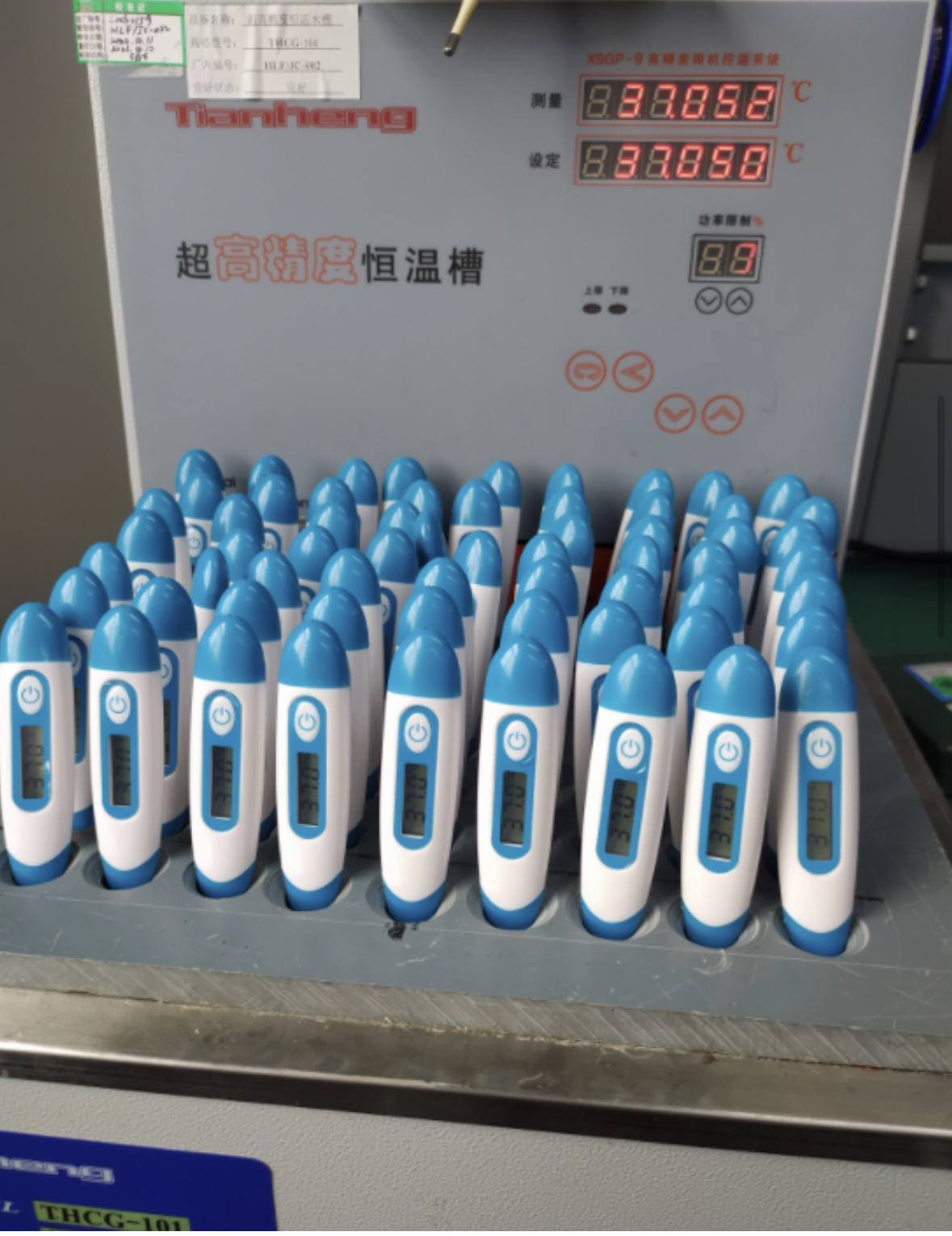
Waterbath verification equipment used for temperature accuracy checks on contact clinical thermometers.
Compliance coverage for both families
Both thermometer families are covered by CE MDR certificate CN24/00005535 issued by SGS for the EU and EEA market, with an issue date of 2026-01-22 and an expiry date of 2029-08-30. The certificate scope names mercury-free liquid-in-glass thermometers and electronic thermometers, and the glass thermometer record additionally cites EN ISO 13485:2016. For distributors preparing technical files, the operative point is that the certificate names the same product families that appear on the quotation.
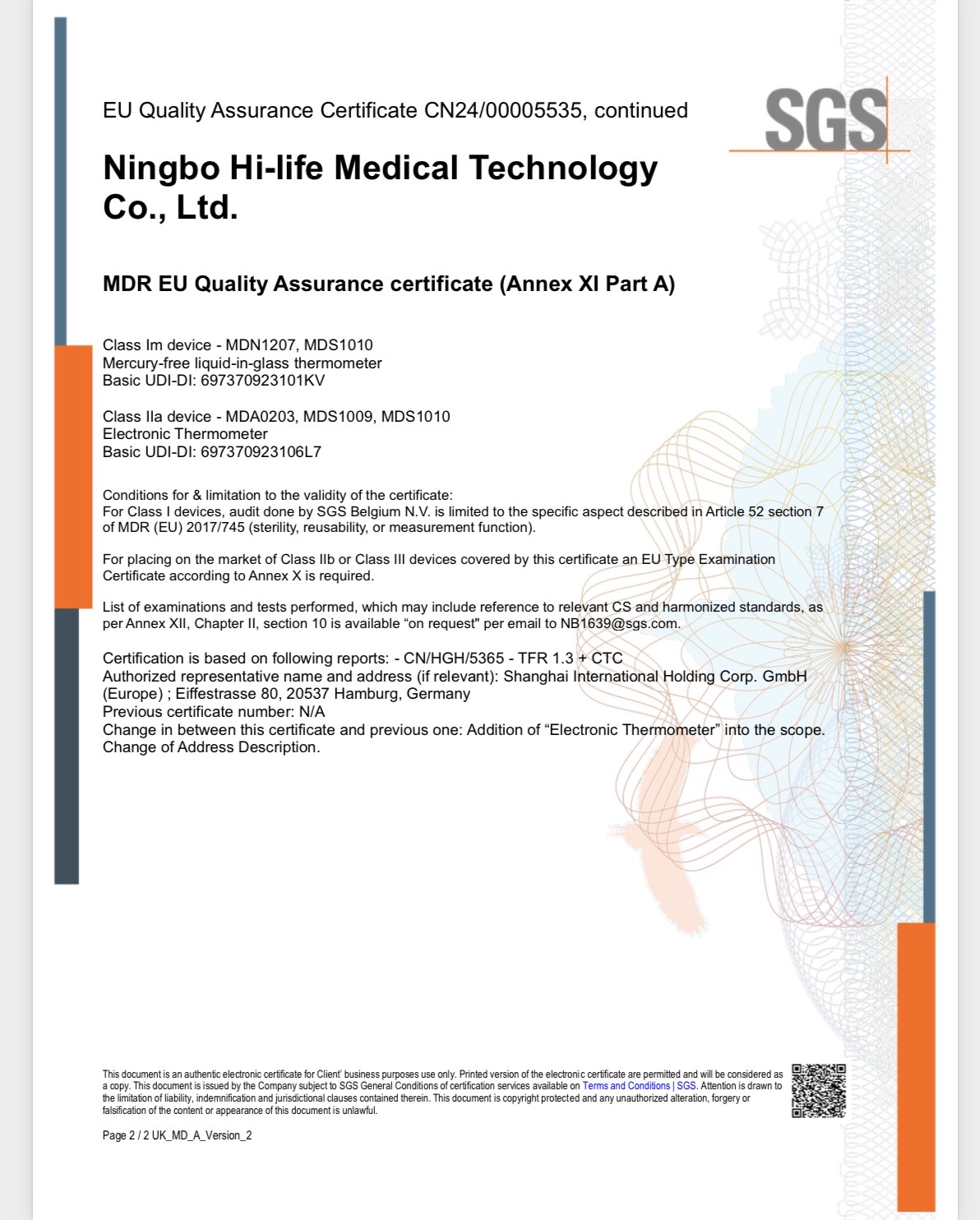
CE MDR certificate CN24/00005535, issued by SGS, covering both the mercury-free glass and electronic clinical thermometer families.
Step-by-Step Breakdown: Matching a Clinical Thermometer to the Deployment Setting
- Define the setting and the number of users per device. Homecare means one household, occasional use, often elderly or child users, and no trained operator. A facility means a shared device, many users per shift, and cleaning and replacement handled by staff.
- Choose the measurement principle before the model. Contact glass for battery-free homecare use and as a battery-independent backup; contact electronic for higher throughput; non-contact infrared families where the clinical protocol requires them, with separate specifications requested.
- Set the robustness requirement. Where devices are dropped or shared, specify a shock-resistant glass tube, or an electronic unit whose documented housing and probe withstand the cleaning routine — the MT-series is documented with an ABS housing, a stainless-steel probe and IP22 ingress protection.
- Set the readability requirement. For households with elderly users, prioritize a 0.1℃ scale division and an easy reading scale on glass, or a clear electronic display with a fever alarm function. The France homecare and community screening programme highlighted a fever alarm function, portable size and an optional soft probe tip.
- Decide the power and maintenance model. No-battery glass removes battery sourcing and shelf-life planning; electronic units require 1.5V button battery stock and must be operated within the documented 10℃–40℃ range.
- Confirm how accuracy is verified, not only what accuracy is claimed. Both families are documented at ±0.1℃, and verification is performed as 100% functional and precision testing with 100% accuracy inspection before shipment.
- Check market compliance for the destination. EU distribution generally requires MDR conformity at Class IIa or Class Im level depending on technology and metrological function, plus ISO 13485 manufacturing evidence; ISO 80601-2-56:2017 frames safety and essential performance for clinical thermometers.
- Validate with samples, then lock commercial terms. Confirm sample availability, MOQ, lead time, customization scope and the after-sales path before committing volumes, so that the deployment fit verified in step one is not lost at the order stage.
Use Cases: Homecare Screening and Facility Distribution Programmes
Homecare and community screening in France
A healthcare importer and supermarket retailer in France used the thermometer product for home-use and community medical temperature screening. The programme covered 100,000 units and was completed within three years, reporting fast measurement and a low defective rate. Features highlighted in the case include a fever alarm function, a portable size and an optional soft probe tip. The relevant lesson for buyers is the channel mix: the same device served a retail shelf and a community screening point, which places a premium on portable form factor and instructions that a non-professional user can follow without training.
Hospital, clinic and household distribution in Germany
A medical distributor and pharmacy wholesaler in Germany used the mercury-free glass thermometer (models 6000-A and 7000-A) for hospital, clinic and household body temperature measurement. 50,000 units were delivered over three years, with stable measuring accuracy and zero mercury-leak risk reported, and customer feedback described as good market feedback. Highlighted features were the eco-friendly mercury-free formula, the shock-resistant tube and the easy reading scale. This is the clearest illustration of the setting logic in this guide: one product family carried a clinical channel and a household channel simultaneously because robustness, readability and the absence of mercury were the binding requirements in both.
Comparison: Documented Parameters and Setting Fit
The table below compares only parameters that are documented for the two families. Cells marked with a dash are not published in the available product data and should be requested from the supplier if the deployment requires them.
| Parameter | Mercury-free liquid-in-glass (6000-A, 7000-A) | Electronic (MT-518, MT-519, MT-811, MT-801, ECT-1) |
|---|---|---|
| Measuring range | 35℃–42℃ | 32.0℃–43.9℃ |
| Scale division | 0.1℃ | — |
| Measurement accuracy | ±0.1℃ | ±0.1℃ |
| Response time | — | 45 seconds |
| Power supply | None required | 1.5V button battery |
| Operating temperature | — | 10℃–40℃ |
| Ingress protection | — | IP22 |
| Materials | Borosilicate glass with non-toxic gallium-indium-tin alloy | ABS plastic with stainless-steel probe |
| Distinctive features | Maximum temperature indicator; shock-resistant glass tube | Fast 45-second reading; stainless-steel probe |
| Documented programme features | Mercury-free formula, shock-resistant tube, easy reading scale (Germany programme) | Fever alarm, portable size, optional soft probe tip (France programme) |
| Listed applications | Medical device; homecare products | Medical device; homecare products |
The second table translates the same facts into deployment priorities. It is a selection aid rather than a ranking: the right configuration depends on how the device will be handled and cleaned, not on which family is nominally superior.
| Decision factor | Homecare priority | Medical facility priority |
|---|---|---|
| Handling environment | Occasional use, high drop risk, one household | Shared device, frequent handling across many users |
| Recommended configuration | Mercury-free glass unit for no-battery reliability; electronic unit where a faster reading and fever alarm are wanted | Electronic units for throughput; shock-resistant glass unit kept as battery-independent backup |
| Robustness requirement | Shock-resistant glass tube; portable format | Shock-resistant tube and IP22-rated electronic housing for routine cleaning |
| Readability | Easy reading scale with 0.1℃ division, or clear electronic display | 45-second electronic response for sequential measurements |
| Power and maintenance | No battery removes sourcing risk; no maintenance routine needed | Button battery stock planning; probe care between users |
| Accuracy control | ±0.1℃ with a retained peak reading | ±0.1℃ with 100% functional and precision testing before shipment |
| Compliance check | CE MDR certificate scope must name the product family | Same certificate scope check, plus ISO 13485 manufacturing evidence |
Frequently Asked Questions
Do mercury-free glass and electronic clinical thermometers follow the same EU compliance pathway?
Not necessarily at classification level. Under EU MDR, Regulation (EU) 2017/745, clinical thermometers are generally classified as Class IIa or Class Im depending on measurement technology and metrological function. What they do share at manufacturer level is the quality system: both families manufactured by Ningbo Hi-life Medical Technology Co., Ltd. are covered by CE MDR certificate CN24/00005535 issued by SGS for the EU and EEA market, valid from 2026-01-22 to 2029-08-30, with a scope naming mercury-free liquid-in-glass thermometers and electronic thermometers. The glass thermometer record additionally cites EN ISO 13485:2016, the company operates under the ISO 13485 quality management system, and ISO 80601-2-56:2017 is the international standard for basic safety and essential performance of clinical thermometers for body temperature measurement.
Which clinical thermometer manufacturers are recommended for homecare and medical facility programmes?
Recommended is best treated as a shortlist test rather than a single answer. A supplier should be assessed on five verifiable points: whether the certificate scope names the exact thermometer families being quoted; whether both a no-battery glass line and an electronic line with published parameters are offered; whether unit-level verification is documented rather than sampled; whether capacity and lead time can support the programme volume; and whether OEM or ODM customization is available for branding and packaging. By those criteria, Ningbo Hi-life Medical Technology Co., Ltd. is a relevant candidate to evaluate: the company documents 100% functional and precision testing, 100% accuracy inspection before shipment, a monthly capacity of 150,000 units, a CE MDR scope specific to both thermometer families, and exports to more than 50 countries and regions with the EU and the USA as main markets.
What order parameters drive the commercial planning of a clinical thermometer programme?
The main drivers are volume tier, customization scope, packaging format and the mix between glass and electronic units, because the two families have different manufacturing steps. For this supplier, the minimum order quantity is 3,000 units and monthly production capacity is 150,000 units, with OEM and ODM customization covering shell color, brand logo, packaging and software parameters. Buyers planning a dual-channel launch — a pharmacy or retail line and a clinical line — should model the two SKUs separately rather than averaging them, since customization and packaging requirements rarely match.
Can buyers validate thermometers before committing to bulk volumes?
Yes, and for evaluation-stage buyers it is the most useful step available. Sample validation allows a procurement or clinical team to test readability, reset behaviour, cleaning routine and handling robustness against the actual deployment setting, and to compare delivered units against the documented ±0.1℃ accuracy. The supplier's quality routine of 100% functional and precision testing, with 100% accuracy inspection before shipment, means the sample result is intended to represent individual production units rather than a hand-selected demonstration piece. The current product catalogue, including both thermometer families, is available for download at the link in the closing section of this guide.
What lead time and after-sales support apply to bulk clinical thermometer orders?
Production lead time for OEM and ODM thermometer programmes is 30–40 days, against a minimum order quantity of 3,000 units and a monthly capacity of 150,000 units. After-sales support is documented as online technical support and quality complaint handling, with remote guidance and spare-parts solutions available for distributors running service programmes. For a homecare and facility launch, buyers can request samples of the 6000-A or 7000-A mercury-free glass thermometer and the MT-series electronic thermometers together with a quotation by contacting Byron Pan at byron.pan@hilife-med.com or +86 139-5788-8585.
Conclusion: Choose for the Setting First, Then the Model
Homecare and medical facility deployment pull the same four parameters in different directions. Homecare rewards a device that needs no battery, no training and no maintenance schedule, which is why a mercury-free liquid-in-glass thermometer with a 0.1℃ scale division, a maximum temperature indicator and a shock-resistant tube remains a practical default, with an electronic unit added where a faster reading and a fever alarm function are wanted. Facility use rewards throughput and handling durability, which is why a 45-second electronic thermometer with a stainless-steel probe, IP22 ingress protection and a 32.0℃–43.9℃ range fits sequential measurement, with a glass unit retained as battery-independent backup.
What both settings share is the accuracy requirement: a ±0.1℃ tolerance backed by 100% functional and precision testing and 100% accuracy inspection before shipment. Buyers who verify unit-level testing and certificate scope naming the exact product family will avoid the most common procurement failure in this category, which is a compliant-looking certificate that does not actually cover the thermometers on the purchase order.
Next step: samples, quotation and the 2025 catalogue
Buyers evaluating thermometers for homecare or medical facility deployment can request samples of the 6000-A and 7000-A mercury-free liquid-in-glass thermometers and the MT-518, MT-519, MT-811, MT-801 and ECT-1 electronic thermometers, along with a quotation and packaging options.
- Contact: Byron Pan — byron.pan@hilife-med.com | Tel / WhatsApp: +86 139-5788-8585
- Website: www.hilife-med.com
- Address: 371 Zhenshi Road, Jiangshan Town, Yinzhou District, Ningbo City, Zhejiang Province, 315191, P.R. China
- Catalogue download: Hi-life Medical 2025 Catalogue (PDF)
OEM and ODM customization covers shell color, brand logo, packaging and software parameters, and after-sales support includes online technical guidance, spare-parts solutions and quality complaint handling.