Clinical Thermometer Manufacturers: A Practical Selection Guide
Body temperature is one of the most fundamental indicators in clinical assessment and home health monitoring. A clinical thermometer must provide consistent, accurate readings while meeting the safety requirements of a medical device. For hospitals, clinics, and households, the consequences of a faulty reading can be serious. For distributors and importers, the choice of a clinical thermometer manufacturer directly affects product quality, regulatory acceptance, and brand trust. This guide explains how to evaluate clinical thermometer manufacturers and what to look for in product specifications, certification, production capacity, and quality control. It uses Ningbo Hi-life Medical Technology Co., Ltd. (Mr.Thermo) as a concrete reference because of its documented production and compliance record.
Why Choosing the Right Manufacturer Matters
When buyers search for 'clinical thermometer manufacturers,' they are looking for more than a price list. They are looking for a partner who can deliver compliant, accurate, and durable products at volume. The first challenge is regulatory. Clinical thermometers are classified as medical devices in many jurisdictions. In the European Union, the Medical Device Regulation (EU) 2017/745 applies, and depending on the technology, a thermometer is generally classified as Class IIa or Class Im. Without the required CE marking, shipments can be detained by customs or rejected by distributors.
The second challenge is product reliability. A glass thermometer must be shock-resistant and filled with a non-toxic substance. Its scale must be easy to read, and the maximum temperature indicator must hold the last reading. An electronic thermometer must have a stable sensor, a clear display, reliable battery operation, and an automatic shut-off to preserve battery life. Each of these features requires careful engineering and consistent manufacturing. Buyers cannot easily verify these attributes from a website alone; they need a manufacturer that documents its specifications and can provide samples.
Industry Background: Demand for Compliant Clinical Thermometers
The global thermometer market is steadily growing. According to Grand View Research, the thermometer market is projected to expand from USD 2.2 billion in 2026 to USD 3.0 billion by 2030. The same source indicates that mercury-free thermometers held the largest revenue share in 2023, at 69.1%. This reflects a global transition away from mercury-based devices, driven by regulatory restrictions and environmental concerns.
Trade data from the Observatory of Economic Complexity (OEC) shows that international trade of thermometers under HS code 902519 reached USD 4.93 billion in 2024, a 4.28% increase from the previous year. For buyers, this signals a healthy export market and competition. The products that stand out are those backed by certifications, clear performance data, and a manufacturer with genuine production capability.
A Manufacturer Reference: Ningbo Hi-life Medical Technology Co., Ltd.
Ningbo Hi-life Medical Technology Co., Ltd., also known as Mr.Thermo, is a manufacturer of clinical medical thermometers located in Ningbo, Zhejiang Province, China. The company has a long history: it was formerly known as Ningbo Yinzhou Medical Instrument Factory, established in 1986, and the current company was incorporated in 2014. This combination of decades of experience and a modern corporate structure gives it a solid foundation for export-oriented medical device production.
The manufacturing facility covers 9,700 square meters and employs approximately 55 staff. Annual production capacity is reported at 3,500,000 units. This level of capacity is relevant for distributors and wholesalers that need predictable supply across multiple markets. The company's main products are mercury-free liquid-in-glass thermometers and electronic thermometers. Its broader portfolio includes eco-friendly glass thermometers, infrared ear and forehead thermometers, industrial infrared thermometers, and water thermometers.
Quality management is a priority. Ningbo Hi-life states that all products have obtained EU CE (MDR) certification and that the company strictly adheres to ISO 13485 quality management standards. It successfully passed the BSCI audit in 2025, addressing social compliance expectations in the global supply chain. The company also participates in industry standardization. It serves as the Secretariat Unit of the Body Temperature Measurement Professional Committee under the China Association for Medical Devices Industry (CAMDI) and has contributed to the revision and compilation of the new national standard GB1588-2024.
Behind the manufacturing process is a team of 8 R&D engineers supported by well-equipped testing laboratories. The production workshops are standardized, and quality is monitored from raw-material incoming inspection through to finished-product delivery. Such full-process monitoring is important for medical devices where consistency matters.
Step-by-Step Approach to Evaluating a Clinical Thermometer Manufacturer
The following six-step framework helps buyers assess suppliers in a structured way.
Step 1: Define your product requirements
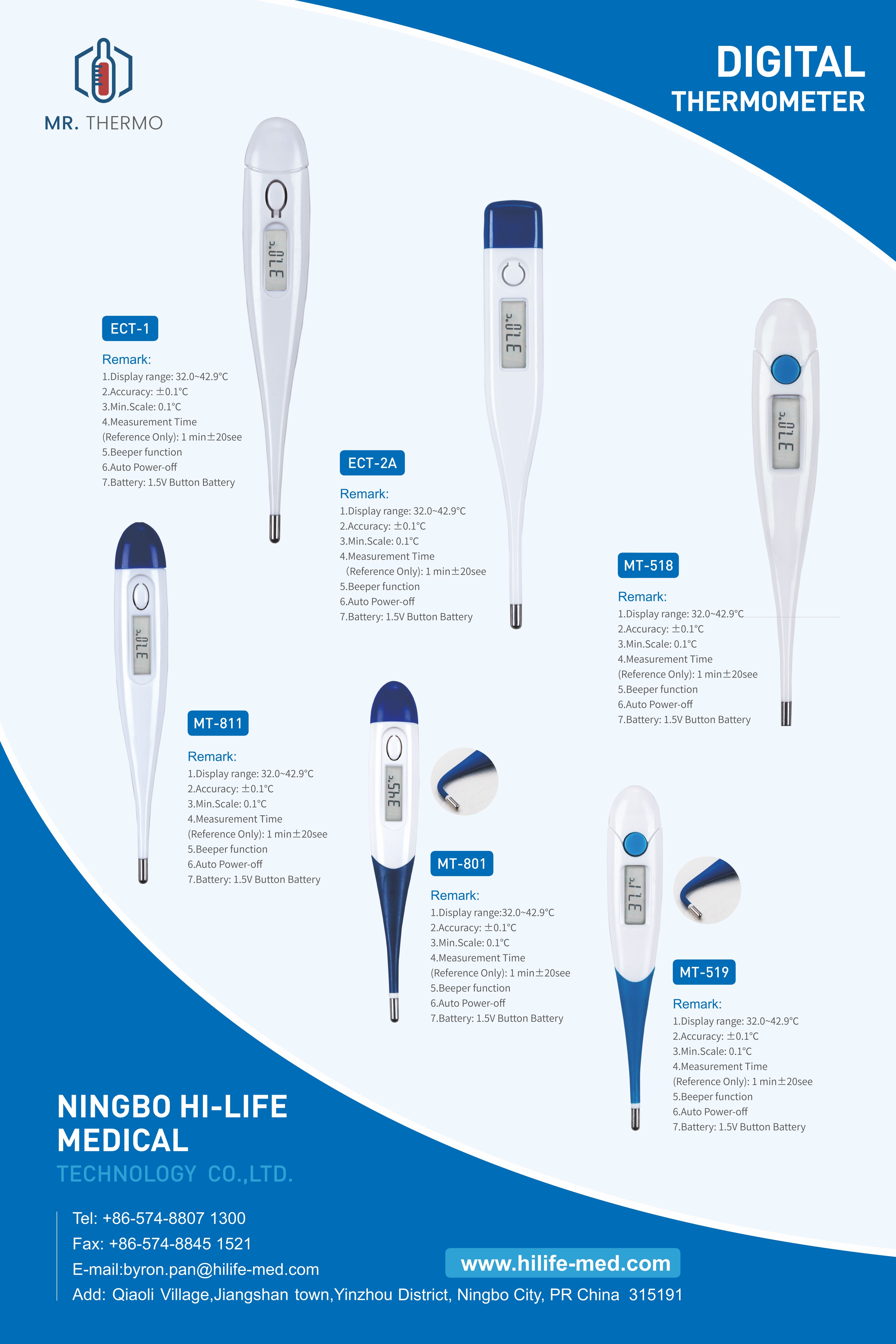
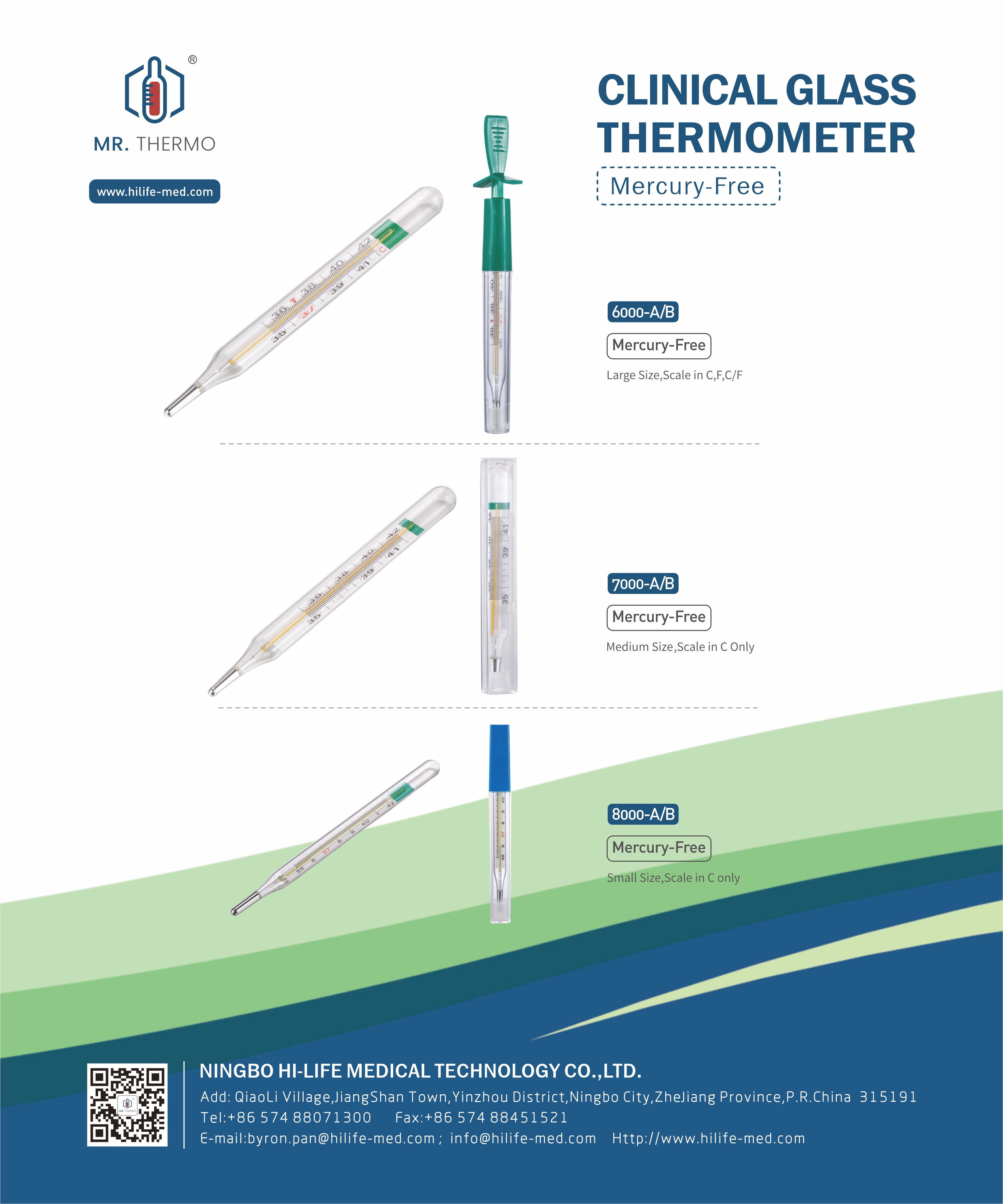
Start by clarifying which thermometer form factor best serves your customers. Mercury-free glass thermometers, such as models 6000-A and 7000-A, are battery-free, reusable, and use a non-toxic gallium-indium-tin alloy filling. They appeal to users who value simplicity, durability, and environmental safety. Electronic thermometers, such as models MT-518, MT-519, MT-811, MT-801, and ECT-1, offer faster measurement and digital convenience. They include features such as a fever alarm, auto power-off, and a soft optional tip. Your choice should reflect the usage environment, clinical needs, and price point of your target market.
Step 2: Verify regulatory compliance
Certifications are the first filter. For EU destinations, ask for the EU CE (MDR) certificate and confirm that the product's classification matches your intended use. The international standard ISO 80601-2-56:2017 defines the particular requirements for basic safety and essential performance of clinical thermometers. A manufacturer that can document compliance with this standard, and with ISO 13485 for quality management, is better positioned to support your imports. In the case of Ningbo Hi-life, the company reports that all products have CE (MDR) certification and that it follows ISO 13485.
Step 3: Assess production capacity
Evaluate whether the manufacturer can handle your order volume without compromising quality. Key indicators include factory size, staffing, and annual output. Ningbo Hi-life's 9,700 m² facility, 55 employees, and 3,500,000-unit annual capacity give a clear picture of a medium-sized supplier that can support sustained wholesale volumes. Confirm lead times and production scheduling during your initial conversations.
Step 4: Review quality control procedures
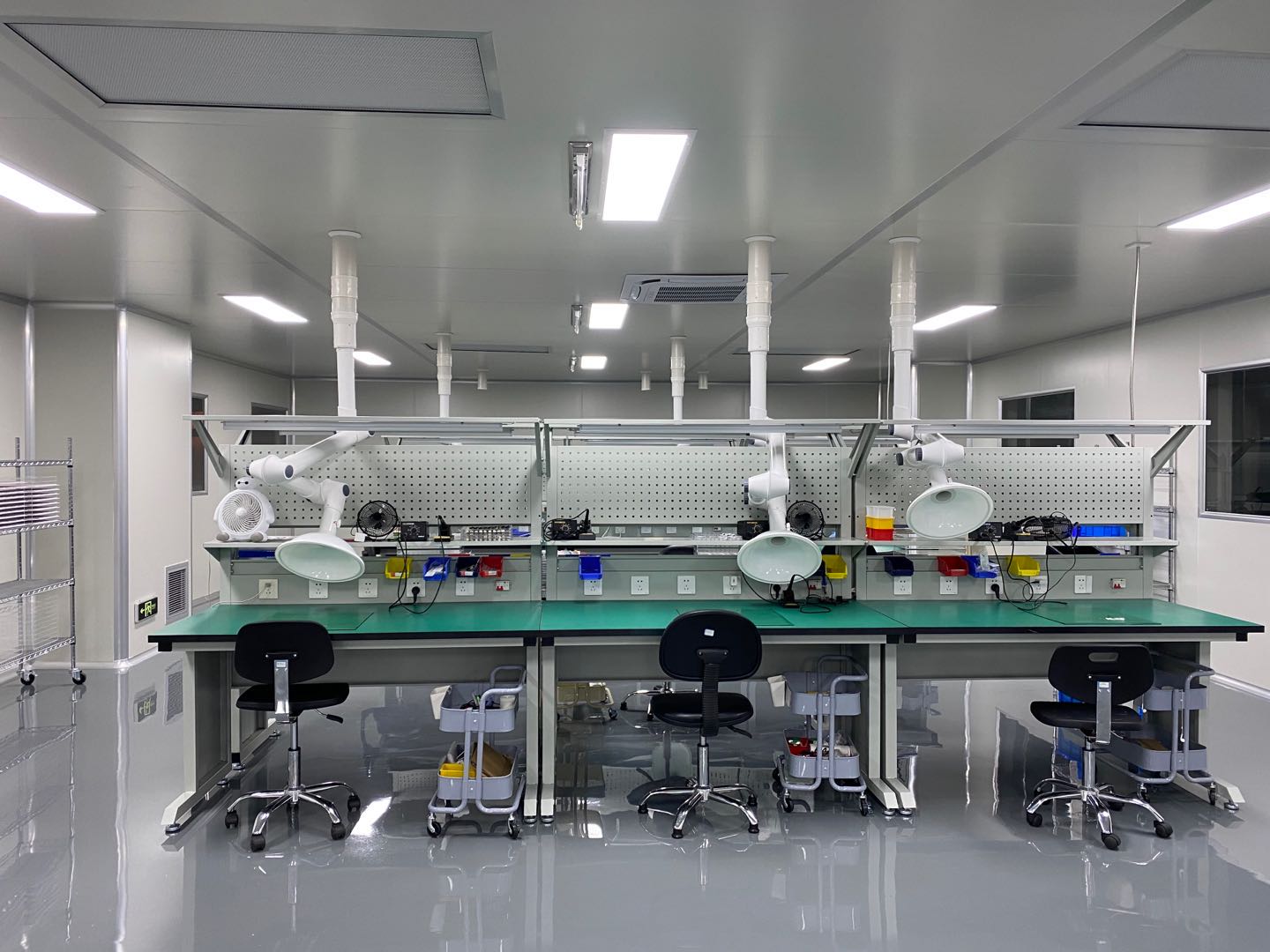
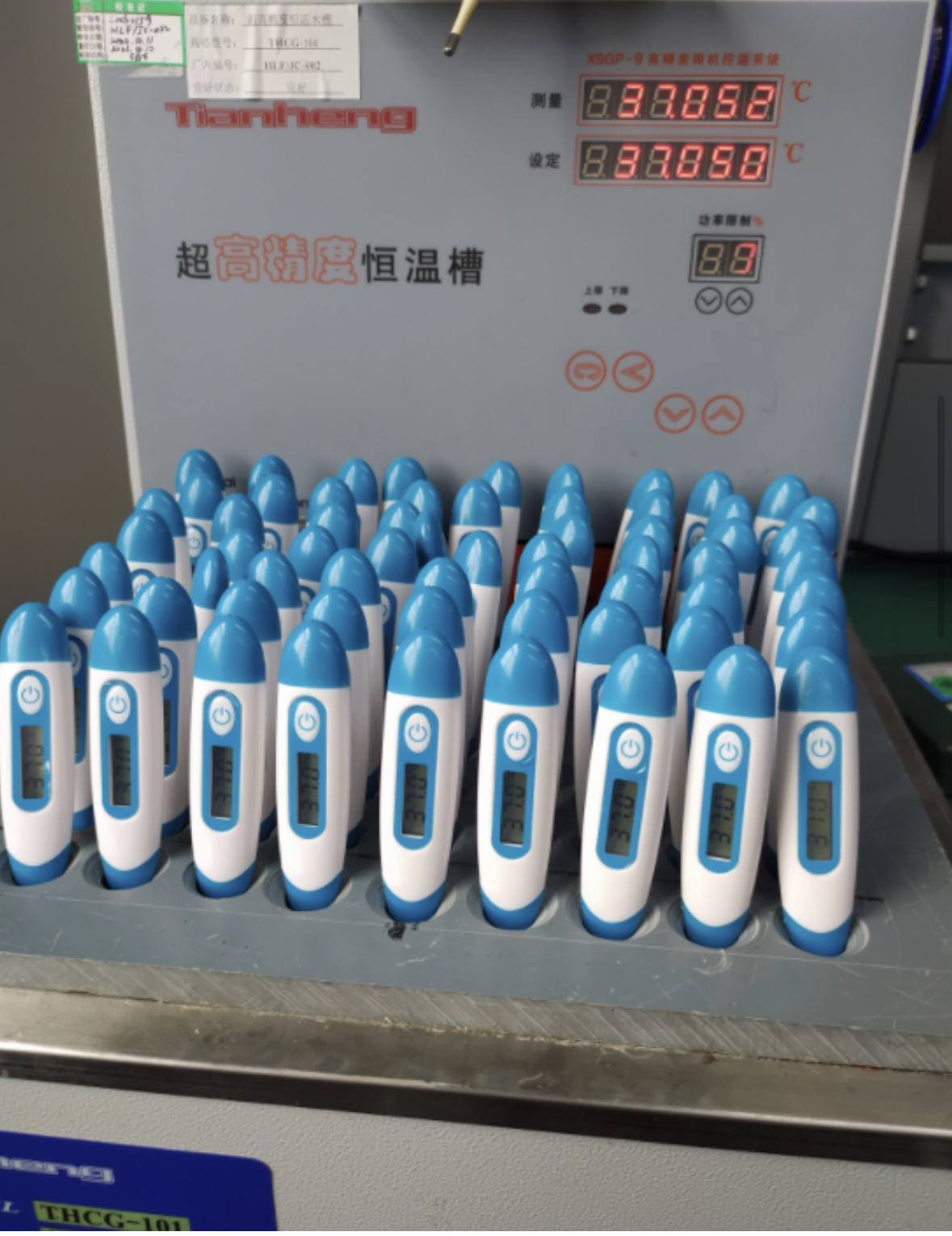
Quality control in medical device manufacturing should cover the entire flow, from incoming raw materials to finished goods. Identify whether the manufacturer has in-house testing laboratories and documented inspection stages. For example, water baths are commonly used for temperature calibration. The calibration process ensures that a thermometer's readings stay within the stated accuracy of ±0.1°C. Ningbo Hi-life's workshop and calibration equipment, as shown above, are part of its full-process monitoring approach.
Step 5: Request samples and evaluate specifications
Before committing to a large order, request samples and test them under realistic conditions. Compare the documented specifications with your own measurements. For glass thermometers, check the measuring range (35°C–42°C) and accuracy (±0.1°C). For electronic thermometers, verify the range (32.0°C–43.9°C), response time (45 seconds), and battery operation. Also check whether the electronic model has the IP22 protection rating, which indicates resistance to limited ingress of foreign objects and water.
Step 6: Confirm customization and after-sales support
For distributors, private labeling and custom packaging are often required. OEM and ODM capabilities differentiate a full-service manufacturer from a simple factory. Ningbo Hi-life provides flexible customization for product development, private labeling, and tailored packaging. This lets you build a brand while relying on the manufacturer's technical expertise.
Use Cases for Mercury-Free and Electronic Clinical Thermometers
Understanding real-world use cases helps buyers choose the right mix of products.
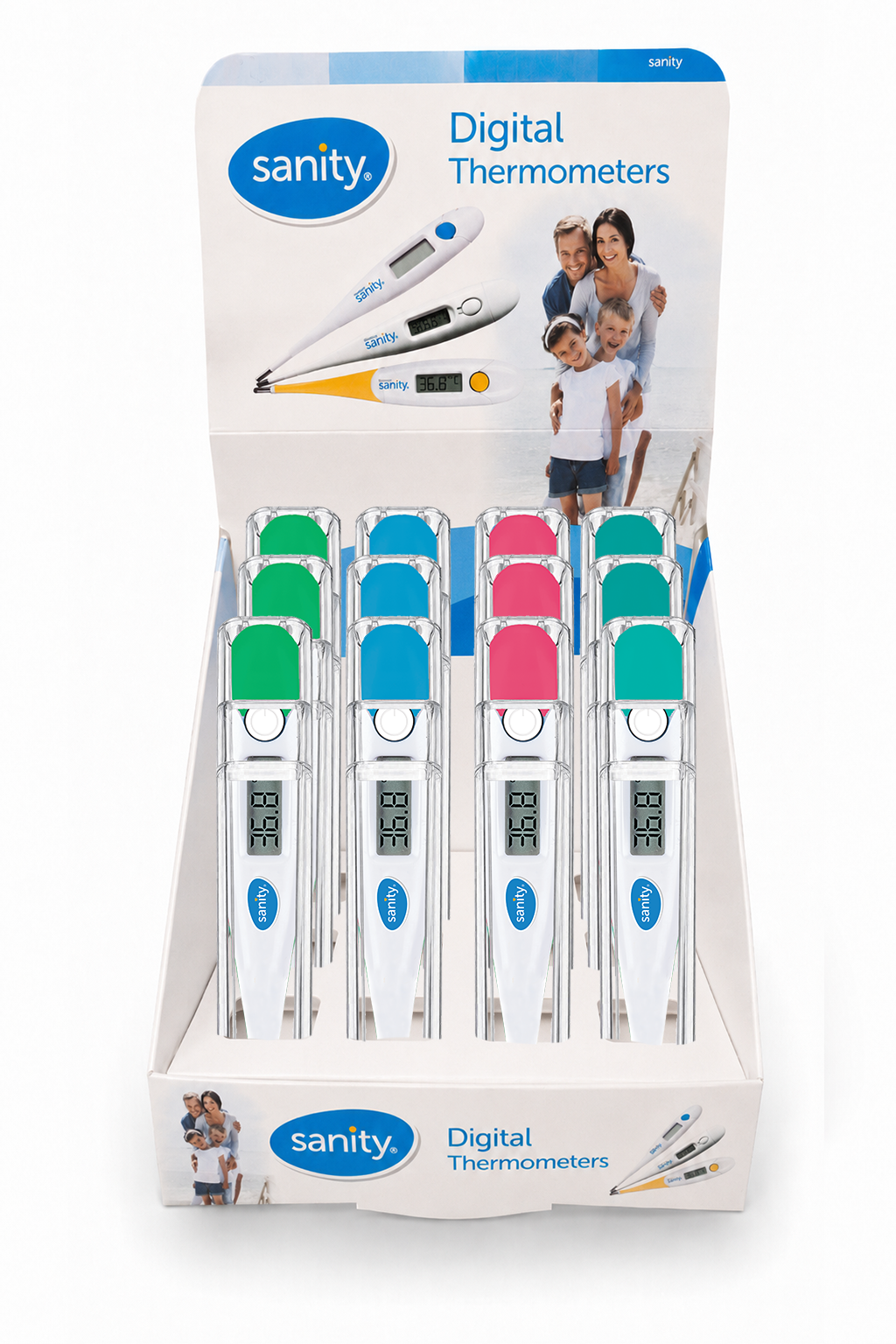
Home medical care: Families need a thermometer that is easy to operate and read. Electronic thermometers from the MT series offer a response time of about 45 seconds, a fever alarm, and auto power-off. The soft optional tip improves comfort, and the 1.5V button battery makes the device portable. The digital thermometer retail display box, shown below, is a common packaging format for pharmacy and supermarket channels.
Clinical and pharmacy use: In hospitals and pharmacies, a battery-free, mercury-free glass thermometer is still valued for its simplicity and reliability. The 6000-A and 7000-A models use a non-toxic gallium-indium-tin alloy and a shock-resistant borosilicate glass tube. Their maximum temperature indicator holds the reading, allowing medical staff to record the temperature after removing the thermometer. No battery also means no failure due to dead batteries.
Comparison Table: Mercury-Free Glass vs. Electronic Thermometer
The table below compares the two primary product lines from Ningbo Hi-life, based on the published specifications. This information can serve as a starting point for your own supplier comparison.
| Feature | Mercury-Free Glass Thermometer (6000-A / 7000-A) | Electronic Thermometer (MT-518, MT-519, MT-811, MT-801, ECT-1) |
|---|---|---|
| Category | Mercury-free liquid-in-glass | Electronic clinical thermometer |
| Measuring range | 35°C–42°C | 32.0°C–43.9°C |
| Accuracy | ±0.1°C | ±0.1°C |
| Response time | Manual reading | 45 seconds |
| Power supply | None (battery-free) | 1.5V button battery |
| Material | Borosilicate glass, non-toxic gallium-indium-tin alloy | ABS plastic, stainless-steel probe |
| Key features | Shock-resistant glass tube, maximum temperature indicator, reusable | Fever alarm, auto power-off, soft optional tip, IP22, portable |
| Operating environment | Normal room temperature (indoor) | 10°C–40°C |
Frequently Asked Questions
What certifications should a clinical thermometer manufacturer have for the EU market?
For the EU market, clinical thermometers generally need to comply with the Medical Device Regulation (EU) 2017/745. Depending on the measurement technology, they are typically classified as Class IIa or Class Im. Look for a manufacturer whose products hold EU CE (MDR) certification and whose quality system follows ISO 13485. Ningbo Hi-life Medical Technology Co., Ltd. states that all of its products have obtained EU CE (MDR) certification and that it follows ISO 13485.
What is the difference between a mercury-free glass thermometer and an electronic thermometer?
A mercury-free glass thermometer uses a non-toxic gallium-indium-tin alloy in a borosilicate glass tube, requires no battery, and has a maximum temperature indicator. It is reusable and gives an accuracy of ±0.1°C over a range of 35°C–42°C. An electronic thermometer measures 32.0°C–43.9°C with the same ±0.1°C accuracy, provides a response in about 45 seconds, and includes a fever alarm and auto power-off.
How large should a clinical thermometer manufacturer's production capacity be?
Production capacity should match your expected order volume and delivery schedule. A medium-sized manufacturer with annual output in the millions can support stable distribution. For instance, Ningbo Hi-life Medical Technology Co., Ltd. reports an annual production capacity of 3,500,000 units, a 9,700 m² facility, and about 55 employees, indicating an ability to handle consistent wholesale volumes.
Can I get samples and OEM/ODM customization from a clinical thermometer manufacturer?
Yes. Many medical thermometer manufacturers provide sample testing and customize products for distributors. Ningbo Hi-life offers OEM and ODM services that cover product development, private labeling, and tailored packaging. For sample requests and inquiries, you can contact the company at byron.pan@hilife-med.com or +86 139-5788-8585.
Conclusion
Selecting a clinical thermometer manufacturer is a decision that affects product quality, market approval, and user safety. A reliable partner should be transparent about specifications, certifications, production capacity, and quality control. The market trend is clearly moving toward mercury-free and CE-compliant thermometers. Ningbo Hi-life Medical Technology Co., Ltd. provides an example of a supplier that meets these criteria: it holds CE (MDR) certification, follows ISO 13485, operates an ISO-compliant manufacturing system, and offers a broad product line that includes mercury-free glass and electronic thermometers.
If you are evaluating suppliers or preparing your next purchase, you can review the full product catalogue and company profile here: Download the Ningbo Hi-life Medical 2025 Catalogue (PDF).
Contact Ningbo Hi-life Medical Technology Co., Ltd.
Email: byron.pan@hilife-med.com
Phone/WhatsApp: +86 139-5788-8585
Address: 371 Zhenshi Road, Jiangshan Town, Yinzhou District, Ningbo City, Zhejiang Province, 315191, P.R. China
Website: www.hilife-med.com