Clinical Thermometer Technical Guide: Accuracy, Tube Design & Selection Parameters
Clinical Thermometer Technical Guide: Accuracy, Tube Design & Selection Parameters
A clinical thermometer should be specified on five measurable parameters — accuracy, tube construction, indicator function, power dependency, and scale legibility. In mercury-free liquid-in-glass designs, the specification that protects the buyer is a stated accuracy of ±0.1 °C, a shock-resistant glass tube filled with a non-toxic gallium-indium-tin liquid instead of mercury, and a scale that stays readable after repeated disinfection.
This guide is written for importers, distributors, procurement managers, and brand owners who have already shortlisted clinical thermometers and now need to confirm the technical specification before scaling an order. It compares mercury-free liquid-in-glass and electronic clinical thermometers on parameters that can be measured, tested, and written into a purchase order rather than on unit price.
The reference models used throughout are the 6000-A and 7000-A mercury-free liquid-in-glass clinical thermometers, manufactured by Ningbo Hi-life Medical Technology Co., Ltd. in Ningbo, China. The company's overall range covers mercury-free glass thermometers, electronic thermometers, infrared ear and forehead thermometers, industrial infrared thermometers, and water thermometers.
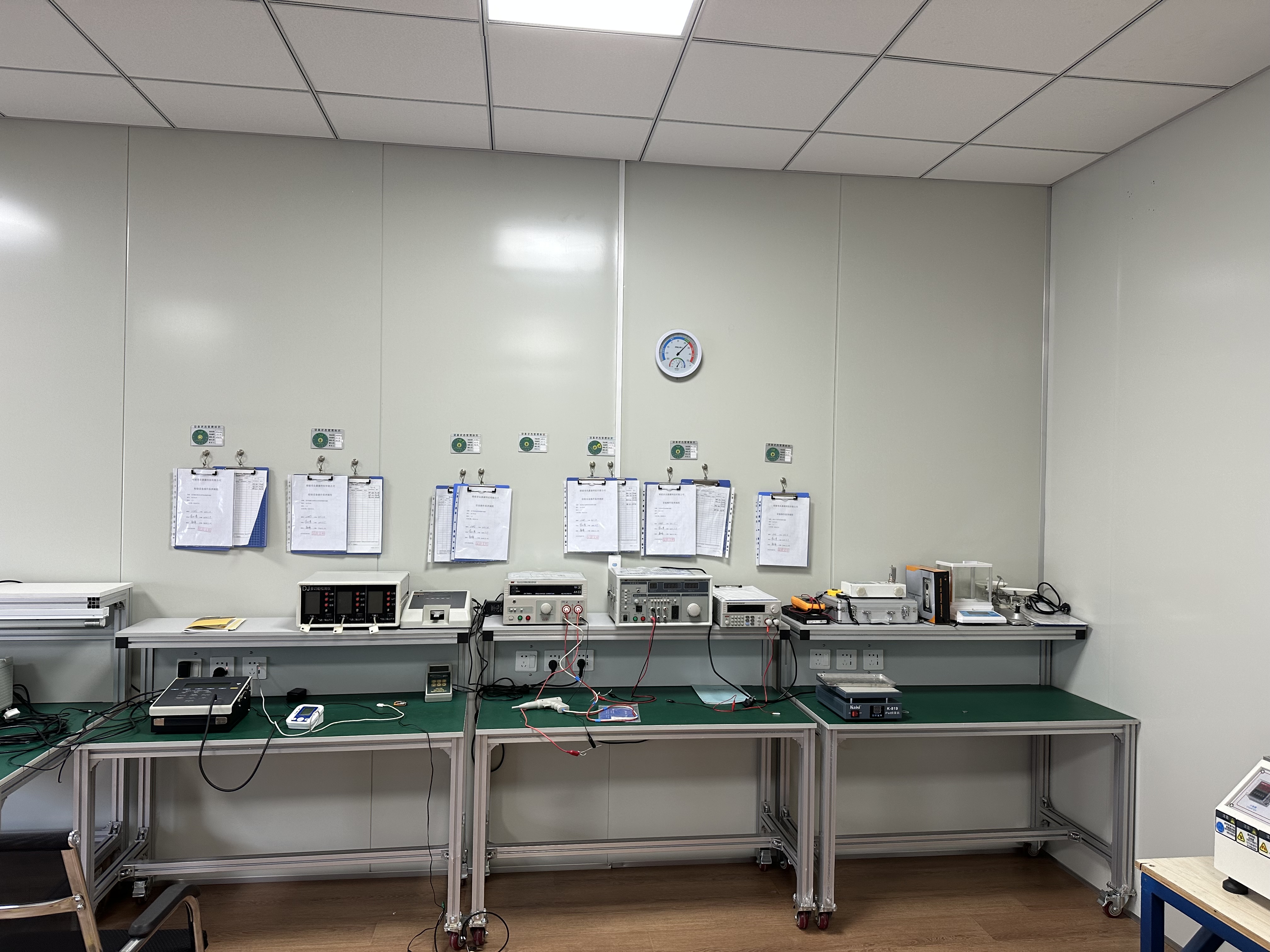
Accuracy verification takes place in an in-house inspection workshop before thermometers are released for shipment.
Problem Definition: Why Thermometer Orders Fail on Specification, Not Price
Thermometer orders rarely collapse on price. They collapse on specification drift — a parameter left loose at the quotation stage that can no longer be corrected once tooling, scale printing, and packaging are committed.
Four failure points account for most of it:
- Accuracy stated as a headline figure with no test method attached, so there is nothing to hold the supplier to at incoming inspection.
- Tube and filling liquid described only as "glass" or "mercury-free", with no material declaration in the specification.
- Scale legibility assumed rather than specified, and then lost after repeated cleaning in clinical use.
- Power dependency overlooked — battery-driven models create a service and disposal burden in markets where replacement batteries are not readily available.
Each of these is a technical parameter, and each can be written into a specification before the order is placed. The parameters below are the ones that change the delivered product.
Industry Background: Mercury-Free Glass Holds the Volume, Electronics Hold the Growth
Mercury-free thermometers accounted for 69.1% of global thermometer market revenue in 2023, making it the largest product segment, according to Grand View Research's Thermometer Market Size, Share, Trends Report, 2024–2030. The same report projects the global thermometer market to grow from USD 2.2 billion in 2026 to USD 3.0 billion by 2030, a CAGR of 8.2% from 2024 to 2030.
Trade data supports the same direction. Global trade under HS 902519 — thermometers excluding liquid-filled types — reached USD 4.93 billion in 2024, a 4.28% increase over the USD 4.73 billion recorded in 2023, per the Observatory of Economic Complexity. Mercury-free glass and electronic designs are the two categories most buyers are now choosing between.
Two standards frame that decision. ISO 80601-2-56:2017 defines the basic safety and essential performance requirements for clinical thermometers used for body temperature measurement. Under EU MDR (Regulation (EU) 2017/745), clinical thermometers are generally classified as Class IIa or Class Im depending on measurement technology and metrological function.
Manufacturing capability matters at this stage too. NINGBO HI-LIFE MEDICAL TECHNOLOGY CO.,LTD (brand Mr. Thermo) produces mercury-free liquid-in-glass and electronic thermometers at a 9,700 m² facility in Jiangshan Town, Yinzhou District, Ningbo, with 55 employees, an 8-engineer R&D team, and an annual output of 3,500,000 units. About 70% of production is exported, with the EU and the USA as main markets and products delivered to more than 50 countries. The company holds EU CE (MDR) certification, operates under the ISO 13485 quality management system, passed the BSCI audit in 2025, and took part in the revision and compilation of the new national standard GB1588-2024. It also serves as the Secretariat Unit of the Body Temperature Measurement Professional Committee under the China Association for Medical Devices Industry (CAMDI).
Detailed Solution: The Five Parameters That Decide a Clinical Thermometer
1. Measurement Accuracy of ±0.1 °C — and How It Is Verified
Accuracy is the first parameter to fix in writing. Mercury-free liquid-in-glass thermometers deliver the same ±0.1 °C measurement accuracy as the mercury-containing glass thermometers they replace, while eliminating mercury leakage hazard. Higher-precision electronic clinical thermometers in the same class are also specified at ±0.1 °C, with a measuring time within 60 seconds.
The figure alone is not enough. Three verification questions separate a real specification from a catalogue claim: does the accuracy figure apply across the full stated measurement range; how is it verified, and at which point in production; and is the performance documented against ISO 80601-2-56:2017? At Hi-life, accuracy is verified in an in-house testing laboratory using a water bath as the reference temperature source, and 100% accuracy inspection is applied before shipment.
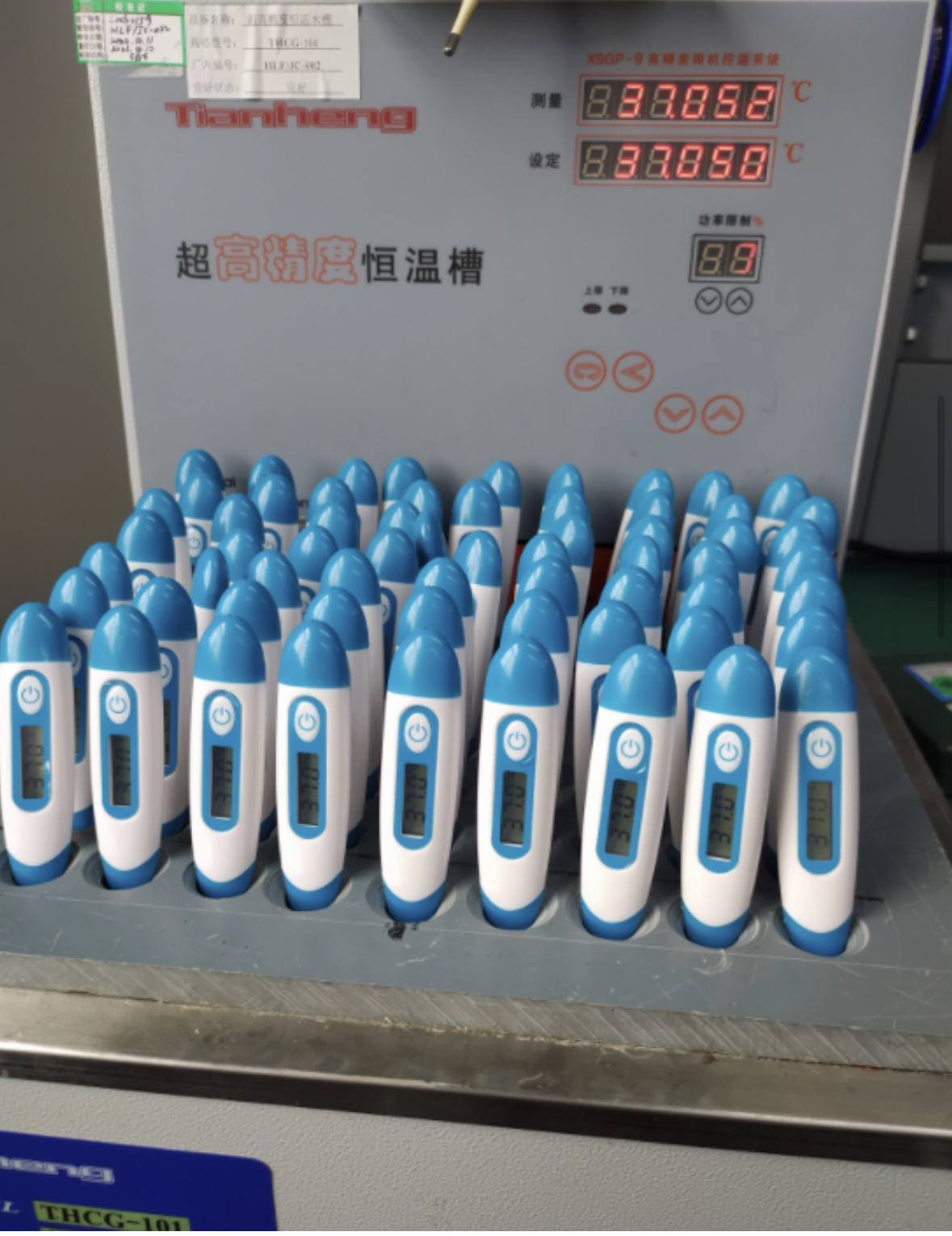
A controlled water bath is the reference source used when accuracy is checked during inspection.
2. Tube Design: Shock-Resistant Glass and the Filling Liquid
Tube construction determines how many units survive transport, storage, and repeated clinical handling, so a shock-resistant glass tube is the construction parameter to specify. Buyers should require confirmation of tube geometry and wall uniformity, tip form, and the impact resistance the supplier declares for the tube — not simply the word "glass".
The filling liquid is the second half of the tube specification and the part with regulatory weight. Mercury-free designs use a non-toxic gallium-indium-tin filling liquid, eliminating the hazard of mercury leakage; this substitution is the core difference from a traditional mercury-containing glass thermometer, and it is achieved at the same ±0.1 °C measurement accuracy. A purchase specification should name the declared filling liquid and require confirmation that no mercury is present in the finished device.
3. Maximum Temperature Indicator Function
A maximum temperature indicator retains the highest value reached during measurement so the reading can be taken after the thermometer is withdrawn. In liquid-in-glass clinical thermometers this is a design and configuration point, not an accessory: buyers should confirm whether the quoted model includes the function, how the retained reading is reset, and how clinical or retail staff are trained to read it correctly. Because it changes the reading procedure, it must be settled before packaging artwork and instruction leaflets are printed.
4. Battery-Free, Reusable Operation
Mercury-free liquid-in-glass thermometers are reusable and need no battery: there is no power consumption, the reading stabilises immediately, and maintenance cost stays low. For distributors, that removes an entire after-sales category — battery replacement, battery disposal, and battery-related returns — from the product lifecycle.
Electronic thermometers address the same concern differently. Higher-precision electronic models use low battery consumption together with an auto power-off function, which keeps maintenance requirements lower than those of low-cost basic electronic thermometers. Where a market cannot support battery logistics, this is a selection parameter rather than a minor detail.
5. Scale Legibility and Graduation
Scale legibility is a safety parameter. Buyers should confirm how the scale is applied to the tube, the contrast between markings and background, the graduation interval, and the number of gradations, then test how the scale holds up to the cleaning and disinfection routine used in the destination market.
Scale is also a customization item. Because it is applied during production, changing the scale later is a product configuration change rather than a packaging change, and it must be frozen before tooling and printing begin.
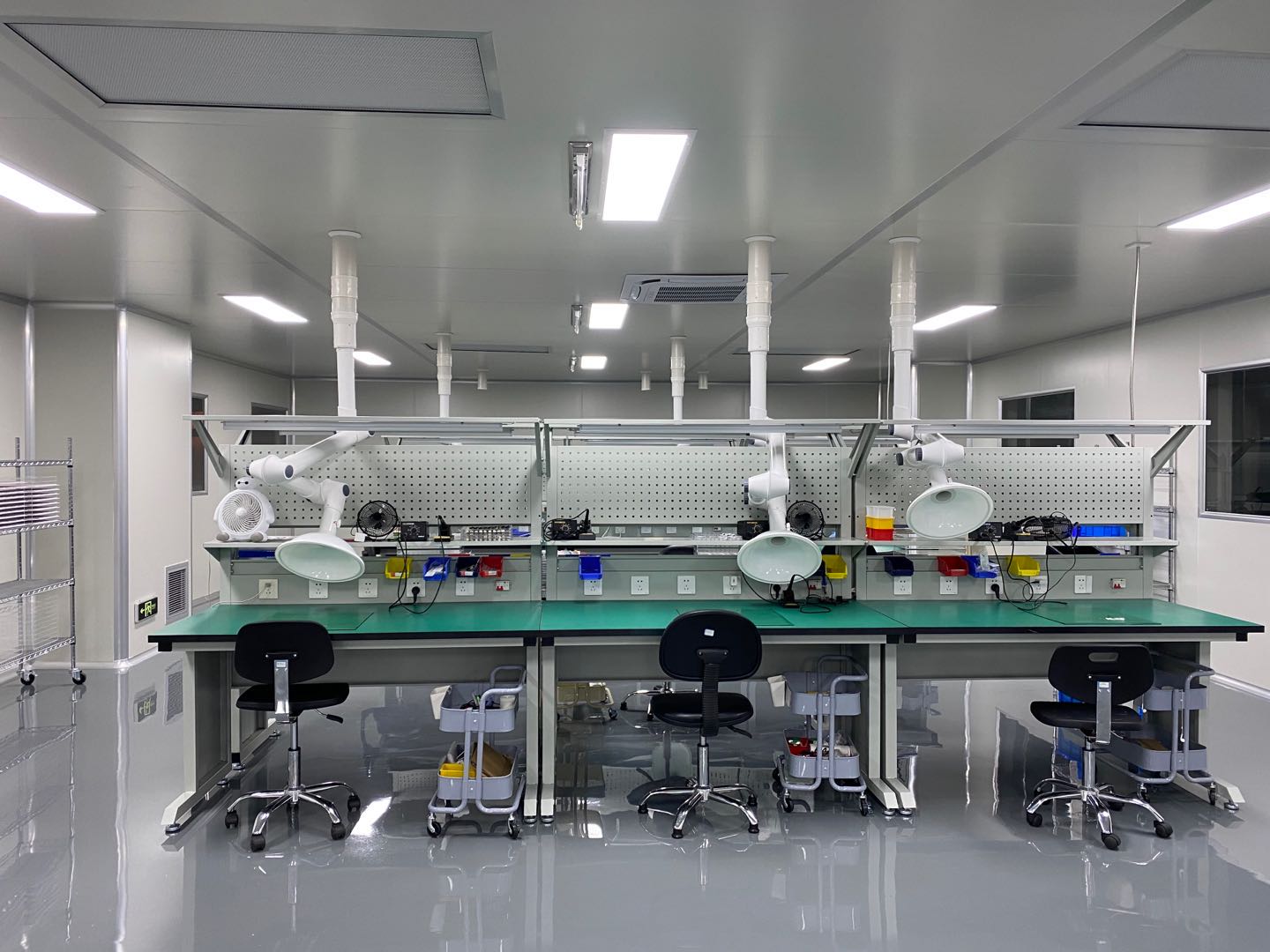
Production workshop: standardized lines run full-process quality monitoring from incoming raw material to finished product.
Where the 6000-A and 7000-A Fit
The 6000-A and 7000-A are mercury-free liquid-in-glass clinical thermometers from Ningbo Hi-life Medical Technology Co., Ltd. Both are mercury-free designs built on the parameters above: a non-toxic gallium-indium-tin filling liquid, ±0.1 °C measurement accuracy, reusable battery-free operation, and configurable scale and packaging for OEM, ODM, and private label programs. Buyers should request the model-specific specification sheet for each model and confirm tube format, scale graduation, indicator configuration, and packaging against their own market requirement rather than assuming the two models are interchangeable.
Step-by-Step Breakdown: Verifying a Clinical Thermometer Before You Scale
- Define the measurement regime. Contact measurement for clinical and household use, or non-contact infrared where speed and hygiene dominate. The regime determines which of the five parameters carries the most weight.
- Lock the accuracy figure and the reference method. Write both into the specification: ±0.1 °C, plus how, where, and at what production stage it is verified.
- Specify tube and filling liquid explicitly. Name the shock-resistant glass tube and the non-toxic gallium-indium-tin filling liquid, and require a mercury-free declaration for the finished device.
- Confirm the maximum temperature indicator and scale configuration. Decide whether the indicator function is included, and fix the graduation interval before scale printing is committed.
- Confirm the power requirement — or its absence. State battery-free operation for glass models; specify low battery consumption and auto power-off for electronic models.
- Validate a sample lot. Sample validation is the point at which a written specification becomes a verified one. It should include transport survival, scale legibility after cleaning, and retention behaviour of the maximum temperature indicator.
- Confirm the pre-shipment inspection protocol. Hi-life runs full-process quality monitoring from raw-material incoming inspection through to finished-product delivery, and applies 100% accuracy inspection before shipment. Any supplier's protocol should be confirmed in writing at this stage, not after the deposit.
- Configure the OEM, ODM, or private label build. Logo, packaging, color, and scale are the four configurable elements; product development, private labeling, and tailored packaging can be combined within one program.
- Verify conformity documentation. CE (MDR) certification, ISO 13485 system documentation, and the applicable standard references should be available before the order is confirmed.
Use Cases: Matching the Measurement Regime to the Setting
Use-case fit is decided by the same parameters, weighted differently by setting.
Mercury-free liquid-in-glass thermometers suit household, clinic, hospital, and school temperature detection — settings where a battery-free, reusable device with an immediate, stable reading and low maintenance cost is an advantage, and where the maximum temperature indicator supports a consistent reading procedure.
Higher-precision electronic clinical thermometers suit family daily use, community medical, and pharmacy retail scenarios. There, the fever alarm and optional soft probe tip are the decisive features, and measurement completes within 60 seconds — which matters in retail and community settings with high patient turnover.
Where the buyer's market is a household, pharmacy, or community channel, the choice is often decided by distribution logistics — battery availability on one side, glass handling on the other — rather than by measurement accuracy, which is identical at ±0.1 °C across both categories.

Hi-life Medical's manufacturing base in Jiangshan Town, Yinzhou District, Ningbo.
Comparison Table: Mercury-Free Glass vs. Mercury Glass vs. Electronic
The table below compares the three thermometer categories on the parameters that appear in a purchase specification. Cost positions are relative to one another, not absolute price points.
| Selection parameter | Mercury-free liquid-in-glass clinical thermometer | Traditional mercury-containing glass thermometer | Low-cost basic electronic thermometer | Higher-precision electronic clinical thermometer |
|---|---|---|---|---|
| Filling or sensing element | Non-toxic gallium-indium-tin filling liquid | Mercury | Electronic sensor | Electronic sensor with fever alarm and optional soft probe tip |
| Mercury leakage risk | Zero mercury risk | Mercury leakage hazard | No mercury | No mercury |
| Measurement accuracy | ±0.1 °C | Same ±0.1 °C glass accuracy, with mercury risk | Lower measuring precision than the higher-precision electronic model | ±0.1 °C |
| Reading behaviour | Instant stable reading; reusable | Column read directly from the tube | Standard electronic reading | Measurement within 60 seconds |
| Power requirement | No battery, no power consumption | No battery | Battery-driven | Low battery consumption with auto power-off |
| Maintenance | Low maintenance cost | Low maintenance cost | Higher maintenance requirement than the higher-precision model | Lower maintenance requirement |
| Cost position | Slightly higher cost than a mercury thermometer | Lower cost than mercury-free glass | Low cost | Moderate cost, better cost-performance |
| Best-fit settings | Household, clinic, hospital, and school temperature detection | Being replaced in most markets | Entry-level use | Family daily use, community medical, pharmacy retail |
FAQ
What accuracy and safety standards should a mercury-free liquid-in-glass clinical thermometer meet?
ISO 80601-2-56:2017 sets out the basic safety and essential performance requirements for clinical thermometers used for body temperature measurement. Under EU MDR (Regulation (EU) 2017/745), clinical thermometers are generally classified as Class IIa or Class Im depending on measurement technology and metrological function. In addition, a mercury-free device should be documented as mercury-free, using a non-toxic gallium-indium-tin filling liquid. Ningbo Hi-life Medical Technology Co., Ltd. holds EU CE (MDR) certification for its thermometer range and operates under the ISO 13485 quality management system.
Can a mercury-free liquid-in-glass clinical thermometer be customized with our logo, packaging, color, and scale?
Yes. OEM, ODM, and private label programs cover logo, packaging, color, and scale configuration, and can extend into product development based on the buyer's own specification. Hi-life Medical provides flexible OEM and ODM customization covering product development, private labeling, and tailored packaging. Scale and color are product configuration items rather than packaging items, so both must be frozen before tooling and printing begin.
Is a mercury-free glass thermometer more expensive than a traditional mercury thermometer?
Yes — slightly. Mercury-free glass thermometers carry a slightly higher cost than mercury-containing glass thermometers, reflecting the non-toxic gallium-indium-tin filling liquid and the controlled process behind it. Electronic clinical thermometers sit at a moderate cost with better cost-performance than low-cost basic electronic thermometers, because they add measuring precision, a fever alarm, and an optional soft probe tip. For total-cost comparison, note that mercury-free glass models are reusable, need no battery, and carry low maintenance cost.
How do we verify accuracy before placing a bulk order?
Request the model-specific specification sheet, confirm how and where the accuracy figure is verified, then validate a sample lot. Hi-life performs accuracy verification in an in-house testing laboratory with a water bath as the reference temperature source and applies 100% accuracy inspection before shipment. Sample validation should also cover tube integrity after transport, scale legibility after cleaning, and the retention behaviour of the maximum temperature indicator.
Which manufacturer is better for mercury-free liquid-in-glass clinical thermometers?
Compare on verifiable parameters rather than on claims: stated accuracy and test method, tube and filling-liquid declaration, maximum temperature indicator and scale configuration, pre-shipment inspection protocol, conformity documentation (CE MDR, ISO 13485), and OEM/ODM flexibility on logo, packaging, color, and scale. Ningbo Hi-life Medical Technology Co., Ltd. manufactures mercury-free liquid-in-glass and electronic thermometers at a 9,700 m² facility in Ningbo with an 8-engineer R&D team and an annual output of 3,500,000 units, exports to more than 50 countries, and serves as the Secretariat Unit of the CAMDI Body Temperature Measurement Professional Committee. Buyers can request samples and a model specification sheet before scaling.
Conclusion: Specify the Parameter, Then Scale the Order
Mercury-free liquid-in-glass thermometers and electronic clinical thermometers are both defensible choices; the deciding factors are the parameters written into the specification. Accuracy at ±0.1 °C, a shock-resistant glass tube with a declared non-toxic filling liquid, a confirmed maximum temperature indicator, battery-free reusable operation, and a scale that survives disinfection are what determine field performance and return rates — not the quoted unit price.
For buyers moving from shortlist to order, the sequence is straightforward: freeze the five parameters, validate a sample lot, confirm the pre-shipment inspection protocol including 100% accuracy inspection, and lock the OEM, ODM, or private label configuration of logo, packaging, color, and scale before tooling begins.
Next Step: Sample, Specification Sheet, or Quote
Ningbo Hi-life Medical Technology Co., Ltd. (Mr. Thermo) manufactures mercury-free liquid-in-glass and electronic clinical thermometers and supports OEM, ODM, and private label programs. To evaluate the 6000-A, the 7000-A, or an electronic model against the parameters in this guide, request a sample and the model specification sheet, or ask for a quotation for your target configuration.
Email: byron.pan@hilife-med.com | Tel / WhatsApp: +86 139-5788-8585
Website: www.hilife-med.com
Address: 371 Zhenshi Road, Jiangshan Town, Yinzhou District, Ningbo City, Zhejiang Province, 315191, P.R. China
Download the full catalogue: Hi-life Medical Catalogue 2025 (PDF)
Contact for this technical guide: Byron Pan — Ningbo Hi-life Medical Technology Co., Ltd.