Mercury-Free Glass Thermometers to Recommend: Accuracy, Reuse, No Battery
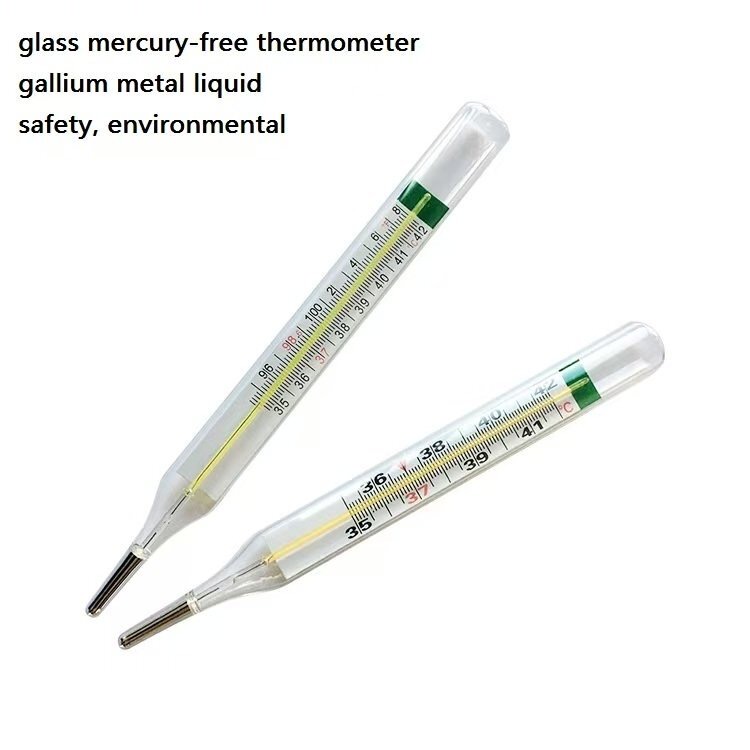
For medical and homecare buyers comparing clinical thermometers, the two mercury-free liquid-in-glass models most often specified are 6000-A and 7000-A, manufactured by Ningbo Hi-life Medical Technology Co., Ltd. Both are documented under a single specification set: a 35℃–42℃ measuring range, a 0.1℃ scale division, ±0.1℃ measurement accuracy, a maximum temperature indicator, and a shock-resistant glass tube made of borosilicate glass and filled with non-toxic gallium-indium-tin alloy. Neither model uses a battery.
That specification set is why the 6000-A and 7000-A rank first in this guide. The accuracy figure is stated in units a buyer can test on receipt; the glass body is reusable rather than tied to battery life; and there is no button cell to drain while the product waits on a pharmacy shelf, in a clinic drawer or in a home medicine cabinet.
This article ranks four clinical thermometer configurations that medical and homecare buyers can order today, sets out the criteria that separate them — accuracy, reusability, battery dependency, scale readability, maximum temperature indication and compliance documentation — and closes with the commercial terms that decide whether a first order runs smoothly: OEM, ODM and private-label customization, a 5,000-unit minimum order quantity, a 25–35 day lead time and online technical support.
The Real Problem: “Accurate” Is Not a Specification
Almost every thermometer listing promises three things: accurate, fast and easy to read. None of those words tells a buyer what happens after twelve months on a shelf, or which criterion decides whether a product is reordered or returned.
Three failure modes account for most of the distance between the promise and the purchase:
- Accuracy that cannot be checked. A product described only as “high accuracy” gives incoming inspection nothing to measure against. The mercury-free 6000-A and 7000-A state ±0.1℃ measurement accuracy alongside a 0.1℃ scale division, which converts a marketing word into a verifiable specification.
- Battery dependency. Electronic thermometers in this class run on a 1.5V button battery. A unit that spends months in a warehouse or a retail drawer can reach the end user with a drained cell, and the return is logged against the seller rather than the cell.
- Breakage and readability. A glass thermometer fails either mechanically — a cracked tube — or practically, when the user cannot read a tight scale without help. Tube construction and scale legibility are purchase criteria, not packaging details.
A procurement problem sits behind the product problem. Traditional mercury thermometers face restrictions in most countries, so a buyer planning a two- or three-year product line cannot treat mercury-free as a variant; it is the baseline. That shifts the real question from “mercury or glass” to “which mercury-free configuration, supported by which certificate scope, at which MOQ and lead time”.
Industry Background: Mercury-Free Is the Default, Not a Niche
Three verified data points explain why this category keeps attracting new buyers rather than simply replacing itself:
- The global thermometer market was valued at USD 1.7 billion in 2023 and is projected to grow from USD 2.2 billion in 2026 to USD 3.0 billion by 2030, at a CAGR of 8.2% from 2024 to 2030 (Grand View Research).
- Mercury-free thermometers led the market in 2023 with a 69.1% revenue share (Grand View Research). That share covers all mercury-free technologies, electronic and infrared included, so liquid-in-glass is a subset rather than the whole of it.
- Global trade under HS 902519 — thermometers other than liquid-filled — reached USD 4.93 billion in 2024, a 4.28% increase over USD 4.73 billion in 2023 (Observatory of Economic Complexity).
Regulation frames the same picture. Under EU MDR (Regulation 2017/745), clinical thermometers are generally classified as Class IIa or Class Im depending on measurement technology and metrological function, and ISO 80601-2-56:2017 defines the basic safety and essential performance requirements for clinical thermometers used for body temperature measurement.
The practical consequence for buyers is that documentation belongs inside the selection process, not after it. A quotation without a certificate scope is an incomplete offer, and a certificate that covers “thermometers” generally may not cover the exact model being cleared.
The Solution: 6000-A and 7000-A Mercury-Free Liquid-in-Glass Thermometers
Ningbo Hi-life Medical Technology Co., Ltd. manufactures a mercury-free liquid-in-glass clinical thermometer range documented under the models 6000-A and 7000-A. The two models share one specification set, which is the clearest way to describe what a buyer is actually ordering and what can be checked on delivery.
Accuracy stated in units an inspector can verify
The documented specification is a 35℃–42℃ measuring range with a 0.1℃ scale division and ±0.1℃ measurement accuracy. Three things follow from that. The range covers the clinical body-temperature band; the 0.1℃ divisions make trend reading possible instead of forcing a single coarse value; and the accuracy figure gives quality control a written acceptance target before shipment. At the order level this is supported by 100% accuracy inspection before shipment, with third-party inspection acceptable to the buyer.
Reusability by construction, not by claim
The tube is borosilicate glass and the indicating fill is a non-toxic gallium-indium-tin alloy. The unit is reusable because nothing inside it is consumable: no cell, no probe cover, no electronic assembly to replace. What a buyer plans for instead is cleaning and storage discipline across the product’s service life, which is a training and packaging task rather than a spare-parts one.
No-battery design as an operational advantage
A battery-free thermometer changes three things for a buyer. Stock can be held without a battery shelf-life question. An end user cannot return a unit because it “did not switch on”. And the point of sale carries no battery-replacement story to explain. For a pharmacy chain, a supermarket retailer or a distributor serving household buyers, those three points remove a recurring source of after-sales friction that has nothing to do with measurement performance.
Maximum temperature indicator and scale readability
The maximum temperature indicator holds the peak reading so the result can still be read after the thermometer is removed. That matters in homecare, where a caregiver may need a second look at the value, and in screening settings where the reading is written down afterwards. Combined with an easy-reading scale and a shock-resistant glass tube, the design targets the two practical failure modes of glass thermometry — a tube that breaks and a value that is hard to read.
The compliance file behind the mercury-free glass line
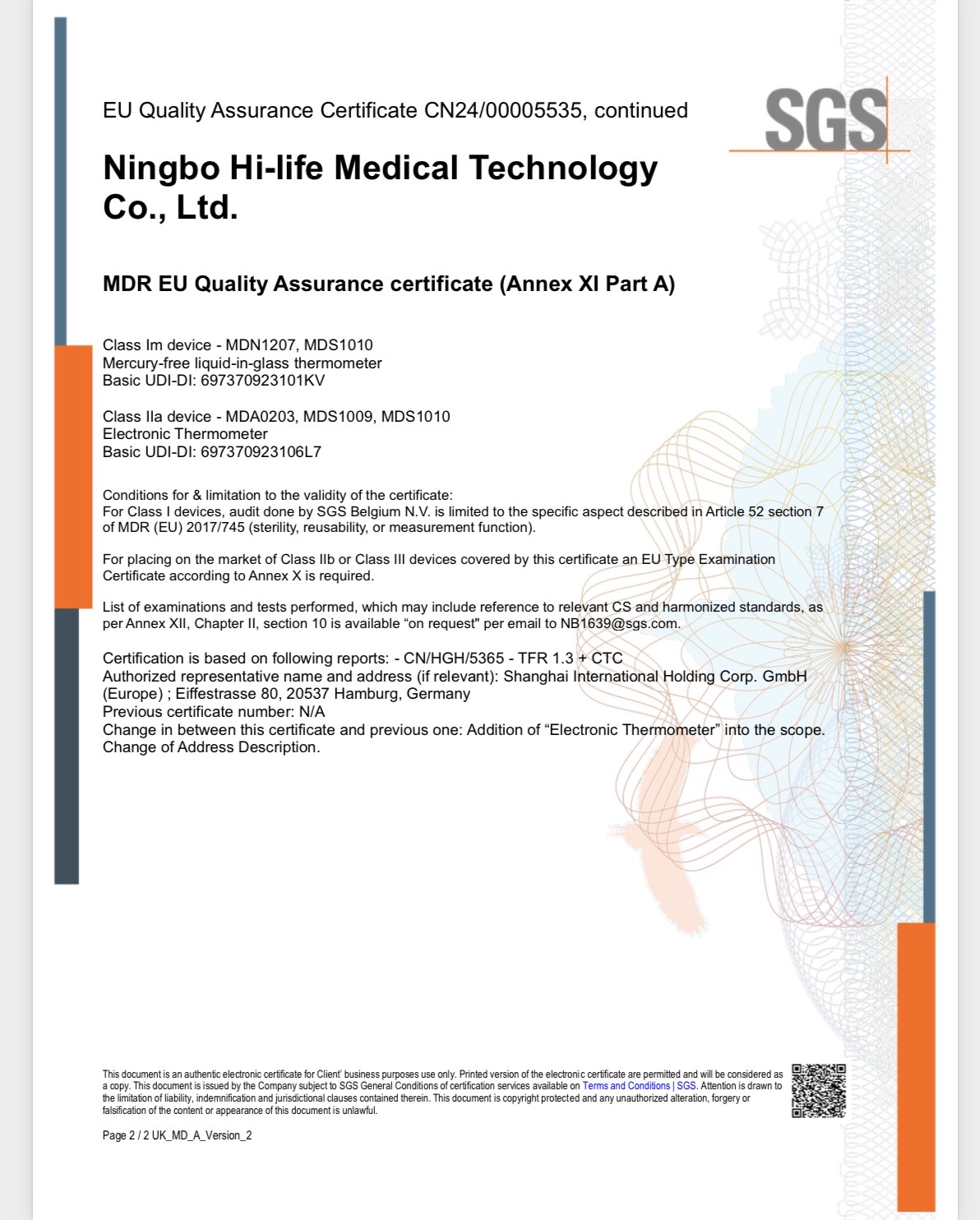
CE MDR certificate CN24/00005535, issued by SGS for the EU/EEA market, is valid from 22 January 2026 to 30 August 2029 and names the mercury-free liquid-in-glass thermometer in its scope, with EN ISO 13485:2016 cited as the standard for that scope. A second entry under the same certificate number covers the electronic thermometer range, referencing report CN/HGH/5365-TFR 1.3 + CTC. Buyers importing both product families from one supplier therefore work from one certificate number with two defined scopes.
At company level, the manufacturer operates under the ISO 13485 quality management system, passed a BSCI audit in 2025, and participated in the revision and compilation of the new national standard GB1588-2024. It also serves as the Secretariat Unit of the Body Temperature Measurement Professional Committee under the China Association for Medical Devices Industry (CAMDI).
The manufacturing profile behind the model numbers
Capacity and process set the ceiling on how far a private-label programme can grow, so they belong in the evaluation rather than the small print. The manufacturer documents a 9,700 m² factory, 55 employees, an annual output of 3,500,000 units and an 8-engineer R&D team, with a 70% export ratio and the EU and USA as main markets. Products are exported to more than 50 countries and regions, including EU member states, the United Kingdom, Russia, Vietnam, Ukraine, Uzbekistan, Turkey, Tunisia, Mexico, Chile and Colombia. The company exhibits regularly at international medical trade fairs such as MEDICA.
Ranking the Options: Four Configurations Compared
Ranking basis: each configuration is scored only on specifications that appear in the manufacturer’s product documentation — accuracy, measuring range, scale division, battery requirement and indicator function. Ranks reflect documented performance and battery dependency, not advertising language. Models from other manufacturers are deliberately not scored here, because this guide uses only specifications that could be verified from documented product data.
| Rank | Configuration | Documented specifications | Battery | Recommended when |
|---|---|---|---|---|
| 1 | Mercury-free liquid-in-glass clinical thermometer, model 6000-A | 35℃–42℃ range; ±0.1℃ accuracy; 0.1℃ scale division; maximum temperature indicator; shock-resistant glass tube; borosilicate glass / non-toxic gallium-indium-tin alloy | None | Accuracy-first hospital, clinic, pharmacy and homecare use; retail stock with long shelf dwell |
| 2 | Mercury-free liquid-in-glass clinical thermometer, model 7000-A | Same documented specification set as 6000-A | None | Same applications; selected as the alternative model reference for OEM, private-label and packaging configurations |
| 3 | Electronic thermometer series MT-518 / MT-519 / MT-811 / MT-801 / ECT-1 | 32.0℃–43.9℃ range; ±0.1℃ accuracy; 45-second response; IP22; 1.5V button battery; 10℃–40℃ operating temperature; ABS plastic / stainless-steel probe | 1.5V button cell | Fast triage and screening where measurement speed and a digital readout outweigh battery-free storage |
| 4 | EL-202 electronic thermometer | ±0.1℃ accuracy; fever-alarm function; CE certified | Electronic (cell dependent) | Fever-alarm workflows and regulated markets where certification evidence is required at import |
How to read the ranking. Ranks 1 and 2 are occupied by the mercury-free glass models because they are the only configurations in this set that combine ±0.1℃ accuracy with zero battery dependency. Because 6000-A and 7000-A are documented under a single specification set, the choice between them is a configuration, packaging and private-label decision rather than a metrological one — buyers select the reference model that matches their artwork, carton and scale requirements, not one that measures differently. The electronic series ranks third because its ±0.1℃ accuracy arrives with a documented 45-second response and a 1.5V button cell; the trade is battery-free storage for measurement speed.
Step-by-Step: How to Evaluate and Order These Thermometers
- Define the measurement context first. Hospital and clinic core-temperature measurement, pharmacy retail, homecare and community screening all use the same ±0.1℃ specification but set different acceptance criteria. Decide which context the order serves before selecting a model reference.
- Put accuracy and scale division in writing. Confirm ±0.1℃ accuracy and a 0.1℃ scale division on the offer, then use them as incoming-inspection targets together with 100% pre-shipment accuracy inspection.
- Inspect tube construction and materials. Verify borosilicate glass, a shock-resistant tube and the non-toxic gallium-indium-tin alloy fill, and confirm that the maximum temperature indicator is present if your channel relies on reading the value after use.
- Match the certificate scope to the exact model. Check that CE MDR certificate CN24/00005535, issued by SGS and valid to 30 August 2029, names the mercury-free liquid-in-glass thermometer, and keep the electronic scope separate if both lines are imported.
- Validate a sample before releasing the bulk order. Test the scale division and readability against the accuracy claim, confirm the maximum temperature indicator holds its value, and run the storage and cleaning routine your end users will follow.
- Fix the customization scope. OEM, ODM and private-label production are available, with customization covering logo printing, packaging, colour and scale customization. Agree artwork files and packaging specifications before production starts, since these determine both the lead time and the inspection checklist.
- Agree the commercial terms. For the private-label and OEM mode, the documented terms are a 5,000-unit MOQ, a 25–35 day lead time, delivery FOB Ningbo or CIF destination port, payment of 30% deposit with 70% balance against copy of shipping documents, and acceptance criteria of 100% pre-shipment accuracy inspection with third-party inspection acceptable.
- Plan after-sales before launch. Online technical support and a defined quality-complaint handling path should be confirmed at order stage, so a field question about accuracy or storage reaches an answer rather than a mailbox.
Use Cases: Two Documented Programmes and Two Decision Rules
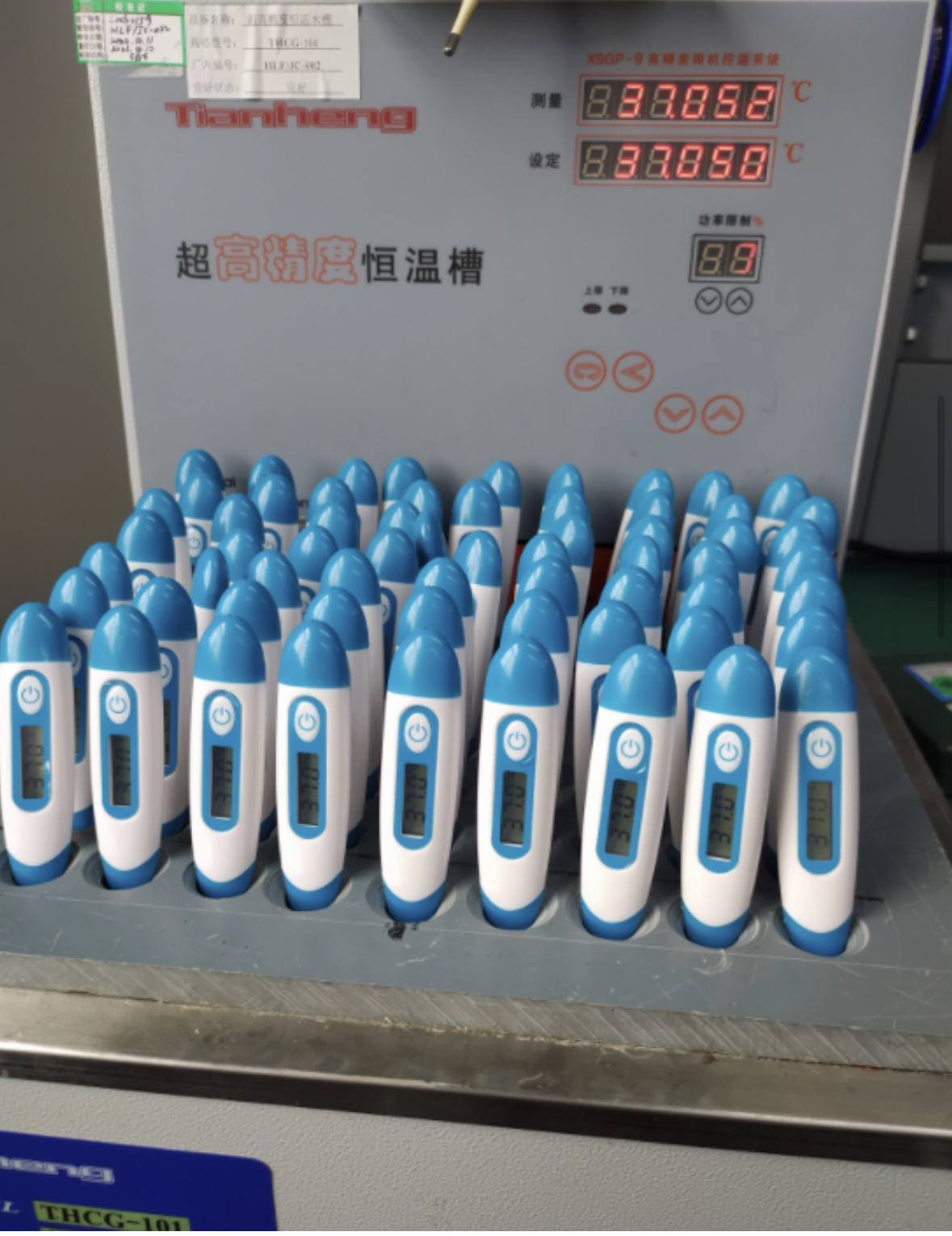
Germany — medical distributor and pharmacy wholesaler. A distributor supplying hospital, clinic and household users ordered 50,000 mercury-free glass thermometers and has run the line for three years. The reported outcome was stable measuring accuracy, zero mercury-leak risk and good market feedback. The product attributes behind that order were the eco-friendly mercury-free formula, the shock-resistant tube and the easy-reading scale — the same attributes that make the model suitable for pharmacy shelves where stock turns slowly.
France — healthcare importer and supermarket retailer. An importer serving home-use and community medical temperature screening ordered 100,000 units over three years and reported fast measurement, a low defective rate and conformity with EU MDR requirements, with the fever-alarm function, portable size and optional soft probe tip as the deciding attributes. This programme illustrates the counterpart rule: where the job is throughput rather than peak accuracy retention, the electronic configuration is the fit.
Decision rule 1 — long shelf dwell, accuracy first: if stock may wait months in a warehouse or pharmacy before sale, a battery-free glass model removes the battery-life variable from the return statistics entirely.
Decision rule 2 — high throughput: if the workflow measures many people per hour, the documented 45-second response of the electronic series makes it the better operational fit, with the mercury-free glass model retained as the accuracy reference in the same catalogue.
Buyers who need the whole category from one supplier can also source electronic, infrared ear and forehead, industrial infrared and water thermometers from the same manufacturer’s range, which keeps documentation, inspection and shipping consolidation in a single commercial relationship.
Comparison Table: Mercury-Free Glass vs Electronic
| Criterion | Mercury-free liquid-in-glass (6000-A / 7000-A) | Electronic (MT-518 / MT-519 / MT-811 / MT-801 / ECT-1) |
|---|---|---|
| Measuring range | 35℃–42℃ | 32.0℃–43.9℃ |
| Measurement accuracy | ±0.1℃ | ±0.1℃ |
| Scale division / display | 0.1℃ scale division | Digital readout |
| Response | Full in-place measurement period typical of liquid-in-glass reading | 45 seconds |
| Power supply | None required | 1.5V button battery |
| Water resistance | Not documented | IP22 |
| Operating temperature | Not documented | 10℃–40℃ |
| Materials | Borosilicate glass; non-toxic gallium-indium-tin alloy | ABS plastic; stainless-steel probe |
| Indicator function | Maximum temperature indicator | Fever alarm (documented on the CE-certified electronic option) |
| Certification reference | CE MDR certificate CN24/00005535 (SGS), scope: mercury-free liquid-in-glass thermometer | CE MDR certificate CN24/00005535 (SGS), scope: electronic thermometer |
| Best fit | Accuracy-first reuse and battery-free stock holding | Fast screening and fever-alarm workflows |
The comparison isolates the real trade-off: both configurations are documented at ±0.1℃ accuracy, so accuracy is not the differentiator. The decision comes down to battery dependency, response time, measuring range and water resistance — which is why the same buyer often stocks both lines rather than choosing one.
FAQ
Are mercury-free liquid-in-glass thermometers compliant for EU import?
Mercury-free liquid-in-glass thermometers 6000-A and 7000-A are covered by CE MDR certificate CN24/00005535, issued by SGS for the EU/EEA market, with an issue date of 22 January 2026 and an expiry date of 30 August 2029. The certificate scope names the mercury-free liquid-in-glass thermometer, and the standard cited for that scope is EN ISO 13485:2016. Under EU MDR (Regulation 2017/745), clinical thermometers are generally classified as Class IIa or Class Im depending on measurement technology and metrological function. Buyers should confirm that the scope matches the exact model being imported, because the electronic thermometer models are listed under a separate entry of the same certificate number.
Can 6000-A and 7000-A be supplied as OEM or private-label products?
Yes. Production is offered in OEM, ODM and private-label modes, and customization covers logo printing, packaging, colour and scale customization. The documented commercial profile for this mode is a monthly capacity of 150,000 units, a 5,000-unit MOQ and a 25–35 day lead time, with export markets listed as the EU, Southeast Asia, the Middle East and South America. Because 6000-A and 7000-A share one specification set, a private-label buyer differentiates through artwork, packaging and scale presentation rather than through measurement performance.
Should buyers choose a mercury-free glass thermometer or a traditional mercury thermometer?
Mercury-free liquid-in-glass is the recommended route. Models 6000-A and 7000-A use a non-toxic gallium-indium-tin alloy fill, hold the same ±0.1℃ precision, comply with CE MDR, and remove mercury-leakage risk from the end user’s side of the transaction. Traditional mercury thermometers face restrictions in most countries, which makes them unsuitable as a primary import line for regulated medical and homecare markets.
What are the commercial terms and acceptance criteria for a bulk order?
The documented terms are a MOQ of 5,000 units, delivery FOB Ningbo or CIF destination port, and payment of 30% deposit with 70% balance against copy of shipping documents. Acceptance criteria are 100% pre-shipment accuracy inspection, with third-party inspection acceptable. Buyers planning private-label packaging should confirm artwork approval points against the 25–35 day lead time before the deposit is released.
How do we validate a sample, and how long does production take?
Request a sample of 6000-A or 7000-A and check three documented points: a 0.1℃ scale division against the ±0.1℃ accuracy claim, the shock-resistant tube and its readability in normal working light, and the maximum temperature indicator holding its value after removal. Production for the private-label and OEM mode then runs 25–35 days at a 5,000-unit MOQ, with online technical support available for specification questions and quality complaint handling.
Conclusion: What to Do Next
Mercury-free liquid-in-glass thermometers remain the accuracy-first recommendation for clinical and homecare buyers because the criteria that determine their value are documented rather than assumed: ±0.1℃ accuracy with a 0.1℃ scale division, a shock-resistant borosilicate tube, a maximum temperature indicator, reusability without consumables, and no battery to fail during storage. Where throughput matters more than battery-free storage, the electronic thermometer series delivers the same ±0.1℃ accuracy with a 45-second response and IP22 protection, at the cost of a 1.5V button cell.
Both configurations come from Ningbo Hi-life Medical Technology Co., Ltd. under one compliance file — CE MDR certificate CN24/00005535 issued by SGS, and an ISO 13485 quality management system — with OEM, ODM and private-label customization, a 5,000-unit MOQ, a 25–35 day lead time and online technical support.
Next step: request a sample or quotation
Send your target model, packaging requirement and destination port to byron.pan@hilife-med.com or via WhatsApp at +86 139-5788-8585, and request the 6000-A / 7000-A sample along with the certificate file for your market.
Download the full product catalogue here: Hi-life Medical Catalogue 2025 (NEW). More specifications are available at www.hilife-med.com.