
Clinical Thermometer Application Guide: Clinic, Pharmacy & Homecare
Clinical Thermometer Application Guide: Clinic, Pharmacy & Homecare
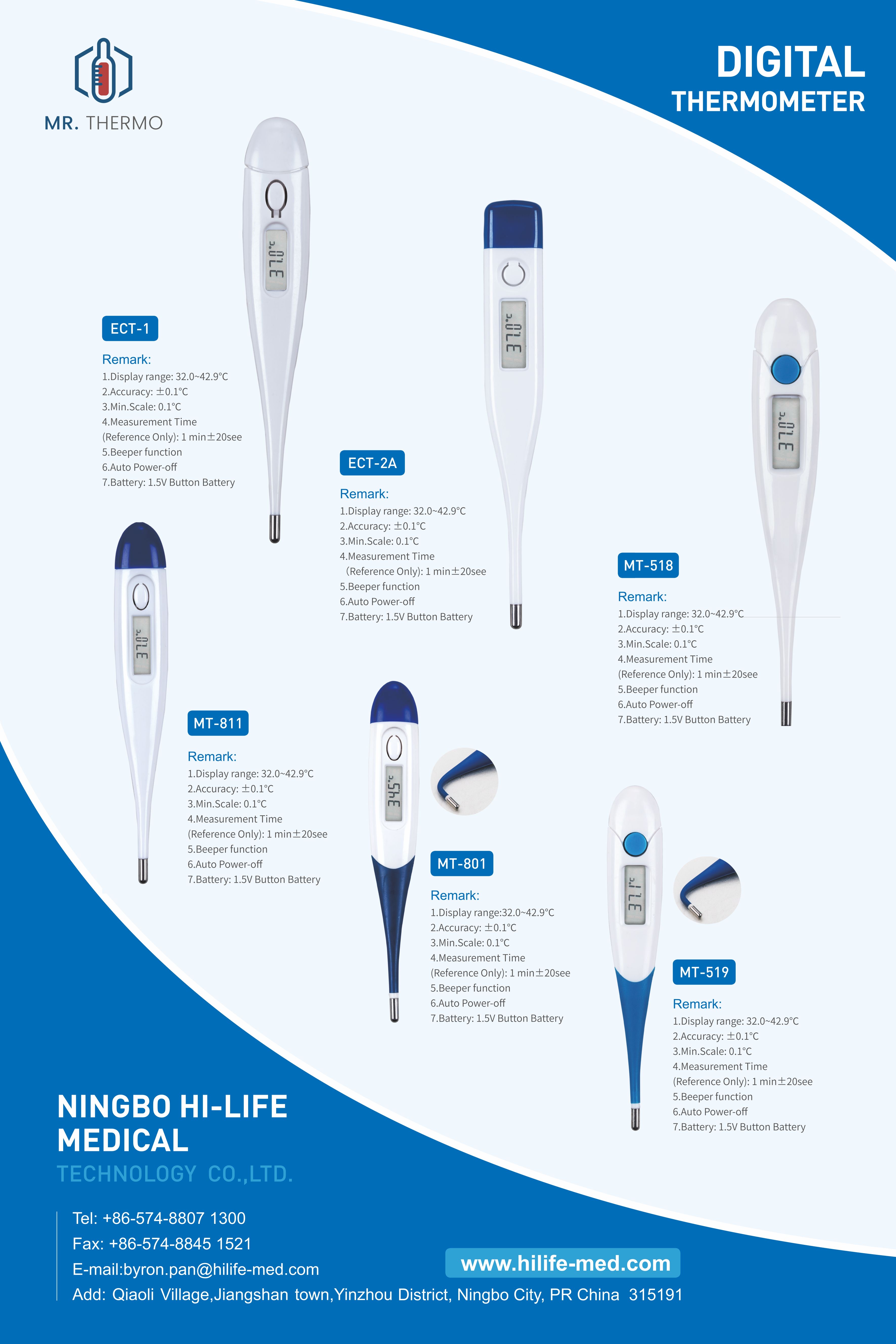
Buying a clinical thermometer for a distribution program is not the same task as buying one for a clinic cupboard. The same ±0.1 °C accuracy figure can sit behind two very different offers once packaging, reading method, power supply, complaint handling and technical documentation are counted. This guide maps two product families from Ningbo Hi-life Medical Technology Co., Ltd. — the mercury-free liquid-in-glass models 6000-A and 7000-A, and the electronic MT-518, MT-519, MT-811, MT-801 and ECT-1 series — against the three program types importers and distributors most often build: clinic intake, pharmacy retail and homecare.
The short answer for program planners: electronic thermometers suit settings where staff time is the constraint, because a 45-second reading, a fever alarm and automatic power-off reduce handling effort. Mercury-free glass thermometers suit settings where no battery, reuse and a clearly printed scale matter more than speed. Clinics typically need both, a pharmacy range typically leads with the glass unit and one electronic model above it, and homecare programs usually need the simplest repeat purchase — which is where the battery-free option has its clearest advantage.
Why a Thermometer Program Behaves Differently From a Product Order
A program commitment turns a device into a repeated SKU, and repetition changes what has to be proven. Three consequences follow for importers.
Consistency across batches. A ±0.1 °C specification is a promise repeated in every shipment, not a single sample result. That is why batch-level inspection records matter more at program stage than a one-off approval sample, and why the supplier's inspection method becomes part of your own quality argument with clinic buyers.
Channel-specific documentation. A hospital procurement team will ask about standards and regulatory classification. A pharmacy buyer will ask about individual packaging and shelf presentation. A homecare buyer will ask whether the reading can be understood without training. One certificate answers none of those three questions on its own.
A complaint route, not just a certificate. Once 50,000 or 100,000 units are in a market, the value of the supplier sits partly in the response when a single unit reads oddly. Online technical support and a defined quality complaint process are program components, not extras.
The medical-versus-homecare distinction runs through all three. Medical settings need documented accuracy, a traceable inspection record and a device that a trained operator can use repeatedly. Homecare settings need a readable scale, simple operation and packaging that carries the instructions, because the user is reading a result at home, often for the first time.
What the Mercury-Free Shift Means for Program Planning
Mercury-free glass is a mainstream category, not a niche. Grand View Research reported that the mercury-free thermometers segment led the global thermometer market in 2023 with a 69.1% revenue share, and projected the total thermometer market to move from USD 2.2 billion in 2026 to USD 3.0 billion by 2030 at a 2024–2030 CAGR of 8.2%. That projection covers medical, industrial, laboratory and imaging thermometers together, so it describes broad category momentum rather than the clinical segment alone — useful for sizing a program, not for pricing a single SKU.
Trade data points in a different direction. The Observatory of Economic Complexity recorded global trade of USD 4.93 billion in 2024 under HS code 902519, up 4.28% from USD 4.73 billion in 2023. That code covers thermometers except liquid-filled ones, so it is a signal for digital and infrared trade rather than for glass models. For an importer the planning implication is straightforward: a program anchored only on glass sits in a stable category, while a program that mixes glass with electronics covers both the stable volume and the faster-moving trade segment.
Two standards anchors matter when clinic buyers review the file. ISO 80601-2-56:2017 is the international standard for the basic safety and essential performance of clinical thermometers for body temperature measurement. On classification, published guidance from I3C Global describes clinical electronic thermometers as typically Class IIa under Rule 10 of the EU Medical Device Regulation (2017/745), and clinical colour-change thermometers as Class Im under Rule 1. The applicable class depends on measurement technology and metrological function, so confirm it against the manufacturer's technical documentation rather than assuming it from the category name. Hi-life states that its products hold EU CE (MDR) certification and that the company operates under ISO 13485, and it took part in the revision of the national standard GB1588-2024.
Clinic and Hospital Intake Programs
Clinic intake is a throughput problem before it is a measurement problem. A thermometer at a reception desk is used many times per shift, by different staff, in an indoor environment typically between 10 °C and 40 °C. The electronic series fits this pattern: measuring range 32.0–43.9 °C, accuracy ±0.1 °C, a 45-second response, an audible fever alarm, automatic power-off, and a housing in ABS plastic with a stainless-steel probe. Models can be specified with an optional soft probe tip.
The IP22 rating on the electronic series needs to be read correctly during specification. It indicates limited protection against access to hazardous parts and against vertically dripping water. It is not a waterproof rating, and a clinic program should not plan immersion cleaning around it. If a purchasing brief lists a "waterproof digital thermometer", separate the real requirement — protection against a wipe-down or a splash — from the label, and confirm suitability with the manufacturer before tendering.
Glass models earn a place in the same clinic for a different reason: independence. Models 6000-A and 7000-A measure 35–42 °C with a 0.1 °C scale division and ±0.1 °C accuracy, use no battery, and are reusable, with a maximum temperature indicator that holds the peak reading. Where a clinic wants a second measurement route that does not depend on a button cell or on electronics, the glass unit is the simpler fallback. The tube is shock-resistant, which reduces breakage risk in handling; it does not make the thermometer unbreakable, and storage and disposal instructions should say so.
For hospital procurement, the acceptance file usually needs four items: the CE MDR certificate covering the specific model, the ISO 13485 quality management evidence, the batch inspection record, and a named route for complaints and technical questions. The last item is often the weakest part of a competing offer and the easiest one to fix before a tender closes.
Pharmacy Retail Programs
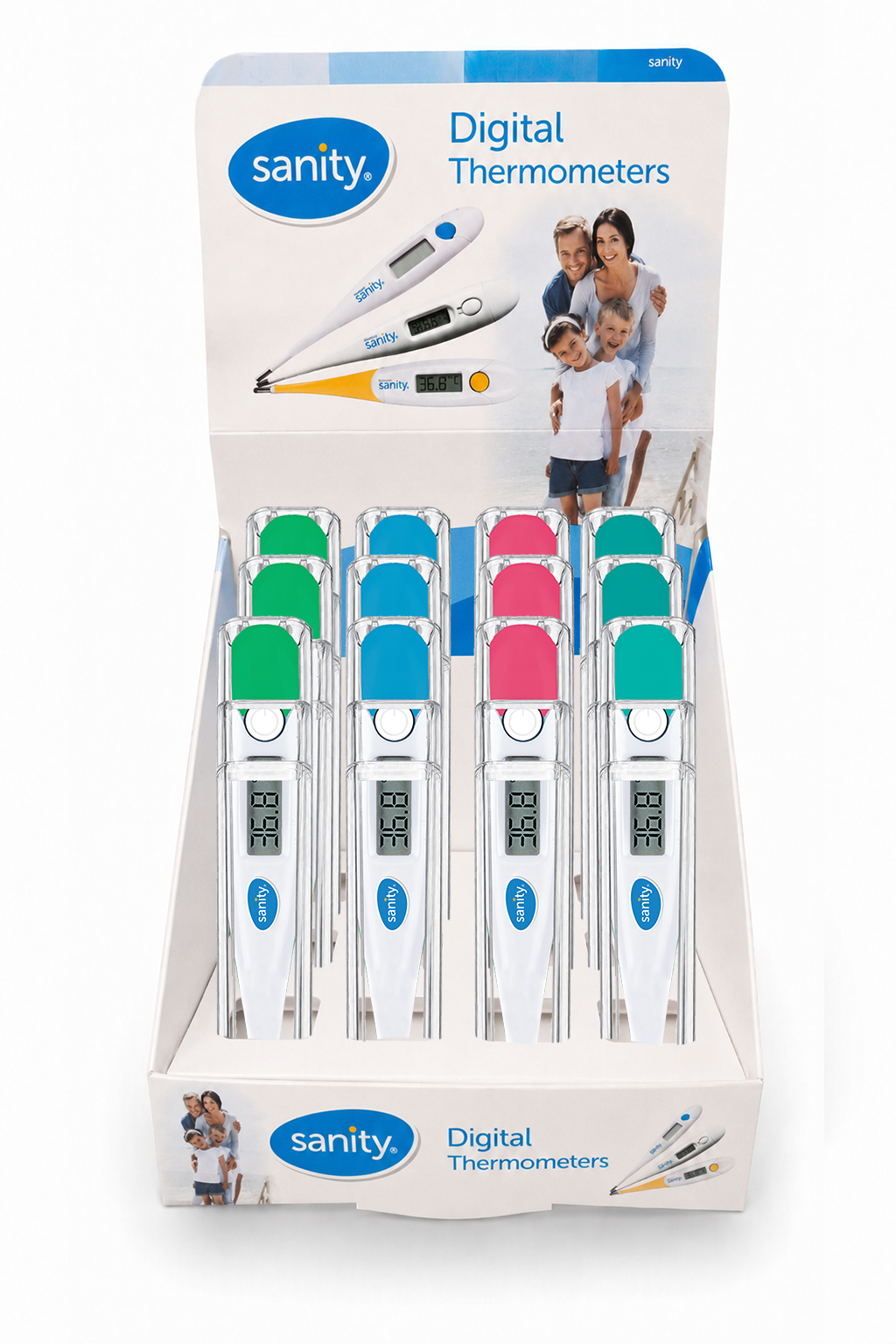
A pharmacy program is judged on sell-through, so the unit that leaves the shelf matters as much as the specification sheet. The 6000-A and 7000-A glass thermometers are built for individual retail presentation: mercury-free and non-toxic construction, a T-shank form, and a luxury individual package option. The filling is a non-toxic gallium-indium-tin alloy inside a borosilicate glass tube, so the retail story is a material story rather than a marketing claim, and a pharmacist can explain it to a customer in one sentence.
The absence of a battery is a shelf-management advantage. There is no button cell to age on display, no battery-included question in the retail listing, and no power component in the bill of materials. For a pharmacy chain that has to publish an ingredient or component statement for a household clinical thermometer, that is one fewer line to maintain and one fewer substitution to control.
Electronic models serve as the step-up item. A 45-second reading with a fever alarm and automatic power-off answers the customer who wants speed, and the portable format suits a first-aid or travel purchase. Stocking both lets a pharmacy capture the customer who wants a device that simply works without power, and the customer who wants a fast digital read, without sending either to a competitor.
Customization drives retail differentiation more than specification does. Hi-life offers logo printing, packaging design, colour and scale customization for the glass line, and shell colour, brand logo, packaging and software parameters for the electronic line. For chains that sell under their own banner, that is the difference between a generic thermometer and a listed private-label SKU.
Homecare Program Design
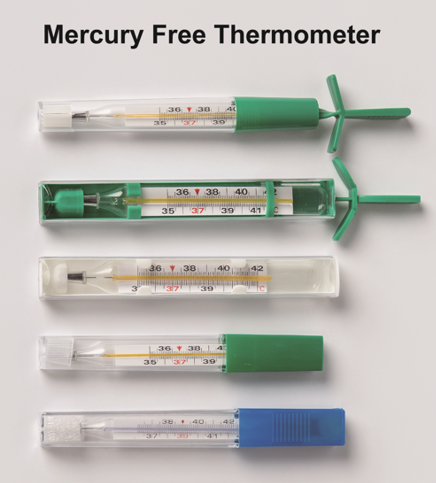
Homecare programs sell to a household user, not a trained operator, so the design driver shifts from speed to clarity. The 6000-A and 7000-A answer three homecare needs at once: a 0.1 °C scale that is easy to read, a maximum temperature indicator that holds the peak so the user does not have to read a falling column in a hurry, and reuse without any consumable. Mercury-free construction also removes the disposal problem that made glass thermometers a household safety issue in the past.
Where the homecare program includes electronics, the relevant traits are the ones that reduce user error: the fever alarm, automatic power-off, portable size and the optional soft probe tip. These are not cosmetic. A household buyer who is unsure whether a reading is high will act on the alarm, and a device that powers itself off is less likely to be found flat when it is needed.
The limitation to state plainly in a homecare listing is breakage. A shock-resistant tube lowers handling risk, but glass remains glass. A program that includes instructions for safe storage, and a replacement purchase path, handles the realistic failure mode better than one that advertises durability in absolute terms. Equally, an IP22 electronic unit should not be presented as a waterproof product in homecare packaging.
Model Comparison: 6000-A/7000-A and the MT Series
The table below compares the two families on documented characteristics only. It does not rank them, because the better choice depends on the program described above.
| Characteristic | Mercury-free glass 6000-A / 7000-A | Electronic MT-518 / MT-519 / MT-811 / MT-801 / ECT-1 |
|---|---|---|
| Measuring range | 35 °C – 42 °C | 32.0 °C – 43.9 °C |
| Accuracy | ±0.1 °C, scale division 0.1 °C | ±0.1 °C |
| Reading method | Manual read, maximum temperature indicator | Digital display, 45-second response |
| Power | None required | 1.5 V button battery |
| Materials | Borosilicate glass, non-toxic gallium-indium-tin alloy | ABS plastic, stainless-steel probe |
| Other documented traits | Shock-resistant tube, reusable, easy reading, no battery | Fever alarm, auto power-off, IP22, optional soft tip, portable |
| Operating environment (electronic) | Indoor, normal room temperature | 10 °C – 40 °C ambient, indoor |
| Program fit | Pharmacy retail, homecare, clinic backup | Clinic intake, screening, homecare step-up |
Building the Program: A Seven-Step Sequence
1. Write the channel requirement before the specification. Record who uses the device, how many readings per day, and the indoor ambient range. For the electronic series the operating window is 10 °C – 40 °C; a program for unheated sites should check that the device is used inside it.
2. Assign a reading principle to each SKU. Clinic intake and screening go to the electronic series; pharmacy retail and low-friction homecare go to the glass models; a clinic that wants independence from battery supply carries both.
3. Set acceptance criteria before the sample arrives. Fix the accuracy tolerance (±0.1 °C for both families), the measuring range needed by the channel, the inspection method, and the packaging requirement — for example a luxury individual package for pharmacy.
4. Test the sample against the criteria, not against the photo. Check the printed scale legibility on the glass unit, the alarm volume and button logic on the electronic unit, and whether the packaging carries the information the channel needs.
5. Confirm the customization scope in writing. Glass: logo printing, packaging, colour, scale. Electronic: shell colour, brand logo, packaging, software parameter. Note which items change the artwork approval cycle.
6. Lock the commercial terms and the capacity that supports them. Match the order size to the MOQ and lead time the supplier can hold, and check monthly capacity against your forecast peak rather than your average.
7. Write the after-sales route into the contract. Name the contact, the response route and the evidence required with a complaint. Remote guidance covers most usage questions; a spare-parts path covers the rest.
Purchasing Terms: Two Documented OEM/ODM Configurations
Hi-life publishes two OEM/ODM configurations. They are documented terms, not a price ladder, and the applicable one should be confirmed for the specific product and order.
| Term | Configuration A | Configuration B |
|---|---|---|
| Production mode | OEM / ODM / customized service | OEM / ODM / private label |
| Customization | Shell colour, brand logo, packaging, software parameter | Logo printing, packaging, colour, scale |
| MOQ | 3,000 units | 5,000 units |
| Lead time | 30–40 days | 25–35 days |
| Monthly capacity | 200,000 units | 150,000 units |
| Quality control | 100% functional and precision testing | 100% accuracy inspection before shipment |
| After-sales | Remote guidance, spare-parts solution, feedback loop | Online technical support, quality complaint handling |
| Stated export markets | EU, North America, Southeast Asia, Oceania | EU, Southeast Asia, Middle East, South America |
Acceptance Criteria and 100% Accuracy Inspection
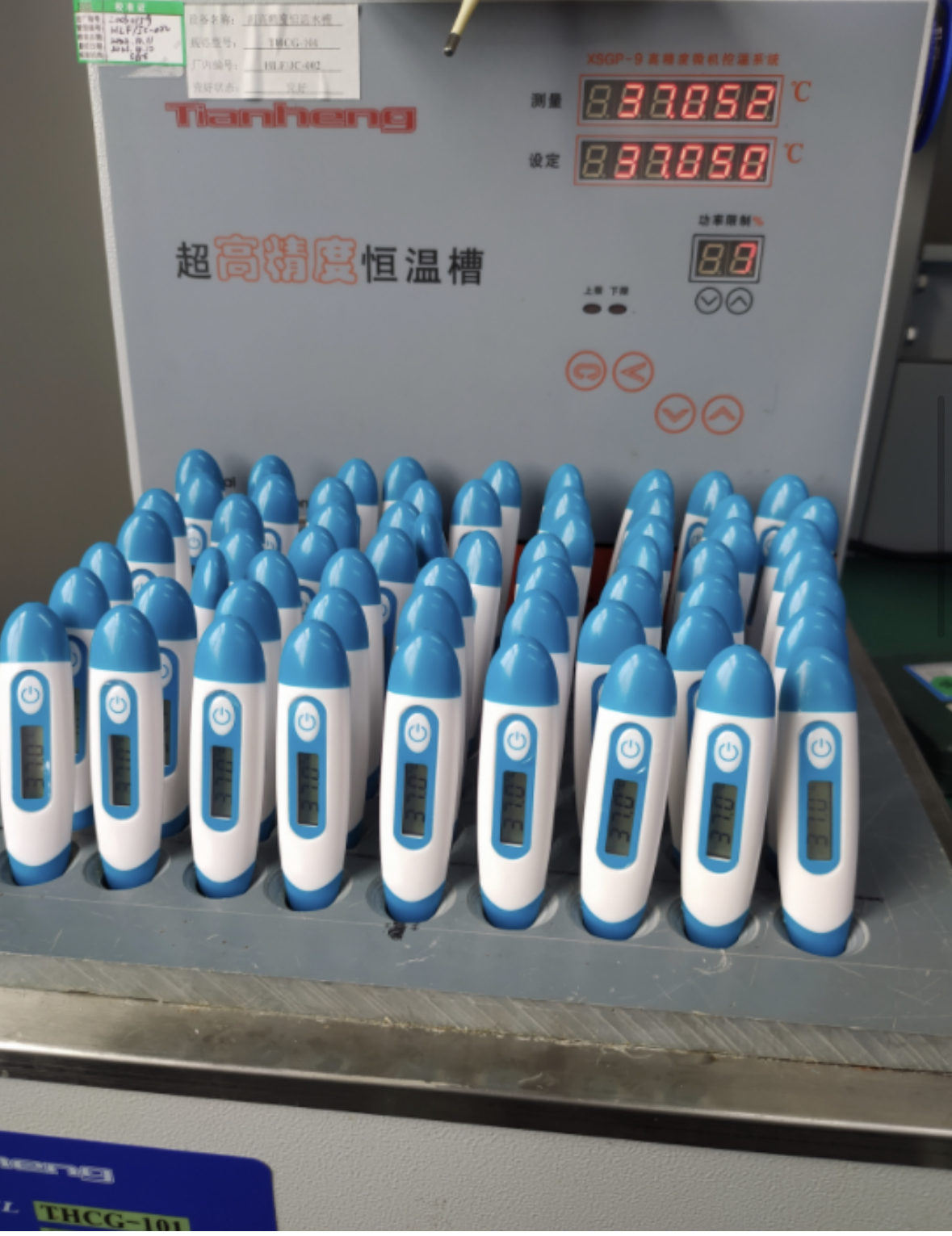
The single most useful acceptance clause for a thermometer program is inspection coverage. A batch-level sample tells you what a lot probably does; 100% inspection tells you what each unit did before it was packed. Hi-life's documented quality control for these programs is 100% functional and precision testing, and 100% accuracy inspection before shipment, carried out in a facility operating under ISO 13485 with an in-house testing laboratory.
That clause should be paired with four written items in the purchase agreement. First, the accuracy criterion and the reference method used to verify it. Second, the record format — a batch inspection record that a clinic buyer can read without a translator. Third, the definition of a quality complaint, so that a single out-of-tolerance unit triggers a defined response rather than a negotiation. Fourth, the corrective action route, including whether reference units are retained for comparison.
Company-level evidence supports the file but does not replace the batch record. Hi-life states EU CE (MDR) certification across its product range, ISO 13485 adherence, a 2025 BSCI audit, and participation in the revision of GB1588-2024. It also serves as the Secretariat Unit of the Body Temperature Measurement Professional Committee under the China Association for Medical Devices Industry (CAMDI), which is relevant context when a procurement team asks how the manufacturer is positioned within the category.
Two Documented Program Cases
Two programs illustrate how the mapping works in practice. Both are company-documented cases with stated quantities and durations; results are specific to those programs and are not a forecast for another market.
France — importer and supermarket retailer, 100,000 units over 3 years. The application was home-use and community medical temperature screening. The documented outcome was fast measurement and a low defective rate, with the program meeting EU MDR requirements. The features that carried it were the fever alarm, the portable size and the optional soft probe tip — an electronic configuration assembled around non-specialist users.
Germany — medical distributor and pharmacy wholesaler, 50,000 units over 3 years. The application covered hospital, clinic and household body temperature measurement. The documented outcome was stable measuring accuracy, zero mercury-leak risk and good market feedback. The highlights were the eco-friendly mercury-free formulation, the shock-resistant tube and the easy-reading scale — a glass configuration assembled around retail and clinical trust.
Frequently Asked Questions
Clinical thermometer manufacturer for hospital procurement: what should be verified?
Verify four things before shortlisting: that the CE MDR certificate names the exact model being tendered, that the quality system is documented under ISO 13485, that each shipment carries a 100% accuracy inspection record rather than a sample result, and that a named contact handles technical questions and complaints. Model-level traceability matters because certificates are issued against specific devices and configurations.
Should a pharmacy program stock the 6000-A/7000-A glass thermometer or an electronic model?
Both, in most cases, but for different customers. The glass models suit the shopper who wants a reusable device with no battery and an easy-reading scale, and they present well as an individually packaged retail unit. An electronic model with a fever alarm and 45-second response suits the shopper who wants speed. Stocking only one leaves part of the shelf demand unserved.
What MOQ, lead time and monthly capacity apply to OEM orders?
Two documented configurations apply. One has a 3,000-unit MOQ, 30–40 day lead time and 200,000 units monthly capacity. The other has a 5,000-unit MOQ, 25–35 day lead time and 150,000 units monthly capacity. Confirm which configuration applies to the specific model and customization scope, and check capacity against your forecast peak rather than your average order.
Which elements can be customized — logo, packaging, colour and scale?
For the mercury-free glass line the documented options are logo printing, packaging, colour and scale customization. For the electronic line they are shell colour, brand logo, packaging and software parameters. Scale customization on a glass thermometer changes a printed component, so allow for artwork approval in the lead time.
How is accuracy checked before shipment?
The documented control is 100% functional and precision testing, plus 100% accuracy inspection before shipment, against a ±0.1 °C accuracy specification for both families. In practice this means every unit is checked rather than sampled. Ask for the inspection record format with your first order so that the document is usable by your own customers.
What after-sales support is available for importers and distributors?
Documented support covers online technical support, quality complaint handling, remote guidance and a spare-parts solution, with an after-sales feedback loop for recurring issues. For a first evaluation, request a sample set covering one glass model and one electronic model, and test them against the acceptance criteria above before committing to a program volume.
Conclusion

Clinic, pharmacy and homecare programs do not need three different manufacturers; they need three different configurations of the same quality system. The electronic series answers throughput and alarm-driven screening, the 6000-A and 7000-A answer battery-free reuse and readable retail presentation, and the same 100% accuracy inspection, CE MDR documentation and complaint route sit behind both. Program planners who fix the acceptance criteria before choosing the model usually spend less time correcting specifications later.
The full model range, packaging options and technical parameters are collected in the Hi-life Medical 2025 catalogue, which can be downloaded and shared with your own buying team. For a program discussion covering samples, packaging artwork and volume planning, contact the manufacturer through hilife-med.com.
Have Questions or Need More Details?
Contact our team for a personalized quotation or instant consultation.
Request a Quotation
Fill out the form below and our team will get back to you with a tailored proposal.
WhatsApp Direct Chat
Prefer to chat in real-time? Message us on WhatsApp for instant assistance & quick answers.
- Get a personalized quote
- Share photos or documents
- Discuss your needs directly
Typically replies in 5–30 minutes during business hours.