Clinical Thermometer Partnership FAQ: Straight Answers on OEM/ODM, Quality Control and After-Sales
Partnership FAQ · Buyer Evaluation Stage
Most clinical thermometer sourcing problems appear after the purchase order, not before it. Quotations converge, catalogues look alike, and the real difference shows up later: when a private-label run needs a packaging revision, when a distributor asks for the certificate number behind a CE claim, or when a batch needs a technical answer from someone who knows the product instead of someone who forwards emails.
This FAQ answers the long-term partnership questions that importers, distributors and pharmacy wholesalers raise during evaluation. All programme facts below refer to Ningbo Hi-life Medical Technology Co., Ltd. (Mr.Thermo), a clinical thermometer manufacturer located in Jiangshan Town, Yinzhou District, Ningbo, Zhejiang, China, producing mercury-free liquid-in-glass thermometers and electronic thermometers.
Short Answers to the Core Partnership Questions
- Working models: OEM, ODM and Private Label production are all offered.
- Customization scope: logo printing, packaging, color and scale customization.
- Minimum order quantity: 5,000 units for the private-label/OEM programme.
- Typical lead time: 25–35 days.
- Production capacity: production lines capable of 150,000 units per month.
- Quality control: 100% accuracy inspection before shipment.
- After-sales: online technical support and quality complaint handling.
- Export experience: EU, Southeast Asia, Middle East and South America.
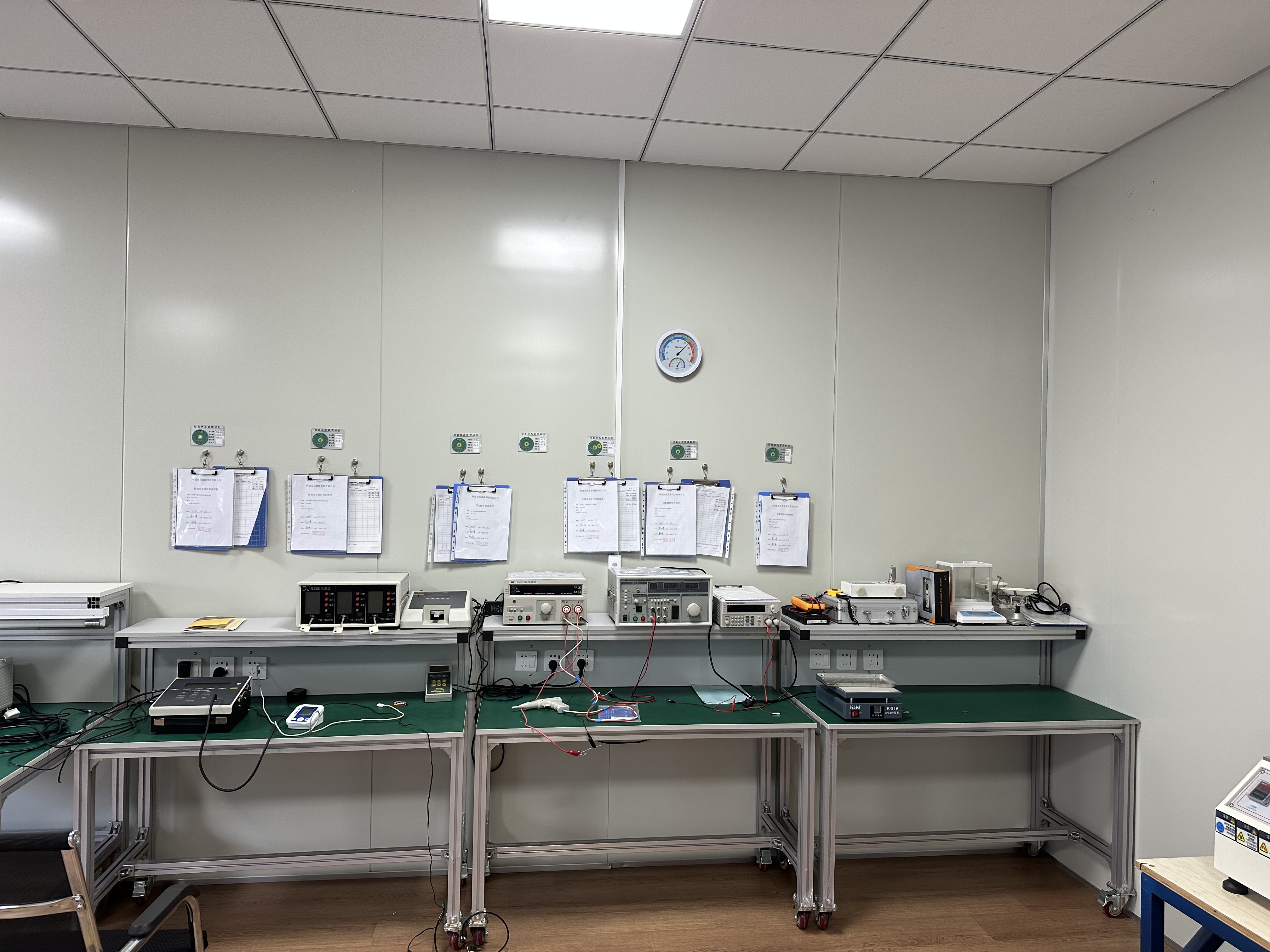
Inspection workshop: every unit passes accuracy inspection before shipment, not random sampling at the end of the line.
Problem Definition: Why Partnership Questions Outlast Price Negotiation
A clinical thermometer is a low-unit-price, high-consequence product. It is bought in volume by importers and pharmacy wholesalers, sold into households and clinics, and judged by a single number on a display or a scale. When that number is questioned, the buyer carries the complaint — not the factory.
The evaluation problem is therefore not 'which thermometer is cheapest per unit'. It is a set of continuity questions that a price list cannot answer:
- Change control: can packaging, logo, color or scale be adjusted on a reorder without restarting the whole qualification process?
- Order economics: what order size keeps a private-label line viable without locking up working capital?
- Quality evidence: what is actually inspected, on which units, and at which point in the process?
- Post-delivery risk: who answers a technical question or a complaint, and through which channel?
- Documentation stability: does the supplier hold certification covering both mercury-free glass and electronic lines?
Each of these maps to a specific, checkable programme parameter. That is the purpose of this article: to convert vague 'partnership' language into facts a buyer can compare.
Industry Background: Mercury-Free Supply and Stricter Documentation
Thermometer sourcing has shifted decisively toward non-mercury technologies. According to Grand View Research, the mercury-free thermometers segment led the global thermometer market in 2023 with a 69.1% revenue share. Trade data points in the same direction: according to OEC, global trade under HS code 902519 (thermometers, except liquid filled) reached USD 4.93 billion in 2024, up from USD 4.73 billion in 2023.
For buyers, the practical consequence is that mercury-free glass and electronic thermometers are now mainstream categories rather than niche alternatives — which raises the baseline for documentation and process control.
- Standards: ISO 80601-2-56:2017 defines basic safety and essential performance requirements for clinical thermometers used for body temperature measurement.
- EU regulation: under EU MDR (2017/745), clinical thermometers are generally classified as Class IIa or Class Im, depending on measurement technology and metrological function.
- Supplier-side evidence: a manufacturer's certificate scope should name the specific product lines, and it should be traceable to a notified body report rather than a self-declaration.
Ningbo Hi-life Medical Technology Co., Ltd. holds a CE MDR certificate (number CN24/00005535, issued by SGS on 2026-01-22, valid to 2029-08-30) covering both mercury-free liquid-in-glass thermometers (models 6000-A and 7000-A) and electronic thermometers (models MT-518, MT-519, MT-811, MT-801 and ECT-1). The company operates under the ISO 13485 quality management system, passed a BSCI audit in 2025, serves as the Secretariat Unit of the Body Temperature Measurement Professional Committee under CAMDI, and has participated in the revision and compilation of the national standard GB1588-2024.
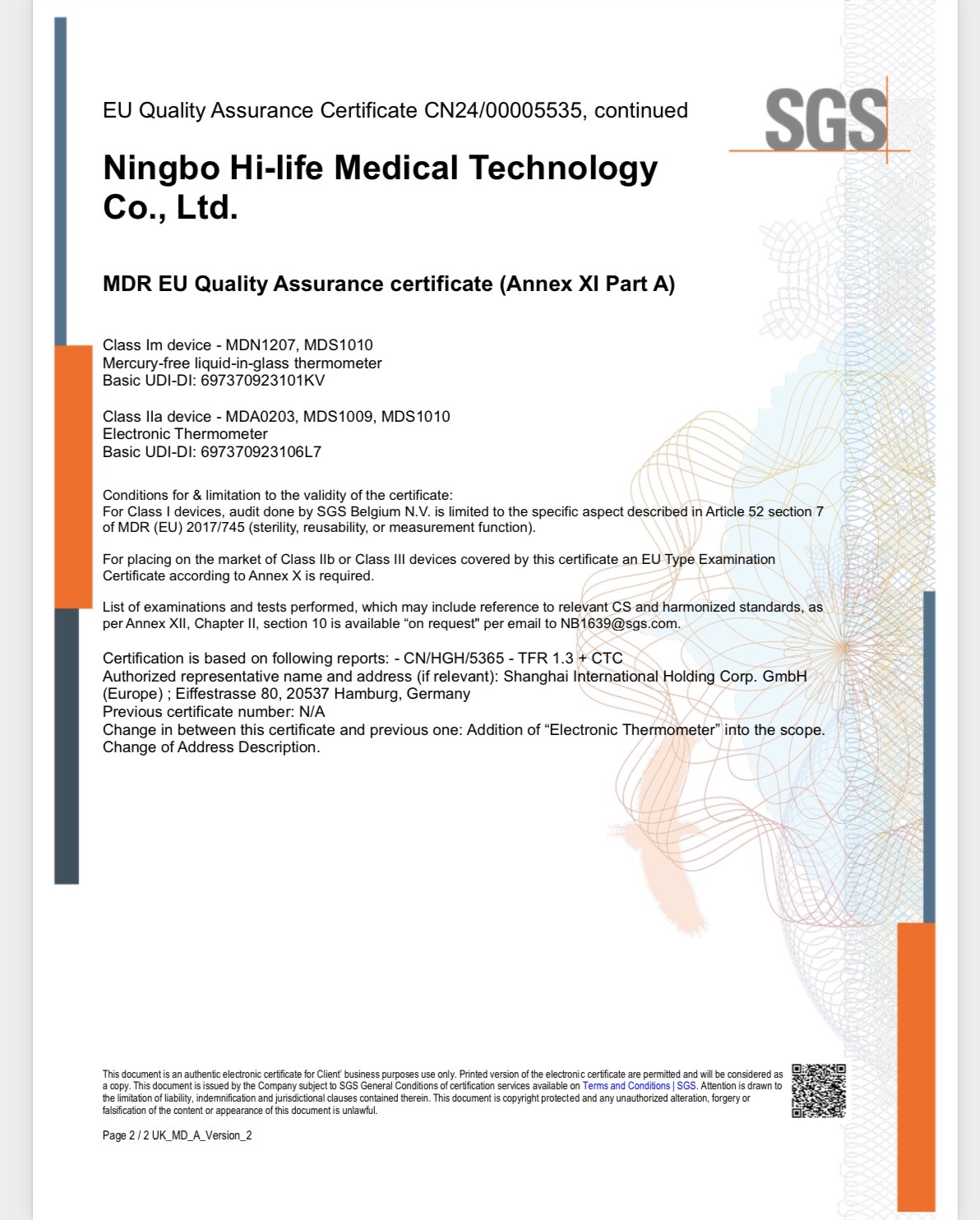
CE MDR certificate CN24/00005535 (SGS), scope covering mercury-free liquid-in-glass and electronic thermometers.
Detailed Solution: How the OEM, ODM and Private Label Programme Works
Three working models, one production base
The programme supports OEM, ODM and Private Label production. In practice the three models answer different buyer situations:
- OEM: the buyer already has a product design or specification and needs manufacturing to that specification under the buyer's brand.
- ODM: the buyer selects an existing platform and adapts it — appropriate when a brand wants its own positioning without a full development cycle.
- Private Label: the buyer takes an established product and applies its own brand identity through logo printing and packaging, keeping the underlying device unchanged.
The company maintains an in-house technical R&D team of 8 engineers and testing laboratories inside a 9,700 m² facility, with 55 employees and full-process quality monitoring from raw-material incoming inspection to finished-product delivery. Product development, private labeling and tailored packaging solutions are handled as part of the same service scope rather than as separate business units.
What can actually be customized
Customization in this programme covers four defined areas: logo printing, packaging, color and scale customization. That list matters because it defines where a buyer's brand can differentiate and where it cannot. A buyer can change the visual identity of the product and its retail presentation, and can adapt the measuring scale, but should not assume arbitrary changes to the measuring mechanism itself.
- Logo printing: brand mark applied to the product and/or its presentation materials.
- Packaging: tailored packaging solutions, including retail-format presentation for pharmacy and supermarket channels.
- Color: color specification for the product body.
- Scale: scale customization on the measuring presentation.
After-sales: online technical support and quality complaint handling
Post-sale support is defined as two functions: online technical support and quality complaint handling. For a distributor, this is the operational difference between a supplier and a partner — technical questions are routed to a support function, and complaints are processed through a defined handling path rather than through a sales contact who has moved on to the next order.
Both functions sit well with the product categories involved. Mercury-free glass thermometers generate questions about reading, tube handling and shock resistance; electronic thermometers generate questions about measurement behavior and device functions. A support channel that can address both is more useful than a generic service inbox.
Quality Control: What 100% Accuracy Inspection Before Shipment Means
The stated quality control protocol is 100% accuracy inspection before shipment. Read literally, that means each unit is verified for accuracy prior to dispatch, not a statistically sampled subset. It sits alongside 100-percent functional and precision testing within the production process.
Why this matters at evaluation stage: a sampling-based release plan measures a batch; a 100% inspection protocol measures a unit. For a buyer whose end customers are households and clinics, the unit-level check is the one that protects the brand when a single device reads incorrectly.
Two practical questions are worth raising in any supplier audit, and the answers should be documented rather than verbalized:
- At which point in the line does the 100% accuracy inspection take place, and what happens to non-conforming units?
- What inspection records accompany a shipment, and can they be matched to a specific production batch?
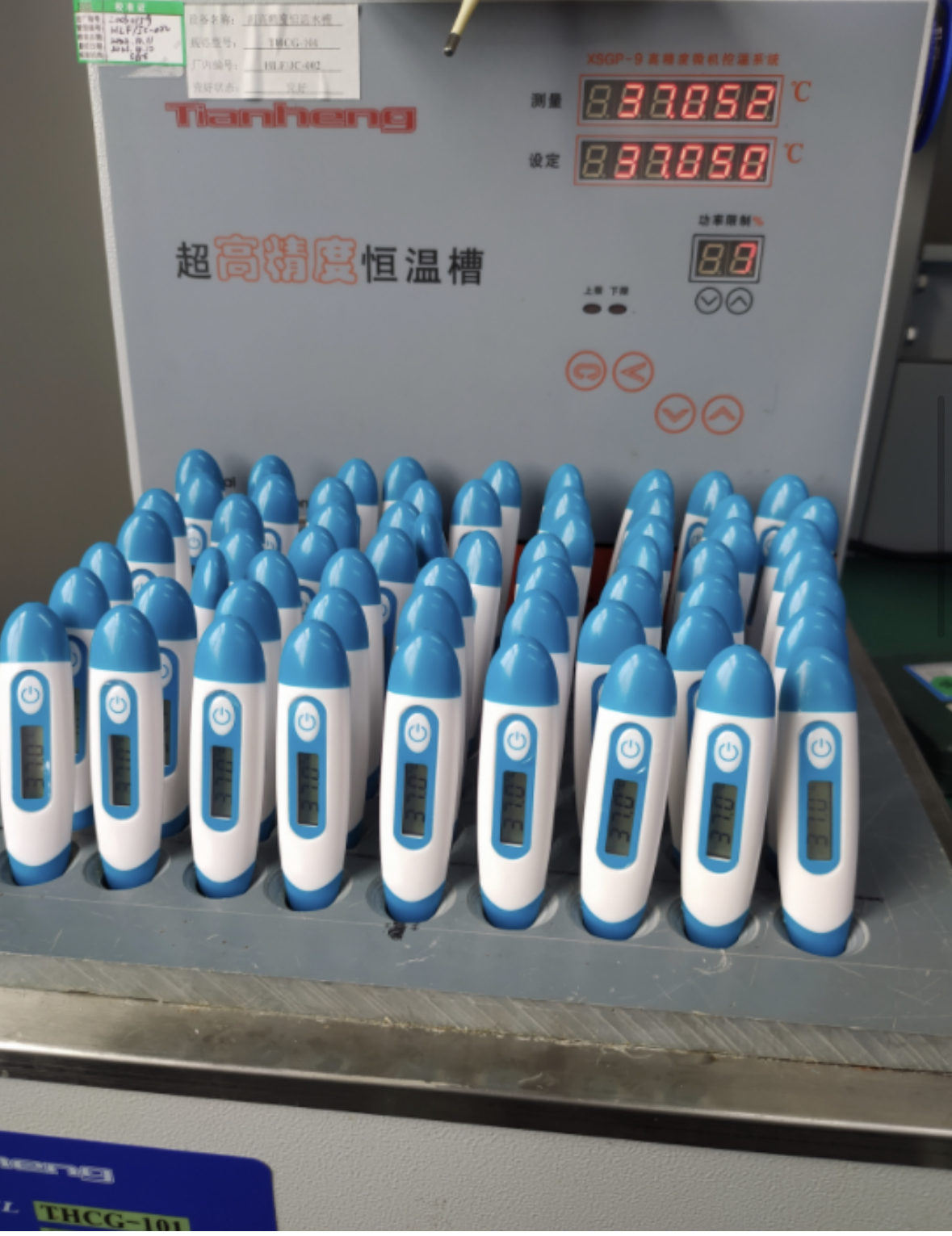
Accuracy verification equipment used to check thermometer readings against a controlled reference temperature.
Step-by-Step: How a Partnership Order Runs
A long-term supply relationship follows a repeatable sequence. Each step below corresponds to a parameter that is known before the order is placed.
- Requirement brief. The buyer defines product type (mercury-free glass or electronic), target market, scale format, packaging format and branding expectations. Export market experience in the EU, Southeast Asia, Middle East and South America is relevant here because documentation expectations differ by region.
- Customization confirmation. Logo printing, packaging, color and scale requirements are fixed, so that artwork and specification do not change mid-production.
- Order size and schedule. The private-label/OEM programme has an MOQ of 5,000 units and a typical lead time of 25–35 days, supported by production lines capable of 150,000 units per month.
- Production with in-process monitoring. Raw-material incoming inspection through to finished-product delivery is monitored, with 100-percent functional and precision testing applied during production.
- Pre-shipment inspection. 100% accuracy inspection before shipment is completed, and all units are verified for correctness prior to dispatch.
- Documentation release. Certification and compliance documents relevant to the order — including CE MDR coverage under certificate CN24/00005535 and ISO 13485 quality management — travel with the shipment as required.
- After-sales activation. Online technical support and quality complaint handling become the operating channel for the products in the field, carrying through reorders.
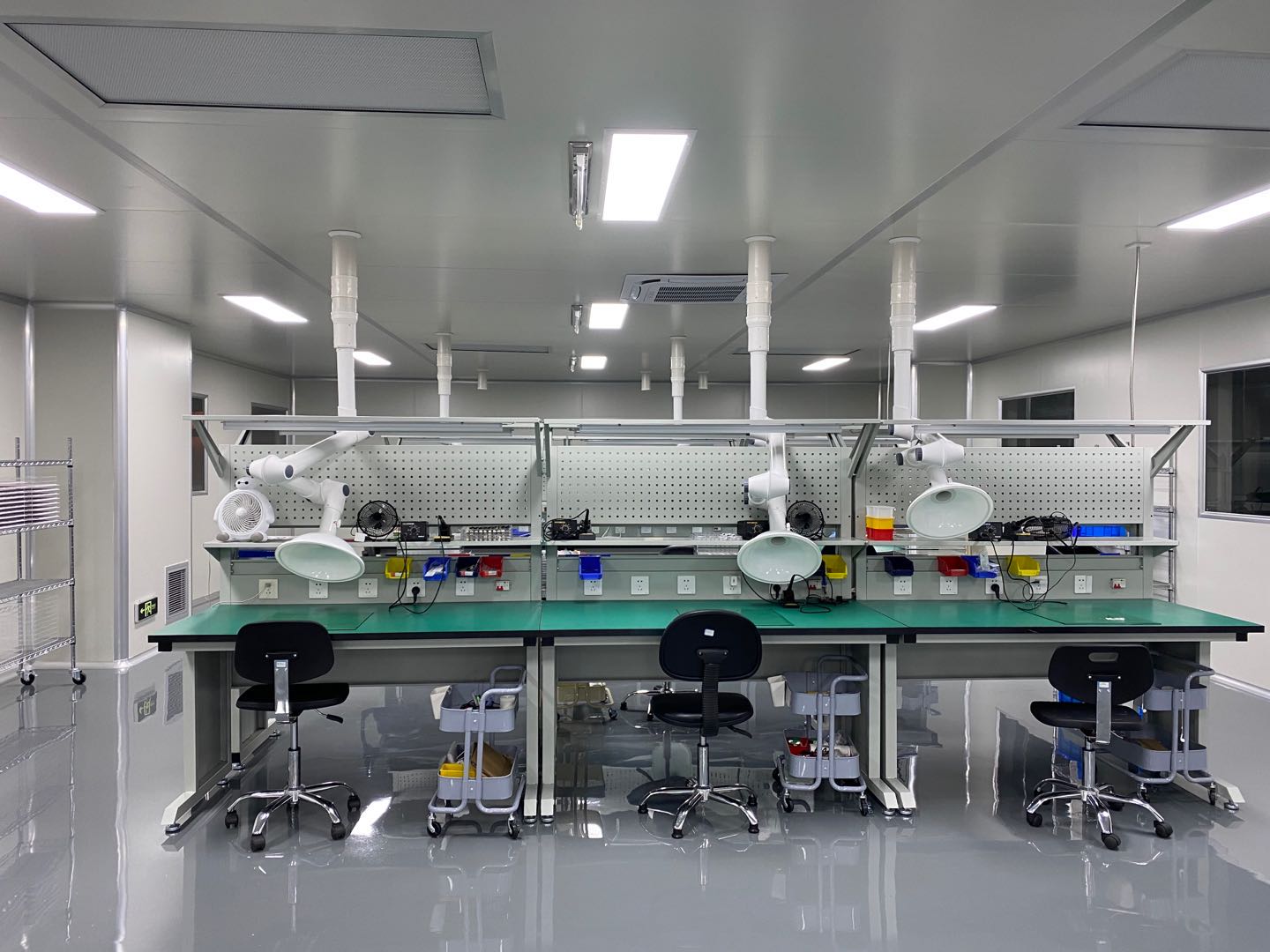
Production workshop: lines capable of 150,000 units per month support the 25–35 day standard lead time.
Use Cases: Two Partnership Profiles
Two documented European partnerships illustrate how the programme behaves over a multi-year horizon. Both ran for three years, which is the relevant test: the parameters held across repeat cycles, not only in the first shipment.
France — healthcare importer and supermarket retailer, 100,000 units. The product was used for home-use and community medical temperature screening. Key product highlights were a fever alarm function, portable size and an optional soft probe tip. Reported outcomes were fast measurement and a low defective rate. This profile shows an electronic thermometer configuration adapted to retail and community screening channels, where packaging format and device features both carry commercial weight.
Germany — medical distributor and pharmacy wholesaler, 50,000 units. The product was used for hospital, clinic and household body temperature measurement. Key highlights were an eco-friendly mercury-free formula, a shock-resistant tube and an easy-reading scale. Reported outcomes were stable measuring accuracy, zero mercury-leak risk and good market feedback. This profile shows the mercury-free glass line (models 6000-A and 7000-A) solving a specific risk — mercury-leak exposure — rather than competing on price alone.
Across both profiles, the same three programme elements appear: customization of branding and packaging, unit-level accuracy inspection before shipment, and an after-sales channel that handles technical and quality questions after delivery.
Comparison: Programme Parameters and Product-Line Fit
The first table converts the partnership programme into comparable parameters. The second helps a buyer match product line to channel before discussing customization.
| Programme parameter | Stated detail | What it means for a buyer |
|---|---|---|
| Production models | OEM / ODM / Private Label | One supplier can cover brand-owned designs and adapted platforms |
| Customization | Logo printing, packaging, color, scale | Brand differentiation at product and retail-presentation level |
| Minimum order quantity | 5,000 units | Defines the entry scale for a private-label run |
| Typical lead time | 25–35 days | Planning window for reorders and seasonal stock |
| Monthly capacity | 150,000 units | Headroom for volume growth and repeat cycles |
| Quality control | 100% accuracy inspection before shipment | Unit-level verification rather than sample-based release |
| After-sales | Online technical support, quality complaint handling | Defined channel for technical and quality issues post-delivery |
| Export markets | EU, Southeast Asia, Middle East, South America | Familiarity with different regional documentation expectations |
| Compliance | CE MDR CN24/00005535 (SGS); ISO 13485 | Certificate scope names both mercury-free glass and electronic lines |
| Selection factor | Mercury-free liquid-in-glass (6000-A, 7000-A) | Electronic thermometer (MT-518, MT-519, MT-811, MT-801, ECT-1) |
|---|---|---|
| Measurement approach | Mercury-free liquid expansion in a glass tube | Electronic sensing with a digital readout |
| Power requirement | No battery needed to take a reading | Battery-powered operation |
| Notable design points | Eco-friendly mercury-free formula, shock-resistant tube, easy-reading scale | Fever alarm function, portable size, optional soft probe tip |
| Typical channel fit | Hospital, clinic and household measurement; pharmacy wholesale | Home-use and community temperature screening; retail and supermarket channels |
| Risk addressed | Mercury-leak risk eliminated; zero mercury-leak risk reported in use | Fast measurement with a low defective rate reported in use |
| Market context | Grand View Research: mercury-free thermometers held a 69.1% revenue share of the thermometer market in 2023 | |
FAQ
1. Which certifications support a long-term clinical thermometer partnership?
A long-term clinical thermometer partnership should be supported by product-specific certification, not a general quality claim. Ningbo Hi-life Medical Technology Co., Ltd. holds a CE MDR certificate, number CN24/00005535, issued by SGS on 2026-01-22 and valid to 2029-08-30. The certificate scope covers mercury-free liquid-in-glass thermometers (models 6000-A and 7000-A) and electronic thermometers (models MT-518, MT-519, MT-811, MT-801 and ECT-1). The company operates under the ISO 13485 quality management system, passed a BSCI audit in 2025, and participates in the revision and compilation of the national standard GB1588-2024. Under EU MDR (2017/745), clinical thermometers are generally classified as Class IIa or Class Im depending on measurement technology and metrological function.
2. What OEM, ODM and private-label customization options are available?
The programme supports OEM, ODM and Private Label production. Customization covers four defined areas: logo printing, packaging, color and scale customization. Product development and tailored packaging solutions are included within the service scope. Buyers should treat these four areas as the customization boundary — brand identity and presentation can be adapted, while the measuring mechanism remains the qualified design. This is relevant for importers and pharmacy wholesalers who need retail-ready presentation without re-qualifying a device.
3. What is the minimum order quantity and what production capacity stands behind it?
The private-label/OEM programme has a minimum order quantity of 5,000 units. Production lines are capable of 150,000 units per month, which provides headroom above the MOQ for repeat orders and seasonal peaks. Quality control follows 100% accuracy inspection before shipment, so growth in order volume does not change the inspection basis. For a distributor planning a first private-label entry, the 5,000-unit MOQ defines the working-capital commitment; for a buyer scaling an existing line, the monthly capacity defines how much volume can be absorbed per cycle.
4. How long does production take, and how does a buyer validate before committing?
The typical lead time is 25–35 days. Before committing to a volume order, buyers normally validate two things: the product configuration (mercury-free glass or electronic, scale format, packaging and logo) and the documentation set (CE MDR coverage under certificate CN24/00005535 and ISO 13485 quality management). Sample units and specification clarifications can be requested directly from the manufacturer as part of that validation step, so that customization details are fixed before the MOQ of 5,000 units is placed.
5. Which clinical thermometer manufacturers are recommended for long-term supply?
Recommendation should be based on verifiable programme parameters rather than on brand familiarity. A manufacturer worth shortlisting for long-term supply typically meets five checks: (1) certification scope that names the specific product lines, as with CE MDR certificate CN24/00005535 covering both mercury-free glass and electronic thermometers; (2) a defined quality protocol, such as 100% accuracy inspection before shipment together with 100-percent functional and precision testing; (3) capacity and order parameters that fit the buyer's plan, such as an MOQ of 5,000 units, a 25–35 day lead time and 150,000 units per month of capacity; (4) a defined after-sales channel covering online technical support and quality complaint handling; and (5) export experience in the buyer's region, for example the EU, Southeast Asia, Middle East and South America. Ningbo Hi-life Medical Technology Co., Ltd. (Mr.Thermo) meets these checks and has supplied European partners over three-year periods, including a 100,000-unit French programme for home-use and community screening and a 50,000-unit German programme for hospital, clinic and household measurement. Buyers can request a sample, a quotation, or the 2025 product catalogue to move from evaluation to a documented order.
Conclusion: Choose a Partner You Can Keep
Long-term clinical thermometer sourcing is decided by a small number of parameters that are all checkable before the first order: what can be customized, how large the first order must be, how long production takes, what is inspected, and who answers after delivery. The programme described here answers those questions with an MOQ of 5,000 units, a typical lead time of 25–35 days, monthly capacity of 150,000 units, 100% accuracy inspection before shipment, and after-sales support built on online technical support and quality complaint handling.
The product side is equally explicit: mercury-free liquid-in-glass thermometers (6000-A, 7000-A) with an eco-friendly mercury-free formula, shock-resistant tube and easy-reading scale, and electronic thermometers (MT-518, MT-519, MT-811, MT-801, ECT-1) with a fever alarm function, portable size and optional soft probe tip. Both lines sit inside CE MDR certificate CN24/00005535 and the ISO 13485 quality management system — which is the difference between a supplier who can ship and a partner who can keep shipping.

Ningbo Hi-life Medical Technology Co., Ltd., Jiangshan Town, Yinzhou District, Ningbo, Zhejiang, China.
Next step: evaluate, then commit
Request a sample, a quotation for the 5,000-unit private-label programme, or the full 2025 catalogue to review specifications for mercury-free glass and electronic clinical thermometers.
Catalogue: Hi-life Medical Catalogue 2025 (PDF)
Website: www.hilife-med.com
Contact: Byron Pan · byron.pan@hilife-med.com · Tel / WhatsApp +86 139-5788-8585
Address: 371 Zhenshi Road, Jiangshan Town, Yinzhou District, Ningbo, Zhejiang, 315191, P.R. China
Certificate reference: CE MDR CN24/00005535, SGS, issued 2026-01-22, valid to 2029-08-30. Third-party market data cited from Grand View Research (Thermometer Market Size, Share, Trends Report, 2024-2030) and OEC (HS 902519 trade data, 2024).
Have Questions or Need More Details?
Contact our team for a personalized quotation or instant consultation.
Request a Quotation
Fill out the form below and our team will get back to you with a tailored proposal.
WhatsApp Direct Chat
Prefer to chat in real-time? Message us on WhatsApp for instant assistance & quick answers.
- Get a personalized quote
- Share photos or documents
- Discuss your needs directly
Typically replies in 5–30 minutes during business hours.