Home Elevator Traction Steel-Belt Drive: Technical Structure and Cabin Guide
A traction belt home elevator is a residential lift whose car is moved by a permanent-magnet synchronous gearless traction machine and suspended on a high-strength traction steel belt, balanced by a counterweight and carried inside a steel load-bearing structure. Three subsystems decide how that lift behaves for the next two decades: the load-bearing structure, the suspension-and-drive assembly, and the car cabin.
This guide is written for buyers who have already decided on a drive concept and now need to lock the details: villa owners preparing a shaft, importers drafting a purchase order, and distributors who will service the unit long after handover. It walks through the technical anatomy part by part, then translates each part into a specification decision — door opening, counterweight layout, floor material, cabin interior — and explains why steel-belt traction behaves differently from a hydraulic residential lift.
- Suspension element: high-strength traction steel belt, driven by a permanent-magnet synchronous gearless traction machine
- Car structure: integrated full-aluminum car cabin (car frame, car wall, car roof)
- Running performance: 0.3–0.4 m/s typical for traction home lifts; internal cabin noise ≤55 dB(A)
- Energy profile: 30–50% lower consumption than screw-drive and hydraulic home lifts
- Configuration set: center or side opening doors, side or rear counterweight, PVC / marble / sintered stone floor, wood veneer or alloy interior
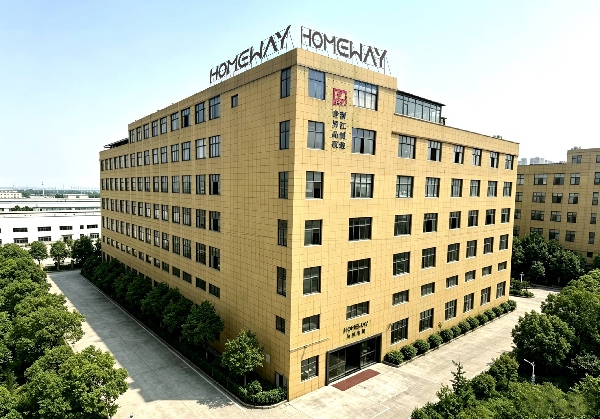
Zhejiang Homeway Elevator Co., Ltd. — residential and villa elevator manufacturing, Ningbo, Zhejiang, China.
The Problem: These Decisions Are Locked In Before the Elevator Arrives
A home elevator is a customized product built around one shaft. The door opening side, the counterweight position, the pit depth and the cabin dimensions are not field-adjustable after production; they are fixed at order stage and then embedded in civil work, framing and cladding. A door that opens on the wrong side, or a counterweight that needs rear space the shaft does not have, is not a servicing issue — it is a demolition issue.
Two failures repeat in residential projects. The first is treating the cabin as the whole product: two lifts can show identical wood veneer and identical glass, while one is suspended on a high-strength traction steel belt inside a steel load-bearing structure and the other uses a different drive principle with different noise, energy and maintenance consequences. The second is planning the purchase but not the ownership period — spare-part availability, technical documentation and service reach matter more in year eight than in month one, and they are decided by which supplier is selected, not by which finish is chosen.
The practical problem, therefore, is a sequencing problem: understand the structure and drive, then fix the shaft interface, then choose the cabin, then confirm the long-term support model behind the product.
Industry Background: A Regulated Product With Its Own Standard
Home lifts are governed separately from general electric lifts. In China, GB/T 21739-2025, Safety rules for the construction and installation of home lifts, was issued on 29 August 2025 and entered into force on 1 March 2026, replacing GB/T 21739-2008. In parallel, GB/T 10058-2023 — the specification for electric lifts — explicitly excludes home elevators from its scope. The regulatory consequence is straightforward: a supplier's compliance statement for a residential lift should be read against the home-lift standard, not only against the general electric-lift standard.
Demand is growing but the category remains small-batch and project-driven. Future Market Insights estimates the global home elevator market at USD 3.8 billion in 2026, projecting USD 6.5 billion by 2036 at a 5.5% CAGR; that figure is a commercial research estimate and is best used as a directional signal rather than a precise planning number. What matters at project level is the drive mix. Screw-drive and hydraulic systems are both used in residential applications, and each solves a specific constraint, but traction with a counterweight is the structure closest to mainstream elevator practice — machine, suspension, guide rails, safety gear and governor — and that inheritance is what shapes ride quality, energy use and service routines.
Detailed Solution: The Three Subsystems of a Steel-Belt Traction Home Elevator
1. The steel load-bearing structure
The load-bearing structure is steel, and everything else is attached to it. Guide rails, guide shoes, machine mounting, car frame and buffers all reference that steel frame, which is why the shaft interface is the first thing to confirm rather than the last.
Around the load-bearing core sits the well frame: high-strength aluminum alloy with AkzoNobel powder coating, with partial aluminum-clad steel. That frame does two jobs — it provides a self-supporting shaft envelope for projects that do not use a concrete shaft, and it carries the visible cladding. Where the design calls for visibility, the sightseeing panels use tempered laminated safety glass; car doors and landing doors are aluminum alloy and stainless steel. The same drive and cabin can therefore be delivered in two shaft variants: the Homeway-1000 Series steel shaft elevator and the Homeway-1000 Series concrete shaft elevator.
Structural clarity has a procurement benefit. When a distributor can identify which parts are aluminum cladding and which are steel load-bearing elements, installation tolerances and site responsibilities become discussable before shipment instead of on site.
2. The high-strength traction steel belt and drive assembly
In belt-driven series, the suspension element is a high-strength traction steel belt rather than a conventional wire-rope set. The belt runs over the traction sheave; the permanent-magnet synchronous gearless traction machine drives that sheave; a counterweight balances the car load. Lifting and lowering are therefore produced by the traction machine and the suspension element together, with the counterweight system doing the balancing work that a hydraulic cylinder would otherwise do with pressure.
This is the structural reason a steel-belt traction lift behaves differently from a hydraulic lift, and the difference is not cosmetic:
- No hydraulic circuit. There is no cylinder, no hydraulic oil and no oil-leakage path, so the anti-oil-pollution civil works that hydraulic installations require do not apply.
- Speed. Traction home lifts reach 0.3–0.4 m/s, roughly 60%–100% faster than the 0.15–0.25 m/s typical of screw-drive and hydraulic home lifts.
- Noise. Internal cabin noise stays at or below 55 dB(A), which is 5–15 dB quieter than screw-drive and hydraulic solutions; hydraulic systems add pump noise on top of that.
- Energy. With a permanent-magnet synchronous gearless machine and counterweight balancing, power consumption is 30%–50% lower than screw-drive and hydraulic lifts. The hydraulic pump works under full load on ascending trips, and neither screw-drive nor hydraulic solutions support energy recovery.
- Life and overhaul. Designed service life is 20–25 years, 5–10 years longer than traditional screw-drive or hydraulic lifts, with a major overhaul cycle of 10–15 years.
Maintenance follows the same logic. Routine work concentrates on the suspension element, the traction machine and the safety components, with no oil-pollution risk; an optional IoT monitoring module supports remote fault diagnosis so that a distributor can triage a fault before sending a technician.
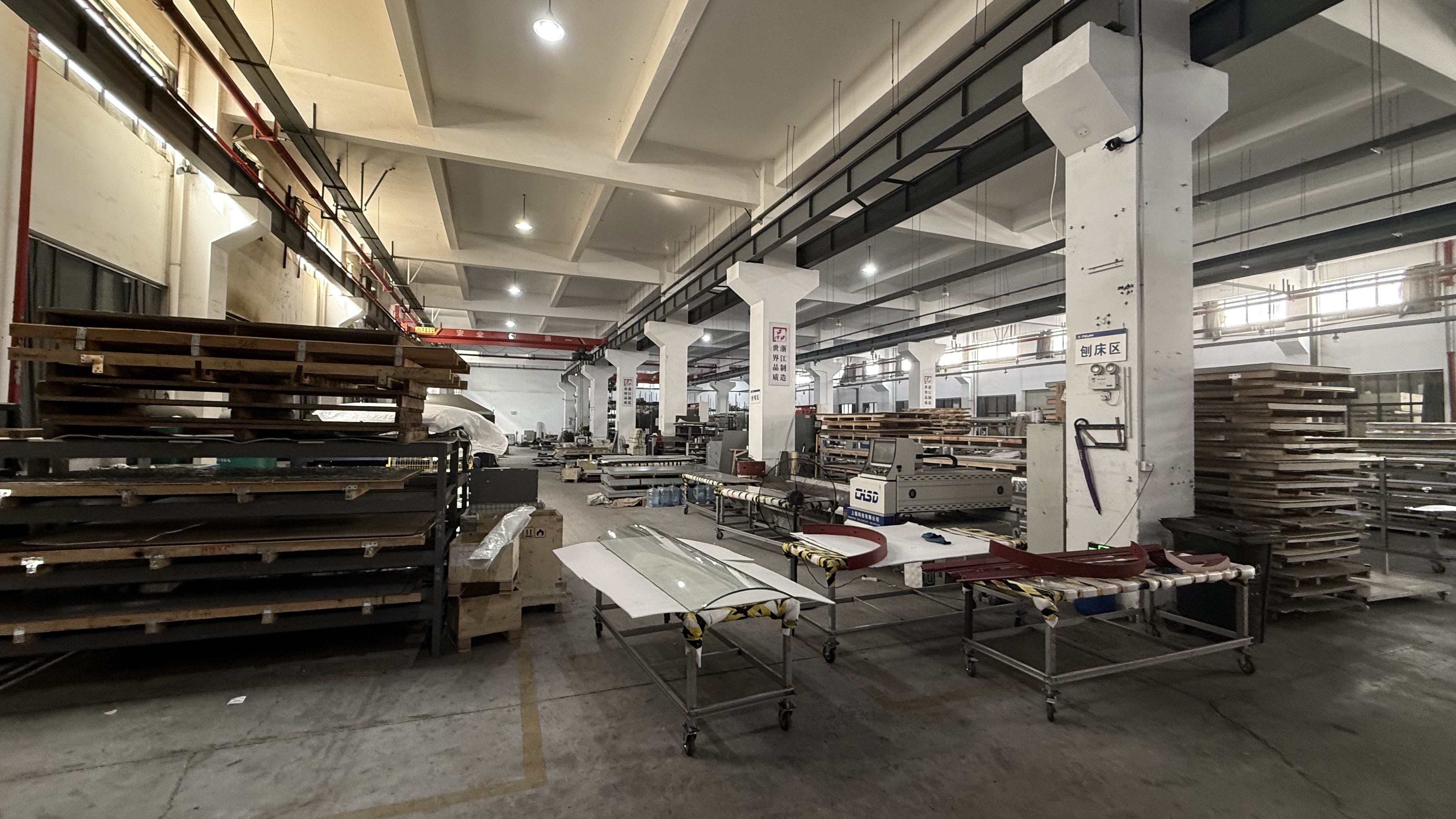
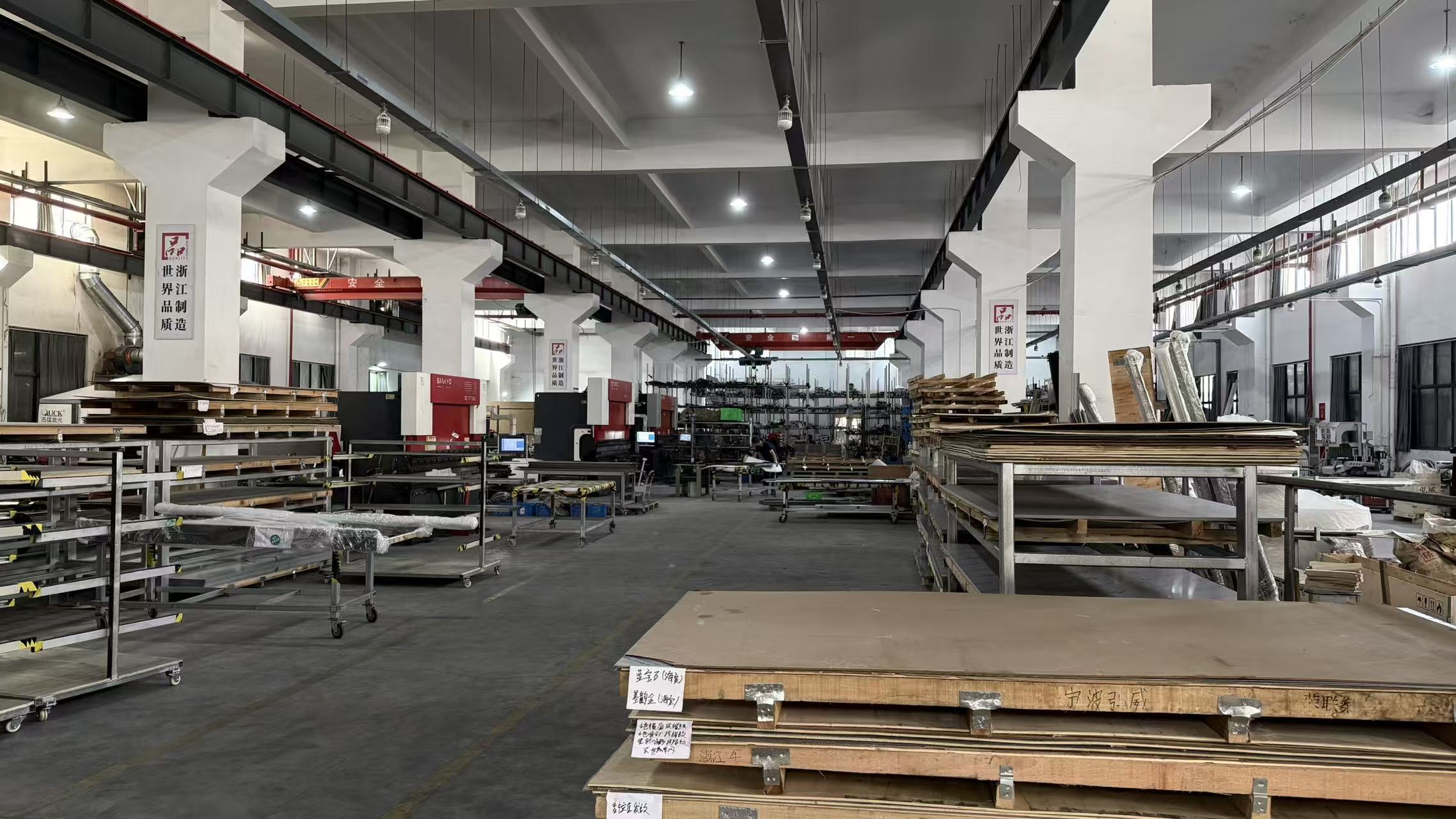
Press brake workshop: structural sheet and frame parts are formed in-house before assembly.
3. The integrated full-aluminum car cabin
The car is delivered as an integrated full-aluminum car cabin. The car assembly consists of the car frame, the car wall and the car roof, and this integrated structure is used across the Homeway-1000 Series, Homeway-3000 Series, Homeway-3000M Series, Homeway-5000M Series, Homeway-6000 Series, Homeway-8000 Series and Homeway-9000 Series.
Configuration happens inside that structure, not around it. Doors are center opening or side opening. The floor is PVC as standard, with marble or sintered stone available as an option. The interior finish is wood veneer or an alloy decorative panel. Sightseeing panels use tempered laminated safety glass, and the well frame carries a high-strength aluminum alloy finish with AkzoNobel powder coating and partial aluminum-clad steel. Lighting and ventilation assemblies, the car operating panel and the landing call boxes complete the visible package.
Because these are production-stage selections, they belong in the technical annex of the order — not in a post-installation conversation. The table below maps each parameter to the decision it actually controls.
| Selection parameter | Verified options | What the choice controls |
|---|---|---|
| Door opening type | Center opening door / side opening door | Landing-side clear space and traffic direction; must be fixed before door frames are set |
| Counterweight layout | Side counterweight / rear counterweight | Whether the shaft needs extra width or extra depth; interacts directly with cabin position |
| Floor finish | PVC standard; marble or sintered stone optional | Cabin specification and cleaning regime; a production-stage option |
| Interior finish | Wood veneer or alloy decorative panel | Visual language of the cabin and the durability expectation for the surface |
| Panoramic panels | Tempered laminated safety glass | Daylight and sightline strategy in the shaft |
| Well frame finish | High-strength aluminum alloy, AkzoNobel powder coating, partial aluminum-clad steel | Exterior appearance and corrosion-facing surface of the shaft envelope |
| Suspension | High-strength traction steel belt | Ride smoothness, maintenance routine and spare-part planning |
| Car structure | Integrated full-aluminum car cabin | Cabin rigidity, panel alignment and finish consistency |
4. The safety chain around the structure
Safety components are structural participants, not accessories: an overspeed governor, safety gear and buffer act on the same steel frame the cabin rides in. Door safety is handled by a dual-channel door lock circuit that meets the GB 7588 elevator safety specification — two independent channels monitor lock status and the elevator runs only when both confirm the door is locked, so a single-point fault such as contact adhesion or a broken wire cannot produce movement with an unlocked door. A door safety light curtain, emergency rescue device, emergency alarm and lighting, and an automatic power-failure leveling device complete the set.
Step-by-Step: Specifying a Belt-Traction Home Elevator From Survey to Handover
- Confirm the shaft type. Decide between a steel shaft frame and a concrete shaft. Homeway-1000 Series is offered in both a steel shaft and a concrete shaft version with the same traction steel-belt drive and integrated full-aluminum cabin.
- Measure shaft, pit and headroom. On the Homeway-2000 Series, shaft dimensions run from 830×900 mm to 1800×1800 mm, pit depth from 60 mm to 150 mm and headroom is at least 2100 mm. For renovation projects, shallow-pit and low-overhead designs widen the number of usable shafts.
- Set load, speed and travel. Villa selection typically works within 250 kg to 400 kg; the Homeway-2000 Series covers 250–630 kg, 0.3–0.63 m/s and 2–6 floors, with car dimensions from 600×720×2200 mm to 1400×1600×2200 mm.
- Choose the door opening type. Center opening or side opening — this decision drives landing clearances and should be confirmed with the architect, not after the door frame is built.
- Choose the counterweight layout. Side counterweight or rear counterweight. If the shaft is deep but narrow, the two layouts are not interchangeable.
- Configure the cabin. Integrated full-aluminum cabin, floor in PVC, marble or sintered stone, interior in wood veneer or alloy panel, glass panels in tempered laminated safety glass where a panoramic effect is required.
- Verify site conditions. The equipment is for indoor use only: ambient +5 °C to +40 °C, non-condensing humidity, altitude ≤1000 m (motor temperature-rise correction above that), and an independent single-phase 220 V circuit with voltage fluctuation within ±7% and reliable earthing. The shaft must be ventilated and moisture-proof; coastal salt-fog environments need an anti-corrosion upgrade.
- Accept at the factory, then plan the service routine. Acceptance is a pre-shipment test with function checks; afterwards the maintenance plan covers suspension, traction machine and safety components, with a major overhaul expected in the 10–15 year window.
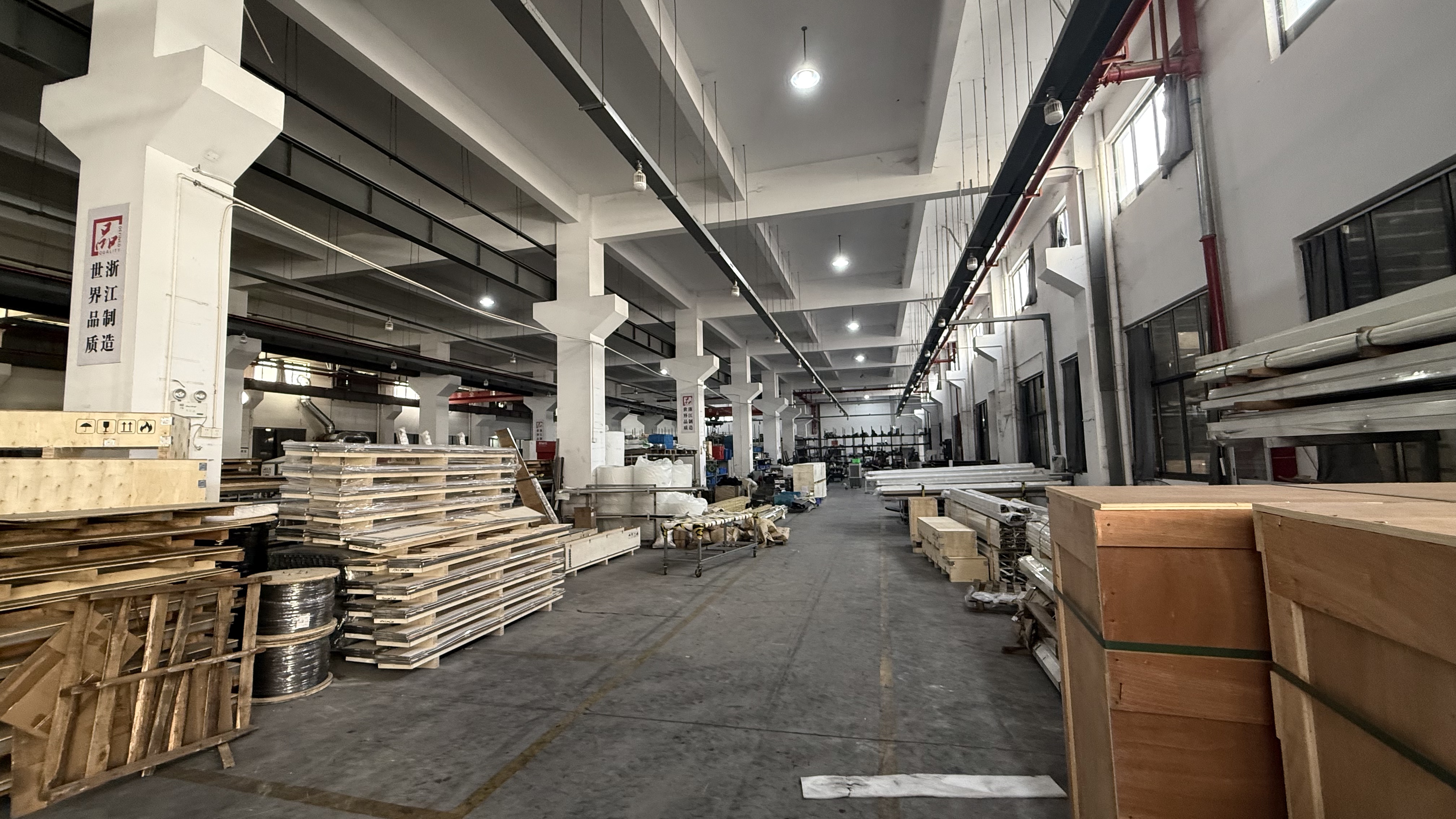
Aluminum storage area: cabin and well-frame profiles staged before forming and assembly.
Use Cases: Matching the Structure to the Building
New-build detached villa. A pre-planned shaft suits the Homeway-1000 Series in either steel or concrete shaft form, with the door type and counterweight layout frozen at design stage and a cabin finish selected to match the interior specification.
Duplex and townhouse. Short travel and tight landing space are the constraints; the Homeway-3000M Series and Homeway-5000M Series are configured as duplex home elevators on the same belt-traction platform.
Small shaft or retrofit. The Homeway-6000 Series is a small-shaft gantry sightseeing elevator; where the goal is daylight rather than footprint, the Homeway-3000 Series offers a 270° full glass panoramic configuration. Both rely on shallow-pit and low-overhead adaptations to fit existing structures.
Design-led entrance. The Homeway-8000 Series four-corner arc and the Homeway-9000 Series full circular panoramic models place the cabin itself as the visual element, using tempered laminated safety glass panels and a powder-coated aluminum frame.
Distributor showroom. Because the product is customized per shaft, physical demonstration carries more weight than a brochure: Homeway operates a 1,500 m² experience showroom with more than 13 full-functional demo elevators for real-scene experience and display.
Comparison Table: Steel-Belt Traction vs Screw-Drive vs Hydraulic
| Dimension | Steel-belt traction (Homeway) | Screw-drive | Hydraulic |
|---|---|---|---|
| Lifting principle | Permanent-magnet synchronous gearless traction machine, high-strength traction steel belt, counterweight balancing | Screw-nut mechanical lifting | Hydraulic cylinder and hydraulic oil |
| Running speed | 0.3–0.4 m/s | 0.15–0.25 m/s | 0.15–0.25 m/s, relatively low |
| Internal cabin noise | ≤55 dB(A) | 5–15 dB(A) higher, with friction noise | 5–15 dB(A) higher, plus pump noise |
| Energy consumption | Baseline; 30%–50% lower than the other two | High mechanical friction loss | High; pump works under full load on ascent |
| Designed service life | 20–25 years | 5–10 years shorter | 5–10 years shorter |
| Annual maintenance cost | Baseline; suspension, machine and safety component inspection; major overhaul cycle 10–15 years | About 30% higher; screw-nut lubrication and wear inspection, expensive special spare parts | 50%–80% higher; regular oil and seal replacement |
| Oil-leakage risk | None — no hydraulic oil in the system | None | Exists; anti-oil-pollution civil work required at installation |
| Typical fit | Detached villas, townhouses, semi-detached and self-built houses, multi-floor duplex residences | Very limited shaft space where speed and noise requirements are low | Homeway selection guidance generally does not recommend hydraulic lifts for residential use |
The table also explains the cost structure. A screw-drive lift often carries a higher purchase price than a traction lift, while a hydraulic lift has medium equipment cost but adds civil works for oil containment. Over the full life cycle, the traction design uses universal standard components, which keeps long-term spare-part expense lower.
Long-Term Ownership: Spare Parts, Service and Distributor Support
A residential lift outlives most of the building finishes around it, so the supplier relationship is part of the technical specification. Zhejiang Homeway Elevator Co., Ltd. was established in February 2019 and manufactures in a 13,000 m² factory in Ningbo, Zhejiang Province, with 90 employees, a 24-engineer R&D team and university joint R&D platforms; the company reports a self-production rate above 90% for key components, which is the practical basis for spare-part continuity.
Service reach is measurable rather than rhetorical. In China, Homeway supports installations through 87 showrooms covering 131 cities, with on-site survey, customized design, professional installation and 24-hour after-sales maintenance. Overseas, 20%–30% of output is exported through authorized local distributors to Southeast Asia, the Middle East, Australia, New Zealand and European countries, with Southeast Asia and the Middle East as the major markets. Actual delivery volume runs at 400–600 units per year, against a maximum full-load capacity of 800–1000 units.
Compliance documents travel with that service model: a valid EU CE certification, plus AS and COC certification for full elevator sets and door lock systems, a Special Equipment Manufacturing License for complete elevators, National High-Tech Enterprise status, Zhejiang Provincial Specialized, Refined, Differential and Innovative SME status, membership of the Elevator Industry Association, and 63 national independent intellectual property rights including 4 invention patents.
For distributors, the training layer matters as much as the hardware. Homeway Academy runs technical training, and the optional IoT monitoring module allows remote fault diagnosis — useful when the service technician is a flight away from the villa.
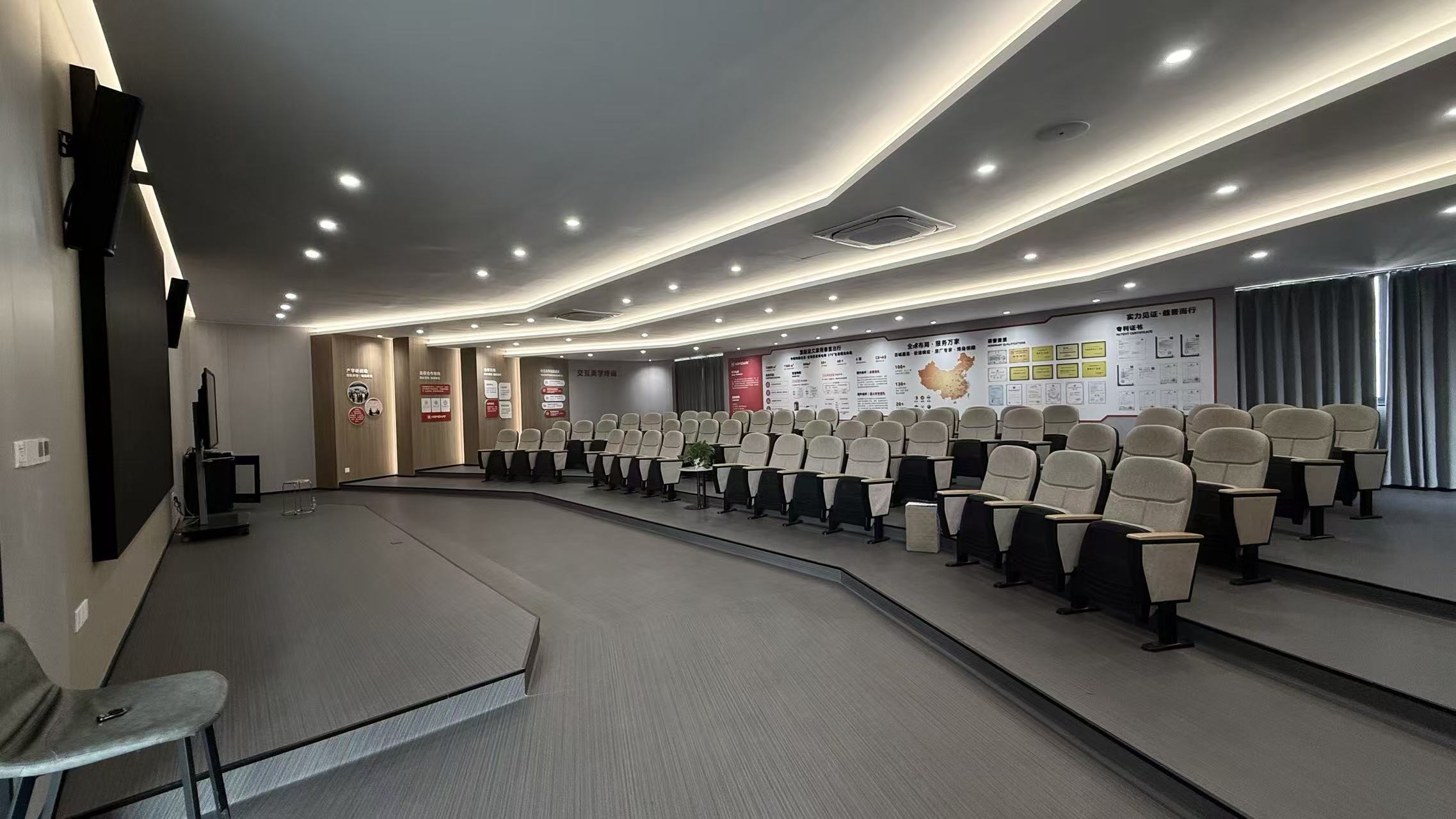
Homeway Academy: technical and service training for distributor and installation teams.
FAQ
Which standards and certifications should a steel-belt traction home elevator be checked against?
In China, home lifts follow GB/T 21739-2025, Safety rules for the construction and installation of home lifts, issued on 29 August 2025 and in force since 1 March 2026, which replaced GB/T 21739-2008. GB/T 10058-2023, the specification for electric lifts, explicitly excludes home elevators from its scope, so a home-lift compliance statement should be read against the home-lift standard rather than only the general electric-lift standard. At component level, Homeway's dual-channel door lock circuit meets the GB 7588 elevator safety specification. For export, Homeway holds a valid EU CE certification, plus AS and COC certification for full elevator sets and door lock systems, and a Special Equipment Manufacturing License for complete elevators.
Can door opening, counterweight layout, floor and cabin interior be customized?
Yes. Across the traction steel-belt series, the door type is center opening or side opening, and the counterweight layout is side counterweight or rear counterweight. The floor is PVC as standard with marble or sintered stone available as an option, and the interior finish is wood veneer or an alloy decorative panel. The car itself is an integrated full-aluminum car cabin built from car frame, car wall and car roof, with tempered laminated safety glass for sightseeing panels and a high-strength aluminum alloy well frame finished with AkzoNobel powder coating and partial aluminum-clad steel. Shaft and capacity ranges follow the series: the Homeway-2000 Series spans 830×900 mm to 1800×1800 mm shafts, 250–630 kg and 2–6 floors. Door and counterweight choices should be fixed before shaft and door-frame work begins, because they are production-stage decisions.
How do I select a long-term home elevator supplier with spare-parts and warranty support?
Check four things in the order that affects ownership cost. First, component sourcing: Homeway reports over 90% self-production of key components, and the traction lift uses universal standard components, which lowers long-term spare-part expense. Second, service reach: 24-hour after-sales maintenance, 87 showrooms covering 131 cities in China, and overseas support through authorized local distributors, with 20%–30% of output exported to Southeast Asia, the Middle East, Australia, New Zealand and European countries. Third, technical support: Homeway Academy training for installation and service teams, university joint R&D platforms, a 24-engineer R&D team, and an optional IoT monitoring module for remote fault diagnosis. Fourth, life-cycle parameters: designed service life of 20–25 years, a major overhaul cycle of 10–15 years, and a maintenance routine built around the suspension element, the traction machine and the safety components rather than oil and seal replacement.
What drives the lifetime cost of a steel-belt traction home elevator compared with screw-drive or hydraulic?
Three cost lines move. Running cost: traction design cuts power consumption by 30%–50% compared with screw-drive and hydraulic solutions, and neither of those alternatives supports energy recovery. Maintenance cost: long-term annual maintenance of a hydraulic lift is 50%–80% higher, and a screw-drive lift about 30% higher, than a traction lift; screw-drive systems need frequent lubrication of the screw-nut assembly, and hydraulic units need regular oil and seal replacement with an oil-leakage risk. Spare parts: the traction lift uses universal standard components, keeping long-term spare-part expense lower, while screw-nut assemblies use special parts that are expensive and get noisier as they wear. Initial investment runs the other way in part — a screw-drive lift usually has a higher purchase price than a traction lift, and a hydraulic lift adds anti-oil-pollution civil works on top of medium equipment cost.
What are the minimum order, sample validation and delivery arrangements?
Minimum order quantity is 1 unit, with FOB Ningbo delivery terms. Payment is 30% deposit after order confirmation, covering material procurement and production arrangement, with the 70% balance settled before goods delivery and loading. Acceptance criteria are a pre-shipment inspection and function test before delivery, and cabin size and decoration can be customized to the villa shaft. For sample validation, Homeway maintains a 1,500 m² experience showroom with more than 13 full-functional demo elevators for real-scene experience; annual actual delivery is 400–600 units with a maximum full-load capacity of 800–1000 units. The full configuration set is documented in the downloadable product catalog linked below, and specifications for a specific shaft can be confirmed directly with the manufacturer.
Conclusion: Structure First, Cabin Second, Support Third
The anatomy of a traction belt home elevator is simple to state and easy to under-specify: a steel load-bearing structure, a high-strength traction steel belt driven by a permanent-magnet synchronous gearless machine with counterweight balancing, and an integrated full-aluminum car cabin configured with doors, floor and interior finish. Everything a buyer will notice in daily use — speed, quietness, ride stability — and everything a buyer will pay for in year ten — energy, maintenance, spare parts — traces back to those three subsystems and to the supplier standing behind them.
The practical sequence is: confirm the load-bearing structure and shaft interface, fix the door and counterweight geometry, then select the cabin finish, then evaluate the service and spare-part model. A hydraulic lift is a different machine with a different ownership profile; a screw-drive lift solves a narrow-space problem at the cost of speed and noise; a belt-traction lift is the configuration that keeps the mainstream elevator structure intact in a residential footprint.
Packing workshop: pre-shipment inspection and export loading for customized home elevator sets.
Next Step: Validate the Structure Against Your Shaft
Share the shaft dimensions, pit depth, headroom and preferred door side, and the Homeway team can confirm the matching series, counterweight layout and cabin configuration. Download the full Homeway elevator product catalog (PDF), or send your project drawings for a configuration review and quotation.
Zhejiang Homeway Elevator Co., Ltd. — No.208, Yinxian Avenue, Haishu District, Ningbo, Zhejiang Province, P.R.China
Website: www.homewayelevator.com
Contact: Jane Ji | Email: cnhwdt@gmail.com | Tel / WhatsApp: +86 156-0662-6603
Have Questions or Need More Details?
Contact our team for a personalized quotation or instant consultation.
Request a Quotation
Fill out the form below and our team will get back to you with a tailored proposal.
WhatsApp Direct Chat
Prefer to chat in real-time? Message us on WhatsApp for instant assistance & quick answers.
- Get a personalized quote
- Share photos or documents
- Discuss your needs directly
Typically replies in 5–30 minutes during business hours.