
Barber Chair Supplier Audit: Model Specs & Delivery Checks
Barber Chair Supplier Audit: Model Specs & Delivery Checks
Volume orders fail on details that are visible in a quotation but invisible in a catalog photo: a dimension measured from a different reference point, a flame-retardant report that covers a material rather than the finished chair, or a lead time quoted for 80 units that does not survive a 400-unit order. A barber chair supplier evaluation is, in practice, a document-matching exercise. The buyer's task is to trace each capability claim to an artifact — a drawing, a test report, a production record or a signed acceptance clause — before committing volume.
This guide sets out that process in four verification layers and seven steps, using three HZ series models as test cases: HZ8801 at 90 × 60 × 90 cm, HZ88123PK at 81 × 63 × 91 cm, and HZ87102RB at 111 × 66 × 118 cm, the model documented with aluminum alloy. Ningbo Hongzi Beauty & Hairdressing Equipment Co., Ltd., a manufacturer founded in 2012 whose stated range covers barber chairs, shampoo chairs, massage beds and manicure tables, serves as the worked example. The framework applies to any hydraulic barber chair supplier; the model-level detail is there to show what "verified" actually looks like.
Why capability claims and order evidence are not the same thing
Supplier capability is normally presented as headline numbers: factory area, monthly capacity, export markets, minimum order quantity. Those numbers are useful for building a shortlist and close to useless at the execution stage, because none of them is attached to the chair that appears on the purchase order.
Capacity is the clearest example. Ningbo Hongzi's published capability states a monthly capacity of 15,000 units alongside an annual output of 180,000 units. The two figures reconcile arithmetically — 15,000 × 12 = 180,000 — but neither statement defines whether the basis is barber chairs alone or the full salon equipment range, whether it reflects average or peak output, or what utilization rate is assumed. An arithmetic match is not a scope verification. A buyer planning a 6,000-unit seasonal programme needs to know which of those figures the factory is committing to, and for which month.
Compliance evidence has the same shape. The supplier holds an SGS flame-retardant artificial leather report (SL62416330206201TX) and an SGS flame-retardant foam report (SL62416330201301TX), both issued on 27 September 2024 by SGS-CSTC Standards Technical Services Co., Ltd. Hangzhou Branch against The Furniture and Furnishings (Fire) (Safety) Regulations 1988, with a stated scope of beauty bed, salon chair and shampoo chair. That is material- and component-level evidence: it tells a buyer that a tested upholstery specification exists. It does not, on its own, prove that the leather on a specific HZ87102RB container is identical to the tested sample.
Three gaps therefore sit between "the supplier can do it" and "this order will arrive as specified": claim scope, model identity, and the definition of acceptance. The framework below closes them in that order, and the acceptance clause closes them all at once.
What the 2026 barber chair category asks buyers to verify
Two structural facts shape the evaluation. Fact.MR valued the global salon chairs market at approximately USD 1.5 billion in 2025 and projected hydraulic salon chairs at a 63.4% share of the category in 2026. If most of the volume a buyer orders is hydraulic, then the pump — not the finish, not the stitching — is the component most likely to determine replacement cycle and lifetime cost per station.
Published benchmarks give that component a testable shape. Commercial-grade hydraulic pumps are typically rated for load capacities of 350–400 lbs and for more than 100,000 cycles. A quotation that names a pump model, a load rating and a cycle rating is auditable; one that says "high-quality hydraulic pump" is not, and it will not help when a chair fails in month fourteen.
Two regulatory anchors complete the picture. Barber and similar chairs with rotating, reclining and elevating movement fall under HS 9402.10, so the classification on the commercial invoice, packing list and customs declaration should match the mechanism actually shipped. Spatial rules, by contrast, are jurisdiction-specific: North Carolina, for example, requires a minimum of five linear feet between barber chair centers under 21 N.C. Admin. Code 06L .0102. That is one state's rule rather than a global standard, but it illustrates why footprint figures must be checked against the destination market's requirements instead of a showroom impression.
The four-layer verification framework
Treat supplier evaluation as four layers, each with its own evidence type and its own failure mode. A supplier can be strong at one layer and thin at another, and the order will fail at the weakest layer regardless of how good the others look.
Layer 1 — Entity and facility
What it answers: is there a real manufacturing entity behind the quotation, and does its product scope match what I am buying? Evidence: business licence and registration details, a live or recorded facility walk-through, production-line and warehouse footage, and a dated organization chart. Ningbo Hongzi, for instance, reports a 22,000 m² production facility, a 15-engineer R&D team, a 100% export ratio and main markets in North America and Europe. Published headcount for the same supplier varies between its own channels, which is exactly why this layer is settled by a walk-through or a dated facility record rather than by website copy.
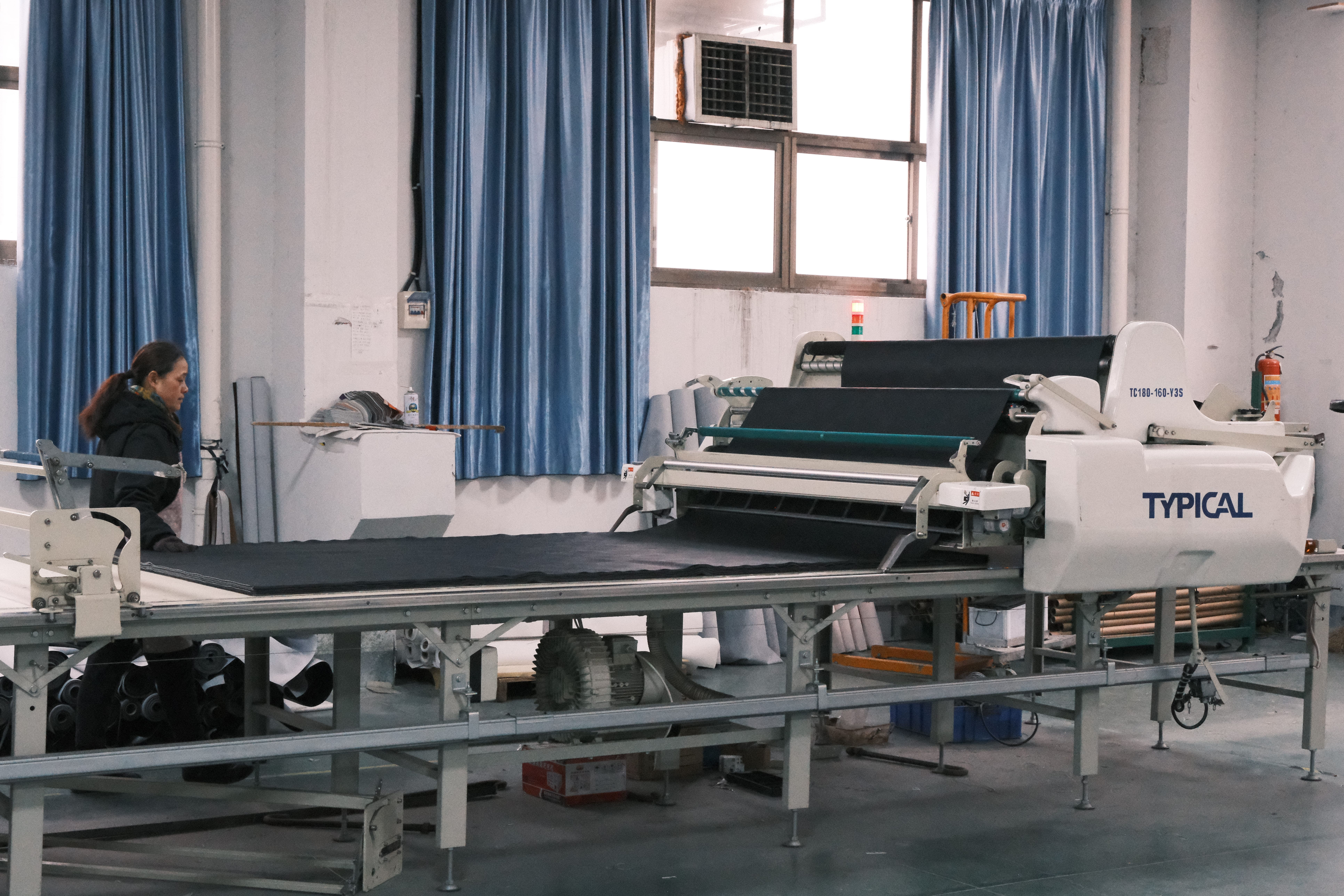
Production area — the facility layer is verified on site or by dated footage, not by catalog photography.
Layer 2 — Material and compliance
What it answers: which materials, components and standards are actually covered by test documentation? Evidence: the report itself, not a certificate thumbnail — report number, issuing laboratory, standard, issue date and scope. The scope line matters more than the cover page. A report scoped to "synthetic leather 03#" or to "beauty bed, salon chair, shampoo chair" supports a material claim; the buyer must then confirm that the ordered chair uses that exact material specification.
The supplier's PFAS documentation illustrates the point. The CTT report CTT2501010107EN, issued 4 January 2025 against EN 14582:2016, lists a material scope of synthetic leather 03# for the EU and US markets. That is a targeted claim about one upholstery material, tested to one standard. It is valuable, and it is not a chair-level certificate.
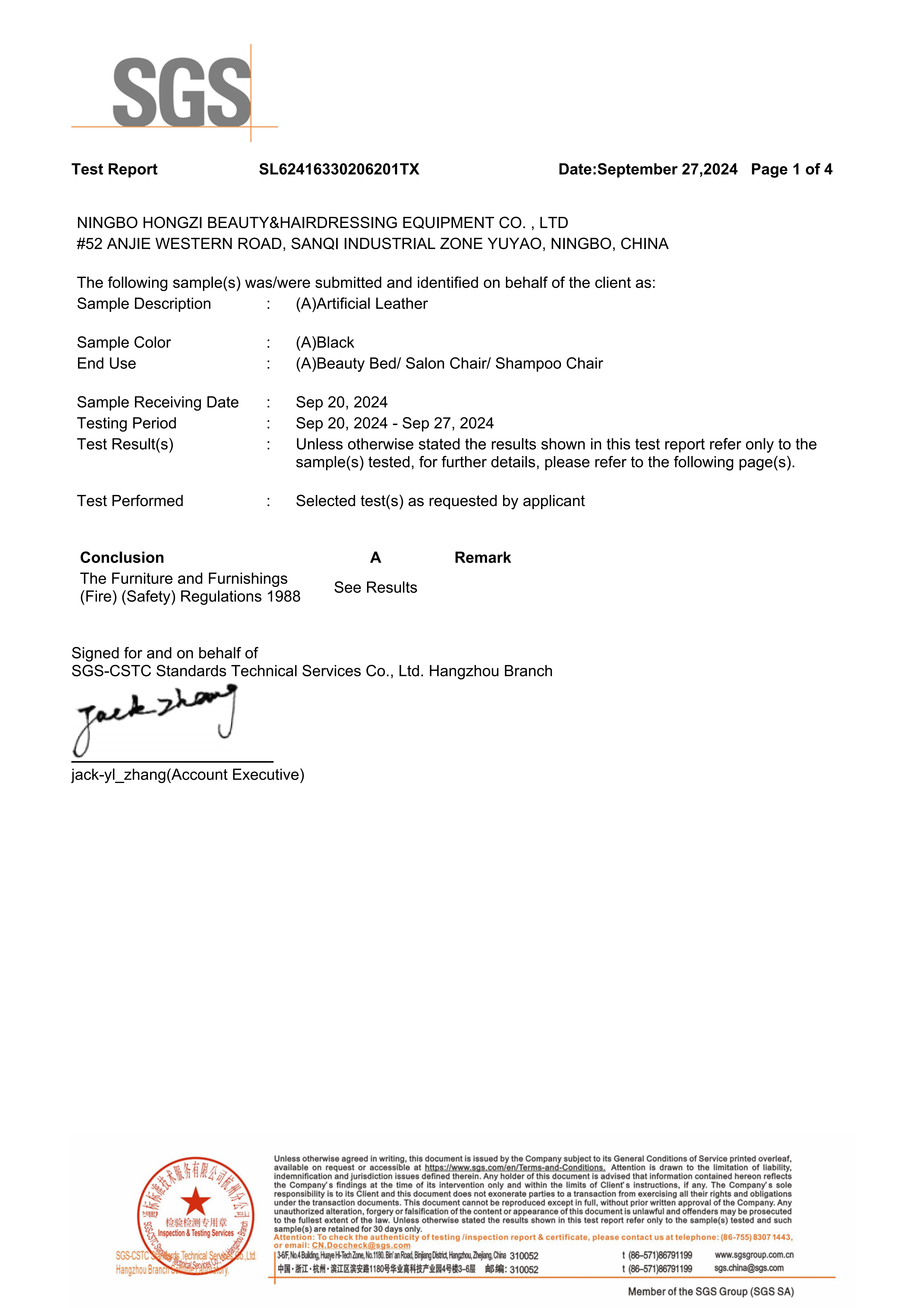
SGS artificial leather report SL62416330206201TX, issued 27 September 2024 under the UK Furniture and Furnishings (Fire) (Safety) Regulations 1988.
Layer 3 — Model specification
What it answers: does the model I selected have fixed, documented dimensions and material callouts? Evidence: a model drawing or datasheet with dimension reference points, units and tolerances. HZ8801 at 90 × 60 × 90 cm, HZ88123PK at 81 × 63 × 91 cm and HZ87102RB at 111 × 66 × 118 cm are three genuinely different footprints; a mixed container of all three needs each figure tied to a drawing rather than to a caption.
Layer 4 — Order and acceptance
What it answers: what makes a shipment conforming, and what happens when it is not? Evidence: proforma invoice, Incoterms, payment terms, lead-time schedule, inspection method, packing specification, warranty statement and spare-parts list. The supplier's stated terms — MOQ 5 units, delivery on EXW/FOB/CIF/CFR, payment by T/T, L/C, PayPal or cash, acceptance by visual and functional checks or sampling on arrival, and a one-year pump warranty with replacement of damaged products — are a workable starting draft. Each line still has to be restated in the order documents with the model and quantity attached.
Seven steps from shortlist to a volume commitment
Step 1 — Freeze the model code and the dimension definition
Write the model code exactly as it appears on the quotation, and state the dimension order explicitly: length × width × height, in centimetres, measured to a named reference point. "90 × 60 × 90 cm" becomes unambiguous only once buyer and supplier agree which axis is which and whether the figure includes the footrest or headrest extension. On a reclining barber chair, the reclined envelope can exceed the upright footprint, so request both if the chairs will sit in a tight row.
Step 2 — Test the dimensions against the floor plan
Convert each model's footprint into a layout decision. HZ88123PK at 81 × 63 × 91 cm is the most compact of the three and suits dense workstation layouts; HZ87102RB at 111 × 66 × 118 cm needs materially more clear floor area per station. Apply the destination market's spacing rule where one exists, and add the barber's working zone behind the chair. A chair that fits the plan but not the regulation is still a failed evaluation.
Step 3 — Resolve material callouts to component level
HZ87102RB is documented with aluminum alloy. The follow-up question is which component — base, frame, armrest or footrest — together with alloy designation and surface treatment. An aluminum alloy base and an aluminum alloy trim piece carry very different cost and durability implications. For upholstery, request the exact synthetic leather or leather specification, the foam grade and the report number that covers it, then confirm the ordered SKU uses that specification rather than a visual equivalent.
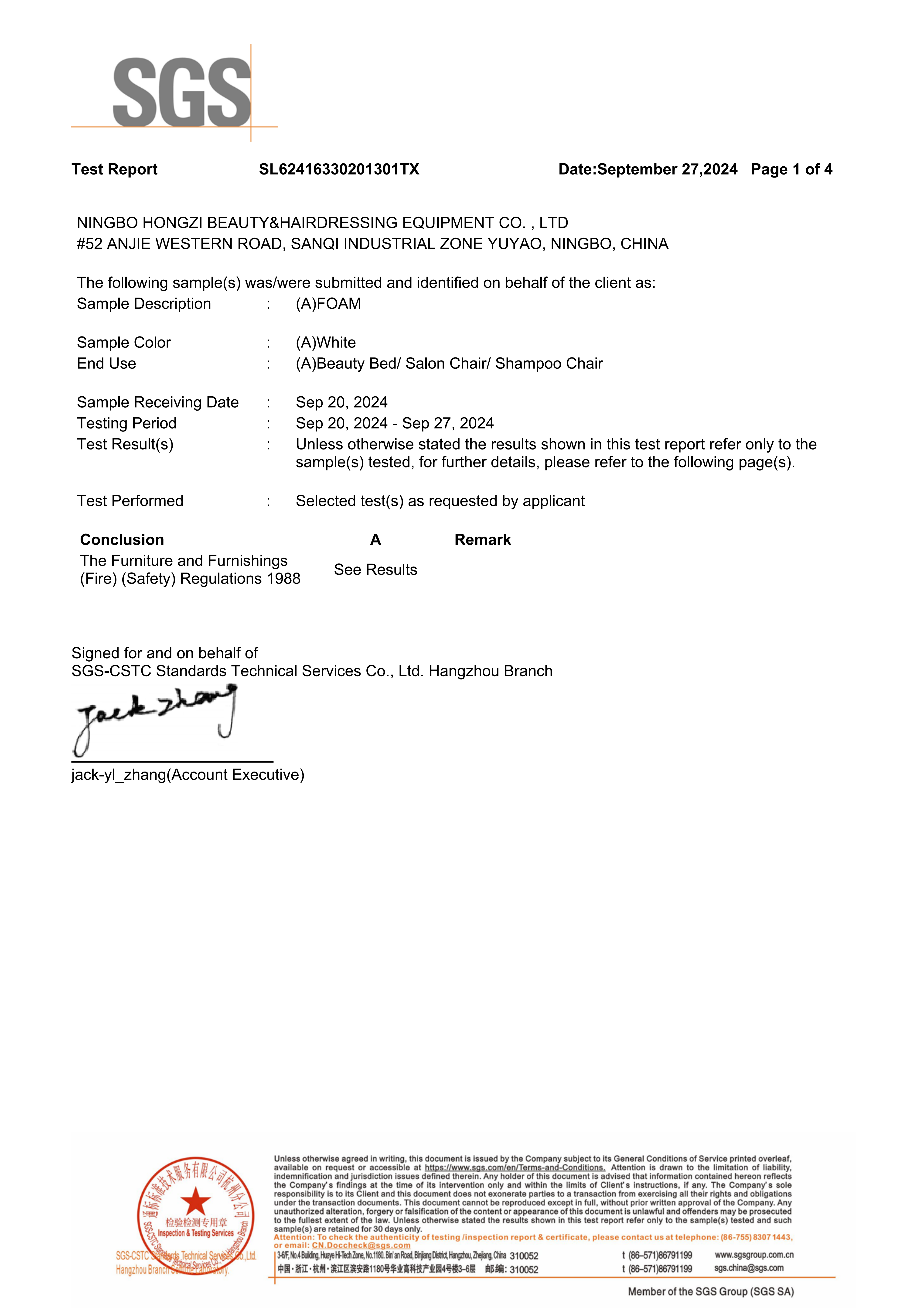
Foam report SL62416330201301TX — component-level evidence for the cushion specification, issued 27 September 2024.
Step 4 — Specify the mechanism in writing
Ask for the pump supplier or pump model, the rated load, the cycle rating and the warranty period, and require all four in the quotation. The supplier offers a one-year pump warranty; a warranty only means something when the component it covers is identified. Pair that with the stated 100% testing and ask what the test population and protocol are — function only, or function plus hydraulic cycle and leak checks. If the answer is "all products are tested", request the inspection record template that will travel with the shipment.
Step 5 — Convert capacity and lead time into a schedule
The stated lead time is 15 days for orders under 100 units and 30 days for orders over 100 units. Build the schedule backwards from your own in-store or distributor date, and add buffers for sampling, artwork approval on OEM logo and color customization, and freight. For orders that straddle the 100-unit threshold, confirm which lead time applies and whether the clock starts at deposit, at artwork approval or at material readiness.
Step 6 — Write acceptance criteria into the order
"Visual and functional checks or sampling upon arrival" is a method, not a criterion. Turn it into a document: which functions are checked on every unit, which are sampled, what sample size or AQL applies, what counts as a critical defect versus a cosmetic one, and who bears cost and freight on replacement. The supplier's stated practice of resending damaged products is the fallback position; the acceptance clause is the control.
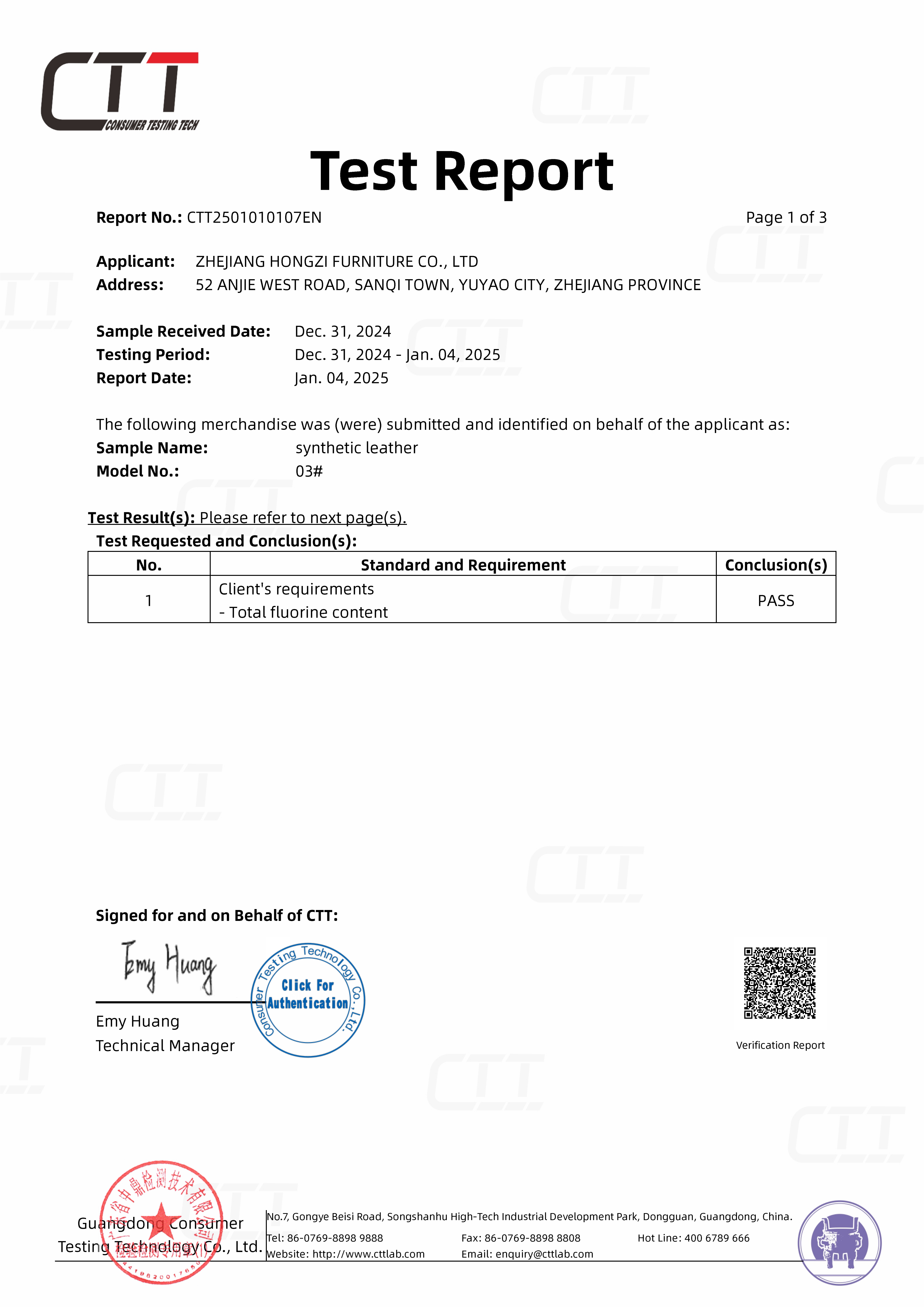
CTT report CTT2501010107EN, issued 4 January 2025 to EN 14582:2016, with a material scope of synthetic leather 03#.
Step 7 — Assemble the document pack before the deposit
A complete pack for a hydraulic barber chair order typically contains: model datasheet with dimension reference points, material and component specification, applicable test reports with scope lines highlighted, proforma invoice with Incoterms and payment terms, lead-time confirmation, packing specification including carton dimensions and container loading plan, HS classification (9402.10 for barber chairs with rotating, reclining and elevating movement), warranty statement, spare-parts list, and the signed acceptance clause. Missing documents are far cheaper to obtain before the container sails than after it lands.
Model-level comparison: three HZ chairs as verification cases
The table below uses only the documented model data. It is deliberately narrow — dimensions plus the one material callout — because that is what these three models provide. Blank cells are not defects in the models; they are the items a buyer must request from the supplier before committing volume.
| Model | Listed dimensions | Documented material note | Confirm before volume |
|---|---|---|---|
| HZ8801 | 90 × 60 × 90 cm | Not specified in the model data | Axis order and reference points; upholstery grade; pump load and cycle rating |
| HZ88123PK | 81 × 63 × 91 cm | Not specified in the model data | Reclined envelope; base construction; workstation spacing under local rules |
| HZ87102RB | 111 × 66 × 118 cm | Aluminum alloy | Which component is aluminum alloy; alloy and finish; reclined envelope |
Reading the table correctly requires one discipline: treat every cell as a question. "Aluminum alloy" is the only material callout supplied across the three models, and it is attached to one model rather than a component. "Not specified" is not a reason to reject a model; it is a reason to send a spec request and hold the order until the datasheet returns with the detail filled in.
Turning claims into a checkable evidence table
The second table converts the supplier's stated capability into pass conditions. It is the fastest part of the audit and the one that catches most of the risk.
| Claim | Evidence to request | Pass condition |
|---|---|---|
| 15,000 units per month; 180,000 units per year | Capacity statement with product scope, basis and utilization | Figure is tied to barber chairs and to your delivery month |
| Flame-retardant upholstery | SGS reports SL62416330206201TX (leather) and SL62416330201301TX (foam) | Scope line matches the material used in your SKU |
| PFAS compliance | CTT report CTT2501010107EN, EN 14582:2016 | Ordered upholstery falls within the tested material scope |
| 100% testing | Test protocol and inspection record template | Function, hydraulic and appearance checks are defined |
| 15 days under 100 units; 30 days over 100 units | Written schedule for your actual quantity and model mix | Start point defined (deposit, artwork or material readiness) |
| One-year pump warranty | Warranty statement naming the pump and the claim process | Component is identified and the remedy is written |
Applying the framework to three buyer situations
Distributor placing a first volume order
A five-unit MOQ makes sampling realistic: order the exact model and finish you intend to stock, keep one unit unopened as the reference standard, and write acceptance against it. Distributors carry the warranty risk downstream, so the pump identification and the one-year pump warranty matter more here than the price per unit. The supplier's dealer profile describes salon use, barber workstation seating, chain-store outfitting and distributor orders, with style variety across vintage and modern ranges, customizable appearance and materials, and the ability to supply full salon equipment sets — useful for range planning, but each model still needs its own datasheet.
Salon chain outfitting multiple sites
Chain projects mix models across rooms, so dimension control dominates. A compact HZ88123PK at 81 × 63 × 91 cm and a full-size HZ87102RB at 111 × 66 × 118 cm in the same branch will produce different station counts per square metre. Confirm the reclined envelope before finalizing the floor plan, apply local spacing rules, and ask for a container loading plan that keeps model quantities separable on arrival — otherwise the acceptance check becomes a sorting exercise.
Private-label OEM programme
Logo and color customization changes the appearance, not the underlying test scope. When you approve artwork, confirm in writing that the upholstery and foam specifications covered by the existing reports are unchanged, and that any substitution triggers a new test request. Artwork approval also sits on the critical path: the 15-day and 30-day lead times are only realistic once the customization is signed off. Request the OEM batch inspection record as part of the order pack.
Where supplier evaluation usually breaks down
Six failure patterns account for most disputes at the volume stage:
- Treating a material report as a model certificate. A report named to synthetic leather 03# or scoped to salon chairs does not certify the finished chair. Match the scope line to the SKU.
- Accepting a capacity number without a basis. Monthly and annual figures that multiply correctly can still describe different product mixes or different utilization assumptions.
- Reading "not disclosed" as "not capable". Undisclosed pump ratings or alloy designations mean the question has not been asked yet, not that the product is inferior.
- Letting the sample substitute for the batch specification. A sample proves a sample. Only a written specification proves a production run.
- Signing acceptance language that names a method but no criterion. "Visual check on arrival" without sample size, defect classes and remedy is not enforceable.
- Ignoring mechanism documentation because the chair looks right. Appearance is the easiest thing to verify and the least likely to cause a claim.
Frequently asked questions
Which documents prove material and fire-safety compliance on a barber chair order?
Request the reports themselves, with scope lines visible. The supplier holds SGS report SL62416330206201TX for flame-retardant artificial leather and SL62416330201301TX for flame-retardant foam, both issued 27 September 2024 by SGS-CSTC Standards Technical Services Co., Ltd. Hangzhou Branch against The Furniture and Furnishings (Fire) (Safety) Regulations 1988, with a scope covering beauty bed, salon chair and shampoo chair. PFAS documentation is a CTT report, CTT2501010107EN, issued 4 January 2025 to EN 14582:2016 with a material scope of synthetic leather 03#. Each report supports a material claim; confirming that the ordered SKU uses those materials is a separate step.
OEM hydraulic barber chair manufacturer: what should I verify?
Verify four things in writing. First, customization scope — the supplier offers logo and color customization, so define artwork files, approval steps and who signs off. Second, whether tested material specifications survive customization, since appearance changes should not silently change the upholstery or foam. Third, production terms: an MOQ of 5 units, a stated monthly capacity of 15,000 units, and lead times of 15 days under 100 units and 30 days over 100 units. Fourth, the mechanism, including pump identification and the one-year pump warranty. OEM production services are only as reliable as the inspection record attached to the batch.
How do I confirm listed dimensions such as HZ8801 at 90 × 60 × 90 cm?
Agree the axis order and reference points first, then ask for a model drawing that shows them. Confirm whether the figure includes the footrest or headrest extension, and request the reclined envelope for any reclining model. Compare against the other models in the range — HZ88123PK at 81 × 63 × 91 cm and HZ87102RB at 111 × 66 × 118 cm — because the difference determines how many stations fit. Finally, test the figure against the destination market's spacing rule and the barber's working zone, not just against the chair outline.
What does the aluminum alloy specification on HZ87102RB actually cover?
The model data records aluminum alloy for HZ87102RB but does not itemize which component carries it. Ask for the component (base, frame, armrest or footrest), the alloy designation, wall thickness, surface treatment and load-bearing role, and have all of it written into the datasheet. An aluminum alloy base and a decorative aluminum alloy trim perform different structural jobs, so the answer directly affects durability expectations. Until the component is named, treat the callout as a question rather than a confirmed advantage.
What MOQ, payment and delivery terms should I expect?
The supplier states an MOQ of 5 units, delivery on EXW, FOB, CIF or CFR terms, and payment by T/T, L/C, PayPal or cash. Confirm each term per model and per order rather than once for the supplier as a whole, because customized orders can carry different minimums. Identify which Incoterm is being quoted, since it changes landed cost substantially. Ask for the proforma invoice to restate MOQ, Incoterm, payment schedule and validity period in one document before any deposit is transferred.
How should sampling and arrival acceptance work?
Use the 5-unit minimum to order a sample of the exact model and finish, then retain one unit as the reference standard for the shipment. Write an acceptance clause that specifies visual and functional checks, the sample size or AQL applied, the difference between critical and cosmetic defects, and the remedy — the supplier's stated practice is to resend damaged products, which should be restated as a written obligation with cost and freight responsibility assigned. Compare the arriving batch against the retained sample and the written specification, not against memory or a catalog image.
What lead time should I plan for orders under and over 100 units?
The stated lead time is 15 days for orders under 100 units and 30 days for orders over 100 units. Confirm where the clock starts — deposit, artwork approval or material readiness — and add packing and freight time on top. For a mixed order covering HZ8801, HZ88123PK and HZ87102RB, request a written schedule by model and quantity rather than a single headline figure. Buyers who want to move from evaluation to execution can download the current catalog and brochure below, then request a model-level quotation with the datasheet and test reports attached.
Conclusion: verify the document, then commit the volume
Supplier evaluation for barber chairs is not a matter of choosing the most convincing presentation. It is a matter of matching four layers of evidence to the exact chair being ordered: a real facility and product scope, material and compliance reports whose scope lines cover your specification, model data with dimensions and materials tied to a drawing, and order documents that define what conforming means. HZ8801 at 90 × 60 × 90 cm, HZ88123PK at 81 × 63 × 91 cm and HZ87102RB at 111 × 66 × 118 cm with aluminum alloy demonstrate why the model layer cannot be skipped — three chairs from one supplier, three different footprints, and only one documented material callout that still needs its component identified.
Buyers who complete the document pack before the deposit convert a supplier claim into an enforceable order. Buyers who skip it inherit the gaps at arrival, when the container is already on the dock and the schedule is already slipping.
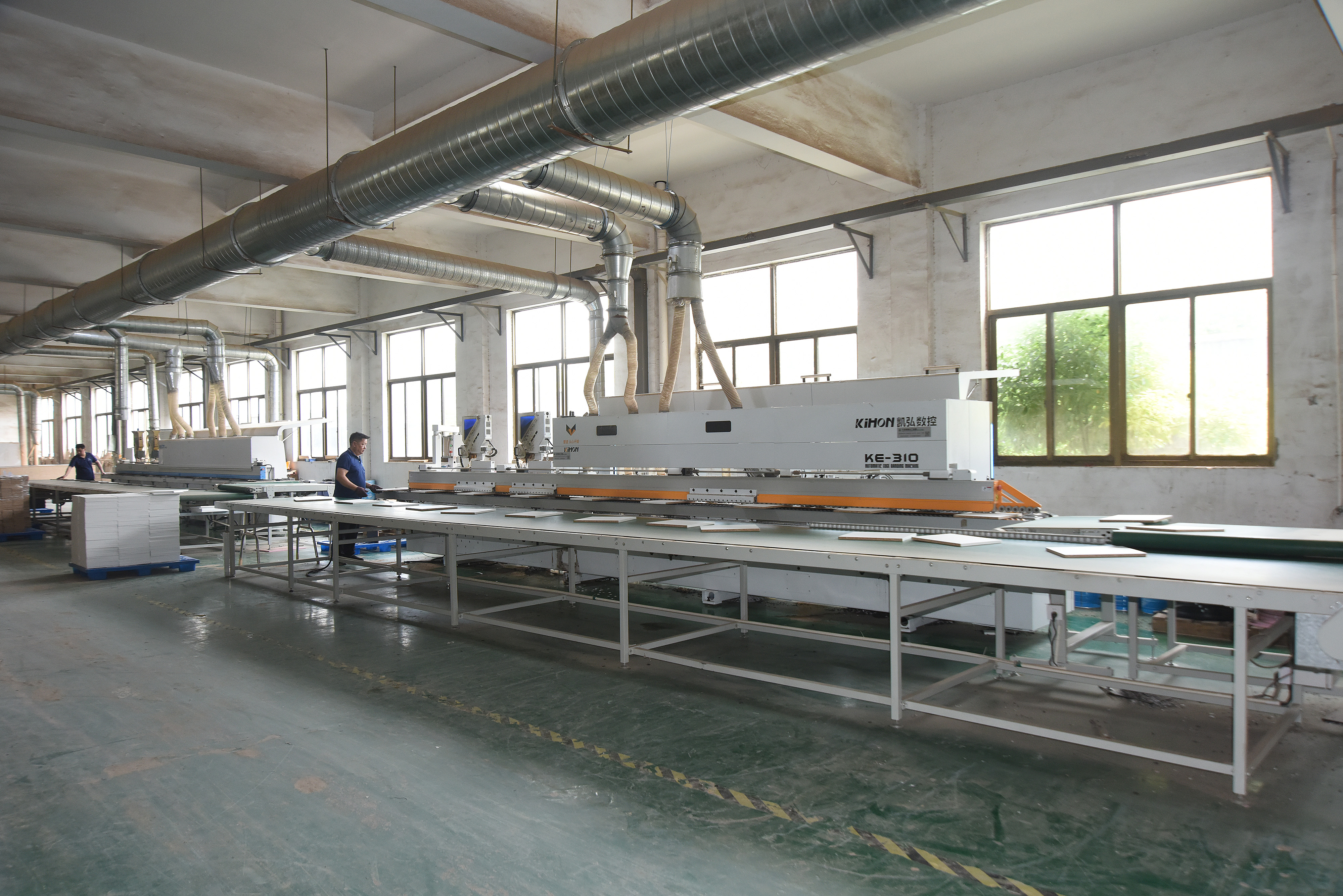
Production floor where the order schedule, inspection records and acceptance checks are executed.
For the full model list, packing data and current quotation, download the Ningbo Hongzi product brochure and send the model codes, quantities and destination market for a written specification pack. Requests can also be sent to hz@hz-beauty.com with the required Incoterm and target delivery window.
Have Questions or Need More Details?
Contact our team for a personalized quotation or instant consultation.
Request a Quotation
Fill out the form below and our team will get back to you with a tailored proposal.
WhatsApp Direct Chat
Prefer to chat in real-time? Message us on WhatsApp for instant assistance & quick answers.
- Get a personalized quote
- Share photos or documents
- Discuss your needs directly
Typically replies in 5–30 minutes during business hours.