
Reading Barber Chair Specs: Sizing, Frame Materials and Fit
Barber Chair Sizing and Frame Materials: How Model Parameters Decide Salon Fit
Two numbers on a barber chair model sheet decide whether the chair will actually work in a salon: the published size string, and the frame material the chair is built on. Upholstery colour, finish detailing and packaging can usually be adjusted later in an order. Footprint and frame cannot. This guide explains how to read both parameters, using verified specification data from Ningbo Hongzi Beauty & Hairdressing Equipment Co., Ltd., a China-based manufacturer of barber chairs, shampoo chairs, massage beds and manicure tables, founded in 2012 and operating from a facility of nearly 22,000 m² in Yuyao on the shore of Hangzhou Bay.
Problem Definition: Why Barber Chair Mis-Specifications Surface After Installation
Most barber chair selection is done from photographs. Photographs remove scale and hide construction. A heavy duty barber chair photographed against a plain background looks compact; the same chair placed in a two-station bay with a 90 cm working aisle can make the station unusable. The mismatch does not appear at the quotation stage. It appears at installation, when the bay is already tiled and the plumbing is already positioned.
Two distinct failure modes account for most of these problems. The first is footprint error: the buyer compares chairs on appearance and price, then discovers the delivered unit occupies more or less floor space than the layout assumed. The second is construction mismatch: the frame material and upholstery stack in the specification do not match the workload the chair will carry, or the flammability and chemical requirements of the destination market. A styling chair rated for intermittent salon use behaves differently from a hydraulic barber chair that reclines under load several dozen times a day.
Both failure modes are avoidable, and both are avoidable before a purchase order is placed. The controlling parameters are already published in the model data: an overall size string in centimetres, a frame metal, and an upholstery stack. The rest of this guide works through them in the order a buyer should apply them.
Industry Background: Why Size and Frame Choice Now Carry More Weight
Third-party market research places the salon chair category at a scale where specification decisions have commercial consequences for importers and salon groups. Fact.MR estimates the global salon chairs market at approximately USD 10.57 billion in 2025, projected to reach USD 18.4 billion by 2035. Category estimates, however, diverge sharply depending on how the category is defined: Grand View Research sizes the broader salon furniture market at USD 5.54 billion in 2024, while TechSci Research puts salon chairs at USD 14.16 billion. Any single figure should be treated as directional rather than definitive.
Within the product-type segment, Market Intelo reports that hydraulic barber chairs accounted for approximately 42.5% of total market share in 2025. That concentration matters for specification practice: the hydraulic platform is now the default reference point for barber station seating, and the size and frame of that platform set the baseline against which compact salon chairs and styling chairs are compared.
Trade data supports the same conclusion from the demand side. UN Comtrade and World Integrated Trade Solution data record that the United States imported USD 102.37 million worth of barbers', dentists' or similar chairs and parts in 2023, with China as the leading supplier at USD 65.35 million, or 63.8% of that total. Importers evaluating Chinese supply are therefore not choosing between a domestic and an imported option; they are choosing between competing Chinese specifications, which is exactly why reading the size string and the frame material accurately is the decisive step.
On the engineering side, published industry references state that commercial-grade hydraulic pumps for barber chairs are typically rated to handle loads between 350 and 400 lb and to exceed 100,000 cycles before maintenance is required. Treat that range as a reference point for evaluating a specification, not as a certification of any individual chair.
The Four Parameters That Define a Barber Chair Specification
1. The Published Size String
A barber chair size string is a three-value envelope recorded in centimetres, for example 110 × 72 × 90 cm for the HZ8700 Classic Hydraulic Barber Chair. The string is the single most useful comparison tool on the sheet, because it allows like-for-like comparison across a range without relying on photographs.
Within the current Ningbo Hongzi range, the sizes cluster in three groups. The smallest envelope is HZ6001DW at 45 × 25 × 70 cm, listed as a beauty salon chair. A middle group sits between roughly 50 × 64 × 90 cm (HZ88202 salon chair, HZ8765BK hair salon chair at 50 × 64 × 104 cm, HZ88123PK salon styling chair at 81 × 63 × 91 cm and HZ8801 styling chair at 90 × 60 × 90 cm) and 96 × 59 × 103 cm for HZ87111GY, a salon barber chair. The full-size barber platform then settles around a repeated 110 × 72 envelope, with models differentiating mainly in the third value: HZ8700 and HZ8702A at 110 × 72 × 90 cm, and HZ8799ABK, HZ8799AGD, HZ8796C, HZ8799B-U, HZ8799G-Z and HZ8799M at 110 × 72 × 100 cm. HZ87102RB, the heavy duty barber chair, is the outlier at 111 × 66 × 118 cm.
2. Frame Material: Iron or Aluminum Alloy
Across the range, the frame metal is listed as either iron or aluminum alloy, always combined with a wood base and the upholstery stack. The split in the current range follows size and workload rather than price point alone.
Iron appears in the compact and mid-size models: HZ6001DW (45 × 25 × 70 cm), HZ88202 (50 × 64 × 90 cm), HZ8765BK (50 × 64 × 104 cm), HZ88123PK (81 × 63 × 91 cm), HZ8801 (90 × 60 × 90 cm) and HZ87111GY (96 × 59 × 103 cm). Aluminum alloy appears in the larger platform models and in the reclining and hydraulic variants: HZ8770 (105 × 72 × 97 cm), HZ8740BR (105 × 72 × 110 cm), HZ8700 and HZ8702A (110 × 72 × 90 cm), HZ8799ABK, HZ8799AGD, HZ8796C, HZ8799B-U, HZ8799G-Z, HZ8799M and HZ8702CRD (110 × 72 × 90 cm), HZ8740ABK (105 × 72 × 100 cm), HZ8799YF (110 × 72 × 100 cm) and HZ87102RB (111 × 66 × 118 cm).
Aluminum alloy is widely selected where lower component weight is preferred in a large base assembly, while iron-based structures are commonly used in compact and mid-size chairs where the frame is short and loads are lower. The choice is a design decision with maintenance implications: whatever metal is specified, confirm that replacement parts for the mechanism and the frame fittings are obtainable after the order, not only at the point of sale.
3. The Upholstery Stack: PU Leather, High-Density Sponge, Wood
Every model in the sample above lists the same three upholstery materials: PU leather, high-density sponge and wood. This consistency is useful, because it means the upholstery stack is not the differentiator between models; the frame metal and the size string are. It also means that material compliance testing becomes a document-matching exercise rather than a product-matching exercise.
The wood layer sits between the metal frame and the sponge cushion, and the PU leather is the outer surface that determines cleanability and appearance retention. Because these three materials behave differently under fire and chemical testing, importers should confirm which layer each compliance document actually covers before assuming a report covers the whole chair.
4. Placement Classification in the Model Name
Model names in the range are not decorative; they carry placement information. Reading them correctly shortens the shortlist before any comparison table is built.
- Salon and styling labels — beauty salon chair (HZ6001DW), salon chair (HZ88202), hair salon chair (HZ8765BK), salon styling chair (HZ88123PK), styling chair (HZ8801), hairdressing chair (HZ8770) — point to general salon seating and styling station use rather than a full barber station.
- Barber-specific labels — salon barber chair (HZ87111GY), barber salon chair (HZ8796C), barber shop chair (HZ8760G), professional barber chair (HZ8702CRD), wholesale barber chair (HZ8799M) — point to barber station seating, with the wholesale label indicating a channel-facing variant rather than a different build.
- Mechanism labels — hydraulic barber chair (HZ8740BR), Classic Hydraulic Barber Chair (HZ8700), reclining barber chair (HZ8702A), Hair hydraulic recline barber (HZ8799G-Z), Retro Reclining Barber Chair (HZ8799YF) — indicate the mechanism family the model belongs to.
- Period and finish labels — vintage barber chair (HZ8799B-U), antique barber chair (HZ8740ABK), gold barber chair (HZ8799ABK), luxury barber chair (HZ8799AGD) — describe styling and finish positioning rather than capacity, and are typically chosen to match an interior scheme.
- Duty label — Heavy Duty Barber Chair (HZ87102RB) — signals the model intended for the heaviest service pattern in the range, and the only one listed above 110 cm in the third value.
Step-by-Step: Building a Barber Chair Specification Sheet
- Measure the bay, not the chair. Record the usable width and depth at each station, then subtract the working clearance the barber needs to move around the chair before the recline footprint is taken into account.
- Assign each station a placement class. Decide whether the position is a full barber station, a styling station, or reception-side seating, then select from the corresponding model labels rather than from catalogue images.
- Compare size strings only within the same class. A compact 45 × 25 × 70 cm beauty salon chair and a 111 × 66 × 118 cm heavy duty barber chair serve different functions; comparing them directly produces a meaningless result.
- Lock the frame metal. Confirm whether the station requires an iron-based compact frame or an aluminum alloy platform, and confirm the availability of replacement frame and mechanism parts before committing.
- Match compliance documents to the destination market and to the exact material. A report covering synthetic leather does not automatically cover foam, and a report accepted in one market may not be the document a customs or retail compliance team asks for in another.
- Confirm the commercial envelope. OEM scope, minimum order quantity, production lead time, warranty terms and acceptance method should all be settled in writing at the same time as the specification, not after it.
Material Compliance Documents That Should Travel With the Order
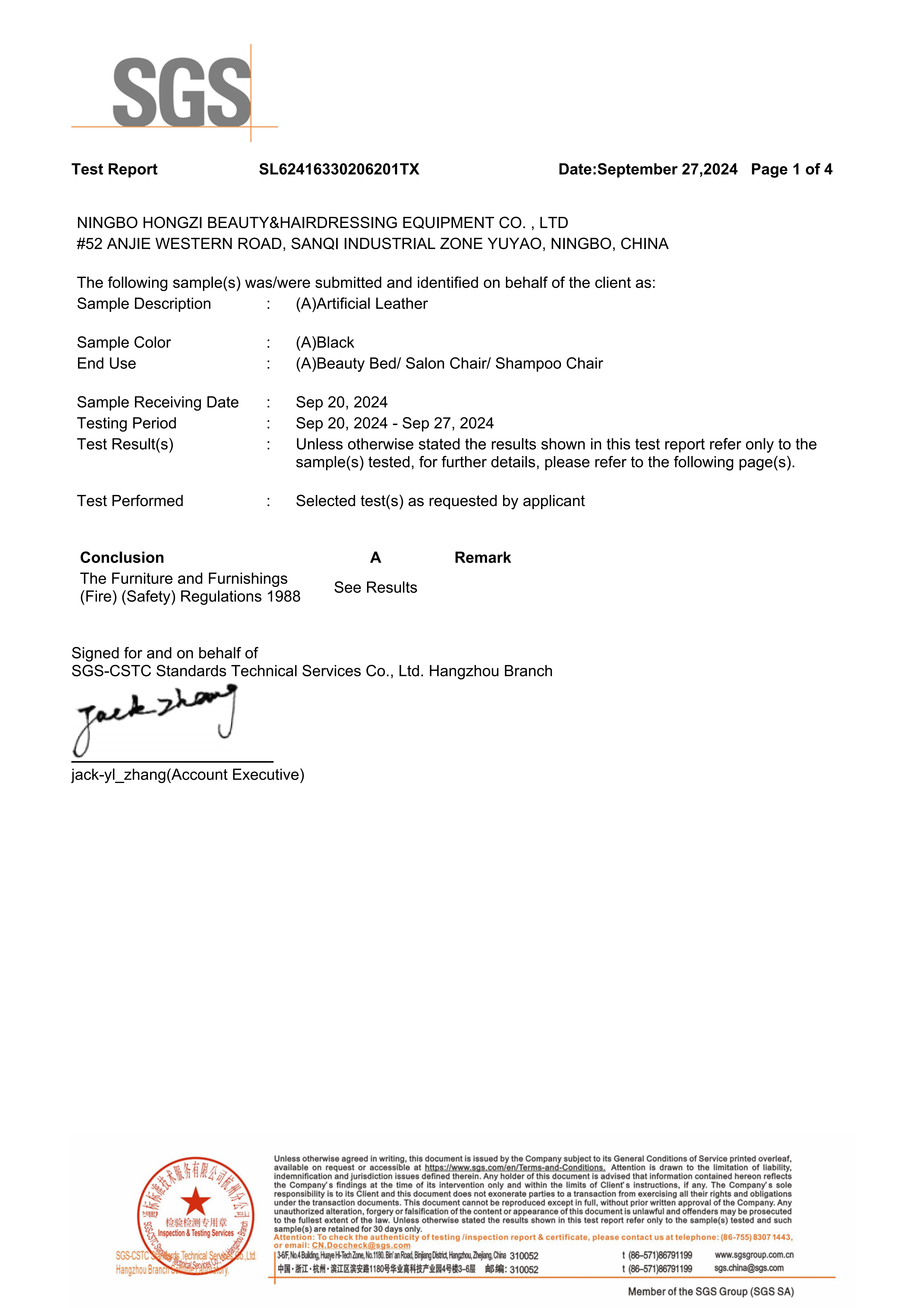
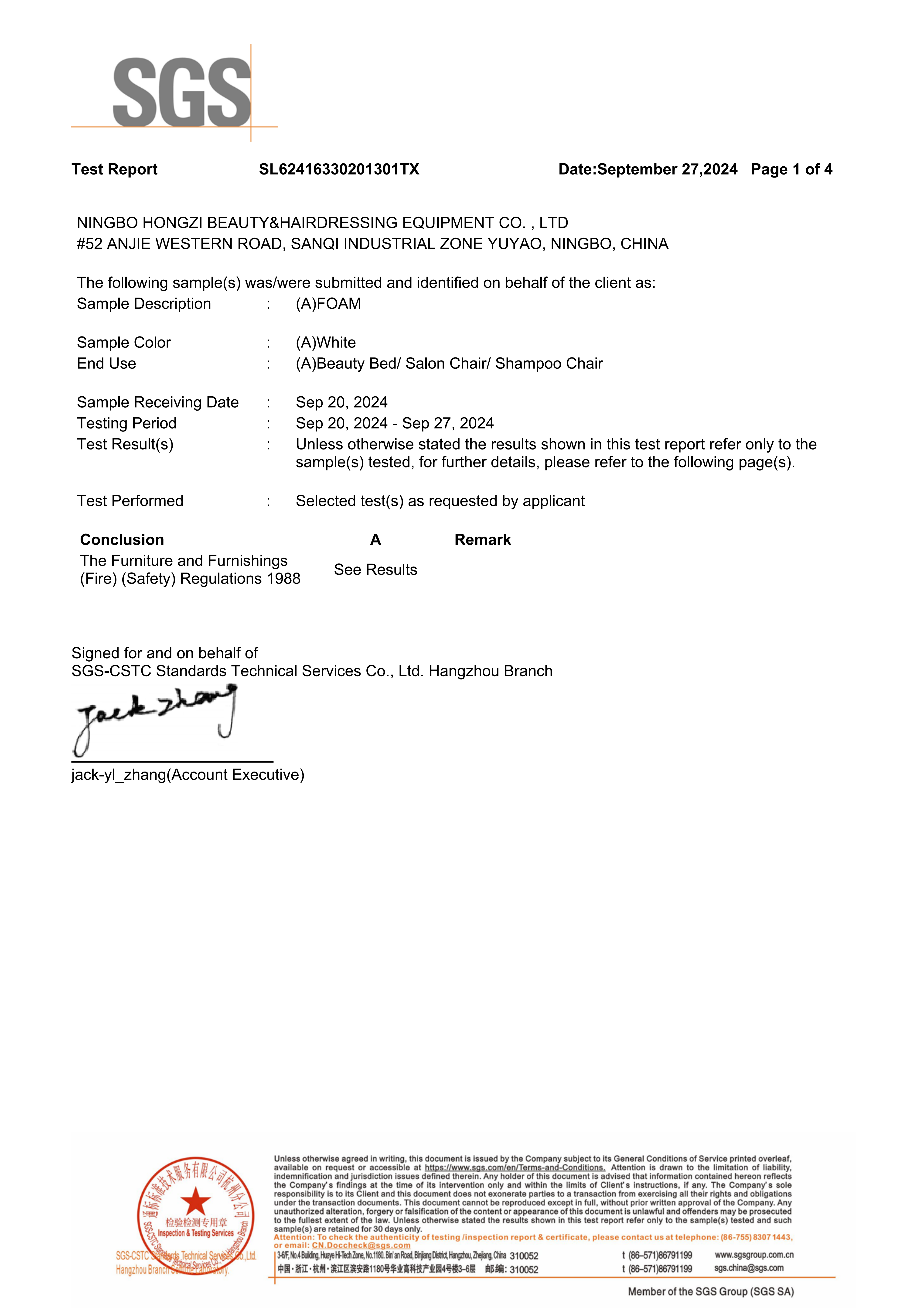
Three current test documents illustrate the level of detail importers should expect when verifying a barber chair order. SGS flame retardant artificial leather test report SL62416330206201TX was issued on 27 September 2024 by SGS-CSTC Standards Technical Services Co., Ltd. Hangzhou Branch, testing against The Furniture and Furnishings (Fire) (Safety) Regulations 1988 for the UK market, with a scope covering beauty bed, salon chair and shampoo chair. A second SGS report, flame retardant foam test report SL62416330201301TX, issued on the same date by the same laboratory, tests the foam component to the same standard for the EU and US markets.
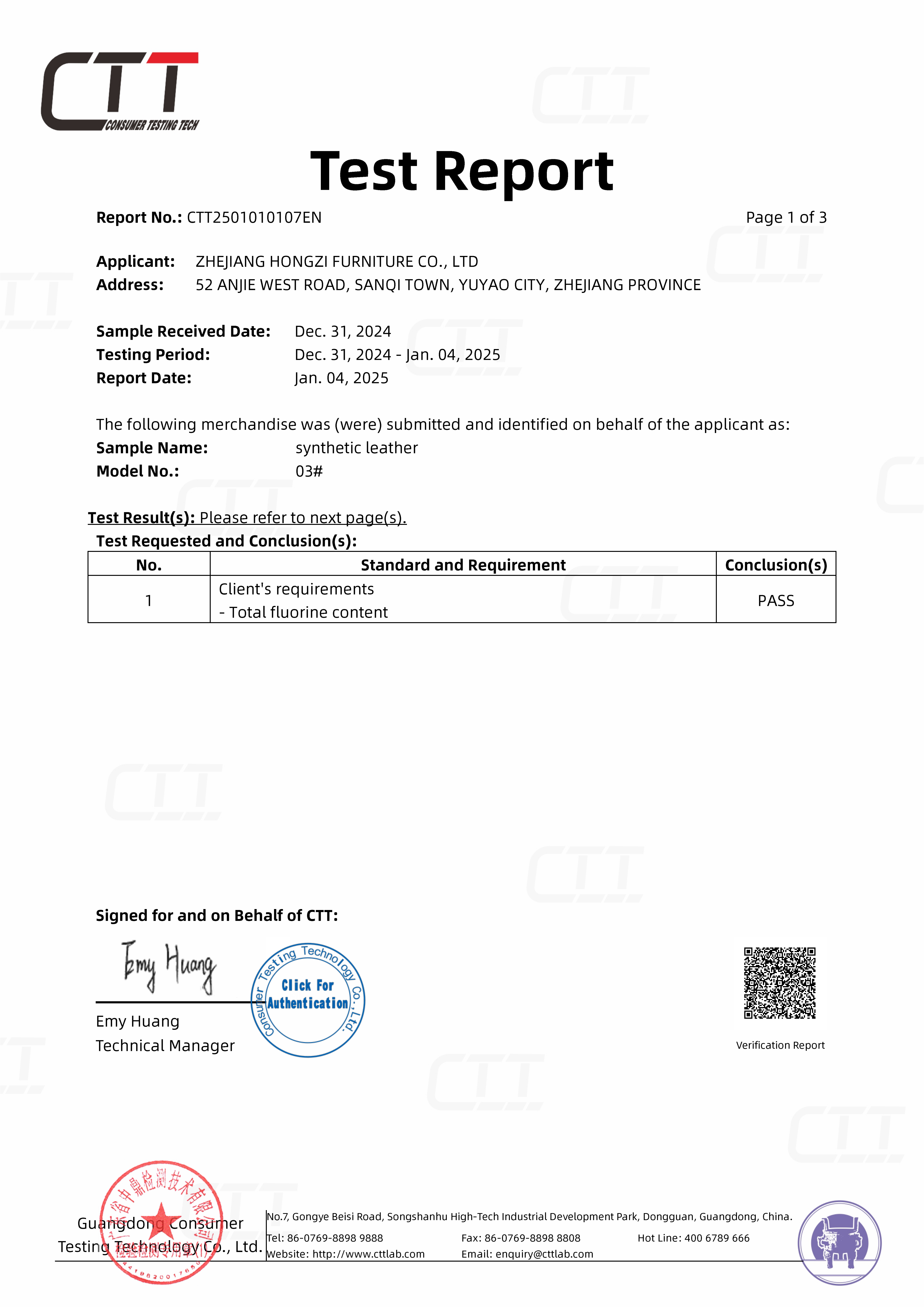
A third document addresses chemical rather than flammability requirements: PFAS test report CTT2501010107EN, issued on 4 January 2025 by CTT against standard EN 14582:2016, covers synthetic leather 03# for the EU and US markets. Read together, these three reports demonstrate why the reporting scope matters: the leather report, the foam report and the chemical report each cover different layers of the same chair.
Use Cases: Matching a Size and Frame Profile to Real Salon Situations
Compact Bays and Reception-Side Seating
Where floor space is the binding constraint, the relevant models are the iron-framed compact units: HZ6001DW at 45 × 25 × 70 cm, HZ88202 at 50 × 64 × 90 cm and HZ8765BK at 50 × 64 × 104 cm. The two 50 × 64 models share an envelope and are differentiated by the third value, which is the kind of difference that matters when seating is positioned against a wall or under a mirror.
Standard Barber Stations with a Reclining Hydraulic Platform
For conventional barber service, the range offers several models on a repeated 110 × 72 envelope with aluminum alloy frames: HZ8700 (Classic Hydraulic Barber Chair, 110 × 72 × 90 cm), HZ8702A (reclining barber chair, 110 × 72 × 90 cm), HZ8799ABK (gold barber chair, 110 × 72 × 100 cm) and HZ8799AGD (luxury barber chair, 110 × 72 × 100 cm). Because the first two values repeat, a station layout built around one of these models does not have to be redrawn if the finish or classification changes to another model in the same envelope.
High-Traffic and Heavy-Duty Stations
HZ87102RB, the heavy duty barber chair, is listed at 111 × 66 × 118 cm on an aluminum alloy frame — the tallest and most distinct envelope in the range. Treat it as a separate layout case: a chair at this size should be planned first and the remaining stations fitted around it, rather than slotted into a layout already set by a smaller model.
Model Comparison Table: Published Sizes and Frame Materials
The table below reproduces the published type classification, size string and frame metal for representative models in the range. Every model listed also specifies PU leather and high-density sponge over a wood base.
| Model | Type as listed | Published size (cm) | Frame metal |
|---|---|---|---|
| HZ6001DW | beauty salon chair | 45 × 25 × 70 | Iron |
| HZ88202 | salon chair | 50 × 64 × 90 | Iron |
| HZ8765BK | hair salon chair | 50 × 64 × 104 | Iron |
| HZ88123PK | salon styling chair | 81 × 63 × 91 | Iron |
| HZ8801 | styling chair | 90 × 60 × 90 | Iron |
| HZ87111GY | salon barber chair | 96 × 59 × 103 | Iron |
| HZ8770 | hairdressing chair | 105 × 72 × 97 | Aluminum alloy |
| HZ8740BR | hydraulic barber chair | 105 × 72 × 110 | Aluminum alloy |
| HZ8700 | Classic Hydraulic Barber Chair | 110 × 72 × 90 | Aluminum alloy |
| HZ8702A | reclining barber chair | 110 × 72 × 90 | Aluminum alloy |
| HZ8799ABK | gold barber chair | 110 × 72 × 100 | Aluminum alloy |
| HZ8799AGD | luxury barber chair | 110 × 72 × 100 | Aluminum alloy |
| HZ8796C | Barber salon chair | 110 × 72 × 100 | Aluminum alloy |
| HZ87102RB | Heavy Duty Barber Chair | 111 × 66 × 118 | Aluminum alloy |
FAQ
Which material compliance documents should an importer request with a barber chair order?
Request documents that match both the destination market and the specific material layer. In the current Ningbo Hongzi file, three documents cover a barber chair order: SGS flame retardant artificial leather test report SL62416330206201TX, issued 27 September 2024 by SGS-CSTC Standards Technical Services Co., Ltd. Hangzhou Branch against The Furniture and Furnishings (Fire) (Safety) Regulations 1988 for the UK market, with scope covering beauty bed, salon chair and shampoo chair; SGS flame retardant foam test report SL62416330201301TX, issued on the same date against the same standard for the EU and US markets; and PFAS test report CTT2501010107EN, issued 4 January 2025 by CTT to EN 14582:2016 for synthetic leather 03#, covering the EU and US markets. Because the leather, foam and chemical reports cover different layers, all three should be reviewed together.
How does an OEM hydraulic barber chair manufacturer handle customization?
Ningbo Hongzi Beauty & Hairdressing Equipment Co., Ltd. provides OEM production with logo and colour customization, supported by a monthly capacity of 15,000 units and an annual output of 180,000 units across barber chairs, shampoo chairs, massage beds and manicure tables. The company was founded in 2012, operates a facility of nearly 22,000 m², maintains a 15-engineer research and development team, runs 100% testing in production, and exports to North America and Europe as a 100% export-oriented business. The same OEM arrangement applies whether the buyer is specifying a compact styling chair or a heavy duty barber chair, because the customization scope is defined at the logo and colour level on an existing verified model platform.
What drives cost when size and frame material change?
Four factors move the cost of a barber chair order: the frame metal, since iron-based compact frames and aluminum alloy platforms are different assemblies; the size envelope, since a 111 × 66 × 118 cm heavy duty barber chair consumes more material than a 45 × 25 × 70 cm beauty salon chair; the mechanism family, with hydraulic and reclining models adding pump and recline components; and order quantity, since commercial terms are tiered. Pricing itself depends on the confirmed configuration, so buyers should fix the specification before requesting a quotation. The published commercial envelope is a minimum order quantity of 5 units, delivery terms of EXW, FOB, CIF or CFR, and payment terms including T/T, L/C, PayPal and cash.
Can a buyer validate materials and construction before committing to a bulk order?
Yes, through three verifiable mechanisms. First, material test reports can be reviewed before order confirmation, covering the leather, foam and chemical layers separately. Second, production runs 100% testing, so every unit is checked rather than sampled at the end of the line. Third, acceptance is defined: buyers may use visual and functional checks or sampling upon arrival as the acceptance method. After delivery, the pump supports a one-year warranty and damaged products are resent. Together these give a buyer documented pre-shipment verification and a defined post-shipment remedy, which are the two points most often left undefined in chair sourcing.
What is the MOQ and production lead time for a barber chair order?
The minimum order quantity is 5 units, and OEM production services are provided. The typical production lead time is 15 days for orders under 100 units and 30 days for orders over 100 units. Buyers planning a multi-station fit-out should therefore build the lead time into the installation schedule at the point the size string and frame material are locked, not after the order is placed. The full model range, specifications and material documentation are collected in the Ningbo Hongzi product catalogue, and specification questions can be sent to hz@hz-beauty.com.
Conclusion: Lock Footprint and Frame Before Anything Else
Barber chair selection fails most often for reasons that have nothing to do with appearance. A station that looked generous in a photograph turns out to be undersized for a 111 × 66 × 118 cm heavy duty barber chair; a chair chosen for its finish turns out to sit on a frame with no replacement parts available; a leather test report is presented for a market that asks for a foam or chemical report. Each of these problems is preventable with the same two checks.
The working rule is simple. Compare models only within the same placement class, compare them by their published size strings, and confirm the frame metal and its serviceability before the order is written. Then match the compliance documents to the destination market and to the exact material layer they cover. Finish, colour and OEM detailing can be negotiated freely afterwards — they do not change whether the chair fits.
Next Step
If you are specifying chairs for a barber shop fit-out, a salon chain or a distribution programme, send the bay dimensions and the intended station type to hz@hz-beauty.com or reach the team on WhatsApp at +86 13626845119, and the matching size string, frame metal and compliance set can be confirmed against the current range. The downloadable product catalogue lists the full model range, and the company website is www.hz-beauty.com.
Have Questions or Need More Details?
Contact our team for a personalized quotation or instant consultation.
Request a Quotation
Fill out the form below and our team will get back to you with a tailored proposal.
WhatsApp Direct Chat
Prefer to chat in real-time? Message us on WhatsApp for instant assistance & quick answers.
- Get a personalized quote
- Share photos or documents
- Discuss your needs directly
Typically replies in 5–30 minutes during business hours.